Web3 debate: Builder vs. user choice
Title: the Web3 debate
Packy McCormick
Block unicorn
Let's hope this is the last time we have such a general, useless debate about web3. I thank NYU Stern School of Business Professor Scott Galloway (@profgalloway) for listing all the arguments against Web3 so we can overturn them and move on.
Web3.0 debate

Last Friday, everyone's favorite professor Scott Galloway posted an article titled "Web3" simple. The article links: https://www.profgalloway.com/web3/
Should I be nervous about opening this article? I'm a long-time crypto holder and I'm not nervous at all because I'm not taking the professor's side on what he's going to write, and this is exactly the article he wrote.
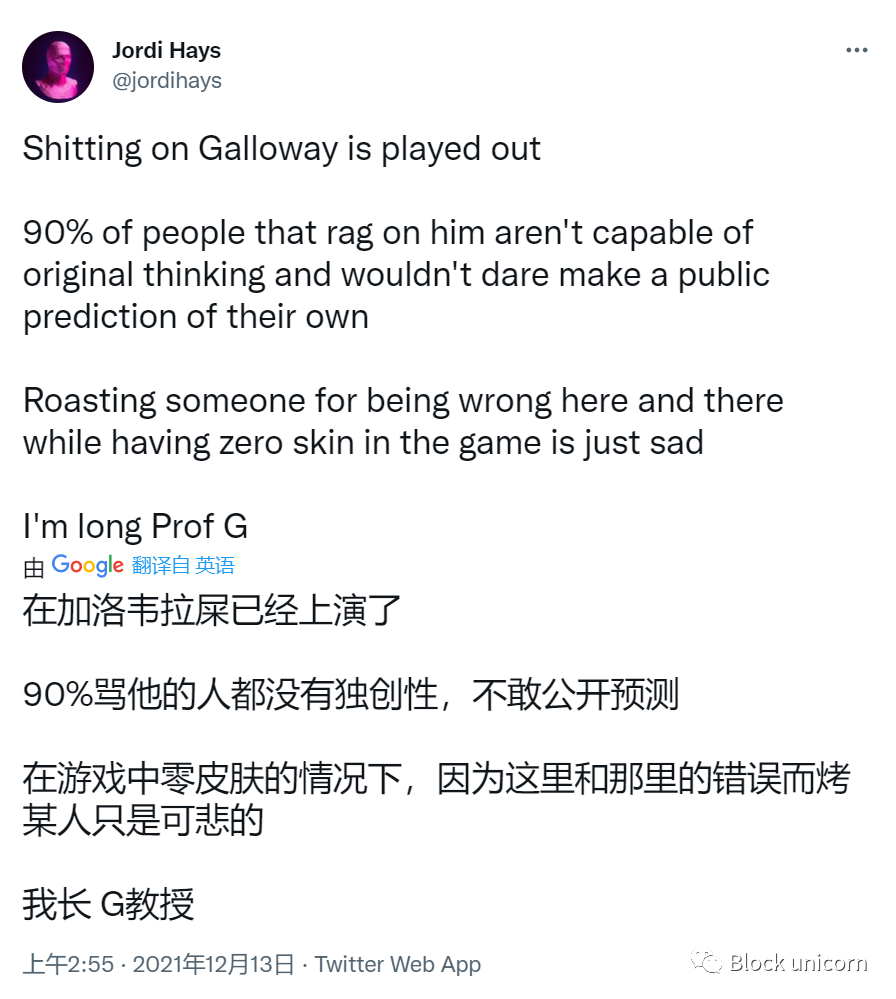
Now I don't want this to be a "professor's dunk because he's always wrong." My friend Jordi Hays, the CEO of Party Round, declared that "shitting on Galloway is over." . I tend to agree with my friends, and I don't even want to respond.
But then I noticed that he had misquoted me and misrepresented what I was involved in. Then I looked a little deeper and found a lot of mistakes and misdirection.
The professor's paper regurgitates the lazy arguments of others (putting half-digested food back into the mouth for chewing) with some key inaccuracies, whether intentional or unintentional. Thousands of people read, listen and even pay to learn from him, and usually that's not my problem... But if he's going to accidentally drag me into this debate anyway, so be it.
Welcome to the debate Club
At the risk of looking incredible: I debated ferociously in high school and college, and in fact, I had just started a debate club in New York City when COVID-19 hit.
In parliamentary debates, as we do in the debate Club, there are two teams - the proposer and the opponent - debating a resolution. The resolution could be something like "general ai should have fundamental rights". The sponsors defended the resolution while the opponents tried to poke holes in it.
The two sides argue back and forth, finally summing up the debate in each team's rebuttal, reiterating their points and trying to figure out why their side won.
There are a few things you need to do to win an argument. Most obviously, you need to find the evidence that works best for you.
In the course of your research, you will also find evidence that contradicts your views. Be aware of this evidence in case you need to defend it, but whatever you do, don't mention it (unless, of course, you're playing an advanced game and want to say "I hope our opponents will tell you X, Y, Z... they're wrong because A, B, C"). ). Less cautious debaters might even bend over or make things up.
Remember, the point of debating is to win, not to learn the truth, which is debate 101 stuff.
Then there's the more advanced shit: Instead of fighting your assigned battle, you start a new one, no matter what your agenda is.
An experienced debater would spend a lot of time setting definitions. Take our general AI debate, for example, what is general AI?
The proposal could define universal AI as "a being with human-like intelligence and emotions, indistinguishable from humans in everything except its origins." If the opposition had let this definition slip, they might have lost the argument.
They are more likely to come back and say that the definition is wrong, and experts agree that "AI is the hypothetical ability of intelligent agents to understand or learn any intellectual task that humans can perform."
The proposal may come back and rally the opposition over the use of wikipedia's definition, restate their own definition, and argue that their own definition is correct.
The outcome of a debate among experienced debaters usually boils down to a definition of who. If general-purpose AI is indistinguishable from humans, then surely it should have basic rights (we don't even begin to define basic rights!). .
If general-purpose AI is merely a hypothetical ability to understand or learn intellectual tasks, it probably should have more computer-like rights than humans.
Really, if you win the definition battle, the actual score you get doesn't matter that much. All in all -- debating is a very interesting intellectual battle if you're a nerd like me, but it's not conducive to finding out the truth, nor is it a particularly useful way to deal with real-world conversations.
Unfortunately, one of the debates over the past few weeks has been precisely that. The conversation becomes.
Web3 Dialogue: More debate than conversation
可能自从中本聪在 2008 年放弃该白皮书的那一天起,就有人支持加密货币,也有人反对它。在那些支持它的人中,交战派系他们选择的 Token 和链,为至高无上而战。
Infighting is stupid, counterproductive, and never ends. Bitcoin and Ethereum. Ethereum and all other smart contracts L1. Arbitration and optimism. Bitcoin and the world. As I've written before, I'm a minimalist.
The front combat will remain the same, but the Angle of attack will change and evolve. First, the objection is that cryptocurrencies are only used by criminals. And then it's bad for the environment. When one criticism is sufficiently refuted, the critic moves on to the next.
今天,争论似乎是 web3——包括传统的「加密货币」以及诸如 dApp、NFT、社交 Token 和 DeFi 之类的东西——是由 VC 组成的结构,并不像你想象的那样去中心化。 无论是什么原因,人们很少改变立场或改变主意。
I think you could administer a personality test that has nothing to do with encryption -- like the Big Five personality Test -- and get a high degree of accuracy about who's on which side. You can do the same thing by looking at someone's last 50 tweets about other technologies or new things. If people who didn't like Elvis Presley and rock 'n' roll in the 1950s were alive today, they would probably be against cryptocurrencies.
So really, what's happening is that people pick their side in advance and then try to use whatever evidence they can to make their case, rather than accepting the evidence and making up their minds.
In this sense, web3 is more about debate than conversation. If we look at this as a parliamentary debate, the resolution for this particular debate would be something like: "Web3 is good."
Opening remarks from the opposition party, former Twitter and current Block CEO and Bitcoin minimalist Jack Dorsey set the stage for this particular debate when he tweeted in December:
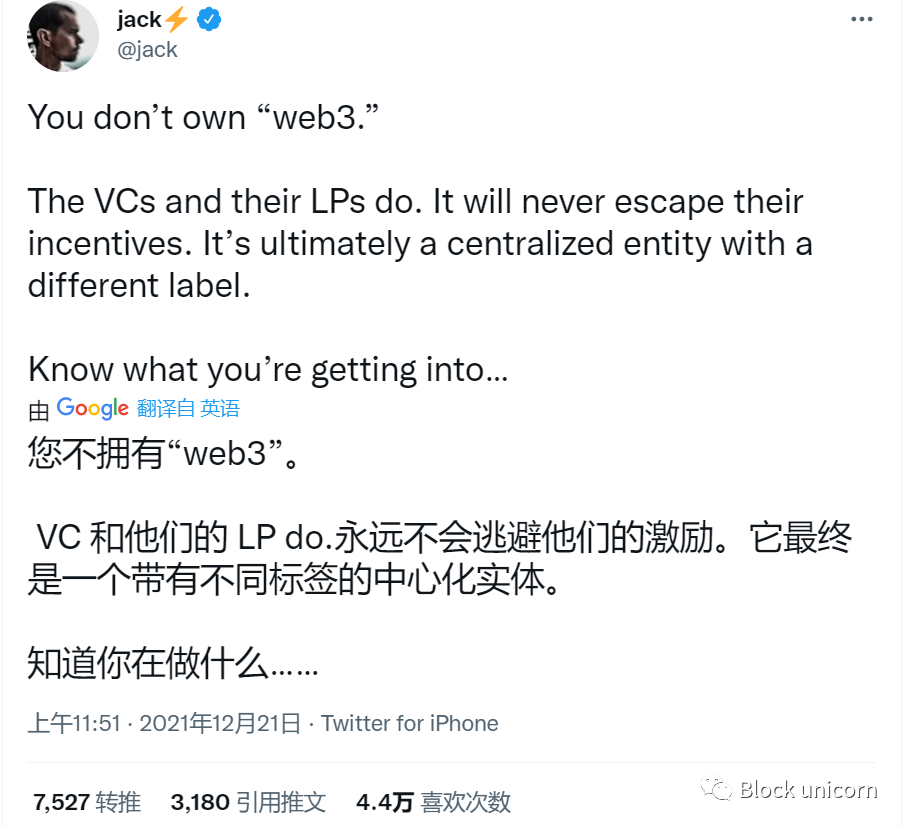
Jack came up with the idea of VCS owning Web3, so it was put in the spotlight.
In the second post, Signal CEO Moxie Marlinspike wrote his very thoughtful post earlier this month: "My First Impressions of Web3 & NBSP;" "Added some texture to it. His greatest contribution to the opposition is that web3 actually relies on much more centralized technology than your opponents would have you believe.
Since you've been exquisitely trained in debate, you should be able to see what's going on here. Jack and Moxie shift the battlefield to the degree of centralization debate.
They are trying to win the battle of Web3 definitions, and instead of saying "Web3 is good", they are focusing on the easier to win "Web3 is more centralized than it looks from the outside, and that's bad". Like experienced debaters, Moxie and Jack skillfully shifted the battlefield.
Then Professor Scott Galloway crashed through the wall like a kool-Aid, uninvited, Professor Scott Galloway entered the debate and exposed one of his tricks in a rude rebuttal to the opposition.
Professor Scott Galloway joins the Web3 debate
When I debated in high school, sometimes we would be randomly assigned to teams of three. If you have two strong speakers and one weak speaker on your team, ideally you will be strong, weak, strong in the course of your three presentations. The strong opening debater sets the tone, the weak one stumbles a bit in the middle, and then another strong debater can come in and clean up the mess with a strong retort.
But sometimes the weaker debaters ask for a rebuttal, and you can't bear to refuse, so you let them leave at the end... It's a train wreck.
The rebuttal is the final argument. It is usually success or failure. In a rebuttal, the debater summarizes his or her team's point of view, tears up the opposing team's point again, and then tries to make a convincing bow on the whole thing. No new information is allowed in the rebuttal; This is just a summary of what was said. The best thing you can do is use more colorful and compelling language on top of existing points, and build everything in a way that makes your team look good.
It should be fairly easy -- no new points to make -- but in the hands of a weak or inexperienced debater, a rebuttal can be a disaster.
When this happens, it's often a matter of two more powerful debaters making the bulk of the arguments and figuring out how they fit together into a larger narrative. They felt the argument in their bones, groped deeper, and actually figured out what they wanted to say, but they needed to rely on weaker debaters to deliver it.
Often, even though the weaker debaters mostly make the right points, in the speech, the word choice, the flow and the way they lean on their notes and look at their partners, they make it clear that this is not their argument, that they don't actually know what they're talking about.
That's how it feels to read the professor's rant about web3. Take this passage, for example, a short and simple one that exposes many of his tricks:

A: wow! Reading this, you might be thinking, "The professor is so bad! He knows web3 infrastructure, he has to know his stuff! I can trust everything he says."
The truth is, it's a terrible copy-and-paste rewrite of Moxie's work. While he did link to the article (it's underlined "People don't want to run their own servers"), he didn't mention Moxie by name anywhere in the article or paragraph.
As a style, this might be forgiven. Personally, I would end with "As Signal CEO Moxie Marlinspike pointed out..." To lead, lest people think I'm trying to pass on these ideas as my own, but that's just me. But there was something else lurking, suggesting that the professor was regurgitating rather than understanding.
First, the only original idea in the paragraph -- people don't want to have to code every time they buy a loaf of bread -- is the scarecrow. Of course, it would suck if people had to write code to buy bread, but that's ok, because no one in the world is suggesting that people need to write a line of code to buy anything.

That's not how it works. That's not how it works
Second, the professor fails to point out that A16Z led Alchemy's Series C round in October at a $3.5 billion valuation, but missed this layup! If I were his debate partner, steam would come out of my ears. He jumped at every opportunity that came along, including investments in Coinbase and OpenSea.
In any case, this is just one part of a larger debate.
- Jack gave the first speech for the Web3 opposition and tried to set the definition for the VC ownership debate in Web3, he messed it up, it was effective.
- Moxie delivered a second speech addressing some of Proposition's propositions and adding a new point for the opposition: the technology stack is also more concentrated than people realize and is also doing well.
- Then the professor stood up and contradicted the opposition party, and... Whoops.
Now, again, I think the Web3 debate is a bit silly, there are good and bad, there are good and bad, some things should be concentrated, some things should be scattered, nothing is good or all bad (because of a more nuanced synthesis of proposals and objections, Check out my friend Dror's article Unpacking the Web3 Sausage, I prefer more constructive conversation.
Everything, everywhere, is always about trade-offs, and Web3 is no exception. I prefer a more constructive conversation from there, the debate is so... The violence.
But like I said, I don't like me and my friends being misled. So I decided to dust off my old debating pants and join the fray to disprove the "Web3 is fine" proposition.
My rebuttal to the proposition in the Web3 debate.
Ladies and gentlemen, judges, teammates and, of course, distinguished opponents: Thank you for being here today for this fascinating debate.
I want to remind you of what we're talking about because we're a little off track. I'm going to read the resolution in the paper directly to make sure I don't miss anything: "Web3 is good."
Right now, the opposition parties have made every effort to debate this definition of centralization versus decentralization. If centralization exists anywhere -- in the cap sheet, the technology stack, or the platform consumers choose to use -- they would have you believe that web3 is bad. They have shown that there is centralisation somewhere. B: of course! You won't hear any arguments here.
But that doesn't mean the opposition has won, because that's not what this debate is about. Arguments about web3 or specific attributes of any network (such as centralisation or the presence of bad actors) are not important, such as arguing that the Internet is bad because of Facebook or 4chan (discussing Japanese otaku culture and popular tile-themed sites or channels).
We openly agree that there are bad actors, scams and frauds, and that large numbers of tokens are kept in the wallets of a few people. We agree that much more needs to be done to build a truly decentralized Internet for those who want it, and strongly agree that not everyone will do it.
We will go further than our rivals and say that a completely decentralized future is impossible. Some people will always prefer centralized services, more people will prefer completely decentralized services, and others will prefer centralized services.
但这场辩论不是关于中心化与去中心化,这是关于选择的辩论。 这场辩论是关于 web3,一个由用户和建设者拥有的互联网,精心策划的 Token ,对人类来说是好还是坏,不仅仅是它今天的最早形式,而是它所拥有的承诺。(看看我在那做了什么?)
It's about whether the world would be a better place if entrepreneurs had Web3 tools. Again, it's about choices -- builder's choices and user's choices.
Some people will want centralized services, some will want completely decentralized services, and many will choose points that work for them at different times and between different things. We think they should have that choice.
We think web3 gives them that option, but we'll get there.
First, let me try to demolish the opposition's argument, as prof Galloway's rebuttal summarises. I'll tell you why they're irrelevant, incorrect, misleading, or just plain wrong. Importantly, I'll show that when the evidence doesn't quite fit, he twists the facts to make them fit.
This web of lies supports what the professor is trying to convey as an argument, and if you can't follow it, I understand, AND I'll try to summarize it, it goes something like this:
Elites are using the "promise of decentralization" to centralize control and gain unimaginable wealth. Centralization is evident in NFT and Bitcoin ownership, Forbes' list of the Twelve (12) crypto billionaires, potential monopolies like Coinbase and OpenSea, and the infrastructure itself. There are crimes, daOs are less centralized, because constitutional DAOs are not, because they elect representatives, why do we need new Internet native structures when we have public companies?
Also, centralization is very good thanks to the Webb Space Telescope, Web3 tools like NFT and DAO have potential but not much potential, and regulators need to discourage innovators. In addition, A16Z also invests in centralized companies. Meet the new boss. He's your old boss. Besides, Elon is on my side and Gary Gensler better do something. Anyway, I don't want Web3 to be regulated. Web3 and Web2.0 are the same thing, Facebook and Google control too much, ask a teenage girl, is this guy good?
I'm exaggerating here, but not really. Go back and read his article, it's for traffic, it may not be yoga Babble, but it's Babble stuff.
But an incoherent argument should arouse sympathy, not anger. Four specific misleads made my blood boil. Two of them were my personal involvement, a third was part of my public rebuttal, and the fourth was just simple numbers. You will see that without this, the professor's argument makes even less sense.
Mislead the # 1
The debate is often a battle of definitions, so my ears perked up when the professor used my version of the Web3 definition (and called it "Yogababble").
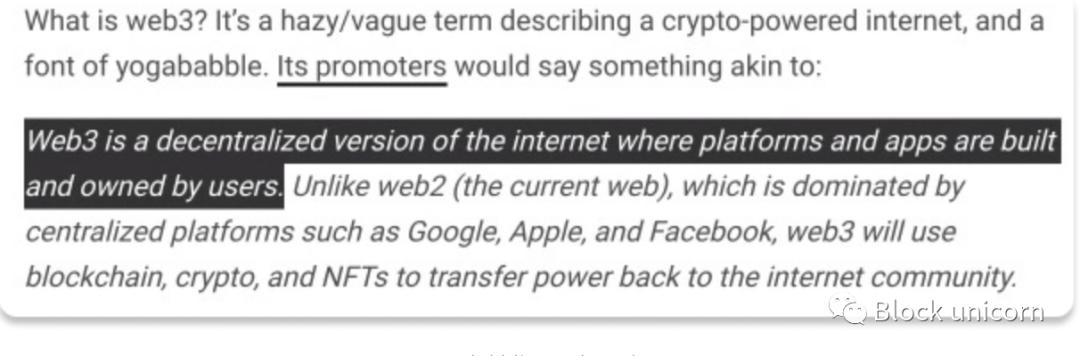
Yogababble (virtue signal of spirituality) is one of the professor's favorite words. He actually repeats this later in the article, arguing that decentralization is "creating a Coachella for fraud, where anonymity, spiritual virtue signals and complexity protect fraudsters from scrutiny or accountability." I'm not offended by the character, and I don't think my definition is perfect by any means.
I was a little annoyed that the professor adjusted my remarks to fit his core argument that Web3 is not as decentralized as it seems. Specifically, he added the word decentralization to the definition of decentralization.
我在他链接的文章中使用的实际定义是:「 Web3 是建设者和用户拥有的互联网,由 Token 编排。」 我故意没有使用去中心化这个词,因为我不认为去中心化实际上是关键特征,但它确实是一个很好的稻草人,所以教授把它扔在那里。
For the sake of charity, it's a delicate distinction, and the article he cites discusses decentralization.
But in the end, that's not the definition that applies to me. He tried to reconstruct what I was saying to fit his argument. He's been caught. You can abandon the attempt.
Misleading # 2
The second misdirection is direct numbers. Galloway uses the chart below to show that "the decentralization of propaganda power from the few is actually a reconcentration of power to the few."
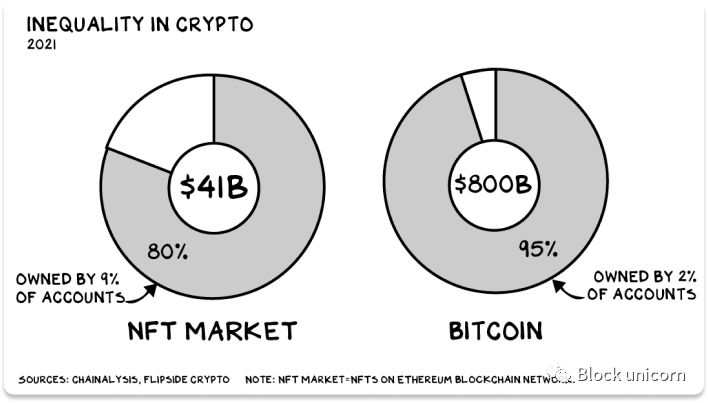
The chart on the right, representing data from BitInfo, shows that 2% of accounts own 95% of bitcoin, which means, "If it were a country, Bitcoin would have the greatest inequality in the world."
(Of course, in his argument, the professor fails to mention that his former enemy and now ally Jack and his company Block are among the largest bitcoin holders in the world, and account for that 2%.)
However, Glassnode (cryptocurrency data platform) discovered a big hole in the analysis last February. The 2% includes wallets on exchanges like Coinbase, which hold bitcoins for millions of people. Adjusting for that, the top 2% own 71.5% of bitcoin. The Glassnode article isn't obscure; This is when you use Google search. The fourth thing that comes out of "Bitcoin concentration."
We agree that 71.5% is still high concentration; Not as sensational as 95%, but it has the benefit of being accurate and in a way important to our adversaries. We agree that we would like to see ownership more evenly distributed. But we disagree that this is relevant to the professor's argument, especially since Jack, Web3, and Bitcoin are very different to the professor's teammates.
This is another small matter, but I hope you will accept the professor's pattern of ignoring any evidence against him.
Misleading # 3
Next, the professor argues that DAOs are generally not decentralized, and he uses the example of constitutional DAOs that I participated in. Specifically, he writes:
ConstitutionDAO, which made news after losing a $43 million bidding war for the original US Constitution, didn't even build a governance model before closing because the founders didn't figure out how to prevent some big holders or "whales" from taking control.
He connected core team member Jonah Erlich to The Verge's Nilay Patel. As it turns out, that's not what Jonah said. I'll give you the full part of the conversation here to show you how professors pick and choose: & NBSP;
边缘:当有人购买名为 PEOPLE 或 WTP 的 Token 时,他们每个 Token 获得一票吗?
Jonah: We haven't figured out the governance model yet, and in the rush to be able to purchase the document, there are a lot of details we need to figure out once we win. If we win, we are actually talking about different models of governance. One of the biggest fears is that some of the big holders in the crypto world -- what we call whales -- will have too much control over what happens to copies of the Constitution. Our main message is: this is a movement for the people. This is the people's copy of the Constitution, so we want it controlled by the people.
我们正在研究不同的机制。我们正在研究直接民主投票:一个象征,一票。我们还在查看每个钱包一票,这不是一个人的确切代表,但它非常接近。二次投票是另一种机制,当一个人拥有更多 Token 时,投票权实际上会减少:你不会为每一百个额外的 Token 增加一百张额外的选票,而是随着 Token 数量的增加而减少的选票数量。
Verge: When you say DAO is fast running the history of organizational structures, you're describing the history of fast running democracy: building a voting system and figuring out how those votes are going to represent a group of people. But what does ConstitutionDAO have to do with the fact that a group of people has to make these decisions, not a complete democracy?
Jonah: There's a great concept called progressive decentralization: It's really hard to really start something completely decentralized, so you have to start with an initial team and build something and then bring it to decentralization. Our plan with ConstitutionDAO is that once we win this auction, we will achieve the maximum degree of full decentralization as quickly as possible.
Only in the least charitable interpretation can you read the above as "no governance model was built because they couldn't figure out how to stop the whales from taking over."
事实上,Jonah 在回答 Patel 的问题时提到了鲸鱼,即人们是否每个 Token 都会获得一票,而不是作为没有治理模型的原因。事实与教授的观点相反;创始人确切地知道如何阻止鲸鱼接管:不要给每个 Token 投一票。
As Jonah tells it, the real story is:
- From conception to auction in less than a week.
- The team chooses to deal with non-mission-critical things, such as governance models in the event of a win, until we actually win.
- Potential governance options are known (Jonah lists some); That's not a bottleneck.
- 99.9% of DAOs have been planned for gradual decentralization, which is generally accepted as best practice.
That's not me relying on memory and firsthand experience, that's exactly what Jonah says in the conversation cited by the professor, who just chooses to omit anything that doesn't fit his point.
A six-day project without decentralization is a weak and amateurish indictment of the entire DAO concept. In fact, the professor's arguments against the DAO seem to be based more broadly on a very basic and inaccurate governance model in which maximum decentralization is the goal and every decision should be one person, one vote. This does not reflect the reality on the ground.
Misleading # 4
Finally, my opponents argue that the narrative of decentralization "is a false god evangelized by high priests who pass through mars-sized money plates and admonish regulators that this is heresy." The language is interesting and colorful; This is not true.
With the exception of a few bitcoin extremists (who tend to hate web3 anyway), there isn't a serious person in web3 or cryptocurrency or whatever you want to call it who doesn't believe that it should be regulated, let alone that such regulation is heresy. Every founder and investor I've spoken to on this topic wants regulation to come soon in the US so they can stop building investments that are vague and move to investments that are specific.
In fact, when A16Z's Chris Dixon and I wrote about the future of cryptocurrencies in The Economist, we ended the article with a call for smart regulation of the industry in the U.S. and beyond:
In the coming year, more leaders in the United States and other democracies will recognize the need for sensible regulation that encourages responsible innovation while allowing entrepreneurs to build the next generation of the Internet.
A16z, I am a consultant, and the professor decided to list them separately with his own section. There is a section on their website devoted to Web3 policy, which states:
We are completely optimistic about the potential of Web3 to restore trust in institutions and expand access to opportunity. But realizing that potential depends on smart policies. Good regulation sets a framework for how innovation can benefit society while managing real risks that can harm consumers. It's time to define that vision.
No one is lecturing that regulation is heresy. On the contrary, I suggest professors look at the company's advice to policy makers or carefully read its US policy agenda, global policy agenda, or legal framework for the DAO.
a16z
These are all facts, but facts can get in the way of a professor's good story, as @Jack put it: " walk the talk and let the truth out." .
Of course, there are many more examples of lack of understanding, or lack of desire to understand. He pointed to A16Z's investment in centralised exchange Coinbase, but not its investment in decentralised exchange Uniswap.
他指出数据显示,最近推出的区块链 Token 在股票发行时拥有更多的内部人所有权,但并未承认这些项目中的大多数都是在加密货币的熊市成立 bi 并得到资助的,需要风险投资才能生存。
No doubt he took his cues from Moxie, and he also used OpenSea as an example of web3 centralization, exaggerating his hand without knowing the facts: & NBSP;
The potential to build monopoly power and own channels (i.e., centralize) is increasingly the source of VC funding and this is the real deal for Web3. OpenSea, the world's largest NFT marketplace, is very much like any other trading platform: in return for making transactions easier and (modestly) safer, the company takes a 2.5% cut of each transaction.
Ironically, four days before the professor published his article, an NFT platform called LooksRare was launched. The NFT platform is being rolled out all the time, and of particular importance is how it guides initial requirements.
LooksRare 向用户空投了其总 LOOKS Token 供应的 12%,这主要取决于用户在 2021 年 6 月至 2021 年 12 月期间在 OpenSea 上的交易量。这些数据对他们来说很容易访问;这一切都在以太坊区块链上公开可用。
LooksRare 能够通过向在 OpenSea 上花费最多的人提供最大的奖励来吸引 OpenSea 的最大客户。他们还能够诱使这些客户在 LooksRare 上执行特定活动以解锁这些 Token :直到我在平台上列出要出售的 NFT 之前,我无法领取我的 200 美元 LOOKS。实际上,我甚至从未在 OpenSea 上列出过 NFT,但我现在已经在 LooksRare 上列出了一个!
So does it work? Yes, according to @Hildobby's Dune Analytics dashboard:

It's still early, there's a lot of talk about LOOKS, but it's a good start. LooksRare's daily transaction volume is 2-3 times that of OpenSea, although OpenSea is still being sucked in by LooksRare in terms of daily users and daily transaction volume. As some have pointed out, there's some brush trading and liquidity mining that makes the difference, it's a good start to the week and shows an Angle of attack that can be used to beat the centralization with decentralized services.
现在,LooksRare 需要在早期势头的基础上再接再厉,留住并扩大其用户群。为此,它构建了平台以降低 gas 费用,奖励购买和出售 NFT 的用户,收取较低的交易费用, LOOKS Token 持有者可以分享 100% 的费用。
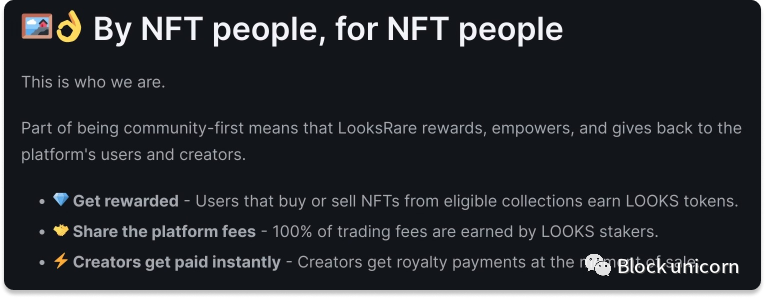
It's hard to see this and call OpenSea a monopoly. Of course, if you're looking, if you're trying to find the truth rather than trying to win an argument.
In fact, this is the point that Jack, Moxie, and of course the professor miss, regardless of whether any particular platform is centralized or who owns how much. This is because the data is open, builders and users have options, and they will choose a platform that extracts less and gives them more ownership.
In web3, if one platform misleads users, those users can choose to move their data and money to another platform.
It also highlights why the whole debate is virtually meaningless. In the course of our conversation, some entrepreneurs opened their laptops, built better things, and made the case for Web3 better than I had ever done before.
I hope we can now end this silly debate and have a more nuanced and thoughtful conversation like Moxie's article, instead of Shouting loudly and inaccurately like the professor, or just get out of the way.
Web3 is not all good or all bad, but we believe it is "good". Either way it is happening, it deserves more thoughtful and honest criticism and, yes, regulation needs to reach its full potential.
The original link
Welcome to join the official BlockBeats community:
Telegram Subscription Group: https://t.me/theblockbeats
Telegram Discussion Group: https://t.me/BlockBeats_App
Official Twitter Account: https://twitter.com/BlockBeatsAsia
 Related Articles