People are the new Web3 platform
Original title: "People are the New Platforms"
Original author: David Phelp
Original compilation: Block unicorn
in In Web3, platforms succeed by being protocols - which means people succeed by being platforms. There may no longer be cringe-worthy combinations of three words, but — God bless us — Zach is right:
“I’ve talked a lot and I think we I think that's what I mean by designing our computing platforms with people at the center, not apps.
On today's cell phones, the most basic Elements are apps, right? That's the organizing principle of your phone and how you navigate it.
But I hope, in the future, the organizing principle will be You, your identity, your stuff, your digital products, your connections, and then you'll be able to switch seamlessly between different experiences and different devices.” —Interview with Ben Thompson
While Mark Zuckerberg may sound out of touch with reality, unfortunately, he is very much in touch with his new brand of virtual worlds, which brings us to three aspect.
First, Zuckerberg sensed from fragmentation an opportunity to lay online railroad tracks -- a project that will apply to the Internet generally, and perhaps even An "organizing principle" for all computers. We could say that the internet still operates in an economy that amounts to agriculture, because that’s where the most precious digital commodity — data — is entrusted to the various platforms: Spotify, YouTube, Twitter, TikTok, and, of course, Facebook. Zuckerberg sees the virtual world as a railroad between these local economies, allowing them to exchange data with users' permission. Powerful users don't mean they have a financial advantage. After all, Zuckerberg's online railroad track building is also a price.
Secondly, while Zuckerberg wants to pave the way for data to be ubiquitously transmitted across platforms, he also wants to make data collection, control, and communication easier. dispersion. Zuckerberg hinted that the basis of the new internet is a kind of storage box stuffed with forgotten sweaters and discarded posters of our favorite bands: "Your identity, your stuff, your digital stuff, your Network.” Zuckerberg understands that in Web3, fragmentation is inevitable as users start owning and managing their data and Metaverse data management — even in the world of Meta, they don’t manage it very well. Monetization. After all, people still need to manage their own data, not just for the continuous transfer of data from one platform to another, but to experience a virtual world tailored to individual tastes, skills, and social networking inclinations. Zuckerberg suggested that our experience of virtual worlds must be personalized to the individual.
At first glance, these two principles -- an Internet of completely common standards and an Internet of completely independent standards -- seem to be in conflict. But notice Zuckerberg's keyword: the real purpose of both is seamless movement from device to device and world to world. In order to move seamlessly in our own private virtual worlds, we need a common catalog of all available experiences, giving us individualized choices. In other words, the two principles of the universal internet and the fragmented internet are completely interdependent. For Each (a control flow statement in computer programming languages that is often used to loop through the elements in an array or collection) is based on the same premise that when aggregating and passing data, individuals replace platforms, each other, and platforms itself.
In other words, these three points boil down to a much simpler question. When people own their content, including its data and metaverse data, they also own its distribution, and they become the new middlemen.
People become the new platform.
1.
Again, We could say that people are the old platform: after all, the Internet was built as a P2P network of individuals not just to connect with each other, but to connect with each other (hence the early chat rooms). So, after Web2 hegemonicly integrated winner-take-all platforms like Facebook, Twitter, and Instagram, why would Web3 bring us back to this seemingly outdated model?
To understand the fundamental difference between Web1 and Web3, see the Brave Browser example: Advertisers pay browser users via Brave's native token (BAT) Paying to watch ads, users earn more than twice as much as Brave itself. Users displace traditional advertising platforms even though they are directly incentivized to share in Brave itself as newfound token holders. It's one thing for users to connect their network to a new platform, as in Web1 - quite another when they have an incentive to do so.
So, by enabling people to meaningfully own digital content for the first time, Web3 does more than just shift ownership from the platform to the user. More importantly, it incentivizes users to also become content distributors, the platform itself. All of this sounds like an exclusive grab for the internet, as if Web3’s crypto upstarts hope to use a dog’s worth of money in their coffers to gain the greatest power of our time: the ability to unload their bags. This narrative makes it easy to see why Man is the new platform. In Web3, what matters most is our individual voice, the louder and more subjective the better, to sell ourselves and our portfolio.
Let's get this story going for a while. Here, Web3 simply adds financial incentives to the internet's long-established social networking sites. The promise of online identities, which are pliable shadows of our lumbering physical selves, always lies in our ability to manipulate them for social and financial capital; One can be most successfully -- if not always -- authentically one's self. In other words, Web3 inspires us to be prominent voices of thought and empathy, and better yet, prominent clowns.
But here, we need to admit a contrary statement. Not only does Web3 incentivize people to promote narratives by giving them an open marketplace to buy and sell, it also gives them the tools to promote narratives, rather than the centralized marketplaces that traditionally act as toll collectors for discovering goods and information online. Just as important as the incentives for shilling information is that they are born on the basis of distributed ledgers to capture, understand and share this information in a completely decentralized manner.
Take the Dune Analytics dashboard as an example: anyone can create a dashboard that aggregates chained data to show the relative financial success of different projects . Being analytical is the new way to get promoted. Everyone becomes an advertiser. Or choose The Graph. Users can stake GRAPH's own tokens as a kind of vote to "curate" their favorite projects -- indicating that they want the indexer to index those projects' data. Instead of just being incentivized to share information, we now have the tools to incentivize others to let us share information, and everyone becomes a marketing agency.
Re-emerging hyperfinancialization for ourselves is therefore only the logical conclusion of disintermediating the traditional players who have long determined our Perceptions on the internet, and our perceptions of the internet itself: what information surfaced, what we were told to buy. In Web3, we decide these ourselves.
But having data in our hands, in terms of how we see it, manage it, own it and financialize it - it's still just Web3 The first step, its prologue. The next step is to provide users with tools not only to track information, but to develop information, creating their own protocols for contributing and earning rewards on-chain. Uniswap is an example: anyone can become a liquidity provider, replacing traditional market makers to earn most of the value. For all the “Uber of [random industries]” hype of the past decade, Uniswap is arguably the Uber of Wall Street, allowing anyone to access its market, but the difference is that LPs are not the supply side of the transaction, and It is the transaction itself, and the user is the market. Uniswap pointed to the growing power of individuals, not just to build platforms like Dune (Dune Analytics) or Graph (GRT), but to become the platforms themselves.
In other words, the next step is not to provide users with ways to aggregate existing types of data, but to fully coordinate and collect new forms of data.
Or more simply put, the next step is to give users the means to build their own platform.
2.
In this sense, Web3 marks both the Generated creation peaked, code costs plummeted, and also marked the beginning of unlicensed builds. Together, these two trends are starting the next wave of people becoming their own platforms.
First of all, the cost of the code is very low. While 14-year-old Degen is poised to write billion-dollar DeFi protocols, Web3 is in some ways the pinnacle of no-code solutions of the past decade. Because smart contracts are open source, anyone can use or modify them; basic financial functionality, like sharing revenue among multiple parties, required months of development work with Strike, and can now be done in minutes through sites like Mirror Split contract execution.
In other words, open source protocols accelerate innovation by allowing anyone to build so that, with the right economic incentives for creators, they can quickly replace closed Web2 protocol. However, this makes it difficult for the platform to extract value, as the open-source environment allows anyone to offload the platform and redeploy it with lower commissions to attract consumers: this is what the famous SushiSwp did to Uniswap, which changed the protocol to users Offer additional fees, and what Hive users are doing to Steemit after getting frustrated with Tron's takeover. So the real winners are the individual consumers. When someone else can hard fork them with a cheaper, community-run version, the platform loses its moat and consumers win with lower fees.
But here it gets interesting. Let's remember that individual consumers are also the ones who can build platforms in low-code environments - and hold tokens to incentivize them to do so. The premise of smart contract composability is that one smart contract can invoke the data and functionality of another smart contract, just like a DJ might remix another artist’s work, often understood as software Lego: one developer builds upon another’s The ability to code people.
However, its impact has redefined business as we know it. After all, companies no longer need to build code from scratch in a silo (the harsh and expensive construction environment of silo engineering) when companies can take advantage of each other's working hours. What's more, when individuals can cheaply build on each other's work, companies no longer need to exist. As we saw with Rari Capital (permissionless lending protocol), a Defi aggregator founded by teenagers with over $1B in TVL (Total Value Locked), anyone with a computer and a bit of development experience anyone - in theory - can create a protocol.
This is the gist of our second trend: when content is engaging/responsive to other content and builds on It's easier than ever, whether it's through Subtweets, TikTok replies, hard forks, or composable smart contracts. In short, the shift to the creator economy that we’ve seen over the past decade is now playing out in tech. Just as the rise of influencers and the decline of corporate legitimacy allowed individuals to become major distributors of brands and eventually brands of their own (Taylor, Rihanna, even George Clooney), the few developers Entire companies can be replaced to build decentralized financial rails.
Just as fans copy creators’ work on platforms like TikTok and more and more people become creators, DAOs and protocol users are becoming more and more Increasingly, they become their workers, helping to build their communities and their code, as composability dissolves the boundaries between consumption and creation.

All of this explains how people can become their own platforms, but the deeper problem is: dubious tokens aside, they Why do you do this?
3.
Who are we online? Well, so far, we've also left our footprints on siled platforms: our music preferences on Spotify, our favorite restaurants on OpenTable, our professional selves on LinkedIn. Basically, we've always been miniature data piles in the image of each platform we use, expressing ourselves only to the extent the platform allows -- like bowls of ingredients that never come together into a dish.
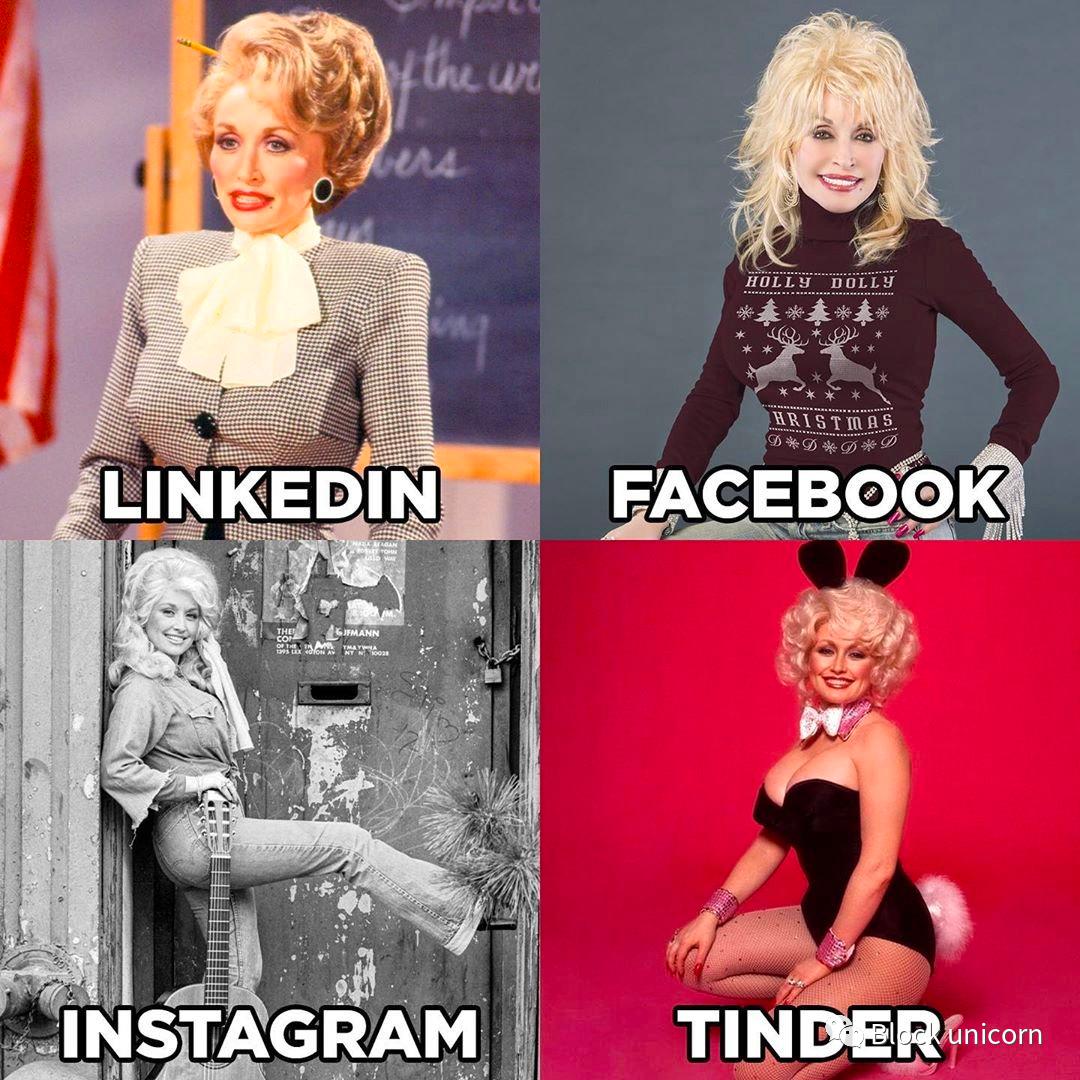
It's a surreality of our inclinations (and instincts) to have to split our identities to fit the context of different platforms to fit us in different physical spaces and communities identity in . We may see here the fundamental promise of the internet - that we can explore ourselves online without fear of censorship or judgment. To paraphrase Marx, we might look for jobs on LinkedIn in the morning, compliments on Instagram in the afternoon, critique each other on Twitter after dinner, and be as lewd as we want on Tinder in the evening, rather than letting those identities define us.
In this subdivision of the self into a series of performance pieces, however, something is lost - not only the division of ourselves into separate Entity, but also the way we build ourselves according to the limited tasks of each platform. At the simplest level, Web3 could allow us to receive better recommendations and find better opportunities by aggregating our online data and sharing the parts we think are relevant, allowing us to Bringing our all to the platform. Web3 enables us to traverse all of these spaces and carry this identity in the form of addresses with on-chain data, while controlling the sharing of those parts we choose.
In Web2 parlance, you can use data from the videos you watch on YouTube to help determine what music you like on Spotify -- and you too There is an option to share this data with advertising agreements to earn revenue directly from ads relevant to your tastes and needs, just as social media platforms have always done on your behalf. (Indeed, the benefits of cross-platform data aggregation help explain the success of Google and Facebook, not for any particular product, but for organizing products in our professional and personal lives). Adult entertainment platforms are likely to be among the first to take advantage of Web3 regulation, not only because decentralization eases user concerns about corporate surveillance that would prevent them from sharing more data, but also because that data can be used to Provide more targeted results for different users.
But more importantly, Web3 allows us to go beyond the limited language of existing platforms and create more advanced, living, breathing identities on the chain . Our data need not be limited to our music choices or our conversations with strangers on dating apps. It can include our contributions to building a community within a DAO, our contributions to writing articles that others borrow and cite, our contributions to successfully promoting others around us. For better or worse, it will include more and more biometrics — cortisol levels, blood sugar, heartbeats, how we make eye contact, how we smile, how we walk. Ultimately, it will showcase who we are, not just as checkboxes of consumer taste, but as active creators, contributors, and collaborators — as people.
It turns out that the real promise of owning data goes beyond the fact that we can store, monetize and share it ourselves. That's because the motivation to do so will also motivate us to track more advanced and personalized data than ever before. In the short term, this data will allow us to replicate our offline identities on-chain as we demonstrate our individual skills and achievements.
In the long run, this data will automate our online behavior, from writing emails as we move from online participants to online curators From investing to just confirming the behavior we want to self-enforce online. In the long run, we will be able to create hypermorphic selves online that are no longer offline selves, but collective creations—perhaps a self that writes emails for us based on collective data, or even without E-mail will be able to communicate with each other's self. Perhaps, in the end, we will become their creations as they alter our daily behavior based on data from people like us so we can better optimize our time.
In the end? We might end up seeing different versions of ourselves, various characters in an online giant RPG: job seeker, flatterer - Fisher, critic, flirt. But these versions of us aren't locked into a specific platform. They will be full-fledged creations that make us newcomers both online and offline. Our online identities will become LinkedIn, Instagram, Facebook, and Twitter themselves, rather than pre-formatted identities that are assumed to be LinkedIn, Instagram, Facebook, and Twitter, data aggregators who derive identities based on data from those closest to us, and Help shape their identities.
At this point we are not far from who we are in real life, creators and creators of the social structures around us. This is why being our own platform is so powerful, so promising, and maybe a little unsettling as well.
4.
As early as 2016, Joel Mogro Proposes the core difference between building a business on the blockchain and building a business on the Internet: on the Internet, platforms such as Google and Facebook capture value on top of a basically worthless open source protocol (TCP/IP), while on the distributed On the ledger, the protocol itself captures value in a country-like currency, reflecting the GDP-like value of the applications built on top of it. The problem with Monero is that blockchain applications on top of the protocol are hard to add value on their own - not just because they are open source, interoperable, user owned, and don't own their own liquidity, but simply because Users invest in the underlying protocol in order to invest in the upper layer application. Therefore, the protocol token used by the application generates value.
A few years later, each application has its own token, and two consequences seem to threaten Mongro (Nobel Economist, Euro
First, value *could* be accumulated on a platform level through its own currency.
Second, having more tokens of much lower value means that, as liquidity disappears, moving from one platform to another has True switching costs. They may represent fleeting victories, but Uniswap and OpenSea are both stories of conquering microcap liquidity.
We might say that this is the end of the FAT protocol paper. Web3's platforms are starting to look a lot like Web2 and Web1's P2P platforms: Conduits, Airbnbs, and eBay, which win markets by capturing liquidity for rare, irreplaceable items and services, backed by their strong liquidity moats. commission.
But there is a difference because: In order to acquire users in the first place, platforms must increasingly airdrop their tokens, not only incentivizing users to use the platform, More importantly, grow its long-term value by getting their network to use it too. Under the supervision of the SEC, no self-respecting platform will say that they are owned by users, but the fact that platforms must relinquish market share of governance to users tells us that the revolution of Web3 is that users and management do not need No longer the opposite of the transaction, but tightly bound together. In a sense, platforms belong to the people.
What if a user discards tokens for a quick transaction or two? A token can acquire a user, but it cannot retain them - for this, users must decide together that both the project and the token are valuable to them practically, socially, and emotionally. The real value is determined by social consensus, that is, users come together to support the value of the token, enough to motivate others to care about this project too. Even the public market doesn't work like this, speculators generate usage, not users generate speculation. Value is truly in the hands of the people.
But there is one last untapped opportunity, and that is for the next few years. Not only will users have control over their data on the Web3 platform - their tokens, their contributions, and their social records - but they will increasingly have the means to use this data as a means to join emerging communities, test their predictions and chained credentials to find jobs. The platform's secret opportunity lies in incentivizing users to collect this data to exploit it. It might sound counterintuitive when platforms don't own user data in Web3, but there are two main points behind it.
First, platforms have the opportunity to build an underlying social graph of unique data that they can then cannibalize themselves by letting other platforms exploit it: in other words, each platform is truly The financial opportunity is to become a protocol that other platforms build upon. Second, at least in theory, if not always in practice, these platforms are not much larger than their users combined. Because it is the user who manages the platform, owns its token, and even uses the platform to transact in the token. So what we end up seeing is a kind of degradation of the Web2 structure: platforms all become protocols, and people create their own networks on top of these new protocols. Or, if you prefer: people become the new platform.
Original link
Welcome to join the official BlockBeats community:
Telegram Subscription Group: https://t.me/theblockbeats
Telegram Discussion Group: https://t.me/BlockBeats_App
Official Twitter Account: https://twitter.com/BlockBeatsAsia

 Related Articles