Web3 New Creator Economy Report: 144 creator economy platforms +100 VC
原文标题:《 Web3 新创作者经济报告:144 个创作者经济平台 + 100 家 VC 》
Xi Yu, the way of the yuan universe
The goal of the Maker Economics Report is to provide a general framework and insight for founders and VCS in the field to discuss the topic. We look forward to hearing your thoughts on what you found interesting, what you think we missed, or any other thoughts on this new Web3 consumer economy.
Now, let's get right to the point!
"The creators of Web3 will rebuild the global economy and take us into a world of beauty, decentralization, freedom and trust. I can't wait." -- Tim Draper, founder of Draper Associates
Speedinvest fundamentally sees Web3 as a technology that will redefine all verticals in the economy. Blockchain is already starting to run the back end of many software applications, and as part of Web3, it has more potential to affect the way we interact with the Internet than mobile and the cloud.
From an economic perspective, this particularly applies to how we create and transfer value online. Creators are now in the driver's seat and have the opportunity to have more control and personality than ever before.
"This is a movement from the people," says Bradford Stephens, co-founder and managing partner of Blockchain Capital. "What's exciting is the self-empowerment of individuals, and that's the change and the big shift in human life!"
Our creator economics report for 2022 includes:
- Trend-setting maps of 144 creators' economic platforms
- 100+ VC to invest in creator economy
- A financing guide that contains key points for investors to focus on when analyzing a company
- Overview of some of the opportunities and challenges facing investors and creators
The maker economy: Traditional platforms dominate
The creator economy is made up of people just like any of us who have a passion or hobby that they can profit from online. But it's platforms that allow creators to earn money doing what they love. One example is youtubers and TikTok users creating content for their fans.
This usually leads to limited revenue opportunities, such as merchandise, subscriptions, advertising revenue or tips, and unfortunately, in practice, only the top 1% of creators with a large number of followers are sustainable.
Worse, today's platforms take a disproportionate share of the revenue creators generate. The typical music artist on a streaming platform, for example, earns about 10 per cent in licensing royalties, with the rest going to the record label.
They also offer no option for creators to be discovered through their algorithms, and only a few offer direct ownership so that all stakeholders can profit from their contributions.
We believe this is the direction for the next iteration of the category.
Creators are no longer just products -- they are new economies.
The number of creators and the demand for content is growing
With the term "creator" now widely accepted, the creator economy is worth $104.2 billion. The same study suggests that one billion people will identify themselves as creators in the next five years. In fact, a staggering 29 percent of American high school students say they want to be "content creators." And, no doubt, in a world of niche entertainment, it's becoming an increasingly viable career option.
Niko Bonatsos, a General Catalyst investor, commented, "Just as Silicon Valley became a way of thinking, millennials from around the world are realizing that tech entrepreneurship can be a career choice, and for the first time Gen Z can make a living from their online ingenuity.
Given these facts, it's no surprise that demand for content is rising and will only continue to rise.
The content comes from your hands
As we move into a "mobile first" economy, consumers are increasingly turning online, devoting their attention and dollars to mobile devices. More than five billion Internet users now spend about seven hours a day online on multiple social platforms -- 93% of whom primarily use mobile phones.
"It's hard to define mainstream today without decoupling it from mobile," said Robby Yung, chief executive of Animoca Brands. "So it's safe to say that in the post-mobile world, nothing is mainstream except on mobile."
Investors are watching
But this growth in the maker economy has also been fuelled by record inflows from high-profile investors -- $1.3bn in 2021 alone. This includes Andreessen Horowitz (A16Z), Greylock, Bessemer, Northzone, and Atomico.
Online content publishers like YouTube, Facebook and TikTok have also launched their own creators funds, giving them direct access to the space and helping them attract creators to their platforms.
Of course, this business strategy makes sense if we keep in mind that the quality of the content on our platform determines its value and is directly responsible for attracting and retaining millions of users.
But despite these advances, most creators still face the same problem they have faced for years: creators are still undercompensated for their efforts, making it difficult to earn a steady income.
But that is changing.
The New Creator Economy: a community-owned ecosystem
Platforms are becoming community-led, making it easier for creators and their audiences to profit from their contributions.
But before we start exploring the next iteration of the creator economy through the Web3 lens, let's take a step back and look at the industry's historical evolution.
Web1 - Information economy = Few creators only consumers
Web1 is the first static version of the Web, also known as the information economy. The user's role is largely limited to reading information from the very few content creators, and the user does not choose to go back to those creators. Some examples are personal websites, AOL, and CompuServe - consumption only.
Finally, Web2 gives every user the opportunity to create content for the first time. But how?
Web2 -- Platform economy = Creator: blogger brand representative
As people began to gravate to the Internet, Web2 saw the rise of "influencers" who started blogging and gradually amassed a reputation and online audience on platforms like MySpace, Blogger, Soundcloud, and Vinyl.
Soon, these creators began profiting from their audiences through affiliate ads and sponsorship deals -- making them conduits for other brands and earning revenue in the process. However, they only serve as conduits for these brands and businesses to reach potential customers, and therefore often have no real loyalty to these companies.
This leads to a power imbalance between platforms and creators in Web2. Creators have come to rely on platforms as the virtual gatekeepers of the new Internet.
Web3 - Ownership economy = creator + viewer new and fairer ecosystem
Today, as the power dynamics shift from platforms to creators and their communities, the definition of creator has changed with the rise of Web3.
Harry Stebbings, Founder of The Twen0 Minute VC and 20 VC Funds, says: "Seeing more value for users individually and collectively is one of the most exciting aspects of Web3. It removes the intermediary from the traditional Web2 aggregators and gatekeepers, which is key to democratizing revenue creation in the digital world."
The creator economy is no longer just about providing value to the platform. It's about a new form of relationship between direct creators and communities. Not only does it give creators the opportunity to offer their fans more services, including financial gain, but it also gives creators and their communities the opportunity to finally participate in the collective value they help create on the platform.
This is where we see opportunities for new community-led platforms of creators with the ability to create self-sustaining networks and more equitable ecosystems where people can serve each other and the entire community.
This will lead to the success of the creator economy.
Jarrod Dicker, partner at TCG, commented: "What Web3 really does is it opens up the possibility for creators to provide more services. If we take newsletters as an example, the concept in Web3 becomes "Why subscribe when you can invest? In the case of Mirror.xyz, you now have the opportunity to invest in the initial stages of the publication in exchange for Token or NFT, so you effectively have ownership in it."
The New Creator Economy Map: 144 of the latest Creator-led platform startups
In this market map, we focus on the new Web3 creator platform, which not only supports creator (and community) ownership, but also ensures a more equitable and circular distribution of benefits to all contributors to the community.
In this case, we divide the field into (1) companies that provide direct monetization for creators and (2) creator tools that allow creators to participate in this new economy.
The United States led the way
When we look at the data, it's clear that the creator economy is by far the largest in North America. Of the 144 companies, only 18 are based in Europe. However, given the differences between the two consumer markets, this is not surprising.
North Americans, especially those in the United States, are generally less risk averse than Europeans. The American Dream promotes the idea that The United States is a "land of opportunity," and a high-risk, high-reward mentality is seen as a virtue. While the validity of this argument can be debated, it has always helped spur innovation because the country was at the centre of multiple tech booms and had a relatively high proportion of early adopter consumers.
The US also happens to be the cornerstone of the global media ecosystem, home to giant Web2 creators like Myspace, YouTube and Snapchat. So it makes sense that the creator economy will take off in America before Europe does.
But times have changed.
Europe is catching up
Web3 creator economy startups are springing up across the continent.
Take France's Sorare, which recently raised $680 million, led by SoftBank Vision Fund 2, to create the next entertainment giant, starting with soccer. Ledger, also French, makes digital assets more secure with their cryptographic hardware wallet. Norway/Vietnam's Axie Infinity also took advantage of the video game trend of monetizing games using NFT.
Businesses like this spring up every week in Europe. Not only are they growing at a high rate, but they are also receiving strong investor interest and capital from European and North American investors.
Paola Vivoli, an investor at Speedinvest, said: "Let ordinary people by making YouTube video to get the idea of steady income is no longer a ridiculous fantasy - this is an effective business model," it has begun to attract the attention of B2 B startup founder and investor in Europe. They now can see clearly the creator economy of wind direction and the direction they want to enter. With that in mind, we expect the European ecosystem to continue to grow, and it will have some catching up to do to reach the same maturity as the US."
If we look at European Web3 creator companies and tools in our mapping and break them down into their respective categories, we have identified the following companies:
Creator tool
Fan interaction: Talkbase
Management: gem.xyz , Passionfroot
Design: Bildr, Customuse
Payment: Earnr
Low/no code solution: Beyond
See the full list below, including information about its categories, stages, and geographic location.
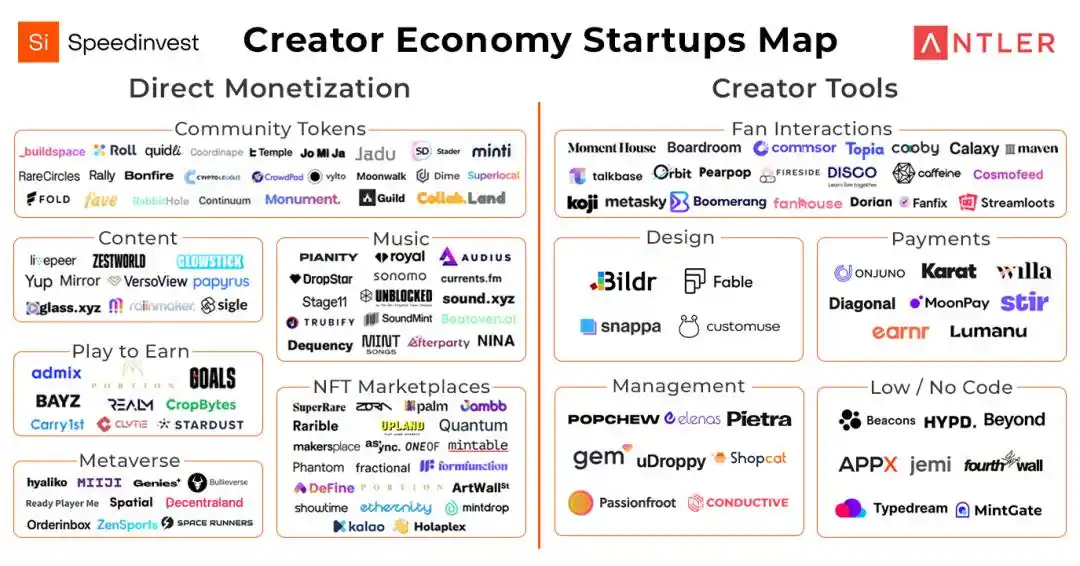
Check out our list of creator Economy startups at :
https://airtable.com/shrDWqZB6IFXMMrRt/tblXeHK4BsxdTGaf9
The aim of this list is neither to be exhaustive nor to rank start-ups, but rather to map the rapidly growing and expanding creator economy start-up ecosystem.
"The new creator economy encompasses everything creators have always aspired to -- an ownership and community-led platform where all community members are compensated for their time and contributions. Being a creator is very difficult. However, we believe that everyone will eventually become a creator in some capacity, "said Ollie Forsyth, Antler Global Community Manager.
他继续说道,「我们很高兴看到这个领域在未来几年从游戏公司的各个方面如何发展,你不再需要在游戏中购买多个化身。您可以只拥有少数可以在多个平台上播放的内容。社区 Token ——基于我们的贡献而发行——可能会让我们中的许多人在未来拥有额外的收入来源——创造新一代财富。」
If your company isn't on the map and you'd like to join, please write me on Twitter. @vivolipaola , we'll add you!
methodology
Our criteria for selecting and ranking startups are as follows:
Direct monetization companies must be community-driven and allow creators to monetize in a Web3 native way
Creator tools are platforms that allow creators to operate, such as back-end tools, analysis platforms, and so on.
We focus on startups that are already well established in the space, which means they are already funded or are raising money publicly. We excluded very large mainstream companies -- like Patreon, Snapchat, etc. -- because our goal was to focus and support the start-up market.
Our primary data sources are Crunchbase and Pitchbook, supplemented by our own deal flow and conversations with other VC investors.
Web3 Investment Environment: A Guide to fundraising
Now, for founders looking to build these new creator platforms, information about what investors are looking for and tips on how to raise money can be scattered, inconsistent and overwhelming.
For this reason, we decided to ask some investors for their thoughts on what to look for when analyzing potential investments in the sector.
1. Big TAM and scalability potential (i.e., volume!)
Investors look for volumes at launch (volume and volume, payments, searches, developer activity, number of wallets traded on the chain, number of mints, etc.).
To understand what liquidity is out there, it is particularly important to consider exchange volumes. Tools founders can use to monitor activity include Nansen - where you can see which projects are taking off in real time. Tools such as Moby and Icy. Tools can be used to track specific NFT projects.
2. The community
Examples of indicators that quantify the quality and health of network participation are as follows:
Daily or monthly active users
-180 - or 90-day tracking averages can be used to measure stable mature networks
- 30-day or 7-day averages are better for real-time insight, but are subject to false signals due to market volatility
每月活跃钱包:过去 1 个月拥有活跃 Token 钱包的唯一用户
Trading indicators:
- Number of transactions
- Trading monthly active users
- Peer-to-peer monthly active users
地址总数、余额地址、零余额、零余额比率:此数据表示用户的生命周期数量和协议的保留。零余额地址是那些已经转出所有 Token 的地址。零余额地址/总地址 = 零余额比率。
人们通常持有加密货币但不与之交易(然而,加密游戏 Token 或社区平台应该有更高的活动率和交易计数)所以这个数字应该比用户的每日平均数要大得多
Keep in mind that 80% of your users are probably just lurkers.
Silvia Oviedo Lopez, head of marketing at Canva, said: "I think the community perspective is going to be the most interesting [part] for some time to come and really bring a new perspective to the creator economy. There are a lot of things to figure out -- but access, inclusion and awareness feel like important next steps. I'm excited to see how things go!"
3. Appeal to different audiences
In our view, Web3 startups should not only be able to attract and grow existing audiences through constant engagement, but also attract and reach new audiences, especially in new markets.
For example, if we take a blockchain-based game as an example, the founders should consider whether the game is designed and built only for gamers, or whether they can go beyond that and design the platform in a way that incentivized third-party developers to build.
4. NFT/社交 Token 和粉丝 Token 经济学的效用
实用 NFT 或 NFT 2.0 是 NFT,其估值基于它们向 Token 持有者提供的访问权限、特权和机会。除了与 NFT 相关的通常稀缺性之外,它们还明确定义了内在价值,并大致分为以下几类:社区、梦幻体育、赌博、游戏和社交。根据用户需求,实用 NFT 被认为是未来,因此,创始人需要了解如何最好地设计它们。
If we take blockchain-based games and in-game NFT as an example, game developers in Web3 have to worry not only about building a good game, but also about creating good enough economic incentives to support a strong and sustainable in-game economy. Is the gameplay engaging? Do the in-game mechanics make sense, and is the NFT functional (other than collectible)? After all, the game has to be a good experience!
Creator Collective Capital co-founder Sasha Kaletsky says: "In addition, some of today's most successful NFT games (e.g. Axie Infinity, Sorare) have a strong 'money making' element that is culturally completely out of sync with the western 'free-to-play' culture of recent years."
更重要的是,对于创作者社交 Token 和 NFT, Token 经济学的结构应该能够创造一个可持续的经济(例如,当前围绕 Web3 游戏中「贫富差距」的争论),这对于创作者的长期采用至关重要。
「社交 Token 通常只是创作者主要收入来源的一小部分,因此创作者往往非常关注他们如何通过 Web3 将粉丝货币化。没有人希望那些赔钱的愤怒粉丝轰炸他们的评论区(以前发生过……)!」Sasha 补充道。
5. GTM and distribution strategy
In Web2, the main GTM stakeholder is the customer. In Web3, the stakeholder primacy of incentives means that the entire community of contributors that make up the network becomes a stakeholder - driving the need for new allocation strategies.
Web3 的机会是利用 Token 和底层去中心化技术来构建和引导这些新网络。
Thus, what this means in practice is that while the GTM strategy of a Web2 enterprise starts with a product (i.e. as a tool), Web3 companies should adopt a more bottom-up approach and design token economics to engage and engage the participating community. That's what investors want.
At this point, it is important for founders to adapt their GTM strategy to the community they are building. Investors want to check that the founders have a good understanding of their (future) community and the company's place in a Web3 environment, and then be able to define Web2: the ideal toolbox of Web3 strategies (such as a mix of marketing and collaboration drives).
Coming soon: an in-depth look at go-to-market strategies and strategies in Web3 #watchthespace
6. Status, contacts and influence of key members/teams
Today, investors often believe/expect that "crypto-native" teams are better positioned to build and win in this space than teams that build social/consumer/game-first startups. However, evaluating a team built with Web3 is not that simple. The most "crypto-native" founders are not necessarily the right people to build these new creator solutions, which, depending on where you are, are actually mostly similar to consumer applications.
In this case, investors may want to see founders who are "native enough" to understand crypto and Web3 in depth, who have the right networks to attract crypto engineers, but who are also so local that they don't understand the experience of the average mainstream non-crypto user they're likely to talk to.
The opportunities investors see in Web3
2021 will be a pivotal year for the industry as Web3 takes every industry by storm. This is a true lateral trend that investors are paying attention to across the board.
What we are seeing today is an amazing combination of talent and capital flowing into the ecosystem, further driving innovation in the decentralized technology stack and consumer-facing applications that are now disrupting all ecosystems. This can be seen in the big rounds raised by the following companies:
September 2021, blockchain-based fantasy football game & NBSP; Sorare raised a $680m Series B round, led by SoftBank, valuing the company at $4.3bn in Europe's largest series B round to date.
Payment infrastructure provider for crypto companies & NBSP; MoonPay raised $555 million in Series A funding in November 2021, led by Coatue and Tiger Global, valuing the company at $3.4 billion.
Forte, a platform used by game publishers to incorporate blockchain technology into their games, raised $72.5 million in Series B funding in November 2021, led by Sea Capital and Kora Management. In May, Forte raised A $185 million Series A round led by Griffin Gaming Partners at A $1 billion valuation.
The company behind NBA Top Shot and The Flow blockchain & NBSP; Dapper Labs raised $250 million in Series D funding, led by Coatue, and saw funding in September 2021 from Andreessen Horowitz, The involvement of Google's GV and Version One Ventures values the company at $7.6bn.
Who else is investing in this sector?
Web3 is attracting more and more attention... But from whom? We've reached out to the broader ecosystem to give you a clearer picture of who is investing in this sector, including their phase, geographic focus and check size.
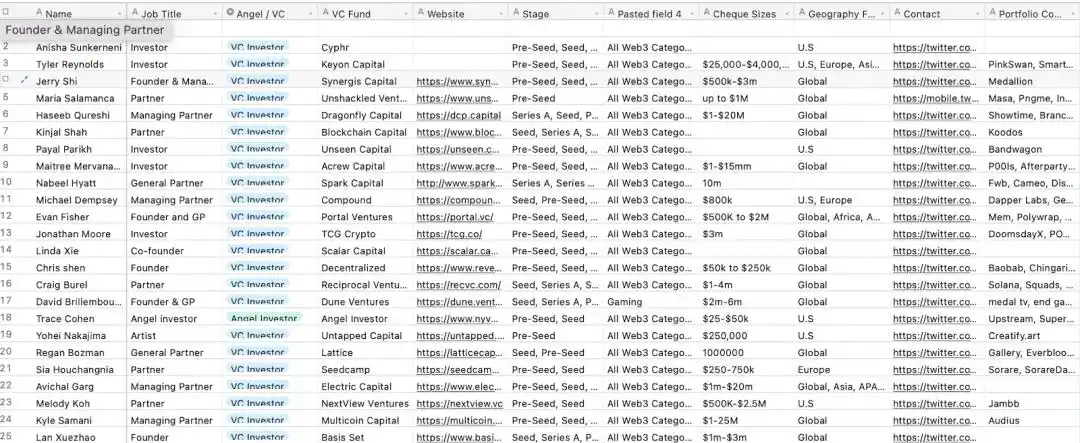
Check out our creator economic Investor list at :
https://airtable.com/shrsrUMBTwytxEtT2/tblJHsTq8C54ZQe0D
What do investors actually think about the market?
With all eyes turning to the space as new opportunities continue to emerge, we asked some investors what they were most excited about and where they thought the biggest opportunities in Web3 were unfolding -- and here's their answer.
Michael Sidgmore, co-founder of Broadhaven Ventures
一切金融化。「Web3 正在实现一切的金融化,其核心主题是所有权。任何资产现在都可以 (A) Token 化和 (B) 您可以创建商业模式,其中 Token 成为有人投资该创建者/资产/平台的原因。因此,它正在成为一项投资决策。此外,不仅仅是任何东西都变得可投资,而且我们如何度过时间也正在成为投资决策。您现在可以通过玩游戏(例如 Axie Infinity、Sorare)来赚钱,并且通过这样做,您现在可以用自己的时间做出决定。您正在通过资产所有权来激励人们,以此作为他们实际增加收入、成为社区的一部分并将其他人带入该社区的一种方式。」
Dominik Tobschall, Speedinvest investor
No part of the economy will be affected. "Speedinvest fundamentally sees Web3 as a technology that will redefine all verticals in the economy. Blockchain is already starting to run the back end of many software applications, and as part of Web3, it has more potential to impact the way we interact with the Internet than mobile and the cloud."
Leer Hippeau investor Meagan Loyst
New tools link Web2 engagement with Web3 loyalty. 'Overall, loyalty is higher. Creators will have the ability to reward their most loyal fans through continued engagement, which is not necessarily tied to $$$$. I'd love to see the emergence of tools that help link Web2 engagement with Web3 loyalty - the ability to trace your biggest fans by attending your events/concerts, spending in your store, engaging in social networking - which could launch the newer Web3 platform for tiered loyalty. That way you won't be starting from scratch with your fan base, and can reward people who have been with you since day one. ' '
Index Ventures investor Rex Woodbury
创作者的生命周期。「我对三个主要部分感到兴奋:1) 创意工具,2) 创作者发现,以及 3) 创作者获利。我认为这些是创作者的生命周期。第一个类别是解锁新表达形式的技术——我对 VR、AR 和低代码/无代码创建工具感到兴奋。第二个是人们在网上找到受众的方式;最好的技术能够更好地形成社区。最后一个包含创作者可以赚钱的方式。我们看到 NFT、社交 Token 和其他新的 Web3 创新重塑了货币化。」
Ann Miura-Ko, Floodgate Ventures co-founder
Creator life. "I'm able to let the creator makes meaningful interaction with the audience rather than in the endless content platform the most excited hamster wheels. As the growth of the creators of audience, their insatiable appetite for content creators may become a kind of consumption life. I would like to see can let the creators of" make money while they were sleeping, "platform."
Mattia Mrvosevic, partner at Eterna Capital
财富的再分配和数据的优化和安全。「在 Web3 中,我最兴奋的机会是(1)通过游戏赚钱游戏和应用于实际用例的 Token 经济学等方式重新分配财富,(2)优化数据和信息流,以及(3)使信息防篡改和更安全。」
Framework Ventures investor Brandon Potts
试验 Token 的可替代性,作为一种分配机制,是新想法蓬勃发展的地方。「目前这个新的创造者经济中的大部分破坏都在于你创造和获取价值的分配机制,然后将其重定向到核心社区,你最早的支持者,以承认他们提供的价值。作为一种分配机制, Token 的可替代性是吸引新创始人和创造者的颠覆性方面,而他们究竟如何试验这种分配并添加额外的实用程序层是最让我兴奋的,因为这是原创想法蓬勃发展的地方。」
Lightspeed General Partner Nicole Quinn
Yuan of the universe. "In the creator world, I'm most excited about the meta-cosmic direction we're all heading in. Web3 is a mash-up of the 3-D world, social gaming, NFT and virtual goods ownership. It stands for community, brand and ownership."
The opportunities and challenges creators see in Web3
Finally, we turned to the major players in this new spatial iteration, and asked some of the creators what they're most excited about and what challenges they might face in the future -- here's what they had to say:
The opportunity to
Caspar Lee is co-founder of Influencer.com and Creator Collective Capital
Deeper and more lasting relationships - across platforms. "In addition to greater monetization potential, community ownership gives creators the opportunity to bring their audiences across different platforms and protocols to build deeper and more lasting relationships."
Jim Shepherd, head of talent partnerships at Snapchat
Offer a wide range of opportunities. "Creator economy is at an inflection point, because the content creators are beyond simply and brand cooperation, and by increasing the many sources of income to develop their business. Therefore, the platform is rapid development, to provide more and more many opportunities. In turn, the creators are using these new tools in direct contact with fans and establish their own community. A by-product of this is the emergence of various content formats -- long and short videos; spontaneous moments captured with cameras; performance content; interactive events, or Vlog style, and creators are even making their own AR."
Max Fosh, creator
Lower barriers to entry. "New technology is to break the barriers to entry, this is an exciting thing. Now to build a huge YouTube channel, you can be operated by smart phone. This is cliche, but it is 100% correct. The same technology to make content to create a very elite system, which is exciting for everyone. We're now seeing a debate between platforms about who can best pay their creators. That's where the eyeballs are -- wherever the creators are, so it's a very exciting time as creators!"
challenge
Blake Michael, creator
Barriers to adoption. "When I talk to creators, I think there's a barrier to adoption. Web3 is something that some creators know about, but very few know exactly where and how to take action and what it actually means to them."
Bremner Morris, CEO, Rally. IO
There is still a long way to go for middle-class creators. "Growing" middle class "for the creator, there is still a long way to go - the top echelon of the creator is earn most of creator economy income. However, as the platform to improve the detection and the creator is more and more used to have a financial relationship with the fans, the creator of the middle class will also reap the rewards."
Sandy Lin, creator
Sustainability and longevity. 'Sustainability and longevity is another big pain point. 77% of creators rely on brand deals for the majority of their income, but brand deals can vary from month to month. Partnerships are a good source of income, but creators should think about long-term success. "We're seeing more and more creators leverage NFT, subscription communities, and brand building to increase revenue streams."
Jade Darmawangsa, creator
Creator burnout. "It's really hard to find the right balance between making really good content that we love and making money because we need to pay the bills. That can sometimes lead to creators working like crazy without much benefit -- it's important that we take care of ourselves."
A more sustainable future driven by creativity
As we examine the direct relationship between new creators and followers and the future of the creator economy, we are very excited about the new "local" ways creators can generate income, funded by and with their communities, and what we believe is the emergence of new and more sustainable economies.
NEA 的投资人 Danielle Lay 说:「创作者可以从基于收费的补偿转变为通过他们建立的社区中的股权来积累财富。Web3 使创作者最终能够像他们的企业家一样获得补偿。为了让股权能够维持两者的价值创作者及其社区,平台将需要帮助创作者设计 Token 经济学。我们可以通过货币政策来了解如何管理 Token 。为了使货币能够存储价值,人们需要信任它,需要观察通货膨胀,消费者可以用货币换取的商品/服务需要对用户有价值。」
The new creator economy will not only change the way content is created, it will also open up a whole new world of technology and monetization opportunities that Web2 simply cannot achieve.
We are excited about the untapped potential of the new Web3 creator platform and creator tools that support these new creators in a direct relationship with the community and build for mainstream consumers, unleashing the next 100 million users in Web3.
"Our focus is on the opportunity at the intersection of consumers and cryptocurrencies. Opening up the market for mainstream users and bringing the masses to Web3 is one of the most exciting investment opportunities of our time," said Paola Vivoli, investor at Speedinvest.
Thank you for reading our article, we hope you enjoy it. We are very excited about how the future of the Internet will evolve, and we remain passionate about supporting the next generation of platforms.
Special thanks to the following for their contributions:
Caspar Lee (Creator, Influencer.com, Creator Collective Capital), Blake Michael (Creator), Bremner Morris (Rally.io), Sarah Nckel (Northzone, Femstreet), Niko Bonatsos (General Catalyst), Sasha Kaletsky (Creator Collective Capital) , Jim Shepherd (Snapchat), Max Fosh (YouTube Creator), Rex Woodbury (Index Ventures), Nicole Quinn (Lightspeed Ventures), Tim Draper (Draper Associates), Sandy Lin (TikTok Creator), Meagan Loyst (Lerer Hippeau), Ann Miura-Ko (Floodgate Ventures), Danielle Lay (NEA), Michael Sidgmore (Broadhaven Ventures), Kieran Hill (20 VC), Harry Stebbings (20 VC), Sameer Singh (Network Effects Consultant and Atomico Angel), Mattia Mrvosevic (Eterna Capital), Jarrod Dicker (TCG), Brandon Potts (Framework Ventures), Robby Yung (Animoca Brands), Bradford Stephens (Blockchain Capital), Courtney Chow (Battery Ventures), Jade Darmawangsa (Creator), Dominik Tobshall (Speedinvest), Sam Nasser Zare (SoftBank)
The original link
Welcome to join the official BlockBeats community:
Telegram Subscription Group: https://t.me/theblockbeats
Telegram Discussion Group: https://t.me/BlockBeats_App
Official Twitter Account: https://twitter.com/BlockBeatsAsia