Analyze the internal mechanism and breakthrough path of "Web3 Paradox"
Original title: "Analysis of the Internal Mechanism and Breakthrough Path of "Web3 Paradox"
Original author: Spike, ThePrimedia; Editor: Jerry Crypto, ThePrimedia
Editor's Note
< p ql-global-para="true" line="CZIr">Mencius said: fish, what I want; bear paws, what I want. It is impossible to have both.
In the world of Web3: Decentralized technology is what the public wants; application value is what the public wants. It is impossible to have both.
This article will try to analyze our The gap between the longed-for Web3 scene and the actual ecological construction, and on this basis, explore the path to break the situation. The full text will be divided into the first part Paradox and the second part Breaking the game.
Part 1 Paradox
In the concept frenzy of Web3, a series of whimsical DAPPs have taken root and sprouted, and under the nourishment of the idea of decentralization, they have sprung up like bamboo shoots after rain.
NFT
DEX Uniswap
Compound, Maker, Aave
USDC, DAI< /p>
Filecoin
Lab DAO
Toucan
Golden
Radicle
Helium
Helium
p>
……
However, after several years of development, what we see is that once CloudFlare collapses, the oracle machine stops singing, The trading platform can't match... most of the projects collapsed into sand.
Why can't the decentralized underlying architecture support application scenarios that meet the habits of the public?
Why can’t top-level applications such as Twitter and Facebook be born from the concept of blockchain upgrade?
Why can't the encrypted world, which is concerned with user privacy, wrap up a silky user experience?
Why can't Web3 applications roll forward in a flywheel effect?
Although there are so many soul tortures, the reality is that almost no one stops to think : What is the gap between the ideal decentralized design and the actual application ecological construction?
Web3 brings us a grand vision of industry iteration, era change and even social evolution. It can be described as a great and risky, top-down top-level social change design. As the ideological totem and action plan for the construction of the encrypted world, Web3's concept of decentralized society is revolutionary—in the past, social changes were often designed from top to bottom, which brought constant repetition and conflict; under the concept of decentralized society, The social practice of Web3 presents a bottom-up "emergence", a "self-organizing" system similar to an ant colony or a hive.
But from a practical point of view, Web3 lacks the executor and promoter of landing practice. Although any major technology related to social change is inseparable from the accumulation and empowerment of the market, wealth, and interests, the development history of the encrypted world is completely penetrated by the desire for wealth, from project developers, studios, and investors. Institutions, down to speculators, hodlers and other major participants in the encryption ecosystem.
The industry iteration, era change and social evolution supported by the bottom-up Web3 application ecological construction compete with the interests of all parties in the encrypted world currency circle, Let all this fall into a "paradox".
VC: The invisible driving force behind Web3
With Token in the name of construction
In the final analysis, the existing Internet industry structure is still a linear relationship of "scale for growth, traffic for valuation"; but Web 3 does not have a central carrier, and cannot be used in the past Valuation logic to evaluate the input-output ratio. All business models and product designs of Web 3 need to be refactored, and a non-linear relationship is used to break the critical point and reach a considerable number of users-this model can be compared to the human brain connected to each other through various synapses, Ultimately complex thinking occurs.
This kind of decentralized reconstruction means that the division between individuals and enterprises will gradually narrow. Values can be mined (Token), transmitted (Web 3 social), and the relationship between them can be migrated (social graph) and stored (IPFS).
However, there are obvious problems in Web 3.0 at this stage:
1. Lack of real use Demand mining:
Web 3.0 mainly relies on copying the ideas of Web 2.0, and frequently launches decentralized versions of various centralized services, lacking in mining the real needs of users . For example, we don’t want a decentralized version of Twitter, we just want a social protocol that preserves social relationships, NFTizes content, resists censorship on the platform, and protects our privacy.
2. Users take profit as the first motivation:
Users are not motivated by use Value and real scenarios use products, but for the purpose of profit, which is why X2E and its imitation disk projects emerge in endlessly. But this model can only attract gold diggers in the entrepreneurial stage, and will not leave a real user group.
If you want to be firm in long-term Web 3, you cannot see returns without long-term investment. Only when the model is formed can the fruit be obtained. Only when the universal application is born, is the time when Web 3 really breaks the game. But we have to accept the reality that there are about 4 million DeFi users, about 500,000 active NFT users in OpenSea, and less than 10,000 users of Web 3 social protocols.
Why is the actual user scale of Web 3 so small——Because of the Token mechanism boosted by VC.
The logic of VC in Web 2 is: continue to invest, seek the monopoly position of a single track, occupy the entire market space, and continue to obtain excess profits.
The logic of VC in Web 3 is: use investment as a bargaining chip, seek early cheap Tokens, use the secondary market as a place for selling, and use the trading platform on Tokens as a node , to quickly drain the token value.
The Token mechanism of Web 3 becomes the water reservoir of organizations and VCs, without any responsibility. There is a bug mechanism here that allows traditional institutions to use Token to attack arbitrage.
Why can’t the Token mechanism bring actual user scale? Rational people believe that some behaviors are not spontaneous behaviors under the market mechanism, but are precisely created by human interference.
Users may really care about privacy and data security when using search engines, but the most important thing is to meet the needs of search, which is the path of Web 3 construction The fundamental reason why it cannot be equated with DeFi and NFT is that the use value of a product should take precedence over the price mechanism.
For example, when users use EthSign to sign commercial contracts, the most important thing is that the contract cannot be tampered with. This is the core advantage of Web 3 products over other tools. Users do not need to understand what on-chain and smart contracts mean, but they can know that this allows the contract to be permanently archived.
Source: EthSign
< /p>
As we all know, the market acts on the basis of maximizing personal interests, but the current market is dancing based on maximizing the interests of others-this cat-funny stick is called Token . Let us use a picture to see the evolution process under the blessing of this Token.

< /p>
Institutions have negotiated a good share. Under the lure of the internal rate of return (IPR), the project party conspires to maintain the currency price. During the bull market, more users will support the value of the Token, but once the bear market is due to the lack of core of the project Users will face the double loss of currency price and users.
After the Token is used up, some project parties will choose to sell it together, or have no choice but to maintain the operation. As a retrospective airdrop currency, instead of using UniToken, it can declare the de facto death of governance Token.
In Satoshi Nakamoto's vision, Token is a form of proof of work. However, under the command of VC, the significance of the project is for the price of Token, and the strategy of institutions and projects for Token is a channel for quick exit, not the key to maintaining the operation and development of the project.
Empty shell: from infrastructure to application scenarios
From infrastructure to application scenarios Empty structures have emptied the developmental spine of Web 3.
When we talk about Web 3, the whole concept of the subject - from the social graph and the creator economy to SaaS and collaboration tools - seems to have Everything is complete, just wait for an order, and Web 3 will quickly occupy the network world and become the infrastructure. But in fact there is nothing - once CloudFlare crashes, the oracle machine stops singing, and the trading platform cannot match...
We suddenly discovered that in Web 3 Under the concept, with the support of the underlying public chain, there are still lower-level Internet protocols in operation. Under the grand vision of Web3, we can find the current gap between ideal and practice: Web 3 is just an empty shell.

The bottom layer of Web 3 is still the traditional foundation Facilities
Without the reality of a phenomenon-level application, the flywheel effect of the Web 3 ecology cannot roll. For example, the current social protocol focuses on the concept of SocialFi or social graph, and the popular BBS Network, 50% of its Token will be distributed to active users. So how to increase the activity? Of course, it is to create "high-quality" information. Under this logic, more traffic is imported, and active users of followers and subscribers will reap more benefits. This mechanism comes from the imitation of transaction mining in DeFi, artificially agitating enough bubbles, and finally leaving a chicken feather.
Right now we only have Web 3 parodying Web 2, but we need privacy , Data portability, social migration and other characteristics require the participation of blockchain, DeFi, and NFT. This is an application with real usage needs.

Why do Web 3 applications lack real usage requirements? ——The reason is very simple, because the product is not easy to use. Behind this is the extreme scarcity of high-quality developers. Users are scarce in the Web 3 ecology on the surface, but based on the tens of thousands of current Web 3 users, there are few exploratory applications, and more technical and basic development tools are still needed.
The languages used by mainstream developers pouring into trading platforms and other cash flow-rich tracks are basically Java, Go, Javascript, etc., and only when it involves on-chain Rust, solidity, etc. will be used for the interactive part. If they don't realize the greatness of Web 3, then the blueprint will never come true if no one builds it.
When the bear market comes, coinbase and bybit will even lay off staff, and these developers will be lost again, further deteriorating the strength of Web 3 development. In the blockchain world, high-quality developers have a huge driving force for new tools and new technologies, but the current situation is that they are being squeezed out of the field of Web 3 infrastructure development. The Web 3 ecology can be said to be ready for everything, but it lacks talent.
Future: Who will enter the game?
We briefly outline the relationship between Web 2/3 - hopefully we can get a glimpse of what the future of Web 3 looks like.
The basic hardware is currently the same: desktop and mobile. Meta's VR devices are not directly related to blockchain technology or chain games. GameFi is mainly based on web pages and clients and does not widely access VR and other devices. This is a key point that has been ignored intentionally or unintentionally. VR devices are also paving the way for wider usage.
The bottom layer protocol is diverging: the bottom layer of the network has not completely abandoned HTTP, browser, TCP/IP and other protocols, but UX/UI is changing, regardless of beauty and ugliness , anyway, "cyberpunk" is the main orientation. In other words, the mode of public chain as a communication protocol and IPFS as a database has not completely replaced the existing communication protocols and centralized databases.
The current Web 3.0 is mainly based on the concept: Internet + re-evolution--> Web 3.0+, if this is an inevitable story, then it can be considered The concept of Web 3.0 as marketing itself is an extension into the real world.
The product is still in the process of iterative research and development: the life cycle of Web 3 products is no longer fixed, and will enter an era full of fluidity: service when you run out It can also be tokenized and NFTized—in essence, tickets are used once and not used again, and marketing services can also be used up. As long as there is a consensus between the buyer and the seller, it can be called Token as a service
.
It’s just that this still needs a process to realize, now there are three main types of people talking about Web 3.0:
The first category: practitioners of traditional Internet giants
Now they are eager to try, mainly because the traditional traffic model has come to an end, Among the large companies that are collectively involved, some people are already preparing to enter the new channel, but if they don’t change their thinking, they will be like Facebook’s Libra, or the so-called alliance chain technology.
The second category: crypto native
This kind of people may start in the public chain, such as Flow began to advertise itself as a Web 3 public chain, or started as a DeFi/NFT/Metaverse project organization, or jumped out of large factories and institutions to participate in the construction of Web 3. They are currently the most important group of people. Just like the Aave team who developed Lens Protocol, everyone must learn to embrace change.
The third category: variants of MLM
The essence of MLM is that the product model is essentially Unable to make profits, in practice, the financing operation mode is mainly based on pulling people's heads. Such people will not have a real interest in product construction, but they are often the loudest, hoping to attract as many people as possible to participate in it. Ordinary people will have the stereotype of "Web 3 = scam" after being deceived.
Only the second group of people becomes the main force, and in the future there will be more people of different types entering Come to this magical space and use the human brain to create truly valuable product services and usage scenarios.
The adaptation speed of Web 3 is super fast. We must believe in the iterative speed of new product models. For example, Nansen has cooperated with Google Cloud to provide real-time market data. It's like joining if you can't beat it. Web 2 and Web 3 are not isolated, but more like twins. Web 3 also leaves time for Web 2 to adapt and evolve.
The point where the two parties can reach a cooperation is that, "Nansen said that data will help market makers, hedge fund managers and asset managers train their algorithms to predict Market trends, generating reports, indicators, etc.” When a new trend takes shape, more mainstream groups will participate in it, which is a good start.
Next: Breaking the game
French sociologist Tarde pointed out in his book "The Law of Imitation", " In the process of human transformation, new inventions rarely appear, but more transformations and imitations.” In order to achieve a breakthrough in Web 3, it is necessary to straighten out the current parallel and actually conflicting logical paradoxes (please refer to the previous article for details), and find its breakthrough points and explore feasible paths.
Facing VC every step of the way Encroachment, the cramped living space also has sparks, we will use faith and technology to expand the territory, gather all developers to conquer the city, until we complete the anti-killing of rentiers; facing the wasteland of the scene, we have never felt Barrenness, social graph, creator economy, and SaaS are ready to go. All false gods that hinder progress will be eliminated, and all new gods will be placed in shrines for people to worship; in the face of the technological gap, the completeness of the development kit will allow more technical tools to directly Facing users, decentralization will deconstruct the role of the platform at the technical level...
Newton once said: If I see farther than others, it is because I stand on the shoulders of giants. Starting from the bottom this time, let's build a nine-story platform together.
Bottom: Faith reconstruction and technology advancement
In the process of Web 3 construction, in view of the dilemma of its internal mechanism, a Reflect on its underlying logic to adapt to new situations.
1. Faith reconstruction:
Without faith, there is no decentralization. Everything has a decentralized solution. Uniswap has used AMM to rebuild the matchmaking. Bitcoin has also used PoW to achieve an objective performance of consensus. Web 3 has SBT, PoS mechanisms, and the expectations of all users. Consensus It has emerged that in order to move towards a more diverse DeSoC society, it is far better to start to act than to sit and talk.
All information can be accessed by the Web 3 Capture and generate corresponding value-yes, all information! These values can be circulated, naturally have value, and everything has value.
This is what Web 3 brings The foundation of belief upon which our opportunity to revolutionize the application of space rests. The belief that was hyped and bubbled by the currency circle in the past has gained trust again in development and practice.
For example, the most widely used privacy The browser Brave has launched the search mode Goggles in the Web 3 era, trying to provide more relevant search results without touching more privacy of users. Combining its own Token BAT's advertising service is already a very mature attempt in business. If it goes further, the backend is completely built on the blockchain and the information is stored on IPFS, then it can have the ability to reconstruct the Internet interactive interface. magic.

Source: Wikipedia
2. Technology first: innovation gradually spread
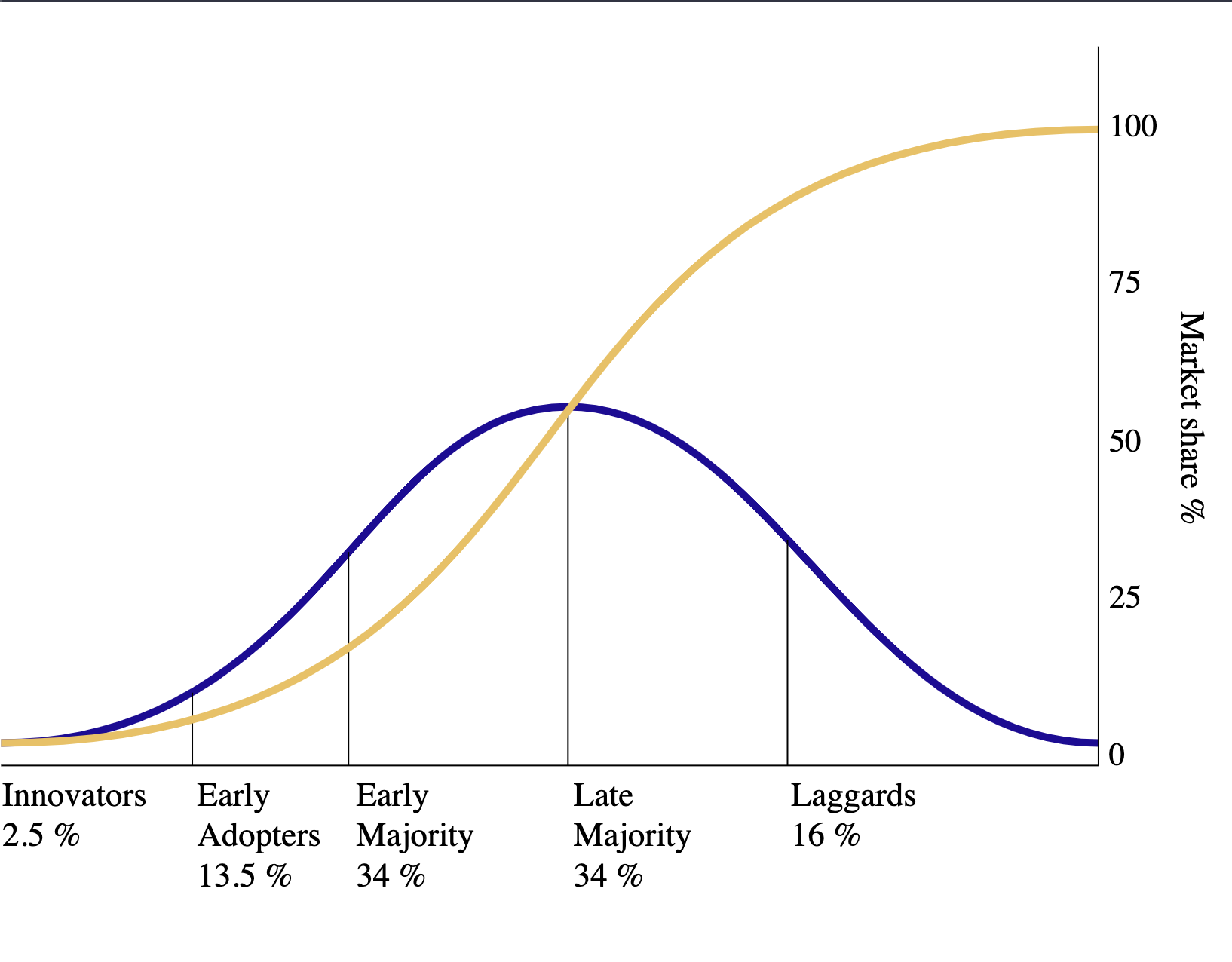
In the innovation diffusion curve, we can see the transformation process of Web 3 from Innovator to Early Adopter. Although this value is still small in terms of absolute market share, the desktop Terminal, enterprise-level, and basic facilities are gradually being built, which is a process of gradual technology diffusion.
For example, the Crypnote note-taking tool has It is a product with a high degree of completion. Previous note-taking products such as Evernote and Onenote needed to face the problem of data migration, while the backend of Web 3 is directly built on the blockchain storage network. This is a redesign based on the technical characteristics of Web 3 and is continuously being upgraded.

What kind of Web 3 application technology innovation will bring us, even if it is a possibility, is our Explore the significance of breaking the game under the paradox. Let's talk about what Web 3 products will look like.
Social: From SocialFi to Graph Evolution
As an important cornerstone product of Web 3.0, social products need no words for their strategic significance. The social synonym given to Web 3.0 by history will not be the often-called SocialFi, but an upgraded new format-"social graph".
Why the popular SocialFi cannot Take on this important task? SocialFi, commonly known as "social money exchange", refers to the behavior of using Token in Web 3 to stimulate users to use products. Taking BBS Network as an example, 50% of its Tokens will be distributed to active users—how can the activity be improved through Token “cheating”? Of course, it is to create "high-quality" information to allow more followers and subscribers to import active user traffic. No matter how strict the review mechanism is, as long as there is a mechanism for exchanging activity for Token, "data creation" will survive space.
Wait until the "function"> The turning point of "hype" is that what can really retain users is to meet real needs, and the product cycle will be lengthened, and finally replaced by an updated mechanism. This is a "whale fall" of natural death, and then everything grows. However, the current socialFi does not have a model design to suppress spam, and the existing governance mechanism will fail under the stimulation of Token-using Twitter is to obtain new knowledge, but using such SocialFi applications is motivated by profit.
There is no way to avoid profit-driven question. The socialFi of "social money exchange" will not be the main social category of Web 3. In the long run, there will be new native social applications, and the "social graph" is the pioneer that dances with the times. The social graph is the "graphization of social relationships", which refers to the direct coupling and transmission of social relationships between individuals relying on the blockchain network without a central node.
When social in Web 2 The website is upgraded to the "social graph" in Web 3. What changes have been made?

First look at the information flow of traditional social networking sites:
First, in the existing social network, there are information flow and The phenomenon of data flow in the opposite direction, the information flow between users is two-way flow, I follow you, you follow me, we can see each other's information content, but the data behind these contents is not synchronized with the information flow, Instead, it is stored on centralized platforms, such as twitter and Weibo;
Second point, the flow of information between individuals does not flow in a direction with the same weight, but tends to be tilted towards KOL and institutional accounts, which will form different sizes in the communication. Class "centralized" node;
Third point, after the data is collected by the platform, it will be made into an API interface with different permissions, and then sold. So it's the flow of data, not the flow of information, that can really be monetized. For example, opening a membership is essentially a platform selling user-created content. If the profit from selling data can cover operating expenses, it is equivalent to the intangible and legal "exploitation" of individuals by the platform. This is also the real business model of platform traffic.
Look at Web 3 Social The information flow method of the graph - in a word: the information flow and the data flow should flow in the same direction, and the relationship can be tokenized, there is no center, and there is no difference.

For the centralization trend of content, cross-chain social graph and interactivity will naturally resolve this problem . Decentralized social applications should be componentized. In different groups, I can exist as an edge node and a central node at the same time.
Currently there are Products in the transitional stage of Web3 have practiced from this perspective, such as Tiktok, which has launched Tiktok Moments through cooperation with ImmutableX, making popular videos into NFTs, and sales revenue will mainly flow to content producers and NFT producers. Furthermore, if anyone can make their own social content and social relationship into NFT, or even issue Token, this is the real direction for Web 3 socialization.
To sum up: why SocailFi does not Will it be the future, and the social graph concept has more chances of success?
First: Token attribute belt The incoming spam cannot be eliminated;
Second: There is still a trend of content centralization of top KOLs, institutions, and commercial companies. Ordinary people naturally prefer stars and celebrities with their own halos.
The social graph is expected to solve These two questions.
The social graph still needs an upgrade It is protected by a version privacy system, which is the "on-chain credit system".
Network socialization does not necessarily require a real identity. If it is ordinary information exchange and you just want to have fun, then you don’t have to care about whether the other party is in reality or not. The character in the movie, as Dowling said, "You can call yourself whatever you want." However, if financial transactions are based on addresses, identity verification must be required, and the information inspection function is bound to be required to become an infrastructure, as important as ChainLink.
The current annotation function path is Continue to record the activities of a certain address. When its historical data accumulates enough, we can use public information to profile its users, which is effective for giant whales, trading platforms, and institutional wallets. But what if the Web 3 wallet is popularized to be used by old, young, women and children in the future?
"Know who is following you Make a deal" is a very real need. If the Web 3 algorithm is optimized in place, it is completely possible to make a high-accuracy judgment by relying on the credit system without knowing who the other party is. For example, users of the contact verification tool Go+ Security can verify more than 360,000 Tokens on the Ethereum chain, including more than 180,000 risky addresses and more than 20,000 phishing websites.
Creation: From NFT to Content Monetization
The basic evolution of creator economy is as follows:
In the era of Web 1.0, creation is a natural behavior based on the desire to share, and there is basically no profit Model is a wonderful utopia;
In the era of Web 2.0, the centralized monopoly platform controls the valve and flow of information flow, and creators basically only get a small part of the profits;
In the era of Web 3.0, because there is no centralized traffic distribution platform, creators can take most of the profits.
For creators, "An Internet without a center is a good Internet!" From the perspective of the most basic text creation, the problem of Web 2.0 is that the monopoly of the platform is so prominent that we ignore the fundamental problem of creative ability. In the Web 3 world, "creative "Itself" began to come to the fore. What really limits dissemination is continuous content production capabilities, not so-called channel restrictions. Really high-quality content cannot be limited to a certain channel. In a fully competitive market environment, if it is suppressed, it can go to the opponent team.
The value of Web 3 lies in the creation It is the first time that rights really return to individuals, with creation itself as the purpose and permanent retention as the value orientation. Such a Web 3 creator economy is indeed worth looking forward to. Imagine a fair creator-friendly economy with more pay for more work, Web 3 will be their main stage, and we can look forward to a fairer environment for high-quality creators to realize their value.
It should be noted that Web 3 Not omnipotent - Although everyone is truly equal in terms of communication access threshold, there will still be differences between individuals in terms of content production capabilities and communication capabilities, and it will still be a historical norm for a few people to communicate with the majority. Take Planet produced by V2EX as an example. This is a blog-like tool for content creation and sharing. It is completely based on IPFS as the storage backend, but in its default interface, Dolin is also the default subscription object.

Taking NFT as an example, the main problem in its development lies in the existence of the King of OpenSea and the content is highly concentrated in PFP field.
From OpenSea dao to LOOKSRARE, to the "rise" of the Magic Eden market on Solona, what do we see? Trying again and again, the heat death after fanaticism, rich categories and user habits cultivated by the first-mover advantage, this long assassination may continue for a while, and the savior will not appear.
From the perspective of creator economy Below, what we see is a high degree of centralization of NFT platforms and creators. Because what users really want is high-quality content, and they don't "care" about the degree of decentralization. Looking further at the NFT transaction category, we will find that it is less decentralized, because the top transaction category is PFP. Although other types temporarily occupy the top sales list every day, Yuga labs is the Deep State, accounting for the vast majority of NFT Market share, including BAYC, MAYC, Meebtis, Otherside, and even ApeCoin based on ERC-20 issued by NFT.

But there is still hope - such as new developments in RRS3 Crossbell, as a content monetization platform, The main goal is to return the data sovereignty of individually created content to creators. Crossbell is an ownership platform, and information generated by social activity will be the initial form of user data ownership on Crossbell. What makes it a game changer is the ability to empower users to take back ownership of their data through built-in capital designs. At the same time, Crossbell is designed with an emphasis on information interoperability, which means that third-party applications can be friendly to develop on this basis.

The wider use scenarios of NFT can exist in GameFi, Metaverse, and DeSoc, only to make NFT more popular , Entering more application scenarios, it is possible to let the dividends of the creator economy fall on more people. For example, Polygon released the new NFT Minter, which allows the use of custom programs to create NFTs without Gas fees, and is making a bold attempt to encourage the public to monetize NFT content.
Content monetization is NFT in Functional directions to be further developed in the Web3 era. Content monetization can be understood as the tokenization of personal value. When human beings begin to enter the Web 3 world more frequently and widely, no matter what form of creation it is, it will be fully guaranteed as a basic "human right".
SaaS: From To B to To C
In the existing network world, SaaS seems to be an exclusive product for enterprises, and To B is a matter of course, such as Jetbrains development tools, Dassault's industrial design software, and EDA in the field of chip design. In the Web 3 world, SaaS will provide a possibility of To Anyone. In addition to the social graph and the creator economy, there are SaaS tools that support the grand blueprint of Web 3.
From To B to To C , not only a change in the object of use, but also a re-upgrade of the production relationship. In Web 3, SaaS will become a ubiquitous infrastructure that anyone can build independently and provide integrated applications or API interfaces for use by various types of users.
The reason, whether it is Social networking, or the creator economy, basically revolves around the relationship between "people and people" for product design, and To C applications will become the main direction of SaaS. If we want the infrastructure to continue to enter more service areas, we must go to the lower level of L1 expansion, or even hardware equipment, just like ASIC mining machines do.
Currently there is a solution The most typical secondary service based on existing products is IPFS, with free trial and unlimited capacity. If commercial services can be built on the basis of it, it is basically equivalent to free prostitution.

For example, Skiff decentralized mailbox + cloud document office suite service, which can be used for personal daily writing and Communication can also replace Google workshop's office suite, and it is completely implemented based on IPFS. If the communicating party also uses the Skiff account, all records of email communication and cloud document collaboration between the two parties will be stored on IPFS without going through any centralized server.
The emergence of such applications, On the one hand, it shows that the current IPFS has initially been able to provide commercial services after years of development; but on the other hand, we must also see that such products still have heavy imitation traces, and long-term development is still needed to explore new product models .
Based on the blockchain market Take analysis tools as an example. Due to the transparency of information on the chain and the frequency of transactions, there has always been a market for professional analysis tools, but there are also barriers to entry. Although individuals can directly analyze the information on the chain, it is obvious that this difficulty requires the technical level of developers and is not friendly to ordinary people. Is it possible to break the game?
Dune and Nansen included The tool has created a myth of financing 80 million US dollars and a valuation of 1 billion US dollars, and such tools are easier to be "infrastructured" because they do not need to include transaction functions, and even functional modules can be customized by users. You need to open the SQL interface. In essence, this is a pipeline device. The project opens API interfaces and documents, and users continuously query and accumulate data. When user habits are cultivated, the traffic formed will have commercial value.

The moat of this tool lies in user habits and data accumulation, not in the difficulty of development. It is the same as Chainlink Different design logic - Chainlink is an infrastructure that everyone recognizes, because the oracle data requires high-precision accuracy, and it cannot be easily replaced just because the interface is better-looking or a few more functional modules.
This is SaaS from To B Scenario iteration to To C and the business opportunities it brings.
The current Web 3.0 is still In the initial stage, we need Web 3 to truly transition to the era of profit model supported by users and services, so that it will last for a long time. At the end of the article, let me look back at the breakthrough path of Web 3.0. Under the guidance of belief reconstruction and project first, whether it is moving towards graph-based social products, or the creator economy of content monetization, or upgrading from To B to To C SaaS software... all announce the arrival of a future lifestyle to the public in a "lonely brave" attitude.
Maybe Web 3.0 still has various The problem, maybe practitioners are still confused in the dark, but these cocoon analysis is not negating Web 3.0. Our original intention is to do our best to avoid a fanatical exhaustion of fish, and prevent many people from encountering the Internet bubble at the beginning of this century. A bear market that is about to plunge into extreme denial and doubt.
Web 3.0 may be a long way off , may need multiple iterations, maybe the "lonely brave" who have entered the game will be smashed into sand, and the project will be wiped out, but it is like a glimmer of light leading to the future world, and it will eventually illuminate the future in an instant in the future A world full of stars. "To the sobbing and roaring in the dark night, who said that those who stand in the light are heroes"...
This article is from a contribution and does not represent the views of BlockBeats.
Welcome to join the official BlockBeats community:
Telegram Subscription Group: https://t.me/theblockbeats
Telegram Discussion Group: https://t.me/BlockBeats_App
Official Twitter Account: https://twitter.com/BlockBeatsAsia
 Related Articles