Web3 - The answer to a Better Internet + the engine of a New economy
Original article author: Zheng Jincheng is a researcher at New Yue University of Social Sciences, a builder of Biteye and Mandala Ventures, anda columnist for Ocean Views
Lee Kwok-kuen is Professor at the University of Social Sciences, Vice President of the Economic Association of Singapore, and Chairman of the Global Fintech Institute.
On April 12, the Hong Kong Convention and Exhibition Center was crowded with government officials, researchers, investors, fintech entrepreneurs and many Web3 enthusiasts. They have come from all over the world to participate in the 2023 Web3 Carnival in Hong Kong and witness another milestone in Hong Kong's financial history.
What is the charm of Web3 that makes people from all walks of life fall for it? Conference halls, streets and alleys in Hong Kong are full of discussions and hot discussions on Web3? The answer is clear: Web3 is the answer to a better Internet and the engine of a new economy in the post-pandemic era, giving people full confidence and expectation for the future.
There are 5.03 billion Internet users worldwide, equivalent to 63.1 percent of the population, according to July data from Hootsuite. Internet users are still growing by about 4% a year. But when people enjoy the convenience of the Internet, they also lose the right to privacy and data ownership. Some Internet giants monopolize the market and can determine users' access.
So people started looking for a better Internet, and Web3 is the most active and successful solution at the moment. Different from the existing centralized Internet, Web3 embraces decentralization and returns the power from the company to the user, allowing the user to jointly own and operate the Internet.
In the Web3 era, data will be permanently decentralized and stored on multiple nodes, which cannot be tampered with or stolen. People can freely express their views on the platform, and privacy security is protected. The virtual economy is emerging and sustainable. People can have another digital identity to work, study and socialize in the virtual space, transcending the barriers of time and space to meet their spiritual and material needs. DAO based on blockchain smart contract will gradually become an optional organizational form to replace the corporate system. Members' crowdfunding and crowdwisdom will achieve a high degree of consistency between personal interests and organizational interests to ensure the fairness of the organization.
Web3 aims to solve many of the Internet's existing problems. Before we introduce Web3, let's take a look at the evolution of the Internet. At present, the definition and understanding of the Web in the industry are confused. Many practitioners do not have a clear understanding of the Web in different stages, which causes communication barriers and even affects the direction of investment and product development route. Therefore, in combination with the definition of different stages of the Internet by Eshita, a researcher from Messari, the author puts forward two new definitions of Web2.0+ and Web3+, in order to provide a clear reference for the industry.
The development process of Internet: Web1-Web2-Web3
Eshita thinks it can be divided into "read only" Web1, "read + write" Web2, "read + write + own" Web3.
Web1
In 1989, Tim Berners-Lee of the European Organization for Nuclear Research (CERN) invented the World Wide Web, now known as Web1. According to the definition of Wikipedia, it is an information system made up of many linked hypertexts accessed via the Internet.
In 1990, the first web browser was created. In 1991, the web browser was opened to the public. Since then, the World Wide Web has become an important tool for people to browse information. Web1 is mainly used by professional writers and journalists for one-way information transmission in static web pages. During this period, Internet users mainly browse web information and rarely make comments or create content. Web1 is roughly from 1990 to 2004. Internet services during this period were built on open protocols controlled by the Internet community. Netscape and Yahoo are typical companies during this period.
Web2
The term Web 2 was coined by Darcy DiNucci in 1999 and popularized by Tim O'Reilly. Compared with Web2, content censorship in Web1 is less and content is controlled by a few Internet companies. Therefore, people begin to question the credibility of information and start to pursue the opportunity of expression. In 2004, with the advent of social media platforms, Web2, the Internet phase we're in now, began. Internet technology companies offer better software and services than open protocols. Users are moving away from open protocols like the World Wide Web to centralized service platforms that offer free services. The explosion of smartphones has accelerated the process.
It is worth mentioning that Web2 emphasizes more changes in the way of Internet activities. Unlike Web1, when only companies provided content to users, Web2 companies also shared user-generated content, allowing users to interact with each other, such as Posting, liking, and commenting. In the Web2 era, users are both creators and consumers of content. Representative companies during this period are Facebook, Twitter, Sina blog and so on.
Web3
Tim Berners-Lee, the father of the World Wide Web, first expressed his vision for the Semantic Web in 1999 in Weaving the Web: The Original Design and Ultimate Fate of the Creators of the World Wide Web: "A computer capable of analyzing all data on the Web - content, links, and transactions between humans and computers." The goal of the Semantic Web is to make Internet data machine-readable. In 2006, Tim Berners-Lee described the Semantic Web as part of Web 3.0, saying, "People keep asking what is Web 3.0? SVG builds on Web2.0 -- everything is corrugated, folded, and seemingly angular -- and with a semantic web that covers a lot of data, you have access to incredible data resources."
In 2009, Tim Berners-Lee, Ching-man Au Yeung and others published Decentralization: The Online Social Network of the Future, which proposed the establishment of open decentralized social networks that let users control their data. The text emphasizes giving users the right to privacy and letting them decide who to share information with. There are also proposals to store information on trusted servers or local computers, giving users ownership of the data. It also mentions using URIs as a user's Internet identity, connecting data and applications. But Tim Berners-Lee's proposal lacks an incentive scheme, and the Web2 Internet giant has not adopted it.
That same year, Satoshi Nakamoto published Bitcoin: A peer-to-Peer electronic cash System, which proposed that value could be transmitted directly from peer to peer, without relying on an uncontrollable third party. This laid the foundation for Ethereum, which has smart contract capabilities.
Shortly after launching Ethereum in 2014, co-founder Dr. Gavin Wood offered a different definition of Web3.0 than Tim Berners-Lee in Decentralized Applications: What Web3.0 looks like. He advocates using blockchain to record public information, protect personal privacy, and use smart contracts to eliminate the need for trusted third parties. This is the first time blockchain has been introduced into the design of the Internet, and is widely discussed by those in the crypto industry as Web 3.0. As Tim Berners-Lee advocates decentralizing data storage on servers or local computers rather than blockchain, many crypto advocates prefer Gavin Wood's definition of Web 3.0. Some in the industry and the media have replaced Web 3.0 with the abbreviated "Web3" for convenience.
I believe that Tim Berners-Lee's and Gavin Wood's visions for a better Internet share many similarities, but the means to achieve them are fundamentally different, so the two definitions of Web 3.0 are fundamentally different, So Web 3.0 and Web3 should be separated. Web3 aims to restore control of personal data from Web 2.0 enterprises to users through decentralized storage, blockchain technology, and community-based self-sovereign identities. Users will have ultimate authority over who has access to their data. The implementation of Web3 aims to give users ownership of their data through the use of cryptocurrency wallets. These wallets serve as a means for users to store their keys and secure their digital identities. Users log into various blockchain applications through their cryptocurrency wallets and have full control over who gets access to their data, a marked difference from the centralized control exercised by Web 2.0 giants. This method of accessing and managing data is comparable to logging in with a Facebook or Google account, but the key difference is that users retain full ownership and control of their information.
Web 3.0 aims to improve efficiency and intelligence by connecting data across websites. In contrast, Web3 prioritizes security and user control, giving them ownership of their data and identity.
Web 3.0 uses Solid Pod to store user data in a decentralized server. Data stored in a user's Solid Pod is not replicated or propagated in any other Solid Pod. The data stored in Solid Pod can be modified or updated by its owner. If a hacker is able to gain unauthorized access to a user's account, it is possible for them to modify personal data stored in Solid Pod, and there is no way to definitively determine whether a particular modification was made by the hacker or by the user himself or someone else with legitimate access. With blockchain-based Web3, users store their data immutable and securely in a cryptocurrency wallet accessed with a private key. Due to the decentralized nature of blockchain and the difficult-to-modify data stored on multiple nodes, data in Web3 is much more secure than in Web 3.0.
Tim Berners-Lee is still questioning the role of blockchain and cryptocurrencies. Web 3.0 and Web3 are essentially different solutions for better iot.
In 2021, many well-known companies invested in the Web3 track and the cryptocurrency bull market fueled the surge of interest in Web3 and the frequent discussion.
Web 2.x+
Cryptocurrencies are not the only way to achieve decentralization. At present, Web3 has a high threshold to use, its performance cannot meet the requirements of large-scale applications, and security accidents occur frequently. Therefore, we can consider to implement Web 2.x+ first, that is, to provide better services by utilizing mature traditional Web 2.0 technology and the advantages of blockchain. To better understand the design options available, we can categorize the different approaches on the larger scale of Web 2.x+, where x can range from 1 to 9. For example, a design that combines the benefits of Web 2.0 technology with a cryptocurrency-free blockchain platform could be called Web 2.5, or 2.4, or 2.6. Or the platform uses cryptocurrency and blockchain technology, but the platform hosts user assets, and the user still uses an account and password to log in, which is one of Web 2.x+. Recent media reports simply refer to the new Internet design as Webx, without decimals, and may lead to further confusion. Web 2.x+ is less decentralized than the fully open, permissionless blockchains and cryptocurrencies.
Web3+
I think Web3 includes the use of blockchain technology and the integration of smart contracts. While there is still much debate about the role of cryptocurrencies in Web3, we believe that a blockchain without cryptocurrencies may lack the necessary incentives to make Web3 viable and prosperous. Our definition of Web3+ encompasses all possible implementations of Web3, including blockchain technology and cryptocurrencies. The + here refers to cryptocurrency, which is a different concept from Internet +. With cryptocurrencies, we are able to cover the full range of possibilities for the future of Web3. With this definition, it is possible to better distinguish the different impacts of coin-free and coin-based blockchains on the Internet.
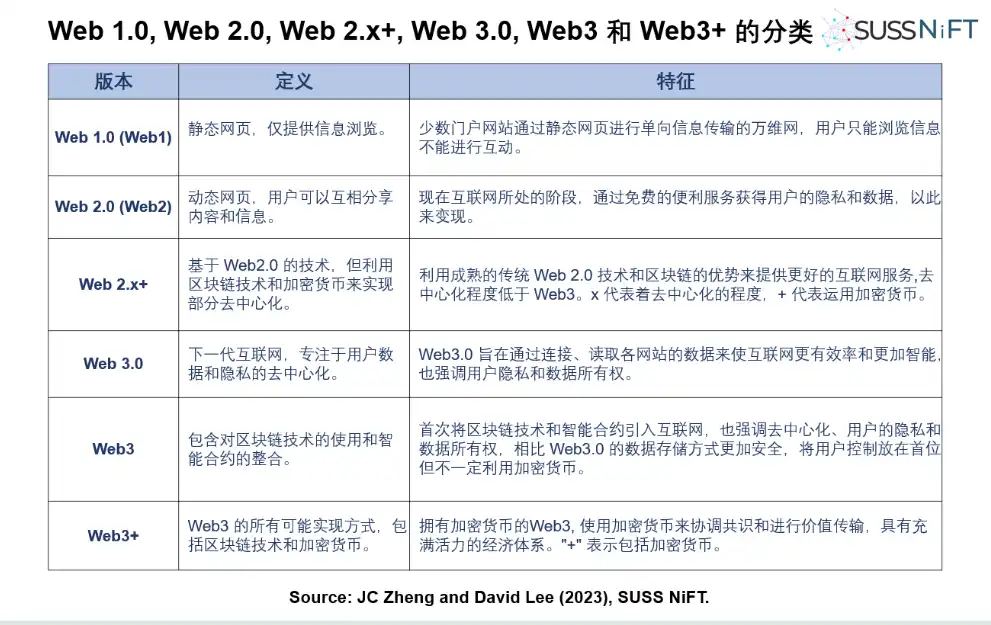
(Note: The above is the author's definition and understanding of the different stages of the Internet. If you have different views, please feel free to contact us. For the reader's understanding, Web3 discussed below uses the definition commonly used in the industry today, which includes the use of cryptocurrencies.)
So, what does the Web3 look like today in Singapore and Hong Kong?
Ethereum.org says in its Introduction to Web3 article that the core of Web3 is the use of blockchain, cryptocurrencies and NFT to allow users to regain ownership.
Packy McCormick of Not Boring Capital describes Web3 as a builder - and user-owned Internet, coordinated with tokens.
A policy brief published by the Bennett Institute for Public policy at the University of Cambridge defines Web3 as "the putative next generation of network technology, law and payment infrastructure, including blockchain, smart contracts and cryptocurrencies.
Yao Qian, Director of the Science and Technology Regulatory Bureau of China Securities Regulatory Commission, published Web3.0: As mentioned in the Coming New Generation of Internet, We3 is an Internet infrastructure owned and trusted by users and builders, a safe and reliable Internet of value, a new economic system co-built and shared by users and builders, and a three-dimensional intelligent holographic Internet.
So what is the core of Web3? The author thinks there are the following points.
Decentralization: Ownership is shared by builders and users, and data is stored decentrally
Privacy protection: Users have the right to privacy, access to user information needs to be authorized
No permission required: Everyone can participate equally in Web3 and is not excluded
No trust: Consensus mechanism based on blockchain, not trusted third party
Immutable: The data recorded on the blockchain cannot be modified and is trusted
Independent freedom: Each node can carry out activities independently and is not affected or controlled by a third party
Interoperability expansion: Different protocols and blockchains can be combined to stimulate innovation
Native tokens: Use native tokens for spending and incentives, rather than traditional currency and payment systems
Grayscale Research believes that Web 2 mobile Internet has changed how, where, when and why we use the Internet. This, in turn, has transformed our products, services and the companies we use, as well as our business models, culture and politics. This is also possible in the Web3-dimensional universe.
Why do we need Web3?
In order to obtain convenient services in the Web2 era, users have lost many rights. These companies make rich money by using algorithms to promote targeted ads and content based on user profiles. It may even spread purposeful fake news or seductive rhetoric. Users provide data, but not profits, and lose privacy. Content creators are in a weak position, and their creative achievements may be deleted or banned, which makes it difficult for them to gain profits through the creation sharing platform. The company uses centralized servers, which are easy to cause network breakdown and user data leakage or loss. Each platform is relatively isolated, and users need to create an identity on each platform in order to interact, and do not have ownership of that identity.
The growth of Web2 Internet technology companies is also detrimental to innovation. These giants will use traffic and resources to crush start-ups and change the way the market plays. Small businesses either choose to be acquired or struggle against the giants.
Chris Dixon, an investor in A16z, used the following chart to predict the irreconcilable conflict between the Web2 platform and its users and ecological participants during its life cycle.
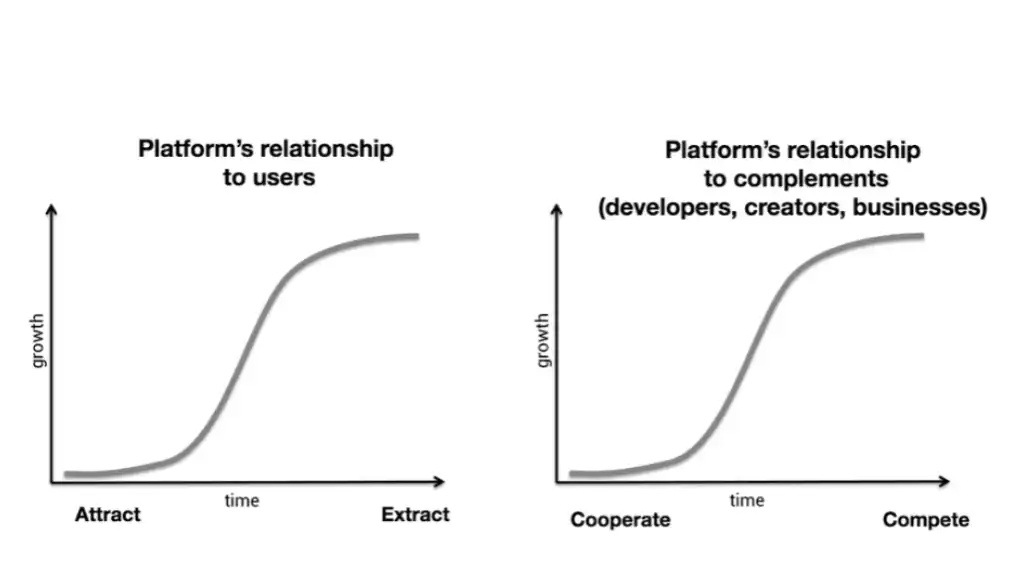
In the early stage of development, centralized platforms will recruit employees and partners to create good services and attract users with subsidies, so as to obtain various network effects. As market share grows, the power of centralized platforms exceeds that of users and ecological players. At the top of the S-curve, the relationship between the centralized platform and the ecological participant changes from a positive-sum state to a zero-sum state. The easiest way for them to grow is to monetize user data and compete with ecological players for profits. For ecological players, this shift from cooperation to competition acts as a decoy. Some entrepreneurs, developers, and investors are starting to think of better solutions.
So will Web3 based on blockchain technology be the right answer? Let's look at what changes Web3 can make.
ownership
NFT, or non-homogeneous tokens, are digital assets stored on the blockchain. Because of its non-homogeneous nature, it can be used as a digital certificate to confirm user ownership. NFT can tokenize art, music, movies, and even real world assets such as real estate, ensuring that ownership is open, verifiable, and immutable.
Take the use of NFT in gaming. Web2 game manufacturers have absolute control over the game and can modify the characters and prohibit player accounts. If the manufacturer goes out of business, the player's hard-honed characters and collected equipment will disappear with them. Player payment is not ownership of goods, but a form of lease. However, Web3 games, characters and equipment are controlled by players in the form of NFT, and game manufacturers have no right to modify and prohibit. If the game is poorly designed, or if the manufacturer decides to stop operations, players can transfer their characters and equipment to another game for greater autonomy. Users can even sell items to other players for economic value.
anti-censorship
Web2 company will require users to abide by the rules of the platform. Centralized social media such as Twitter, Facebook and Youtube will review the content posted, and can close an account at will. Users will lose contact with friends or fans, and the works published on the platform may disappear overnight. However, Web3's social platform allows users to decentralize their content in IPFS and Arweave in the form of NFT, without fear of being censored or deleted.
Decentralised domain services such as Ethereum Name Service (ENS) and Unstoppable Domains allow users to register untamperable domain names without permission.
Web3's underlying blockchain is validated by multiple decentralized nodes distributed around the world. Anyone who meets the conditions of pledge or mining can become a verification node of the blockchain without a license. As long as the underlying public chain runs smoothly and the smart contract is complete and cannot be modified, the Web3 application will continue to run and cannot be shut down.
Privacy protection
It's no secret that Web2 companies are accessing users' data for financial gain, and people are giving up their privacy for convenience services. Web3, on the other hand, is designed to protect users' privacy and requires applications to obtain authorization before accessing user data. Users can create anonymous addresses at will, making it difficult for third parties to know who is behind the address. In addition, Web3 protects users' property privacy. Users can use privacy coins such as Zcash to achieve private transfers, and third parties cannot know how much money users have transferred and to whom. Privacy public chains make it impossible for third parties to query assets owned by users. Zero-knowledge proof technology allows users to prove they are accredited investors without revealing their account balances. However, in traditional financial institutions, users have no property privacy in front of the account manager, which may lead to potential property and personal risks. Privacy is a prerequisite for freedom.
Decentralize identity
The types of ID cards vary in different regions, so it is difficult to verify the legitimacy of unconventional ID cards. Identity cards, if lost or stolen, can easily be used for illegal purposes. In addition, one billion people lack an official ID card, with one in two women in low-income countries lacking one, according to the World Bank.
Internet users create a new account every time they use a traditional app. An operation in one application cannot be automatically synchronized to another application. Some apps allow users to log in with a generic Account such as Google Account, but collect user data.
In open Web3, users can sign transactions with a private key in one, proving themselves to be the correct user in multiple protocols. Users can use a decentralized identity such as wallet address, ENS and other domain name services to log in to multiple protocols. This decentralized identity is anonymous, permissionless, and users can create multiple decentralized identities. A decentralized identity with an unmodifiable transaction history builds reputation, allowing users to participate in apps with access and even unexpected airdrops in the future.
Changes in the relations of production
A Decentralized Autonomous Organization (DAO) is a decentralized Internet community on a global scale, which is the organization form of Web3.
Each community member can use the token to vote and decide community affairs, preventing the abuse of power after centralization. DAO uses smart contracts to automatically execute voting results, ensuring fairness and transparency.
In DAOs, users and contributors are also investors and owners. The interests of all parties are highly aligned and there is no zero-sum game. The flat management of DAO organizations allows members to avoid wasting time on bureaucracy and makes it easier for talented people to stand out.
Scalability and composability lead to innovation
The scalability and composability of blockchain bring infinite possibilities for Web3 product innovation. Each of Web3's new open source products is Lego bricks that can be reused and reassembled.
Huddle01, for example, is a decentralized Zoom that plays over streaming protocol Liverpeer and stores videos in IPFS.
Klima DAO has brought DeFi to low-carbon, issuing green bonds to buy carbon credits and boost carbon prices as an incentive for companies to invest in more green projects. Mirror, a decentralized writing and funding platform, casts content into NFT, which is permanently stored in Arweave, a decentralized storage protocol, and makes money selling NFT.
The blockchain has no limit on working hours and can run all the time. Developers around the world can collaborate at any given moment to create more meaningful new products. Some products do not fully satisfy the user's needs at first, but lay the foundation for the next step forward. The flywheel of Web3 innovation is turning, bringing great changes in the future.
Encrypted tokens make Web3 a reality
There are still many people who don't have bank accounts. The traditional financial system can impose financial sanctions on certain countries or regions. The existence of cryptographic tokens makes it possible for money to circulate freely without reliance on a trusted third party. This is consistent with Web3's permissionless, independent kernel.
Seeing various drawbacks of Web2, Tim Berners-Lee launched the SOLID project in 2016, advocating that user data belong to users. Users carry their own data into applications, and the value of data belongs to users. In 2019, he launched "Contract for the Web," an attempt to address political manipulation, fake news, and privacy violations. Google,Microsoft and Facebook are all supporting the campaign. But despite its apparent support, Facebook appears to have ignored Berners-Lee's demands to Mark Zuckerberg, such as stopping targeted political advertising for the 2019 UK general election. So it's impossible for these Internet giants to revolutionize themselves, because they lack an incentive system. The creation of encryption tokens made Tim Berners-Lee's vision possible.
Encryption token is an essential link to coordinate the relationship between parties. A token represents each party's stake in an organization, and the more the organization grows, the greater the value of the token.
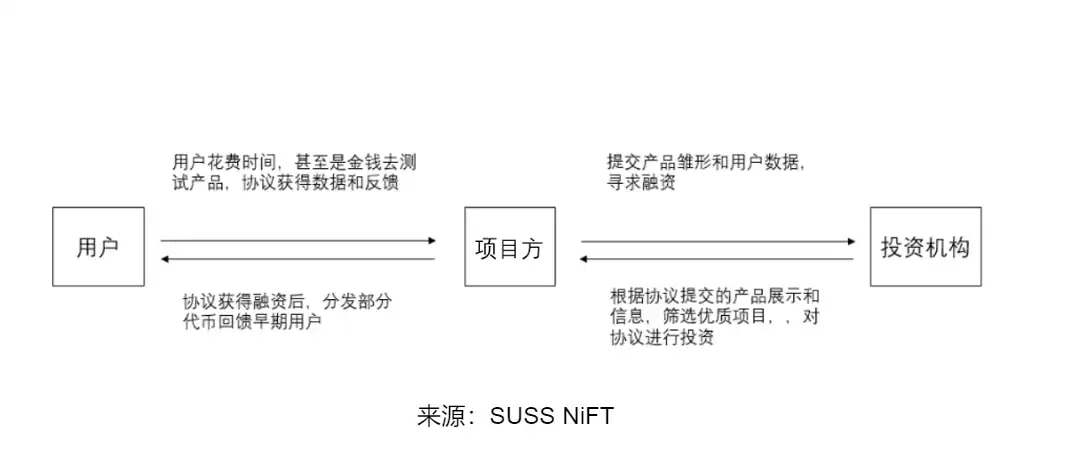
Cryptographic tokens also give rise to Web3's unique airdrop mechanism. When a Web3 project is launched, there is no money to subsidize users to use the product. Users spend their own time and money to experience the product. According to user experience feedback, the project will conduct stress test and product upgrade before financing. Investment institutions invest in excellent potential projects after understanding the fundamentals that have been tested in practice. Once the project is funded, tokens are issued to reward early adopters. Early users can participate in DAO governance with tokens. Entrepreneurs and investors with Web3 aspirations will support this crypto token-based solution, which is a low cost, coordinated start-up solution. The implementation of Web3 can no longer rely on the reform of Web2 giants, but can directly carry out the revolution.
The above benefits of Web3 are not separate, but often combined. Web3 can make our lives better. To make more money while having fun, and to have more fun while making money. Packy McCormick, investor at Not Boring Capital, sums up the benefits of Web3 by saying it extends the Pareto fun curve outward. Making at least one person's life better without making anyone worse off.
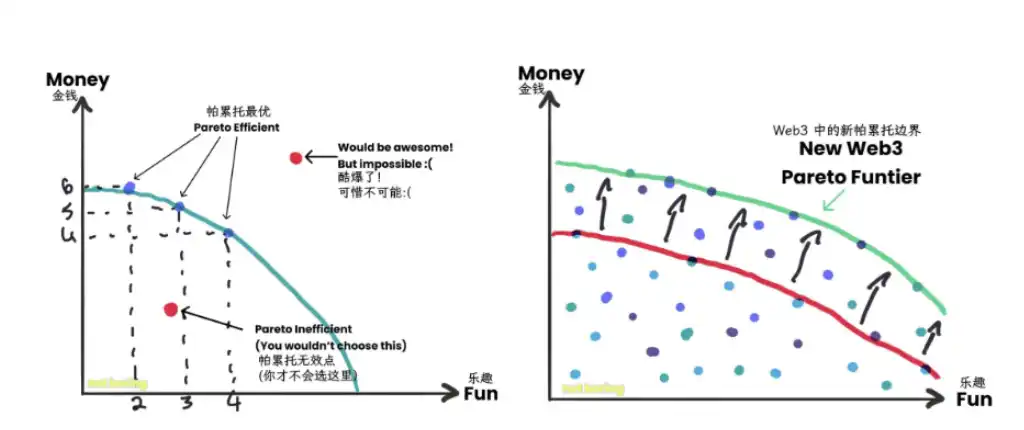
In the Web3 world, people have the opportunity to make a living through the skills they like and are good at, work with like-minded partners to create new products, and live a more fulfilling and meaningful life freely and equally. Let's take a look at some of the classic applications Web3 has brought us.
Web3 Classic application
Lens Protocol
Facebook, Twitter, Youtube and other Web2 social networks read data from a centralized database. Each of these platforms owns and controls the profile, network, and content of its users. As a result, each social platform competes with each other for users' attention, resulting in an intense zero-sum game.
Lens Protocol aims to address these issues with existing social media networks. As a Web3 social graph, Lens Protocol allows creators to connect with the community, creating a fully interoperable, user-owned social media network.
Lens Protocol gives users ownership through NFT. Only addresses in the white list can be cast profile NFT, effectively preventing fake accounts. Each single address can have one or more profile NFTS. NFT differs from other on-chain identities in that it can publish content. A user profile contains all the content they create, including posts, retweets, comments, and other forms of content. In addition, the introduction NFT has a focus module. Each concern NFT has a unique Token ID, incrementally increasing according to the order of their concern. Using Token ids, DAOs can easily screen out early supporters for additional benefits.
That's because you can use your data in any application built on the Lens Protocol. Content creators no longer have to worry about losing their work or fans, because they are the real owners of the content through NFT. In addition, Lens Protocol is modular and can add new features as needed. What's more, each app built on top of Lens Protocol will be able to collaborate and contribute to the entire ecosystem, not just a zero-sum game. As a result, developers can focus on designing meaningful social experiences, not just user growth.
There are already some Lens ecosystem applications that deserve attention. Lenster, a decentralized social media without permission, could be a competitor to Twitter in the future; Lenstube offers decentralized, open source video sharing capabilities; TeaParty is a social credit agreement that provides an innovative way to promote advertising. However, Lens Protocol is still in its early stages of development, and users aren't very active yet, with some apps offering similar features.
Safe
Traditional banks are not transparent enough, sometimes even freezing depositors' money. Although crypto wallets can be used to manage assets, the money in a wallet can be very dangerous if the mnemonics are not well preserved. It is also unsafe for a DAO organization or protocol to have its Treasury funds controlled by a single employee. Employees can run away with their money, or they can permanently lose money because they don't take care of their mnemonics.
Safe aims to address these pain points by offering a multi-sign-up solution. Safe is a smart contract wallet that operates on multiple blockchains and requires a certain number of signers to execute transactions. If a business has three partners, it is possible to set up a wallet that requires two or three people to sign the transaction. By means of multiple signatures, the funds can be protected from personal misappropriation.
Here's a table to compare Safe with other digital asset storage systems.
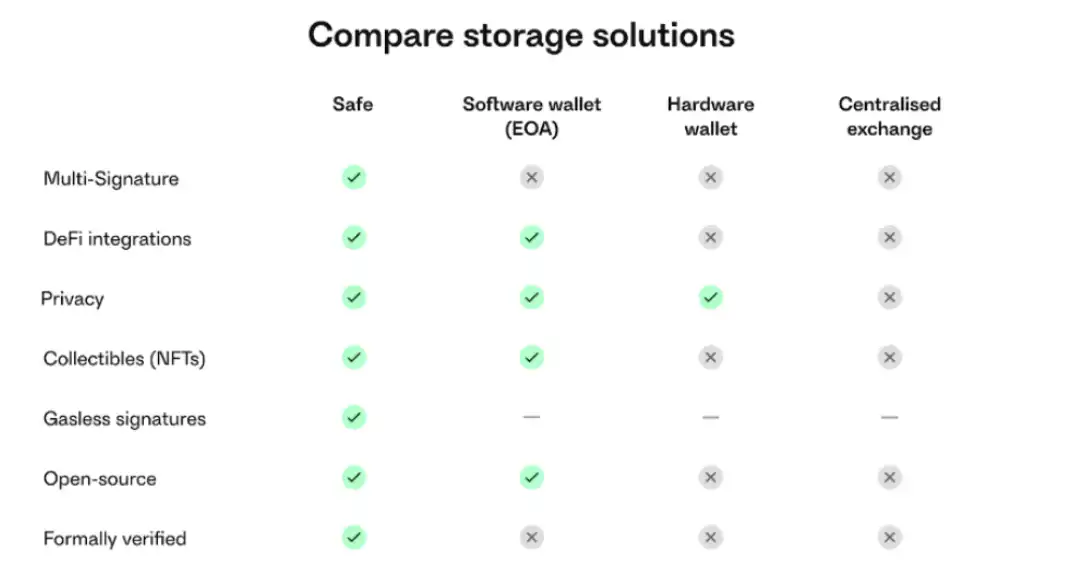
Safe, which began as an internal tool, has evolved into a programmable ownership platform to provide secure management of digital assets, data, and identities for DAOs, institutional investors, and retail investors.
In addition, several applications and tools are built on top of Safe. Conshift is an asset management protocol supported by Safe and Stream Payment Superfluid. Utopia is a DAO tool to streamline operations, payroll management, and consolidated financial reporting. The Linen Wallet is a self-hosting wallet that doesn't require users to use mnemonics. Safe is more than just a Web3 infrastructure; it also builds a financial management ecosystem.
Decentraland
When Roblox went public and Facebook changed its name to Meta, there was a flurry of metacomes. Improvements in infrastructure such as 5G, blockchain, VR, AR and XR have laid the foundation for the development of the metaverse. Since the start of the pandemic, people have been working from home and going out less, which has increased the need for new types of online social networking.
Decentraland is the leader of the decentraland metauniverse. Users can build, explore, and financially benefit from created content and applications on Decentraland. All virtual assets invented on Decentraland are community owned. Landowners can decide what is built on their land. The content created can be static landscapes, real estate, or dynamic interactive systems such as games, classes, concerts. Land is a non-homogenous, transferable, scarce digital asset that can be purchased through the digital currency MANA. MANA can also be used to purchase digital goods and services on Decentraland.
Decentraland is one of the earliest metacomes with a rich ecosystem that can be seen as a 3D version of Taobao, Douyin, Vanke, and more.
Based on Biteye's and Decentraland AMA, the following chart summarizes the use of Decentraland.
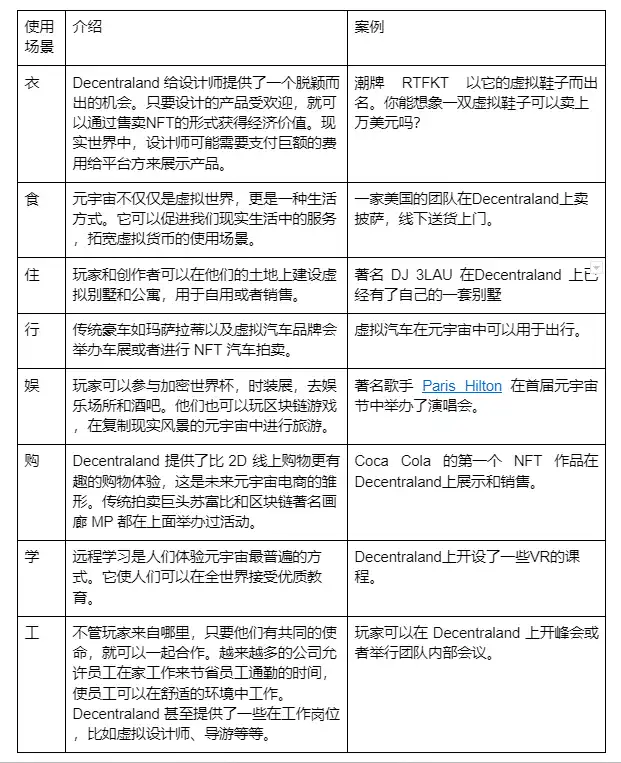
Decentraland's next move is to focus on growing its mobile audience, enhancing VR immersive experiences, reducing barriers to entry, and optimizing network performance. The global metaverse market size is expected to be $38.85 billion in 2021, with a projected compound annual growth rate of 39.4% from 2022 to 2030. Decentrland is a program to experience and participate in.
Axie Infinity
Gaming is an easy way to attract users from Web2 to Web3 because gamers are more receptive to new things and tired of the centralized control of traditional game vendors.
Axie Infinity is the most famous blockchain game, where players can adopt a pet Axie to fight for rewards and build a kingdom for their Axie. In this gaming ecosystem, virtual pets and land can be traded on Ethereum's side chain, Ronin. Players can choose to play against robots or other players. They can use the same account on different devices, such as Android and Apple.
Axie Infinity has two homogeneous tokens. Axie Infinity Shard (AXS) and Smooth Love Potion(SLP) can both be used to raise pet Axies, which are also governance tokens.
Axie Infinity popularized the "earn while you play" model, enabling players to own and trade items acquired in the game. Those who are skilled in the game can spend time and effort to earn real financial rewards. Compared to other jobs, the process of working as a game player is relatively easy and enjoyable. This "play and earn" model has provided an additional source of income for people in less developed countries and regions during the pandemic, and is particularly popular in the Philippines. It's an innovative way to match global resources and build social networks.
It's worth noting that while "earn while you play" is an effective way to attract new players, it's hard to sustain this subsidy model. The next boom in blockchain gaming should be about providing a better gaming experience. It is also possible to spend money on advertising to motivate players in the early stages of development. After improving user experience, blockchain games may fundamentally change the game industry in the future, making blockchain games more than just financial games.
Arpeggi
Wilton Gorske (2022) concludes that artists seeking collaboration in the traditional music industry must:
- Share unreleased works only after establishing a high level of trust
- There is a fee for selecting, synthesizing and referencing other people's song clips
- Look for opaque permission registries to contact multiple permission holders to request permission
- Obtain legal permission to use another artist's work
Arpeggi is a transparent open source collaborative Web3 music creation platform that aims to solve these problems. With Arpeggi's help, artists' contributions are recorded when the music they share is used again.
How did Arpeggi do it?
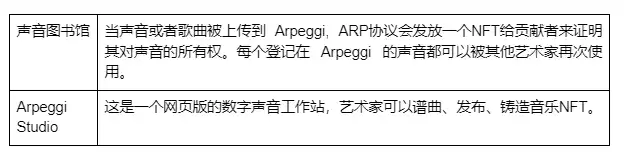
Arpeggi revolutionizes the music platform of Web2 by combining creation and consumption in a collaborative manner. Listeners can remix their favorite songs and share works that can be used again. Most Web3 projects currently focus on musicians achieving the creator economy. Arpeggi focuses on changing the way music is made. Relationships between musicians start by making music, not by building relationships and then making music. It's time to open up the process of making music again.
Web3 policies in Singapore and Hong Kong
As an open economy, Singapore has always been friendly towards Web3, and its policies are relatively stable and sustainable. Vice Premier Wang Ruijie, for example, said that we should keep an open mind towards Web3, understand the fundamental technologies that are potentially transformative, and not throw the whole ship overboard with a single stick. He advocated cooperation with companies with strong risk management capabilities, responsibility and innovation, and jointly build a digital asset ecosystem. Of course, he also stressed that retail investors should avoid investing in secret currencies whenever possible. In contrast to Hong Kong, which wants to develop individual investors, Singapore prefers institutional business activities.
The MAS welcomes the industry's Responsible digital asset innovation Initiative and encourages interested parties to submit proposals to the fintech regulatory sandbox for practical testing. The HKMA is not only responsible for regulation, but also for development. By adopting appropriate supervision for different development cycles of products, we have achieved a good balance between supervision and development.
Back in 2019, Singapore determined that cryptocurrencies have "essential characteristics of intangible assets," clarifying the legality of holding cryptoassets. The HKMA is also working with the industry to promote crypto-asset-based applications. Such as the launch of Project Guardian, led by DBS, jpmorgan and Marketnode, to create a pool of licensed liquidity made up of tokenised bonds and deposits to experiment with defi-backed lending.
Singapore's crypto-asset-friendly policy does not mean it is lax. Encryption service providers in Singapore can only market campaigns on their own social media accounts and cannot promote their services to the public in public. It can be seen that Singapore is relatively restrained in fighting for the market.
In September 2022, the Global Financial Centers Index, jointly released by the British think tank Z/Yen and the China (Shenzhen) Comprehensive Development Institute, ranked Singapore as the third financial center in Asia. Web3's contribution to Singapore's economy is well recognized. Rents of private apartments and HDB flats in Singapore have increased for 21 and 27 months in a row respectively, making them the most expensive in Asia. The Singapore dollar has also remained strong on the back of economic fundamentals.
Hong Kong was once home to a number of important Web3 organisations, but there was a back-and-forth in policy. In the Hong Kong Fintech Week in November 2022, the Hong Kong government issued the Policy Declaration on the Development of virtual Assets, stating that it is open and inclusive towards virtual asset practitioners and recognizes that Web3 and distributed technologies have the potential to become the future development trend of finance and commerce. This has been interpreted by the industry as the beginning of the Hong Kong government's re-embrace of Web3.
In Hong Kong, the regulatory principle of "same business, same risk, same rules" for virtual assets is adopted to license virtual asset exchanges on the basis of "opt-in". Hashkey and Huobi Technology have already received exchange licenses. According to the government's plan, a virtual asset trading framework will be launched from June 1 this year, allowing licensed cryptocurrency exchanges to open to retail investors. Financial intermediaries and banks can partner with their licensed counterparts from the virtual asset community to provide virtual asset trading services to their clients. At the Web3 Carnival in Hong Kong, Zhongan Bank, the first virtual bank license obtained by the Hong Kong Monetary Authority, announced that it will provide cryptocurrency and fiat currency exchange services to licensed cryptocurrencies exchange, and may become the first crypto-friendly bank in Asia to provide related services.
Treasury Secretary Joseph Chan Ho-lim said at the carnival that Hong Kong had issued a tokenized government green bond in February. Hong Kong's budget announced an allocation of $50 million to boost the industry and will launch a Fintech internship program for brokerage students to encourage more talented people to join the fintech industry in the future.
Mr Yau Dagen, member of the Legislative Assembly of the Hong Kong Special Administrative Region, said in his keynote speech that Hong Kong would coordinate its national development strategy from three directions: "Connecting the digital Renminbi, developing the Cyberport Yuan and virtual asset services", "developing innovative applications of distributed ledger technology", and "appropriate Web3 development strategy and regulatory framework to gather global talents". Build an international Web3 hub.
It can be seen that the Hong Kong government's positive affirmation and strong support for Web3. Hong Kong and mainland China have different positions of division of labor, leading to different development directions. The Chinese mainland is rich in technical talents and artists who can provide cultural IP and technical support to Hong Kong. At the carnival, Kong Dejun, Deputy District Governor of Shangcheng District People's Government of Hangzhou, and Li Dafeng, representative of Hong Kong Trade Development Council, signed the "Hangzhou-Hong Kong Web3 Industry Linkage Memorandum" to promote the deep integration of Web3 industry between Hangzhou and Hong Kong. As a pilot demonstration site in China, Hong Kong can become a bridgehead for the development of China's virtual economy.
The risks and limitations of Web3 are of concern
Web3, for all the benefits it can offer, is still in the early stages of development and has some room for improvement.
Regulatory uncertainty
Only El Salvador and the Central African Republic have recognized bitcoin as legal tender. Policies on Web3 vary from country to country and from regulator to regulator within countries, and change frequently. The economic model for crypto tokens is also limited in design due to the fear of being classified as securities, with many tokens having only governance functions and not enjoying dividends. Regulatory uncertainty makes investment institutions and talent hesitant to commit to Web3 at this stage.
Built on a centralized infrastructure
Web3 messaging is currently channeled through Twitter, community building is taking place in Discord, development is taking place on GitHub, API services are taking place in Infura, and use of AWS cloud services are all centralized infrastructures that greatly reduce censorship resistance and system resilience. There are some Web3 projects working on decentralized versions of these infrastructures, but they are not yet widely used.
High use cost
Ethereum, the most ecologically sound public chain, is very expensive to interact with, with users paying close to $100-200 per operation at peak times. As a layer 2 expansion solution for Ethereum, Arbitrum once had higher Gas cost than Ethereum on the main network due to load during Odyssey. High usage costs have hindered the development of Web3 in the developing world.
Performance to be improved
Existing blockchains don't have the capability to handle large-scale applications. Ethereum only trades around 12-15 times per second and is often congested. The high performance Solana public chain, which is running at around 3,000 transactions per second, is experiencing downtime. In contrast, Visa in the traditional financial sector has 1,500 to 2,000 transactions per second and has been running smoothly for a long time. It can be seen that the large-scale adoption of Web3 in the future is very dependent on the improvement of the first-layer and second-layer performance of blockchain.
High service threshold
The threshold for users to use Web3 products is high. First of all, the money stumped a number of users. Then, the correct use of on-chain wallets is a big challenge. Even for older Web3 users, private key loss events can occur. In the Web3 world, whoever has the private key owns the account, and there is no customer service to solve this problem. However, we are also seeing some wallets address this pain point with features such as social recovery. In addition, Web3 projects are numerous, good and bad, so security incidents happen from time to time. How to make Web3 products easier to use is the next step. A Web3 product will only be successful if it allows users to enjoy the same quality of service as Web2 without knowing about Web3.
Lack of proper Web3 education
For one thing, public-facing media outlets are less focused on product development and tend to cover eye-catching news such as the rise and fall of cryptocurrencies. Crypto outsiders thought it was just a playground for speculation, unaware of the changes that Web3 could bring. Secondly, crypto assets are high-risk products, so it is necessary to popularize risk education, so that the public can participate in the use of products with the right mentality, and make rational investment with funds suitable for their own financial situation. Web3 May not be right for everyone immediately. It's a gradual process.
Governance needs to be improved
Although the DAO is governed in a way that allows the public to participate in decision-making, the large number of token-wielding whales have too much say in the governance process, sometimes directly determining the outcome of the vote. However, some tokens only have governance functions, which makes the role of tokens meaningless.
Be used by illegal and criminal activities
While Web3 gives people more freedom, it is also used by other criminals. Some post anti-social comments on decentralized distribution platforms, launder money through private coin mixers, create NFT and sell pornography, and so on. Although technology is said to be neutral, the industry should think about how to reduce the negative impact of technology on society.
The future of Web3
Although Web3 is growing very fast, it is still early days. a16z, in a May 2022 report, predicted that Ethereum has between 7 million and 50 million active users, likening Web3's current state to the commercial Internet in 1995, the early days of current giants Facebook and YouTube.

So, what does the future of Web3 look like? Let's look ahead.
Metauniverse -- twin economy
Web3 is an emerging technology that redefines the way of life, and the meta-universe is the way of life brought by Web3 technology. People can choose to switch between the virtual world or the real world. The ideal Web3 universe is a shared digital space that is not controlled by any organization or individual, where everyone has their own digital assets that can be freely exchanged in social or business activities. Physical worlds can be replicated in metacomes, giving users a sense of real immersion to the point where they can't tell the difference between virtual and real. Instead, brands, activities, and characters that don't exist in reality can be created in the metaverse. The metaverse is actually a twin economy, with the virtual world as much a layer of the new economy as the physical world as we know it today.
The improvement of infrastructure DID makes the metaverse more orderly
Vitalik Buterin, Glen Weyl, and Puja Ohlhaver published The Decentralized Society: In Search of the Soul of Web3, which proposes non-transferable soul-bound tokens (SBT) held by instant accounts to better code social networks in Web3. This is a solution to decentralize identity DID. DID is another identity of people in the meta-universe, which has nothing to do with identity characteristics such as gender, age and appearance in the real world. DID is one of the Web3 infrastructures to be constructed in the next step, and it is an important part of the life of the metauniverse. Each person can have more than one DID, and each DID does not necessarily correspond to a single individual. The perfection of DID is conducive to shaping non-transferable social relations and establishing personal brands. DID also provides new solutions for property rights and governance, prevents witch attacks by airdrop hunters, encourages authentic participation, and builds more vibrant and authentic cloud universe communities from the bottom up.
DAO keeps Web3 alive
How does Web3 function if the entity is not directed? Elinor Ostrom won the Nobel Prize in Economics for her work on the common problem of tragedy. But she didn't have the help of technology to implement her plan. But with the help of tokens backed by smart contracts on Web3 and blockchain, everyone is incentivised to enhance network value, rather than destroy shared space. In the absence of centralization or effective control, computer code can help manage shared Spaces. DAO leverages the token economy to bring together a group of community members who share a common interest and innovate from the bottom up for the same mission. But they are not restricted from self-innovation. There is no top-down control other than code, and each member contributes spontaneously, adding value to the shared space or organization.
Bored Ape Yacht Club (BAYC), currently the most influential and expensive NFT project in the world, allows fans to create based on their NFT holdings, blurring the lines between fans and creators, generating new brands and increasing BAYC's brand exposure;
The decentralized crowdfunding bid PartyDAO originated as a Twitter brainstorm over the weekend; MoonDAO tries to send people into space; Tokenized carbon offsets, Toucan is committed to harnessing the power of DeFi to lower the world's carbon footprint. With its global talent pool, 24/7 work collaboration and flat management structure, DAO inspires enthusiasm for innovation among Web3 members and keeps the Web3 community interesting and vibrant.
Web2 and Web3 merge for better development
Facebook changed its name to Meta, a sign of its determination to develop a meta-universe; Instagram is rolling out its NFT display feature to more than 100 countries; Luxury brands Prada and Tiffany announced. Twitter pushed Bluesky to decentralize social. We are seeing more and more Web2 companies developing Web3 businesses or participating in Web3 themed events. On the one hand, it is to build brand image and expand target customers. On the other hand, it is believed that the metacom promoted by Web3 technology is the potential growth point in the future, and there will be more businesses in the metacom that are not in the real world. The Web2 brand will drive the adoption of Web3 technologies and products in a wider market. According to Precedence Research, the global metaverse market size is expected to reach approximately $167.12 billion by 2030 and grow at a compound annual growth rate (CAGR) of 50.74% between 2022 and 2030. In particular, the virtual economy in the twin economy will create new jobs in manufacturing, tourism, health care, transportation and finance. South Korea, Japan, Singapore and China are using the Web2 and Web3 meta universes to grow their economies.
More interesting Web3 applications impact real life
With the improvement of blockchain performance and the improvement of cross-chain message protocols, different blockchains have changed from closed to open, and the protocols are combined with each other, bringing new applications. After Centrifuge and MakerDAO integrate real world assets into Web3 financial system DeFi to provide loans for the real world. Singapore's DBS Bank and The Sandbox have formed a partnership to build new services and develop DBS BetterWorld for clients in the Metacomes to explore business opportunities in the metacomes; PlatON makes data available but invisible through cryptographic-based privacy computing technology. Platon helps artificial intelligence model establish a compliance data acquisition channel through the data trading market constructed by blockchain technology on the premise of not infringing data privacy, realize the compliance circulation of data assets, and release the potential of data. Due to the open source, interoperable, and combinable nature of Web3 applications, we will see more developers build products that address existing pain points based on proven, established applications.
And decentralized Internet complement each other, make the Internet better
At present, there are two ways to operate decentralized Internet. One is to rely on community donations. For example, Web3's decentralized voting protocol Snapshot has not launched a token for commercialization, and the operating expenses come from community donations. The other is to combine with blockchain protocols to add incentive layers. For example, IPFS, a point-to-point distributed file system, is not a blockchain-based project, but incorporates an incentive layer. Filecoin to reduce data storage and usage costs. BlueSky CEO Jay Graber believes that Dweb and Web3 are so closely related that they don't need to be separated. We've also seen the launch of Gitcoin, a Web3 donation protocol that calls on the Web3 community to support non-coin public goods by holding donation events. And these public goods also provide better service for Web3. In the future, community donations and token incentives will exist together, and Web3 and Dweb will complement each other to create a better Internet. But there is no doubt that there will be more and more Web3 development paths that use tokens as incentive layers to build decentralized products and make the business model sustainable.
summarize
Web3 is not an end, but a means to a better Internet. Based on the concept of decentralized network and blockchain technology, Web3 aims to solve the pain points of Web2, let users regain privacy and ownership, and build a reliable value Internet at the lowest cost. Although limited by the performance of blockchain and the high threshold of use, it is still used in a small range, but its potential for development has been discovered by smart pioneers, scrambling to participate in this is still in the early stage of development of the sunrise industry. Countries with more active economies, such as the United States, the United Kingdom, Japan, Singapore and Hong Kong, are striving to become important nodes of Web3. Web3 technology and application is an important part of the decentralized metauniverse, a breakthrough that cannot be ignored in the uncertain economic prospects, and an engine for the development of the new economy. If you ignore Web3, you're missing out on a fast train that's about to start, and you're not going to be able to make up for it later. There is a bubble in finance, not in technology. Every active participant in Web3 pushes Web3 forward on its development path. Web3 has incomparable development conditions due to its open source and composable features. The open, transparent, equal and free organizational form stimulates participants' enthusiasm for innovation. Web3 will bring people unexpected new products faster than most people expect, giving people the first real sense of "assets and data ownership" after the Internet era, so that our life will be better!
This article is from a submission and does not represent the views of BlockBeats
Welcome to join the official BlockBeats community:
Telegram Subscription Group: https://t.me/theblockbeats
Telegram Discussion Group: https://t.me/BlockBeats_App
Official Twitter Account: https://twitter.com/BlockBeatsAsia

 Related Articles