Thousand-character long article: Analyzing the underlying logic of Web3 from the perspective of institutional economics
Original title: "The underlying logic of Web3: the perspective of institutional economics"
Original author: Kokii
TL; DR
h3>
Web3 is a new economic infrastructure for coordination and exchange. It starts with a fundamental system of property rights and shifts trust in complex systems from individual organizations to decentralized nodes and verifiable code. It has unique economic characteristics that make it possible to complement, and in some cases directly compete with, existing mechanisms.
Institutional economics is a subset of economics. It uses economic methods to study the role of institutions in the context of social economy. The basic theoretical tools are transaction cost theory and property rights theory.
Token is a property rights management tool that can represent any existing digital or physical asset, or access to other people's assets. The Token on the chain can realize cryptography property right protection, competitive property right innovation and efficient property right circulation.
A smart contract is a contract that uses code to ensure automatic execution. With the subdivision and improvement of the property rights system, many components of economic activities, including repetitive mechanical parts, computational rules and orders in production and transactions, may be replaced by machines and smart contracts.
Why should we think about the underlying logic of Web3
Now Web3/Crypto is full of various Fresh terms make this already obscure new industry even more puzzling. From consensus algorithm, Rollup, zero-knowledge proof, DeFi, NFT, GameFi, DAO, cross-chain bridge, oracle, DID, SBT in technology/application, to cypherpunk, sovereign individual, decentralization, anti-censorship in concept , Unlicensed, Composable, Creator Economy, Distributed Governance, Internet of Value, Permanent Storage, Code is Law, X to Earn, all of which are confusing, plus there are various regulatory bans, Ideology, deception, Ponzi, inefficient and counter-intuitive application scenarios make people really confused.

People who love it say it is the future, no less than A basic technological change of the Internet; those who hate it say that it is a pile of concepts, a capital bubble created by venture capital institutions, and the self-entertainment of laissez-faire.
Focusing on details prevents one from seeing the big picture. When the Internet was first adopted by a small number of geeks, it was very illusory. No one could predict the future development. It was full of innovations, protocols and products. Ten years later, there would be no one in a hundred. Technologies such as crawler algorithms of search engines, applications such as news portals are newspapers wrapped in browser shells, and concepts such as how network effects affect social media may be important, but they are not the core logic of the Internet. But as long as you grasp the underlying logic of the Internet "Unprecedentedly reduces the cost of information circulation", you can realize how it will drastically change the society, and it will be used in search engines, social media, online shopping/payment, When smartphones, online car-hailing, local services, and algorithm recommendations appear, it can identify the trend of the wind.
Technological progress is more often stacked than jumping, so it is extremely difficult to predict the future, especially when policies and technologies are very early present. Today's Web3 is still very early, and most of the products and services, business models, and token models we are arguing about will die in the bubble burst. Therefore, this article does not talk about the circuit design of ZK-Rollup, is GameFi a Tokenomics shell game, how composability affects DeFi, etc., but only discusses the core issue: What is the innovation of Web3? where? How will it change the world?
What is Web3
Web3 is related to blockchain or digital assets The Web system established by technology. The definition is used to understand the structure and mechanism. This definition is good enough, but it is also confusing. The most recognized statement of Web3 at present is: "Web1 is read-only for most users, Web2 allows users to read and write, and Web 3 gives users the power to read-write-possess through the blockchain."

But readable and writable is the interactive relationship between people and content, and the The essence is a social contract relationship. The former is information, while the latter is assets. The dimensions of the two are different. Therefore, it is a misplacement of perspective to regard Web3 simply as a continuation of Web2. Why do people not use the cheap and fast Web2, but use the energy-consuming, expensive, slow and complicated Web3?
An innovation is adopted for only one reason, to satisfy a new human need, or to better satisfy an old need. Enduring complicated mnemonic words, expensive handling fees, public chains that go down from time to time, protocols that are used as cash machines by hackers, and the risk of being stolen from your wallet by a phishing website is not for the sake of letting go of things that can be done on mobile phones. Go to the blockchain and do it all over again, at least not now, otherwise it is difficult to explain why someone would spend millions to buy a picture that everyone can right-click to save, and it is ridiculously ugly.
Let's go back to square one, starting with the title of the white paper: Bitcoin, a peer-to-peer electronic cash system; Ethereum, the next generation of smart contracts and go Centralized application platform. This article will explain that the core innovation of Web3 lies in the title of the white paper: "Token" and "Smart Contract". And try to explain it from the perspective of institutional economics. Rather than saying that Web3 is a technological innovation similar to a "steam engine", it is more similar to a "capitalist" institutional innovation.
Institutions and Institutional Economics
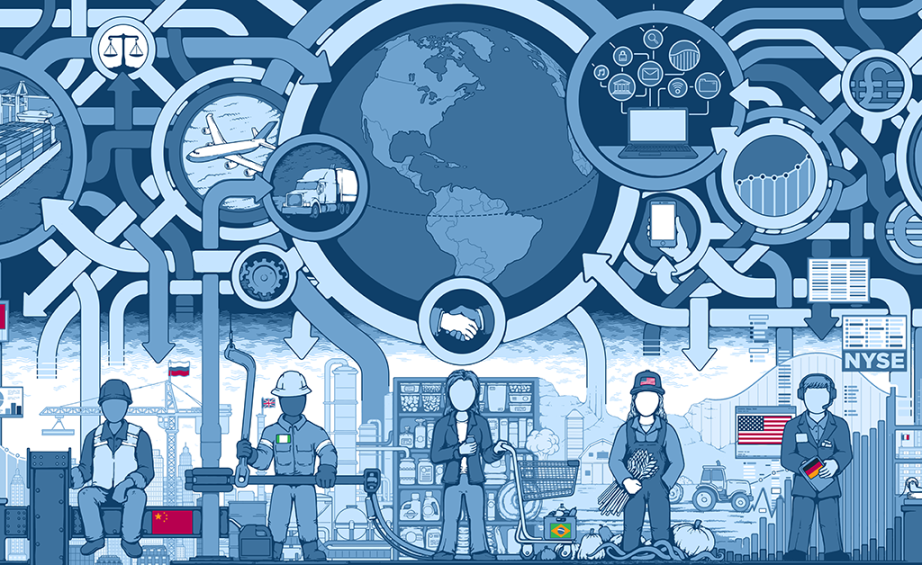
Institutional economics is a subset of economics that intersects with political science, sociology or history and uses economic methods to study the role of institutions in a socio-economic context . The ability of a single person to fulfill his own desires is limited, and no one on earth has ever produced a pencil alone. It relies on the cooperation and contribution of graphite workers in Chile, loggers in Canada, glue manufacturers in Taiwan, assembly line manufacturers in Germany, businessmen in China, and millions of unknown people.
In a modern society with sophisticated and complex specialized division of labor, people need to trade and cooperate with countless strangers and organizations. Human interaction, especially economic interaction, depends on trust. Trust is based on order, and maintaining that order relies on rules that prohibit unforeseen and opportunistic behavior, which we call "institutions."
Why do human societies need institutions? The main reasons can be attributed to the following aspects: human limited rationality (scarce subjective intellectual resources), uncertainty of the objective environment, and human opportunistic tendencies. The system makes people's behavior predictable, and reduces the cost of coordinating activities in large-scale human collaboration in order to effectively use resources. The reason why we can trust the money we earn through hard work to a bank teller who forgets his appearance in the next second, and our body to a doctor we have never met is that they are all subject to the system. Looking back, too many things that are taken for granted in human society actually hang on the web of trust compiled by the system.
Institutions are evolved, not the same thing as policies. When people find that there is a better and more efficient system to replace the existing one, There is a possibility of institutional change. The system regulates the relationship between people, and the relationship between people is a game between social relations. Inconsistent interests appear in almost all human activities. The overall purpose is to achieve a favorable ending for one's own side through one's own choice.
Economists treat the economic process as a game process, not only regard the system as the rules of the game, but also as the result of the game (equilibrium) . As long as people repeatedly engage in transactions or other economic relationships, rules arise through gradual evolution or human conscious design. When we look at it over a longer period of time, the most important essence of all the content in history called revolution, reform, restoration, advancement, and retrogression is institutional evolution.
Compared with law, politics, ethics, culture, sociology and even anthropology, institutional economics pays different attention to the system and perspective . North defines the system as the rules of the game in a society. The system is a variety of economic, social, political and other organizations or systems formed by people. It determines the framework of all social and economic activities and various economic relations. Therefore, all social disciplines are inherently related to institutions, and are a common category of social sciences.
The systems in human society are all-encompassing, from the constitution to social etiquette to the coordination of traffic lights, the importance and influence of different systems vary greatly. Institutional economics is concerned with the creation and evolution of institutions that have the most profound impact on the human economy. Rational human choices will create and change institutions such as property rights structures, laws, contracts, forms of government, and regulations that will provide incentives or establish costs and benefits, and ultimately these incentives or cost-benefit relationships will change over a period of time. govern economic activity and economic growth.
Transaction is the basic unit of human economic activities and the basic analysis unit of institutional economics. The basic theoretical tools of institutional economics are transaction cost theory and property rights theory.
・The transaction cost paradigm constitutes the theoretical framework of institutional economics. If there is no transaction cost, no matter how production and exchange are arranged, resources are used the same. Transaction costs fundamentally affect what is produced in the market and what kind of exchange occurs, what kind of organization survives and what kind of game rules can be sustained;
・The premise of the transaction is the property right, without the property right transaction is out of the question. Trading is different from exchange. It is not the buying and selling of commodities but the buying and selling of rights. The property rights system is the fundamental basis of economic operation, what kind of property rights system will have the kind of organization, technology and efficiency;
property rights method and transaction cost method The difference is that the former requires an analysis of individual incentives, while the latter places the individual within a wider institutional framework, allowing for example the analysis of the corporation as an organized entity.
a. Property rights
Property rights are short for property ownership or property rights, The emphasis is on the ultimate control that the owner of the property has over the property. The laws used in business in all countries in the world today are derived from Roman law, and the core of the concept of property rights in Roman law is control. For the simplest commodities such as pencils, the rights are inseparable from the commodities themselves, but for complex commodities such as land, forests, enterprises, knowledge, ideas, and financial products, the right to control and enjoy them becomes something that cannot be handled by simple commodity sales. The transaction of any commodity or resource can go smoothly only when property rights are clearly defined, the market price mechanism can play a role, and resources can be effectively allocated.
Private property rights, common property rights and state-owned property rights basically cover the scope of property rights. Different types of resources should have different forms of property rights to match them. Property rights are both an interest relationship and a responsibility relationship, corresponding to incentives and constraints. Well-defined property rights restrict how people can use assets and incentivize people to maximize their value.
Property rights as control rights derive many other rights, called rights bundles. Including the right of possession, right of use, right of income, and right of disposal; the right of disposal is further divided into right of transaction, right of inheritance, right of gift, etc. The divisibility of property rights can increase the usefulness of assets, enabling people with different needs and knowledge to put a unique asset into the most valuable use they can find.
For example, people with entrepreneurial talents but no assets can more easily acquire the assets of others to maximize the total output of both parties; major projects and infrastructure The huge capital required can be pooled through shareholding and so on. From the perspective of development trend, as the degree of socialization of production increases, the transformation of property rights from unity to disintegration is a concrete manifestation of the development of social division of labor in terms of the ability to exercise property rights.
On the basis of the property rights system, other systems have emerged, such as enterprise system, market system, financial system, legal system, political system, etc. Innovation in the property rights system is the basis for innovations in the intricate corporate structure and financial markets of modern society. Property rights are important variables in institutional change and institutional innovation. China, which has undergone market economic reforms, should have a deep understanding of this point.
b. Transaction costs
Transaction costs are the operating costs of the economic system, In a broad sense, it includes system formulation costs, implementation costs, maintenance costs, and change costs. In reality, there are various systems or transaction rules, and each system has transaction costs. For example, the cost of the property rights system is the cost of measuring, defining, maintaining and exchanging property rights.
Transaction costs are the core of institutional economics, and transaction cost theory can be used to study various institutional arrangements in human history and reality. In the perfectly competitive market of neoclassical economics, transaction costs are zero, private property rights are sound, and Adam Smith's "invisible hand" can make resource allocation reach Pareto optimality. Property rights, laws, regulations, etc. are optional. In real economic life with frictions, many institutions are created either to reduce costs or to make possible things that were previously impeded by high transaction costs.
The measurement of transaction costs is the key and difficult point of the theory, including two parts: the cost that can be measured through the market, according to some estimates, the transaction costs in modern market economy Accounting for 50%-60% of net GNP, this figure does not include the initial costs of establishing new institutions and organizations; losses resulting from implementation.
Specifically, transactions in real life are done through contracts. A contract is a right transfer relationship established by the parties (more than two people) in the transaction process to improve their own economic conditions (at least rational expectations). Any transaction is always carried out in a certain contractual relationship either explicitly or implicitly. Modern economics regards all market transactions, whether long-term or short-term, explicit or invisible, as a contractual relationship. When a consumer buys a train ticket, there is an implicit contract between the consumer and the railway company: the consumer pays the fee, and the railway company will safely send the consumer to the destination within the specified time.
The basic function of the contract is to maintain the cooperation between the contracting parties and encourage the contracting parties to seek new and more far-reaching interests on the premise of abiding by their commitments and assuming responsibilities . It is precisely this nature of the contract system that thousands of different and subtle ownerships are combined into a huge ownership; the same ownership can be reasonably separated, and the division of labor and cooperation constitutes an owner-operator-user chain. different links. In the long process of economic development, the transaction behavior between people has continued to expand and evolve, and the contracts have become more and more complex.
From the perspective of the contract, the transaction costs of specific transactions should include: the cost of preparing the contract (collection of information), the cost of reaching the contract (negotiation , signing), monitoring and enforcing the contract.

From property rights to Token
An efficient property rights system can transfer property rights from inefficient people to efficient people. Applying the transaction cost theory mentioned above, in order to achieve a more efficient property rights system, it is necessary to reduce the cost of measuring, defining, maintaining and exchanging property rights:
1. Property rights The attributes of property rights are complete, and the more complete the attributes of property rights, the more efficient the property rights system
2. The definition of property rights is clear, which is the prerequisite for the effective functioning of the market mechanism
2. p>
3. Effective protection of property rights, the better the protection of property rights, the better the function of property rights
Every progress in the property rights system is inseparable from the above innovation . The definition of intangible assets such as patents and copyright ownership enables knowledge owners to obtain material benefits from sharing knowledge with others; the separation of ownership and management rights leads to the emergence of modern joint-stock companies; the higher the degree of rule of law and marketization in a country , the market is more efficient. In contrast, the ownership of air is difficult to define, and there is a market failure in pollution problems.
Token is the atomic unit of Web3 and is jointly managed by distributed ledgers. Token originated from Bitcoin, the first time humans tried to replace the currency system with technology, but it has obviously failed, and now Bitcoin has become a kind of digital gold. Its failure was predictable, because the monetary system is the most complex and fundamental system in human economic activities. But Bitcoin has opened a door to a new world for us: Token.
On public infrastructure such as Ethereum, anyone can deploy Token at a very low cost. As of writing time (August 2022), there are over 9,000 publicly traded tokens listed on CoinMarketCap, and that's just the number of Fungible Tokens. These FTs can be subdivided into many categories, from securities to utility to value storage to governance, and different rights correspond to various existing property rights in real life.
Token's multiple roles are intricate, it seems like it could be any form of economic value or access (on-chain version): stock, bond, currency, gift Cards, points, club memberships, ID cards, diplomas, air tickets, etc. While a lack of clarity is common in emerging fields, this doesn’t mean that tokens’ multiple roles are a mistake, but rather their ability to represent value in the most abstract sense.
Tokens can be used by anyone to issue any type of asset and access rights, including entirely new asset classes. In connection with the concept of property rights in the previous article, Token is a property rights management tool that can represent any existing digital or physical assets, or access rights to other people's assets. If you agree with the previous statement about the importance of property rights, it should not be difficult to understand how far-reaching this matter will be.
But why must property rights management be Token? Why must it be put on the blockchain? The number in Alipay is also a proof of property rights, and it is more efficient. It is not enough to just invent a concept, the implementation of the concept requires the supporting application. Compared with off-chain property rights, Token's core advantages lie in: property right protection in cryptography, property right innovation in competition, and efficient property right circulation. At the same time, the underlying property rights innovation is the cornerstone of complex economic activities, such as contract innovation (smart contract) and organizational innovation (DAO).
a. Property rights protection in cryptography
Only if you already have the protection of property rights Only under the background of the protection of property rights can people pay special attention to efficiency issues and operational issues under the protection of property rights. In the complex property rights mechanism of modern society, the underlying scheduling depends on state management. Because the state has the corresponding rules to order its internal structure, and has the coercive power to enforce the rules and compete with other states, that is, the state has the advantage of "violent potential" compared with other organizations.
Violence is essentially a resource, which includes not only violent tools such as the army, police, and prisons, but also intangible assets such as authority, privileges, and monopoly power. The violence here does not have any derogatory meaning. The system evolved from the mutual restraint of individuals. The current logic of property rights protection is because it is more efficient for the state to undertake this function. The reason why the resources of state violence can be used more effectively is that it is violence against violence, and its function is to produce and sell (tax system) a certain social product: security and justice. If we are in a state of anarchy where all must resist others to defend their property, state violence achieves economies of scale and prevents the "free rider" problem.
But the protective function of the government is limited. Among the protective functions of the government, a considerable part is realized through government regulation. There is a tendency in the protective function of government to favor emphasizing security at the expense of fostering the ability to coordinate and control competing systems, and thus prosperity. In addition, the globalization of information and capital has made transnational transactions and collaborations more and more frequent. At this time, the protection of a single country is often unable to do what it wants. When geopolitical conflicts intensify, trade exchanges are even more divided.
Blockchain/Web3 is a new economic infrastructure for coordination and exchange with states. It uses cryptography to protect the security of property rights, starting with fundamental property rights, and transfers trust in complex systems from individual organizations to decentralized nodes and verifiable codes. It has unique economic characteristics that make it possible to complement, and in some cases directly compete with, existing mechanisms.
b. Property rights innovation in competition
The whole body is affected by the property rights system , the evolution of property rights has been quite slow in history, but every progress will have a huge impact. The current on-chain economic system has little to do with the real economy, and innovation is much more radical. Web3 uses technical means to ensure no access, low barriers to entry, open source and competitiveness, making basic Token innovations emerge in endlessly. "One day in the currency circle, one year in the world" originally means that the rise and fall of Token is much more violent than that of traditional assets. This also shows that in such an open and competitive market, there are new standards, protocols, and products every day. Generated and quickly verified and eliminated by the market.
For example, in the definition of property rights, NFT that capitalizes digital information, such goods cannot be freely exchanged without Tokenization. Although the current real application is only in the avatars and digital art that seem to be purely toys, this is because the current ERC-721 standard has not really opened up the rights bundle of digital information property rights, which leads to the search for application scenarios according to the map. In the end, it can only fall into the show-off economy where there is no performance risk and what you see is what you get.
But constantly updated new protocols, such as ERC-4907, which can separate NFT ownership and usage rights, and non-transferable SBT, are constantly exploring real use cases , and will immediately be eliminated by the market. Many outstanding talents are exploring how to use NFT to create a fairer creator economy and more open games.
Another example is the composability of the DeFi protocol in terms of attribute definition. Combined with the automatic performance features of smart contracts described in detail later, new DeFi applications can safely access existing DeFi applications, which is equivalent to adding functions and rights to the original Token out of thin air, and can obtain liquidity from other protocols and improve Fund utilization efficiency.
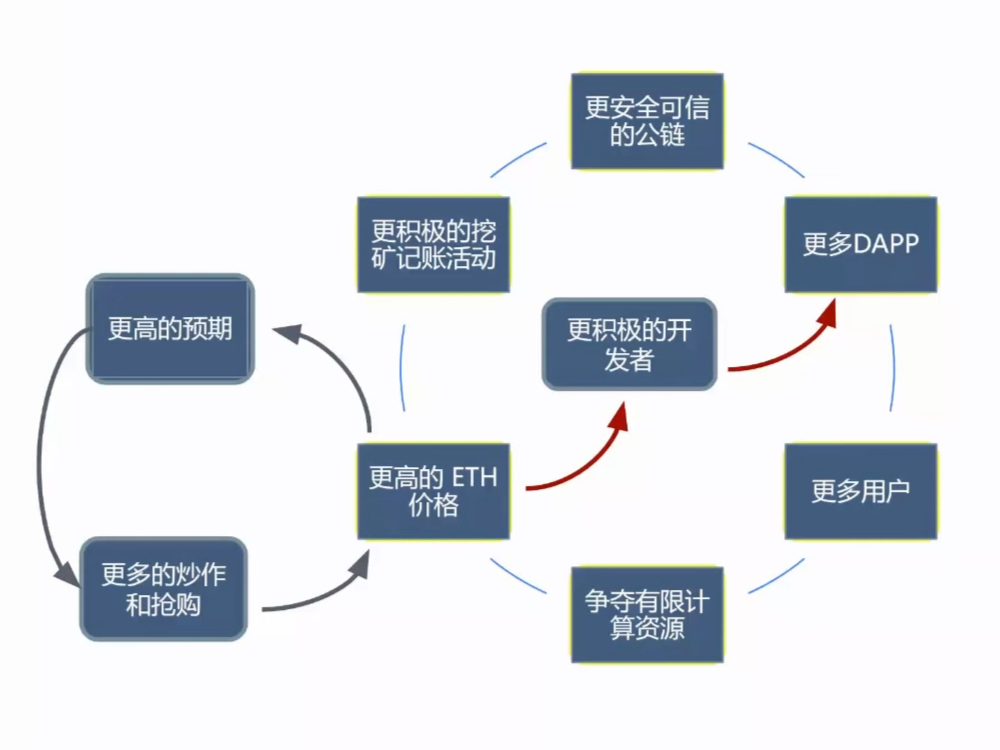
For example, on the business model, there are all kinds of dazzling Tokenomics designs. The same Token can be divided into a series of right bundles. Holding ETH can pay gas fee, which can be used as the base currency to interact with the Ethereum ecology, and can enjoy the currency price appreciation brought about by the prosperity of the Ethereum ecology. After the Merge, it can also Enjoy dividends through staking. Token holders are both customers and owners. Introducing the property rights separated from the business under the traditional corporate system into the business logic, using Token as a link to connect the business flywheel and the financial flywheel, can motivate users in the early stage to accelerate the critical point of network effects. Although some models have been criticized as Ponzi and death spirals, the exploration of such business models is meaningful.
From contract to intelligence Contract
With the property rights, the next step is the transaction. The essence of smart contracts is to use code to ensure automatic implementation of contracts. The name is bluffing, but the smart contract is actually not smart and a bit clumsy, and a bug can lead to a huge amount of money being attacked. Similar to replacing salespersons with vending machines, replacing CEX with AMM can reduce transaction costs, trust costs and human risks in the process, increase the speed of asset circulation, and accelerate price discovery.
Can algorithms really replace contracts? Going back to the transaction cost theory, in other words, can algorithms reduce the cost of preparing a contract (collection of information), the cost of reaching a contract (negotiation, signing), the cost of monitoring and implementing a contract? The ideal is full. Simple transfers, over-collateralized loans, and the implementation of computers/codes/machines/smart contracts are of course the lowest cost, but the economic activities between people are so complicated that the current smart contracts even the most basic credit contracts and employment contracts. (the cornerstone of DAO) cannot be well implemented.
The computational nature of smart contracts makes them more suitable for dealing with full contracts. But in real life, because contracts involving human capital face higher measurement costs than physical capital, most contracts are incomplete contracts. In the theory of complete contract, the terms of the contract show in detail the rights and obligations of each contracting party under different circumstances, the situation of risk sharing, the way of compulsory performance of the contract and the conditions of the contract when the corresponding future unpredictable time of the contract behavior occurs. achievable end result.
In the incomplete contract theory, due to the limited rationality of individuals, the complexity and uncertainty of the external environment, information asymmetry and incompleteness, the parties to the contract Both parties and arbitrators know that contractual terms are incomplete, and that different incentives and constraints need to be coordinated to fill gaps in the contract, correct distorted contractual terms, and more effectively accommodate unexpected disruptions.
As the cost of measuring, defining, maintaining and exchanging property rights continues to decrease, the incompleteness of the contract can be alleviated to a certain extent. There are many "computational" components in economic activities and contracts, and we used to use human simulation to achieve calculations. However, with the advancement of technology, today's computers, especially the development of blockchain smart contracts, are closer to the nature of computation. In depositors and bank deposit and withdrawal contracts, complex check verification needs to be assisted by bank tellers. As the banking system and bank cards continue to reduce the cost of monitoring contracts, ATMs have replaced bank tellers. Also in the employment contract between the employer and the employee, the output of the employee needs to be evaluated subjectively by the employer. With the evolution of the standard assembly line, piece rate wages have replaced the evaluation by the employer.
Machine/code contracts are superior to humans in that they are precise and efficient. When the property rights system is advanced enough, whether it is due to technological progress or institutional progress, the computing system can greatly reduce transaction costs, improve accuracy, and replace humans as the leader of the contract. The trend can already be seen from the complex Meituan food delivery scheduling system. The huge system connects riders, merchants, and customers, which involves the signing and fulfillment of multiple complex contracts:
・The cost of preparing the contract: the merchant presents the product information on the platform for customers to choose
・The cost of completing the contract: the customer uses online payment to sign the contract, The employment contract that the rider chooses to enter from the system distribution, the merchant accepts the order and prepares the goods
・The cost of supervising and implementing the contract: rider/merchant evaluation system, automatically calculated by the system And settle the income of the rider and the merchant
The contract is the result of the free choice of the parties without interference and coercion, which includes the freedom to sign the contract or not, and the choice of the party to sign the contract freedom, the freedom to determine the content of the contract, and the freedom to choose the form of the contract. Any third party, including the country as a legislator and judiciary, should respect the free agreement of the parties. One of the major claims of Web3 is to overthrow the Web2 giants because although they provide the above-mentioned freedom on the surface, the cost of canceling the contract is actually extremely high. The creators of blockchain and smart contracts are the makers and maintainers of the rules, and they are not necessarily the participants themselves. The participants are people who do not know each other in the world. When more and more property rights are clarified and put on the chain, imagine a food delivery scheduling algorithm running on Web3 without the participation of Meituan, or a contract system in a broader sense, making the formulation and maintenance of rules open and competitive It will create fairer and more efficient rules and reduce the tragedy of the brutal growth of platform power such as "delivery riders trapped in the system".

With the subdivision and improvement of the property rights system, Many components of economic activity, including repetitive mechanical parts of production and transactions, computational rules and order, may be replaced by machines and smart contracts. The financial system has well-developed property rights, clear computational rules, and high transaction costs. Therefore, the transformation is not difficult and the economic benefits created are large. It is not difficult to explain why DeFi is the first explosive application direction of Web3.
The future of Web3
The logical chain is down, we may communicate under the chain in the future , production, and the formulation, performance and supervision of contracts related to economic activities are all on the chain, which greatly reduces transaction friction and improves resource allocation efficiency. It sounds a bit cyberpunk, and it is always pleasant to imagine the future, but it is clear that the current Web3 is definitely not the ideal Web3 described above, it is just a chaotic state. Different from the information attribute of the Internet, because of its inherent economic attribute, gamblers and scammers flock to it, and because of its profound revolutionary significance, dreamers who love big words do not hesitate to preach.
Progress cannot rely on realists who only talk about reality, idealists who only have ideals, but realists with ideals and ideals who talk about reality Activists. Vitalik is the last type of person. We all know that things are not as good as we want, but the point is to solve the problem. We have a lot of work to do, which also means that there are many business opportunities:
・Encryption technology innovations, such as better consensus algorithms, privacy protection, virtual machines, programming languages, sharding, zero-knowledge proofs, decentralized storage, etc.;
・Improve user experience, such as better developer tools, easy-to-use wallet, cheap transaction fees, strict asset security, etc.;
・Connected to reality, such as more accurate and decentralized oracles, simpler legal currency Token conversion, ownership of more physical assets, actual contract operation on the chain, DID, SBT, etc.;
・Regulatory intervention, even if it can compete with the existing system in the long run, short-term integration is the only way;
< /p>
・...
As for the application, what rights can be represented by Token? What kind of transaction rules should be designed to reduce the transaction cost of Token? How can ordinary users without a programming background easily create their own smart contracts? How should organizations based on property rights and contracts evolve? There is a long way to go, and there are still many innovations worth exploring.
End
On the issue of economic development, "technical determinism" and "institutional determination "Theory" are two representative views. Neoclassical theory believes that economic growth is mainly constrained by factor input and technological progress, and the system is only adjusted passively or laggingly; while institutional economists believe that the most fundamental factor is institutional progress. It was efficient economic organization and appropriate incentive system arrangements that led to the rise of the Western world and the outbreak of the Industrial Revolution.
It is very difficult to separate the system and technology decisively. The relationship between them is actually that there is me in you, and you in me. The so-called determinism of the two is ultimately related to cost, and their performance on social and economic development can be analyzed by cost. Viewing innovation as a system, technological innovation and institutional innovation are two indispensable components, and only when they are combined can they complement each other and interact.
Although the Internet is more about the innovation of information technology, it also brings a flatter and borderless organizational form. Although this article uses an institutional perspective to think about the logic of Web3 throughout, the advancement of technology is also very important. In addition, the analysis of more complex institutions such as organization, cooperation, enterprise, and even state theory will have the opportunity to expand later due to space limitations. The author is not a professional scholar of institutional economics, but just to provide a new perspective to think about Web3, welcome to exchange.
References
https:// www.coinbase.com/learn/market-updates/around-the-block-issue-22
https://wenli.substack.com/archive
https:// github.com/JoanJiao/TokenEconomyBook_Chinese/wiki
https://book.douban.com/subject/11511489/
https://www.amazon.com/Understanding-Blockchain -Economy-Institutional-Cryptoeconomics/dp/1800373856
https://www.youtube.com/watch?v=o7x_mikyMWU
< a href="https://mp.weixin.qq.com/s/8zNlCXlOWPqeRF7YXNucfw" target="_blank">Original link
Welcome to join the official BlockBeats community:
Telegram Subscription Group: https://t.me/theblockbeats
Telegram Discussion Group: https://t.me/BlockBeats_App
Official Twitter Account: https://twitter.com/BlockBeatsAsia

 Related Articles