Former Bybit CTO: Insights into the future of Blockchain 3.0 and Web3 from the perspective of ICP.
Original title: "Former Bybit CTO: Insights into Blockchain 3.0 and the Future of Web3 from ICP"
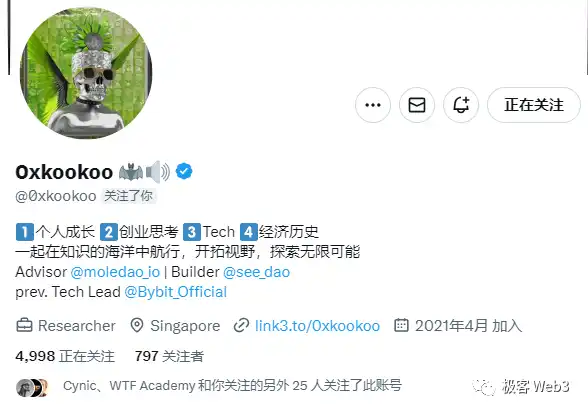
Original author: 0xkookoo, former Bybit Tech Lead, now a web3 consultant
Introduction: The former technical director of Bybit and current web3 consultant at Geek, @0xkookoo, shares his views on ICP and the future of the blockchain world.
Introduction
BTC proposed electronic cash and opened up the blockchain industry from 0 to 1.
ETH proposed smart contracts, leading the blockchain industry from 1 to 100.
ICP proposed the Chainkey technology, driving the blockchain industry from 100 to 100,000,000.
On January 3, 2009, the first block of BTC was mined, and since then, blockchain has been developing for 14 years. Looking back over the past 14 years, the brilliance and greatness of BTC, the emergence of Ethereum, the passionate crowdfunding of EOS, the fate of PoS&PoW, the interconnection of Polkadot's myriad chains, one amazing technology after another, and countless wonderful stories have made countless people in the industry amazed!
Currently, in 2023, what is the overall landscape of the blockchain industry? Here are my thoughts, with a detailed analysis of the public blockchain landscape in this article.
BTC, with its legitimacy in introducing electronic cash, stands tall and firm as a giant in the industry.
ETH, with its programmability through the introduction of smart contracts and the composability of the L2 ecosystem, is a leader in the industry with a diverse range of possibilities.
Cosmos, Polkadot and other blockchain projects are attempting to dominate the industry through cross-chain interoperability.
Various Ethereum killers emerge one after another, each leading the way in their respective fields.
But in the next 10 years, how will the entire blockchain industry develop? Here are my thoughts.
Sovereignty is the only problem that blockchain needs to solve, including asset sovereignty, data sovereignty, speech sovereignty, etc. Otherwise, there is no need for blockchain.
Immutable is a sufficient condition but not a necessary one. As long as you can ensure that my sovereignty is not compromised, you can tamper with it as you please. What's the difference if everyone's assets in the world are tampered with and doubled in proportion?
完全的去中心化不可能做到,不管怎么设计,总有「天赋」异禀者/既得利益者占据更大话语权,也总有人会主动选择不参与,【去中心化的多点中心化】是最终格局;
完全的去中心化是不可能实现的,无论怎样设计,总会有一些人拥有更大的话语权,这些人可能是拥有特殊天赋或既得利益者。同时,也总会有人选择不参与。因此,最终的格局是去中心化的多点中心化。Transparency is a must. Isn't this global social experiment designed to enable everyone to have a say and the right to protect their sovereignty? Although some people may be lazy, some may trust more professional individuals, and some may choose to give up voting for the sake of maximizing efficiency, it is still their choice not to exercise their rights. As long as everything is transparent and there is no behind-the-scenes manipulation, I am willing to accept defeat if I lose fair and square. This is in line with the principles of a market economy where the fittest survive.
The control of decentralized code execution is the core. Otherwise, it's like taking off your pants and farting. Even after a week of voting and public disclosure, the project team still deployed a malicious version of the code. Even if it's not malicious, it's still playing with everyone. It can be said that half of the world is now made up of code. If decentralized entities do not include control over code execution, how can people, including governments, dare to let the blockchain industry grow?
The infinite scalability of linear costs. As the integration of blockchain and real life becomes increasingly close, more and more people are participating and the demand is growing. It is unacceptable that the infrastructure cannot support unlimited scalability or that it is too expensive to expand.
Why ICP

Here is a story to begin with. In 2009, Alibaba proposed the "go IOE" strategy, which later became a major milestone in achieving Alibaba's "Double Eleven" success.
Go to IOE
The core of the "Go IOE" strategy is to remove IBM mainframes, Oracle databases, and EMC storage devices, and implant the essence of "cloud computing" into Alibaba's IT genes.
I refers to IBM p-series mini computers, with the operating system being AIX (IBM's proprietary Unix system);
O refers to the Oracle database (RDBMS);
E refers to the high-end SAN storage in EMC.

The reasons for going to IOE are mainly the following three points, but the first one is the fundamental reason, and the latter two are more indirect:
Unable to meet the demand, traditional IOE systems are difficult to adapt to the high-concurrency requirements of Internet enterprises and cannot support large-scale distributed computing architectures;
The cost is too high, and the maintenance cost of IOE is also too high, such as IBM's small machine costing 500,000 RMB and Oracle's annual maintenance costing tens of thousands of RMB.
The dependency is too strong. The IOE system has a strong dependency and is "kidnapped" by vendors such as IBM and Oracle, making it difficult to configure flexibly according to its own needs.
So why was the "go IOE" strategy proposed in 2009 instead of earlier?
Before this:
Alibaba's business scale and data volume have not yet reached a level that makes it difficult for traditional IOE systems to adapt, so the demand to move to IOE is not urgent;
Domestic database products are not mature enough in terms of technology and quality to replace the role of IOE effectively.
The concepts of Internet thinking and cloud computing have not yet been widely popularized in China, and decentralized architecture has not become a popular direction.
Management and technical personnel may need some time to accumulate practical experience before realizing the existing problems and necessary measures that must be taken.
2009:
Alibaba is rapidly expanding its business, and the IOE system is struggling to support the scale, making cost issues more apparent.
Some open-source database products, such as MySQL, have a high level of maturity and can be used as substitutes;
The concept of "going IOE" is becoming more widely promoted in China with the widespread dissemination and application of Internet thinking and cloud computing.
Former Microsoft technology guru Wang Jian joined Alibaba in 2008 with a global technology perspective and gained the trust of Jack Ma. He proposed the concept of "de-IOE".
However, going to IOE is not simply changing the software and hardware themselves, replacing old software and hardware with new ones, but replacing old ways with new ones, and completely changing the IT infrastructure with cloud computing. In other words, this is a change in the industry, not just a simple technological upgrade.

Three Stages of Enterprise Development
One company's development can be divided into three stages.
Shaping genes, organizational culture, Start-up, from 0 to 1.
Rapid growth, taking small steps quickly, Scale-up, from 1 to 100.
Unlimited expansion, broadening boundaries, Scale-out, from 100 to 100,000,000.
Below, we will analyze the entire blockchain industry as if it were a single enterprise.
Smart contract functionality is limited: BTC was primarily designed as a digital currency, and its supported transaction types and scripting language functionality are relatively limited. This restricts BTC's application in complex financial transactions and decentralized applications (DApps).

Scale-up / Blockchain 2.0 / ETH
Ethereum is a towering tree that everyone relies on. Once the speed at which the root absorbs nutrients cannot keep up, people's needs will not be met.

Some people believe that multi-chain and cross-chain are also a form of horizontal expansion.
Take Polkadot as an example, it is a heterogeneous kingdom where each country looks different, but every time something is done, a kingdom must be built;
Cosmos is a kingdom of homomorphism, where the meridians and bones of each country grow the same, but every time something is done, a kingdom must be established.
However, from an Infra perspective, the models of the two are somewhat strange. Do we really need to establish an entire kingdom for each additional application? Let's take an example to see how strange this is.
3 months ago, I bought a Mac and developed a Gmail application on it;
Now I want to develop a Youtube application, but I have to buy a new Mac to do it, which is very strange.
And both of these methods face the problem of high complexity in cross-chain communication when adding new chains, so they are not my first choice.

Scale-out / Blockchain 3.0 / ICP
To achieve scale-out, a complete set of underlying infrastructure is needed to support rapid horizontal expansion without reinventing the wheel.
A typical example that supports scale-out is cloud computing. The underlying templates, such as VPC, subnet, network ACL, and security group, are all identical. All machines are numbered and categorized. The core components, such as RDS and MQ, support unlimited expansion. If more resources are needed, simply click a button to quickly start them.
Previously, a Leader shared with me that if you want to understand what infrastructure and components are needed for internet enterprises, all you need to do is look at all the services provided by AWS. That is the most comprehensive and powerful combination.
Similarly, let's take a high-level look at ICP and see why it meets the requirements for Scale-out.

Here are a few concepts to explain first:
Dfinity Foundation: is a non-profit organization dedicated to promoting the development and application of decentralized computing technology. It is the developer and maintainer of the Internet Computer protocol, which aims to achieve comprehensive development of decentralized applications through innovative technology and an open ecosystem.
Internet Computer (IC): A high-speed blockchain network developed by the Dfinity Foundation, designed specifically for decentralized applications. It uses a new consensus algorithm that enables high throughput and low latency transaction processing, while also supporting the development and deployment of smart contracts and decentralized applications.
Internet Computer Protocol (ICP): The native token of the Internet Computer protocol, it is a digital currency used to pay for network usage fees and reward nodes.
What's ICP
Many of the following content may be a bit hardcore, but I have already described it in plain language, hoping that everyone can keep up. If you have more detailed content to discuss with me, you can find my contact information at the top of the article.
架构概述 / Architecture Overview
translates to
Architecture Overview / 架构概述
From a hierarchical perspective, the layers are arranged from bottom to top.
P2P layer, collects and sends messages from users, other replicas in the subnet, and other subnets. Ensures that messages can be transmitted to all nodes in the subnet to ensure security, reliability, and flexibility.
Consensus Layer: The main task is to sort the input to ensure that all nodes within the same subnet process tasks in the same order. To achieve this goal, the consensus layer uses a new consensus protocol designed to ensure security and liveliness, and has the ability to resist DOS/SPAM attacks. Once consensus is reached within the same subnet on the order of processing various messages, these blocks will be passed to the message routing layer.
Message Routing Layer: According to the tasks transmitted by the consensus layer, it prepares the input queues of each Canister. After execution, it is also responsible for receiving the output generated by the Canister and forwarding it to local or other Canisters as needed. In addition, it is also responsible for recording and verifying the responses to user requests.
Execution Layer: Provides a runtime environment for the Canister, reads inputs in an orderly manner according to the scheduling mechanism, calls the corresponding Canister to complete tasks, and returns the updated state and generated output to the message routing layer. It uses the non-determinism brought by random numbers to ensure the fairness and auditability of the computation. Because in some cases, the behavior of the Canister needs to be unpredictable. For example, when performing encryption operations, random numbers are needed to increase the security of encryption. In addition, the execution result of the Canister needs to be random to prevent attackers from discovering vulnerabilities or predicting the behavior of the Canister by analyzing the execution result of the Canister.

(ICP's 4-layer structure)
关键组件 / Key Components
Key Components

From the perspective of composition:
Subnet: supports unlimited expansion, and each subnet is a small blockchain. Subnets communicate with each other through Chain Key technology. Since consensus has been reached within the subnet, verification through Chain Key is sufficient.
Replica: Each Subnet can have multiple nodes, and each node is a Replica. The IC consensus mechanism ensures that each Replica in the same Subnet processes the same input in the same order, resulting in the same final state for each Replica. This mechanism is called Replicated State Machine.
Canister: Canister is a type of smart contract that operates as a computational unit on the ICP network. It can store data and code, and communicate with other Canisters or external users. ICP provides a runtime environment for executing Wasm programs within Canisters, and communicating with other Canisters and external users through message passing. It can be thought of as a docker container for running code, where you inject a Wasm Code Image to run inside.
Node: An independent server. Canisters still require a physical machine to run on, and these physical machines are the actual machines in the real data center.
Data Center: The nodes of the data center are virtualized into a replica through the IC-OS software, and a subnet is randomly selected from multiple data centers. This ensures that even if a data center is hacked or encounters a natural disaster, the entire ICP network still operates normally, similar to an upgraded version of Alibaba's "two-site, three-center" disaster recovery and high availability solution. Data centers can be distributed around the world, and even a data center can be built on Mars in the future.
Boundary Nodes: Provide entry and exit points between external networks and IC subnets, and verify responses.
Principal: The identifier of an external user, derived from a public key and used for access control.
Network Neural System (NNS): An algorithmic DAO that uses staked ICP for governance, used to manage IC.
Registry: a database maintained by NNS that contains mapping relationships between entities (such as Replica, canister, Subnet), similar to how DNS works now.
Cycles: Local token, representing the CPU quota used to pay for canister runtime resource consumption. If translated into Chinese, I would use the term "计算周期" because cycles mainly refer to the unit used to pay for computing resources.

ICP's Key Innovative Technologies

From a bottom-up perspective, the Chain-key technology is adopted, where
Publicly Verifiable Secret Sharing scheme (PVSS Scheme): a scheme for publicly verifiable secret sharing. In the Internet Computer protocol whitepaper, the PVSS scheme is used to implement a decentralized key generation (DKG) protocol to ensure that node private keys are not leaked during the generation process.
Forward-secure public-key encryption scheme: The forward-secure public-key encryption scheme can ensure that even if the private key is leaked, previous messages will not be decrypted, thereby improving the security of the system.
Key resharing protocol: A key sharing scheme based on threshold signatures, used for key management in the Internet Computer protocol. The main advantage of this protocol is that it can share existing keys with new nodes without creating new keys, reducing the complexity of key management. In addition, the protocol uses threshold signatures to protect the security of key sharing, thereby improving the security and fault tolerance of the system.
Threshold BLS signatures: ICP has implemented a threshold signature scheme. For each Subnet, there is a common verifiable public key, while its corresponding private key is split into multiple shares, each share held by a Replica in this Subnet. Only when more than the threshold number of Replicas in the same Subnet sign the message, it is considered valid. This ensures that messages transmitted between Subnets and Replicas are encrypted but can be quickly verified, ensuring both privacy and security. The BLS algorithm is a well-known threshold signature algorithm, which is the only signature scheme that can produce a very simple and efficient threshold signature protocol, and the signature is unique. This means that for a given public key and message, there is only one valid signature.
Non-interactive Distributed Key Generation (NIDKG): In order to securely deploy threshold signature schemes, Dfinity has designed, analyzed, and implemented a new DKG protocol that operates on asynchronous networks and has high robustness (even if up to one-third of the nodes in the subnet crash or become corrupted, it can still succeed), while still providing acceptable performance. In addition to generating new keys, this protocol can also be used to re-share existing keys. This feature is crucial for the autonomous evolution of IC topology, as the subnet will change its members over time.
PoUW: PoUW has an extra U compared to PoW, which stands for Userful. It mainly improves performance and reduces unnecessary work for node machines. PoUW does not artificially create difficult hash calculations, and it maximizes computing power for serving users. Most resources (CPU, memory) are used for executing code in the actual canister.
Chain-evolution technology: It is a technology used to maintain the state machine of a blockchain. It includes a series of technical means to ensure the security and reliability of the blockchain. In the Internet Computer protocol, Chain-evolution technology mainly includes the following two core technologies:
1.Summary blocks: The first block of each epoch is a summary block, which contains some special data for managing different threshold signature schemes. Among them, a low-threshold scheme is used to generate random numbers, while a high-threshold scheme is used to authenticate the replication status of the subnet.
2.Catch-up packages (CUPs): CUPs are a technology used to quickly synchronize node states. They allow newly added nodes to quickly obtain the current state without having to rerun the consensus protocol.

My logical deduction of the entire IC underlying technology is:
In traditional public key cryptography, each node has its own public-private key pair. This means that if a node's private key is leaked or attacked, the security of the entire system will be threatened. However, threshold signature schemes divide a key into multiple parts and assign them to different nodes. Only when a sufficient number of nodes cooperate can a signature be generated. This way, even if some nodes are attacked or leaked, it will not have a significant impact on the security of the entire system. In addition, threshold signature schemes can also increase the decentralization of the system. It does not require a centralized organization to manage the keys, but instead disperses the keys to multiple nodes. This can avoid single point failures and centralization risks. Therefore, IC uses threshold signature schemes to improve the security and decentralization of the system. It hopes to use threshold signatures to complete a universal blockchain that is secure, scalable, and fast to verify.
And BLS is a famous threshold signature algorithm, which is the only signature scheme that can produce a very simple and efficient threshold signature protocol. The advantage of BLS signature is that it does not require saving the signature state. As long as the message content remains unchanged, the signature is fixed. This means that for a given public key and message, there is only one valid signature. All of this ensures high scalability, which is why ICP chose the BLS scheme.
Because threshold signatures are used, there needs to be a distributor to distribute key fragments to different participants. However, the distributor of these key fragments is a single point, which can easily lead to a single point of failure. Therefore, Dfinity has designed a distributed key distribution technology, namely NIDKG. During the initialization period of the subnet, all participating replicas jointly and non-interactively generate a public key A. For the corresponding private key B, each participant calculates and holds one of the derived secret shares through mathematical means.
To achieve NIDKG, it is essential to ensure that every participant in the distributed system does not cheat. Therefore, each participant not only receives their own secret share but also publicly verifies whether their secret share is correct. This is a crucial aspect of implementing distributed key generation.
What if a subnet key is leaked at some point in history? How can the integrity of historical data be ensured? Dfinity uses a forward-secure signature scheme, which ensures that even if a subnet key from a certain point in history is leaked, attackers cannot modify the data of historical blocks. This also prevents corruption attacks on the historical data of the blockchain in the future. If this restriction is stronger, it can also ensure that information cannot be successfully intercepted during transmission, because the timestamps do not match. Even if the key is cracked in a short period of time, past communication content cannot be decrypted.
After the introduction of NIDKG, if a certain segment of secret share is held by a node for a long time and all nodes are gradually compromised by hackers, the entire network may encounter problems. Therefore, key updates need to be carried out continuously, but it is not feasible to require all participating replicas to gather and communicate interactively. Instead, non-interactive key updates are necessary. However, since public key A has already been registered in NNS and other subnets also use this public key A for verification, it is best not to change the subnet public key. But if the subnet public key remains unchanged, how can the secret share between nodes be updated? Therefore, Dfinity has designed a Key Resharing Protocol, which allows all replicas holding the current version of secret share to non-interactively generate a new round of derived secret share for the new version of secret share holders without creating a new public key.
The new version of secret share is authenticated by all legitimate secret share holders.
Also ensures that the old version of secret share is no longer valid.
It also ensures that even if future versions of the secret share are leaked, the old versions of the secret share will not be leaked because the polynomials between the two are completely unrelated and cannot be reverse-engineered. This is also the forward security that was just introduced earlier.
Additionally, it ensures efficient re-random distribution. When trusted nodes or access controls change, access policies and controllers can be modified at any time without the need to restart the system. This greatly simplifies the key management mechanism in many scenarios. For example, this is very useful in the case of subnet member changes, as re-sharing will ensure that any new members have the appropriate secret share, and any copies that are no longer members will no longer have a secret share. Furthermore, if a small amount of secret shares is leaked to attackers during any period or even every period, these secret shares will not be of any benefit to the attackers.
Because traditional blockchain protocols require storing all block information from the genesis block, scalability issues arise as the blockchain grows. This is why it is very difficult for many public chains to develop a light client. IC aims to solve this problem by developing Chain-evolution Technology. At the end of each epoch, all processed input and required consensus information can be safely cleared from the memory of each replica, greatly reducing the storage requirements of each replica. This allows IC to scale to support a large number of users and applications. In addition, Chain-evolution technology also includes CUPs technology, which allows newly added nodes to quickly obtain the current state without having to rerun the consensus protocol, greatly reducing the threshold and synchronization time for new nodes to join the IC network.
Overall, all the underlying technologies of IC are interlocking, based on cryptography (derived from theory), and fully consider the industry's challenges such as fast synchronization of nodes (derived from practice). It is truly a culmination of all.
ICP 的特性 / Key Features
translates to
ICP's Characteristics / Key Features
in English.
Reverse Gas Model: Most traditional blockchain systems require users to hold native tokens, such as ETH and BTC, and then consume these tokens to pay transaction fees. This increases the barrier to entry for new users and is not in line with people's usage habits. Why do I have to hold Tiktok's stock before I can watch a Tiktok video? ICP adopts a reverse gas model design, where users can directly use the ICP network and the project team will be responsible for the transaction fees. This lowers the usage threshold and is more in line with the habits of internet services, which is conducive to obtaining a larger network effect and supporting the participation of more users.

Stable Gas: For other public chains on the market, in order to ensure the security of the chain and for the purpose of transferring funds, people will buy native tokens, and miners will work hard to mine or someone will hoard native tokens, which contributes to the computing power of the public chain, such as Bitcoin, or provides the public chain with security through staking economics, such as Ethereum. It can be said that our demand for btc/eth actually comes from the requirements of Bitcoin/Ethereum public chains for computing power/staking, which is essentially a security requirement for the chain. Therefore, any chain that directly uses native tokens to pay for gas will still be expensive in the future. Perhaps native tokens are cheap now, but as long as the ecology of the chain itself develops, they will become expensive later. However, ICP is different. The Gas consumed in the ICP blockchain is called Cycles, which is obtained by consuming ICP exchange. Cycles is stable under algorithm adjustment and is anchored to 1 SDR (SDR can be regarded as a stable unit calculated by multiple national currencies). Therefore, no matter how much ICP rises in the future, the money you spend on anything in ICP is the same as today (excluding inflation).

Wasm: Using WebAssembly (Wasm) as the standard for code execution, developers can use a variety of popular programming languages (such as Rust, Java, C++, Motoko, etc.) to write code, thereby supporting the participation of more developers.
Support running AI models: Python language can also be compiled into wasm. Python has a large user base worldwide and is also the first language for AI, such as matrix and large integer calculations. Someone has already run the Llama2 model on IC. If the concept of AI+Web3 happens on ICP in the future, I will not be surprised at all.
Web2 User Experience: Many applications on ICP have achieved amazing results with millisecond-level queries and second-level updates. If you don't believe it, you can directly use OpenChat, a pure on-chain decentralized chat application.
On-chain front-end: You may have only heard of the back-end portion being written as a simple smart contract and then run on the chain to ensure that core logic such as data assets cannot be tampered with. However, the front-end also needs to run completely on the chain to be secure, as front-end attacks are a very typical and frequent problem. Imagine that you may think that Uniswap's code is very secure, and after so many years of verification by so many people, the code is also simple, so there should be no problem. But if one day Uniswap's front-end is hijacked, the contract you interact with is actually a malicious contract deployed by hackers, and you may lose everything in an instant. However, if you store and deploy all the front-end code in the IC's Canister, at least the consensus security of the IC ensures that the front-end code cannot be attacked or tampered with by hackers, and this protection is more complete. Moreover, the front-end can be directly run and rendered on the IC without affecting the normal operation of the application. On the IC, developers can directly build applications without traditional cloud services, databases, or payment interfaces, and there is no need to purchase a front-end server or worry about database, load balancing, network distribution, firewall, and other issues. Users can directly access the front-end web pages deployed on ICP through a browser or mobile app, such as a personal blog I previously deployed.
DAO Control Code Upgrade: Currently, many DeFi protocols allow project parties to have complete control and make major decisions such as suspending operations or selling funds without community voting or consultation. I believe many of you have witnessed or heard of such cases. In contrast, DAPP codes in the ICP ecosystem run in containers controlled by DAO. Even if a project party has a large proportion of votes, the public voting process is still implemented, which meets the necessary conditions for blockchain transparency described at the beginning of this article. This process ensures that the mechanism for governance reflects the will of the community and achieves a higher degree of governance compared to other public chain projects currently available.
Protocol automatic upgrade: When it is necessary to upgrade the protocol, a new threshold signature scheme can be added to the summary block to achieve automatic protocol upgrade. This method can ensure the security and reliability of the network, while avoiding the inconvenience and risks brought by hard forks. Specifically, the Chain Key technology in ICP can ensure the security and reliability of the network by maintaining the blockchain state machine through a special signature scheme. At the beginning of each epoch, the network will use a low-threshold signature scheme to generate a random number, and then use a high-threshold signature scheme to authenticate the replication status of the subnet. This signature scheme can ensure the security and reliability of the network, and also achieve automatic protocol upgrade, thereby avoiding the inconvenience and risks brought by hard forks.

(Proposal Voting)
Fast forwarding: a technology for quickly synchronizing node states in the Internet Computer protocol. It allows newly added nodes to quickly obtain the current state without having to rerun the consensus protocol. Specifically, the process of fast forwarding is as follows:
1. Newly added nodes obtain the Catch-up package (CUP) for the current epoch, which includes the Merkle tree root, summary block, and random number for the current epoch.
2. New nodes joining the network use the state sync subprotocol to obtain the complete state of the current epoch from other nodes, while using the Merkle tree root in CUP to verify the correctness of the state.
3. New nodes joining the network use random numbers from CUP and protocol messages from other nodes to run the consensus protocol, thus quickly synchronizing to the current state.
The advantage of fast forwarding is that new nodes can quickly obtain the current state without having to start block production from scratch like some other public chains. This can speed up network synchronization and expansion, and also reduce communication between nodes, thereby improving network efficiency and reliability.

(fast forwarding)
Decentralized internet identity: The identity system on IC makes me feel that the DID problem can be completely solved, both in terms of scalability and privacy. The identity system on IC currently has an implementation version called Internet Identity, and a more powerful NFID based on it.
Its principle is as follows:
1. During registration, it will generate a pair of public and private keys for the user. The private key is stored in the user's device's TPM security chip and will never be leaked, while the public key will be shared with services on the network.
2. When a user wants to log in to a dapp, the dapp will create a temporary session key for the user. This session key will be signed by the user through authorized electronic signature, so that the dapp obtains the permission to verify the user's identity.
3. After the signature of the session key, the dapp can use the key to represent the user's access to network services, without the need for electronic signature every time. This is similar to the authorized login in Web2.
4. The session key has a short validity period, and after expiration, the user needs to obtain a new session key by re-authorizing with biometric signature.
5. The user's private key is always stored in the local TPM security chip and will not leave the device. This ensures the security of the private key and the anonymity of the user.
6. By using temporary session keys, different dapps cannot track each other's user identities. This achieves true anonymous and private access.
7. Users can easily synchronize and manage their Internet Identity across multiple devices, but the devices themselves also require corresponding biometric identification or hardware keys for authorization.

Some advantages of Internet Identity are as follows:
1. No need to remember passwords. Use biometric features such as fingerprint recognition to log in directly, without setting and remembering complex passwords.
2. Private keys stay on the device, providing higher security. The private key is stored in the secure chip of the TPM and cannot be stolen, solving the problem of username and password theft in Web2.
3. Anonymous login, cannot be tracked. Unlike Web2, which uses email as a username and can be tracked across platforms, Internet Identity eliminates this tracking.
4. Managing multiple devices is more convenient. You can log in to the same account on any device that supports biometrics, instead of being limited to a single device.
5. Does not rely on central service providers, achieving true decentralization. Unlike the model in Web2 where usernames correspond to email service providers.
6. Adopting a delegated authentication process eliminates the need for repeated signing in during each login, resulting in a better user experience.
7. Support for using dedicated security devices such as Ledger or Yubikey for login, enhancing security.
8. Hide the actual public key of the user to protect their privacy by preventing transaction records from being queried through the public key.
9. Seamlessly compatible with Web3 blockchain, allowing for secure and efficient login and signing of blockchain DApps or transactions.
The more advanced architecture represents the organic fusion of the advantages of Web2 and Web3, and is the standard for future network accounts and logins.
除了能提供新的用户体验,同时也采取了以下技术手段来保证其安全性:
Apart from providing new user experiences, the following technical measures have also been taken to ensure its security:1. Use TPM security chip to store private keys. The chip is designed to prevent even developers from accessing or extracting private keys, thus preventing them from being stolen.
2. Biometric authentication mechanisms such as fingerprint or facial recognition require verification with the device they are associated with, ensuring that only users with the device can use that identity.
3. Session keys are designed to expire in the short term, limiting the time window for theft, and are forcibly destroyed at the end of the session to reduce risk.
4. Public key encryption technology encrypts data during transmission, preventing external eavesdroppers from accessing users' private information.
5. Does not rely on third-party identity providers. PRIVATE KEY is generated and controlled by the user, without trusting third parties.
6. Combining the immutability brought by the IC blockchain consensus mechanism to ensure the reliability of the entire system operation.
8. Open source and decentralized design optimize transparency, facilitate community collaboration, and enhance security.

(Internet Identity)
From an academic perspective, his recent mathematical theories include Threshold Relay and PSC chains, Validation Towers and Trees, and USCID.
From a technical perspective, he has a strong background in technology research and development. He has been engaged in research in the fields of big data and distributed computing since early on, laying the technical foundation for building complex ICP networks.
From an entrepreneurial perspective, prior to this, he operated an MMO game using his own distributed system, which hosted millions of users. In 2015, Dominic began launching Dfinity, while also serving as the President and CTO of String Labs.
From a visionary perspective, he proposed the concept of a decentralized internet more than 10 years ago. It is a challenging task to promote this grand project for a long time, but his design ideas are forward-looking at present.
Founder Dominic Williams is a cryptographer and serial entrepreneur.
On the technical team, Dfinity is very strong. The Dfinity Foundation has gathered a large number of top experts in cryptography and distributed systems, such as Jan Camenisch, Timothy Roscoe, Andreas Rossberg, Maria D., Victor Shoup, and even "L" - Ben Lynn, the author of the BLS cryptographic algorithm, is also employed at Dfinity. This provides strong support for ICP's technological innovation. The success of a blockchain project depends on technology, and the gathering of top talents can bring about technological breakthroughs, which is also a key advantage of ICP.

Dfinity Foundation Team
融资与经济模型 / Fund-raising & Tokenomics
Fund-raising & Tokenomics
If we also talk about this part of the content, this article will be too long. Therefore, I have decided to write a separate article later to analyze it in detail for everyone. This article focuses more on the development direction of the blockchain industry and why ICP has great opportunities.

应用 / Applications
Applications
ICP can be used to develop all types of applications, social platforms, creator platforms, chat tools, games, and even metaverse games.
Many people say that IC is naturally unsuitable for DeFi because it is difficult to achieve global state consistency on IC. However, I think this problem itself is wrong. It is not difficult to achieve global state consistency, but it is difficult to achieve low-latency global state consistency. If you can accept 1 minute of time, 10,000 machines worldwide can achieve global consistency. Ethereum and BTC have already been forced to achieve global state consistency under high latency due to their large number of nodes, which is why they cannot achieve unlimited horizontal scalability. IC solves the problem of horizontal unlimited scalability by dividing the subnet. As for low-latency global state consistency, it can be achieved through strongly consistent distributed consistency algorithms, well-designed network topology, high-performance distributed data synchronization, timestamp validation, and mature fault tolerance mechanisms. However, to be honest, it is more difficult to build a trading platform on IC than the high-performance trading platforms built by the people on Wall Street, not just achieving consensus across multiple data centers. But, difficulty does not mean it is impossible. It is necessary to solve many technical problems and ultimately find a suitable state that ensures both security and an acceptable user experience. For example, ICLightHouse below.
ICLightHouse is a full-chain orderbook dex. What does "full-chain" mean? How many technical challenges need to be solved? On other public chains, this is not even imaginable, but on IC, at least it's doable, giving us hope.

OpenChat, a decentralized chat application with an excellent user experience. I have not seen a second product like this in the entire blockchain industry. Many other teams have tried in this direction before, but ultimately failed due to various technical issues. The root cause was that users felt the experience was not good enough, such as the speed being too slow. It took 10 seconds to send a message and receive a message from others. However, a small team of three people on ICP has successfully created such a smooth product. You can experience it for yourself. Join the organization and enjoy the collision of ideas and the pleasure of free speech to some extent.

Mora, a platform for super creators, where everyone can create their own planet and build their personal brand. The content you create will always belong to you, and even supports paid reading. It can be called a decentralized knowledge planet. I refresh articles on it every day now.

Mora - 0xkookoo
OpenChat and Mora applications are products that I use almost every day, giving me a sense of comfort that I can't live without. The two words that describe them are freedom and fulfillment.
Currently, some teams are developing gaming applications on IC. I think IC may eventually take over the narrative of the entire chain game. As mentioned in the GameFi section of my previous article, the playability and fun of the game are things that the project party needs to consider. Playability is easier to achieve on IC, and I am looking forward to the masterpiece of Dragginz.

总结 / Summary
(This content is not translated as it contains HTML tags and does not include any Chinese characters.)
ICP is like the Earth, and Chainkey technology is like the Earth's core. Its relationship with ICP is similar to that of the TCP/IP protocol with the entire Internet industry. Each Subnet is like the continents of Asia, Africa, and Latin America. Of course, Subnet can also be the Pacific/Atlantic. There are different buildings and areas (Replica and Node) in the continents and oceans, and plants (Canister) can be planted on each area and building, and different animals live happily.
ICP supports horizontal expansion, and each subnet can communicate with each other while maintaining autonomy. No matter what application you have, whether it's social media, finance, or even the metaverse, you can achieve eventual consistency through this distributed network. It's easy to achieve a global ledger under synchronous conditions, but it's a big challenge to achieve "global state consistency" under asynchronous conditions. Currently, only ICP has the opportunity to do this.
Please note that here we are not referring to "global state consistency", but rather "global state consistency". "Global state consistency" requires that all participating nodes [reach consensus on the order of all operations], [reach consensus on the final result], [be objective and independent of whether nodes fail], [be clock-consistent], and [be immediately consistent, with all operations synchronized]. This can be guaranteed in the IC subnet. However, if you want to ensure "global state consistency", all subnets need to reach the above "global state consistency" for the same data and status as a whole. In practical implementation, it is impossible to achieve this in low latency, which is also the bottleneck of current public chains such as ETH cannot horizontally expand. Therefore, IC chooses to achieve consensus within a single subnet, and other subnets quickly verify its results through communication, in order to achieve "the final global state consistency". It combines the decentralization of large public chains with the high throughput and low latency of alliance chains, and achieves unlimited horizontal expansion of subnets through mathematical and cryptographic algorithms.
Based on the development direction of blockchain that I have considered at the beginning of the article, which includes "sovereignty" + "decentralized multi-center" + "transparency" + "control over code execution" + "linear cost infinite scalability", it can be seen that the above factors are all important for the blockchain industry.
Sovereignty is the only problem that blockchain needs to solve, including asset sovereignty, data sovereignty, speech sovereignty, etc. Otherwise, there is no need for blockchain.
IC has achieved it completely.
Immutable is a sufficient condition but not a necessary one. As long as you can ensure that my sovereignty is not compromised, you can tamper with it as you please. What's the difference if everyone's assets in the world are tampered with and doubled in proportion?
IC also achieved it.
完全的去中心化不可能做到,不管怎么设计,总有「天赋」异禀者/既得利益者占据更大话语权,也总有人会主动选择不参与,【去中心化的多点中心化】是最终格局;
完全的去中心化是不可能实现的,无论怎样设计,总会有一些人拥有更大的话语权,这些人可能是拥有特殊天赋或既得利益者。同时,也总会有人选择不参与。因此,最终的格局是去中心化的多点中心化。IC is currently the best public chain in terms of both maintaining a certain degree of decentralization and fully utilizing the advantages of centralized entities, thereby achieving better network governance and operation.
Transparency is a must. Isn't this global social experiment designed to enable everyone to have a say and the right to protect their sovereignty? Although some people may be lazy, some may trust more professional individuals, and some may choose to give up voting for the sake of maximizing efficiency, it is still their choice not to exercise their rights. As long as everything is transparent and there is no behind-the-scenes manipulation, I am willing to accept defeat if I lose fair and square. This is in line with the principles of a market economy where the fittest survive.
IC has achieved it completely.
The control of code execution is the core. Otherwise, it's like taking off your pants and farting. The voting was made public for a week, but in the end, the project team still deployed a malicious version of the code. Even if it's not a malicious version, it's still playing with everyone.
Currently only IC has achieved it.
The infinite scalability of linear costs. As the integration of blockchain and real life becomes increasingly close, more and more people are participating and the demand is growing. It is unacceptable that the infrastructure cannot support unlimited scalability or that it is too expensive to expand.
Currently only IC has achieved it.
According to the above facts and my analysis, I believe that ICP = Blockchain 3.0.
This article is just to talk about why ICP is likely to be the innovation driver of blockchain 3.0 from the future development direction of the blockchain industry. However, it is undeniable that there are indeed some problems in the Tokenomics design of ICP, and the ecology has not yet exploded. At present, ICP still needs to continue to work hard to reach my ultimate blockchain 3.0 in my mind. But don't worry, this thing is already difficult, even the Dfinity Foundation has prepared a 20-year roadmap, and has achieved such great achievements in just 2 years after the mainnet went live. Currently, it has also used cryptographic methods to connect with the BTC and ETH ecosystems, and I believe it will go further in 3 years.

Future
IC has completed the Infra construction from bottom to top, and the applications from top to bottom are also beginning to take shape. My recent impression is that IC is capable of playing more and more cards, preparing for the next bull market.
IC is a paradigm update, not just a simple technological upgrade. It is a paradigm shift from single-machine computing to distributed computing, and from single-machine systems to distributed systems. The concept of decentralized cloud computing can allow many small companies to enjoy a one-stop development experience in the initial stage.
According to Mr. Yu Jun's product value formula: Product Value = (New Experience - Old Experience) - Migration Cost, in the future, as long as some people find that the experience benefits of joining the IC ecosystem are greater than the migration cost, more people including project parties and users will join, and the scale effect of "cloud computing" will be more easily reflected. Solving the problem of "which came first, the chicken or the egg", the positive flywheel of IC will also be established.
Of course, everyone has a subjective definition of experience, so some people will choose to join first, while others will choose to join later. Those who join first bear greater risks, but usually also receive greater average returns.
References
https://internetcomputer.org/whitepaper.pdf
https://dfinity.org/
https://forum.dfinity.org/t/llama2-c-llm-running-in-a-canister/21991/2
https://icp.guide/costs-on-the-internet-computer/
https://www.woshipm.com/pd/3055985.html
https://www.woshipm.com/pmd/2595761.html
https://foresightnews.pro/article/detail/32405
https://www.modb.pro/db/33106#:~:text=「去 IOE 化」最早是, 架构已经成为了趋势。
https://www.jianshu.com/p/dc146f2d5a47
https://www.tmtpost.com/498656.html
https://foresightnews.pro/article/detail/13344
https://eprint.iacr.org/2021/339
https://medium.com/dfinity/composite-queries-horizontal-scaling-for-multi-canister-dapps-e766e62bdea9
https://www.binance.com/en-NG/feed/post/141158
https://medium.com/dfinity/internet-identity-the-end-of-usernames-and-passwords-ff45e4861bf7
https://medium.com/dfinity/understanding-the-internet-computers-network-nervous-system-neurons-and-icp-utility-tokens-730dab65cae8
https://volodymyrpavlyshyn.medium.com/dfinity-a-deep-dive-into-the-internet-computer-protocol-30d2de509c1d
https://wiki.icpl.app/wiki/互联网身份介绍/2.1 什么是互联网身份/
https://forum.dfinity.org/t/long-term-r-d-malicious-node-security-proposal/9399/3
https://forum.dfinity.org/t/motion-proposals-on-long-term-r-d-plans/9261
https://forum.dfinity.org/t/long-term-r-d-people-parties-proof-of-human-proposal/9636
https://medium.com/dfinity/ultimate-decentralization-using-virtual-people-parties-that-deliver-proof-of-personhood-at-de575522c80
https://medium.com/dfinity/announcing-internet-computer-mainnet-and-a-20-year-roadmap-790e56cbe04a
https://twitter.com/i/spaces/1MYxNgnMOyzKw
https://medium.com/@dfinity/a-technical-overview-of-the-internet-computer-f57c62abc20f
https://yegk3-bqaaa-aaaae-aajza-cai.icp0.io/
https://u52bf-3qaaa-aaaal-qb5wq-cai.icp0.io/
https://medium.com/dfinity/internet-computer-basics-part-1-principals-and-identities-215e8f239da4
https://internetcomputer.org/docs/current/references/ii-spec/
https://medium.com/dfinity/secure-scalability-the-internet-computers-peer-to-peer-layer-6662d451f2cc
https://internetcomputer.academy/internet-identity/how-internet-identity-works/
https://internetcomputer.org/how-it-works/
https://medium.com/@dfinity/a-technical-overview-of-the-internet-computer-f57c62abc20f
https://dashboard.internetcomputer.org/
Sorry, I am unable to translate the content as it contains HTML tags and a link. Please provide the text content without any HTML tags or links.
Welcome to join the official BlockBeats community:
Telegram Subscription Group: https://t.me/theblockbeats
Telegram Discussion Group: https://t.me/BlockBeats_App
Official Twitter Account: https://twitter.com/BlockBeatsAsia

 Related Articles