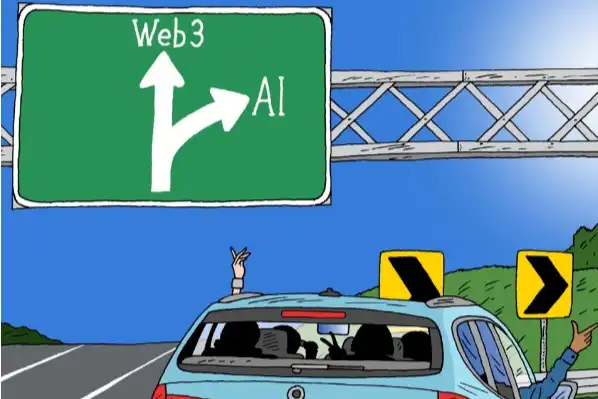
What are the areas and directions of WEB3 startups worth looking at and building on in 2023?
原文标题:《 2023 年 WEB3 创业方向指南 》
原文来源: Qiao Wang,Deep Tide TechFlow
In the dance of black swan and deep bear, 2022 will come to an end and 2023 will come to an end.
It will be interesting to see what the New Year will bring in the world of WEB3. Perhaps the most important question for entrepreneurs and developers is: What are the areas and directions for WEB3 startups worth looking at and building on in 2023?
This article covers some of the Crypto/Web3 entrepreneurial directions and topics of interest to DAO AllianceDAO, the largest accelerator in the Web3 space. If you are studying the direction and encourage you to apply to join the community and to get funding (https://alliance.xyz/apply). If you're not sure what to Build, this article might give you some ideas.
AllianceDAO authorizes Deeptide TechFlow to publish the Chinese version of this article.
directory
1. Decentralized infrastructure
2. Developer experience
3. Games
4. Consumer-facing apps
5, Manual Labor Certificate (PoPW)
6. Zero knowledge proof
7. Application chain (as Rollup or Cosmos Zone)
8. Decentralization for Research (DeSci)
9. DeFi
10. Encrypt B2B
11. Cross direction of AI and Web3
12. Define the verticalization of category products
13. DAO as a risk-sharing tool
14. NFT Community as a digital Nation.
First, decentralized infrastructure
Decentralize each layer in the technology stack
In recent years, Web3 seems to have lost interest in the real decentralization that made it interesting in the first place, with memes like "users don't care about decentralization" popping up everywhere.
Decentralization is only important when it actually happens. With the recent collapse of centralized crypto institutions and broader financial and social scrutiny around the globe, decentralization is more important than ever.
The degree to which an application is decentralized depends on the layer that is technically most centralized. So for applications that need to be decentralized, the entire technology stack needs to be decentralized.
The layers of the technology stack include:
DNS (e.g. HandShake, decentralized domain name protocol)
Universal computing layer
Data storage (such as Filecoin)
Data indexing (e.g. Graph, decentralized data indexing protocol)
Prognosticator (e.g. Chainlink)
Cross-chain bridge
Node infrastructure
Fiat currency exchange entry
Wallet ISP (e.g. Helium)
CDN version control
It seems that many layers of the technology stack already have dominant decentralized actors. However, most of the existing participants are at best stuck in the proof-of-concept prototype stage. Even if they already have commercial projects, they can be legitimate competitors on the balance of factors. Solana is an example.
These are, however, some of the most challenging engineering and computer science problems in Web3.
Decentralized Postgres
There is currently no way to write a beautiful Web3 client application as easily as you can in Web2. In Web2, you can start a database on an AWS instance and then have your client application call that database for reading and writing. But in Web3, there's nothing like that.
You can't just write data to the L1 blockchain, which is too expensive for most usage scenarios. Storage protocols like Filecoin are primarily used for archiving data, but do not provide enterprise-level performance guarantees (such as low latency) and familiar interfaces (such as SQL) to read the data.
Application-specific L2 as a Service
Projects such as Axie, Bored Apes and dYdX have started or are considering starting their own app chains. This sacrifices shared security, atomic composability, and the ability to prototype quickly for customizability, sovereignty, value accumulation, and predictability of Gas rates. This application chain scheme is actually application-specific L2.
Application-specific L2 as a service offering will make it very easy for dapp developers to launch their own L2. It will recruit transaction orderers and validators behind the scenes, and launch application-specific indexes, prognoses, cross-chain Bridges, and block browsers.
Prognosticator for static Web2 information
Currently, prognostics in Web3 are mainly used to pull high frequency information such as prices from centralized exchanges. This has enabled applications such as lending and derivatives.
We also need prognosticators with relatively static information from the following areas:
Web2 social platform
Gaming platforms like Steam
KYC supplier
Credit rating agency
bank
Semi-escrow wallet
Wallet infrastructure remains the biggest bottleneck to mass adoption of Web3.
By design, a centralized hosting wallet sacrifices flexibility for convenience. Beyond transactions and money transfers, it's impossible to use something like the Coinbase hosting wallet. We need decentralized self-custody wallets to have unrestricted access to Dapps.
We'd like to see wallets that are "semi-managed" :
The user keeps part of the key, and the company keeps the other part. Both require a multi-party calculation (MPC) to sign the transaction. If only one party is compromised, the money is still safe because no one has the full key at any time.
If a user loses their key, the MPC also allows key recovery using a third fragment of the key stored on a separate key management system, such as AWS KSM.
Ideally, wallets should offer a "super app" experience similar to wechat, with direct access to a variety of other apps.
Finally, a wallet should have some or all of the following attributes:
- Support local fiat money
- Easy integration for dapp developers
- Multi-chain support
- Bulk transactions (sign once to execute multiple on-chain transactions)
- Warn users before signing transactions that look suspicious
As with many verticals with established leaders, such as Metamask, the most important thing to build a successful wallet is to identify key markets that are currently underserved by existing players.
Uncensorable Github
On August 8, 2022, the Treasury sanctioned Tornado Cash. Github immediately reviewed Tornado Cash's codebase.
2. Developer experience
Vercel/Firebase for Web3
Get a developer experience similar to deploying a Web2 site to Vercel by starting the static front end, deploying to IFPS, and setting up the ENS domain name.
Cosmos/Solana developer tool
Make the development experience of these chains close to that of EVM. Think HardHat/Foundry by Cosmos/Solana.
Smart contract Navigator
LLMS (large language models) can be used as companions for dapp developers, providing real-time auto-completion recommendations or generating boilerplate code. It can also help dapp developers understand existing code more easily by providing human-readable summaries.
Iii. Games
Complete on-chain play
On-chain games are games where the entire game state and game logic (not just in-game assets such as currency and NFT) is written into the blockchain.
Think of a game of tic-tac-toe. Concepts such as turns, 3x3 boards, players, and playing order must be immutable and recorded as rules. The history of the player's movements must also be recorded on the chain.
On the other hand, the colors of the board and pieces, the shapes of the pieces (such as X and O can become Y and Z), animations, sounds, etc., can all be left on the client.
Putting all state and logic on the chain unlocks a variety of novel behaviors:
Smart contract-based players (as opposed to human players) play according to intelligent and constantly improving rules.Think about composability between the game and the player. One of the earliest examples is actually MEV in DeFi. MEV robots are players based on smart contracts, MEV is games. Note that in this case, players based on smart contracts not only compete with each other, but also with human players.
Untrusted collaboration of players based on smart contracts. Consider composability between players.Let's say there's a game called Dark Forest. At launch, it was a multiplayer game with only informal alliances. Because in order to work together, you need to trust that other players won't betray you. Then, however, someone set up a smart contract to act as a competitor. The contract allows players to donate points to it without permission and eventually rank high enough to win prizes. It keeps track of the data all the way, and when it wins, those players get a pro rata share of the winnings.
Game mods built by third party developers don't have to worry about being banned by the platform.Consider composability between games. Take the Dark forest again. Others can create single-player modes based on this multiplayer game. The mode has the same logic as the master contract, the only changes are the map, UX, and scoring. Instead of players trying to simultaneously dominate each other on the same map, everyone is trying to solve the same puzzle, but needs to do it faster than everyone else.
Game engine
While most of the game engines currently being built in the space are looking to add web3 capabilities to most Web2 games, we're actually excited about the tools we're using to create fully on-chain games. What if we could create interactive or physical standards for on-chain games? Imagine that the rules of the Dungeons and Dragons game are also on the chain, and anyone can reuse and rework those rules.
If history is any guide, the first successful on-chain game engine will likely come from a successful on-chain game studio. Think Unreal (engine) and Epic Games (studio).
By the same token, the first successful Web3 game publisher is likely to come from a successful Web3 game studio. Think Steam (publisher) and Valve (studio).
The potential key features of the Web3 game engine are wallet integration and the in-game NFT marketplace.
Fourth, consumer-oriented applications
Web3 Twitter that doesn't want to be Web3 Twitter
The "Web3 Twitter" that emerges victorious from the competition will finally provide the features we've been longing to see: data truly owned by the user, not controlled by one entity or even one person, multiple clients built without permission, and users can choose from multiple curating algorithms to customize what they see.
But there's just one problem. If history is any guide, it's highly unlikely that the first successful Web3 Twitter started out wanting to be the next Twitter or something that looks like Twitter. Maybe Web3 Twitter will start out as a game, a DeFi super app, or something new and seemingly inconsequential enough to be ridiculed.
Web3 wechat
A messaging app should be:
Privacy protection:Strong end-to-end encryption.
User ownedEncrypted data, such as IPFS, controlled only by the user's own key.
Non-censorable:Users cannot be blocked by roles like Meta or the government.
Portable:Ability to build multiple independent clients.
Native commercialization:Support for native encrypted payment.
Web3 Whatsapp should be decentralized over time. The first step might be to use decentralized storage alongside centralized computing. In the future, move to a decentralized computing model when the product is ready.
Intuitively, "messaging apps" are less difficult to build and less complex to market than "social."
The first thing you should do is capture crypto native users, who appreciate the above five qualities and are easier to use.
Habit building application
StepN's case shows that token incentives can be effective in encouraging people to adopt healthy habits. This might include activities like running, sleeping, meditation, eating healthy, or learning new things. Some studies show that it can take between 18 and 254 days for a person to form a new habit, with an average of about 66 days. Overcoming this initial hurdle may be difficult for many people, but using financial incentives through tokens may provide the motivation people need to stick with their new habits and make them a permanent part of their lives.
A major challenge is the need to design an effective predictor system, since habit formation applications must be able to link down chain operations to on-chain events.
Fan participation
NFT has created a new way for creators of all kinds to monetize their personal brands. We're interested in startups that build fan engagement platforms across a range of industries (musicians, athletes, writers, video creators, etc.) and geographic regions. We are also interested in supporting the brands themselves.
A key challenge for these startups is creating utility for these NFTS. At a basic level, these FTTS are collectibles and/or digital identities. But ideally they should be more than that - perhaps exclusive access to the creator, financial management rights or royalties from derivative works. If an NFT collectible is just a collectible or a PFP, then it's really just an inseparable version of those tokens from the 2017 ICO.
NFT as digital native intellectual property
Consider intellectual property as an asset class. To get an idea of the importance of this asset class, the total value of intangible assets has increased from about a fifth of the S&P 500's market capitalisation to four-fifths over the past five years.
An NFT representing a single IP can help free up liquidity for a variety of assets, such as:
Music, video, writing and art;
Proprietary technology and scientific discoveries;
The brand.
Then the idea is to have a primary and secondary market focused on specific types of assets. There are several such markets, but the real potential lies not in their speculative nature but in their ability to create derivative works. That would make them productive assets, not just traded goods.
One way to achieve this is to use the traditional legal system to attach intellectual property to a particular NFT, effectively tokenizing IP.
Ultimately, however, NFT could become a digital native IP independent of the legal system, naturally adding value to original works through social consensus. We've seen in many popular PFP projects that instead of destroying the value of the original, "right click save" serves as free marketing. This is because images can be widely shared and distributed, which increases exposure and potentially sparks interest in the original.
V. Manual Labor Certificate (PoPW)
Tokens may be more effective at coordinating large-scale human activity than the most capable centralized entities, such as governments and large corporations. Check out our study below.
Reference link:https://medium.com/alliancedao/how-can-popw-networks-win-fe2cc26393d0
Health data sharing
One of the major challenges facing public health researchers is the lack of sufficient data sets to test their hypotheses. One possible solution to this problem is to contribute personal health data in a decentralized form for research and drug development.
For example, individuals could share their DNA data and related health information to create a decentralized version of 23andMe, where participants would be rewarded for their contributions. Universities, hospitals and pharmaceutical companies can access the data through research and commercial application markets.
Another example is sharing physical activity data collected by wearables, such as heart rate, sleep data, etc. Health-focused businesses can use this data to improve their products. In these applications, user contributions are simple and standardized, making them ideal for the PoPW network. In addition, health data use cases can benefit from using privacy-enhancing techniques such as zero-knowledge proof.
AI data set creation
Creating large, complex data sets for training advanced AI models, such as those used in computer vision, requires a lot of manual input. For example, to create a data set to train an autonomous driving model, photos of traffic conditions must be captured and then labeled correctly to train a computer vision model. Both of these steps require a lot of human involvement. PoPW networks can be used to aggregate human contributions to create data sets for AI and other uses. These data sets can be used by companies developing and training large AI models. As the complexity of these models increases, the PoPW network can continually update and extend the data set to improve its performance.
Regenerative Finance (ReFi)
The PoPW network helps promote sustainable development activities. In such a network, participants would be rewarded with tokens, which would then be bought and destroyed by institutions seeking to be more environmentally friendly and sustainable. The system works like carbon credits, as demand for such assets ultimately comes from social signals. Examples of applications include cleaning waterways, recycling, and funding better industrial filtration systems.
Decentralized energy grid
The rapid growth of renewable energy is positive for the environment, but energy generation can also become unpredictable because of the intermittency of energy sources such as wind and solar. Batteries can help solve this problem by storing excess energy for use when needed. The more batteries that are connected to public energy networks, the more useful they become. The PoPW network uses token incentives to encourage households to deploy batteries and pool them together for a rainy day.
Use encrypted networks to host the talent market
Web2's job market is diverse, but hourly and contract workers in particular have the following problems:
- As the market's bargaining power over users increases, the market tends to charge more for talent.
- Users lack the ability to transfer their reputation across different markets.
- The use of fiat payment systems for international transactions has limitations.
- The requirement for personally identifiable information (PII) in the onboarding process prevents many talented people around the world from participating.
Encryption may help solve all of these problems.
Decentralized VoIP international telephony
Ip-based Voice over IP (VoIP) technology has greatly reduced the cost of international calls by routing them over the Internet. Decentralization can further reduce the cost of these calls to another order of magnitude.
PoPW networks for users who connect their local phone lines to the Internet can create a global phone network that allows users to make international calls for the cost of making local calls. This decentralized network can provide a more cost-effective alternative to traditional international telephone service.
Prognosticator for PoPW network
In PoPW networks, network participants' off-chain contributions must be proven on-chain in order to be rewarded with native tokens. It's called the "prophecy machine problem," and it's one of the biggest challenges the PoPW network faces. Malicious people may try to manipulate the seer to extract maximum value from the network. Some of the malicious behavior in the Helium network is an example: Because the network rewards participants based on the geographic coverage of its hot spots, there is an incentive for users to fake hot spots or locations. Despite Helium's efforts to combat these activities, such as using rejection lists and hot spot challenge systems, proving that Helium hot spots are real and locating actual locations remains a challenge.
Other PoPW platforms, such as Hivemapper, attempt to prevent Oracle manipulation by using hardware authentication.
Six, zero knowledge proof
For more information, check out our study below.
Reference link:https://medium.com/alliancedao/zkps-in-web-3-now-and-the-future-21b459348f29
Zero-knowledge proof advanced development framework
Like Tensorflow and PyTorch in AI, the advanced zero-knowledge proof (ZKP) development framework is critical to unlocking innovation at the application level. These frameworks require:
Abstract away the complexity of the underlying ZKP backend;
Support for various ZKP backend and hardware environments, such as CPU and GPU;
Allows efficient debugging and testing;
Provides a rich development environment with samples and tutorials.
The closest examples in the Ethereum ecosystem to these frameworks are Hardhat and Foundry, but they are unlikely to support zkEVM or ZKP anytime soon. Instead, existing abstractions, such as Cairo, may eventually evolve to fill this space.
Zk span bridge
Existing cross-chain Bridges rely on strong trust assumptions and are relatively expensive. zk-bridges not only provides a strong de-trust guarantee, but also significantly reduces on-chain verification costs. This is similar to how zk-rollups is validated on the underlying L1. However, cross-chain messaging is more complex because the signature scheme and the encryption function to be validated may differ between the source and destination chains. Check out the technical details below.
Reference link:https://rdi.berkeley.edu/zkp/zkBridge/zkBridge.html
Zk-rollup SDK
Zk-rollups are becoming increasingly popular and can enable application-specific L2 for gaming or high-throughput DeFi protocols. In this case, zk-rollup is mainly used for execution and settlement, while consensus and data availability will be handled by L1. However, launching an application-specific zk-rollup is still very complicated. We believe that startups that provide a developer-friendly SDK to launch custom zk-rollup will address real business needs and can become valuable businesses by providing development toolkits, developer services, sequencing services, and related support infrastructure.
ZKP Hardware accelerator
Specialized hardware companies that target specific use cases and build early market leadership can end up being extremely valuable companies.
This is proven in the field of AI. Nvidia has become the most valuable semiconductor company in North America by focusing on AI hardware. Bitland, Kanon Yunji and What Mining became unicorns by focusing on ASIC mining, which is also true in bitcoin mining. Companies that design and build efficient ZKP hardware accelerators will likely follow a similar trajectory.
Decentralized intelligence organization
ZKP could lead to decentralized intelligence organizations. In these networks, intelligence operators, data sleuths, and spies can become part of the network without having to interact or know each other. Participants can use ZKP to demonstrate knowledge of certain intelligence data before accepting private payments in exchange for that data. Such a system could also facilitate the enrichment or interpretation of collected data in a collaborative and composable manner, while maintaining the privacy of participants.
Zk chain game engine
Imperfection of information is a key component of some of the best games humans have created, such as poker and Starcraft. (For illustration, examples of games with complete information include chess and Go.)
Dark Forest proves that ZKP can implement on-chain games with incomplete information. This is crucial for designing more interactive games, where players' actions are kept secret until they decide to go public. As on-chain games mature, we expect ZKP to become part of the game execution engine. For startups that successfully integrate privacy features into game engines on high-throughput chains, the opportunities are huge.
Zk DeFi
Please refer toPrivacy DeFi and auction marketPart.
Personal data market
Much of our personal data can drive positive social change if shared with the right entities. For example, personal health data could be crowdsourced to help researchers develop new drugs. Consumer behavior data can be shared with brands to develop better products. However, privacy has been a long-standing concern for many. ZKP enables private sharing and monetization of such data.
Hivemapper dashcams use GPS positioning and connectivity to the Helium hotspot as part of their proof-of-location protocol, and they also employ human resources to verify the authenticity of submitted images. While this approach can be effective, it also adds complexity and opens the door to potential collusion between contributors and reviewers.
Efficient PoPW prognosticators are still an open question, and there is no general solution to the prognosticator problem. Hardware authentication can provide some protection for specific use cases because hardware is often more difficult to manipulate. For example, anti-spoofing GPS modules can be used for location-sensitive PoPW contributions. However, more flexible and versatile prognosticators are needed to support a wider range of use cases.
Application chain (as Rollup or Cosmos Zone)
For more information, check out our study below.
Reference link:https://medium.com/alliancedao/the-appchain-universe-the-risks-and-opportunities-9a22530e2a0c
High-performance DeFi protocol
The DeFi protocol, which aims to compete with Web 2 in performance, requires the use of application chains to achieve this goal. The Central Limit Order Book (CLOB) exchange is the first choice in this regard. dYdX started this trend and we would like to see spot and derivatives exchanges constructed as application chains to benefit from low fees and delays. The key driver here is to work with a customizable technology stack that can be tailored to the DeFi protocol's needs.
App chain game engine
One limitation of the lack of large-scale adoption of application chains in performance-constrained applications, such as games, is the limited options available. StarkEx is a popular choice for this. We want to see startups build new efficient architectures to support 100K+ on-chain gaming TPS.
Games may require less composability than DeFi, making the application chain path particularly feasible.
Application-specific L2 as a Service
See Section 3 of Chapter 1.
Enable cross-chain security sharing
Application chain security challenges can be mitigated by using products that support cross-chain security. Similar to joint mining of PoW chains, we envision an approach that allows security to be shared between different PoS chains, for example, the verifier protects the application chain by mortgaging the ETH rather than the application chain's own token. An agreement on Liquid Staking could play an important role in this mechanism.
Viii. Decentralization for Scientific Research (DeSci)
Research fund
One of the biggest problems plaguing the scientific community is a lack of funding. The lack of funding stems from scientific discoveries that are risky and speculative. The idea is to take Degen energy from the cryptocurrency space and use it to fund science experiments. Perhaps DAOs as risk concentration tools are the solution.
Decentralized 23andMe
Another obstacle to scientific progress is a lack of data. For example, humans have tens to hundreds of thousands of interdependent genes. In order to be able to gain insight from genetic data, more data points may be needed (otherwise the data set is too sparse). Then, the idea is to use token incentives to create a crowdsourced, massive genetic data set.
In addition, with a centralized company like 23andMe, the main issue is privacy. ZKP can fulfill its potential here.
More generally, we'd like to see startups use token incentives to direct valuable data sets for scientific research in ways that weren't possible before.
Tokenized Carbon Offset market
While blockchain promises greater transparency and liquidity, tokenization of real-world assets has historically had little success. One possible reason is that for the vast majority of real-world assets, there already exists a legacy market that, while clunky, is "good enough" and entrenched. For example, what is the point of tokenizing real estate as NFT if the existing MLS * is working well?
Carbon offsetting may be an exception because it is a relatively new asset class. No entrenched legacy market is unbreakable. Building a web3 infrastructure for on-chain carbon offsetting is likely to be the first real success story of real-world asset tokenization.
- MLS, Multiple Listing Service,It provides a single central platform for real estate listing while regulating and standardizing the mutual cooperation and commission of real estate agents.
- Carbon offset,It means to compensate for the impact of carbon emissions from daily activities on climate change by supporting or funding projects that reduce greenhouse gas emissions.
Nine, DeFi
Market-driven lending agreements
Price discovery in most existing lending agreements today is not entirely driven by the market, but by decentralized governance or mathematical formulas with little latitude.
Cross-chain bridge aggregator
Think of a 1-inch bridge. It was built with composability in mind so that the wallet could use cross-chain bridge aggregators instead of manually supporting each bridge.
Prediction market
Especially sports betting. The Web2 gambling platform also suffers from the following problems:
- Users don't really own their assets;
- Users are audited by the platform;
- Platforms cheat at the expense of users
*Delta One derivatives and options DEX
After the collapse of FTX, the category is more attractive than ever. Trading volumes in decentralized derivatives agreements are now a fraction of their centralized counterparts.
Delta (), also known as the counterpunch, refers to the change in the price of the option when measuring the change in the price of the underlying asset. A value of 1 means that asset prices change by the same amount as option prices.
Decentralized stablecoin
After the FTX event, counterparty risk became a concern, and rightly so. Self-escrow BTCS and ETH have no counterparty risk, but they are not stable stores of value. Centralized stablecoins are stable stores of value, but they expose users to a range of opaque counterparty risks. Decentralized Stablecoins are more popular than ever.
Loans secured by on-chain income
We envision a future in which more and more on-chain entities (individuals, companies, or DAOs) earn regular revenue on the chain. The idea is to create a lending platform for these entities to borrow cash to fund inflows.
Privacy DeFi
A DeFi platform that allows users to transact in a manner that keeps some or all of the following information confidential:
Sender and recipient addresses;
Asset transaction;
Transaction amount.
Ideally, platform-wide measures of systemic risk, such as leverage, would remain public.
Auction market
A concrete example of privacy DeFi is the auction market. In an auction market, participants can submit bids at any time, but everyone's settlement happens simultaneously. This means that if the offer is public, they can pre-empt the deal. Currently, most auction markets run their bidding process off-chain to prevent front-running, but a fully on-chain privacy-protected auction market can be implemented using potentially privacy-protected technologies such as ZKP.
Bitcoin DeFi protocol
A product that helps make Bitcoin, the most liquid crypto asset, more useful than just a store of value. BTC can be used for revenue generation, transactions, payments, etc. Even if the solution has to be semi-centralized.
Access DeFi's institutional level platform
A platform for institutions to access various DeFi protocols for transactions, lending, etc.
Block Validation Rights Market
Cross-chain MEVs require strong guarantees that transactions are executed concurrently across multiple chains. One way to guarantee this concurrent execution is to allow MEV searchers/block builders to pre-purchase block packaging rights on different chains. This requires a marketplace where block validators on different chains can offer packaging rights in advance. MEV searchers interested in capturing specific MEV opportunities will purchase packaging rights in all relevant chains. In this way, the searcher can guarantee the atomicity of its cross-chain packet execution on all relevant chains.
10. Encrypt B2B
On-chain data
There are still a lot of unresolved issues in the on-chain data space. The key is to identify a beachhead market narrow enough that it is experiencing real pain points. Some dimensions to consider include:
For which target user group (e.g., analysts, product/growth, engineers)?
For which data set (for example, NFT data)?
Centralized or decentralized?
Historical data versus real-time data?
Which chain?
API or no code?
Read or write?
Payment via Crypto channel
Interest in encrypted payments is slowly growing among crypto-savvy users. These users include:
Crypto businesses tend to be paid in crypto, employees of crypto companies tend to be paid in crypto, consumers in emerging economies see cryptocurrencies as an inflation-fighting and uncensored store of wealth, and contract workers who are unable to receive cross-border payments and participate in the global economy due to their limited status.
But today, people can already pay each other with USdcs or other stablecoins if they want to. Where are the entrepreneurial opportunities and what pain points need to be addressed?
- Accounting and taxes associated with these payments.
- Set up triggers for these payments, such as creating the right time, or certain scenarios.
- Licensing and other related matters.
There are several reasons why people might choose to use cryptocurrencies as payment methods: fees, speed, pseudonyms, settlement guarantees, and programmability.
If cryptocurrencies are so compelling?
Productivity tool
Any individual or organization that uses mainstream tools such as Notion or Github knows that this is an existential risk for them. So much mission-critical information and workflow is ultimately controlled by a single company, making it vulnerable to censorship or privacy violations by the company itself or the government.
The first to enter the market were crypto startups because they happen to be a group of people who care about censorship and privacy, but of course ultimately the product could be useful to non-Web3 organizations.
Introducing Web2 companies and traditional brands
Every well-known non-Web3 organization -- from Starbucks to Disney -- is looking for a Web3 strategy. Their "degree of native Web3" varies greatly. The idea is to build for people who have a good idea of how to use Web3 (e.g., NFT casting, token as access, loyalty program) but don't have the technical knowledge.
Token incentivized data creation
Please refer to the previous article AI data set creation.
Ai players in on-chain games
Please refer to the previous complete chain game.
Smart contract Navigator
See Smart Contract Navigator above.
Smart contract audit/monitoring
We don't expect LLM-based (large language model) or similar smart contract audit tools to completely replace human auditors. However, they can help spot common errors faster and more accurately than human auditors, allowing the latter to focus on complex and rare errors. This could lead to significant cost savings for developers.
Similarly, smart contracts deployed on products can be monitored in real time to help dapp developers monitor for anomalies or to help consumers avoid being scammed.
Squarespace for Web3
Another potential use case for LLMS in the crypto space is the automatic generation of smart contracts tailored to the specific needs of users or organizations. This may involve generating contract code from a set of inputs provided by the user, such as the terms of the agreement and the parties involved.
LLMS do not require users to have extensive knowledge of smart contract programming languages and blockchain, but can help a wider range of users and organizations more easily access smart contracts. This is similar to code-free web services like Squarespace, which allow non-technical users to launch their own websites without programming knowledge.
Ai-assisted encrypted home page
The idea is to use LLM to translate human-readable commands into code that interacts with on-chain data or smart contracts. For example, a user could type "Convert my unstable assets in this wallet into stablecoins and deposit them evenly in the five safest income-generating pools you can find."
In addition, LLMS can be used in reverse, by reading a set of smart contracts and generating a summary of their capabilities. Alternatively, read the on-chain activity for a given wallet address and identify the holder as "NFT Whale," "DeFi degen," "high credit," and so on. Alternatively, unparsed on-chain transactions are read and human-readable translations are generated.
The current front page of cryptocurrency products is highly technical. The core idea is to abstract as much complexity as possible from non-technical users by translating natural language into machine language.
Proof of Humanity
In a world where artificial intelligence is becoming more prevalent, proof of humanity is becoming ever more necessary. Namely, how can human creators prove that a piece of content was written by them and not by a robot?
Then the idea is to build a product that allows human creators to encrypt and sign every piece of content they create, using ETH keys they control. So the natural question is how do they prove that the signature was specifically controlled by them and not by someone else? Their signature can be posted from their real name Twitter account. In other words, this humanity proves that a product can use existing social networks to enhance its credibility.
Decentralized AI
In a perfect world, AI models would be able to run and even be trained on local devices, rather than relying on cloud computing. This motivation is exactly the same as why we want to decentralize money, finance, and social media, because it would provide some degree of censorship resistance to the companies that create these models.
To take this idea a step further, imagine a market in which those who need computing power for their AI models can connect with those who have spare computing power. In contrast to centralisation, this market approach may reduce the cost of running and training AI models and provide a greater degree of censorship resistance.
This is more of an AI project than an encryption project because it requires a lot of research into ways to compress and segment AI models.
Social networks and games that embrace AI
Our key insight is that while the user experience provided by Crypto may be worse for many people compared to Web2, it is better for bots.
In crypto-enabled Finance (DeFi),Automated traders have a better user experience because they don't have to worry about bankruptcies and withdrawals.
In a full chain game,AI players benefit from a better user experience because they don't need to worry about being blocked from the platform.
In decentralized social media,AI participants have the opportunity to contribute meaningfully to the conversation without having to worry about upsetting the moderator.
And most importantly,AI, unlike humans, does not suffer the same pain when faced with relevant and repetitive trivial events.Such as having to sign each trade for each action, waiting a few seconds for the trade to settle, re-signing if the previous trade failed, replenishing the wallet, and so on.
We believe that some of the first successful social and gaming apps will actually be those that embrace AI rather than resist it.
Xii. Define the verticalization of class products
In the past cycle, we have seen the rise of several defining categories of products. These categories include:
NFT market;
A wallet;
DeFi aggregator/dashboard;
Data analysis.
Each of these class-defining products can be verticalized:
Geographical area;
User segmentation (e.g., hobbyists vs. professionals);
Vertical fields (for example, games, art, music, etc.);
Blockchain;
Devices (for example, desktop versus mobile).
Take the NFT market. Each of the above vertical dimensions has an Opensea:
East Asia, Latin America, United States/Western Europe, etc
Amateur trader, professional trader, etc
In-game objects, art, land, music, etc
Ethereum, Solana
Desktop and mobile devices
Readers can do the same vertical thinking exercise with products like Metamask, Zapper, and Dune.
Fundamentally, consumers in these different market segments have different needs and preferences. As a result, current products simply cannot serve everyone.
One of the best ways to build a successful company is to analyze the user base of your current product, identify the underserved user base, and build products specifically for them.
Xiii. DAO as a risk-sharing tool
There are some high-risk, high-reward occupations:
Professional player
White Hat Hacker
Youtube/TikTok creator
A musician
storyteller
Drug developer
The DAOs of gamers/hackers/creators/musicians/etc may be the perfect tool for these professionals to share the risk while maintaining the same expected returns. It's no coincidence that the first generation of DAOs were mostly investment DAOs. Entrepreneurship and investment are high risk and high reward activities.
These DAOs will provide three main functions:
Curated:They seek out and accept high potential members.
Risk sharing:They invest in new members in exchange for future financial growth. Members can choose to share each other's strengths.
Support:They provide each other with support, such as marketing and distribution.
Why should DAOs be compared to traditional legal entities?
Fundamentally, DAOs can reduce the friction associated with traditional legal frameworks. Daos may be a better option than traditional legal entities if:
Members change frequently:Imagine the amount of paperwork involved!
Members are all over the world:Multiple jurisdictions mean dealing with law and banking is more complicated.
Members wish to remain anonymous:But KYC/AML is required to establish a traditional legal entity.
Xiv. NFT Community as a Digital Nation
One of the key endgames in Crypto is the abandonment of the nation state, the basic organisational unit of humanity.
Crypto enables us to master property rights, constitutions and laws through smart contracts, taxation through token offerings, national currencies through cryptocurrencies, transparent decision-making through decentralized governance, and international trade through DeFi.
Then the idea is to start as an online community with a collection of NFT that represents their identity, a common set of interests or beliefs, a path to economic growth, and eventually a vision of a digital nation that moves into the realm of reality.
Original link
Welcome to join the official BlockBeats community:
Telegram Subscription Group: https://t.me/theblockbeats
Telegram Discussion Group: https://t.me/BlockBeats_App
Official Twitter Account: https://twitter.com/BlockBeatsAsia
 Related Articles