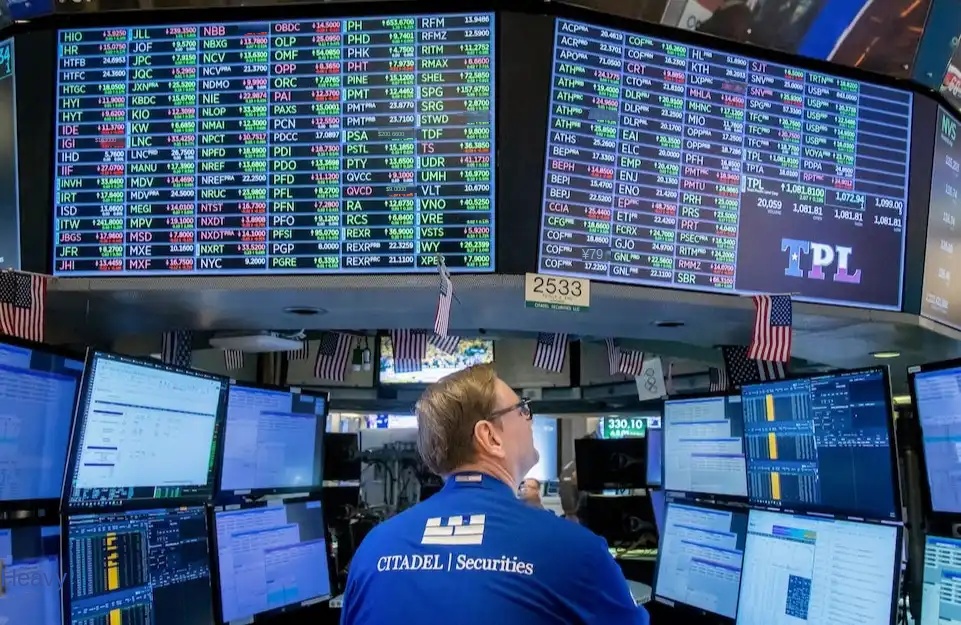
Only 3 out of 1,000 participants achieved multiple consecutive wins—how hard is it to "guess" the direction of this round of US stock earnings season?
Currently, although the third-quarter earnings season for U.S. stocks has not fully concluded, the peak disclosure period has already passed. Looking back at the companies that have reported, what is most noteworthy is not how many have "beaten expectations," but that earnings and subsequent market reactions sometimes move in the same direction and sometimes diverge. According to the settlement results of OKX prediction events, AMD's third-quarter revenue grew 45% year-over-year, meeting the preset threshold, and its price rose on the first full trading day after earnings; Robinhood's revenue hit a record, but its specified earnings per share fell short, and its price did not rise on the first day. SK Hynix's quarterly revenue and operating profit also set records, its specified profit metric fell short, yet its price rose on the first day; Microsoft and Apple beat on results but their prices did not rise.
These results include growth that was expected, as well as surprises significant enough to make one pause and re-examine the question. Whether AI investment can translate into profit, whether consumer demand will persist, and what the revenue quality of financial platforms looks like — these companies were not answering the same question. OKX Planet split two of these judgments into prediction events: one asked whether earnings met a pre-specified threshold, and the other asked whether the price rose on the first full trading day after the earnings release. Using these two questions to review the earnings season makes clearer the distance between "what report card the company delivered" and "what price the market is willing to pay for it."
24 companies, 12 with opposite answers to the two questions
We compiled 48 earnings prediction events on OKX Planet from October 20 to November 10, covering 24 companies with two types of questions per company. The combinations of performance and first-day price are as follows; among them, "earnings beat" follows the preset metric threshold for each event, and price direction follows the event settlement criteria, which is not equivalent to the specific percentage change in U.S. spot stocks.
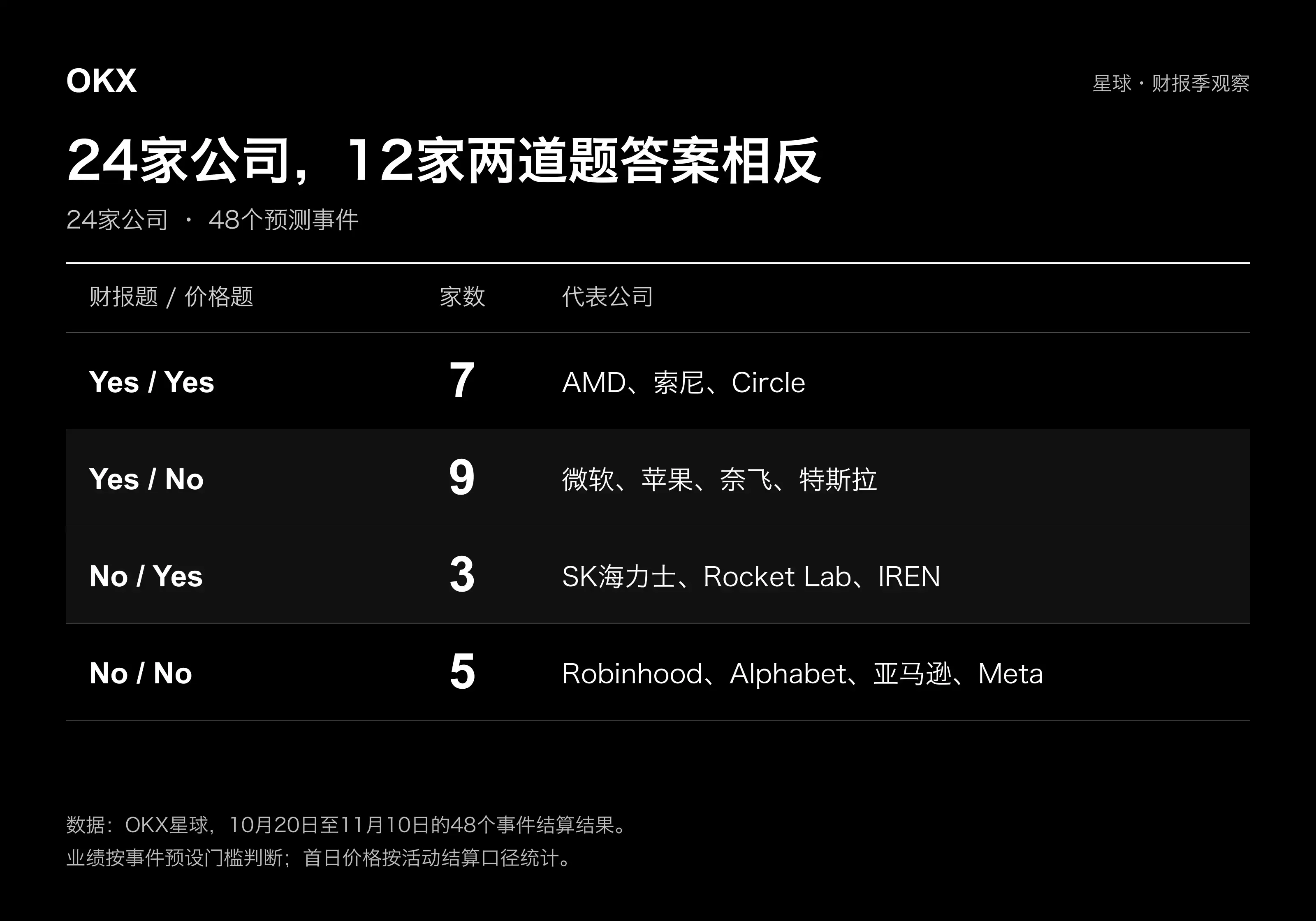
Among the 24 companies, exactly half had performance and price direction differ. More notably, of the 16 companies that beat earnings, only 7 rose on the first day, accounting for 43.8%; of the 8 companies that missed, 3 still rose, accounting for 37.5%. The difference in the proportion rising between the two groups is only about 6 percentage points.
This small sample is insufficient to estimate long-term patterns, but it shows that within this observation window, merely knowing "whether earnings beat" is of quite limited help in distinguishing whether the price will rise on the first day. The 9 companies that beat but did not rise cannot simply be uniformly explained as operational deterioration. They may still be growing, but the magnitude, quality, or sustainability of that growth did not provide enough new reasons for the price to continue higher.
Putting this back into the broader earnings season reveals two levels: corporate profits generally exceeded analyst benchmarks, but "exceeding the benchmark" itself is no longer scarce information; investors also need to judge whether this earnings report can drive upward revisions to future profit expectations. Although FactSet's S&P 500 statistics and the event thresholds for these 24 OKX companies are not on the same basis and cannot be directly compared for beat ratios, the former provides background: when beats become widespread, what truly differentiates is by how much and whether it can persist; the latter provides a comparison between performance and price reaction, revealing a point easily overlooked when只看盈利达标比例 — beating earnings does not mean the market is willing to assign a higher price. To understand this gap, one must further judge whether these performance improvements have already been reflected in prices.
The Closer to the Result, the More Accurate the Prediction?
The predictions in this round were generally optimistic about earnings. Three hours before the earnings release, 20 of 24 companies had earnings predictions leaning toward Yes, but only 16 ultimately met the threshold. Of the 6 earnings questions with inconsistent directions, 5 were cases that had been viewed favorably but ultimately fell short, involving SK Hynix, Alphabet, Amazon, Robinhood, and Meta respectively; only Oklo produced the opposite result.
In other words, the main deviation was not a broad underestimation of companies, but an overestimation of the likelihood that some companies would reach the profit threshold. The gap between industry conditions, revenue growth, and actual profit delivery is precisely what these companies need to be further broken down on. But as the result approaches, how much are these judgments revised? The changes in the two types of predictions are not the same.
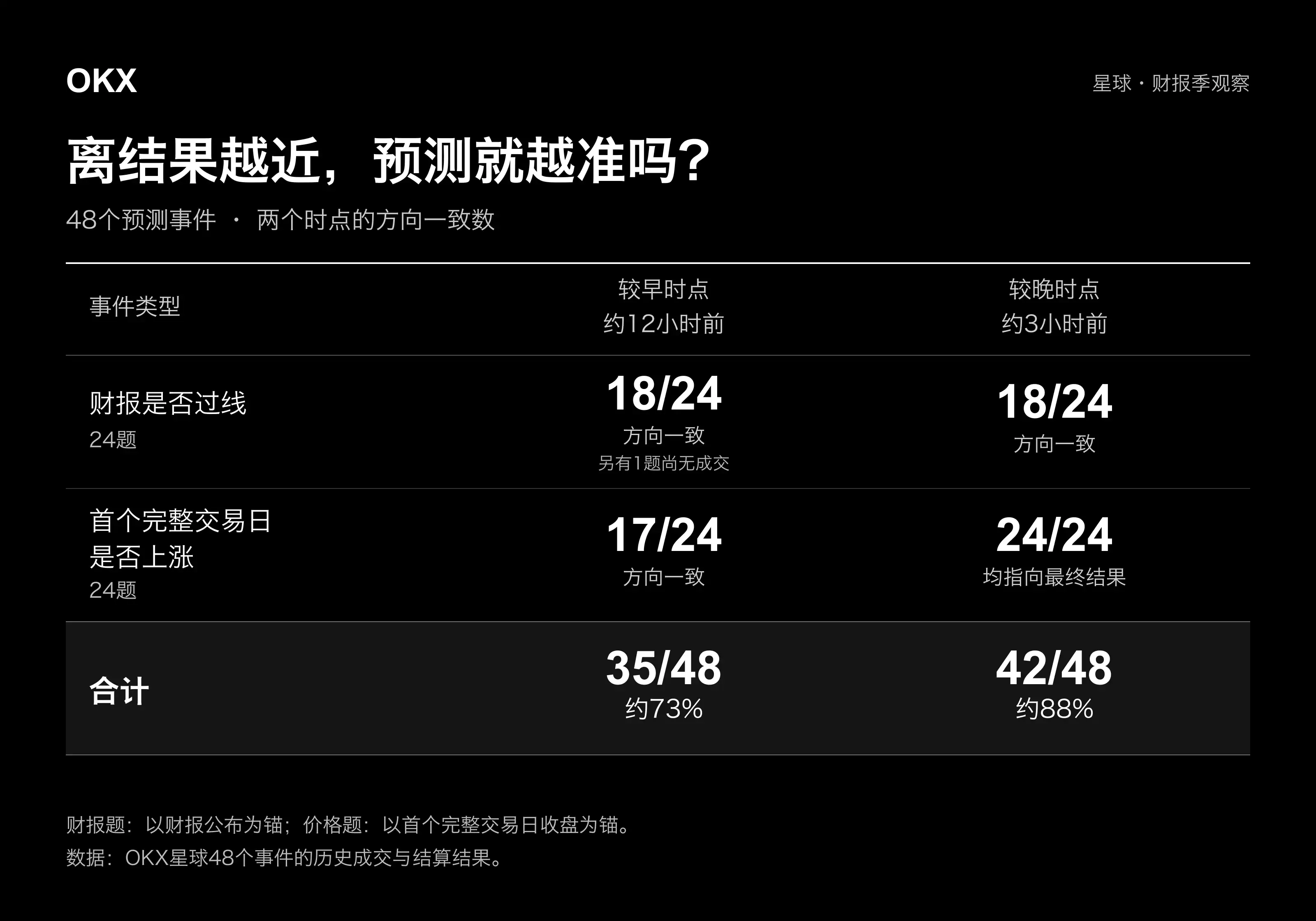
In aggregate, judgments consistent with the results increased from 35 to 42, with the share rising from about 73% to 88%. All 7 of the net increase came from price predictions, with first-day up-or-down judgments rising from 17 consistent to 24, while earnings predictions were 18 consistent at both time points. Therefore, the improvement shown in this set of data occurred in tracking market moves, not in advance estimates of corporate earnings.
The two face different information conditions. Before earnings are released, even with only 3 hours left before disclosure, participants may not have obtained new evidence sufficient to change earnings estimates, and prior optimistic or pessimistic judgments may persist. When price predictions approach the close of the first full trading day, earnings have already landed, and the market has spent most of a trading day reacting, making it easier for judgments to move toward the result. This set of data supports "new information and market feedback help revise judgments" rather than "the longer you wait, the more accurate predictions naturally become." For market research, subsequent quotes can help observe whether the market has accepted the initial interpretation of earnings, but they cannot conversely prove that ex-ante judgments are equally reliable.
How a 50% prediction divergence moves toward one answer
A reading near 50% is still not enough to form a clear judgment. Intel's earnings question had a Yes trading price of 51% 12 hours before release, and its earnings ultimately cleared the threshold; Amazon once showed a reading of 53%, but ultimately fell short. Both leaned slightly favorable, yet moved toward different results. For such companies, what is more worth studying is where the divergence lies, such as whether there is consensus on revenue growth, and whether different estimates remain on margins, expenses, or next-quarter guidance. Directly interpreting 51% or 53% as "the market is already bullish" would magnify a very small leading margin.
A stronger inclination does not necessarily point to the correct answer either. Oklo's earnings question had Yes trading prices of 20%, 18%, and 11% at 6 hours, 3 hours, and 1 hour before the earnings release, respectively, yet its earnings ultimately reached the threshold. In contrast, SanDisk rose from 57% 12 hours before release to 65% 3 hours before, with a strengthening favorable inclination, and ultimately did clear the threshold. One falling and one rising, both changes need to be explained by returning to operating information and earnings estimates; changes in quotes themselves cannot replace the evidence supporting a judgment.
7 Revisions, 5 Withdrawals of Bullish Calls
Looking further at these 7 price target revisions, Netflix, Microsoft, Tesla, Meta, and AST SpaceMobile shifted from leaning bullish to leaning non-bullish; Rocket Lab and AAOI adjusted in the opposite direction. As the trading days progressed, some of the earlier optimistic price expectations did not hold.
The relationship between forecasts and market moves is not simply "forecast first, verification later." Before earnings, quotes record what participants are willing to believe; after earnings, operating data, management guidance, and trading action in turn change the quotes. For analysts, the most valuable thing is to identify after what information the shift in judgment occurred. If bullish expectations continue to fade even after earnings meet targets, one should examine whether the previously favored growth has already been priced in, or whether new guidance has weakened it; one cannot simply infer from falling quotes which factor caused the decline.
The Earnings Numbers Are Right, So Why Does the Price Still Move the Other Way?
First, look at Robinhood. Its third-quarter revenue was $1.42 billion, up 12% year-over-year, a record; but GAAP earnings per share fell 16% to $0.51, and adjusted earnings per share also fell 3% to $0.60. Even without discussing which methodology is used for activity, the fact that revenue growth did not translate into earnings-per-share growth in tandem is already a question the earnings report itself must answer. Robinhood earnings announcement
Revenue was also not uniformly strong internally. Options and equities trading revenue grew 31% and 41%, respectively, while cryptocurrency trading revenue fell 55% and net interest revenue fell 9%. The total revenue record masked the shifts among businesses. For platforms like this, whether new revenue can offset declines in existing businesses and leave more profit behind is more important than whether total revenue hits a new high. It did not clear the profitability threshold, and the first-day price did not rise, which at least aligns with the earnings characteristic that "growth has not broadly improved profitability," rather than being a pure settlement-methodology issue.
SK Hynix presents another situation. Although the designated profitability metric did not cross the line, the company disclosed that both revenue and operating profit hit record highs; the more forward-looking information is that sales of HBM4 and high-value server products expanded, and long-term agreements have already covered more than half of capacity from 2027 to 2028. SK Hynix earnings announcement These pieces of information give investors a basis for observation beyond the current quarter's earnings per share: whether the share of high-value products can continue to rise, and whether future capacity already has demand to absorb it. Long-term agreements are not a guarantee of future profit, but they help assess the visibility of growth. This is also why a certain metric falling short in the current quarter does not necessarily overturn the judgment on subsequent operations.
The divergence in the AI supply chain is easier to see between Microsoft and AMD. Microsoft's revenue grew 19% in the quarter, operating profit grew 21%, and Azure revenue grew 48%—this is not an earnings report showing weak demand. But its operating cash flow was about $58 billion, and cash capital expenditures on fixed assets were about $39.37 billion; calculated as operating cash flow minus this expenditure, the difference was about $18.63 billion, lower than $25.66 billion in the same period last year, a decline of about 27%. This calculation does not include finance lease investments. Microsoft earnings report and cash flow statement
Profits are growing, but the cash left after investment is declining, indicating that business expansion still requires faster capital input. For cloud platforms, the next step is to prove not only that "customers need AI," but also whether the new computing power can be continuously utilized, whether pricing can cover the investment, and how depreciation and operating costs will affect future profits. Microsoft's results beat expectations but its share price did not rise on the first day — this is a thread worth continuing to study, rather than simply attributing it to "the market failing to understand a good earnings report."
AMD sits at the other end of the same investment chain. Its third-quarter revenue grew 45%, data center revenue grew 97%, and GAAP operating margin rose from 14% in the year-ago period to 21%; fourth-quarter revenue guidance midpoint is approximately $17 billion, corresponding to year-over-year growth of about 66%. AMD earnings announcement Here there is not only revenue growth, but also margin improvement and next-quarter growth expectations. Compared with merely beating single-quarter profit thresholds, this set of information is more helpful in supporting the judgment that growth can continue.
Putting the two companies together does not mean that companies buying equipment must fall and companies selling equipment must rise; rather, the same round of AI investment will leave different traces on different companies' financial statements. Platforms bear the construction and payback cycle first, while suppliers may recognize revenue and profit earlier. One cannot expect them to deliver the same cash returns in the same quarter simply because both benefit from AI.
Apple provides another clue. Quarterly revenue grew 12% and earnings per share grew 14%, but earnings per share included a tariff refund benefit of about $0.05, which also benefited gross margin by about 1 percentage point. Apple earnings report This does not deny growth in the core business, but it means that when judging next-quarter earnings, one must distinguish which improvements can continue and which come from special factors in the current period. The financial numbers are real, but sustainability still requires separate judgment.
The trend these cases collectively point to is that the quality of growth and the timing of its realization explain company differences better than a single profit threshold. To further explain first-day price action, one must also put earnings reports together with prior valuations, sector performance during the same period, and management guidance, rather than simply picking one number from the report that matches the direction of the price move.
A thousand people predicted, only three remain on multi-win streaks with 26 correct answers
Turning from the overall sample to individual judgment adds another layer of difficulty. The second season of OKX Planet's "Earnings Big Winner" attracted more than 1,400 participants; midway through the competition, only Lin Moyang, abingttt, and Speculation Lab remained. The three are tied for first with multi-win streaks of 26 consecutive correct answers, splitting 10,000 USDT equally, with each receiving about 3,333 USDT, and each used one revival opportunity during the period.
The difficulty of a continuous challenge lies in the fact that the research subjects keep changing. Cloud platforms, chipmakers, trading platforms, and consumer electronics companies all have different variables affecting profit and valuation. The reason that was correct in the previous round may no longer be the most important factor by the time the next company comes around. The mid-competition interviews with the three contestants left a record of how they handled such differences.
First Miss: All Three Stumbled on SK Hynix
All three contestants' first misses occurred on SK Hynix. Lin Moyang and abingttt got the earnings question wrong, while Speculation Lab missed on the first-day price move question. In a mid-contest interview, Lin Moyang mentioned that he misunderstood the relationship between the trading cutoff and the settlement snapshot, and adjusted his judgment to earn XP, consuming a revival opportunity. His research habit is to collect information along the upstream and downstream supply chain, use AI to integrate company business and industry development materials, and then discuss and verify. The value of this approach lies in placing a single company's growth back into the industrial chain—Microsoft's investment can become supplier demand, but one must continue checking whether orders, deliveries, and profits actually correspond.
Also stumbling on SK Hynix, the earnings question and the price move question exposed different problems: the former required re-examining profit estimates, while the latter required understanding why the market was still willing to trade future demand when quarterly metrics fell short of thresholds. This corresponds to the divergence that repeatedly appeared this round—industry prosperity does not guarantee every earnings metric meets the bar, and missing earnings targets does not automatically erase future growth value.
abingttt and Speculation Lab also had different methods. abingttt put EPS, revenue, consensus expectations, and company guidance together, and checked how much optimism had already been priced in before the earnings report; Speculation Lab separated earnings estimates from price judgments, referencing options implied volatility and OKX perpetual contract long/short ratios, and also reading Planet discussions that took the opposite side. Each type of information has its use—earnings reports help estimate how much a company can earn, while derivatives and prediction quotes help observe what the market has already bet on; the two cannot substitute for each other.
The Three on a Winning Streak—Which Questions Did They Finally Get Wrong?
In the final round, all three judged that AMD and Circle would not rise on the first full trading day after earnings, but the actual results were both gains. Both companies met earnings thresholds, and first-day price action moved in the same direction; this time, what all three missed was not the earnings judgment but the price judgment.
Looking at the earnings reports themselves, AMD simultaneously offered data center expansion, margin improvement, and forward growth guidance—one could not simply assume it would replicate the same path just because Microsoft and Apple previously "beat estimates but didn't rise." Studying earnings requires both identifying anomalies and accepting that strong results and rising prices can indeed move in the same direction. "Beat expectations but still fall" is only one scenario to guard against; it should not become another mechanically applied formula.
As Earnings Season Wraps Up, What Usable Judgments Remain?
The judgment more worth keeping from this earnings season is not "whether US stock earnings are good or bad," but that earnings growth, growth quality, and valuation tolerance are being tested separately. In FactSet statistics, the S&P 500's forward P/E fell from 19.0x at the end of September to 17.7x on November 6—a decline in the multiple of price relative to future earnings expectations does not mean corporate earnings are simultaneously weakening. Subsequent earnings still need to be verified along these directions: whether AI suppliers' orders can continue converting into profits, whether new cloud platform investments can generate cash returns, and whether revenue growth at consumer and financial companies can improve EPS. The answers to these questions determine whether growth is becoming more solid or requires more capital and more time to support.
The value of predictions should also be measured within this process. Before earnings reports, they leave market expectations; after earnings are released, they record how these expectations are revised by operating data and market conditions. The truly useful feedback is to identify which growth was overestimated, which investment was underestimated, or mistakenly treating short-term profits as long-term trends, and then adjust judgments accordingly. Being right about the direction does not equal making money. Compared with remembering a string of wins and losses, what is more valuable is continuously refining research methods.
Welcome to join the official BlockBeats community:
Telegram Subscription Group: https://t.me/theblockbeats
Telegram Discussion Group: https://t.me/BlockBeats_App
Official Twitter Account: https://twitter.com/BlockBeatsAsia

 Related Articles