Jensen Huang has locked everything about Nvidia into the future—except himself.

The original title: "Jensen Huang Locked Everything About Nvidia Into the Future—Except Himself"
The original author: Dongcha Beating
Nvidia released the strongest quarterly earnings report in the company's 33-year history.
Quarterly revenue was $115.8 billion, more than double that of a year earlier. Vera Rubin, which had just entered mass production, sold nearly $20 billion in its first quarter, and the networking business generated more than $21 billion in quarterly revenue. Management raised its revenue growth forecast for the next fiscal year from 70% to 75%. If the forecast is met, Nvidia's revenue in fiscal 2028 will be around $740 billion.
The person who read out these numbers on the conference call was interim CEO Colette Kress.
Speaking before her was Chairman Harvey Jones, a position that had been established less than a week earlier. Jones stated on behalf of the board that the board unanimously accepted Jensen Huang's resignation and "does not intend to let him return."
Jones joined Nvidia's board in 1993, the year the company was incorporated in California. Among the current ten directors, including Jones, two have served since 1993 through today. They accompanied Jensen Huang through several life-or-death junctures over more than thirty years and understand better than anyone what he means to this company.
Several of the most important numbers in this earnings report can almost all be traced back to Jensen Huang's own decisions.
Why would a group of people who know him best let him leave within three days and publicly rule out the possibility of his return?
We reviewed Nvidia's earnings reports, 8-Ks, proxy statements, and all Form 4 filings over the past year in an attempt to find the answer to this question.
The Tracks
The board dared to let go at this moment precisely because its confidence came from Jensen Huang himself. The tracks Nvidia will follow over the next two years had already been laid by him.
Among the key decisions he made, the earliest one was seven years ago.
On March 11, 2019, Nvidia announced the acquisition of Israeli networking company Mellanox in an all-cash transaction at $125 per share, for a total price of about $6.9 billion. At the time, Nvidia's total market capitalization was only $91 billion. Intel also participated in the bidding, with a per-share offer only $2.5 lower than Nvidia's.
At that time, the outside world still saw Nvidia as a company that sold gaming graphics cards. Jensen Huang's judgment was that future data centers would be giant computing engines connected by tens of thousands of computing nodes. The networking business bought for $6.9 billion that year generated more than $21 billion in revenue this quarter, or more than $84 billion annualized, far exceeding Cisco's total revenue for an entire year.
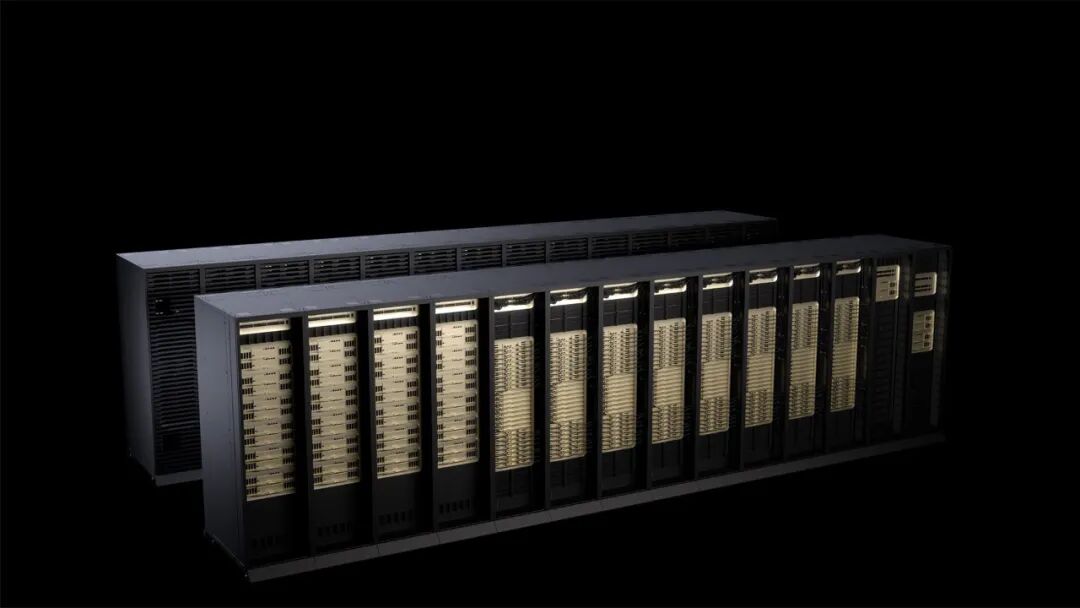
Vera Rubin platform's rack system, NVIDIA official product illustration
Image source: NVIDIA
In October 2023, NVIDIA unveiled its "one generation per year" product roadmap in investor materials. That cadence ran into trouble in the summer of 2024. Blackwell was found to have underlying design flaws, forcing NVIDIA to redo photomasks and delay shipments. Jensen Huang publicly took responsibility, saying it was "100% NVIDIA's fault." Subsequently, the GB200 rack underwent repeated design revisions due to overheating issues, and several major cloud providers cut or delayed some orders.
Learning from that lesson, NVIDIA set a rule at its March 2025 GTC conference for the next-generation Vera Rubin: continue using Blackwell's Oberon rack architecture.
As a result, cloud providers would not need to retrofit data centers and liquid cooling systems just to swap in new chips. Twenty months later, Rubin sold nearly $20 billion in its first quarter of mass production, becoming the fastest-ramping product in NVIDIA's history. Kress described the transition on the earnings call as "exceptionally smooth."
In 2026, the world is facing a memory shortage. According to TrendForce, conventional DRAM contract prices rose 93% to 98% quarter-over-quarter in Q1 this year. NVIDIA's own financial reports also noted that memory price increases suppressed demand for consumer PCs.
NVIDIA locked in supply before the industry-wide shortage hit. As of late October 2025, its supply chain purchase commitments stood at $50.3 billion, rising to $95.2 billion, $119 billion, and $279 billion over the following three quarters. As of October 25 this year, that figure reached $390 billion, growing nearly 8x over the year, with the majority being memory. TrendForce estimates that in 2026, NVIDIA alone will account for 58% of global HBM demand.
Of that $390 billion, $203 billion falls in fiscal year 2028.
GPUs sold years ago are still creating value for NVIDIA.
Last November, big short Michael Burry publicly questioned whether cloud providers were deliberately extending GPU depreciation schedules to inflate profits. NVIDIA issued a dedicated 7-page memo in response. A year later, Kress provided data on the earnings call: rental prices for GPUs across all generations have risen across the board, with B300 up more than 60% since launch, and Hopper from several years ago seeing renewal rents on multi-year contracts rise to as much as double the original.
Older cards become more valuable with use—not only due to supply and demand, but also thanks to CUDA. After a chip leaves the factory, each software iteration allows the same chip to deliver a bit more computing power. Jensen Huang has cultivated this software ecosystem for twenty years.
These four decisions formed the board's first layer of consideration. Rack specifications, a $390 billion procurement commitment, and a twenty-year software ecosystem are all in place. Over the next year and a half, Nvidia will run along the tracks Jensen Huang has laid.
The board can replace the CEO, and this machine will keep running as usual.
Working Capital
The machine is running normally, but Nvidia's internal disagreement is over how to use the money.
Acquiring Mellanox and locking up HBM used the same method: while others were still hesitating, use cash to buy up future scarce resources. Starting in the second half of 2025, Jensen Huang applied this method to customers.
At the time, Nvidia faced a situation where demand remained strong, but customers no longer had enough money. The chips OpenAI and a group of neoclouds wanted had exceeded what their balance sheets could support. Jensen Huang's phrasing was, "What's missing in the middle is the working capital to drive growth."
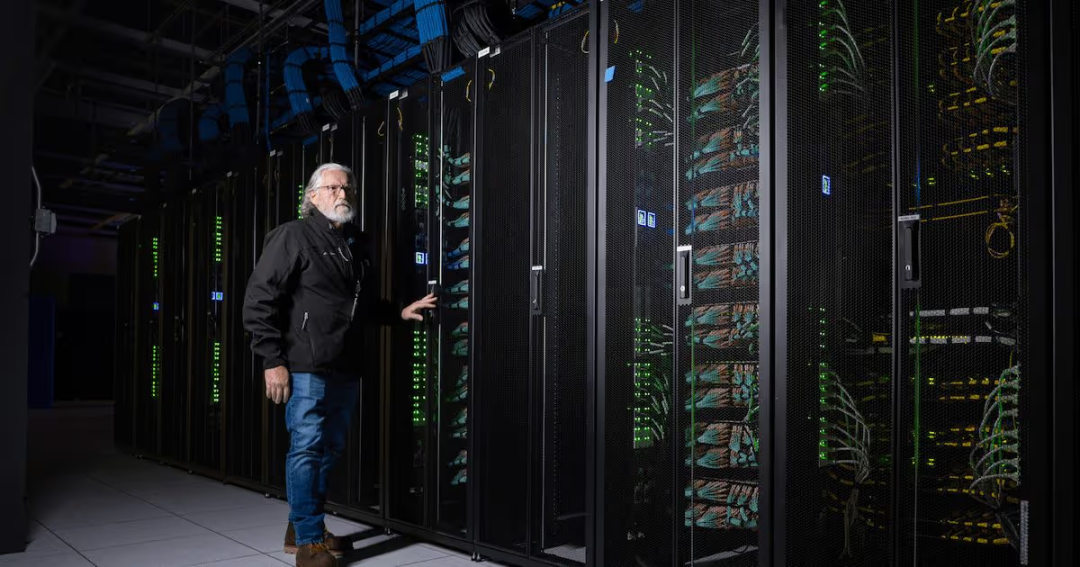
Data center server room in the CoreWeave and Nvidia partnership announcement
Image source: CoreWeave
If customers can't borrow money to buy cards, Nvidia will put up the money itself.
In September 2025, Nvidia signed a $6.3 billion agreement with CoreWeave, committing to backstop purchases of CoreWeave's unsold computing power through 2032. In the same month, Nvidia proposed an investment intent of up to $100 billion in OpenAI. Two months later, it announced an investment of up to $10 billion in Anthropic. In February this year, OpenAI announced $110 billion in financing, with Nvidia contributing $30 billion; in March, Nvidia invested another $2 billion in Nebius. In the first three quarters of this fiscal year, Nvidia's spending on equity-type assets totaled $58.1 billion.
By August, Nvidia began providing direct guarantees.
On August 10, Nvidia signed memoranda with Apollo, BlackRock, Blackstone, Brookfield, Goldman Sachs, and KKR, planning to mobilize more than $500 billion in third-party capital for AI infrastructure, with final agreements still pending signature. Jensen Huang said Nvidia could choose to guarantee up to 25% of that, or at most $125 billion. A week later, Nvidia also provided credit support for SB Energy's planned AI campus in Pike County, Ohio, with a maximum guarantee of $105 billion, covering part of the rent and electricity costs for roughly 4.25 gigawatts of IT capacity in the first phase. After completion, the campus will be leased to OpenAI under a 20-year long-term contract.
As of October 25, Nvidia disclosed a maximum aggregate exposure of $118 billion across various guarantees. According to CNBC's tally based on August filings, Nvidia's total off-balance-sheet commitments exceed $500 billion, most maturing by fiscal year 2029.
Jensen Huang said at the time that Nvidia's AI factory platform "is now an investable asset." These guarantees all carry maximum exposure caps, and the Pike County campus is backed by OpenAI's 20-year lease. As of the latest quarter, Nvidia has not paid out on any guarantee. Nvidia has thus become, beyond a chip supplier, a financier of AI infrastructure.
The market has had lingering doubts about this arrangement. On July 26, The Wall Street Journal reported that Nvidia was in talks for up to $250 billion in financing guarantees. From early May to early October, Nvidia's results were still accelerating, yet its forward P/E fell from about 24x to about 17x.
On October 6, Nvidia's stock hit an all-time high of $239.24. Then the debt-fueled neoclouds ran into trouble first. By October 24, shares of CoreWeave, Nebius and IREN had all fallen more than 30% for the month, CoreWeave's credit default swap spread had widened past 11%, and its 2031 and 2032 bonds were yielding over 15%. Moody's sees guarantees as the fastest-growing off-balance-sheet financing tool in 2026. How much of this exposure investment-grade AI companies can actually absorb is, according to Moody's Vice President David Gonzales, "the center of all our discussions right now."
October 28 was the last trading day before The New York Times first reported on Huang's personal relationships; Nvidia closed at $215.38, down 10% from its peak. This correction occurred before the controversy, with pressure coming from credit risk on the customer side.
After the report came out, the stock fell faster. By November 17, Nvidia closed at $155.46, a 35% drawdown from its peak.
After the November 17 earnings release, Nvidia's P/E based on next fiscal year's expected earnings was just over 10x. On the morning of November 18 Beijing time, the NVDA perpetual contract on-chain at trade.xyz was quoted at $160.94, 3.5% above the Nasdaq closing price. Record earnings brought a bit of premium, but market caution has not dissipated.
Shifting Gears
Inside Nvidia, the person most cautious about the guarantee pace was Colette Kress.
According to The Wall Street Journal, this summer, Nvidia's finance team held an internal meeting to discuss whether to provide billions of dollars in credit guarantees for some data center operators that cannot afford chips. Kress raised questions within the CFO's purview: how to define which deals truly benefit Nvidia, how to price guarantee risks, and how to calculate returns. Jensen Huang focused on the other end—the working capital gap in the middle of the industry chain. According to reports, the two disagreed at the meeting. The details of this meeting come from only one anonymous source.

Nvidia Interim CEO and Chief Financial Officer Colette Kress
Image source: NVIDIA
Another matter was also reported. The guarantee for the OpenAI campus was initially discussed at a scale of $250 billion, and Nvidia ultimately committed a credit support cap of $105 billion. According to TechCrunch citing The Wall Street Journal, it was Kress who drove the reduction in scale.
On the evening of November 11, the board accepted Jensen Huang's resignation and handed the interim CEO position to Kress. The company did not appoint a new CFO, and Kress holds both roles and continues to oversee finance.
In her first earnings call as host, Kress said Nvidia's future support for the ecosystem would be "disciplined and selective," and that the company is "rigorously evaluating future investments, commitments, and guarantees." In the written CFO commentary she issued, she wrote that many neoclouds and frontier labs are expanding "faster than their balance sheets and long-term credit profiles can support."
Bernstein analyst Stacy Rasgon asked in the Q&A session whether this was a new set of talking points.
Kress replied, "Is it new? No. Did we change anything? No."
Judging from the capital uses she subsequently discussed, most of the arrangements Jensen Huang left behind will continue. She called stock buybacks the "top priority," and said suppliers are the "number one priority," with some suppliers needing prepayments to expand capacity. Committed investments will be honored as usual. Customer financing and guarantees were discussed last, and she said "some of it will be done," but each deal requires extensive evaluation.
Some speculated that the personal scandal was merely a pretext, and what the board truly wanted to change was Nvidia's approach to guarantees.
Self-Protection
Even if the board and Kress had concerns about off-balance-sheet exposure, the conventional corrective measure would be for the board to reclaim approval authority over guarantees. Why force the founder out within 72 hours?
On November 8, Nvidia announced the launch of an independent investigation, and a company spokesperson's line was still "Jensen Huang will continue to lead the company." Three days later, on November 11, his resignation took effect.
The outside world finds it hard to understand because the outside world looks at market cap. The ten people on the board had to consider their own legal liability. This was the board's second layer of consideration.
In today's U.S. corporate governance environment, when encountering such incidents, swift action is the board's standard move.
According to CNBC, the direct reason for the board's change in attitude was that the media subsequently reported another relationship involving Jensen Huang, said to involve the company's internal reporting line. Nvidia's Code of Conduct stipulates that employees and directors must avoid conflicts between personal interests and corporate obligations, and personal relationships are among the enumerated circumstances. When a conflict arises, the individual must "immediately recuse themselves from related decisions," and any waiver requires written approval from the compliance committee.
Once a reporting line is involved, the matter moves from media reports into Delaware's legal framework.
Over the past eight years, major companies have handled such incidents in days. In 2018, after the Intel board learned of Brian Krzanich's office romance, it had him step down in about a week, with the CFO also serving as interim CEO. In 2019, McDonald's board voted on November 1 and announced Steve Easterbrook's departure on November 3. In 2023, BP's Bernard Looney resigned immediately. In 2025, Nestlé directly fired Laurent Freixe.
The McDonald's board already paid the price for moving slowly.
At the time, the McDonald's board first gave Easterbrook a generous severance package. Later, more problems surfaced, and the company had to turn around and sue its former CEO, recovering $105 million only by 2021. In 2023, the SEC took enforcement action against McDonald's over disclosure issues. That same year, the Delaware Court of Chancery explicitly ruled in a shareholder lawsuit that corporate executives, like directors, bear oversight obligations.
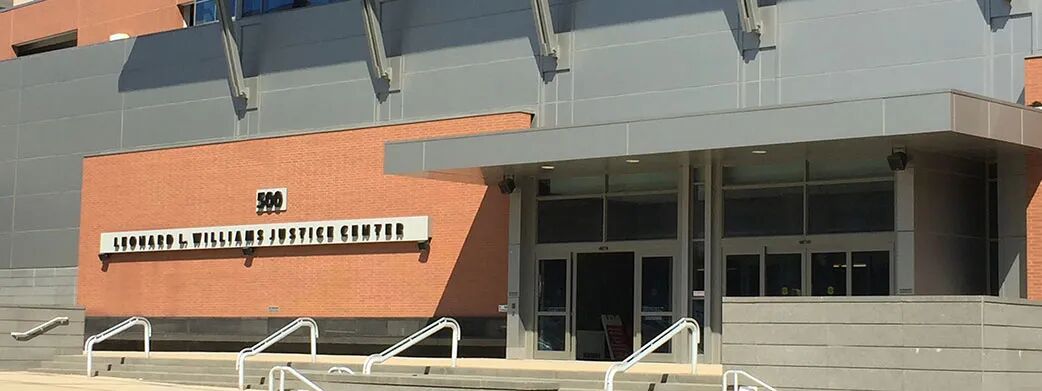
One of the Delaware Court of Chancery's locations in Wilmington: the Leonard L. Williams Justice Center | Image source: Delaware Courts
Nvidia is also incorporated in Delaware.
The plaintiffs' lawyers moved faster than the board. Around November 9, the federal court in Northern California had already received a securities class action complaint, with a class period running from October 9, 2025 to November 8 of this year. A shareholder derivative suit was subsequently filed. According to The Wall Street Journal, the SEC has also opened a civil investigation. They are all focused on the same question: how much did the board know, and from what day did it know it.
Will Fahey, a managing director in charge of directors' liability insurance at insurance brokerage Marsh, believes that in the derivative suit, the plaintiffs have a "plausible argument" that Jensen Huang controls the board.
This is the plaintiffs' claim, but it strikes precisely at the board's weakest point. According to Semafor, Nvidia directors have an average tenure of nearly 15 years, and the board does not include a single current or former CEO of an S&P 500 company. At the shareholders' meeting in June this year, institutional investors had already expressed dissatisfaction. Stephen Neal, the 77-year-old lead independent director and chairman of the nominating and governance committee, received only 86.7% approval, the lowest among all directors. Jones, who now serves as chairman, also received only 90.66% of the vote at that time.
Under Delaware corporate law, once directors are found to have acted in bad faith or breached their duty of loyalty, the company generally cannot cover their compensation. The only backstop left is directors' liability insurance, and policies have coverage limits and exclusions, with any excess to be borne personally by the directors.
For a board questioned as being controlled by its founder, the most direct way to prove its independence is to have the founder leave.
On November 10, Nvidia's independent directors announced that they had engaged Wall Street's top law firm Wachtell Lipton and Joon H. Kim, a former acting U.S. Attorney for the Southern District of New York, to conduct an investigation.
The board also faces a deadline: December 4.
That day is the statutory deadline for Nvidia to file its third-quarter 10-Q report, which has not yet been filed. Under the Sarbanes-Oxley Act, the CEO and CFO must each sign personal certifications on the 10-Q, guaranteeing that internal controls are effective and that there is no fraud; signing false certifications carries criminal liability. The CEO certification for the previous quarter was signed by Jensen Huang, while both certifications this quarter will be signed by Kress alone.
While the independent investigation remains unresolved and two lawsuits are underway, any hint from the board welcoming Jensen Huang back would be seized upon by plaintiffs in court as proof that the board still answers to him.
3.58%
Is there any chance Jensen Huang could return to his post with employee support, as Sam Altman did in late 2023?
The odds are very slim.
Altman was able to return because, first, his departure did not involve company compliance provisions, and second, OpenAI was a nonprofit structure at the time, and even Microsoft had no board seat. At a standard U.S. public company, once matters enter compliance procedures and litigation, the board has almost no room to maneuver. We reviewed cases from the past two decades and found no CEO of a public company who departed amid a personal-relationship controversy involving internal reporting lines and later returned to the same role.
NVIDIA has only one class of common stock, one share one vote.
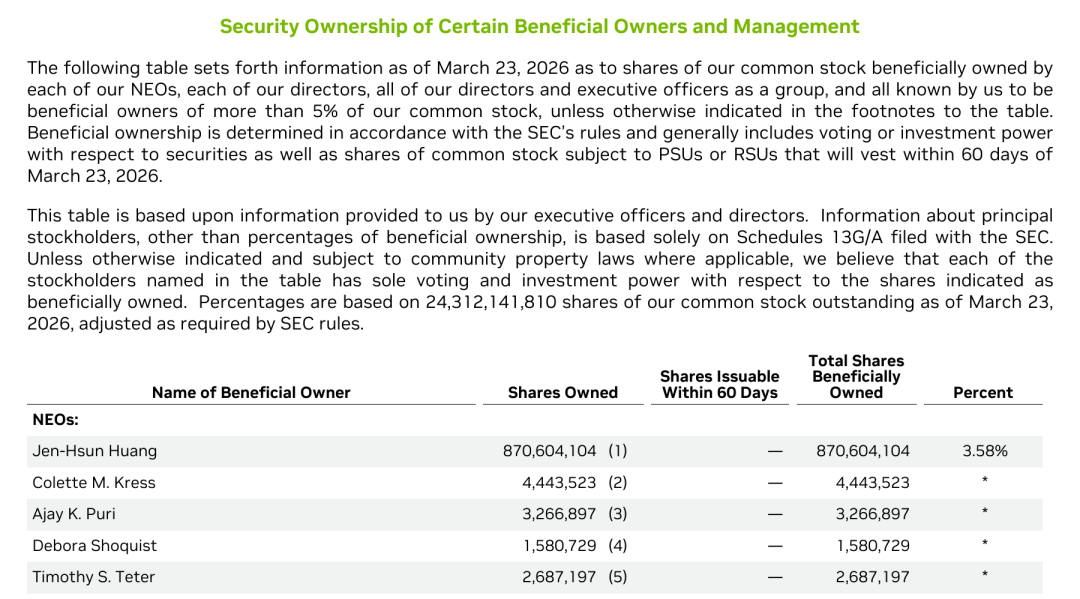
As of March 23, 2026, Jensen Huang beneficially owned 3.58% of NVIDIA's common stock
Source: NVIDIA 2026 proxy statement
According to the March proxy statement this year, Jensen Huang beneficially owns approximately 870 million shares, representing 3.58% of total share capital. He is NVIDIA's largest individual shareholder, yet his voting power is also only 3.58%. By comparison, Zuckerberg holds roughly 13% economic interest in Meta, but thanks to the AB dual-class share structure, he alone controls about 60% of voting power.
NVIDIA went public in 1999, back when Silicon Valley had not yet popularized super-voting rights for founders. Over more than three decades, Jensen Huang built moat after moat for NVIDIA — CUDA, NVLink, rack standards, storage lock-in orders — not one of them was built for himself.
If he wanted to return through a shareholder vote, the company's charter leaves him very narrow room.
Under NVIDIA's proxy access provisions, shareholders holding 3% or more for over three consecutive years may nominate director candidates, but the cap is 2 people or 20% of board seats. The next nomination window is between February 24 and March 26, 2027. To bypass the regular process and convene a special shareholders' meeting, shareholders holding a combined 15% or more for at least one year would need to initiate it.
Even with two seats, that's far from a majority on a ten-person board.
The real votes belong to Vanguard and BlackRock. These passive index funds prioritize compliance and corporate governance guidelines, and so far, neither has publicly commented on Jensen Huang.
There are many speaking out for him. Brad Gerstner of Altimeter and Gavin Baker of Atreides co-signed an open letter to the board, urging them to act "slowly, prudently, and carefully" and leave room for Jensen Huang's return. But according to the latest 13F filings, the two funds together hold only about 11.48 million shares, less than 0.05% of Nvidia's total share capital.
Many support him, but few hold the votes.
Even the 3.58% under Jensen Huang's name is not entirely at his sole discretion.
According to Forbes estimates, on October 2 this year, Jensen Huang's net worth reached $204.5 billion, ranking seventh globally. By November 17, that figure had dropped to about $135 billion, a decrease of nearly $70 billion in a month and a half. According to Bloomberg statistics, 97% of his net worth is in Nvidia stock alone. SEC filings show that this year, aside from donations, he has not sold a single share on the open market.
His latest Form 4 filed on September 18 shows that the shares under his name are distributed across multiple legal entities. He personally directly holds about 70.1 million shares. About 468 million shares are in a family living trust where he and his wife Lori serve as co-trustees. Another approximately 133 million shares are held by six limited liability companies named TARG, whose sole shareholder is also this joint spousal trust.
There are also about 140 million shares in two irrevocable trusts. By law, once assets are transferred into an irrevocable trust, the settlor cannot freely retrieve them. In March this year, two annuity trusts established in 2016 matured, and about 58.96 million shares were transferred into one of them. According to this year's proxy statement, about 58.68 million shares are under the Huang couple's charitable foundation, with Lori Huang serving as president; the couple has no economic interest in these shares. Last December, nearly 40 million shares were transferred through a partnership and a trust into an independently managed limited liability company, and Jensen Huang no longer has beneficial ownership of these shares.
These arrangements include annuity trusts, irrevocable trusts, and charitable foundations. As of today, most of the shares under Jensen Huang's name either require his wife's co-signature to move or are no longer under his control.
Those who have almost all their wealth riding on Nvidia have at most only 3.58% of a say in who leads Nvidia.
The board has already engaged headhunting firm Heidrick & Struggles to find the next CEO. This is reportedly the first time in Nvidia's thirty-three-year history that it has looked externally for a CEO.
Nvidia had no established succession plan in the past, which is related to Jensen Huang's views on handing over the reins.
In March of this year, Jensen Huang appeared on Lex Fridman's podcast, when Nvidia was at the height of its prominence. On the show, he talked about his management style: 60 executives report directly to him, with no middle-management buffer in between, and he never does one-on-one conversations with subordinates, "because it's just impossible."
Later in the show, Fridman asked him whether he thinks about death and whether he is afraid to die.
Jensen Huang said he is famously not a believer in succession plans. What he wants to do is keep passing on knowledge so that the company does not have to depend on any one person. As for the ending, he hopes to die at his post.
Original link
Welcome to join the official BlockBeats community:
Telegram Subscription Group: https://t.me/theblockbeats
Telegram Discussion Group: https://t.me/BlockBeats_App
Official Twitter Account: https://twitter.com/BlockBeatsAsia

 Related Articles