Is Anthropic's IPO overpriced? DCF model suggests fair value is only $53.
TL;DR
· Valuation divergence is stark: Capital Times author Ihor Pokhyton estimates Anthropic's DCF-weighted value at approximately $53 per share, about 24% to 32% below the proposed offering price of $70 to $78; conversely, the offering price represents a premium of about 32% to 47% over the estimated value.
· Growth remains fast but is decelerating: third-quarter revenue was approximately $17 billion, up about 12x year-over-year, yet the quarter-over-quarter increase slowed from about 140% in the prior quarter to 47%.
· Margins hinge on compute efficiency: third-quarter server and infrastructure costs as a share of revenue rebounded from 48% to 58%, and long-term margin prospects still face scrutiny.
· The offering price front-loads a decade of growth: under the assumption of $430 billion in revenue ten years out, sustaining a $70 to $78 price would require long-term operating margins of approximately 48% to 54%.
Anthropic, the company behind Claude, is bringing one of the most astonishing growth stories in the AI industry to the public markets. But does a company growing fast enough mean investors can buy at any price?
On November 10, Anthropic disclosed in an updated prospectus a proposed IPO price range of $70 to $78 per share. Based on fully diluted shares outstanding after listing, that equates to a valuation of approximately $1.22 trillion to $1.36 trillion. In an analysis published on November 17, Capital Times author Ihor Pokhyton instead arrived at a weighted valuation of approximately $924 billion, or $53 per share, using a discounted cash flow (DCF) model.
Using $53 as a reference, even at the low end of the range at $70, the premium reaches about 32%; at $78, it reaches 47%. This is not to say Anthropic lacks room to grow, but rather that the current price requires investors to believe its expansion and profitability over the next decade will consistently surpass the historical experience of most tech giants.
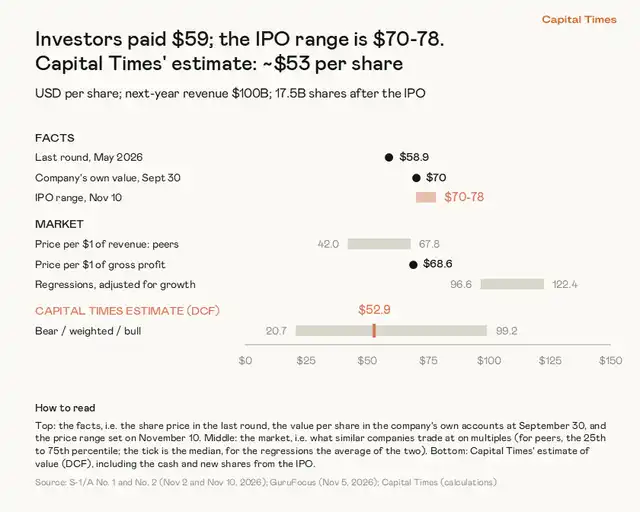
Figure 1: Comparison of market offering price, previous funding round price, and Capital Times' DCF valuation. Source: Capital Times.
Behind the 12x Growth: Compute Costs Are Testing Profitability
From a financial data perspective, Anthropic is indeed experiencing extremely rare expansion. In the third quarter of 2026, the company's revenue was approximately $17 billion, compared with only about $1.4 billion in the same period a year earlier, growing about 12x in one year. By comparison, even Nvidia's strongest quarter during the AI boom saw year-over-year revenue growth far below that multiple.
The expansion of paying customers is equally evident. The number of customers spending more than $100,000 annually increased from about 950 to more than 11,900; customers who were already using its services a year ago are now spending about 9x what they did then. This shows that growth is not only coming from new customers—existing customers are also continuously increasing their AI usage.
But on a high base, growth is beginning to decelerate. In the second quarter of this year, Anthropic's revenue grew to about 2.4x quarter over quarter, while in the third quarter it was about 1.5x, meaning the quarter-over-quarter increase slowed from about 140% to 47%. The company also warned investors in its prospectus that future growth rates are expected to continue declining.
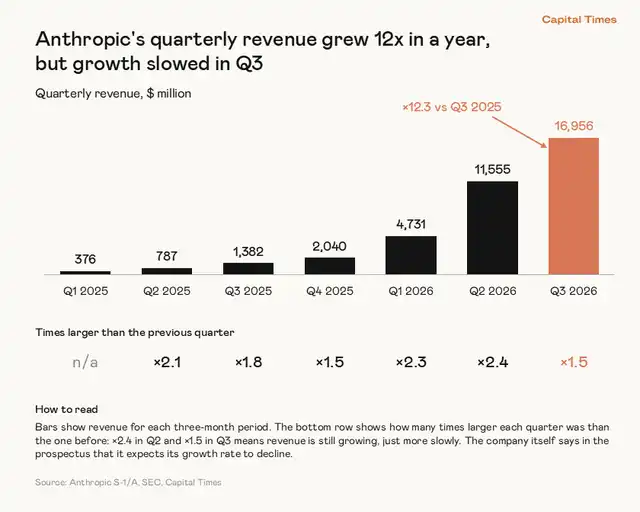
Figure 2: Anthropic's quarterly revenue from Q1 2025 to Q3 2026; the latest quarter's year-over-year growth was about 12x, but quarter-over-quarter growth slowed. Source: Capital Times.
On the other hand, Anthropic is no longer just an AI company whose growth is supported by financing. Its book loss for the first nine months was as high as $104 billion, but about $94 billion of that stemmed from fair value remeasurement of convertible notes and was not a cash outflow for the period. After excluding one-time items and including stock-based compensation expenses, the company's operating margin in the last two quarters reached 8.4% and 8.2%, respectively; operating cash flow for the first nine months also reached about $6.6 billion.
However, from just achieving operating profitability to the long-term high margins needed to support a trillion-dollar valuation, there is still a key threshold: compute costs.
In the author's view, the key to determining Anthropic's long-term value is not only how strong the models are and how fast customer growth is, but also how much must be paid for servers and compute for every dollar of revenue created.
In the third quarter of 2026, Anthropic's compute and infrastructure spending reached $9.9 billion, with a cumulative total of about $18.8 billion in the first nine months. Previously, this type of cost as a share of revenue had declined for five consecutive quarters, from 251% to 48%, once showing that the company was gaining economies of scale. But the third quarter reversed: compute costs rose 77% quarter over quarter, faster than revenue growth of 47%, and the cost share rebounded to 58%.
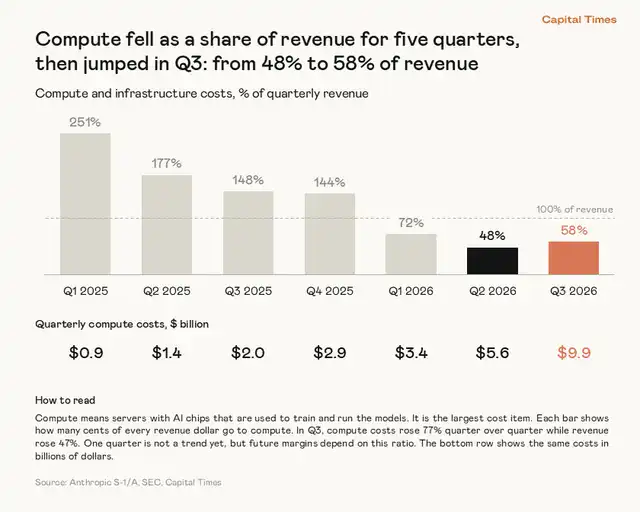
Figure 3: Compute and infrastructure costs as a percentage of quarterly revenue, rebounding from 48% to 58% in Q3. Source: Capital Times.
Anthropic explained that to meet demand, the company purchased additional compute capacity through higher-cost short-term contracts, which drove up spending for the quarter. A single quarter is not enough to prove a long-term trend reversal, but whether compute costs can continue to decline is directly tied to the ceiling on future profit margins.
More importantly, Anthropic has signed approximately $895 billion in server, cloud services, and data center-related purchase and lease commitments, with payment periods extending to 2045. Some of these contracts carry termination rights or conditional clauses and are not all irrevocable debt; but they still reflect the massive infrastructure investment the company relies on to sustain its AI expansion.
After the IPO is completed, the company is expected to hold approximately $213 billion in cash, with related payments over the next 12 months approaching $70 billion. The immediate funding pressure may not be the core issue. The real risk is that if revenue growth slows faster than expected, long-term compute commitments could begin to squeeze profits.
Why does DCF only yield $53? What growth assumptions does the offering price imply?
Unlike deriving market prices from peer price-to-sales ratios, DCF attempts to calculate what a company's future cash flows are worth today. The author's model mainly depends on three factors: revenue scale in ten years, mature-stage operating margin, and cash flow discount rate.
The author projects Anthropic's revenue will reach approximately $100 billion in 2027. Based on the annualized revenue run rate of approximately $81 billion as of October this year, this is not a particularly aggressive near-term assumption. But for valuation purposes, whether next year's revenue comes in at $85 billion, $100 billion, or $120 billion is not the decisive variable; what really drives the valuation gap is the scale of the business ten years out.
In the base case, the author assumes Anthropic's annual revenue reaches $430 billion in ten years, with a mature-stage operating margin of 30%, mainly referencing Alphabet's growth trajectory after crossing the $100 billion revenue threshold and AWS's average margin over the past eight years. The bear case assumes revenue of $250 billion and a margin of 21.5%; the bull case assumes revenue of $715 billion and a margin of 40%.
The model uses an 11.6% discount rate for the first five years, gradually declining to 9% thereafter, and separately accounts for the possibility of business failure. After incorporating IPO new shares and raised funds, the bear, base, and bull cases correspond to approximately $21, $46, and $99 per share, respectively. Weighted at 25%, 50%, and 25%, the result is approximately $53.
A distinction needs to be made here: $53 is not the valuation under the base-case scenario, but rather the weighted result of three scenarios. It is a model estimate built on a set of long-term operating assumptions, not a precise target transaction price.
To test the $53 valuation conclusion, the author further back-solved: if the IPO price of $70 to $78 is reasonable, how much revenue and profit would Anthropic actually need to generate in ten years?
Under the assumption of a 30% long-term operating margin, supporting $70 per share would require annual revenue of approximately $757 billion in ten years; supporting $78 would require approximately $868 billion. As a scale reference, the original article lists Amazon's trailing twelve-month revenue at approximately $797 billion. In other words, Anthropic would have to grow within a decade to roughly the same size as, or even larger than, today's Amazon.
If revenue only reaches the author's base-case scenario of $430 billion, then to support the IPO price, the long-term operating margin would have to be raised to approximately 48% to 54%. That is higher than Microsoft's operating margin of approximately 47%, and significantly exceeds AWS's average of approximately 30% over the past eight years.
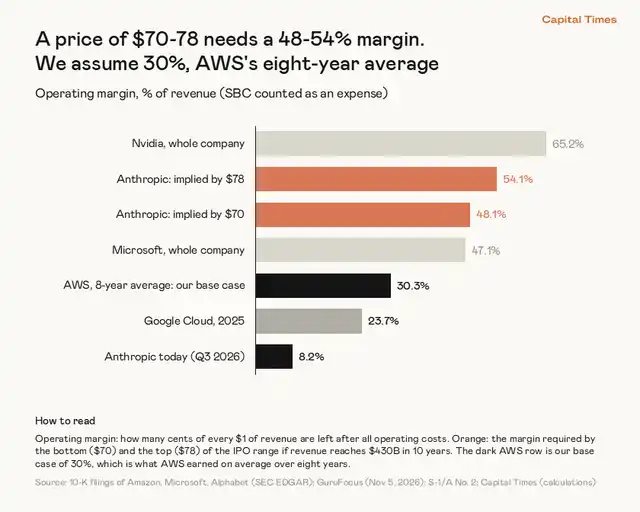
Figure 4: Under the assumption of $430 billion in revenue after ten years, the operating margin implied by the $70–78 IPO price, compared with the margins of AWS, Microsoft, Nvidia, and other companies. Source: Capital Times.
This is precisely the hardest part of the IPO price to achieve: Anthropic, on the one hand, needs to continue paying high computing power costs to the cloud computing and chip ecosystems, and on the other hand, must establish profitability close to that of top-tier high-margin tech companies. The two are not absolutely impossible to achieve simultaneously, but the margin for error is limited.
Valuation divergence: How big is the endgame of the AI market, really?
This is not the only Anthropic cash flow valuation on the market. Renowned valuation scholar Aswath Damodaran gives an equity valuation of approximately $1.45 trillion, notably higher than Capital Times' approximately $924 billion.
The biggest divergence between the two models is not a few percentage points in the discount rate, but the judgment on the endgame of the AI market. Damodaran assumes Anthropic's annual revenue in ten years will approach $1 trillion; Capital Times' base-case scenario is only $430 billion. The former implies that after Anthropic's revenue reaches hundreds of billions of dollars, it would still need to maintain an average annual growth rate of nearly 29% for many years, exceeding the historical performance of most large tech companies at a similar scale stage.
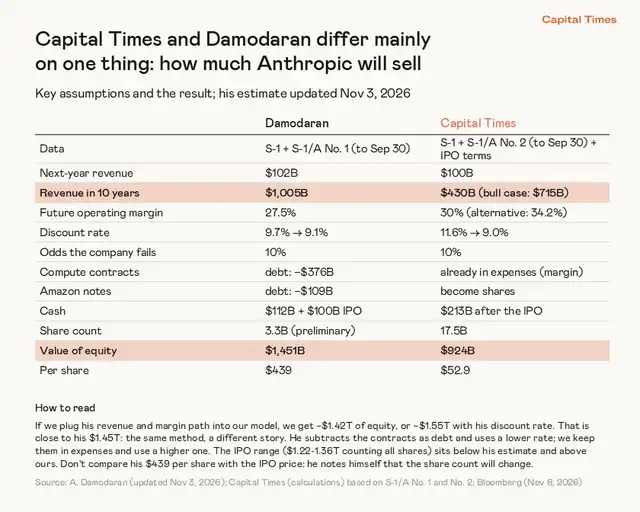
Figure 5: Comparison of key valuation assumptions between Damodaran and Capital Times. The differences mainly stem from revenue projections beyond ten years. Source: Capital Times, Aswath Damodaran.
This comparison table has another important detail: the two models use different share bases. In the chart, Damodaran's preliminary share count is approximately 3.3 billion shares, while Capital Times uses a fully diluted share base of approximately 17.5 billion shares including potential conversion shares, so the per-share prices in the chart cannot be directly compared; what is more comparable is the overall equity valuation and operating assumptions.
After plugging Damodaran's revenue and margin forecasts into its own model, the author also arrives at a valuation of approximately $1.4 trillion. In other words, the real question is: will AI ultimately become a tool that improves work efficiency, or will it create a new market far larger than today's software and cloud computing?
If Anthropic ultimately reaches $1 trillion in annual revenue, the current IPO pricing may not be expensive; if its scale expansion is closer to the path of historically mature tech giants, then investors may have already prepaid a considerable amount of growth.
Despite disagreements over long-term revenue forecasts, the IPO still has strong capital support. According to the prospectus, Alphabet, Nvidia, AMD, Broadcom, Micron, Microsoft and TSMC intend to subscribe to a total of approximately $26 billion in shares at the offering price. Some investors are also important computing power or chip partners of Anthropic, and the two sides have both investment relationships and commercial procurement relationships.
From a relative market valuation perspective, $70 to $78 per share is approximately 10 to 11 times the company's projected revenue for the next year, close to some high-growth tech stocks; but based on trailing 12-month revenue, the valuation multiple reaches approximately 29 to 32 times. Among the 150 U.S. software and large tech companies compared by the author, only a few have higher multiples.
This does not mean the market is necessarily wrong. Historical financial data of high-growth companies often understate the business changes underway. But strategic capital being willing to subscribe and peers being willing to grant high multiples are two different questions from whether a company's long-term cash flow is sufficient to support that price.
Another factor to note is equity dilution. The author estimates that after accounting for preferred stock conversion, Amazon notes, employee options, restricted stock units and IPO new shares, Anthropic's fully diluted share base is approximately 17.5 billion shares. If market capitalization is viewed only based on the existing number of common shares, the dilution faced by actual per-share equity may be underestimated.
Corporate governance is another layer of uncertainty that the model has not yet fully covered. The prospectus shows that the founder holds a fixed voting power of approximately 50.1%; Anthropic's public benefit corporation status also allows management to make decisions that may be detrimental to short-term operating performance or share price when weighing the company's mission against stakeholder interests. Some valuation experts believe this governance arrangement warrants an additional discount.
Conclusion: A Good Company Does Not Equal a Good Price
Anthropic's revenue growth, expansion of paying customers, and preliminary operating profitability all provide a realistic basis for its high valuation. The controversy is not about whether it is an excellent AI company, but about what kind of future the current offering price requires in order to be supported by cash flow.
Capital Times' DCF model concludes that the company's weighted intrinsic value is approximately $53 per share. Under the author's baseline of $430 billion in ten-year revenue, to support an offering price of $70 to $78, Anthropic must achieve profit margins far exceeding AWS's average level; if margins remain around 30%, the revenue scale must then catch up with today's Amazon.
The author acknowledges that the weakest link in this valuation is precisely the forecast of revenue ten years out. AI commercialization may break historical experience, and once Anthropic becomes a trillion-dollar revenue company, $53 would clearly underestimate its value. But under current assumptions, the author believes the proposed offering price is 32% to 47% above their own valuation, and therefore leans toward avoiding it and waiting for a lower price.
What this IPO truly tests is not whether the market believes in AI, but how many years of AI growth investors are willing to pay for in advance.
Welcome to join the official BlockBeats community:
Telegram Subscription Group: https://t.me/theblockbeats
Telegram Discussion Group: https://t.me/BlockBeats_App
Official Twitter Account: https://twitter.com/BlockBeatsAsia

 Related Articles