Autumn of the AI Stock Oracle: Tens of Billions of Dollars and an Escape Without Liquidity
The original title: "The Fall of the AI Stock God: Tens of Billions of Dollars and an Escape Without Liquidity"
The original author: Sleepy
Over the past year, the Chinese internet has given this young man quite a few nicknames, but the one used most often is still those four words: AI Stock God.
He attended a public school in Germany, skipped several grades, and went to New York at 15 to study at Columbia University. In his junior year, he wrote a paper discussing economic growth and human existential risk. After reading it, economist Tyler Cowen couldn't believe it was written by a 17-year-old. At 19, he graduated from Columbia as valedictorian.
After graduation, he went to FTX Future Fund, the philanthropic fund under SBF, where he met his future wife, Avital Balwit, who is now chief of staff to Anthropic CEO Dario Amodei. After the collapse of FTX, he moved to OpenAI's superalignment team, but was fired in less than a year. OpenAI's official statement was that he leaked information externally; his own account was that he wrote a memo sharply criticizing the company's internal security vulnerabilities and sent it directly to the board.
Two months after being fired, in June 2024, he dropped a 165-page long essay online titled "Situational Awareness: The Decade Ahead." The first sentence was extremely provocative: "In San Francisco, you can see the future first."
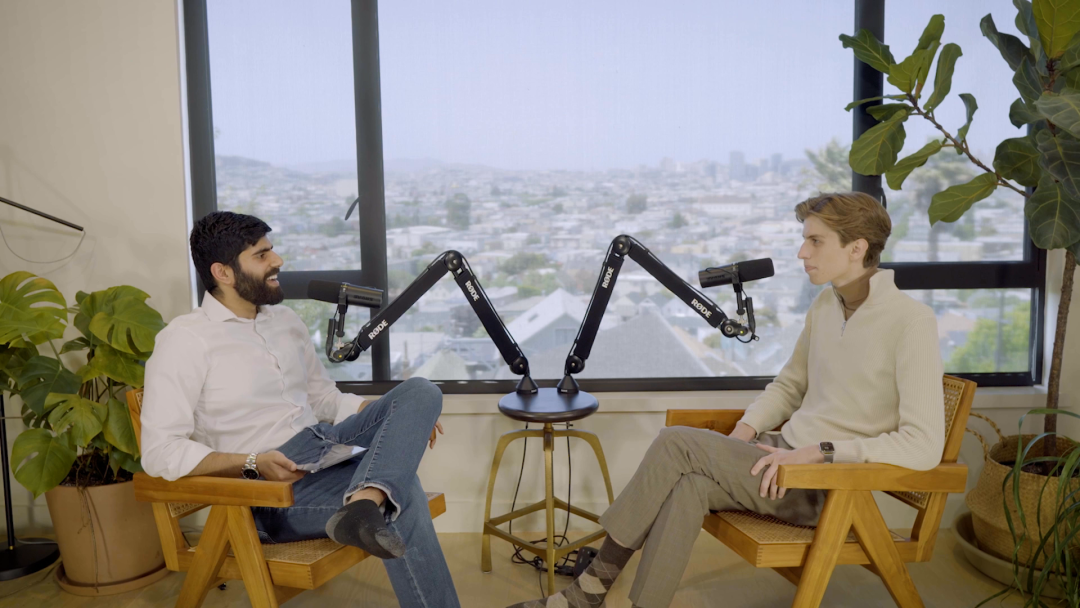
Leopold appeared on Dwarkesh Patel's podcast | Image source: Dwarkesh Podcast
Soon after, he founded a hedge fund of the same name, starting with $225 million. Among those who put in money were the Collison brothers, Stripe's co-founders.
Financial media have already written a lot about what happened later. The fund's size snowballed, but in July of this year it lost 67% in just one month, and most of its public-market positions had to be sold at a discount to Wall Street giant Citadel. Rather absurdly, on the same weekend he signed the fire-sale agreement, he held his wedding in a small coastal town in California, and the wedding schedule even included a serious academic seminar.
On November 16, he submitted another 13F holdings report.
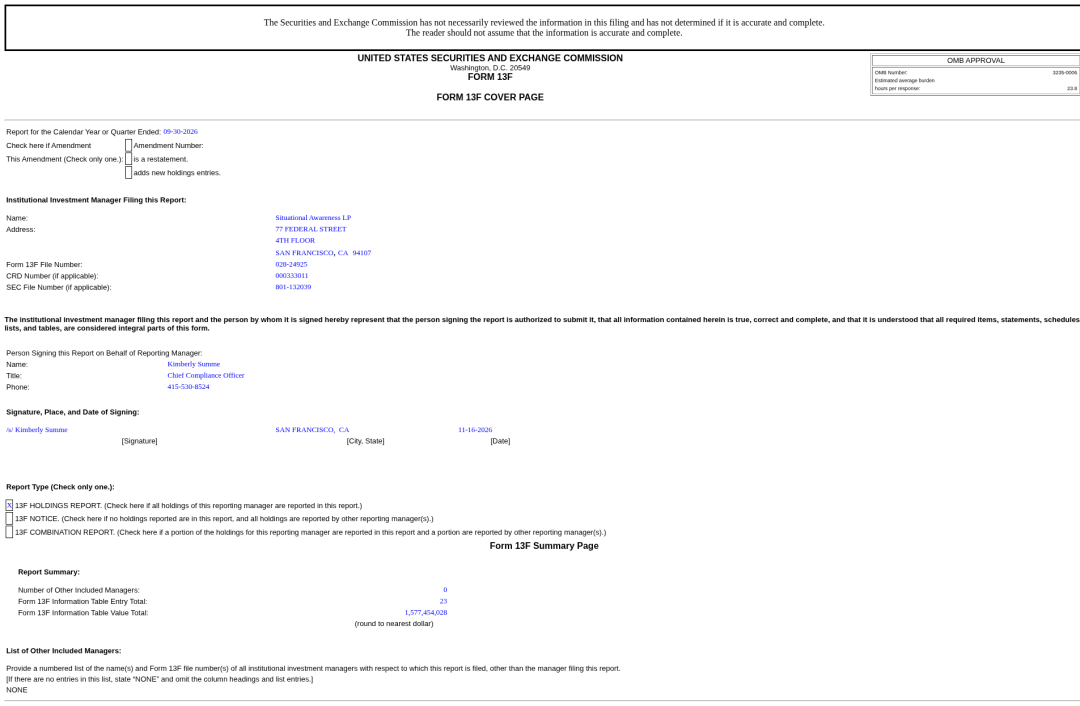
Situational Awareness's Q3 2026 13F Summary | Source: SEC
We went through this latest 13F and pieced together regulatory filings scattered across the US and Japan over the past four months, and found that the truly intriguing part of this story actually happened after the blowup.
Hoover Dam
In that 165-page essay, he drew up a table projecting the expansion rate of the world's largest AI training clusters year by year. The 2026 row read roughly 1 million H100 equivalents, 1 gigawatt of power, and tens of billions of dollars in cost. To give people a sense of what 1 gigawatt means, he put a reference point next to it: the Hoover Dam.
Most people who saw that table two years ago probably thought it was just another unrealistic fantasy from a young Silicon Valley mind.
But two years later, looking at the data that research firm Epoch AI just pulled in November this year, the three largest AI compute campuses under construction globally are Anthropic and Amazon's New Carlisle in Indiana at 1,037 megawatts; xAI's Colossus 2 at 946 megawatts, roughly 1.11 million H100 equivalents; and OpenAI's Stargate Abilene in Texas at 824 megawatts, roughly 1.02 million H100s.
He also made a call in that essay: by 2027, global annual AI-related investment would surpass $1 trillion. In July this year, Moody's latest estimate showed that the combined capital expenditure of Microsoft, Amazon, Meta, Alphabet, Oracle, and CoreWeave is expected to reach $785 billion this year and approach $1 trillion next year.
His macro projections were astonishingly accurate, and his market instincts in secondary markets were equally sharp.
He later recalled that in late February 2020, the New York mayor was still on TV urging citizens to go see Broadway shows as usual — "At that point, all I could do was buy masks and short the stock market." By January 2025, DeepSeek R1 burst onto the scene, triggering a panic selloff in US chip stocks. He and fund research director Carl Shulman had been tracking DeepSeek early on, judged the market reaction was overdone, and bought the dip while others were selling at a loss. According to fund advisor Graham Duncan's account to Fortune, a large tech fund had wanted to sell at the time, but an analyst's remark — "Leopold says it's fine" — kept them from pulling the trigger.
Fund size kept climbing, and in the first half of 2025, the fund rose 47% after fees. According to WSJ, as of May this year, the fund's year-to-date after-fee return was about 270%, and it had multiplied more than 10 times since inception, with even quant giant Jane Street becoming one of his LPs. By midyear, an investor letter obtained by FT contained an even more staggering figure: an after-fee return of 439% in the first half of this year.
Was it a tailwind, or skill?
Frankly, both reasons apply. The tailwind was a gift from heaven; understanding the tailwind was his skill.
But beneath that 439% return myth lay two other things: leverage as high as 4x, and that 165-page PDF. Plenty of people on Wall Street saw the right direction; few dared to charge ahead with 4x leverage; and even fewer could turn a set of technological extrapolations into a Silicon Valley doomsday revelation and then convert that revelation into tens of billions of dollars in ammunition.
The so-called "AI stock god" was in fact selling these three things as a package.
Ten percent off
His willingness to add leverage this aggressively was related to the way he looked at the market.
Traditional hedge fund traders watch stop-loss lines, drawdowns, and risk exposure every day, while Aschenbrenner watched the technology trend line five years out. Identify a sufficiently grand direction, bet heavily, buy more as it falls, endure all the intermediate volatility with time, and wait for the final power law to materialize—this is the playbook of primary-market VC.
A hedge fund chief who is also an LP relayed his logic: the impact of AGI will be boundless, and the fastest place to monetize this non-consensus view is "the world's most liquid public market."
The secondary market became his primary market.
The playbook was that of the primary market, and the team was built like an early-stage boutique VC. According to the regulatory filing Form ADV updated in June this year, the firm managing tens of billions of dollars in assets had only 8 employees in total, of whom only 4 were responsible for investing.
Yet this "ragtag team" was utterly unhesitating when borrowing from major Wall Street banks. According to reports, the fund borrowed tens of billions of dollars from banks through prime brokerage business. Shortly before the blowup, Barclays' prime brokerage division rejected his business on the grounds of excessive single-sector concentration; Goldman Sachs took the business, making him Goldman's largest hedge fund prime brokerage client, with fees paid to Goldman across various items exceeding $200 million in the first half of this year alone. Even on the eve of the July crash, he was still negotiating with several banks to push leverage further from 4x to 10x.
His positions grew increasingly concentrated. At the end of Q1 this year, his 13F filing still showed put options with a notional value of about $8.46 billion, covering semiconductors ETF (SMH), Nvidia, Oracle, Broadcom, AMD, Micron, TSMC, and ASML, essentially providing insurance for his entire long book; by the end of Q2, those protective hedges had been completely dismantled. Of his reported holdings totaling $20.24 billion, just two memory chip stocks—Sandisk and Micron—accounted for roughly 55%. And beyond what the 13F captures, he was a cornerstone investor in SK Hynix's July Nasdaq listing and also snapped up a 16.61% stake in Japanese passive components giant Taiyo Yuden on the Tokyo market in one go.
Hedges removed, leverage maxed out, tens of billions of dollars slammed into memory and power infrastructure in one all-in bet.
Then July arrived.
From July 1 to 29, his top holding Sandisk was cut in half from $2,032 to $1,016, Australian computing power stock SharonAI fell nearly 50%, fuel cell leader Bloom Energy dropped over 40%; and to make matters worse, Adobe—which he had shorted—was rising against the tide.
Leopold was too transparent. Once 13F and major shareholder disclosure filings were submitted, the entire Wall Street was watching his open cards—and could even calculate which arm he would have to cut first when banks demanded margin calls.
Fame brings trouble, especially on Wall Street where the sharks circle.
The WSJ later did a full post-mortem of those harrowing 48 hours at the end of July.
On Tuesday, July 28, sensing trouble was imminent, a Citadel executive reached out to Sven Khatri, who had just left Citadel.
To prevent forced liquidation of publicly traded stocks from triggering a stampede, the fund on Wednesday, July 29 attempted to sell its most valuable private asset—roughly $3.5 billion worth of Anthropic shares—at a 20% discount for cash to shore up liquidity. Sequoia, Greenoaks, and Michael Dell's family office all received inquiries under extremely harsh terms: decide within 12 hours, cash settlement by 8 a.m. the next morning. Greenoaks' team pulled an all-nighter doing due diligence, and even Anthropic officially signed off on the secondary transfer overnight.
The turning point came early Thursday morning. Negotiations between the fund and Citadel narrowed from an initial package deal for the entire public market portfolio to acquiring only the leveraged equity positions. Citadel chief Ken Griffin, in London, dialed in remotely to make the call, with the purchase price set at a 10% discount to market. About 20 minutes before the U.S. market open, both sides signed the contract.
The moment he secured Citadel's rescue money, the fund immediately withdrew its old-share trade in Anthropic. Several top Silicon Valley buyers, who had stayed up all night, were stood up at the last minute.
In the public market, he took a 10% haircut to dump shares, but the cornerstone holdings in the private market were preserved.
The batch of shares Citadel took over at a 10% discount staged a violent collective rebound after the open, with Nebius and Bloom surging 27% that day and IREN soaring 31%. A few days later, on August 3, his 10.81% stake in Taiyo Yuden was also carved up in one go in the Japanese off-exchange market: Citadel took 3.41% at ¥9,397 per share; JPMorgan's institutional arm, Barclays, and one of his LPs, Jane Street, split the remaining shares at ¥10,225 per share.
By dollar amount, this loss of roughly $30 billion to $35 billion ranks among the largest single-trade losses in financial history.
23 Lines
If the story had stopped in early August, it would have been just another old playbook: an arrogant young Silicon Valley kid overleveraged, ganged up on and harvested by Wall Street veterans.
But Leopold had no intention of leaving the table.
On August 25, the SEC subpoenaed four major Wall Street banks over the fund's trading and leverage issues. In September, JPMorgan cut off his financing support entirely. With the big banks' doors closed, he turned to boutique broker Clear Street and, with the money he had left, charged back into the options market.
The Q3 13F filed at 4:30 p.m. on November 16 documents those three months of survival after the crash.
The entire table is just 23 lines long, reporting total holdings of $1.577 billion—three months earlier, that number had been $20.24 billion.
In a letter to investors in late July, he announced that all short positions had been closed, and that public-market positions would be entirely shifted to spot purchases and fully paid option premiums using only his own capital, with no more margin borrowed from banks. Options carry inherent high leverage, but the biggest advantage is that losses are capped—no matter how bad the market gets, the worst case is losing the entire premium, and no risk officer will ever call at midnight demanding he cut losses.
From the largest hedge fund loss in human history, this 25-year-old's first lesson was not reverence for volatility, but how to keep himself from being forcibly liquidated.
In the same letter, he remained defiant, saying he was "very optimistic" about the market opportunities at hand.
That optimism was written unchanged into the latest 13F. Of the $1.577 billion in reported value, $1.045 billion was in call options, with the underlying bets still on Bloom, Nebius, Sandisk, and a memory chip ETF. Those were exactly the names that nearly killed him in July.
Of the remaining roughly $530 million in spot positions, there were only five stocks in total: three bitcoin miners pivoting to computing power, totaling about $80 million; Texas energy company Fermi accounting for $11.25 million; and the largest chunk, $441 million, all bet on an Australian computing power company named SharonAI.
Of course, the 13F is just the tip of the iceberg above the water. On the same day, he also separately filed a 13G/A disclosure for Nebius, showing that as of September 30 he beneficially owned 8.01 million shares of the company, worth about $1.89 billion at the then-current share price. According to CNBC, after the July crash the fund still held about $10 billion in assets, with the bulk in private markets, such as its stake in Anthropic, now valued at about $5 billion, and Source Foundry, a chip lithography startup into which he had poured $500 million cumulatively.
However, the SharonAI position above the water is almost a microcosm of his entire public-private mixed-play logic.
When CNBC reported this 13F on November 16, it described the entire portfolio as Aschenbrenner's renewed bet on AI after being wiped out, with SharonAI being the largest spot position; but a look at historical SEC filings reveals that this position was not newly built after the blowup—he already held about 800,000 shares by the end of the first quarter.
SharonAI is a small Australian company that went public by reverse-merging into a liquidated SPAC. On June 12 this year, it loudly announced a deployment partnership for up to 40,000 GB300 chips from Nvidia. Just five days later, the company announced the completion of a massive $1.6 billion financing, including $900 million in a private placement priced at $68.73 per share and $700 million in convertible bonds, with the anchor investors being Leopold's fund and Oaktree Capital. He shelled out $524 million in one go to buy a 21.1% stake in the company.
The problem is that shares obtained through a PIPE are locked up until the SEC resale registration becomes effective and simply cannot be sold on the secondary market. So in the emergency list sold to Citadel at a 10% discount at the end of July, SharonAI's name was not there at all—not because he didn't want to sell, but because he couldn't. The 5.396 million shares at the end of the second quarter remained unchanged into the third quarter; the only addition, 2.67 million shares, came from exercising pre-funded warrants on September 15 at a nominal price of $0.0001 per share. Apart from that, there was no buying or selling during the period.
Private placements, warrants, lock-up periods—all are standard tactics of primary market VCs.
But once this playbook is used to heavily bet on a small-cap stock in the secondary market, when the storm hits, liquidity gets welded shut at the peak.
On November 16, the same day he filed his 13F, SharonAI also released its Q3 report, with quarterly revenue of just $9.93 million. In September of this year, the company had just spent about A$50 million to buy the site of an abandoned paper mill near Albury in New South Wales, Australia, planning to convert it into a data center facility. As of market close that day, its stock price had fallen to $20.13, and the 8.07 million shares in Aschenbrenner's hands were worth only $160 million—a nearly 70% shrinkage from the real money he had plowed in five months earlier.
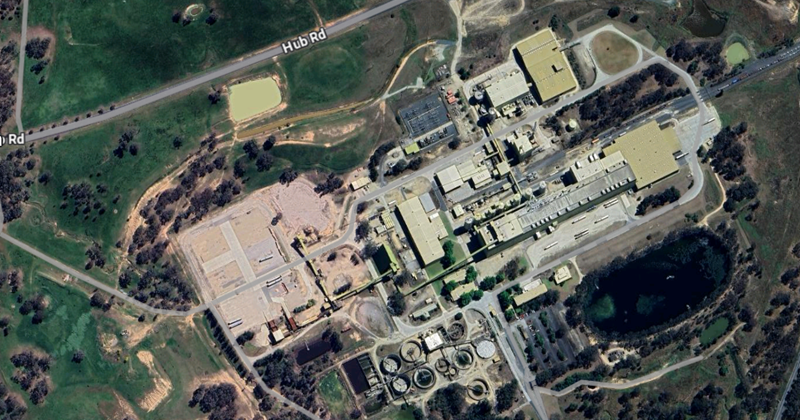
The former Ettamogah paper mill site in Australia acquired by SharonAI
Image source: Data Center Dynamics
What's even worse is that the few stocks he bought back in September by switching into options didn't fare much better.
Comparing the trading dates and stock prices makes it clear that he chased the rebound back in. According to a CNBC report on September 11, he repurchased options on stocks including Bloom in early September; based on the September 11 closing price, Bloom was 68% more expensive than just before he capitulated on July 29, and Nebius was also 52% more expensive. As a result, after September 30, AI infrastructure stocks suffered another deep selloff, with both Nebius and Sandisk halving. By November 16, Nebius's stock price was 28% lower than the blood-soaked floor price at which he sold to Citadel at the end of July, and Sandisk was also 20% lower.
For the July crash, he could blame four times leverage, blame Wall Street peers for precisely sniping his open cards. But by October and November, he had already removed all bank margin, and there was no second $10 billion-level forced liquidation dumping on the market.
Why were those stocks he regarded as the "lifeline of AGI" still falling?
The County Magistrate and the Electricity Meter
The answer is actually hidden in his famous piece from two years ago—except he only got half of it right at the time.
"The biggest hard constraint on the supply side is probably electricity." Not only did he diagnose the ailment, but he also confidently prescribed a remedy: America's natural gas reserves are more than sufficient, and to feed a 100-gigawatt compute cluster, roughly only 1,200 more gas wells would need to be drilled; as long as environmental approvals are loosened and federal regulation gets out of the way, everything can be solved. In his article, he called on the United States to muster a "new level of national resolve," and later added: "America's construction capacity is unmatched — at least in red states (Republican-governed states)."
But two years later, reality has proven that electricity was never a matter of resolve — it is a dull, tedious physical and administrative problem that no one can cut in line for.
According to the latest Epoch AI statistics, the largest single-site campus currently planned for completion by the end of 2028 is only about 2 gigawatts, far short of the 10-gigawatt scale. In July of this year, PJM, the largest regional grid operator in the United States, held a capacity auction, and electricity prices hit the federally approved cap directly, with a grid shortfall of 6,831 megawatts, yet the generation capacity that could actually be added or upgraded was a mere 525 megawatts. Of the $16.4 billion in grid capacity costs, about $6.3 billion was driven up squarely by data centers.
The cost quickly trickled down to ordinary people: this year, U.S. residential electricity prices rose by an average of 5.4%. On the industrial side, ordering a large power transformer now requires waiting about 128 weeks for delivery; for a new generation project seeking grid interconnection, the median queue time exceeds 5 years.
Even the red states he placed high hopes on dealt him a blow. On September 21 of this year, Greg Abbott, the Republican governor of Texas — an energy powerhouse state — suddenly ordered a suspension of approvals for all state-level permits related to data centers. According to Goldman Sachs estimates, similar moratoriums across the United States could directly choke off 45% of the country's planned data center capacity.
In Aschenbrenner's own 13F, that company Fermi — which accounts for $11.25 million of his spot position — is an energy infrastructure company assembled personally by former Texas Governor and former U.S. Energy Secretary Rick Perry. When it comes to doing energy in red states, there is no stronger political resource than that. Their blueprint is dauntingly ambitious: lease about 5,000 acres of Texas Tech University land near Amarillo, Texas, and build an 11-to-17-gigawatt super energy campus, starting with natural gas generation as the foundation, then adding four AP1000 nuclear units.
In October 2025, Fermi listed on the stock exchange, and on its second trading day the share price touched $36.99.
Then, real-world troubles came crashing down one after another. First, the massive compute deal with Amazon fell through; then a co-founder was outright fired by the board for "gross negligence"; even former Governor Perry himself failed to win re-election to the company's board; the previously agreed compute tenant TensorWave turned around and tore up the lease; and most critically, that 5-gigawatt gas emissions permit ran headlong into Governor Abbott's moratorium.
On November 5, Fermi's stock price fell to $1.44—worse than an ankle-height cut.
The logjam wasn't just in Texas. Another heavily weighted stock of his, Nebius, had a compute campus in Vineland, New Jersey, custom-built for Microsoft. Because the site operator withdrew the temporary diesel power supply ahead of schedule, the campus could only wait for Bloom's fuel cells to arrive and be installed before it could get power, and part of the compute delivery was forced to be postponed all the way to Q2 2027.
On November 5, the second trading day after the U.S. midterm elections ended, Sandisk plunged 22% in a single day, and SharonAI fell 20%. Even though Bloom Energy had just loudly announced that same day that it had won two massive orders from NTT DATA and Google totaling more than 1,600 megawatts, its stock still got hammered down 16%.
The University of Massachusetts conducted a poll in August this year showing that only 11% of residents nationwide supported building AI data centers near their own communities. According to Motley Fool statistics, among local referendums and hearings on data center siting across the United States this year, opponents won 40 out of 41.
Looking one layer deeper, another reason is that AI is no longer a purely "bit" industry.
Leopold may be one of the earliest investors in Silicon Valley to clearly see that AI would crash from the bit world into the atom world, and to dare to stake tens of billions of dollars heavily on atoms. His misalignment with reality lies in how to read the word "bottleneck."
In the logical framework of economics graduates and Silicon Valley VCs, a bottleneck means extreme scarcity, and scarcity means monopoly pricing power and excess profits. But in the eyes of industrialists who deal with cement, steel, and power grids year in and year out, a bottleneck means work stoppages waiting for materials, budget overruns, local wrangling, and a payback period with no end in sight. The memory chips he overweighted by more than half are even more of an old-school, deeply cyclical business.
Different trades are as far apart as different mountains. You have to have seen with your own eyes how an inventory cycle can smash gross margin from 80% to -30% within a year; you have to have dealt with a clerk at the local environmental protection bureau; you have to know how many stamps a gas emissions permit needs; and you also have to know how far a gust of political wind has to travel from a governor's campaign podium to a state power grid dispatch room.
The AI business is getting heavier and heavier, and the knowledge structure it requires has long since changed.
The Borrowing Wave
Beyond the friction between engineering and politics, the physical world has another problem: it consumes an enormous amount of cash, and increasingly, that cash is borrowed money.
Ironically, Aschenbrenner himself pointed this out two years ago.
In that four-hour-plus breakout podcast episode in 2024, host Dwarkesh Patel asked him a particularly sharp question face-to-face: during the dot-com bubble, many people correctly saw that the internet would change the world but bought and sold at the wrong time, ultimately missing out on returns — "got the thesis right but timed it wrong." The podcast transcript even included a hyperlink pointing to legendary investor Stanley Druckenmiller's painful experience of buying tech stocks at the top in the spring of 2000.
At the time, Leopold confidently laid out the transmission sequence of the AI industry chain: money would first flow to Nvidia, then to TSMC, memory chips, and power infrastructure, and finally reach giants like Google, which would earn $100 billion a year in AI revenue. He also casually predicted that the people building compute clusters and robot factories "would borrow like crazy," even pushing up real interest rates across society.
The borrowing wave indeed arrived as expected.
According to media reports on the Federal Reserve's latest Financial Stability Report dated November 13, in the first 10 months of this year, global bond and debt issuance related to AI compute has already exceeded $680 billion, whereas in all of 2023, when ChatGPT had just exploded onto the scene, that figure was only about $130 billion.
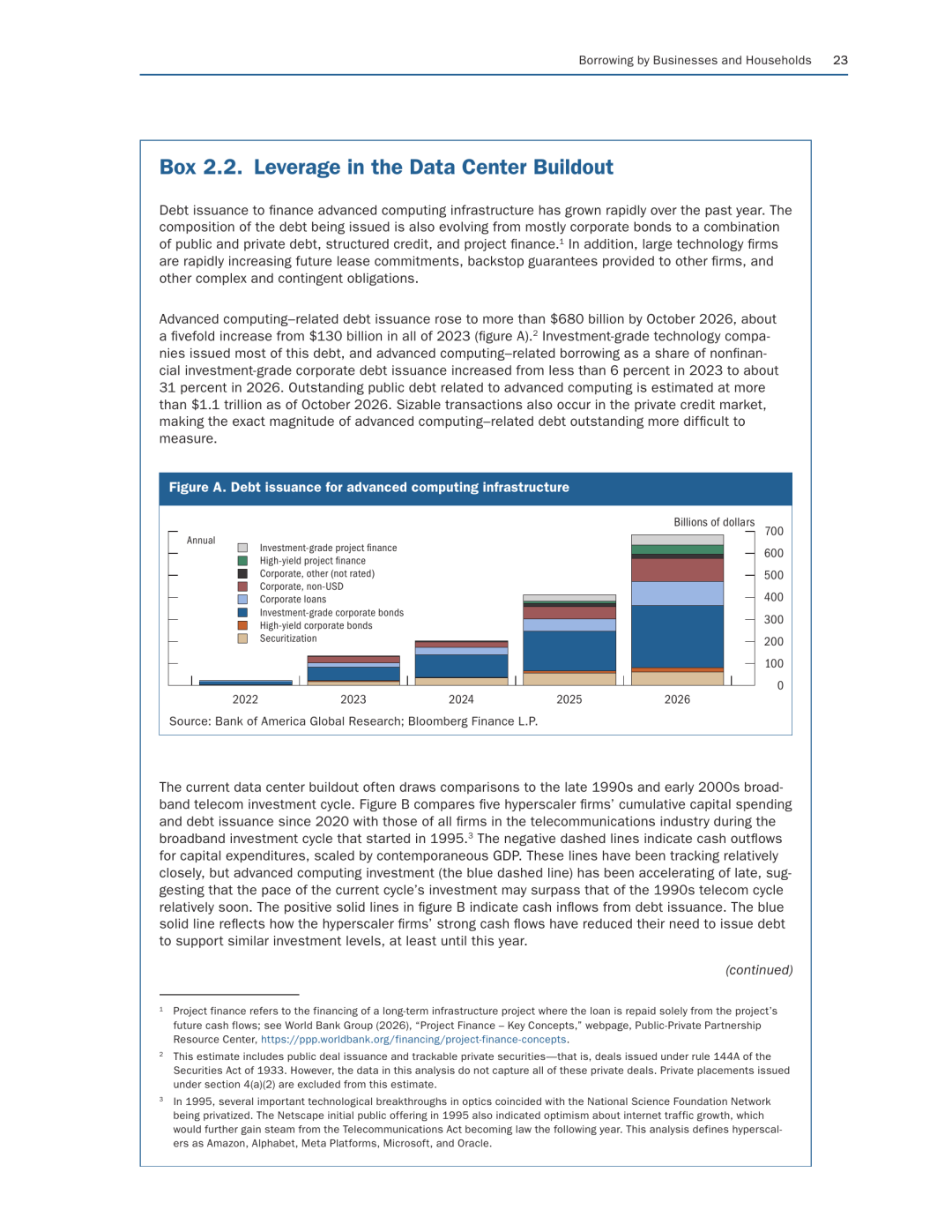
Federal Reserve November 2026 Financial Stability Report | Source: Federal Reserve
Looking back at the perfect transmission chain he drew at the time: terminal AI software revenue surges, pushing tech giants to keep increasing capital expenditure, and money flows down the pipeline to chips, memory, power, and data centers. In his long essay, he predicted that by around 2026, a company of Google's or Microsoft's scale would be able to earn $100 billion in annualized revenue from AI alone.
Where has reality gotten to? Microsoft's most recent earnings disclosure showed AI annualized revenue of about $37 billion.
Revenue is indeed rising, but the lion's share stays with top-tier labs like OpenAI and Anthropic, and with Nvidia in its position of absolute monopoly; the second-tier Neoclouds, fuel cell makers, and mining companies pivoting to new businesses in the middle of the chain are, at this stage, mostly getting high equipment depreciation and bond interest. The hundreds-of-billions-of-dollars gap between upstream revenue and downstream infrastructure spending is being filled entirely by Wall Street's debt-issuance machine.
And the Nebius, SharonAI, Bloom, and the cohort of mining companies he bet everything on are precisely the most fragile link in the entire industrial chain, the ones most dependent on borrowing new to repay old.
Two years ago he precisely predicted the industry-wide borrowing frenzy; two years later he has staked his entire fortune on the very borrowers most afraid of the bank cutting off their credit cards.
A Blow-Up
By Wall Street's rules, a young fund manager who in six months ran a position of tens of billions of dollars into forced liquidation at a loss, then flipped to an options posture and lost another round, would basically see his career come to a full stop.
But this is Silicon Valley.
On July 30, the very day the news of Citadel picking up assets at a 10% discount spread through the financial world, billionaire former legendary hedge fund manager John Arnold posted a loaded line on X: "The optimal number of past blow-ups is one."
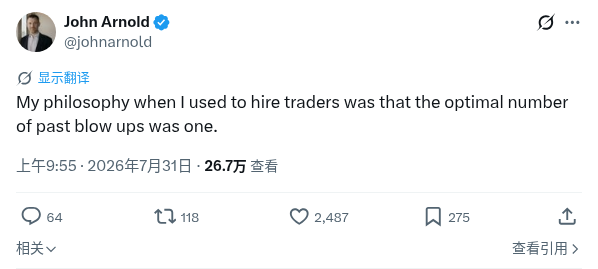
John's tweet | Source: X
The next day, in the opening segment of Silicon Valley's hottest tech podcast TBPN, the title was simply "Leopold is Back." In a darkly comic twist, in the latter half of the same episode, Numerai founder Richard Craib sat down in the livestream, and the core topic was exactly "investor hero worship."
By August 7, Bloomberg published a report saying that Silicon Valley's top investors had not only not steered clear of this young man who had just lost tens of billions of dollars, but were regrouping around him, lining up to stuff new money into his fund. Sequoia Capital partner Pat Grady even publicly came out to vouch for him, saying flatly that he would be an important figure in Silicon Valley for many years to come. The fund's official response was equally proud: it is not accepting new outside capital for now.
Wall Street is watching the joke; Silicon Valley is handing over checks. This anomaly is like a mirror, reflecting several of Silicon Valley's anxieties.
The first bugbear is the superstition of precocity.
Leopold has spoken many times about why he left Germany back then—he couldn't stand the "tall poppy syndrome" pervasive in European society, where the gardener cuts down whichever flower grows taller than its neighbors; in the classroom, the smartest, most inquisitive child is always the one the teacher finds a way to suppress.
Germany strikes down the nail that sticks out; Silicon Valley is the exact opposite—it loves to give the nail that sticks out ten times the leverage. At 17, he received funding from Tyler Cowen's Emergent Ventures; Cowen pulled the young man aside and whispered that he was one of the most brilliant young economists he had ever met, "but you'd better not go to grad school." From Columbia's top student at 19, to OpenAI whistleblower at 22, to head of a $10 billion fund at 23—Silicon Valley desperately needed a script featuring a heaven-sent prodigy like this.
The second bugbear is an apocalyptic view of time.
At the beginning of that 165-page long essay, he wrote that the number of people worldwide who truly see the AGI situation clearly totals only a few hundred, and the vast majority are concentrated in San Francisco and those few top AI labs.
Former OpenAI board member Helen Toner pointed out in an interview with The Atlantic that his massive losses essentially stem from a single worldview of "only one certain endpoint." In his reasoning, since the endpoint on the road to superintelligence in 2027 is already nailed down, then the margin calls along the way, the local environmental agency hearings, the transformer delivery delays—all become trivial historical noise. In this apocalyptic rush of a timeline, doing risk control looks downright cowardly.
The third bugbear is an addiction to "grand insights."
Amjad Masad, founder of the AI coding company Replit, commented that Silicon Valley has developed an extreme hunger for "Insight Porn"—whoever can write a grand narrative that makes people feel they've glimpsed the next ten years in an instant can suck up the entire market's money and attention in the shortest time possible. Bestselling author Tim Ferriss calls him "the Nostradamus of AI"; domestic retail investors call him "the AI Stock God." Strip away the trader's outer garment, and his most outstanding craft is actually attracting attention.
Finally, there is an unstoppable ideological team-picking.
After the blowup, podcast host Dwarkesh Patel immediately posted in support, saying that after going through the trough, he was even prouder of this friend; on the other side, Guillaume Verdon, leader of the accelerationist (e/acc) camp, treated the crash as a loud slap in the face, fiercely striking at "the rationalists who are closely associated with effective altruism." Neither side cares at all about the risk-control details in the sandbox—they are both using his net worth curve as a weapon to bomb the other side.
However, those applauding from the shore and those paying tuition with real money in the water have never been the same group of people.
The earliest batch of old LPs who put money in for him were mostly Bay Area tech upstarts and top family offices. Even after enduring a 67% drawdown in July, their net value has still posted a positive return of about +80% year-to-date, and the fund has multiplied several times since inception, so naturally they can sit tight.
Those truly buried at the top are the people who later rushed in following the trend. Regulatory filing Form D shows that from March to September this year—the months when the myth of "a 439% gain in half a year" was circulating in Silicon Valley—the cumulative subscription amount of this fund surged by $7.57 billion, with 79 new investors crowding in. Quant giant Jane Street suffered an overall loss of about $15 billion in July alone this year, and according to reports, a considerable portion of that was lost on this fund.
As for the man at the center of the storm himself?
Two years ago on a podcast, he calmly analyzed his own chips. He said that on the eve of AGI's arrival, the asset in his hands that was truly depreciating rapidly was actually human capital: "I was the valedictorian at Columbia University. What made me different in the past was being smart." But in another four years, intelligence itself might be completely automated by machines.
His friend joked at the time that setting up this hedge fund was, for him personally, a perfectly profitable "perfect hedge." If AGI really arrived within three to five years as he predicted, he had already converted his depreciating human capital into tens of billions in financial capital in advance; even if AGI did not arrive and the fund completely blew up, "I am still in my twenties, and still that extremely smart person."
There is nothing wrong with that. After turning Wall Street upside down, he is indeed still only in his twenties this year.
Situational Awareness
In 2006, 32-year-old Canadian trading prodigy Brian Hunter bet on the price spread between winter and spring natural gas futures at hedge fund Amaranth Advisors, single-handedly carrying the entire firm's profits, and the fund's assets at one point surged to $9.2 billion. In September of that year, weather forecasts and market spreads suddenly reversed, and Amaranth was wiped out within just one month, losing more than $6 billion.
The two institutions that took advantage of the chaos and bought Amaranth's energy positions at a discount were, as it happened, also Citadel and JPMorgan Chase.
And in that epic blow-up, the one standing on the opposite side of Brian Hunter and making a fortune was another 32-year-old Texas natural gas trader, John Arnold. That year, his Centaurus Energy fund posted an astonishing return of 317%.
Later, after the blowup, Hunter tried to make a comeback. In 2007, he worked feverishly to set up a new fund and was reported to have secured $800 million in subscription interest at one point, but ultimately failed to launch due to regulatory lawsuits. In 2014, he reached a settlement with the U.S. Commodity Futures Trading Commission, paid a fine, and accepted a permanent trading ban, exiting the industry for good.
Exactly twenty years later, the one who casually wrote on X that "the optimal number of blowups in the past is one" to help the young man out was none other than the winner from back then, John Arnold. He even told a reporter from The Atlantic that Leopold's $10 billion loss in July was merely a "small episode" in a long cycle.
If we look further back, there is another subtle foreshadowing that Leopold himself planted.
In that podcast two years ago, Dwarkesh chatted with him about a biography of Silicon Valley godfather Peter Thiel and casually mentioned that when Thiel personally entered the macro hedge fund arena in his early years, his performance was actually quite dismal.
Aschenbrenner immediately picked up on it, his tone revealing a clear-eyed awareness: "It blew up. That's a counterexample—too theoretical."
Dwarkesh then quoted an assessment from the book, saying that Thiel's fund was essentially "a think tank hidden inside a hedge fund shell."
Hearing this, the 23-year-old Aschenbrenner's eyes lit up: "That's exactly what I want to build."
Peter Thiel's fund back then, which had wild swings and lost its way from $7 billion all the way to liquidation, was called Clarium Capital. Coincidentally, Carl Shulman, who now sits alongside Leopold at the trading desk as co-portfolio manager, once worked at Clarium Capital in his early years.
As for the term he used as the title of his breakthrough long-form article and printed on the fund's front door—"Situational Awareness"—the concept can be traced back to World War I fighter pilots, and the term was popularized by U.S. Air Force pilots after the Korean and Vietnam Wars.
American ergonomics scholar Mica Endsley, in her classic paper cited tens of thousands of times, broke "situational awareness" down into three progressive levels. The first level is perceiving the basic elements in the environment; the second is understanding what those elements mean when put together; the third is predicting what state they will become in the next second.
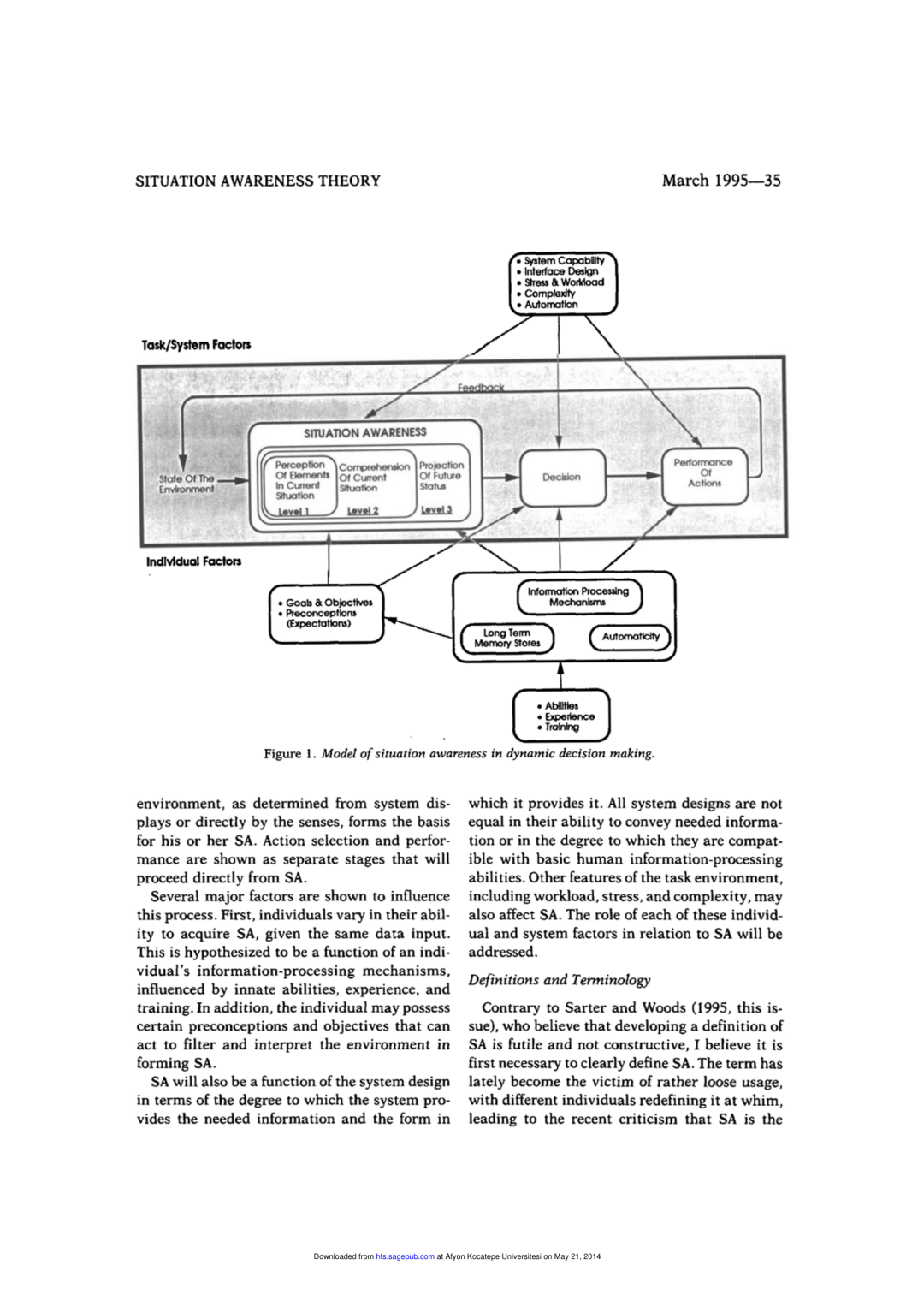
The situational awareness model proposed by Mica Endsley in her 1995 paper
Image source: Endsley's original paper
Each layer must be built on the solid foundation of the previous one.
Endsley later analyzed crashes at major U.S. airlines caused by pilot human error between 1989 and 1992. She found that in 88% of those accidents, pilots had problems with "situational awareness"—staring fixedly at a distant target or a single reading on the instrument panel, while missing the icing wings right under their noses and the altimeter rapidly dropping altitude.
Two years ago, 23-year-old Leopold Aschenbrenner sat in front of a microphone in San Francisco and confidently told the world:
"Our situational awareness will far exceed that of the money managers in New York."
Original link
Welcome to join the official BlockBeats community:
Telegram Subscription Group: https://t.me/theblockbeats
Telegram Discussion Group: https://t.me/BlockBeats_App
Official Twitter Account: https://twitter.com/BlockBeatsAsia

 Related Articles