The Truth Behind the 25-Year-Old AI Stock Prodigy's Downfall: Not a Story of Death by Leverage


On July 29-30, Citadel executed a large block trade to acquire the entire publicly traded order book of Situational Awareness. Both long and short positions were liquidated overnight.
Now, the hedge fund led by the "AI Stock God" Leopold is left only with its private holdings, along with a small portion still available for secondary trading. Among the private holdings, Anthropic, valued at around $5 billion, has become the fund's most valuable position.
From a 400% performance in six months to almost zero in secondary positions, Situational Awareness was brought back to its origins overnight—a venture capital fund.
The market is buzzing with discussions, with even Chen Bin offering a conclusion: Stay away from leverage. It seems like a cliché, a tale of a trader consumed by greed and meeting their end due to excessive leverage.
But the reality is different.
In Wall Street, this Silicon Valley elite created a miracle in the Silicon Valley way, initiating an AI bull market with a paper and then, in the Silicon Valley manner, stuck to their beliefs, ultimately facing a downfall.
Carrying the "Silicon Valley Imprint"
Leopold's legend stems from the collision of his tech elite background and Wall Street trader identity. A paper titled "Situational Awareness" was seen as the starting point of this AI bull market and was also the name he used when founding the fund in 2024.
The entire position structure of this fund seemed like an expression of a viewpoint based on the "Situational Awareness" paper, leaving a deep Silicon Valley-style "growth imprint."
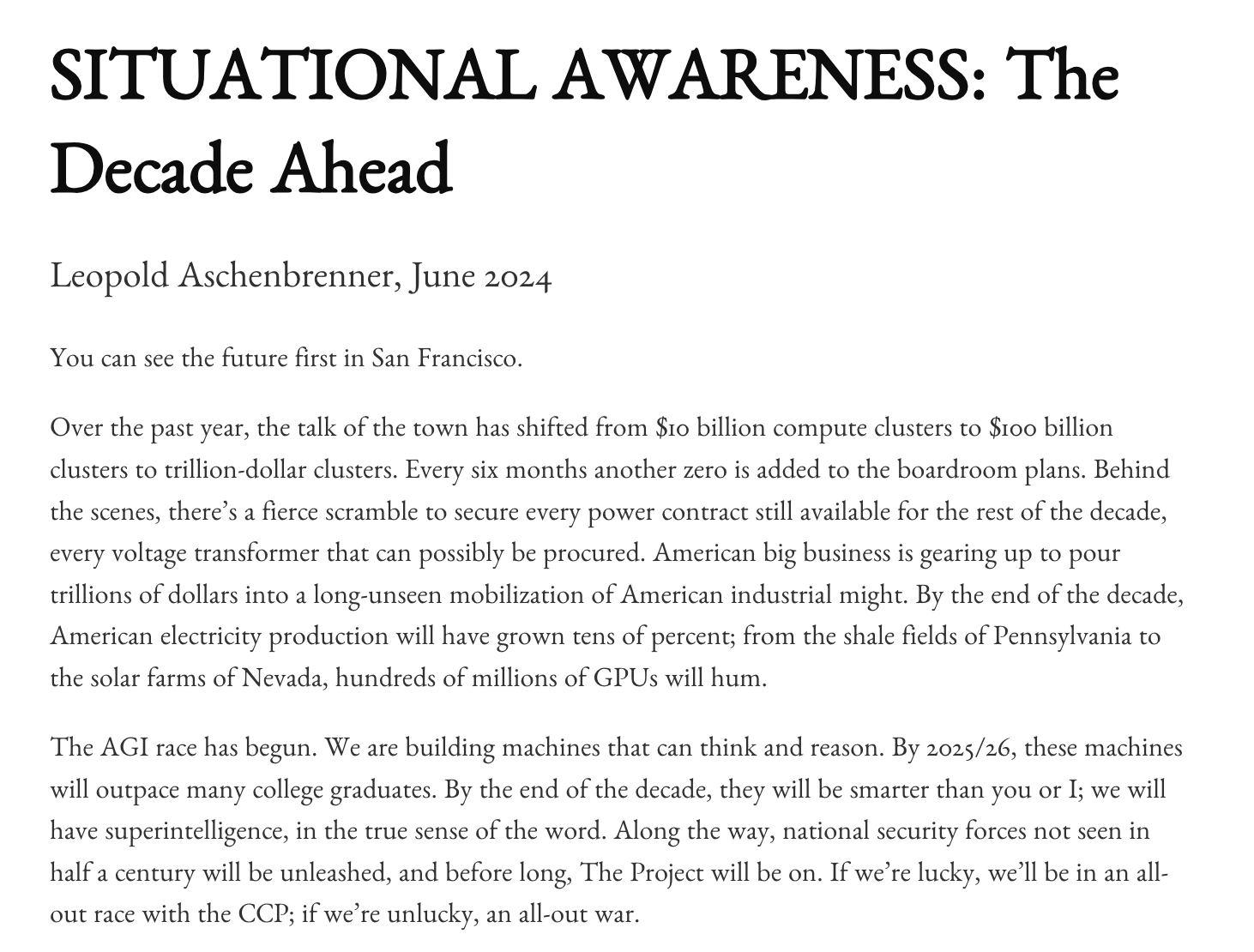
In June 2024, Leopold published a 165-page article titled "Situational Awareness." The core thesis was that by around 2027, the model would be capable of replacing AI researchers and engineers. This article later became a public text in Silicon Valley discussions on AGI and was one of the key narrative engines of this AI bull run.
He infused his beliefs into his positions, making them a tool to express his viewpoints. However, the Wall Street game is not played that way.
A while back, Situational Awareness disclosed that they held multiple put options. These included $20.4 billion in Semiconductor ETF puts, $15.7 billion in NVIDIA puts, as well as Oracle, Broadcom, AMD, further down to Micron, TSMC, ASML, Intel.
Many people thought they were hedging, but in reality, that was not the case.
This structure directly originated from their whitepaper. In Situational Awareness, Leopold wrote that chips are likely a constraint smaller than power. He believed that the real bottleneck is electricity, the power generators and turbines, HBM, and advanced packaging, rather than the GPU itself. He even calculated the number of shale gas drilling rigs – one rig can drill three wells per month, and forty rigs could power a hundred-gigawatt cluster within a year.
Following this assessment, both the long and short positions were justified.
The long side was for companies powering and hosting chips. Bloom Energy focuses on fuel cell power generation, while CoreWeave, IREN, Core Scientific are transitioning data centers and mining farms, and T1 Energy is in power infrastructure.
The short side targeted companies manufacturing chips. The market's valuation of this chain was built on the premise that "chips are the scarcest things." If the scarcest things are actually electricity and space, that premise collapses. Thus, what he shorted was not the semiconductor's fundamentals but the scarcity premium of semiconductors.
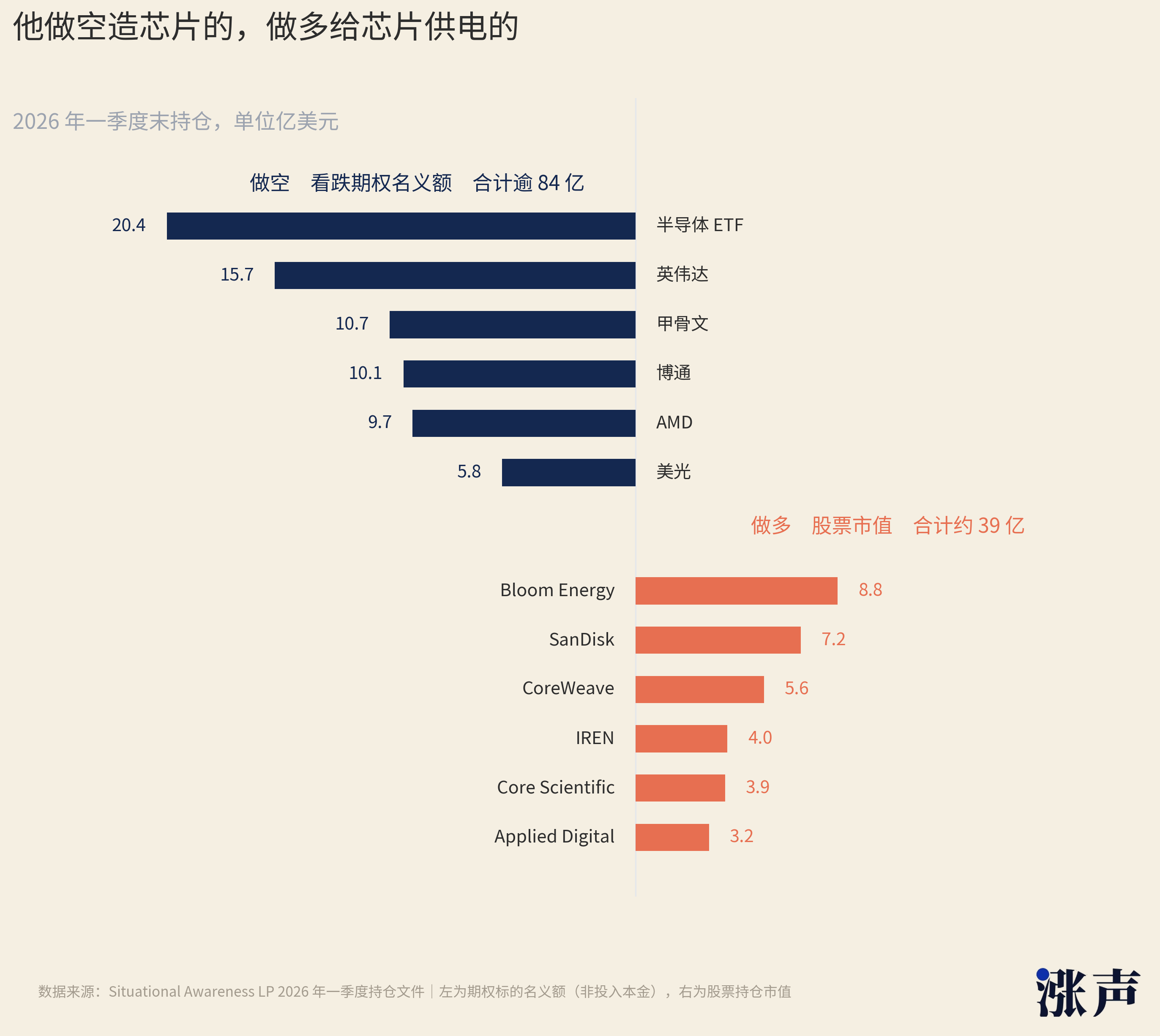
This was not actually downside protection but using his own expectations to do a Beta hedge. His long-short structure conveys a viewpoint: the dividend of AI infrastructure like computing power, semiconductors has already been priced in, whereas Neocloud, energy have not. Therefore, in the future, the latter's appreciation will be greater.
It's actually Silicon Valley's growth logic, pursuing a higher Alpha, rather than correct downside protection. Consequently, these days, the market has begun to teach the "AI Stock Godfather" a lesson.
The semiconductor sector indeed dropped. That week, the Semiconductor ETF fell by 5.63%, AMD by 12.9%, Intel by 6.52%, NVIDIA by 4.75%. Looking solely at the short side, he did indeed profit.
But the things he was long on dropped even more brutally.
In July, his core holdings saw declines ranging from 27% to 54%, with his largest position, Bloom Energy, retreating by approximately 43% in just a month.
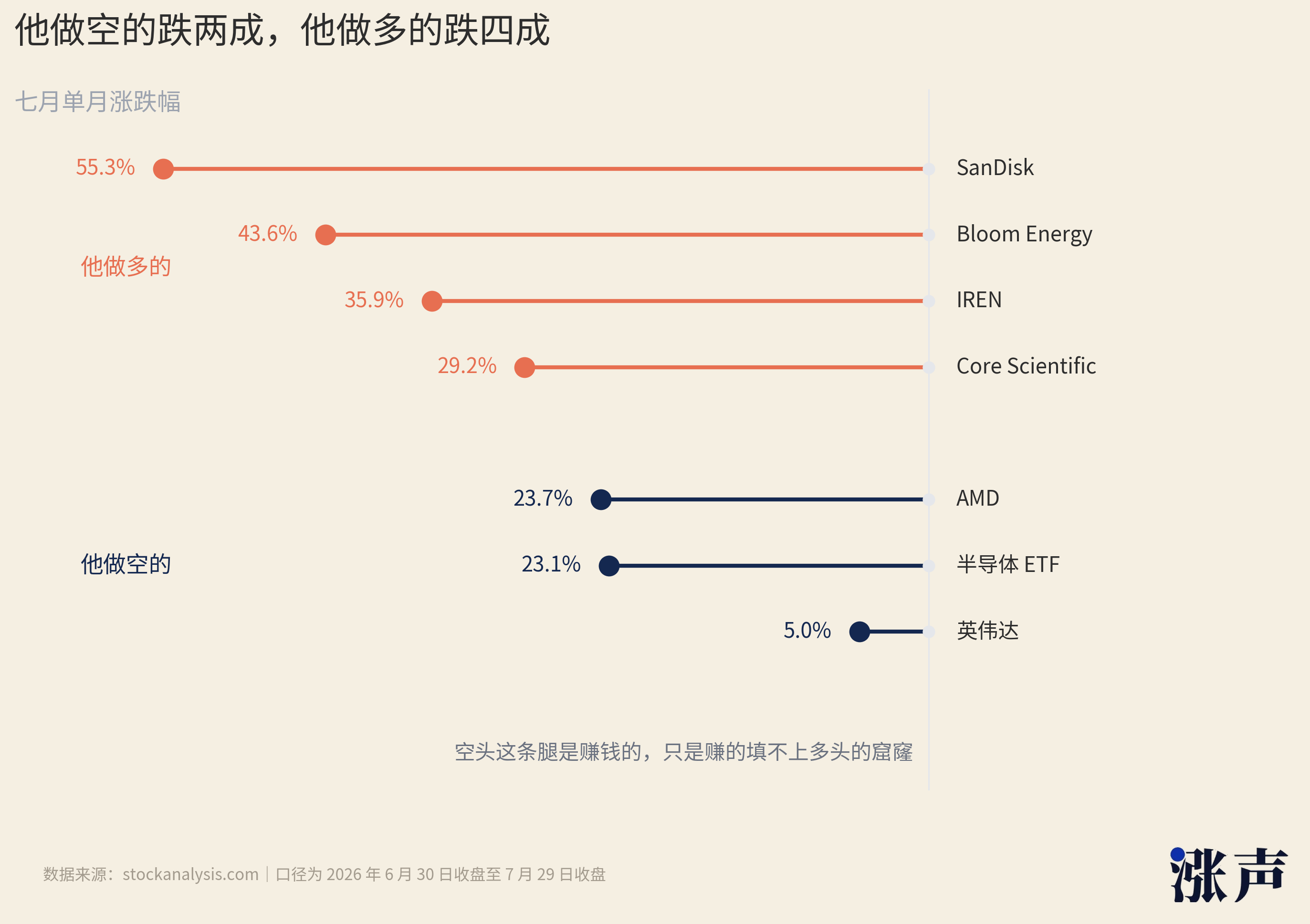
He never bet that the semiconductor would fall, but rather that energy and data centers would rise more than semiconductors. The answer given in July turned out to be the exact opposite. The direction was right, but the relative relationship completely flipped. The little money earned from hedging couldn't fill the hole left by long positions. And under four times leverage, not being able to fill that hole is no longer a matter of retracement.
In Silicon Valley, you can be wrong nine out of ten times, as long as one investment surges a hundredfold. But on Wall Street, being wrong just once can wipe you out completely.
Silicon Valley's 2027 Hasn't Arrived Yet, Wall Street's Wednesday Has
When Silicon Valley talks about the future, they often speak about time very specifically. Leopold, in "Situational Awareness," was specific all the way to the year 2027.
From GPT-2 to GPT-4 took four years, and he recalculated the next four years: computing power will continue to increase, and algorithms will keep saving computation. Chatbots will sprout limbs for tools, planning, and action. Adding up the first two factors, he believes effective computing power could increase by about a hundred thousand times. By 2027, models will be doing the work of AI researchers and engineers without needing to first believe in science fiction.
The first half of this chart is more urgent. In his paper, he writes that from 2025 to 2026, machines will surpass ordinary college graduates. Looking further ahead, giant training clusters will climb from tens of billions of dollars, with power, land, permits, and data center construction all becoming slower than the chips themselves. The chip is not a monolithic plate. Advanced packaging and HBM memory will be stuck first, and power will block the path further downstream.
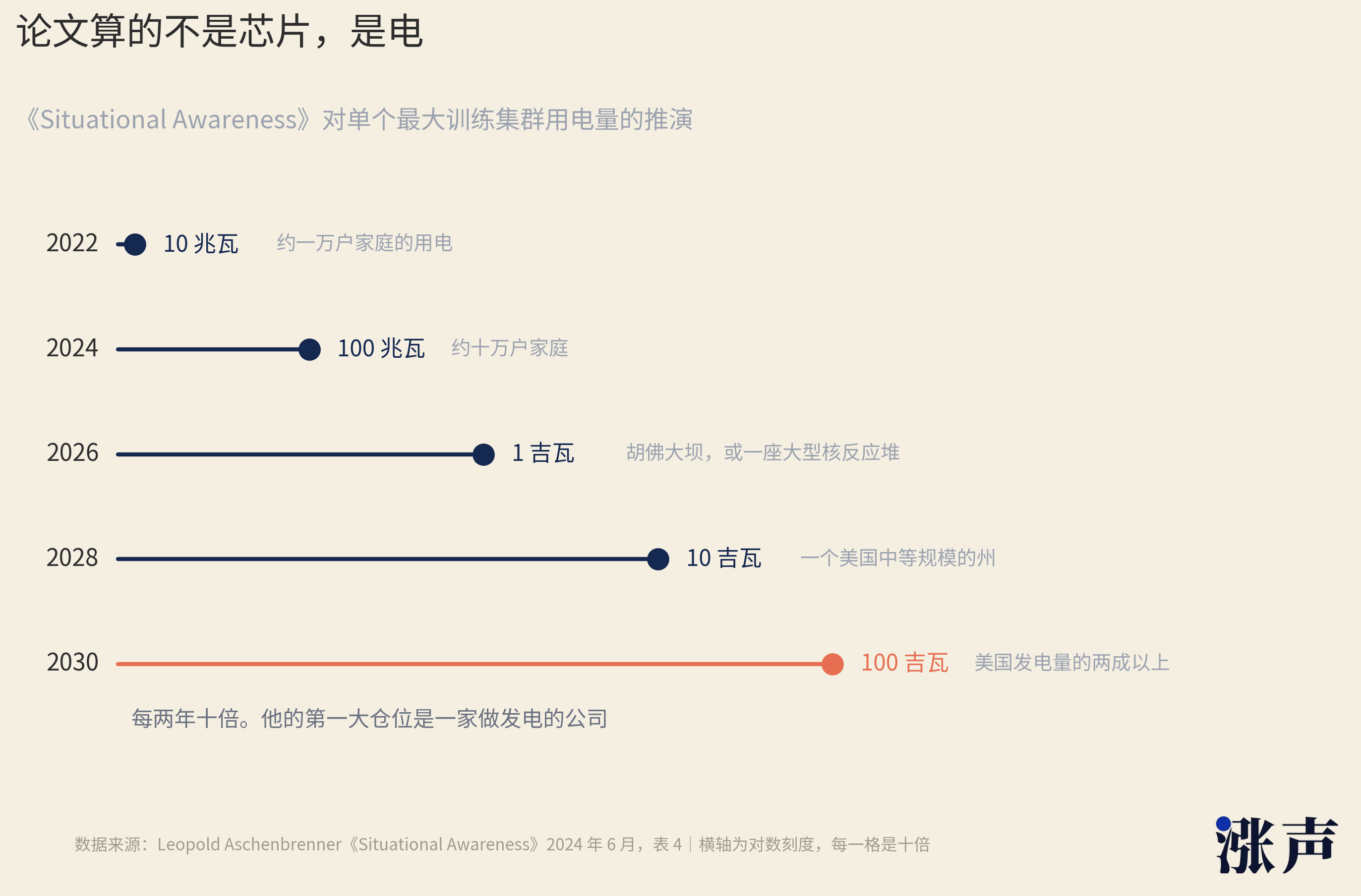
This timeline was written into his positions.
Leopold's purchases were not just about "AI"; he was chasing the inflection points that the computing power curve was set to pass. GPUs, memory, advanced packaging, data centers, electricity. These companies may seem to belong to different sectors, but they are actually all collecting tolls for the same thing. On the other hand, he doesn't quite believe that software companies that haven't had time to turn AI into profit deserve their original valuations. Leopold pushed his positions up layer by layer, as if he were prepping for 2027.
That's also why every reshuffling of storage, computing power, and software makes him uneasy.
The logic in the paper is lengthy. However, bottlenecks in reality will take turns coming to the forefront. Today the market is focused on HBM, tomorrow on GPUs, the day after tomorrow it's discovered that capital expenditures have squeezed cloud providers' profits. Each phase may only last a few weeks, but it's enough to chop up a grand and coherent future into many fragmented losses.
Compared to Silicon Valley, Wall Street's calendar is much thinner.
It only has the next earnings report, the next interest rate cut, the next supply chain meeting, and the last few hours before market close today. A fund manager is not unaware of the potential importance of 2027. He just has to get through the phone call tonight first. Client redemptions won't wait for the model's ability curve to complete. Stop-loss levels don't have a sense of history either.
When these two calendars collide, it's easy for things to go wrong.
Leopold's advantage is seeing the future as a line. The market's skill is continuously planting flags on this line. It doesn't have to deny the endpoint, as long as it sets up several toll booths along the way, it can allow someone driving in the right direction to pull over first.
A Moment's Dividend
Silicon Valley's patience for returns has always been much longer than that of the trading floor.
Money invested by a venture capitalist that only takes shape five years later is not considered a mishap. If it becomes a public company ten years later, no one is surprised. Even twenty years later, when people are still determining what a company has truly achieved, Silicon Valley is still willing to listen. A good project must first endure through product development, talent acquisition, and cash flow before valuation comes into play.
Leopold has already compressed this calendar significantly. He's not waiting for ten years. He wrote 2027 in 2024, leaving himself only four years for the future. In Silicon Valley terms, this is almost like sprinting.
He has tried using an even shorter calendar but still hasn't switched to the shortest one available.
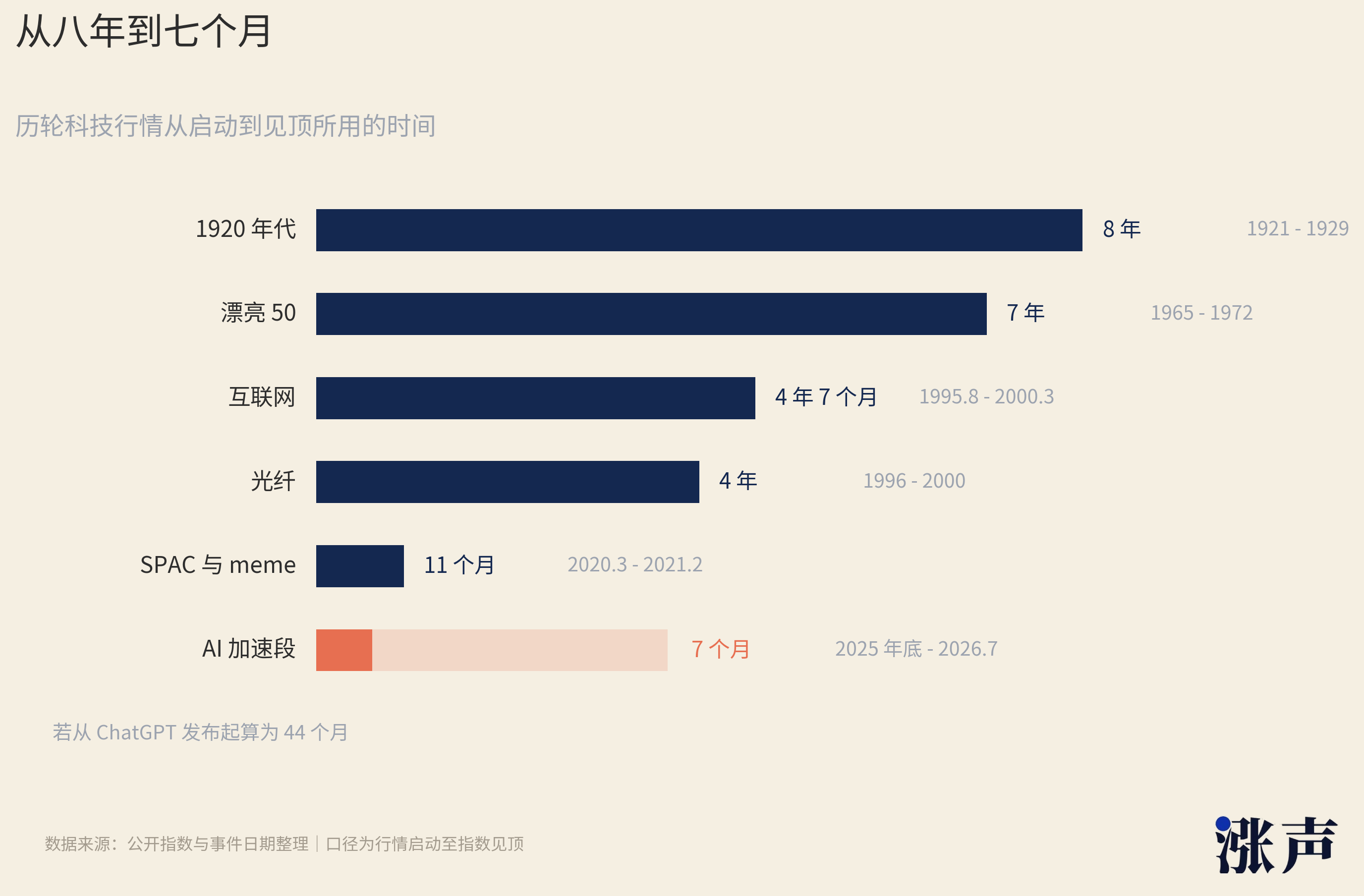
In the past, a bull market cycle would leave some time for learning. But today's Wall Street only gives you half a year. One quarter is allocated for belief, and the next quarter you need to see the money. If it's not visible, the price will make an assessment for you.
Back in the 90s when the internet was just heating up, information had to circulate between magazines, TV, and brokerage reports before money caught up. Despite the presence of bubbles, after making a mistake, there was still occasionally a chance to reflect. There is no such gap now. While 2027 is still distant, the market is already trying to factor it into the second half of the year.
Just as a lengthy article is published, podcasts start reading the harshest sentences from it. After a while, someone cuts it into a forty-second video. Then, on trading software, someone has already translated it into code, options, and triple-leveraged ETFs. Before the viewpoints have a chance to grow old, positions are already maxed out.
《Situational Awareness》's position in this market cycle is delicate. Of course, it is not the sole driving force. Without chip orders, without cloud provider spending, without actual model advancements, an article couldn’t have sparked such a blaze. But it provided a voice for many previously scattered excitements. Suddenly, people knew why they should be excited and where they should put their money.
This ability used to be rare, but today, it is too easy to replicate. Screens will find readers for an article and buyers for a stock. By the time search interest goes up, the trading volume has often arrived first. Many people have not even finished reading that report, let alone understood its reasoning. They only see one thing: it seems like everyone else is buying.
That is already enough to make a stock take off.
The barrier to entry for buying is so low that it is almost invisible. In the past, to research a company, you would at least have to commit to opening an account, pick a stock, and acknowledge that you might be wrong. Later on, you could buy an industry index directly. Then, you could amplify your judgment with just one click. Believing a story becomes a matter of simply swiping a finger.
This has eroded the consensus without friction, making it arrive exceptionally quickly.
When prices are rising, everyone will find a very lovely reason for themselves. The models become stronger. The demand becomes greater. The world is never the same again. When prices fall, the reasons remain, but the sequence is reversed. The models are strong, so costs will decrease. The demand is high, so competition will increase. The world is indeed different, but it may not necessarily reward only the few stocks you hold.
This whole thing works for both FOMO and fear as well.
What used to take a long time to instill fear now does not require stepping out of a building. An incomprehensible earnings call, a contextless chart, a viral short video—all of these can make everyone simultaneously remember why they should run. ETFs will gather the runners. Leverage will urge them to run faster. By the time everyone is finally willing to carefully read that report, the numbers on the screen have already read it for them.
More and More Stock Gods, fewer left at the table
A byproduct of the shorter cycle is the increase in the production of Stock Gods.
The market likes to deify people because deification is effortless. It does not have to understand all of someone's judgments; it only needs to pick out a screenshot from their most beautiful trades. If a young person hits on AI, chips, or a software stock, their account curve turns upwards, and their name will spread in the group. Some see him as a teacher. Some are afraid of falling behind. Some have already begun to write down his next victory.
The tools for spreading this have made the process faster, and the tools for buying have made it cheaper. Deification no longer requires a bull market cycle; one quarter is enough.
But the same things that lifted people up will also bring them down.
Serenity made 4502% in half a year, with a 49% drawdown in July alone. Leopold returned over 1000% from inception to establishment in less than two years; then, from over 1000% to the entire public ledger being sold off, it took just one month.
They are not greedier than others, and may even be more conscientious. Many retail stock gods are like this, spending a long time reading materials, memorizing company names, waiting for a moment when they can finally speak up. The market rarely gives them a chance to be right, so when they are right, it seems like a gift.
This is also why Buffett repeatedly appears to be an antique. He talks about margin of safety, discusses return on capital, and likes to keep money for a long time. In a market where consensus can be rewritten in three minutes, these words sound a bit like asking a high-speed train to wait for a porter. In the first half of this year, many people outperformed him. As of July 29, he lagged behind the S&P 500 by six point six percentage points, still holding $397.4 billion in cash.
Leopold is more qualified than most to believe in his own deductions. He has spent time, written arguments, and knows how those dull components in the data center are connected to national competition and company profits.
However, the more someone is like this, the harder it is for them to accept that sometimes the market simply does not want to see the endgame.
And everyone who has gone from legendary to liquidation in two years is conducting an experiment for Buffett. The shorter the cycle, the more times this question is asked. So the more stock gods there are, the higher their value. Not because they did something new correctly, but because others tried all the faster routes for them.
After Leopold exits, the market will continue to tell stories to AI. It will find new names, new stock gods.
Those public market positions taken by Citadel will become a new set of numbers in other people's models. And the private shares in Leopold's hands will still remain silent.
They are waiting for the companies to grow bigger.
Welcome to join the official BlockBeats community:
Telegram Subscription Group: https://t.me/theblockbeats
Telegram Discussion Group: https://t.me/BlockBeats_App
Official Twitter Account: https://twitter.com/BlockBeatsAsia