This generation of meme stock traders no longer bothers to look at financial reports

In the 2026 U.S. stock market AI wave, the biggest earners are not those holding familiar stocks like NVIDIA, Microsoft, Amazon, and Google. While these trillion-dollar giants are certainly rising, the elephant in the room struggles to dance.
A group of new stock gods focusing on "supply chain sniping" are emerging in bulk from Reddit, X, and Substack, leaving the far-off gains of Buffett-style value investors behind. They hold a pile of micro-cap stocks worth from a few million to tens of billion dollars, stocks that Wall Street analysts disdain and ordinary investors can't even pronounce.
And the person who turned these micro-cap stocks into a trading consensus and trend is Leopold Aschenbrenner, a 22-year-old German who, with a starting capital of $200 million, made $14 billion in stock trading, becoming synonymous with the "new stock god".
After Leopold, the Buffett-style charm is fading fast. A group of new stock gods focusing on "supply chain sniping" are emerging in bulk from Reddit, X, and Substack. They barely look at financial reports; instead, they focus on those "bottleneck" micro-cap stocks in the supply chain upstream. According to this logic, the editors of LoDo have found some new stock gods for analysis.
Do All "New Stock Gods" Come from Reddit?
Among this group of new stock gods, the most recent and most high-profile is Serenity, from the WallStreetBets channel on Reddit.
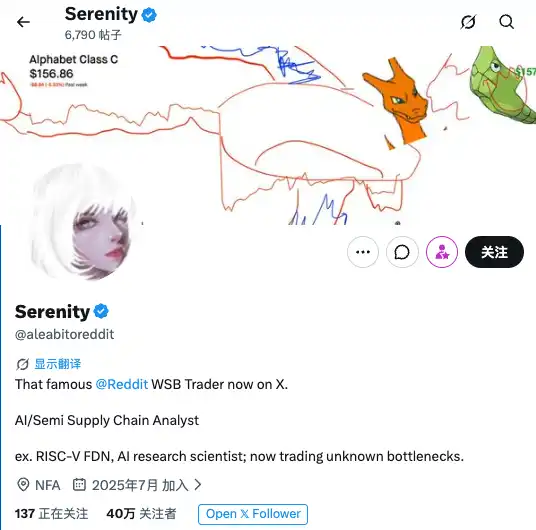
Many readers who trade U.S. stocks should be familiar with the story of Serenity. In short, he was a former AI research scientist, involved in the RISC-V Foundation, published papers in Nature, and even joked that he turned down an offer from NVIDIA's AI team when NVIDIA's stock price was $6.
What truly solidified Serenity's narrative as a "new stock god" was not his self-proclaimed resume but because he hyped a stock called AXTI on WSB. His core argument was straightforward: the entire construction of the AI industry relies on this $700 million market cap monopoly, which all players, including Google, NVIDIA, and Microsoft, rely on for their indium phosphide substrate and materials. He believes the entire AI industry is transitioning from Google TPU to photonics, adopting optical interconnect technology. Without the indium phosphide substrate, the entire AI "growth" story will end in 2026.
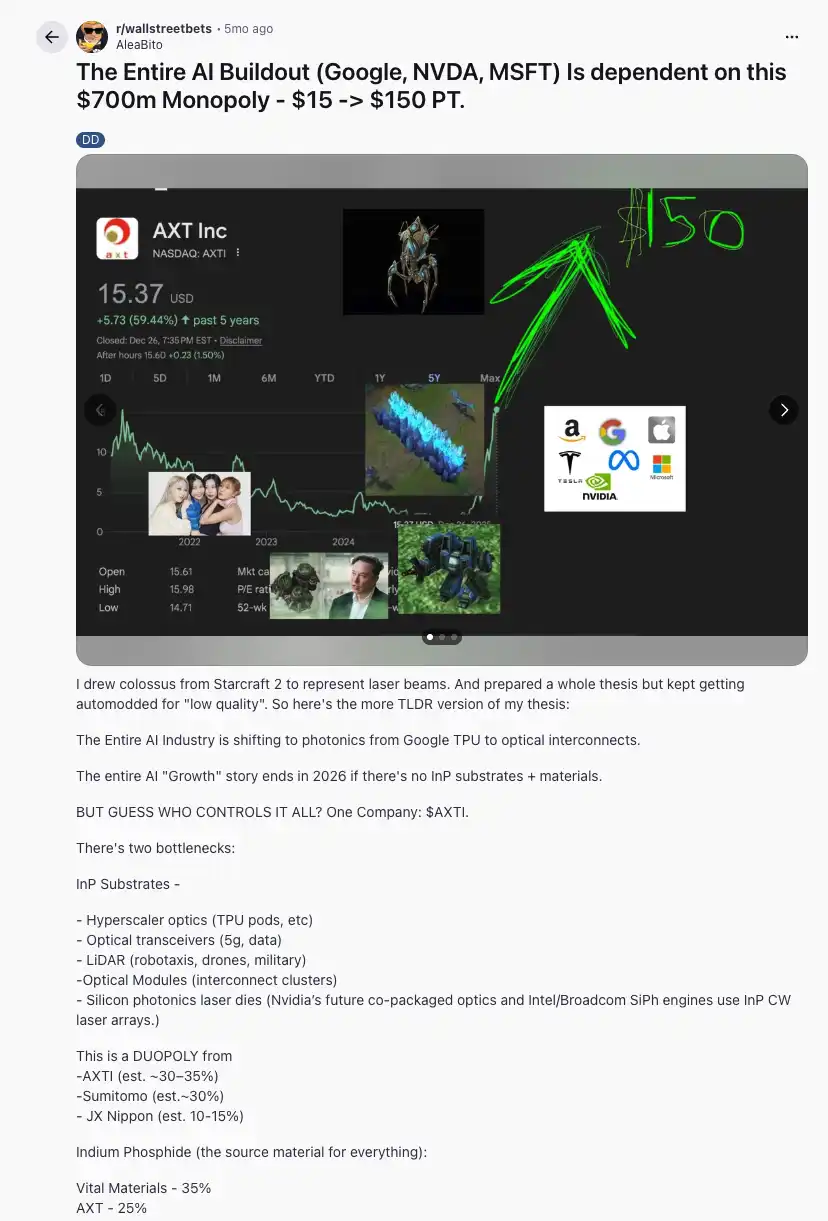
He directly shouted his price target for AXTI from $15 to $150 in that hot AXTI post, and the title was very straightforward.
Related reading: "Refusing NVIDIA's $6 offer price, he said he could earn more by trading stocks."
The stock price gave Serenity the best endorsement. When Serenity was discussing AXTI at the time, the stock price was around $12. After that, AXTI rose all the way up, first to $70. Serenity himself described this as a single-ticket trade with a floating profit that once reached 1000%. As of the time of writing, public market websites show that AXTI has closed at $140.83, just a step away from the $150 price target he initially set.
This has made Serenity's image more complex and three-dimensional. He is not just a lucky gambler in WSB but a deep researcher in the new technology AI industry chain.
Why would someone like this first emerge from the WallStreetBets Reddit channel?
We need to take some time to talk about the history of WallStreetBets.
WallStreetBets, or WSB for short, is the most famous U.S. stock retail community on Reddit. It is powerful not because everyone here is rational or because the correct answers can always be found here.
On the contrary, WSB became famous in the beginning because it openly displayed the most extreme aspects of U.S. stock retail investors: on one side, there were short-term option expiration, all-in bankruptcies, and mutual taunting; on the other side, occasionally a post would emerge that was enough to change the market narrative.
The "retail investor vs. Wall Street" battle in 2021 originated from WSB. A large number of retail investors clashed head-on with Wall Street around GameStop, a game retail stock that was originally considered a relic of the past, turning it into global financial news. After that, WSB was no longer just a forum. It became a trading culture: rough, exaggerated, adventurous, out of control, but occasionally able to extract something real from all the noise.
WSB was already an extreme place suitable for "non-consensus trading" to take root. Serenity is a new variant of WSB in the AI bull market.
It used to be about GameStop, AMC, short squeezes, and memes; now more and more posts are discussing cloud infrastructure, enterprise automation, AI agents, HBM, optical modules, data center power, photonics, and supply chain bottlenecks.
The WSB meme stock culture is still alive, but what's being memed about has changed.
This Generation of Stock Wizards Doesn't Look at Financial Reports
And this culture has also spread from Reddit to other platforms.
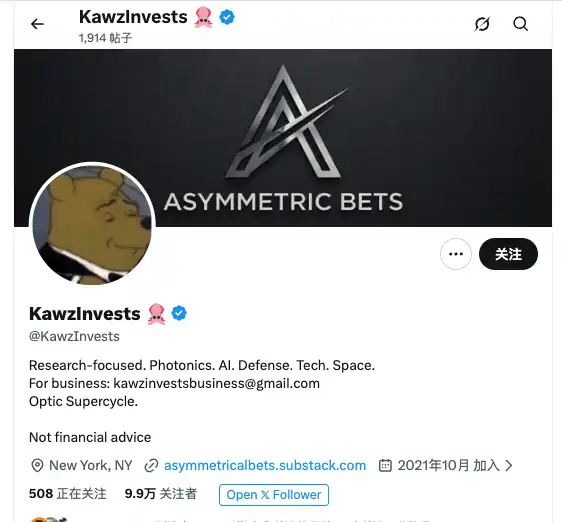
KawzInvests is also representative of the new generation of stock wizards, with a focus on U.S. stock trading views and thematic research. Similar to Serenity, his content leans more towards being "theme-driven" rather than traditional financial report analysis.
KawzInvests usually looks at AI infrastructure, optical communication, defense robots, biotech, in-vehicle software, and small-cap growth stocks in these high-resilience sectors, and then seeks logic from supply chain positions, order clues, partners, management changes, merger possibilities, and valuation reassessment space.
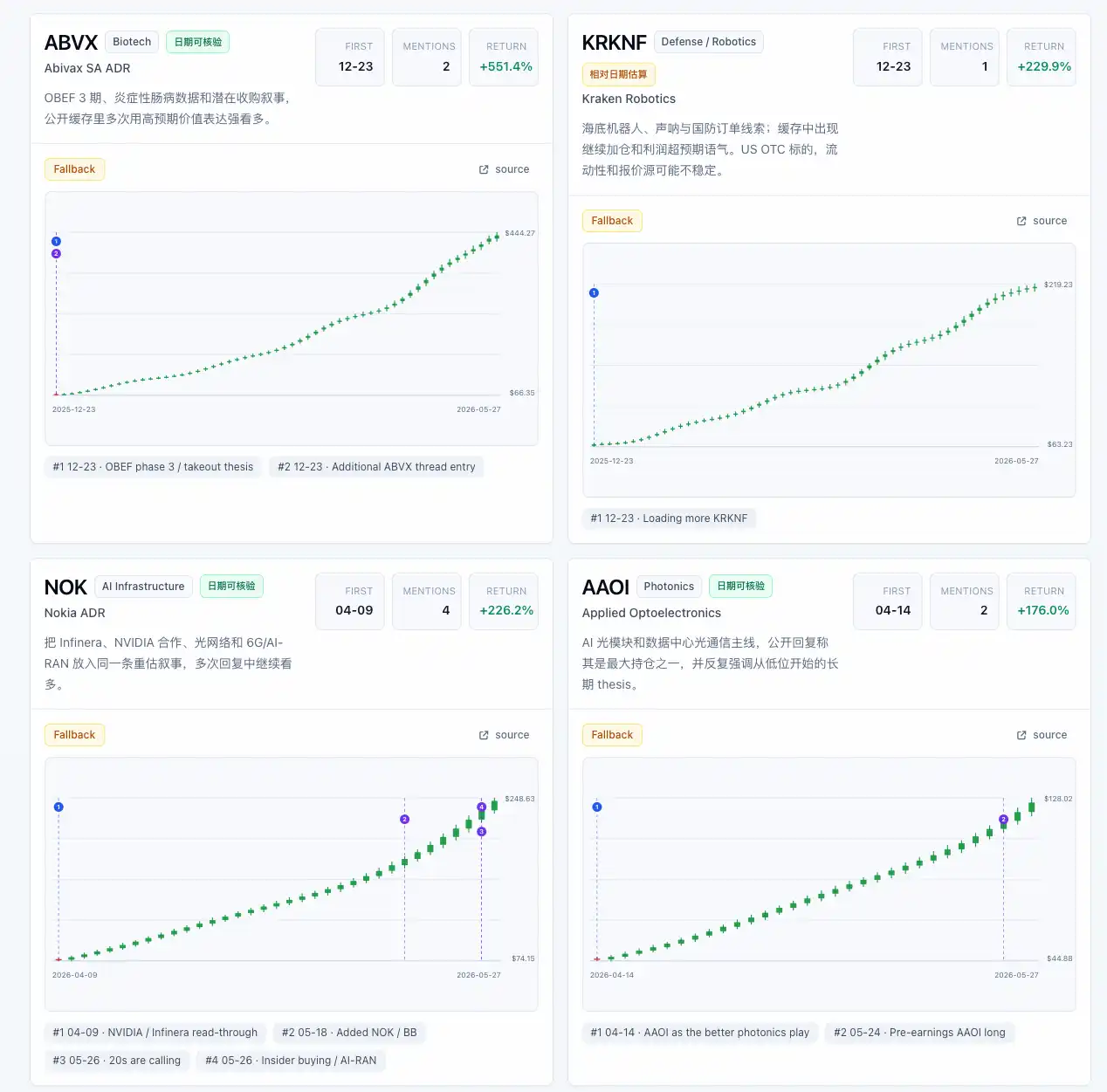
KawzInvests' Stock Calls
PhotonCap is another typical example.
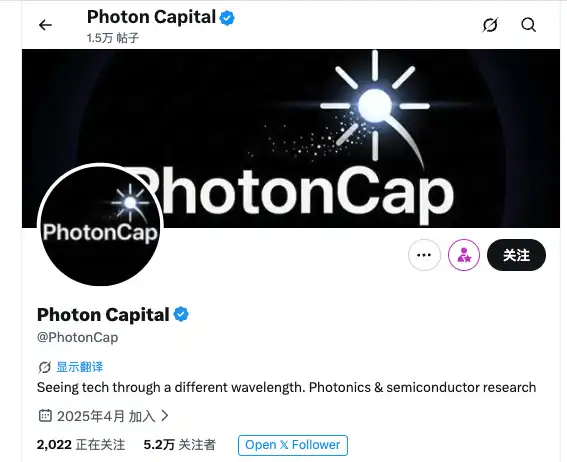
There are rumors in the market about whether PhotonCap is the institutional backer behind Serenity, or another shell for Serenity. This statement has a strong sense of mystery and fits everyone's imagination of an anonymous deity. However, currently available information does not indicate this relationship. PhotonCap has written in its own Substack that it is a research account run by an optical and photonics engineer who deals with lasers, optical fibers, transceivers on a daily basis, hence wanting to explore how these things are priced in the stock market. It has also expressed gratitude for Serenity's inspiration in its portfolio disclosure articles.
Returning to where Serenity originally started, there are still many similar "stock gods" on Reddit.
For example, a user with the ID u/imacompnerd.
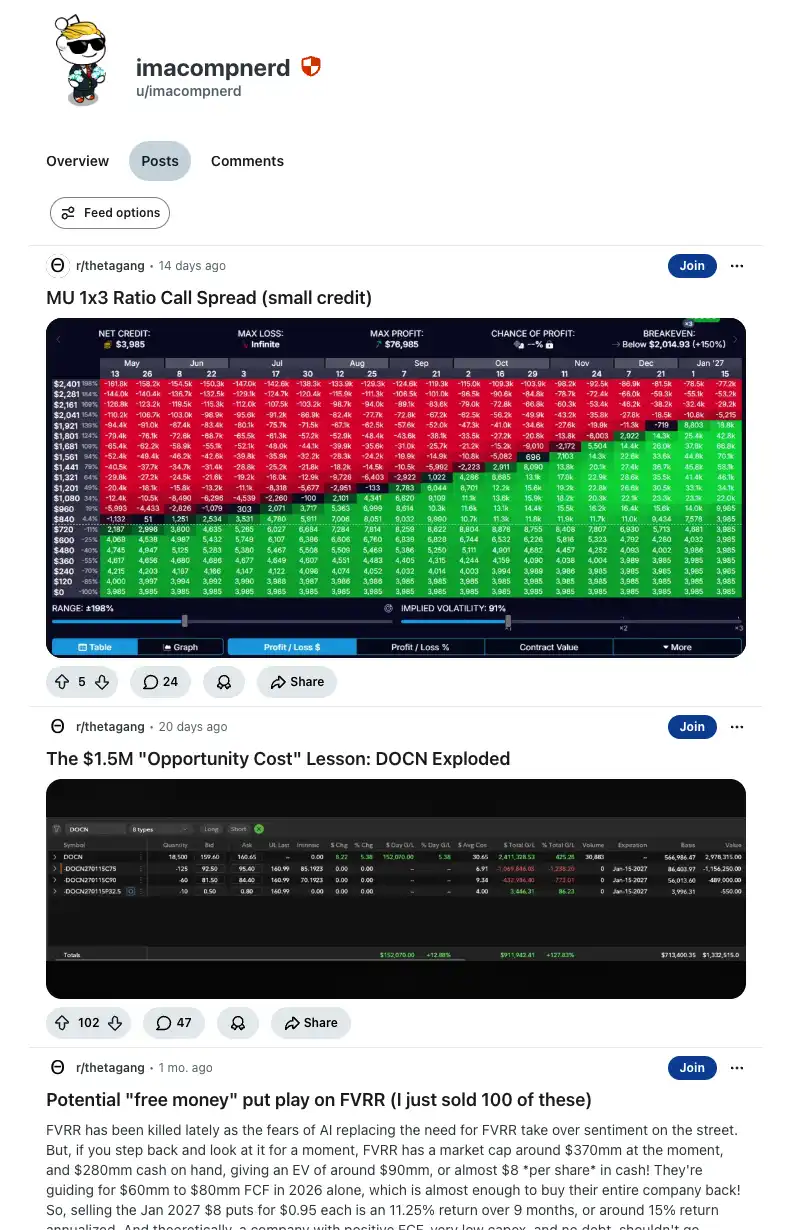
u/imacompnerd's most notable investment is also in DOCN DigitalOcean. This company may not be the most well-known AI leader in the market, but it can be placed in the narrative of the 2026 AI transaction intermediaries: not every developer and small to medium-sized enterprise will directly use AWS, Azure, or GCP, and not all AI/ML deployments require the complex systems of giant cloud providers.
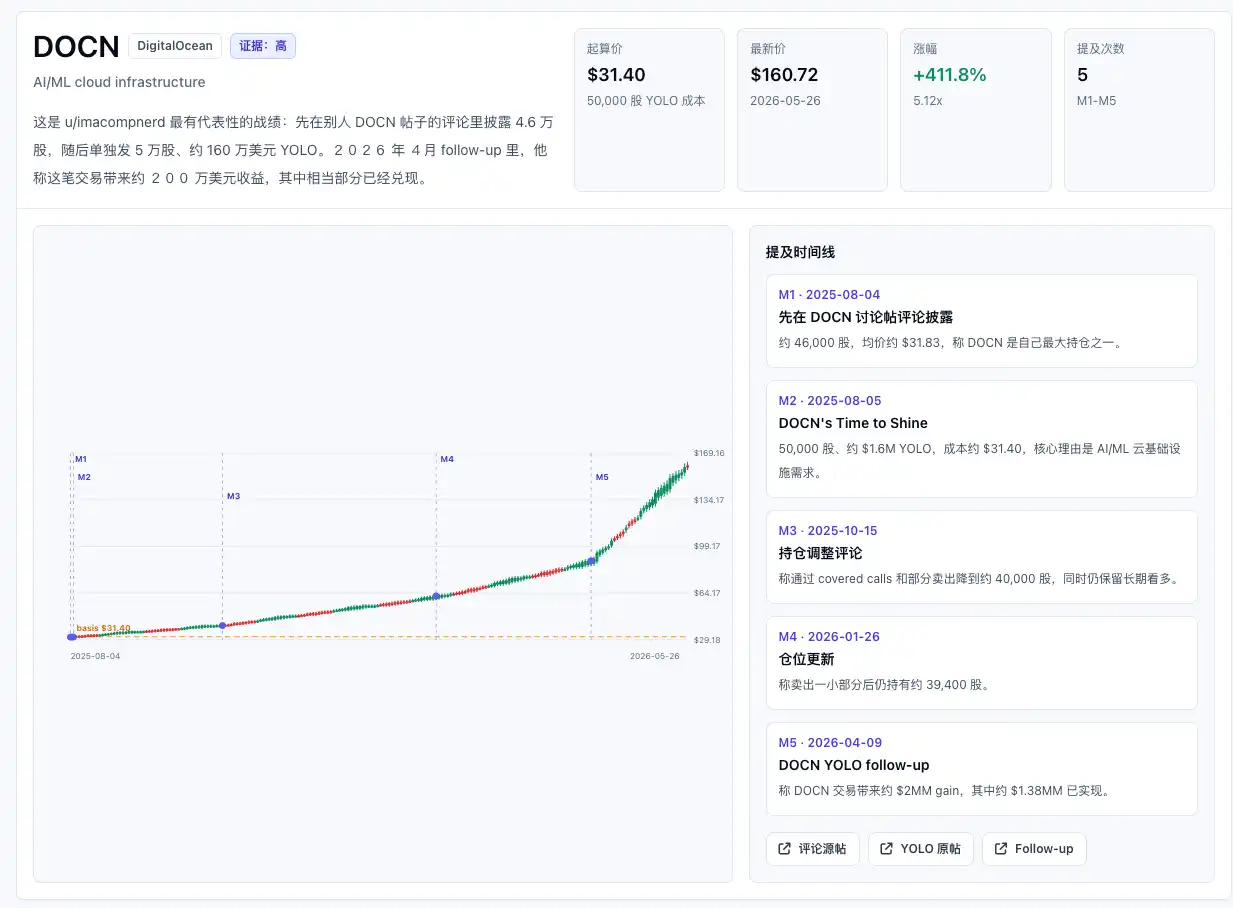
The story of DigitalOcean is that it could become a lighter, cheaper, and more user-friendly entry point for AI cloud infrastructure. imacompnerd is betting on this position. He had publicly disclosed holding 50,000 shares of DOCN, with a position of approximately $1.6 million at an average cost of around $31.4 per share; he later provided a follow-up, stating that this trade brought in about $2 million in profit. Looking at the current price, this is no longer just a simple bullish sentiment but a large concentrated investment with a clear wealth effect.
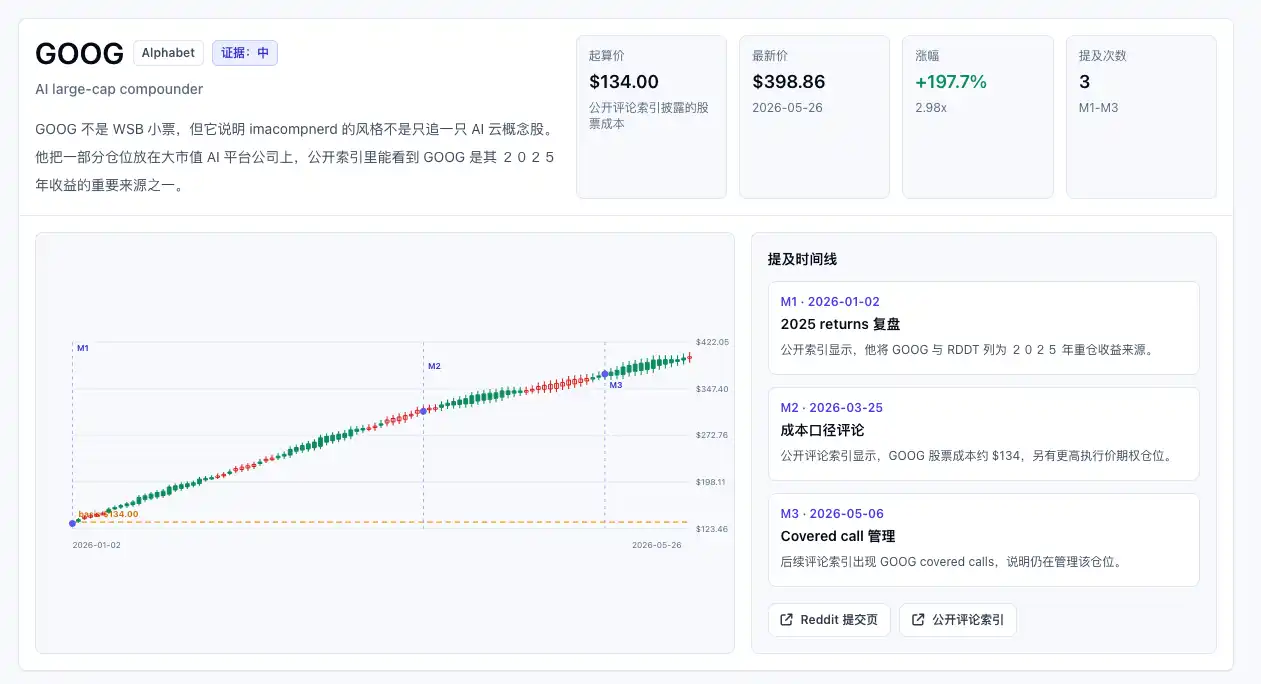
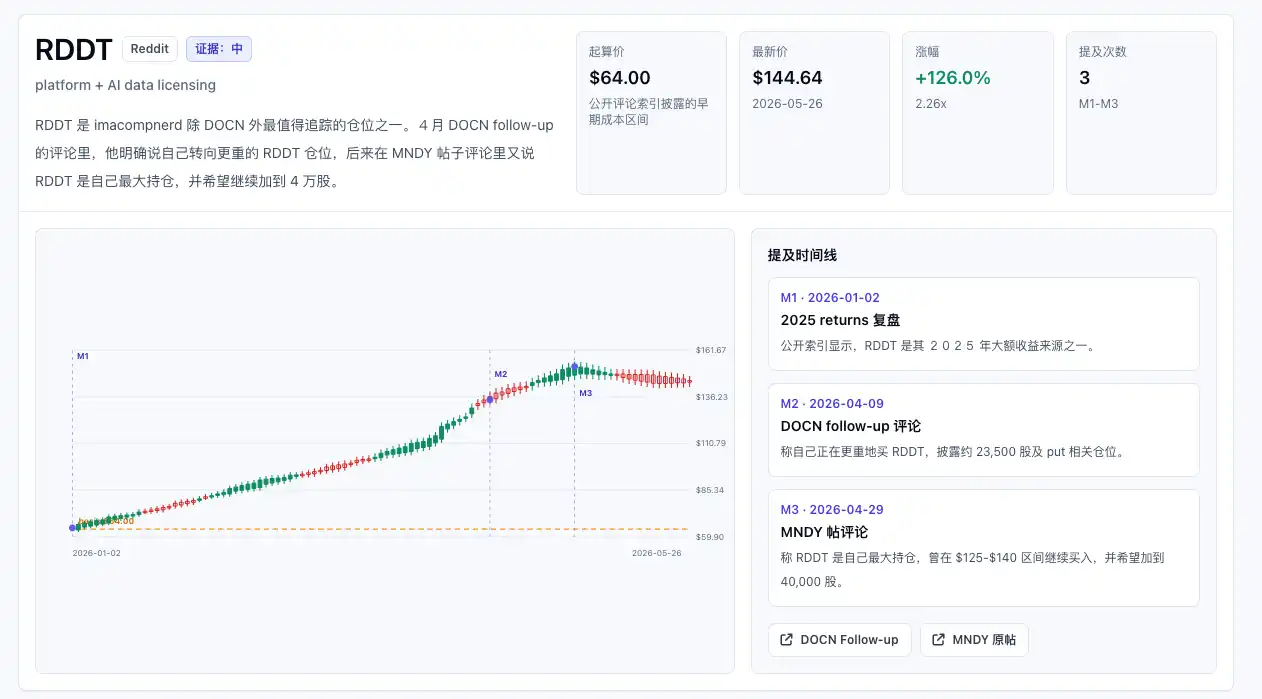
What's even more intriguing is that he didn't rely solely on one DOCN investment. Public records also show his heavy positions and reviews on RDDT, GOOG, and MNDY. RDDT corresponds to Reddit's platform traffic, community, and AI data authorization vision; GOOG is a more traditional large AI platform company; and MNDY represents another revaluation attempt in enterprise software. The MNDY investment is particularly worth mentioning because it's not a beautiful victory screenshot: he disclosed a position of about $1.9 million, but his cost was higher than the price when he posted, which was not a pretty sight in stages. It is precisely because of this that this individual is more real than the typical "show profit" accounts. In his account, there are both significant wins and paper losses; there is AI cloud infrastructure, as well as platform stocks and enterprise software; there are concentrated bets, as well as position management.
The AI sector of 2026 is once again fiercely competitive in the market.
During midday trading, the U.S. stock market's AI sector saw a pullback for half an hour, and soon funds rushed in to buy the dip; when stocks like Micron and Hynix in the storage sector moved, the Korean market followed suit, and then the A-share semiconductors, storage, communications, CPO, and optoelectronics sectors continued to move. The market action is like a wildfire, burning from one AI market to another.
errorThese people come from the same era's zeitgeist and together form a new faction in the 2026 AI bull market.
An Attention Economy Bull Market
Low liquidity assets, early narratives, strong communication symbols, community diffusion, and a sense of "not yet discovered by mainstream funds" entry.
List these words together, and you'll find they can be used to describe both meme coins and the hottest batch of microcap stocks in today's US stock market. The difference is that meme coins have always acknowledged that they are in an attention game, while microcap stocks wear the cloak of "hard technology supply chain research."
But the essence is the same. Small market cap, thin trading volume, limited institutional coverage, yet often positioned within an industry narrative that sounds big enough. A $700 million market cap company is spun as a bottleneck in the AI era, a $3 billion cloud vendor is pitched as the AI entry for SMBs, an obscure substrate manufacturer is framed as the upstream supplier for NVIDIA, Google, and Microsoft in unison. Once the narrative is established, the price will run first, and whether the fundamentals will truly materialize will only be known after a few quarters.
What's most intriguing about microcap stocks is that they are not a battlefield where institutions naturally excel. On the contrary, the further they venture into small market cap and low liquidity territory, the easier Wall Street's advantages can become constraints.
A multi-billion-dollar or even trillion-dollar AUM asset management institution, when looking at a small company with a market cap of three to four hundred million dollars, doesn't first think, "Is this the best opportunity?" but rather, "Can I get in and out of this position?" It has position size limits, liquidity rules, risk committees, disclosure requirements, and trading impact costs. For retail investors, a small cap with a $300 million market cap and a daily trading volume of a few tens of millions might already be large enough; for institutions at the level of BlackRock, this could be a position so small that it can't get any smaller. Buying too little is meaningless, buying too much can directly drive up the price, or even trigger position disclosures. When it's time to sell, they might experience high slippage due to shallow liquidity.
So they don't turn a blind eye, but many times they simply can't participate. The bigger an institution's assets, the more power they have in large-cap assets; but in microcap stocks, scale can become a prison. The microcap stock pond is too shallow for the big ship to enter.
But the attention economy also has its own physical laws.
So whether this cross-market alpha can continue depends on three things.
First, does information asymmetry still exist? If only a few FinTwit accounts can explain the photonics supply chain clearly, CT may indeed have early access to a batch of low-coverage assets. But once mainstream sellers, ETFs, and quant funds start to cover, the narrative premium will quickly be flattened.
Second, can the fundamentals keep up with the spotlight? AI optical communication is not a mere narrative, but the biggest issues for small-cap stocks are order uncertainty, customer concentration, financing dilution, and long production validation cycles. A company may be on the right track, but unable to capture true economic value.
Third, the speed of dissemination itself can create an exodus congestion. The surge in low-liquidity assets can easily be interpreted as the "market validating the narrative," but it may also just be a short-term influx of attention. The more it resembles a meme coin, the more we must beware of meme coin-style liquidity outflows—the story remains, but the buying pressure is gone.
This also gives us a hint of a market migration: crypto traders are applying their on-chain narrative sense to microcap US stocks, AI hardware, energy, power, and supply chain assets. Perhaps this is also the most noteworthy cultural shift in trading behavior within the crypto community this year.
The attention economy attributes of microcap US stocks have existed long before the emergence of meme coins.
Times create heroes, and times never lack new gods.
Welcome to join the official BlockBeats community:
Telegram Subscription Group: https://t.me/theblockbeats
Telegram Discussion Group: https://t.me/BlockBeats_App
Official Twitter Account: https://twitter.com/BlockBeatsAsia