Wintermute: Bitcoin bear market is far from over, next stop could be $50,000
TL;DR
· The bear market is not over yet. Wintermute believes that Bitcoin's rebound since the July low was merely a fake breakout, and with the price falling below the 200-week moving average, long-term technical support has been lost.
· The funding engine of the bull market is stalling. Since 2026, spot Bitcoin ETFs have seen cumulative net outflows of about $1.9 billion, the stablecoin supply has decreased by about $14 billion to $16 billion over the past 30 days, and buying from digital asset treasury companies is also shrinking.
· $1.7 billion in liquidations does not mean the market has bottomed. The recent rebound comes more from short covering than from new capital entering the market. There is still a large amount of leverage in the altcoin market waiting to be flushed out.
· The next target may be the $50,000 range. Wintermute believes Bitcoin may first test the $62,000 low, then approach the densely populated $60,000 put option zone. To change its short-term defensive stance, it needs to see the price reclaim $68,000 while ETFs resume net inflows.
Macro Market: Rates Repriced, Bitcoin Becomes the Selling Target
As U.S. core CPI rose 0.3% month-over-month for the third consecutive month, market expectations for a Fed rate hike in December have further intensified, with the probability of a hike now reaching about 92%. This inflation reading precisely hit the condition previously set by Fed official Waller for considering a 50-basis-point rate hike. Meanwhile, the U.S. 10-year Treasury yield closed at 5.15%, up about 30 basis points in a week.
Two weeks ago, we pointed out several risks that could affect the market. Now it appears that what actually caused the shock was interest rates, not oil prices or the aftermath of the Binance incident. Oil prices have already pulled back, and the impact of the Binance incident is gradually fading, but the pressure from rising rates on risk assets persists.
Over the past week, Bitcoin fell 12.7% to close at $65,400, while the S&P 500 rose 2.5% over the same period. Ethereum fell to about $1,800, gold stood at $3,900 after a decline of about 5%, and Brent crude was at $96 per barrel.
The simultaneous selloff in long-term bonds, gold, and crypto assets reflects the market repricing the rate outlook. Because Bitcoin itself generates no yield, it has become the asset investors sell to obtain liquidity in this round of trading, and it is also the high-volatility asset most vulnerable to being hit when bets on the direction of interest rates go wrong.
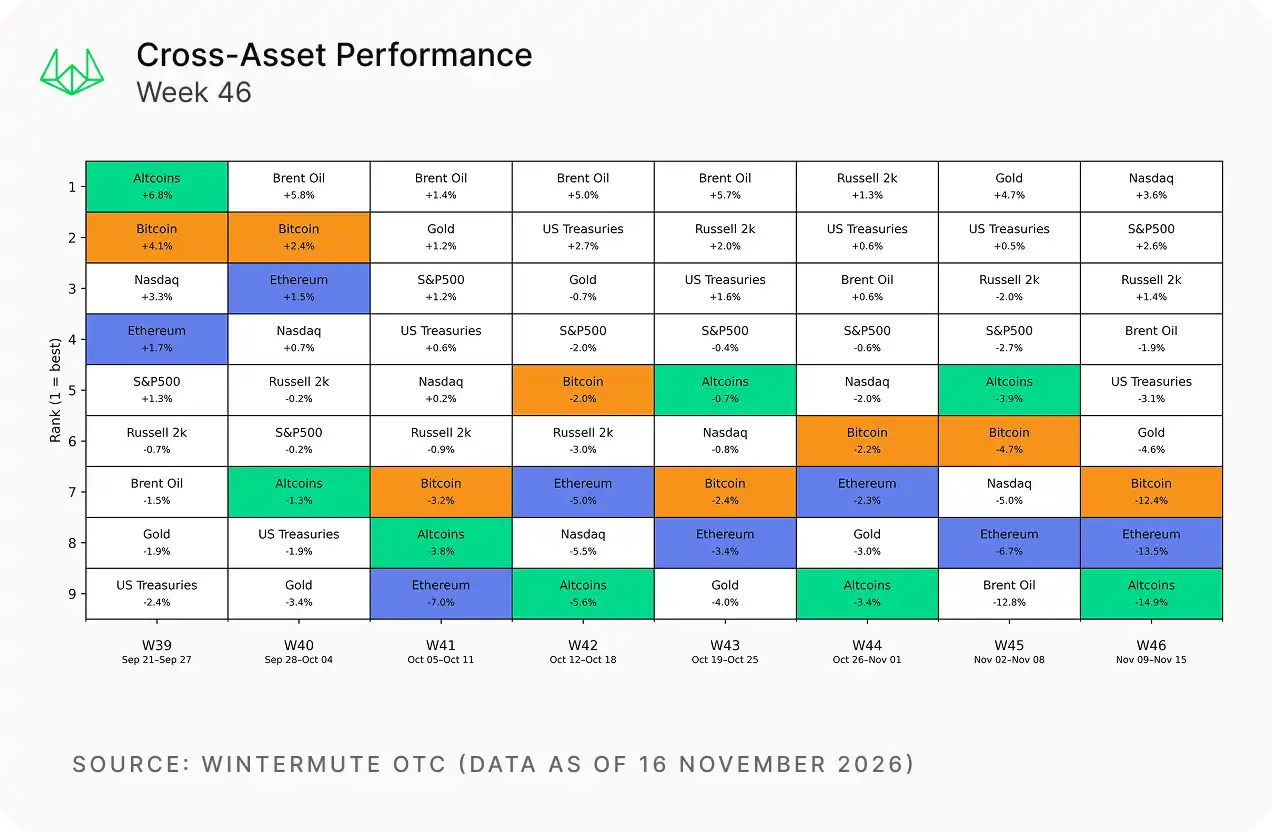
Bitcoin vs. Macro Asset Performance Comparison
The focus of market discussion has also shifted accordingly. Previously, investors mainly debated whether the Fed would raise rates by 25 basis points or keep rates unchanged; now the question has become whether to raise by 25 basis points or by 50 basis points at once.
October CPI is the last CPI data the Fed can obtain before its December 9 policy meeting. Therefore, Warsh's speech on Monday and the meeting minutes released on Wednesday have become important information for the market to watch next.
Although a 50 basis point rate hike at once is an aggressive move, the market is re-accepting the view that the Fed is already behind the curve in controlling inflation and needs to take more decisive action. The performance of the bond market also reflects this judgment.
The stock market likewise faces new risks.
After Jensen Huang stepped down last Thursday, Nvidia's stock price continued to fall. Recently, crypto assets have shown strong correlation with the Nasdaq index during market declines, so Nvidia's third-quarter earnings report released on Tuesday will become the main stock market risk affecting Bitcoin's trend this week.
Overall, corporate earnings have supported U.S. stocks' ability to withstand interest rate shocks, while the crypto market has borne more direct pressure through ETF fund redemptions. This is also the main reason why crypto asset declines have significantly widened over the past week.
Crypto Market: The Bear Market Is Not Over; The Rebound Since July Was Just a False Breakout
What is now clear is that the crypto market has not yet emerged from the bear market, and the rebound from the July low has ultimately proven to be a false breakout.
On November 2, we focused on two technical levels: the $80,000 mark and the 50-week moving average. Now, Bitcoin has successively broken below both support levels and further closed below the 200-week moving average at around $68,000.
The loss of this long-term trend indicator may make $68,000 an important resistance level for subsequent rebounds. Last Saturday, Bitcoin once fell to $62,000, hitting its lowest level since July.
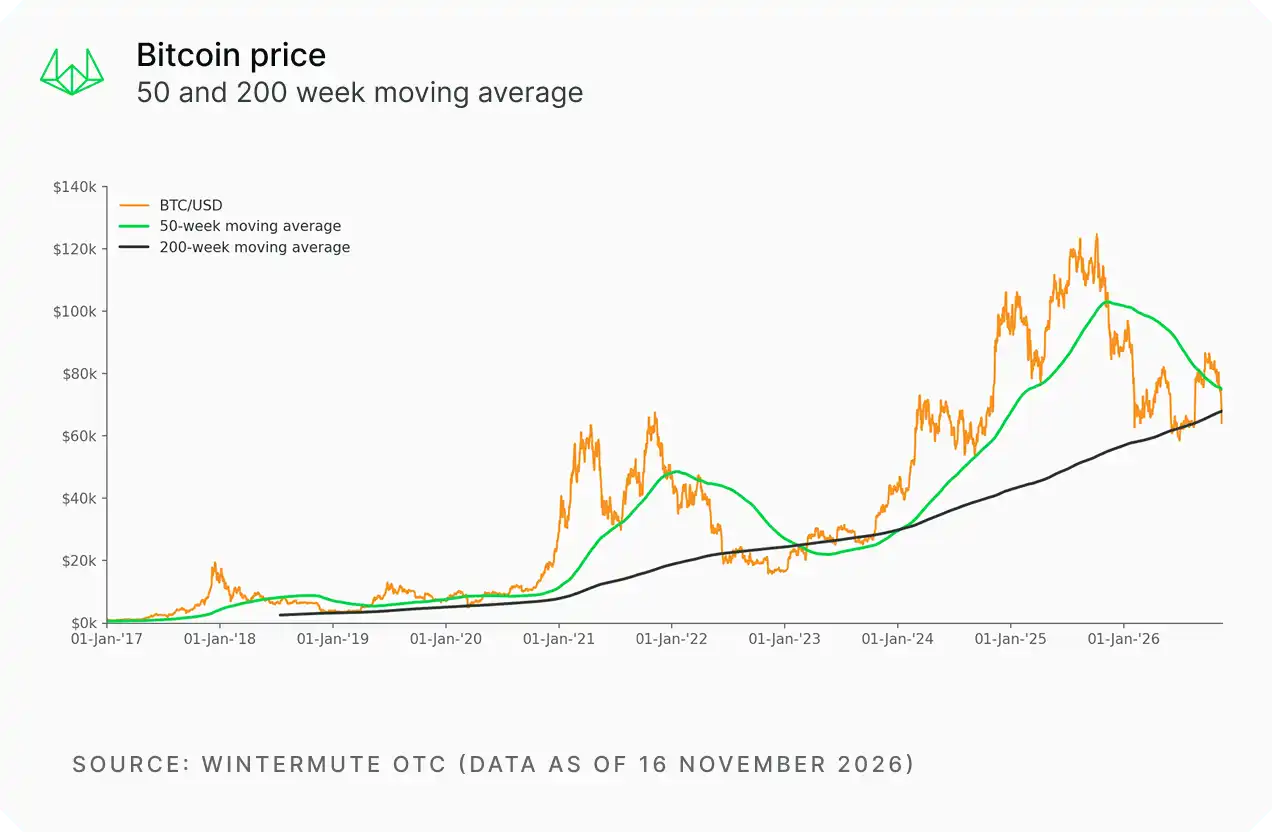
Bitcoin Price Trend and the 200-Week Moving Average
What is more alarming than the technical breakdown is that the source of funds supporting the bull market over the past two years is now reversing.
According to the latest data, U.S. spot Bitcoin ETFs have recorded cumulative net outflows of approximately $1.9 billion year-to-date in 2026, compared with net inflows of about $21 billion and $35 billion in 2025 and 2024, respectively.
In other words, the ETF buying that had been driving Bitcoin's rally over the past two years has now turned into net selling.
The stablecoin market has likewise failed to provide fresh incremental capital. Over the past 30 days, stablecoin supply has shrunk by roughly $14 billion to $16 billion, indicating a lack of new dollar inflows into the market.
Meanwhile, buying from digital asset treasury (DAT) companies is also contracting.
MSCI will remove Strategy from its indexes after the close on November 30, and the current spot Bitcoin price is about 14% below Strategy's average holding cost of roughly $75,500.
For companies that raise equity or debt to purchase crypto assets, the premium of their stock price over the net asset value of their crypto holdings is a critical condition for sustaining continuous financing and coin purchases. As that premium comes under pressure, this financing-and-buying mechanism also faces challenges.
From ETFs and digital asset treasury companies to retail and institutional fund flows, nearly every channel points to the same conclusion: market liquidity is stalling or even deteriorating further.
Only when these fund flows show a clear and sustained reversal would we reconsider the possibility of the market entering an uptrend.
Large-scale liquidations do not mean the market has bottomed
This is also why we do not believe the recent large-scale liquidations signal that a bottom has formed.
In the 24 hours through Sunday, the crypto market saw approximately $1.7 billion in forced liquidations, about 80% of which came from long positions. At the same time, funding rates across major trading platforms have all turned negative.
Under these circumstances, any post-liquidation price rebound is more likely driven by short covering rather than genuine new capital entering the market.
So far, we have yet to see sufficient new capital actively stepping in to absorb supply at current price levels.
Leverage levels are another factor warranting caution. Currently, altcoin open interest remains nearly twice that of Bitcoin. This means markets with high retail participation still carry a large accumulation of leveraged positions, and a full flush-out may still be some way off.
Therefore, we do not believe altcoins will bottom before Bitcoin.
At the policy level, there is also a lack of catalysts sufficient to reverse capital flows. After the Democrats won the U.S. midterm elections, the CLARITY Act has yet to receive a clear voting schedule in the Senate, and the bill will expire on January 3. Therefore, we will not base our investment judgment on clear progress in crypto regulatory legislation being achieved within the year.
Wintermute View: Stay defensive in the short term, watch the $50,000 range
Our core judgment is: "The current market is dominated by interest rates, and Bitcoin has become a non-yielding asset that investors sell to obtain liquidity. ETF buying has disappeared, and key technical supports have successively failed, so we maintain a defensive stance. The path of least resistance for the market remains downward, and the short term may be accompanied by repeated volatility."
The current macro environment has similarities with the major crypto market drawdown in 2022.
At that time, rising real interest rates forced investors to simultaneously reduce risk exposure to long-term bonds, gold, and crypto assets. Now, the market has fully priced in a December rate hike, the U.S. 10-year Treasury yield has reached 5.15%, and core CPI has恰好 hit the key inflation level proposed by Waller.
The rates market has currently priced in three rate hikes through March next year, while expectations for rates further out still have room for further upward revision.
With capital continuing to flow out and Bitcoin falling below its 200-week moving average, we expect prices may still come under pressure toward the $50,000 range.
Two levels need close attention in the short term:
$62,000: The interim low formed last Saturday, and also the first important observation level recently.
$60,000: The strike price area where put option open interest on the Deribit platform is relatively concentrated, which may become the next target for the price to approach.
However, we do not attempt to predict the absolute bottom or lowest point of the market, because that is actually impossible to do.
For capital with an investment horizon measured in several quarters, relatively high confidence in Bitcoin's long-term value, and the ability to withstand volatility, a price close below the 200-week moving average may still offer a risk-reward opportunity worth studying.
But that is a different matter from short-term trading.
Long-term investment value may be improving, but that does not mean short-term prices have already stopped falling. We remain bullish on Bitcoin's long-term prospects, but we will not mechanically apply this judgment to short-term position management. We should still remain flexible and adjust in a timely manner according to market changes.
Under what circumstances would we change our short-term bearish stance?
We are watching two scenarios that could alter our current defensive judgment.
First, Bitcoin reclaims the 200-week moving average at approximately $68,000, with a daily close confirming the breakout, accompanied by a return to net inflows for spot Bitcoin ETFs on the same day.
This would mean the price recovery is supported by real capital inflows, not just a technical rebound driven by short covering.
Second, the Fed meeting minutes released on Wednesday, or the subsequent October Personal Consumption Expenditures (PCE) inflation data, cause the market to no longer price in a January rate hike.
This would signal a potential easing of the interest rate pressure that has been driving risk assets lower.
Additionally, market liquidity tends to be relatively thin during the holiday period, and price moves in either direction could be amplified following major news releases.
Key items to watch this week include Fed-related news on Monday, Nvidia's earnings report on Tuesday, and ANT's trading performance after entering the public market.
Overall, Bitcoin falling below the 200-week moving average does not in itself mean the market cannot rebound, but until there is substantive improvement in ETF flows, institutional buying, and the macroeconomic rate environment, any rebound should be treated with caution.
What the market truly needs is not just a halt in the price decline, but a return of capital flows that can once again support an uptrend.
Welcome to join the official BlockBeats community:
Telegram Subscription Group: https://t.me/theblockbeats
Telegram Discussion Group: https://t.me/BlockBeats_App
Official Twitter Account: https://twitter.com/BlockBeatsAsia
 Related Articles