After Claude Code, what will be Anthropic's next big hit?
Video Title: Anthropic's hunt to find the next Claude Code
Video Author: ACCESS Podcast
Translation: Peggy, BlockBeats
Editor's Note: Against the backdrop of large-scale model capabilities leaping forward and AI programming tools rapidly becoming popular, industry discussions are shifting from "Can the model complete the task" to "How can model capabilities be organized into products, workflows, and business systems".
Over the past year, products such as Claude Code, Codex, and Co-work have successively entered the developer and knowledge worker scenes. AI is no longer just a chat box that answers questions, but has begun to become a production interface that can be invoked as a tool, perform tasks, and verify results. However, as the consensus that "the agent will become the next generation of software form" gradually emerges, a more critical question begins to emerge: Who can first transform model capabilities into reusable, distributable, and scalable working systems?
This article is compiled from an interview of Mike Krieger by ACCESS Podcast. Mike Krieger, co-founder of Instagram and currently Chief Product Officer at Anthropic, is responsible for Anthropic Labs, which aims to lead the team in exploring the next batch of cutting-edge products after Claude Code.
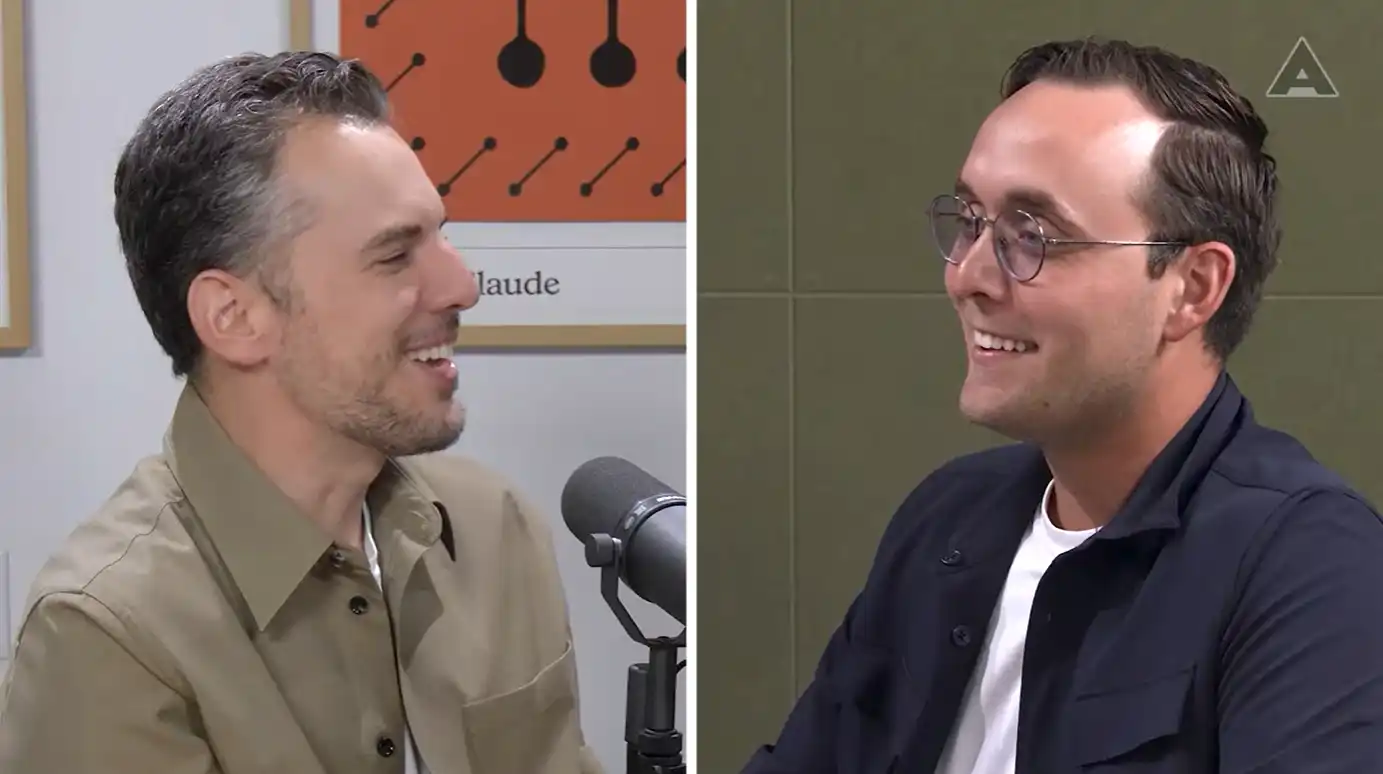
Alex Heath (left) and Mike Krieger (right)
In this conversation, Mike Krieger does not simply discuss what Anthropic's next product will be, but breaks down AI product competition into a set of more foundational structural issues: how model capabilities enter real workflows, how AI companies organize innovation internally, how platform companies handle boundaries with ecological customers, and as AI execution capabilities become stronger, where human judgment will be repositioned in the production chain.
First, the product form transitions from "chat" to "task". In the past, large models mainly existed in the form of dialog boxes, where the user input a prompt and the model generated a response. Now, products like Claude Code, Co-work, and Claude Design represent a different product logic: enabling AI to continuously advance work around a goal, and in the process, invoke tools, generate results, and perform verification. This means that the key to AI products is no longer just answer quality, but the ability to decompose tasks, maintain continuity of context, invoke tools, and verify results. Whoever can encapsulate these capabilities into a seamless workflow is closer to the next generation productivity gateway.
Second, the organizational approach has shifted from "Big Team Planning" to "Small Team Experimentation." The operating style of Anthropic Labs is more like an entrepreneurial unit embedded within a large company: starting with two or three people, holding bi-weekly reviews, and using high-frequency feedback to determine whether the project should continue. In the past, innovation labs in large companies tended to fall into long cycles, unclear responsibilities, and projects deemed "good enough" being postponed. Now, the model has reduced the construction cost, and what is truly scarce is judgment, taste, and decision speed. This means that the organizational efficiency in the AI era depends not only on the number of engineering personnel but on whether a smaller team can more quickly validate the direction.
Third, the boundary between platforms and applications is being redefined. The success of Claude Code has transformed Anthropic from just a model provider to also actively shaping application forms. The controversy between Claude Design and Figma demonstrates that a model company venturing into applications will inevitably encroach on the interests of customers and ecosystem partners. In the past, basic model companies mostly provided underlying capabilities, with vertical applications such as Cursor and Figma handling user interfaces and scenario encapsulation. Now, model companies also need to showcase an agent-first future form through their own products. This means that AI platform competition is not only about API competition but also about product paradigm competition.
Fourth, the stronger AI becomes, the scarcer human judgment is. Mike has repeatedly emphasized that Claude can code faster, generate prototypes, and perform tasks more quickly, but it cannot replace the most difficult part of the 0 to 1 process: posing the right questions, understanding real users, defining the product's North Star, and determining what is "right." In the past, execution ability was the primary bottleneck of knowledge work. Now, execution is being accelerated by models, and human value is more focused on preliminary judgment, creativity, relationship networks, and organizational abilities. AI will not automatically eliminate difficult decisions but will instead magnify the impact of erroneous directions more quickly.
If this discussion were to be condensed into one judgment, it would be this: After Claude Code, Anthropic is not seeking a single blockbuster product but a set of methods that will transform AI from model capability into a production system. In this sense, the subject of this article is no longer just Anthropic's next product roadmap but a structural turning point for the entire AI industry, transitioning from a "model competition" to a "system competition."
The original text content (reorganized for readability) is as follows:
TL;DR
- The competition in AI products has shifted from "stronger models" to "how capabilities are implemented," fundamentally leading large model companies to vie for workflow entry points.
·The significance of Claude Code lies not only in writing code, but in demonstrating that an agent can continuously execute tasks with a clear goal, driving AI from a chat tool to a production system.
·The core value of Anthropic Labs is not in releasing many products, but in quickly validating what capabilities the next step should have with a small team.
·Co-work, on behalf of Anthropic, aims to extend Claude Code's methodology to non-programmers, essentially abstracting "programming ability" into the work automation ability of ordinary people.
·The catch-up of OpenAI Codex has made Claude's advantage not just about technological leadership, but dependent on whether Anthropic can integrate Claude Code, Co-work, and Claude.ai into a unified experience.
·Model companies getting involved in applications themselves will intensify the boundary conflicts with customers, but this is also the inevitable path for them to define the next generation of AI product form.
·The faster AI can execute, the more human value is concentrated on upfront judgment, product taste, and problem definition, because errors in direction can also be magnified more quickly by AI.
·The impact of AI on employment is not a problem that a single company can solve, fundamentally forcing society to re-examine skill reshaping, distribution mechanisms, and irreplaceable human capabilities.
Original Content
Alex Heath (Host): After Claude Code, what will be the next big product from Anthropic? This week, we have Mike Krieger as our guest. He is the co-founder of Instagram and is now in charge of the "Moonshot Project" team at Anthropic.
Mike Krieger (Chief Product Officer at Anthropic):
One of the darkest days during my time at Anthropic was when we named it 3.5 v2. As for why we ended up choosing that name, I can explain.
Alex Heath: Mike and I recorded this conversation in person during the Claude Code conference held recently at Anthropic in San Francisco. During that conference, Anthropic announced a new large-scale computing power partnership with Elon Musk. So, are you now going to space with Elon?
Mike Krieger: Absolutely right. Yes, we are looking for new, and even somewhat unexpected, sources of computing power.
Alex Heath: We talked about what Mike is doing now, the intense competition between Anthropic and OpenAI, and Mike's belief about which parts of human work will continue to be important even as AI becomes increasingly powerful.
Here is "Access".
Mike, great to see you at the Claude Code conference in San Francisco. I was just reminiscing about our last conversation. Back then, you had just taken over Labs not too long ago, but now it's been a few months, right?
Mike Krieger: Yes, almost four months.
How Labs Operates: Biweekly Eliminations and Small Team Validation of Big Products
Alex Heath: Almost four months. For those who are not familiar with Labs, I want to start here. Because this is a pretty special organizational structure. A few months ago when I was at your office, we also talked about this. What exactly is Labs? What is its mission within Anthropic?
Mike Krieger: In simple terms, my understanding of Labs is—this current version, I would call it Labs v2. We can also discuss later what Labs v1 has done and what Labs v2 aims to do.
But I think Labs primarily does two things.
First, it is to narrow the gap between Claude's theoretical capabilities and the everyday user experience. That is, Claude can do a lot in theory, but how can these capabilities truly enter people's daily work and life? What products, prototypes, or projects do we need to do to demonstrate how to unlock more of this potential, and how to minimize the gap between them as much as possible?
Second, we are more like a "frontier scouting team" to determine which direction models need to evolve in the future to meet the needs of different users.
So, a successful Labs project is not necessarily a final product. It could also be a prototype. After we create it, we realize that the current model is not good enough and cannot yet complete the task. So we put it aside, wait for the next generation of models to be released, reevaluate it, or turn it into an evaluation metric for future model development, and then continue to iterate.
Therefore, unlike a pure product company's product lab, where the measure of success might be "did you ship a product," at Anthropic, the value of Labs can also be seen in other aspects: it can influence Anthropic's future direction.
Alex Heath: Labs has indeed produced some hits, right? Claude Code is one of them, as well as MCP. What else is there?
Mike Krieger: Agent Skills is also a very important thing that Labs has produced. Additionally, I can mention a project that was not released at the time but was very helpful for research: computer use, which is about enabling Claude to use a computer.
I joined Anthropic in May 2024. Next week will mark my two-year anniversary at the company, which we internally call the "antiversary."
Alex Heath: Is it an anniversary?
Mike Krieger: It's an antiversary. Everything in Anthropic has to be related to ants. At first, I was quite resistant to it. We don't even say dogfood; we say antfood.
After I joined, we began building Labs. One of the earliest projects proposed at the time was: why not try having Claude use a computer?
Alex Heath: That's computer use, right?
Mike Krieger: Yes.
Alex Heath: In what era was that model?
Mike Krieger: That was during Claude Sonnet 3.5. That was also the first-generation model I was involved in releasing. I started working on this release in my third week. We often joke that Anthropic doesn't have so-called onboarding projects; it throws a very difficult project at you right away. So, in my third week, I was already involved in a release.
Sonnet 3.5 is a very interesting model because it was one of the earliest models to truly unlock some programming scenarios. It wasn't yet at the level of full agentic coding, but you could already see some potential.
So, we introduced Sonnet 3.5 and built a product around it for computer use. However, it had many issues. For example, it was too slow in using the computer, not accurate enough, and its visual capabilities were insufficient. It would see the screen and then say, "I need to click that button," but end up clicking somewhere else.
But building this "partially available" testing framework itself was very helpful. Because later when we got to Sonnet 3.5 v2 — the name of which I can expand on later, that was truly one of my darkest days at Anthropic — we were able to put the new model into this framework for testing.
Later, we tried 3.6, which still wasn't great, but there was some improvement. Then, with 3.7, I have a very vivid memory of that day. I was in New York on a business trip, meeting the New York team. Suddenly, someone messaged me saying: we think what Labs had done before, which was the computer use project that had been running for nine months at that time, was really starting to show signs of life on Sonnet 3.7. We believed it was time to consider computer use as a capability, open it up to the public, and have a public discussion about it.
This process took about nine months. Every few months, we would test a new model in the same testing framework. Even though Labs had temporarily set aside this project, it was still very useful because it had become a test suite for assessing the evolution of the computer use capability in the models.
Alex Heath: When you first joined Anthropic, you were the Chief Product Officer. I remember thinking at the time: Mike Krieger, this co-founder of Instagram, in my mind, a very consumer product-centric founder, how did he join an enterprise AI company?
Mike Krieger: Yes.
Alex Heath: We might have discussed this at the time. I remember thinking that it was a very interesting choice. In hindsight, it was the right choice. Of course, the timing was also very good.
I'm curious, when you first joined as CPO, responsible for the entire product line. And the concept of "AI product" itself is a bit vague and evolves quickly. How did you transition to Labs about four or five months ago? From what I understand, you are now more like an IC, a individual contributor? Are you still managing people now?
Mike Krieger: I'm not managing people now. We happen to be entering the performance evaluation period.
Alex Heath: So this is what you wanted, right? You wanted to escape writing performance evaluations?
Mike Krieger: Exactly. I opened the system, looked at what assessments I needed to write, and found out: you only need to write your self-assessment and evaluate your manager.
Alex Heath: Is that it?
Mike Krieger: That's it.
Alex Heath: So, Claude is now doing the performance reviews?
Mike Krieger: Yes, Claude does help with some of the evaluations, which is quite useful. It doesn't write the whole thing for you, but at least it helps you remember: What have I really done in the past six months?
I feel like the company has gone through different stages, and the things I'm truly passionate about at each stage have varied.
When I first joined, the entire product and engineering team was probably only about 30 people, maybe split half and half between product and engineering. We also had some engineering teams working on research infrastructure, scalability, and such, but if you look at the people actually building around the product, it was mainly Claude.ai and what we then called the API—back when it wasn't even called the Claude Platform—there were probably only 30 to 35 people in total, very, very small.
It still felt very much like an early-stage startup at that time, with many things still in the definition phase. For example, "What is this product really?" was far from being shaped. Claude.ai back then didn't have Projects, didn't have Artifacts; basically, it was just a list of conversations between you and Claude, with hardly any additional functionality.
So, joining Anthropic at that time felt like joining a startup that was still searching for its product-market fit. Of course, it had a tailwind by then.
Alex Heath: When you joined, Claude 3 series had already been released, right? Including Opus, Sonnet, and Haiku.
Mike Krieger: Yes, that's correct. That was when Anthropic first brought out a series of models that were at least close to the cutting edge. There were still many product-level things to figure out: What should this product really be?
Although my background leaned more towards consumer products, the reason I was excited was that, between Instagram and Anthropic, I and Instagram's co-founder, Kevin, made numerous investments. We had a whole set of investment themes, one of which was "the future of work"—how work would be accomplished in the future.
And it seemed like Anthropic was very likely to unlock this theme: What would happen when you have a very smart assistant helping you work? I didn't even foresee at that time how disruptive this would turn out to be.
Alex Heath: You might have thought at the time: this is a pretty interesting small AI company that might help me understand some investment themes.
Mike Krieger: Yeah, it might help us understand some of the themes we're thinking about. But in reality, what it changed was far more than I initially imagined.
That was the first phase: the team was very small, and the projects we were working on could be counted on one hand. Then we fast forward to the end of last year, and the product team had grown to hundreds of people. We had a whole portfolio of projects, a lot of the work was turning into deployment, understanding customer needs, customer-facing work, managing layers, and all the inevitable things that come with growing a company.
I gradually realized that some people really enjoy this kind of work and are really good at it. I respect them a lot. But for me, I had a great coach who called this state the "competence zone" – it's what you're good at, you do it well, and you can handle it, but it's not the thing that truly ignites you, that truly drives you.
It's actually a very dangerous place to be. Because you can stay in that place for a long, long time, and you might look good on the surface, but it's not where you have the most fire, the most passion.
So, in the fourth quarter of last year, I started discussing this with Daniela. I said, the company has grown. We've indeed compressed the usual five-year growth process into a short span. Although it was actually only about two years.
Alex Heath: Yes, I think you've grown quite well.
Mike Krieger: Yes, the growth has been good. The team size and product portfolio have expanded rapidly. So I said, I feel like I want to go start a new company.
Daniela asked me: Is this because you want to leave Anthropic, or is it because you want to adjust what you're doing at the company? I said, I really like this company. The people here are great, and I also love the technology, the mission, and so on.
And coincidentally, at that time, we were also reactivating Labs. Because Labs v1 was too successful, all the projects graduated, and no one was left behind. So Labs was actually temporarily put aside, set aside.
So we decided to restart Labs, and I also returned to the role of a builder. Everyone who saw me inside and outside of work would say, "Mike, you look too happy."
Alex Heath: Some of your colleagues mentioned that to me earlier today as well. They said, Mike is in such a good state now, living a particularly happy life.
Mike Krieger: Yes. Of course, I am still my harshest critic. So I ask myself every day: How can I do better? What can we do? What can we build? What are we really validating?
So it's not an easy thing. But it does align more with the things that truly drive me.
Alex Heath: We don't have to dwell on this issue for too long, but I am indeed fascinated by tech companies doing this kind of "moonshot," "from 0 to 1" experiment internally. Alphabet may be the most typical example, but similar attempts have actually been made many times in tech history. Some have succeeded, and some have not.
Anthropic's Labs v1, at least from a product standpoint, has clearly been successful.
Mike Krieger: Yes.
Goal: Find the Next Claude Code
Alex Heath: I think this also brings a lot of pressure to you now. Because you'll think: Well, Claude Code is already there, I have to create something that can compare to it.
Mike Krieger: Yes. Interestingly, we have an internal phrase similar to a mission statement: We need to find the next Claude Code.
By the time Labs v2 was launched, this bar was already set high. But since then, Claude Code has continued to evolve, so the bar has been raised even higher.
I think there are several important things. For me, having entrepreneurial experience is very helpful because you can never fully replicate that feeling: two to three people against the whole world, with only a certain amount of money in hand. If we can't create something viable, we have to shut down the company and return the money to the investors.
Alex Heath: It's like you and Kevin back in the days.
Mike Krieger: Exactly. I remember that life-or-death question weighing on me every day: What if this doesn't work out? Can I still maintain this independence? Can I still do what I really care about?
That feeling is hard to artificially create inside a large company unless you design some very complex structures. I've seen that approach too. Before launching Labs v2, I studied many cases of internal company labs. Some companies would allow teams to have a part of the equity in what they create, or design other similar incentive mechanisms.
Alex Heath: Yeah, it's all these different "patchwork" arrangements.
Two-Week Trial-and-Error Cycle
Mike Krieger: Yes, they are all trying to patch up this feeling.
But what we found is that the truly effective way is not entirely through incentive mechanisms. Because Anthropic itself attracts many proactive, ambitious, and mission-driven individuals. What we need to be wary of is not whether everyone is motivated to do the project well, but how to avoid this place becoming a comfortable space where some "okay" ideas are dragged on for months.
So our approach is to shorten the cycle. Labs v1 was basically a review every four to six weeks, where a project would receive support, and then the team would have about six weeks to prove something.
Now we are using a two-week sprint. Every two weeks, each project has to report to the entire Labs leadership team. This is not the kind of "slaughter committee" meeting; it's usually a more rational discussion unless a project is really off track.
But we will seriously ask each project one question: What have you learned in the past two weeks? And: Have we learned enough?
Sometimes, a project has already completed what it needed to. You might say, this project is great, it has already proven what needs to be proven, and we don't actually need to spend another two weeks.
Change is happening too fast now, and with the help of these models, the construction speed is also very fast. So, the opportunity cost of letting a project drag on for an additional four weeks is actually quite high.
I think this is the best thing Labs v2 has done: we have spun the flywheel faster. At least every two weeks, we measure our learning speed, even if we can't yet measure external impacts.
Alex Heath: Are most people in Labs former founders?
Mike Krieger: Indeed, many people are former founders.
Alex Heath: Is this your screening criterion for people?
Mike Krieger: We have about two types of roles in Labs. We call all projects "bets" because they are essentially high-risk, high-volatility bets. Then there are bet leads, who are project leaders.
If you are the DRI (Directly Responsible Individual) in the spiritual sense, you are most likely someone with a founder background.
However, Labs also has other members. They may not be founders but are highly practical builders. For example, someone who was an early employee of a startup and went through the 0 to 1 process, or simply someone who loves to build things.
We have a colleague who joined Labs after being an early employee at a previous startup. She possesses the ability to "cover the entire tech stack and go wherever is needed."
I believe this ability is as important as a founder background. You can't just have pure founders; you also need that complementary "founder team" quality.
The Future Form of Companies: Small Teams + AI
Alex Heath: My co-host Ellis couldn't make it today, but he sent me some questions to ask you. One of the questions is: Is the "founder super-team" you have assembled in Labs a new type of company organization model? Especially in the AI era. Or is it just a specific case for companies like Anthropic?
Mike Krieger: That's a great question.
I think there will be more teams like this in the future: a small team working alongside models. Since models are not perfect, you still need founders with judgment, taste, and a sense of direction.
For example, yesterday I spent about two hours discussing a Labs project with the team. In that project, we were discussing what the multiplayer aspect of the product should look like.
Those two hours were very valuable, very "human." We were just in a room constantly colliding and debating. And then for the next roughly 12 hours, I had Claude asynchronously handle those ideas.
But the key is, you need someone with judgment: which issues should be fully discussed upfront? Which things should be implemented directly? Because if you don't specify, the model will make many decisions for you.
So, I believe founder-type talent still plays a very important role. But once you get the structure right, you can do a lot.
I recently did a quick retrospective to review what Labs has been up to in the past few months. It's only been four months, but some projects were conceptualized in January, entered testing in February, and concluded in March; while some projects were brainstormed in February and have now evolved into Claude Design.
So a lot has happened, and it has happened very, very quickly.
I believe that in the future, more companies will shift to this model: smaller teams, giving them autonomy, letting a truly responsible person drive the project, and not overstaffing in the beginning.
This is a crucial lesson we learned in Labs v2: don't start a project by assigning it to five people. It should start with just two or three people, more like a startup.
Alex Heath: Now onto my favorite part: I'll try to extract more information about these projects from you.
When we met in March this year, you told me that you were researching how to make Claude run for a longer time, addressing the long-horizon problem, to tackle tasks with longer timeframes. You were in charge of that project back then. Are you still overseeing it?
Mike Krieger: No, I'm not. This project is quite typical: we actually set it aside for a while, but its learnings later went into the Outcomes in the Managed Agent released today.
The core idea of this project is to have Claude execute a task based on a rubric, an assessment standard, targeting the final outcome or goal of the task, rather than just responding to a single prompt. This concept is very much in line with the direction we previously explored in Labs.
At that time, I was also figuring out where this project would extend to. In this morning's release, there are two themes that directly stemmed from this Labs project.
One is Outcomes. The other, in Boris's demo, you see Claude Code validating its work through screenshots, testing what it has produced.
This was also one of the key directions we were driving towards at that time. Because Claude looking at the code it wrote and saying, "I think it's fine," is one thing; it is another thing for it to thoroughly explore and validate its work.
In the project I was in charge of, we even looked into having Claude record the entire process of completing its work, then review the video itself, to assess: "Oh, this animation is flawed." Some issues cannot be discovered through screenshot verification alone.
So, yes, the project we discussed back in March, which was still in development at the time. We have since set it aside. It still runs internally, and we occasionally use it for some demos. But its primary value has been as a source of upstream inspiration and capability validation.
Alex Heath: Another project, you mentioned allowing Claude to choose its own form at the time. For example, it would self-determine: the next dialogue, instead of using a command-line interface, should be turned into a website.
Mike Krieger: Yes.
Alex Heath: Is that Claude Design? Or is it something else?
Mike Krieger: It shares a lot of spiritual alignment with Claude Design, but it is not the same thing.
The question we are currently exploring is: Claude Design is essentially a form of "agent + canvas." You can imagine there are many combinations like this.
Even within Claude Design, I have used it for many things. For example, writing technical specification documents. Now, my favorite way to write technical documents is actually using Claude Design. Because you can visualize the flow of information: how does information flow? How else can it flow? And then you can watch it evolve directly.
This may be my second favorite use case. The first is making slides; I now often use Claude Design to create slides. But you can totally imagine that the canvas can support other formats. So, this is a direction Labs is exploring: something like Claude Design but oriented towards more types and more application scenarios.
I find this very exciting.
Alex Heath: So is it essentially a more generalized productivity software? Is this the core idea?
Mike Krieger: I think this is a theme that can be further explored: a kind of productivity software, preferably highly personalized to adapt to your productivity needs. I think this is a very interesting trend.
Alex Heath: Are there any blank areas in AI that you are currently considering?
Mike Krieger: As models continue to advance, I think their ability to become useful partners in fields like life sciences will be very interesting.
I've recently seen more and more examples of this. For example, there is a fantastic thread on X where someone did a full genome sequencing at home. Later, they even professionalized this and can now come to your home to do it.
I'm very interested in this because I'm the kind of person who really enjoys "self-awareness" and wants to figure out how these things are done.
Some people who really understand this field have told me that there is a significant difference between models from a few months ago and models like Opus 4.7 now. The current models are becoming truly useful in analyzing genetic data, deriving inferences from it, or interpreting your lab results.
Previously, it might have just been like, "Oh, that's cute, it says something a doctor would also say after looking at it," or just repeating things we already knew based on experiential rules. But now, it is really starting to add value.
So, personalized medicine is a blank space that I am very interested in. I feel like we are at a tipping point. There is still a lot of so-called overhang here, which is the space where the technology is already possible but the products and applications have not been fully unleashed.
Alex Heath: Indeed, there are many similar startups popping up right now, such as Superhuman, Superpower, Ro, and Function Health, all doing these kinds of things.
Mike Krieger: Yes, exactly. In January this year, when we were doing early explorations for Claude for Healthcare, one of the partners was Function. You can import your lab results into Claude and then do further analysis.
This week, I also started using a supplement service called Subco. You input all the supplements you are taking, and it understands how these supplements interact with each other, then gives you suggestions like: you actually don't need these eight, you can reduce it to four.
They haven't done the next step yet, but I can imagine someone will: combining your most recent lab results or combining your genetic data to determine if you have a super-strong reaction to a certain supplement.
So, this whole field is very fascinating. This is only the "optimal" side. If we think about areas where medical services are currently lacking, such as many people not having access to quality local medical resources, then AI might be able to fill these gaps to some extent.
There is a lot of very intriguing white space here.
Mike Krieger: Another area that's really interesting. About a year ago, I attended a consumer AI conference organized by Forerunner. I was on stage discussing with some founders: Besides chatting and endless assistants, what would be the breakout case of consumer AI, the application that would truly break through?
Until now, I haven't really seen it. Maybe health comes close, but it doesn't quite fit the type of consumer application I just described. AI-driven dating products might have some opportunity, but there's a natural discomfort in them.
Alex Heath: So we won't see Claude launching a dating service?
Mike Krieger: I don't think we would do a Claude Dating Service. But perhaps a customer using the Claude API would create a similar product. I don't think we would do that internally.
However, I still think there's an interesting open question here: Can AI really help us better understand ourselves, understand the world, understand communities, and make human connections stronger rather than more distant?
For example, I've recently become interested in civic engagement: how to organize representative groups of people for public issue debates. I'm not an expert in this field, but I'm starting to get interested in this issue.
In this scenario, AI's role is not to make decisions for people, but to help identify representative groups. In other words, keeping people in the loop but ensuring that we hear the right voices.
Alex Heath: I'm curious, do you still have that "social media product" instinct in you?
Mike Krieger: It might not be as strong now. However, if there are still interesting ideas in that direction, I think Sora once explored an interesting point: you can describe the algorithm you want, and then the system generates it for you.
Alex Heath: This direction is now appearing everywhere. It's in Threads, and X has it to some extent. I think this will become a standard capability.
Mike Krieger: Spotify also has it. I've used it on Spotify myself. I create some "weird" playlists. For example, my daughter and I can't agree on what to listen to, so we let Spotify generate a playlist that combines our preferences. The end result might be a mix of Pavement and "Frozen" music. Really good.
Alex Heath: I like this. Very intriguing.
Mike Krieger: The AI DJ for Spotify is indeed quite innovative. But I think this is a way AI is helping us personalize.
I've been thinking about another point recently. Not sure if it's a Labs thing, but maybe someone should do it: could AI be a useful filter to cut out the noise from the outside world?
I've started using Dispatch and Co-work for this reason as well. Otherwise, I'm a lost cause news addict. I would constantly check every news site, read a lot of stuff. It's valuable, but sometimes I wonder: Am I just rereading the same stories over and over?
So, now I have something akin to a daily digest in my workflow. It curates the sources I usually read. A lot of times, I still click through to the original article, but it at least helps me understand the trends and prevents me from opening a dozen websites first thing every morning.
Alex Heath: As long as you're still reading The Verge's Sources newsletter, Mike, you can keep aggregating.
Mike Krieger: Of course, that one will go straight to my inbox.
Alex Heath: I think I saw a leak on X before, not sure if it's real, mentioning you're considering some more proactive things. Maybe called Orbit or something? Perhaps more actively bringing in the things you talked about into Co-work or another part of the interface, geared towards more consumer-facing users.
Do you see this as an opportunity?
Mike Krieger: I think so. Every time you see power users creating such use cases on their own, a natural question arises: what would it look like to turn this capability into a built-in feature?
Like scheduled daily briefings, or actively monitoring certain things. We heavily rely on Slack internally at Anthropic, so it could actively monitor Slack; it could also monitor email.
I've started doing this myself recently as well. My morning Claude routine has a few things. One is the news digest I mentioned earlier. Another is having it scan Superhuman, my personal email client. Because MCP is out now, it can scan my inbox.
This is very useful because it knows different email categories and can tell me: this one you really should look at; these you can read later. So now, before opening my inbox, I will first look at the summary Claude sent me.
There are also some shopping-related things. For example, if I'm waiting for something to be restocked, instead of compulsively checking every morning, I can have Claude look into it.
Alex Heath: Is this for buying sneakers?
Mike Krieger: I should use it for buying sneakers. But it might not be fast enough for that; buying sneakers requires a faster system.
There are also many internet rabbit holes, those information caves you accidentally stumble into. Of course, there is a balance here: you don't want to completely eliminate this kind of fun. Occasionally getting lost on the internet is actually quite interesting. But maybe you can do it more consciously, rather than unconsciously scrolling back and forth in the background.
From Claude Code to Co-work, AI Products Start Serving Non-Programmers
Alex Heath: I am a Co-work user myself, using it every day. I even used it to prepare for this interview and for writing; I use it for almost everything. It has changed the way I work a bit. I have also recommended it to my wife and friends. But I do feel it is still in its early stages. Most people may not use it as extensively as I do. From a product perspective, there is still some disconnect between Co-work and traditional chatting, as well as Claude Code. I don't think in the long term they should be three separate things.
Mike Krieger: I agree.
Alex Heath: A few months ago when I visited your office, some of your colleagues also said that perhaps Co-work will eventually become the frontend interface for everything.
Co-work was a Labs project that you had before joining Anthropic, right? But it was released when you were still the CPO. So I'm curious, what was the insight behind starting Co-work? Did you suddenly realize: we need to abstract the ability to code so that ordinary people can use it? Was this an opportunity? Or was it for another reason?
Mike Krieger: Here I really want to give credit to Dario.
At any given time, Anthropic is simultaneously thinking about many different things: research, product, business, computing power, policy, social impact, and so on. It is not a typical company where only product and go-to-market are the two most important things, and the CEO's attention is mainly focused there.
Dario's attention switches between different domains based on the most urgent issue at hand. Shortly before the Co-work launch, he mentioned to us: I recently noticed an interesting trend where someone is using Claude Code for personal scenarios. However, for most people, this is challenging because you have to open the terminal, which itself has a high barrier to entry.
So he posed a question: What would a 'Claude Code for everything else' look like? This was a very insightful prompt and aligns well with his approach. He doesn't hand you a product sketch or define the product entirely.
Alex Heath: So, that's your problem to solve.
Mike Krieger: Exactly. He simply said: This is a product problem for you to solve. What really shaped Co-work later on was the combination of two types of personalities. Of course, there were many people involved, but I especially think of two individuals.
One is Felix, one of the main maintainers of Electron, very knowledgeable about desktop software, or at least very familiar with desktop-web software. He has always been pondering a question: How can people get work done on their computers? The other is Boris, who has a deep understanding of Claude Code.
When we brought these two and their respective teams together, it only took a few weeks to release Co-work. Not that all the work happened in those weeks, but because there was already a lot of prior reflection on the Claude Code side and the desktop side: How to enable not just programmers, but everyone to use this capability?
Because these models are inherently very powerful agentic engines, in other words, intelligent engines with agency. The question is, how to hand over this engine to more people.
But I completely agree with your assessment: Right now, it feels a bit like we are not releasing an organizational chart, but rather our harness strategy, or a testing and execution framework strategy. This is not easy for most users to grasp.
Alex Heath: And it's also not a great product experience. For example, threads in Co-work cannot sync to the Claude mobile app. Meaning, I can't take the interview documents I've been preparing in Co-work directly to my phone.
Mike Krieger: Yes. Some products naturally point to what the next step should be in their evolution.
For example, I am a heavy user of Dispatch. Dispatch allows you to remotely access a Co-work, but your computer must be on. So the next natural question is: What if I didn't have to keep my computer on all the time? How do we evolve in that direction?
Claude Code has already been on this path, just about six months to a year ahead. For example, Claude Code Remote, I've been using it. I can be out and about and start a coding task. Many times, by the time I get back to my computer, it's already submitted a pull request.
You can imagine that Co-work will also move in a similar direction.
But I agree, we are indeed at a stage where, for innovation's sake, we let many things grow organically first. This is certainly good. But looking ahead, from a context and continuity perspective, whether you are having a conversation here or there shouldn't be something the user has to think about.
My wife often asks: I can't remember, was that something I did in coding? Or asked in chat? Or done in Co-work? This shows that the abstraction layer is bad, and we need to fix it.
Alex Heath: This actually makes a lot of sense. Because when I communicate with the OpenAI team, their current super app strategy, and the direction they are taking around Codex, is actually a final form that you guys first achieved with Co-work.
I'm curious, firstly, do you think this "super app" path is the right direction for AI products? Secondly, will this bring you more pressure? Because I think OpenAI has realized that this is a huge opportunity: to bring programming ability to those who can't code.
Mike Krieger: Yes, and they are advancing very quickly.
Alex Heath: Codex is also very good, the new models are also good, Codex has developed very well for them.
Claude had a huge growth in coding before, and even now it is widely believed that Claude is ahead in coding ability. But Codex is indeed hot on their heels, right?
Mike Krieger: Yeah, it really did get strong.
Some of the most interesting times for me at Instagram, coincidentally, were when we had competitors like Snap. They were in the same space as us but approached it differently. In a fast-growing market, you'll find that some ideas you borrow from them, and some ideas they borrow from you.
Alex Heath: So in this analogy, is Anthropic Snap?
Mike Krieger: I don't even know who's who. The market dynamics are different, and the market cap is not quite the same.
Alex Heath: Yeah, a bit different.
Mike Krieger: But the company culture is indeed very different.
At least in my understanding at the time, not all competition evolves this way, but the Instagram vs. Snap competition did, to some extent: we each had our strengths and looked at the future in somewhat similar but not entirely identical ways.
The question became: How does each company evolve to reach those different positions?
Take Instagram, for example. Our previous impression was posting a very polished photo once a week. We wanted to move to a place where users could share more freely. And being able to introduce Stories was crucial for us.
For Snap, they also wanted more influencer and celebrity-related content because that demand was growing. So both sides had to manage their own evolution paths.
This analogy may be a bit stretched. But coming back to us, having OpenAI in this space is very interesting. I think the most important thing for us is two-fold.
First, as we just discussed: to make our product ecosystem more coherent and rational. Whether on the web or desktop, it doesn't necessarily have to be a single app or super app, but at least your various building blocks should be interconnected and make sense together.
Second, it's to continue narrowing the gap between capability and usage. Because even today, with Co-work or any of our current products, this issue still exists.
I was just talking to one of our recruiting colleagues. He is the most extreme Co-work power user in the company and the highest Co-work user among non-engineers at Anthropic. When you see his workflow, you'll find it remarkable.
But even at Anthropic, most of the recruiting team members don't work that way.
So, whether the ultimate form is a super app or not, the goal is the same: Can we create the right product form so that the experience of this recruiting colleague quickly diffuses, making it easy for others to adopt a similar workflow? Or can everyone achieve the confidence and proficiency in using Claude?
Alex Heath: I was actually looking forward to hearing more about Co-work today. Although I know this is a developer conference. I'm curious, how has Co-work developed compared to Claude Code? Is it growing faster? Do you have any data?
Mike Krieger: I'm not sure how it compares to the overall coding product because coding itself is growing very, very quickly. But the growth trajectory of Co-work, at least from what I remember of Claude Code at the time, is similar, if not faster. It's very exciting.
I'm personally very excited as well because I've always hoped that Claude's influence could extend beyond just the codebase scenario.
Now, almost every few days, someone in an internal Slack channel more focused on productivity will share a new milestone for Co-work. This kind of growth is really exciting.
When we talk to enterprise customers, they also say: Great, we've adopted Co-work, and then they see this phenomenon — some people really get it, some still need a lot of hand-holding, different departments use it differently.
That's a good question because it indicates that in the right people, in the right scenarios, in the right product form, this product can already do the right things. But there is still a gap in between.
I think once we can get most people to not have too much onboarding cost and reach a state of "Oh, AI is really helping me work," its growth will accelerate even further.
Alex Heath: Speaking of competition, about a year and a half ago, we talked about another topic at a conference: competing with customers. At that time, you hadn't released the Claude Code product yet.
Mike Krieger: Right.
Model Companies are Starting to Build Apps
Alex Heath: What we discussed at the time was, for big clients like Cursor, what would happen if you made a similar product yourselves? As CPO at the time, you needed to make that call. Now that you are no longer CPO, you probably don't need to make that decision anymore.
But what about now? We've actually circled around this issue quite a bit. For example, the controversy between Claude Design and Figma. You were on the Figma board at the time and subsequently resigned. Dylan later said some friendly words, so it seems this matter may not have been personal against you.
However, this incident is indeed an example. Many in the market see the current trend and think, "Wow, it seems like Anthropic is poised to enter every key vertical. The Figma situation seems particularly nuanced."
Mike Krieger: This matter is definitely more complex than before. When I first joined Anthropic, we only had Claude.ai. At that time, I felt like we weren't really competing with anyone; it was more like a completely new product form.
Now, we still very carefully and thoughtfully consider which products to develop.
I believe that only when we release a product that can bring some unique value does this make sense. Because there are many excellent clients on the Claude Platform, and many people within the company are deeply committed to supporting the success of these clients.
So the question is: Are we showcasing a certain direction to show the industry a possibility? Ideally, this should have a rising tide effect, prompting many companies to adopt this way of thinking.
Claude Code is a great example of this. Previously, much of the focus was on the editor rather than the terminal. After the release of Claude Code, especially the way we released it and gave it so much attention, the entire industry largely began to move in this direction. Of course, there were already people thinking about terminal scenarios before.
That's my hope for these products. Not that they should become the only products in their respective fields. That would actually be bad. I hope to see a diverse range of products.
More ideally: first, they make sense in our product portfolio. For example, if you are already connected to all MCPs in Claude.ai, this should make other products better too.
Second, they can demonstrate a forward direction. For example, Claude Design is very agent-first, emphasizing the prioritization of intelligent agents and giving agents a lot of control output space. This will bring a very specific product experience.
For me, it's useful when doing things like slides. I can brainstorm with the agent while also producing content with it.
Alex Heath: Don't you think it will encroach on Figma?
Mike Krieger: I think they serve different use cases.
Where Figma excels is in production, refinement, and collaboration – formal production, fine-tuning, and working together. These are indeed Figma's strengths. I really like the Figma team; they've polished that product to serve this scenario very well.
Whereas my use of Claude Design is different because I'm not a full-time designer. I'm more into creating visual communication materials or doing some interaction exploration. The goal here is not precision or final production but rather the feel of an early mockup.
I once used Claude Design to prototype our iOS App. Its pixel effect was very different from what we would eventually release, but it pointed in a direction: what I believe we should be able to achieve in this space. So, they will both continue to evolve. I used Claude Design and Figma as examples here, but any similar products are like this: everyone is moving forward.
I hope our good ideas will inform other products, and vice versa. I think everyone is actually exploring together: what kind of product form do we need to create to maximize the use of agents?
I had a very good conversation with a researcher this week. He said the more you restrict agent behavior, the more you try to overly constrain it, the less likely those naturally emerging magical things will happen.
I think Claude Code really embodies this point well, and Co-work also reflects it to some extent. In contrast, Claude.ai is more like you're chatting, executing some very specific tasks.
We will continue to build products in this form. Its most important role is to make more people understand this paradigm and embed excellent experiences into their products.
If these products are driven by Claude, that's great, of course. We also hope Claude continues to be the best, or at least one of the best agentic underpinnings, the intelligent core capability behind the next generation of AI products.
In summary, this matter is indeed much more complex than before. However, we will still try our best to adhere to the same principles: carefully consider which areas we venture into and ensure that the platform-side building blocks remain open to everyone. For example, Managed Agents. Now, what you can build based on Managed Agents is just as powerful as what we can build internally.
Unless for security reasons, we will not refrain from releasing a model just because "retaining model capability can give us a competitive advantage." This has always been our guiding principle.
We only release a product when we believe it truly embodies something novel.
Alex Heath: So, are you and Dylan on good terms? He has been on our show before, so I have to confirm.
Mike Krieger: I really like Dylan and have a lot of respect for what they are doing.
Alex Heath: This is another question from Ellis on this topic. Now, especially in the early-stage startup community, everyone is discussing the viability of consumer startups. People wonder: What will Anthropic do next? What will the next Claude Design be? What will OpenAI do next?
On the other hand, the enterprise market seems somewhat safer. Dario mentioned today that he believes there will be a "single-founder to a billion-dollar" company this year. I guess that would likely be an enterprise company.
But how do you view the current state of consumer startups? If you were to go back to the time when you and Kevin were building Instagram and face the current environment, what different approach would you take?
Because the world has changed a lot. It seems much harder now to build consumer startups.
Mike Krieger: I think if we break down the breakout of a consumer product into a super simplistic view, it probably requires two things.
First, it's some new capability or new form. For us, that was the camera phone back in the day. Now, no one calls it a "camera phone" anymore because having a camera on a phone is a default feature. Or it could also be richer media forms, like TikTok, Reels, and similar products, as streaming capabilities had matured by that time.
Second, it's a distribution mechanism that can help you break out of the circle.
For us, that was still a bit of a "Westworld" era back then. You could share Instagram photos to Facebook, Twitter, Tumblr, and even Posterous—this also exposed how early Instagram was as a product. All these platforms allowed you to freely link back to your product, so you could form a growth loop.
But today is completely different.
I was chatting with some founders, like Matt, the founder of Locket. They found some ways, like you can enter the conversation space on TikTok, leading to some interesting growth moments.
But I think the distribution ecosystem now is more difficult to predict and more uncontrollable.
So, rather than any AI player, I think this may be the biggest trend or the biggest challenge right now: when faced with such a distribution ecosystem, how do you break through?
Before, you might have been competing with Facebook for user engagement. Let me give you an example off the top of my head, maybe back then Facebook's average daily usage was 15 minutes. But now you are competing with TikTok. I guess TikTok's average daily usage might exceed one hour. It's actually pretty crazy, but that's the reality. You have to try to grab some attention from there.
So, if you need those two elements: a new capability or form, and a new distribution mechanism. In the former case, maybe it will be some new interaction between you and an AI-driven entity; or conversely, it's AI helping you step out, go "touch grass," meaning back to the real world, generating more real interactions.
Whichever it is, you still have to address the second issue: distribution.
Now, a lot of attention is shifting to these conversational AI agents. But I don't think anyone has really figured out: what does "viral spread" in a chat actually mean? Today, this question is even a bit irrelevant.
Perhaps something new will emerge here. For example, we launched MCP apps as an open standard.
Alex Heath: This could potentially turn into a new kind of app store-style distribution, right?
Mike Krieger: Possibly. You could plug apps in. Maybe the first truly viral MCP app will be something consumer-facing. That would be very interesting because this could be a new distribution mechanism.
I've spoken with someone from a nonprofit explorer project before. We once wrote an article introducing how MCP was used in certain scenarios. He mentioned that it was interesting for him to see what "viral growth" meant for a nonprofit explorer project.
While the numbers were not particularly large, he mentioned that when he looked at the connector list, they were in the top five for a few days, right next to Gmail and Slack. This brought a lot of attention to them.
So now I am kind of thinking out loud with you. That's also what makes these conversations interesting. We may not immediately arrive at a perfect answer. But perhaps we will see something like this next: Can you provide enough practical value within a framework like Claude, ChatGPT, or Gemini, and then find an interesting way to spread it?
I am really looking forward to seeing something like that happen.
AI Gets Stronger, Judgment Gets Scarcer
Alex Heath: You recently did a podcast with Every's Dan Shipper. I listened to that episode, where you talked about rebuilding Burbn using Claude. For those unfamiliar, Burbn was the app before Instagram, which you later pivoted to become Instagram. Claude rebuilt it in minutes.
I'm curious, first, emotionally, what was it like to see AI recreate something you and Kevin spent a long time building in minutes? Second, if the 2010 Mike had access to today's Claude, would Instagram still have been created?
Mike Krieger: That's a great question.
Alex Heath: Because I guess the AI might not have found that direction on its own.
Mike Krieger: Right. My feeling after it was done was: first, I was very clear on what I wanted it to do. And I also told Dan an interesting point: it actually over-engineered it. It did filters in Burbn, but Burbn didn't have filters back then. We only added filters when we later launched Instagram.
Because Burbn was entirely web-based. There was no technology like WebGL back then to do filters. So seeing it create that on its own was pretty interesting.
But I think, going back to our earlier discussion about the Anthropic internal founding team, a big part of the product work is still about posing those difficult questions and showing the product to real users.
I both love and hate the feeling of being "slapped in the face" by users the first time you take a product out. Someone might say, "What is this? I have no idea how to use it." Or, "I'm so confused."
My first job out of college was as a UX researcher, and I would bring people into the lab every week for testing. I still love doing this today. Whether the product was written by Claude or by hand doesn't matter at all to the end user. They only care about: Is this product useful? Is it usable? Does it create some kind of delightful moment?
These things are still hard. Claude won't solve these problems for you. So, if we had Claude back in 2010, there would certainly be many areas where we could deliver faster, especially when what needs to be done is already clear.
For example, after our release, we quickly realized we needed to implement @mentions. That might take a week, from the user interface to the text layout engine, all the way to server-side persistence, with many details in between. If we had Claude at the time, we could definitely complete it faster and deliver value to users sooner.
But in the journey from Burbn to Instagram, I don't think Claude would have changed much. Except for certain coding sprint stages, it would make us faster. At least at the time, I didn't think that going from 0 to 1 in coding itself was often the limiting factor. The real limiting factors were the thought and exploration processes.
So what I want to say is: hard things are still hard.
I have a concern: if LLM makes too many decisions for you out of the box, will it hinder you from finding that less orthogonal, more unexpected product form?
Of course, you can also use it in reverse. You can say, okay, generate three alternative solutions for me, and then I'll see which one feels right. I've done this myself too.
But it will definitely not exempt you from making difficult product decisions. In fact, you will need to make these decisions even more.
Alex Heath: I think this has become more important.
I feel this in my own work as well. My job is not about writing software, but about producing media. I can delegate more to Claude, let the skill file remind it as much as possible of what style I like, and so on.
But when I actually read the output, I still think, "Hmm, not quite right." And then I communicate with it like I would with reporters in the newsroom.
Mike Krieger: Yeah.
Alex Heath: I feel like as its capabilities get stronger, that skill becomes even more important. Because I don't want to lose my intuition in this process. I feel like a lot of people might be starting to over-entrust it because AI programming is advancing so rapidly. I hope we can return to a more balanced state later on.
Mike Krieger: I think human intuition is still very important. I really like your analogy of "reporters and editors". Unless the reporter has completely gone off track, most of the time, the editor is dealing with a draft that is already close to what you want.
Alex Heath: I have indeed encountered situations where it has gone completely off track before.
Mike Krieger: But most of the time, the editor might think: this draft is already 90% close to what I want, a little more editing can get it to 95%; or it's now at 80 to 85 points.
But if you were involved in shaping it from the beginning, maybe you could get closer to 100%. Of course, these things cannot be precisely quantified.
I have experienced this when building things internally at Labs as well. What I have learned now is: it's best to have a more thorough conversation with it before Claude writes any line of code, to carefully think things through. Then I would say, okay, now this direction feels right, we have effectively collaborated on a spec, now you go and implement it.
If I just give it a high-level feature description, it will indeed build the feature. All the validation mechanisms we are building will also ensure that it functions as intended.
But when I look at it later, I feel like: if it was me, I would have done it slightly differently. The feeling of "not quite right," I don't really like it.
So, we are moving towards a way: first clearly express the North Star, and then help Claude converge efficiently and effectively towards that North Star.
Someone within the company put it well: when we program with Claude, the core of the work is to clearly articulate the North Star, the ultimate direction, and then help Claude converge towards that direction.
This is a kind of guide, in a sense also a manager. Of course, managers in software are usually more about people development. So perhaps more like an architect. But I haven't found a particularly good word yet.
It's more like being a project Sherpa or a guide with Claude: you take it with you towards the goal, rather than expecting it to do everything automatically from the get-go, nor are you completely hands-off in shaping the early direction.
Alex Heath: There are many interesting parallels between Instagram and Anthropic. I remember there was an issue early on at Instagram that also gave you a headache: compute power, or the server capacity to handle the app. You didn't have enough servers at that time. There was a moment where you had to figure out how to solve that problem.
Mike Krieger: Yes.
Alex Heath: And that transition happened very quickly.
Now, what's interesting is that over a decade later, compute power is still a problem. Although I know you're not directly in charge of compute power, I imagine within Anthropic, compute power must be a frequent consideration. When you first joined this "small AI lab," you probably didn't anticipate this.
Mike Krieger: There are two anecdotes that really highlight this. The first one also shows that I've learned a lot over these two years.
When Claude 3.5 was released, on the day of the release, although we were much smaller in scale back then, users were rapidly adopting it. We were almost maxing out all the chip resources allocated to us at that time.
I remember asking the infrastructure team: Ok, what happens if we run out of resources? Should we just increase capacity?
Because in my Instagram world of the past, unless you were using some very special hardware on AWS, there was always more hardware out there to use.
And they said: No, no, no. If those resources run out, they're really gone. Those GPUs have all been fully allocated. Of course, we're working hard to get more resources.
That's when I realized: Oh, this is a very different environment. You can't just click "launch new instance" to solve the problem like before.
Alex Heath: So that's why you're seemingly now looking to go to space with Elon.
Mike Krieger: Exactly. We are indeed looking for new, and even somewhat unexpected, sources of compute power. It was a very rapid learning curve for me. I immediately grasped and internalized that.
We are now indeed thinking a lot about compute power. Even within a single product, you don't want to sacrifice intelligence. So the question becomes: How can we deliver intelligence as much as possible without wasting compute power? For example, what things can be processed asynchronously? When must we use the largest model? When can we use a smaller model?
So, compute power is indeed an important consideration. I think in many ways, it is also healthy. It also brings us closer to the customer's situation. You just mentioned customer issues, and they also live in a world: they are essentially buying tokens and then reselling these tokens in some form of product.
So in many ways, we are aligned with them, both hoping that this ecosystem is healthy. Over the past year, you have seen the market more prominently shift towards token-based pricing or usage-based pricing, that is, billing based on tokens or usage.
I remember a year ago when I looked at this ecosystem, I would think: Our customers want to charge higher prices, or they want to deliver more value, but they are limited by the current pricing model.
And now, more and more customers can truly deliver value around intelligence, or at least allow users to customize the relationship between cost and capability. For example, you can say: I want to optimize costs, so I will use a less cutting-edge model, but I know what value I can get; or I really want to do this well, so I will use fast mode, consume more tokens, because I have this adjustable knob.
So, yes, at Anthropic, compute power is obviously more important than in the Instagram era. But in some ways, there are similarities: the growth of Instagram at that time was also exponential, at least if you calculate it.
Alex Heath: Dario said your Claude Code grew around 80 times in the first quarter. I don't know if Instagram ever had an 80-fold growth.
Mike Krieger: No. I think apart from that stage from 100 to 100,000 in the first week, we did have very stable, very nice percentage growth, but not like this.
Alex Heath: We can wrap up here. You are already quite early at Anthropic. Although I say "early," it's actually been two years, but in the AI world, this is still early.
The culture of Anthropic is something that I find very interesting. The more I interact with people in the company, the more I sense this. Many people, looking from the outside at Anthropic, see all sorts of headlines, see Mythos, see Dario talking about maybe 50% of work disappearing. Many people would say: they are just creating panic, or there is a regulatory capture strategy behind this.
But I find the culture of Anthropic to be very unique. I am curious, in your opinion, where is the biggest disconnect between the outside perception of Anthropic and what Anthropic truly believes it is doing?
Mike Krieger: This is something that is very hard to make others believe. Because I can keep saying: we are a very transparent company. What we say is what we truly think.
Dario may be the most outspoken person I have ever met. He speaks his mind, not with a carefully crafted idea of: "Will saying this help me raise the next round of funding?" Not at all.
As I got to know him more and see how he operates internally and externally, I am very clear that this is not the driving force behind his communication or product rollout strategies. Of course, saying is one thing, consistently acting the same way over the long term is another.
But maybe I can use an internal example to explain. This year has been great from a business growth, usage growth, and so on. But I believe the reason the company still remains grounded, meaning it has not lost its focus, is because Anthropic's goal is not to build a huge commercial company.
Anthropic's goal is to do everything in our power to push the world towards a better AI future. Once you view everything from that perspective, it can explain a lot of subsequent decisions.
Of course, I cannot ask others not to remain skeptical. Ultimately, we still have to continue to prove through action: we are not creating panic, nor are we intentionally holding back certain things because we think it makes us look more cutting-edge.
Let me give you an example. The internal belief in the company is: we should be able to safely release a Mythos-level model. And so far, we have not achieved this, which is actually a bad thing. We are not proud of this.
Because if we get this right, all the positive use cases can come to fruition. We just talked about life sciences, and with Mythos-level models, there can indeed be many interesting things happening. I have personally written a lot of software internally using Mythos, and it is really strong in this area.
Alex Heath: Your internal software doesn't have any cybersecurity risks, right?
Mike Krieger: Right. We have indeed figured out ways to do this as securely as possible. But this is how we view the world. We want to put these capabilities in people's hands and not hold them back. We are working very hard to avoid having capabilities not be released due to security issues.
So, this does require us to prove it. I think it's fair for the outside world to ask us to prove this.
But when I see people say, "They just want to boost their next valuation round," "They just want to look cool," "They don't actually believe these words," at least to the extent that you are willing to believe me, I can say that this is not Anthropic's true internal driving force.
But still, it comes down to us proving this over time.
Alex Heath: One last question. When someone comes to you and says, "Mike, I'm worried about my job. I'm also worried about the financial security of my family, children, and grandparents," how would you respond to them?
Mike Krieger: I wouldn't tell them "not to worry." Because I do believe that significant change will happen. We don't know how fast it will happen. People can have different views on the timeline, but change is already occurring.
Recently, I received a type of email, many from people I know socially or professionally, whose children have just graduated from college. They would ask: What should we do? I usually tell them one thing that I believe in: This issue is not one that a single company or a government department can solve. It requires a societal-level conversation.
If we are talking about what we have been trying to do, it is to drive this conversation. Although sometimes this is interpreted as instilling panic. Whether it's different tax structures or reskilling, which is actually retraining and reshaping skills, they all need to happen together. I think you also see that we have recently started to become more specific in some policy proposals.
If I were really to answer someone, it would be a very long answer. Because the problem itself is very complex. But I would tell them: You are not alone. This is a complex issue that we all face together.
I also believe that some things will still remain human, ineffable, and extremely important. Such as relationships, curiosity, creativity, and the ability to bring a group of people together towards a common goal. These will still be very, very important. I don't think AI will quickly replace these things.
If you can master this ability, or at least continue to cultivate and nourish it, I think that is very important.
Also, do not see the current moment as a fixed state. Things will continue to change. Even in this moment of uncertainty, or even difficulty, if a friend's child did not get the job they most wanted, it does not mean things are set in stone. Nothing is set in stone.
If people can stay curious, continually proactively explore what the frontier is, they might be involved in creating a whole new job category or moving to a different role within their company.
I think the whole landscape will keep shifting. So, do not see this current uncertain, challenging phase as a static state that will lock everyone in.
Alex Heath: Okay, Mike, I'll let you get back to the lab. Thank you for chatting.
Mike Krieger: Great to see you.
Alex Heath: Thank you.
Mike Krieger: Thank you.
Welcome to join the official BlockBeats community:
Telegram Subscription Group: https://t.me/theblockbeats
Telegram Discussion Group: https://t.me/BlockBeats_App
Official Twitter Account: https://twitter.com/BlockBeatsAsia
 Related Articles