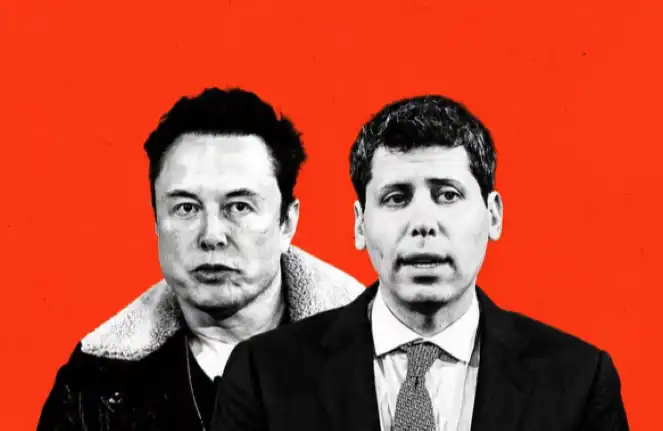
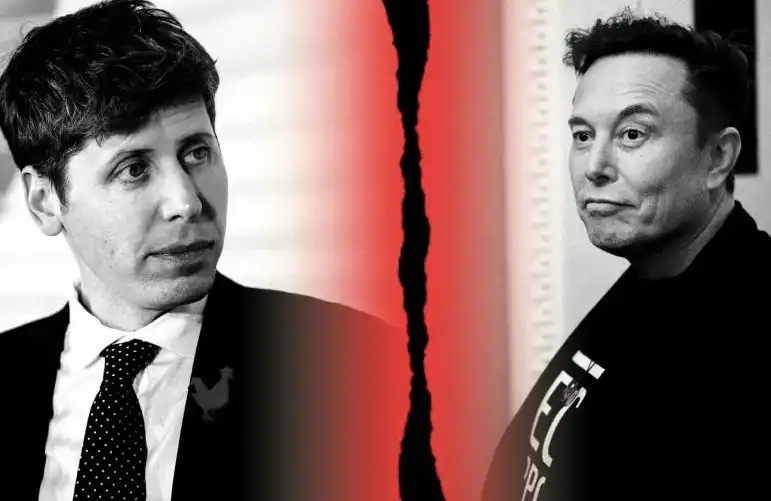
Century-Defining Lawsuit: Why Did Musk Lose? Elon Musk, the enigmatic CEO of Tesla and SpaceX, recently found himself in the middle of a historic lawsuit that sent shockwaves through the business and tech worlds. The lawsuit, which alleged that Musk engaged in market manipulation and violated securities laws with his Twitter activity, concluded with a surprising verdict that left many onlookers stunned. While Musk and his legal team presented a vigorous defense, the evidence presented by the p
Original Title: "The Lawsuit of the Century, Why Did Musk Lose?"
Original Author: Joba, Tencent Technology
On May 18th, U.S. time, a federal judge at the Oakland, California, federal court ruled to dismiss all charges brought by Elon Musk against OpenAI and its executives.
After nearly three weeks of trial, involving the exposure of hundreds of private text messages and emails, and multiple tech billionaires taking the stand, the nine-person jury entered the deliberation room. Everyone thought it would be a long wait.
However, in less than two hours, they returned.
The jury unanimously ruled: Musk's lawsuit against OpenAI and CEO Sam Altman is time-barred. Presiding Judge Yvonne Gonzalez Rogers accepted the ruling on the spot, dismissing all of Musk's requests.
While OpenAI's legal team embraced and celebrated within the courtroom, as Musk's two lawyers exited the courtroom, they only said two brief words to reporters: "We appeal."
Musk himself also posted on X, calling Rogers a "radical judge," accusing her of "using the jury as a fig leaf," and claiming the ruling created "a free pass to plunder a charity."
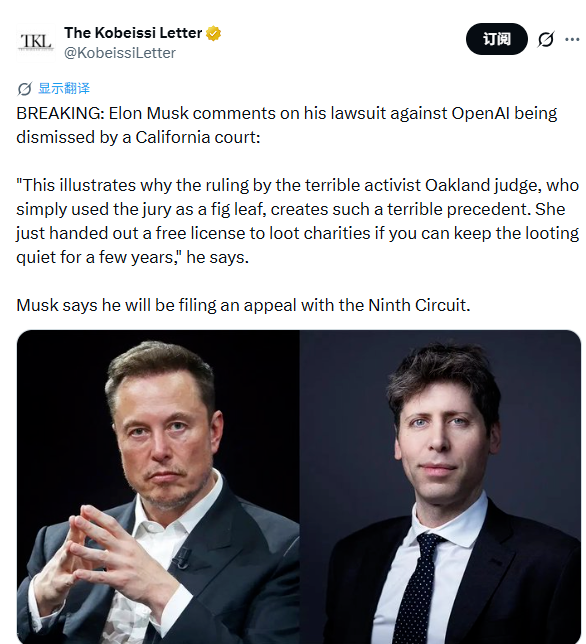
The news of the ruling quickly exploded on social media, eliciting sharply contrasting reactions.
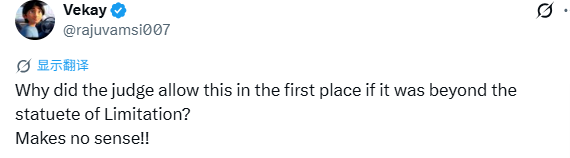
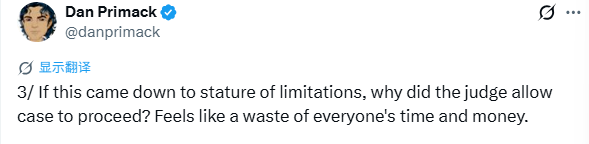
Some comments questioned the fairness of the process: if this case did indeed exceed the statute of limitations, why did the judge allow it to proceed to trial in the first place, which seems completely unreasonable, like a waste of everyone's time and money.
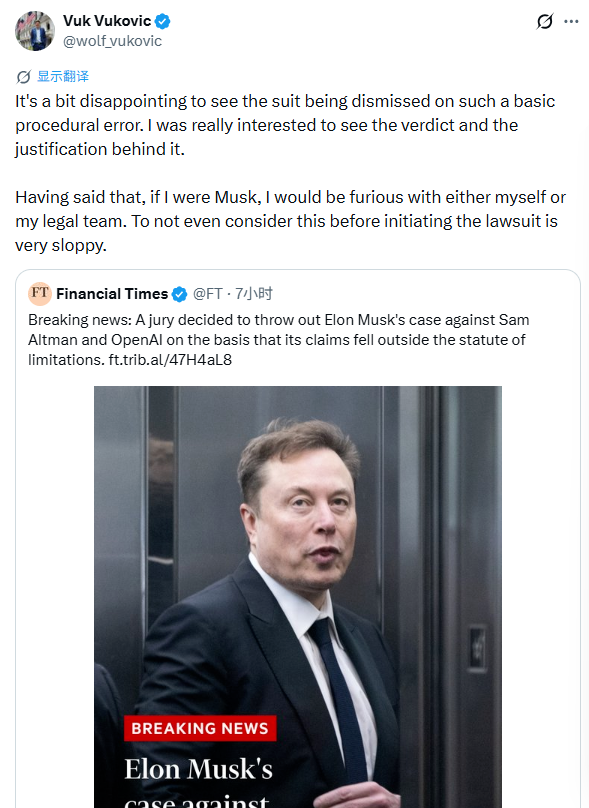
Others lamented not seeing a substantive judgment, but equally found it puzzling, believing that the statute of limitations issue should have been considered before initiating the lawsuit, which appeared somewhat hasty.
Musk's supporters sharply criticized, stating that this is a case where a radical judge let Altman off the hook, after he had turned a nonprofit organization originally committed to benefiting humanity into a for-profit empire worth tens of billions, and now using the "statute of limitations" to betray public trust.
With this, the lawsuit that several media outlets have referred to as the "biggest feud in the tech industry" has temporarily come to a close.
01. Core Allegation Ignored
To understand why this lawsuit has garnered so much attention, we need to go back to 2015.
That year, Musk, along with Ilya Sutskever, Greg Brockman, and a group of AI researchers, co-founded OpenAI. It was established as a non-profit organization with a very clear mission: to develop artificial intelligence for the betterment of humanity, free from commercial interests. Musk testified in court that he donated around $38 million to OpenAI, based on the understanding that it would develop AI for the benefit of humanity, not for anyone to get rich.
However, the subsequent turn of events was evidently far from the original vision.
In 2018, Musk exited the OpenAI board in a power struggle with Sutskever. The following year, OpenAI created a for-profit subsidiary and started receiving investments from Microsoft. From 2019 to 2023, Microsoft has poured over $13 billion into OpenAI. By the end of 2022, ChatGPT emerged, propelling OpenAI overnight into one of the world's most sought-after tech companies.
In 2024, Musk filed the lawsuit. His main contention was that Sutskever and Brockman "stole a charity" and transformed a non-profit organization dedicated to the public good into a profit-chasing business machine. He demanded that the court compel OpenAI and Microsoft to hand over up to $134 billion in "ill-gotten gains," remove Sutskever and Brockman from their leadership positions, and reverse the restructuring of the company in 2025 designed to benefit its for-profit arm's growth.
During the closing arguments, Musk's lawyer, Steven Morrow, told the jury, "There are five witnesses in this case who have sworn that Sutskever is a fraudster." Morrow emphasized that Sutskever's integrity issues were directly related to the core of the case.
This lawsuit also implicated Microsoft. Musk claimed that the software giant aided and abetted OpenAI in alleged violations of charitable trust. Microsoft CEO Satya Nadella testified, revealing that the company had spent over $100 billion on its collaboration with OpenAI, aiming for a $920 billion return. As of last October, Microsoft's stake in OpenAI was valued at $135 billion.
02. OpenAI's Counterattack
Facing Musk's accusations, OpenAI's legal team painted a very different picture.
Their core argument was that Musk not only knew early on about OpenAI's plan to transition into a for-profit entity, but also actively pushed for it, under the condition that he could gain control. OpenAI's chief lawyer, William Savitt, referred to this lawsuit as a "sour grapes" case in his opening statement.
During the three-week trial, OpenAI's lawyers presented a wealth of evidence to the jury, including private text messages and emails, proving that Musk was aware of and supportive of the potential for-profit transition as early as 2017. The lawyers claimed that Musk even proposed merging OpenAI into Tesla at the time and at one point suggested he should own 90% of the shares.
From OpenAI's perspective, Musk left because he couldn't secure control. His reason for the lawsuit was that OpenAI achieved substantial success after the release of ChatGPT, while his own competing company, xAI, failed to keep up.
Following the verdict, Savitt was more direct in his remarks to the press. He stated that Musk's lawsuit was a "fabrication completely unrelated to facts," representing a "hypocritical attempt to harm a competitor."
OpenAI also emphasized that the nonprofit organization did not vanish. The foundation still controls the for-profit entity and now holds over $200 billion in assets. OpenAI's lawyers argued that restructuring the business was the only way to succeed in the expensive competition with Google's DeepMind, and Musk's donation at the time had no strings attached.
On the issue of trust, another of OpenAI's lawyers, Sarah Eddy, accused Musk and his legal team of resorting to "evasive language and irrelevant false allegations" in her closing statement.
03. Jury Selection
Ultimately, the jury did not reach a verdict on the core of Musk's allegations—whether the "stealing from a charity" behavior truly existed.
They made a judgment on a more foundational issue: the statute of limitations.
Per the law, the statute of limitations for claims of violating a charitable trust is three years, and for unjust enrichment, it is two years. Musk filed the lawsuit in August 2024. OpenAI's lawyers demonstrated that Musk had full knowledge of the behaviors he later accused several years ago. The jury found that Musk did not file the lawsuit within the prescribed timeframe.
Following the ruling, Saviet stated to reporters, "This is not a technical decision, but a substantive one. It shows: you filed the lawsuit too late, and you did so because you have always seen them as a weapon against a competitor that cannot compete in the market. So we are pleased to get this result."
Shubha Ghosh, a law professor at Snow City University, said that appealing such rulings could be very difficult. "These rulings are rarely appealed because usually this is a clear rule. The jury found that he waited too long."
Musk clearly disagrees with this interpretation. He posted on X, "Regarding the OpenAI case, the judge and jury never made a ruling on the merits of the case itself, but relied on a calendar technicality. Anyone closely following this case is undoubtedly aware that Ultraman and Brockman did indeed siphon from a charity for their own gain. The only question is when they did it!"
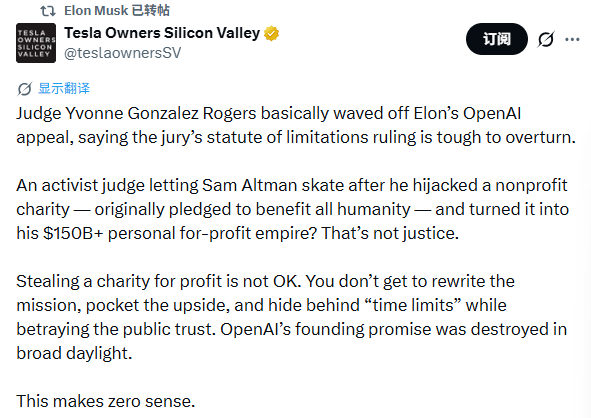
Musk's lawyer, Moro, preserved the right in court for the parties to appeal directly to the judge. But Judge Rogers expressed clear skepticism, saying she was prepared to "immediately" reject the appeal. She stated at the end of the trial, "There is ample evidence supporting the jury's verdict."
04. The Cost Behind the Testimony
While OpenAI won the lawsuit, the three-week trial was not without its costs. A large number of internal documents and witness testimonies were made public, revealing the turmoil within the world's hottest AI company and some embarrassing details.
Most notable was the testimony regarding Ultraman's integrity issues. Musk's lawyer, Moro, reminded the jury in his closing arguments that several witnesses questioned Ultraman's honesty or directly labeled him as a "fraud." More subtly, when Ultraman was asked during the trial if he was entirely trustworthy, he did not give an affirmative answer himself.
OpenAI CEO Brockman's personal diary was also exposed, with one entry stating, "Financially, what can get me to $1 billion?" In his testimony, Brockman revealed that his stake in OpenAI is now valued at close to $30 billion.
While Ultraman does not directly hold OpenAI shares, he has stakes in other companies doing business with OpenAI, including a $1.7 billion share in fusion energy company Helion Energy, a $633 million share in payment processor Stripe, and a stake in semiconductor company Cerebras Systems valued at around $25 million.
The former Chief Scientist, Ilya Sutskever, has confirmed that his equity is valued at around $7 billion.
OpenAI did not miss the opportunity to attack Musk either. Brockman, while testifying, belittled Musk's level of understanding of AI technology: "Listen, he understands rockets, he understands electric cars, but he doesn't understand AI." OpenAI's lawyers portrayed Musk as capricious, quick to anger when things don't go his way.
The two sides also revisited the event in 2023 when Ottman was briefly removed from the CEO position, with Musk's side using it as evidence that "even OpenAI's board does not trust him."
Wedbush analyst Dan Ives commented, "Although Ottman's personal image and leadership have been somewhat affected, the judgment is a huge win for Ottman and OpenAI."
05. IPO Race
The timing of this ruling coincided with two key milestones.
OpenAI is in the process of advancing a possible initial public offering (IPO), which could see the company valued at $1 trillion, making it one of the largest IPOs in history.
Over the past year, the company has successfully navigated a series of challenges: renegotiating its relationship with Microsoft, obtaining regulatory approval to transition to a for-profit entity, and addressing the rise of competitor Anthropic. In late March of this year, OpenAI secured $122 billion in funding at a valuation of over $850 billion, the largest fundraising in Silicon Valley history. The company claims that its annualized revenue from subscriptions, licenses, and advertising will exceed $200 billion by 2025.
Evidently, Judge Rogers' ruling removes a significant doubt regarding the OpenAI IPO.
On another track, Musk's SpaceX is also heading towards the public market. SpaceX secretly filed for an IPO in April, with its prospectus likely to be made public this week. Following the merger of Musk's AI startup xAI in February, the company is valued at $1.25 trillion. Musk is expected to soon begin meeting with investors to prepare for SpaceX's IPO.
The competition between these two men is now extending from the courtroom to the capital markets.
06. What Remains from this Trial
The judge's ruling marked the end of the core part of the three-week trial, but Musk still has cards to play.
Musk's lawsuit also includes antitrust allegations against OpenAI and Microsoft. Judge Rogers chose to split this case into multiple stages, with the antitrust portion slated for the next phase. However, her remarks in court have already signaled, "Antitrust law protects competition, not any individual. And competition in this industry is fierce." Implicitly, the outlook for this part of the allegations is also unfavorable.
What truly emerged from the three-week trial is a fragmented portrait of the Silicon Valley AI frenzy. Hundreds of private messages, executive diaries, and internal documents were disclosed, revealing OpenAI's journey from a financially strapped startup team to a nearly trillion-dollar company. Surrounding this process, Silicon Valley has split into two camps: one believes that the funding required to develop powerful AI is simply unattainable within a non-profit structure; the other believes that embedding public interest in a commercial shell is a betrayal of the founding mission.
OpenAI's non-profit foundation now holds assets exceeding $200 billion, ostensibly controlling for-profit entities, but in the eyes of critics, it has long turned into a corporate extension, forfeiting its regulatory function.
Post-ruling, both sides' statements have been confrontational. Musk wrote on X, stating that this ruling amounts to setting a precedent for "plundering a charity," which will have "incredibly destructive" implications for U.S. charitable donations. His lawyer, Toborov, referred to this as a "brand-new Silicon Valley formula" — starting with a non-profit organization, then creating a for-profit entity to expand, allowing executives and directors to enrich themselves.
OpenAI lawyer Savitt's response was equally sharp: "A hypocrite trying to undermine a competitor's hypocritical attempt." Microsoft, on the other hand, made a concise statement, saying the facts and timeline have always been clear, and their collaboration with OpenAI will continue.
As Toborov mentioned, this war is far from over. For those closely following this tech world's biggest feud, the next thing to watch for is whether the appellate court judges will have a different opinion.
Original Article Link
Welcome to join the official BlockBeats community:
Telegram Subscription Group: https://t.me/theblockbeats
Telegram Discussion Group: https://t.me/BlockBeats_App
Official Twitter Account: https://twitter.com/BlockBeatsAsia

 Related Articles