Bitcoin ETF passed but fell? The follow-up direction is not as simple as we thought
Original title: "Bitcoin ETF approved but prices fall? The future trend is not as simple as we thought."
Original source: Mu Mu, Plain Language Blockchain
Recently, the long-awaited Bitcoin spot ETF has finally been approved, and domestic and foreign media have used eye-catching words such as "milestone", "historic", and "heavyweight announcement" to describe the sensational nature of this event. However, the cryptocurrency market, after learning of the news, has remained flat and even began to decline two days later. This has left many people puzzled as to whether the approval of the Bitcoin ETF is positive or negative news. What are the short-term and long-term substantial impacts? Today, we will analyze the changes that need to be known after the approval of the Bitcoin ETF one by one...
Spot ETF: Don't Overestimate or Underestimate Its Impact
The market is always influenced by the emotional state of funds, and all directions are based on overwhelming consensus. When an event occurs, people often overestimate its short-term impact and underestimate its long-term impact, or make misjudgments under asymmetric information. So, from a rational perspective, what kind of impact has the spot ETF brought from multiple angles?
1) Good news landing, only negative news left? Not necessarily
In the past, there was a popular saying "good news is coming" but now only bad news remains. The approval of Bitcoin spot ETF is a long-awaited positive development. However, overall, most of the expectations have already been released before the approval. This can be seen from the strong performance of Bitcoin in the past year.
But if good news is bad news, it may not be. In addition to short-term profit-taking and pullbacks, we have already seen that the trading volume of about $4.6 billion on the first day of the opening of the spot ETF is quite impressive compared to various new ETFs that have opened before, which meets the expectations of new funds entering through traditional financial channels, and will form a strong new buying force in the future.
2) A new major indicator in the cryptocurrency market
Bitcoin spot ETF actually has a very similar reference, which is the gold ETF. Taking the world's largest gold ETF "SPDR Gold Trust" as an example, because its holdings account for a large proportion, it is usually relied on whether it increases or decreases its holdings of gold as a data basis for judging the trend of gold prices, which has strong indicators.
Looking at the past GBTC holdings of tens of thousands of BTC, it is expected that the Bitcoin spot ETF will only increase and become one of the major indicators of the cryptocurrency market, just like the daily rebalancing of gold ETFs, affecting the direction of the cryptocurrency market. Therefore, the following historical patterns of the impact of gold ETF holdings on gold prices have reference significance:
Increased trading volume and decreased ETF gold holdings have led to a rise in prices, indicating that prices may soon fall.
Increased trading volume, while ETF gold holdings and prices have fallen, indicating a potential turnaround in prices.
Trading volume, ETF gold holdings increased, and prices rose, indicating that prices may continue to rise.
Trading volume, ETF gold holdings increased, prices fell, and prices may continue to fall in the short term.
Trading volume, ETF gold holdings decreased, prices fell, and prices may continue to decline in the short term.
The trading volume has decreased, while the ETF gold holdings have also decreased. Despite this, the price has risen, indicating a short-term upward trend. However, it is expected to fall soon.
Similarly, when the position of Bitcoin spot ETF reaches a certain share, it will also have a similar impact on the cryptocurrency market.
3) Pay attention to the risk of GBTC converting to ETF in grayscale
Among the approved 11 spot ETFs, most of them are in the initial market entry and net buying status. However, GBTC from Grayscale is definitely an exception, as the Grayscale GBTC Trust has long been in a negative premium state. Some investors with over 600,000 holdings have been holding for a long time. After a bear market, many people choose to take profits, which is understandable. Therefore, we will see the short-term outflow of funds from GBTC, and the amount is not small.
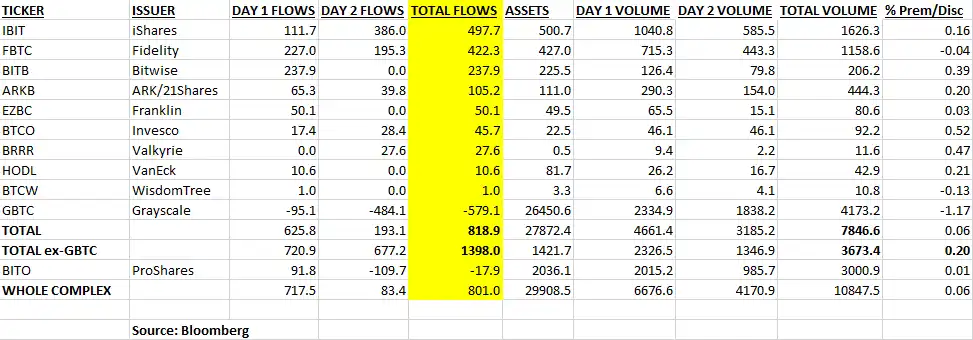
But for now, it is worth celebrating that the inflow of other spot ETFs far exceeds the outflow of the "rebel" GBTC. Eric Balchunas, an ETF analyst at Bloomberg, wrote on the X platform that in the two days since the launch of the Bitcoin spot ETF, nine issuing institutions have already absorbed $1.4 billion in funds, exceeding the outflow of $579 million from GBTC, with a net inflow of $819 million.
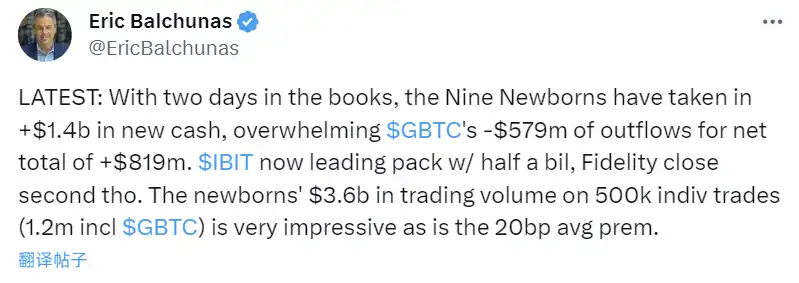
Translation: So far, Nine Newborns has attracted $1.4 billion in new funds, far exceeding GBTC's $579 million outflow of funds, with a net inflow of $819 million. Currently, IBIT leads the way with $5 billion, followed closely by Fidelity. The new trading volume reached $3.6 billion, involving 500,000 individual transactions (including 1.2 million transactions including GBTC), an impressive performance with an average premium rate of 20 basis points.
4) Will Bitcoin become decentralized and be controlled by Wall Street and held hostage by ETFs?
Some people oppose spot ETFs, believing that although they have helped Bitcoin transition from an alternative asset to a mainstream asset, they have also weakened Bitcoin's decentralized nature. This is because the massive influx of traditional capital brought by ETFs will dominate the Bitcoin market in the future, and its pricing power will be controlled by Wall Street.
The author believes that this concern is not unfounded, but may overestimate the trading volume of spot ETFs. Compared with the trading volume of several billion and the position value of several hundred million of spot ETFs, the daily trading volume of Bitcoin on mainstream cryptocurrency trading platforms is as high as 10-20 billion. The main battlefield of Bitcoin trading is still on the platform. Currently, new funds entering through ETFs are mostly unfamiliar with the characteristics of Bitcoin and have concerns about compliance and other reasons, so they do not enter directly from the trading platform. With the approval of ETFs, the platform will also be subject to more rigorous supervision, and the compliance and stability of the Bitcoin trading market will be better guaranteed.
Currently, the funds of spot ETF are all entrusted to centralized platforms for custody. However, since both centralized and lower-cost encrypted platforms are available for custody, why not choose them directly? Therefore, after some new funds become familiar with the characteristics of encrypted assets such as Bitcoin, they are likely to switch and diversify to compliant and regulated encrypted asset platforms around the world. As a result, spot ETFs are unlikely to have overwhelming advantages. When these funds further advance, they may even obtain more flexible asset management and appreciation experience through DeFi.
Of course, the US stock market itself is a game, and small targets are often manipulated. However, the larger the target, the harder it is to control. Compared to the traditionally regulated financial market, the cryptocurrency market used to be completely unregulated and easier to manipulate under the law of the jungle. Now, with the strict supervision of the SEC, it has become more regulated.
As for the so-called "rich taking over Bitcoin" in the future, this is not something we can change, but it does not affect Bitcoin's continued operation according to its original principles of openness and transparency, because only in this way can the interests of the rich themselves be protected.
This world was never truly decentralized. The term "decentralization" was not mentioned in the Bitcoin whitepaper and was later interpreted as meaning power distribution, sufficient decentralization, anti-fragility, and transparency. The goal is to prevent centralized power from secretly manipulating the financial system.
Actually, even for physically strong and materially decentralized gold, the main mining of gold relies on concentrated gold mines, and the mining rights are often only held by a few institutions. However, due to the sufficient global distribution of holdings, the impact of large gold ETFs with huge holdings on the price of gold is also very limited. Moreover, the rebalancing of gold ETFs is often lagging behind market reactions, which means that after the market is affected by major macroeconomic events and causes fluctuations in the price of gold, gold ETFs are sold or bought in large quantities, and the rebalancing is carried out only after the market closes that day.
Therefore, it is more accurate to say that the market affects ETFs rather than ETFs affecting the market. ETFs follow the market.
Welcome to join the official BlockBeats community:
Telegram Subscription Group: https://t.me/theblockbeats
Telegram Discussion Group: https://t.me/BlockBeats_App
Official Twitter Account: https://twitter.com/BlockBeatsAsia

 Related Articles