Strategy removed from stock index, how large are passive selling pressures really?

TL;DR
· On November 11, 2026, MSCI announced the results of its index review, and Strategy's Class A common stock was placed on the deletion list for the MSCI US Index, effective after the close on November 30, 2026.
· The basis is MSCI's "non-operating company" screening: bitcoin accounts for more than 90% of assets and fails to pass for two consecutive annual reporting periods, so it is treated as a fund-type issuer. Passive funds must sell shares; the company does not have to sell coins.
· Related tickers: MSTR, Metaplanet, Yellow Cake, spot bitcoin and IBIT; JPMorgan's $2.8 billion is an estimate from the old 2025 plan.
On November 11, 2026, MSCI announced the results of its November global standard index review, and Strategy's Class A common stock appeared on the deletion list for the MSCI US Index, with the change effective after the close on November 30, 2026. The news was released after the US market close, and MSTR fell 1.5% to 2.6% in after-hours trading at one point; the company's quarterly report at the end of October had already anticipated this step. What needs to be reassessed is not the 850,000 bitcoins it holds, but the position of this stock in passive portfolios.
The line MSCI drew: fund-type companies do not enter stock indexes
Let's make the mechanism clear first. MSCI first checks whether a company has substantial operating assets; if they account for less than half, it then checks a set of financial ratios, and if most are not met, the company is treated as a fund-type issuer and excluded from stock indexes. Constituents already in the index must fail for two consecutive annual reporting periods before being removed.
The screening criteria were finalized earlier, and this review was conducted under the new standards. Bitcoin accounts for more than about 90% of Strategy's total assets, and the software business is negligible relative to the treasury, so failing the screen for consecutive periods is not surprising; it had already appeared on the potential deletion list.
Among the same batch of names listed by the market are Japan's Metaplanet and the UK company Yellow Cake, which holds uranium. Yellow Cake has nothing to do with crypto, and this detail is crucial: what MSCI is drawing is the boundary between "asset wrappers" and "operating companies," not setting separate rules for bitcoin.
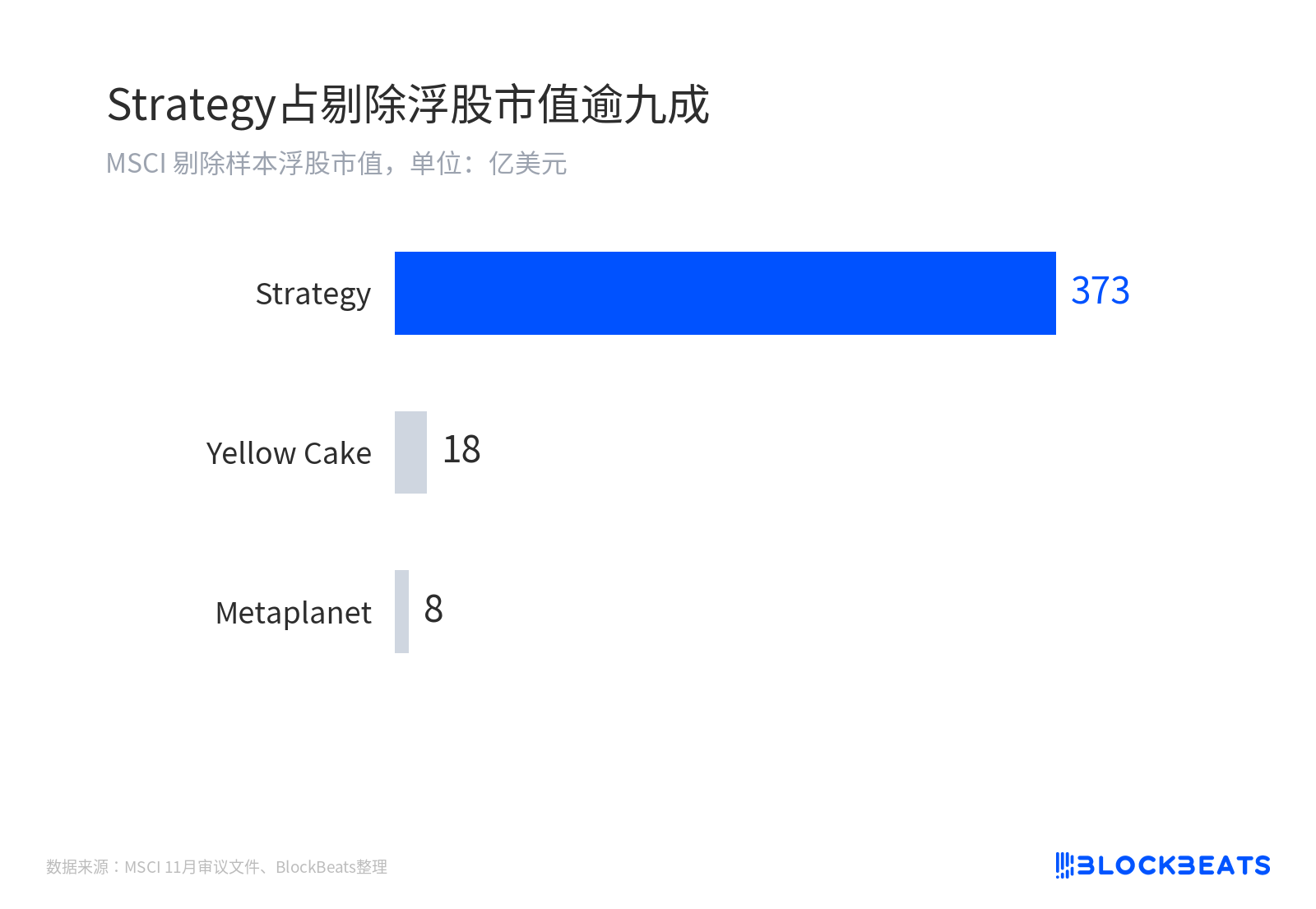
Strategy accounts for the deleted float shares
The disagreement lies here as well. MSCI's position is written in the rule text: such issuers are more like funds and should not remain in equity benchmarks. In its consultation response, Strategy accused the rules of discriminating against digital asset treasury companies, stressing that the bitcoin treasury is reported as an operating segment under US accounting standards and that the deletion "will not have a meaningful impact on the business."
But the company's quarterly report for the same period also warned that index exclusion could depress the stock price and weaken liquidity and financing capacity. The two statements must be read side by side; citing only the first would lead to overly optimistic conclusions.
$2.8 billion is an estimate from the old proposal; the company's figure is about 13 million shares
After the announcement, the most widely circulated figure was JPMorgan's $2.8 billion in passive selling. That number came from a November 2025 report by Nikolaos Panigirtzoglou's team, corresponding to the old proposal at the time that "digital assets exceeding half of total assets would be excluded," and the report also estimated that other indices following suit would add about $8.8 billion. Both figures carry preconditions and are not the actual outflow scale this time.
The company's figure is smaller. In a previous consultation response, Strategy said funds tracking the MSCI Global Index hold about 13 million shares, accounting for 3.1% of basic share capital, less than one day's trading volume, equivalent to about $1.6 billion at $122. The dollar amount was converted by researchers at current prices; the company only provided the share count and percentage.
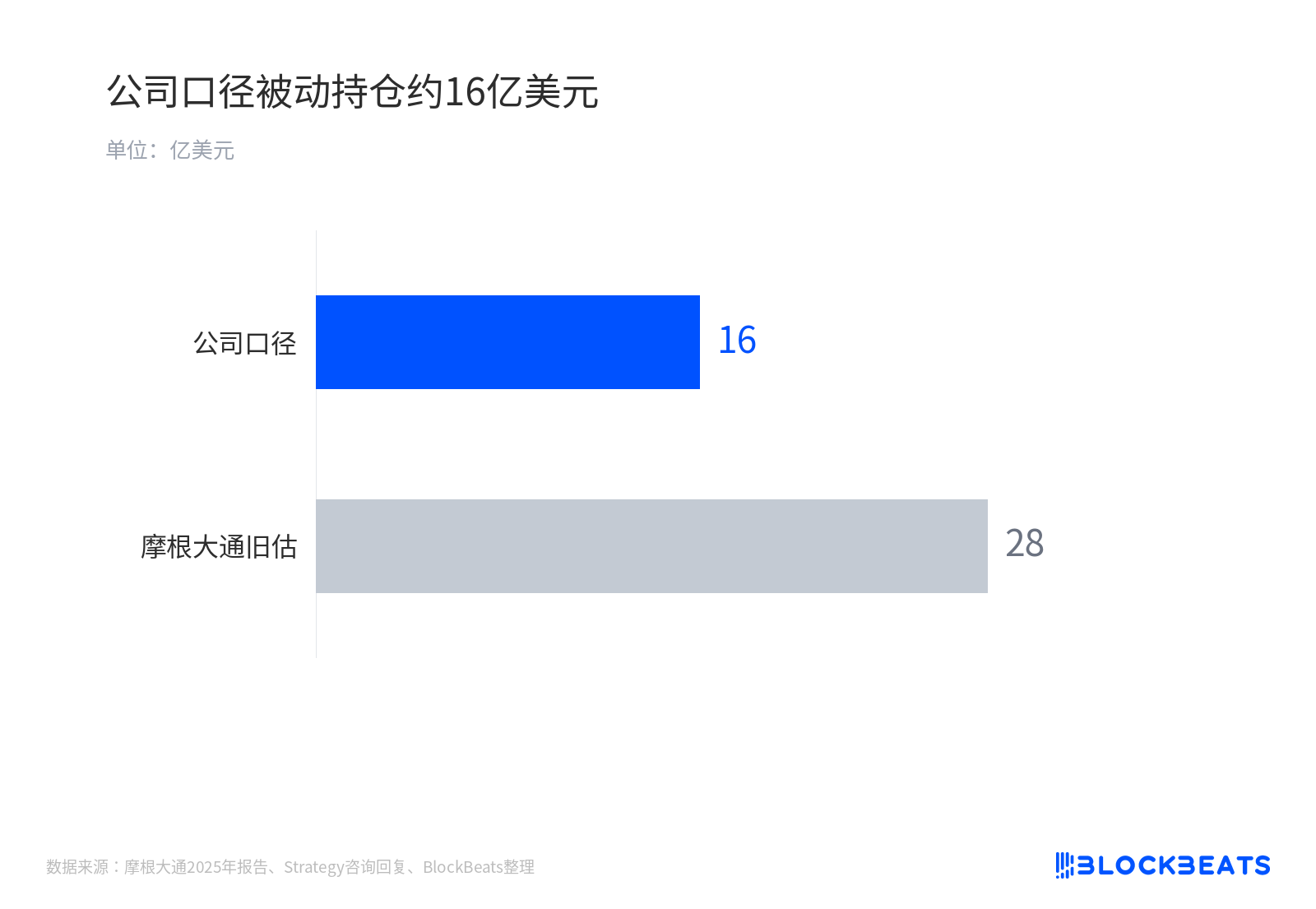
Company figure for passive holdings is about $1.6 billion
The direction is certain. Passive funds tracking the MSCI USA, World, and ACWI indices must sell before the close on November 30, because the stock is no longer in the indices. Active funds are not constrained. As of November, MSTR was still in the Nasdaq 100, while it has never been included in the S&P 500 because it did not meet the GAAP profitability threshold.
Under a discount, issuing shares to buy coins is inherently uneconomical
The transmission to the asset side is not that the premium flywheel has been broken, but that the discount may deepen. mNAV (the ratio of stock price to net asset value of holdings) is currently below 1, roughly 0.82 on a rough basis of market cap to holdings market value, before deducting debt.
On the holdings side, as of the most recent disclosure date, the company held 850,364 bitcoins at a cost of about $64.16 billion, an average price of $75,456. Bitcoin was then around $74,000, below the average price, leaving the holdings at an unrealized loss, equivalent to about $62.9 billion at the price at the time of writing, still on a market value basis.
In a discounted state, issuing shares to buy coins is inherently uneconomical; a share issuance means not being able to get one dollar of cash for one dollar of net assets, which dilutes existing shareholders. After the index identity disappears, passive buying loses a chunk, and if the discount continues to widen, ATM issuance will be even harder to launch.
Before November 30, Neither Selling Pressure Nor Follow-Through Has Materialized
Passive rebalancing is concentrated before the close on November 30. The degree of front-running determines how far actual selling pressure is from $2.8 billion or $1.6 billion — both figures are only reference points.
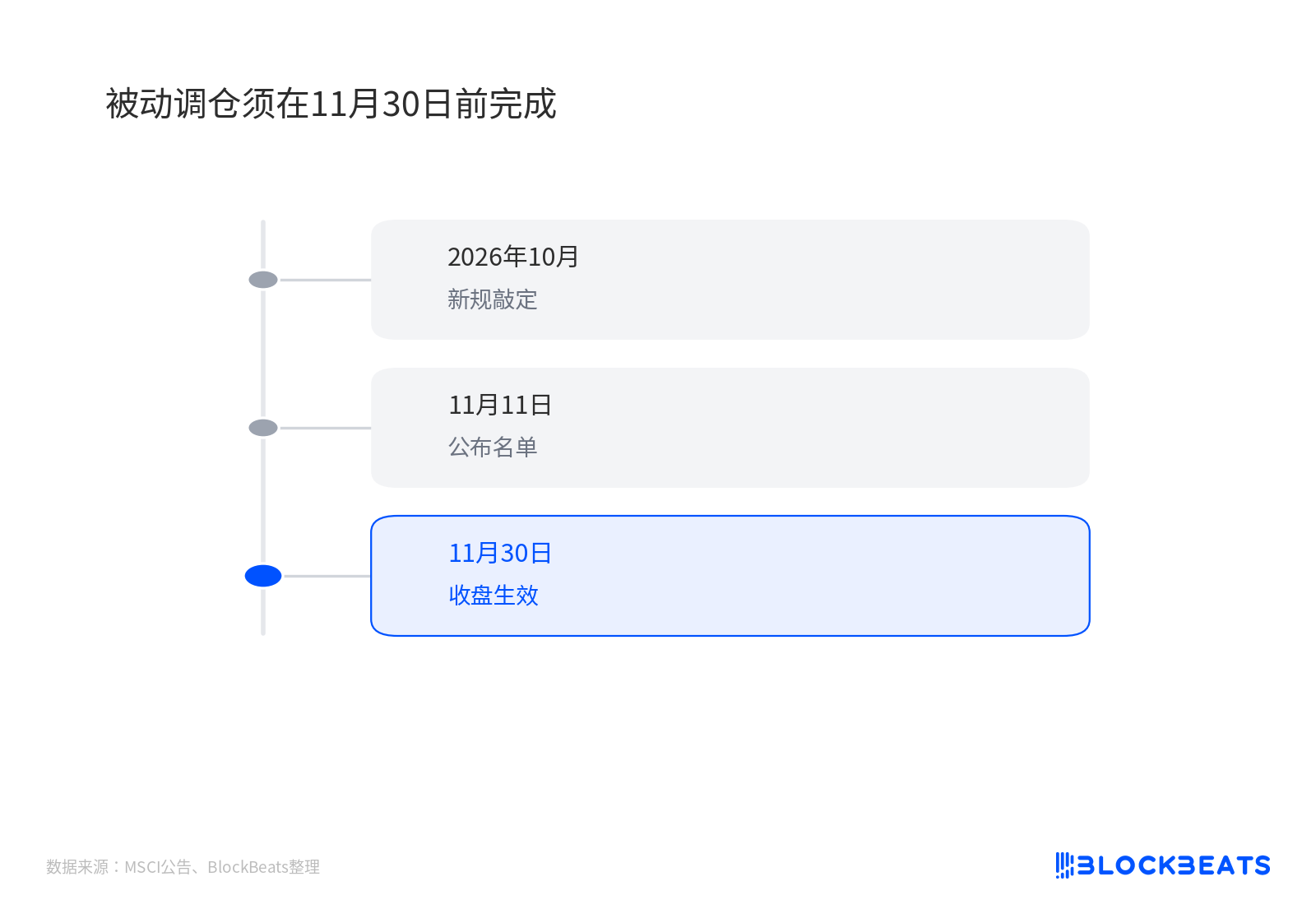
Passive rebalancing must be completed before November 30
What is more worth watching is follow-through at the index level. S&P Dow Jones Indices and FTSE Russell have so far made no public statement. Treating "other indices will replicate" as an established fact is to write a possibility as a result. MSCI has also not explained its screening process company by company; outsiders can only infer from the list and the rule text.
The observation points at the company level are the discount and financing. If the discount continues to widen and secondary offerings remain suspended for a long time, the digital asset treasury model of issuing shares to buy coins will shift from deceleration to a gear change, and the impact of that will last longer than a single rebalancing. Conversely, if MSTR can use tools such as digital credit to maintain its financing pace, the exclusion will be just an event that was priced in advance.
Spot bitcoin has no forced selling, and this point must be viewed separately from equities. What transmits to the coin price is sentiment and peers' financing capacity, not mechanical sell orders from index funds. After November 30, whether the discount narrows, whether secondary offerings restart, and whether a second index provider makes a statement will determine whether this exclusion is ultimately priced as a technical rebalancing or as a watershed for the DAT financing model.
Welcome to join the official BlockBeats community:
Telegram Subscription Group: https://t.me/theblockbeats
Telegram Discussion Group: https://t.me/BlockBeats_App
Official Twitter Account: https://twitter.com/BlockBeatsAsia
 Related Articles