The Art of Trading: How They Make Money Through USDE Stock Arbitrage
Original Title: The USDE mNAV Trade
Original Author: Starkiller Capital
Editor's Note: If a company holds $1 in token assets but its stock market cap is only 32 cents, how do you profit from this discount?
Digital asset quantitative investment firm Starkiller Capital's approach is to buy StablecoinX stock (Nasdaq ticker USDE) while shorting an equivalent amount of ENA, the token held by the company. This way, even if both the stock and the token are falling, as long as the stock falls less, the short position's gains could potentially offset the stock losses.
Starkiller has done this before. According to its disclosures, as early as August this year, every $1 of ENA held by StablecoinX corresponded to a market value of only about 18 cents. Starkiller bought the company's stock at that time. As the discount narrowed and the market valuation of every $1 of ENA rose to about 60 cents, the firm sold its accumulated stock position to lock in profits. Later, the stock price fell faster than ENA, and the discount widened again to 32 cents per $1 of assets, so Starkiller entered again with a larger position.
In this re-entry, Starkiller is betting on an additional buyback pathway unlocked after the unlock. On October 5, the lock-up restriction on the ENA held by StablecoinX was lifted. The company can sell ENA to fund a stock buyback plan approved by the Ethena Foundation. At the then-current price, for every $1 of ENA sold, the company could buy back stock corresponding to about $3.13 in token assets. The company uses up some tokens, but the share count decreases faster, so the remaining ENA per share actually increases.
Whether this trade can be profitable again depends on whether the stock can outperform ENA. Buybacks may help narrow the discount, but StablecoinX has no redemption mechanism, so shareholders cannot exit at the value of the underlying assets, and the discount can persist for a long time. In the upcoming third-quarter report (10-Q), what's worth watching is whether the company will announce a specific buyback plan and how many shares it intends to repurchase.
The following is the original text:
Anyone who has spent a few years in the crypto market remembers GBTC. For most of 2022, you could buy Bitcoin through Grayscale at a significant discount, sometimes exceeding 40%. Those who bought the discount and waited until GBTC converted to an ETF made money.
Right now, a similar opportunity is emerging that is smaller and less liquid, but with potentially higher profits.
StablecoinX (ticker USDE) is a crypto asset treasury company (DAT) holding tokens that account for about 20% of the total ENA supply. As of last Friday's close, the stock price was $6.43, with each share corresponding to 125.48 ENA, valued at $20.10. That equates to paying only 32 cents for every $1 of ENA, meaning $155 million buys a batch of tokens worth $485 million.
Six weeks ago, Ethena granted the treasury company an exemption, unlocking all these tokens. The lockup was originally the main reason the stock traded at a discount. The market had long anticipated the exemption would be approved. Before the exemption was approved, USDE's mNAV rose from 0.15x to 0.61x, and has since plunged to 0.32x.
Starkiller has held this trade since August, when mNAV was 0.18x. We later rebalanced the position, taking profits on the accumulated USDE position at 0.60x. Over the past six weeks, as mNAV fell along with the broader crypto market, we rebuilt the position, and this time with a larger size. By publishing this research, we clearly have our own interests at stake. We are highly confident in how irrationally the market is currently pricing this, so we are willing to speak out publicly, and we hope like-minded peers can benefit from it.
Below, we explain the logic and risks of this trade as plainly as possible.
Some Background
StablecoinX went public in June through a merger with special purpose acquisition company TLGY. Ethena built it as a public-market investment vehicle for ENA, following the approach of Bitcoin and Ethereum treasury companies. The company also has a small infrastructure business attached, currently immaterial to valuation, with revenue of $62,000 in the last two weeks of June. At the end of the second quarter, the company had about $19 million in cash and about $18 million in liabilities. Therefore, from a practical valuation perspective, this company is just a batch of ENA, and it can be valued on that basis.
Before continuing, let us be direct: we generally think crypto asset treasury companies are terrible, and by now they are basically unnecessary. In fact, USDE is also unnecessary. It brings no real value to the ecosystem, and as can be seen from its discount to net asset value, it is usually not a good tool for holding beta exposure.
However, we will set aside these views and look at it using mNAV, which is the company's market capitalization divided by the market value of the ENA it holds. The stock price equals the ENA price multiplied by the number of ENA per share, then multiplied by mNAV. Hedge out the ENA price exposure, and what remains is this multiple, and it is this multiple that we trade.
The discount made sense originally, then things changed
For most of the time after listing, this stock's significant discount was fully justified. Under the token purchase agreement, about half of the ENA is to be gradually unlocked over 48 months, not fully unlocking until 2029. In addition, every sale requires the consent of the Ethena Foundation. As of October 4, 1.56 billion ENA remained locked.
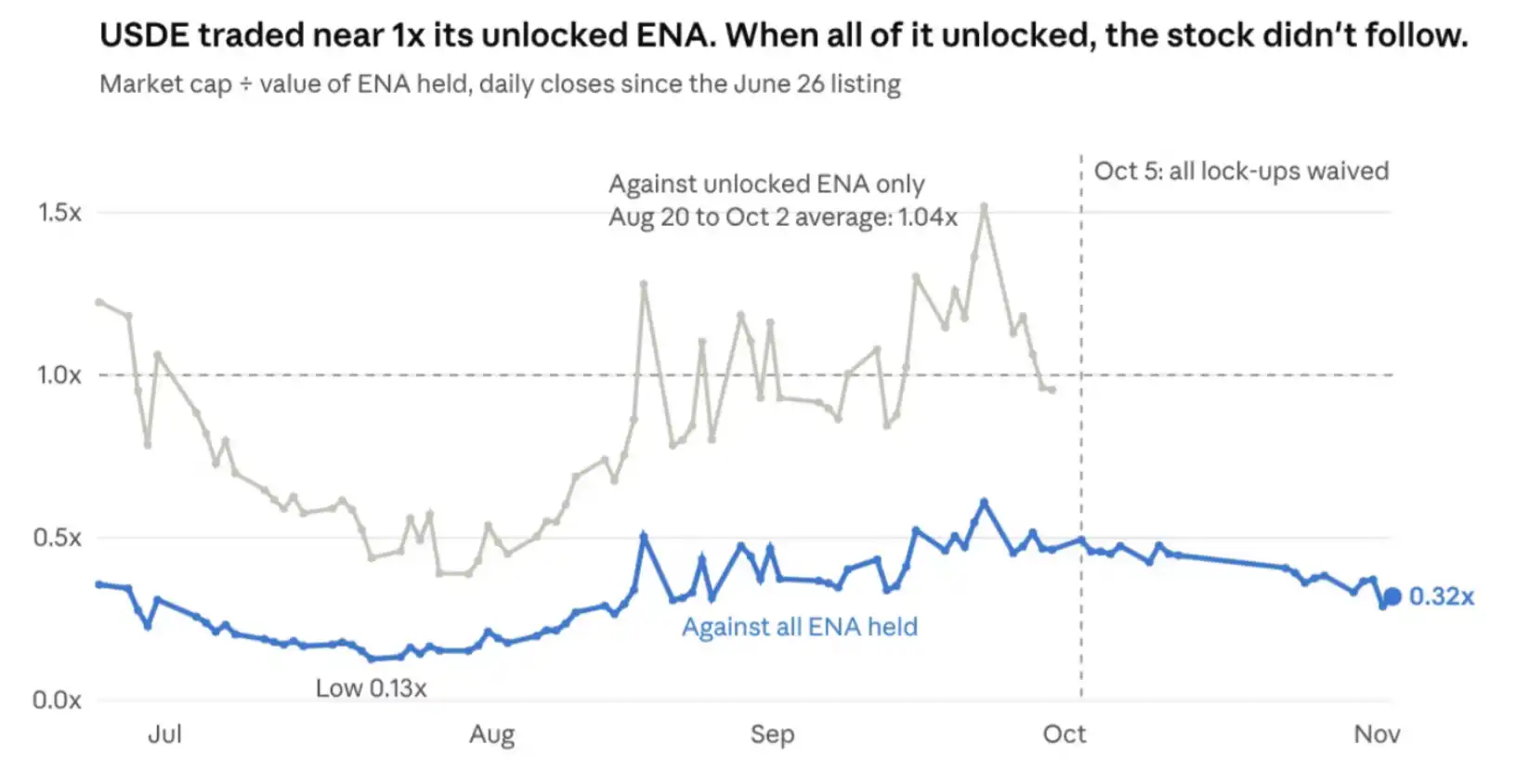
The market's pricing at the time was quite rational. Measured only by the value of unlocked ENA, from late August to early October, the stock traded at around 1x. Investors were willing to pay full price for the tokens the company could actually use, and assigned zero value to the remaining tokens.
Then, Ethena and the Foundation signed a letter on September 14 waiving all lock-up restrictions, effective October 5. Overnight, the value of unlocked ENA per share rose from $14.82 to $30.28. The stock price rose from $14.15 to $14.96.
If the market had continued to price USDE based on unlocked ENA in the original way, the stock price should have roughly doubled. What actually happened is that the gray line became the blue line, and the valuation multiple gradually slid from 0.49x to 0.32x.
Why did the discount widen instead?
Because by October, the market fell. Bitcoin fell 7%, and ENA fell 29%. When the entire market is falling, no one sits down to recalculate the net asset value of a small-cap treasury company. Investors are cutting crypto exposure, and USDE is exactly that kind of exposure.
The stock price fell more heavily than the token for several reasons. Many holders bought USDE in order to go long ENA through securities accounts. So when they want to exit their ENA positions, they sell USDE. USDE is also one of the least liquid assets among those held by these investors. The company's market capitalization is only $155 million, with daily trading volume of about 1 million shares, so once investors cut overall exposure, the price of this position is prone to gap moves.
Shorts have piled in too. Short interest rose 78% to about 2.8 million shares, roughly 15% of the free float.
None of this has touched the company's ENA holdings. It still holds the same 3.029 billion tokens it had in September, and every one of them can now be used to fund buybacks. The share price is falling for reasons unrelated to the asset backing it, and that is exactly the kind of discount we are willing to buy.
Valuation multiples tracking crypto beta cuts both ways. When the market recovers, multiples tend to recover too. In August and September, as ENA rallied, the multiple went from 0.15x to 0.61x as investors who had used USDE as a proxy for ENA bought back in. In October, the same mechanism ran in reverse. Once sentiment turns, the people who sold shares to reduce beta exposure will come back to buy.
After the token unlock, the company still needs foundation approval to sell tokens. Crucially, the exemption letter pre-approved what it calls "fundraising sales," and one of the uses it explicitly lists is buying back stock under a foundation-approved 10b5-1 plan.
How the discount closes
Buying back stock below net asset value is the most powerful way for this kind of investment vehicle to raise NAV per share. At a 0.32x valuation, the accretion is especially pronounced. For every $1 of ENA the company sells to fund buybacks, it retires shares representing $3.13 of ENA assets, leaving $2.13 of additional NAV for shareholders who stay. At Friday's prices, deploying one-third of the treasury assets would repurchase all outstanding Class A shares.
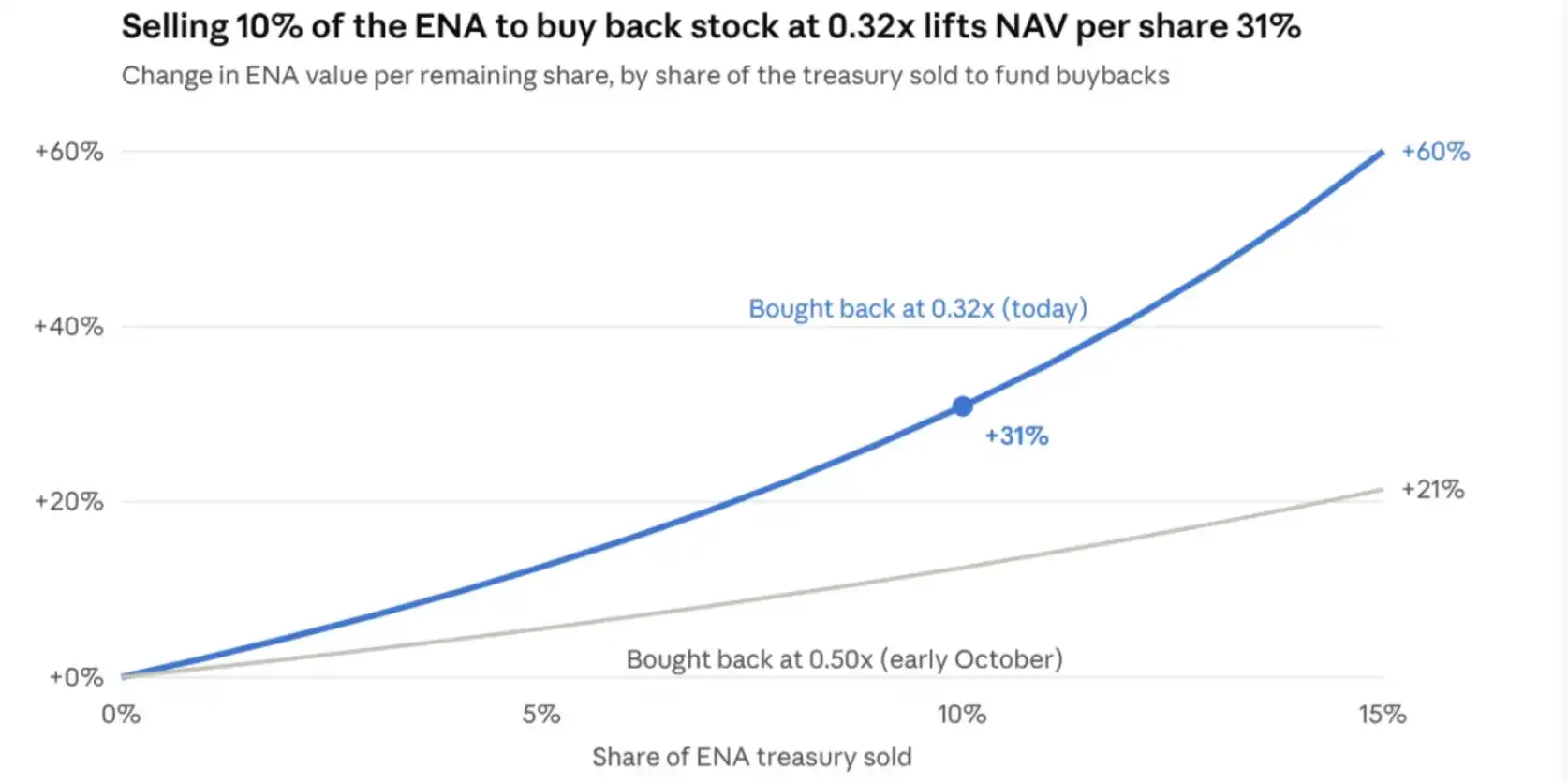
It doesn't even require selling ENA on the open market. The letter gives the foundation the right to buy any ENA the company proposes to sell. So the foundation can take the tokens over the counter, the company uses the cash to retire shares, and ENA holders never have to absorb the selling.
Will they do it? I think the interests of all parties point that way. The CFO said in the Q2 earnings announcement that narrowing the gap between the company's market cap and the value of its assets is the company's priority. The company also changed CEOs in September. Ethena is pitching USDe to users of BlackRock's Aladdin platform, Janus Henderson and Coinbase. A listed stock representing exposure to its own token trading at one-third of the value of the underlying token doesn't help those conversations. The foundation was under no obligation to sign an exemption letter that explicitly lists stock buybacks as a use, but it did.
The next observation point is the Q3 10-Q report, which should be filed no later than November 16. This will be the first quarterly filing after the exemption letter was signed.
How to establish a position
Go long USDE and short ENA, with equal dollar notional amounts on both sides. Many people get this step wrong. For every share bought, you do not need to short 125 ENA. Assuming valuation multiples remain unchanged, the percentage moves of the stock and ENA are one-to-one, so the hedge should have equal dollar notional amounts on both sides.
We short ENA through perpetual contracts, so funding fees need to be factored into the budget. However, since we established this trade, the funding rate for ENA perpetual contracts on Hyperliquid has consistently been positive, including over the past six weeks. USDE's daily trading volume on Nasdaq is approximately 1 million shares.
If the trade develops as expected, the market value of the long position will grow faster than the notional amount of the short position, so you will need to rebalance; otherwise, you will end up with a net long exposure to ENA. Of course, in an upward market, if you are willing to take on some beta risk using the cumulative gains from mNAV revaluation, this actually works in your favor. We did this from August to October and made money, but it requires timing.
If the ENA price remains unchanged, the following are approximate returns based on the long notional amount, excluding funding fees and trading costs. The total exposure on both long and short sides is twice the long notional amount.
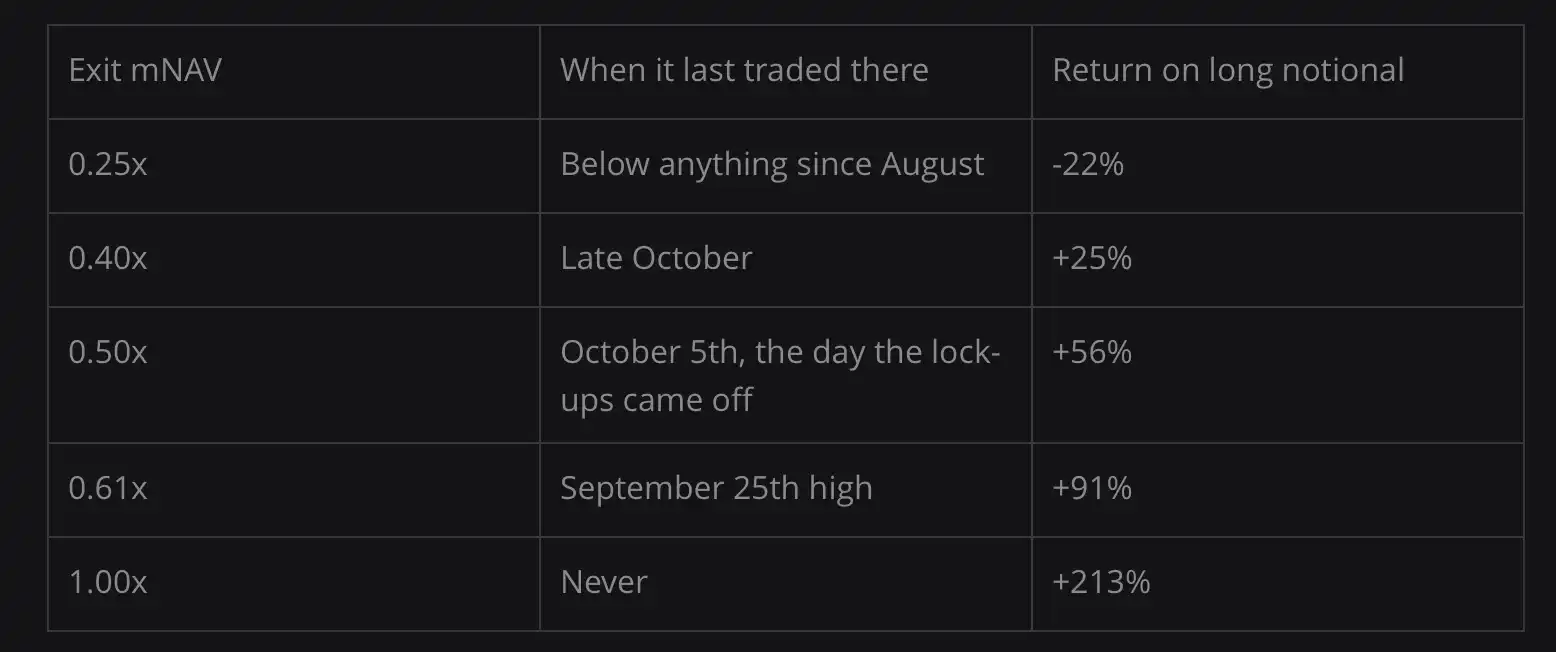
Even if the valuation does not return to 1x, this trade can still deliver very substantial returns. As long as it returns to the level on the day the lock-up was lifted, the long side has a 56% return. We believe the stock should ultimately trade at 0.7x mNAV. Quite a few other treasury companies trade at this level, and some of them even have large amounts of tokens still locked up.
Several short-term catalysts have been listed above, but in reality, this is an arbitrage trade whose timing is difficult to judge. Given the valuations of comparable companies and the fact that holding this trade actually yields about 5%, equivalent to half of the positive funding rate earned on the ENA short, the more reasonable approach is to continue holding this position and wait for the catalysts to materialize.
Where things could go wrong
There is no mechanism forcing the discount to narrow. The company has no redemption mechanism, and GBTC is likewise a reminder here. Its large discount persisted for two years and only disappeared when it converted to an ETF.
The foundation controls the exit path. Selling tokens requires the foundation's consent, one of the three seats on the investment committee is designated by the foundation, and it also controls the voting rights of Class B shares. If the foundation never approves a buyback, the discount could persist at this level indefinitely.
The market also faces potential selling pressure. An S-1 registration statement registered approximately 12.7 million shares for resale by existing shareholders, more than half of the total Class A shares. These shareholders can sell when the stock price rebounds.
The discount could widen further. The stock listed at an mNAV of 0.36x, and fell to as low as 0.13x in July. In October, with no problems at the company itself, mNAV still dropped from 0.49x to 0.32x.
Warrants will bring dilution when the stock price recovers. There are 11.5 million listed warrants with an exercise price of $11.50. Another approximately 7.6 million warrants held by the sponsor have exercise prices of $11.50 and $15, respectively. These warrants are currently out of the money, but they will cap the upside for the stock price.
The crypto market could also crash directly. At that point, investors might simply conclude that the ENA held by USDE is worthless and that this portion of assets will never be realized, pushing mNAV back to lows.
Conclusion
For three consecutive months, the market priced this stock based on the ENA the company could actually sell. Then, all the ENA became sellable, and the company had a pre-approved buyback path to repurchase stock at 32 cents per $1 of asset value, yet the market assigned a lower valuation. We have held this trade since August, and at 0.32x, we are more bullish on it than when we first entered.
Welcome to join the official BlockBeats community:
Telegram Subscription Group: https://t.me/theblockbeats
Telegram Discussion Group: https://t.me/BlockBeats_App
Official Twitter Account: https://twitter.com/BlockBeatsAsia
 Related Articles