Morgan Stanley: Which AI stocks are worth buying on dips?
TL;DR
· Project delays mainly affect 2028. Morgan Stanley expects the new review process could push about 20% of U.S. data center projects from 2028 to 2029. If the delayed capacity comes online by then, U.S. data center construction volume could grow by about 40% in 2029.
· Leading cloud providers are expected to widen their advantage. New power supply constraints raise the value of already-committed computing power. Large providers are also better positioned to secure financing, shift projects across states, and increase revenue per unit of power.
· Supply chain opportunities depend on orders and valuation. Morgan Stanley uses Solaris as an example, estimating that its four existing long-term contracts can support a valuation of more than $90 per share, above the $69 share price cited in the research report.
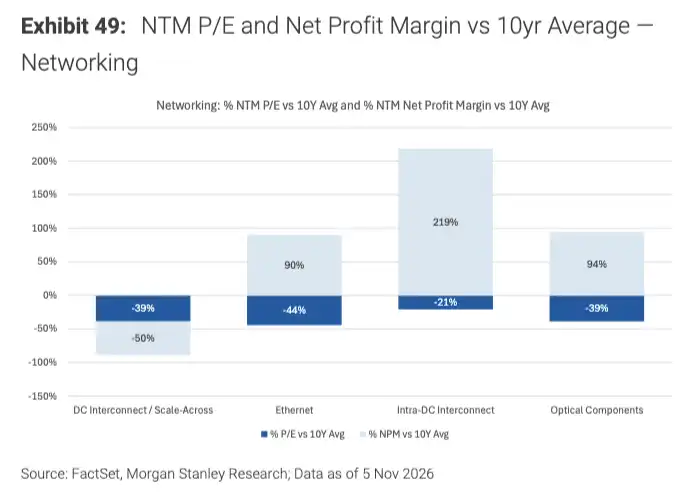
· Valuation within network equipment has already diverged. The forward 12-month P/E ratios for data center interconnect and optical components are both 39% below their respective 10-year averages, while Ethernet is 44% above.
· Excess return opportunities are expanding toward the software and application layers. Morgan Stanley is focused on cybersecurity, infrastructure software, and enterprises that have already deployed AI in actual business operations.
After the U.S. midterm elections, uncertainty over data center approvals weighed on a batch of AI stocks. Morgan Stanley expects the Texas election results to have limited impact on 2027 data center construction, with the new review process mainly affecting 2028. The bank's power supply model shows that election-related delays could reduce available power capacity by about 6 GW between 2026 and 2028, with the net power capacity gap reaching 44 GW over the same period, accounting for about 38% of model-estimated demand.
Morgan Stanley's buy thesis rests on one judgment: some projects will be delayed by a year, and related demand is expected to be released as projects resume. For data centers already powered up, tighter supply could support computing power leasing prices. For equipment suppliers, delays first affect deliveries and revenue recognition, with the ultimate loss depending on whether orders can be retained. Projects still awaiting grid connection and financing will bear longer capital tie-up.
Leading cloud providers have both ready computing power and the ability to continue expanding
Morgan Stanley rates Amazon, Meta, Alphabet, and Microsoft "Overweight." The later new data centers come online, the more customers rely on existing computing power. Large cloud providers can also shift some projects to states with relatively friendlier approval environments, such as Tennessee and Louisiana, reducing the impact of approval delays in individual states on overall construction plans. Financing conditions are also diverging. The bank expects AI-related bond issuance to continue rising in 2027, driven mainly by large cloud providers. Independent AI cloud providers and new projects will face stricter scrutiny, with tenant credit, grid connection timing, and contract protections directly affecting financing conditions.
The bank maintained its combined capital expenditure forecast for major cloud providers in 2027 and 2028 at $1.6 trillion and $1.8 trillion, respectively. Among them, Amazon's capital expenditure for the two years is projected at $355 billion and $365 billion, respectively. Approval delays combined with labor and material constraints may still push some spending later, causing actual investment in 2028 to fall below forecasts.
Under power constraints, computing efficiency directly affects profitability. As model and chip efficiency improve, the same amount of power can process more tokens, and cloud providers also have the opportunity to increase revenue and profit per unit of power. Morgan Stanley believes this is conducive to leading players expanding market share and improving profit margins. Nvidia also received an "Overweight" rating, and one of its investment theses is helping customers increase computing output per watt of power.
For the data center supply chain, look at how much share prices have fallen and how many orders have been preserved
Morgan Stanley focused its screening scope on the technology supply chain, power delivery, and data center developers. For power equipment and on-site power generation suppliers, judging whether share prices have fallen too far depends on whether customers can cancel orders, whether equipment can be redirected to other sites, and how much of a company's business is concentrated in regions where approvals may tighten.
Solaris is an example cited in the research report. The company has signed four key long-term contracts with major cloud providers and data center operators. Customers can redirect contracted equipment to other locations, the company also enjoys relatively favorable cancellation terms, and its exposure to Texas business is limited. Morgan Stanley estimates that, excluding future growth or new contracts, existing contracts can support a valuation of more than $90 per share, above the $69 share price cited in the main text of the report.
There is also divergence within utilities. Morgan Stanley maintained Overweight ratings on Sempra (SRE) and American Electric Power (AEP), because neither company's long-term plan includes large-scale data center-related capital expenditure, and project delays have a relatively limited impact on existing growth plans. The bank is more cautious on Southern Company (SO), focusing on a potential pause in data center approvals and changes in utility regulation.
Valuations in the technology supply chain also differ. As shown in the chart, the forward 12-month price-to-earnings ratios for data center interconnection and optical components are both 39% below their respective 10-year averages, data center intra-connection is 21% below, while Ethernet is 44% above. These valuation differences provide a starting point for further screening, while opportunities in individual companies still depend on whether orders and earnings expectations can be delivered.
Excess return opportunities are expanding toward software and the application layer
Morgan Stanley believes that the opportunity for excess returns from AI investment is expanding from semiconductors and infrastructure to software and applications. The firm prioritizes cybersecurity and infrastructure software that are in the early stages of deployment, while also favoring enterprises that have already integrated AI into their actual business operations. The former's opportunity stems from the new security and infrastructure demands created after enterprises deploy AI, while the latter's returns depend on whether AI can improve products, enhance efficiency, or generate new revenue.
For such companies, what is worth tracking is whether deployments can convert into paid subscriptions, renewals, and usage growth, as well as whether enterprises adopting AI can demonstrate benefits on the cost or revenue side. As more enterprises move from pilot programs to formal deployments, the application layer may also become a source of excess returns from AI investment, following in the footsteps of chips and infrastructure.
Welcome to join the official BlockBeats community:
Telegram Subscription Group: https://t.me/theblockbeats
Telegram Discussion Group: https://t.me/BlockBeats_App
Official Twitter Account: https://twitter.com/BlockBeatsAsia
 Related Articles