Morgan Stanley Report: Raises Alphabet's Price Target to $415, Bullish on TPU Outlook

TL;DR
· Morgan Stanley has raised Alphabet's target price from $375 to $415, maintaining an Overweight rating, implying approximately 20% upside based on the June 29 closing price of $353.65.
· The report projects that Google Cloud revenue will reach $214 billion/$308 billion in 2027/2028, with growth rates of 106%/44%, respectively.
· Key assumptions include Alphabet adding about 9GW of computing power by 2028, with around 7GW coming from TPUs and approximately 4GW of first-party TPU being sold externally.
· Google Cloud EBIT is estimated to reach around $132 billion in 2028, accounting for approximately 46% of the company's total EBIT.
· Risks include TPU external sales gross margin, revenue per watt realization, and whether the $350 billion/$375 billion capital expenditure in 2027/2028 can generate sufficient returns.
Morgan Stanley, in a report on June 29, raised Alphabet's target price from $375 to $415 and maintained an Overweight rating. Calculated based on the June 29 closing price of $353.65 used in the report, the new target price implies approximately 20% upside. The report also noted that GOOGL had fallen by about 10% in the past month, partly due to funds continuing to flow into the hardware and semiconductor sectors. However, the bank believes that the fundamental visibility for the company in 2027 and 2028 is increasing, and the pullback in stock price is creating a buying opportunity.
The core of this upward revision is not just search advertising but Google Cloud and in-house TPUs. Morgan Stanley believes that Alphabet is entering a new phase of valuation: if TPU expansion is successfully implemented, Google Cloud can not only continue to increase revenue but may also contribute nearly half of the company's EBIT in 2028.
According to the report's model, Google Cloud revenue is projected to reach $214 billion in 2027 and further increase to $308 billion in 2028; during the same period, Google Cloud EBIT is estimated to reach approximately $132 billion, accounting for about 46% of Alphabet's total EBIT. These numbers are MorgaStanleyanley's calculations based on computing power capacity, TPU shipments, external sales, and cloud revenue conversion and are not Alphabet's official guidance.
Target Price Raise, Focus on Cloud Revenue and EPS
Morgan Stanley's target price increase this time is directly from the 2027 and 2028 model revaluation.
The report raised Alphabet's total revenue forecast for 2027/2028 by 4%/1% respectively, and EPS forecast by 4%/1% respectively. In the new model, Alphabet's EPS in 2028 reached $19. The $415 target price corresponds to approximately 22 times the 2028 EPS, equivalent to a P/E ratio of 23 times the average EPS for 2027/2028.
The report believes that the current P/E ratio of GOOGL is about 18 times based on the new 2028 EPS, lower than its long-term forward P/E ratio average of about 21 times. Morgan Stanley's assessment is that if the profit elasticity of Google Cloud and AI-related businesses materializes, Alphabet should receive a higher valuation multiple.
This is also the core contradiction of the entire research report: Alphabet is making large-scale investments in AI computing power, and the market is concerned about capital expenditure pressure. However, Morgan Stanley believes that these investments may translate into Google Cloud revenue, TPU external sales revenue, and core product AI monetization.
9GW New Computing Power Addition Sets the Tone for This Model
Morgan Stanley raised its Google Cloud forecast, primarily based on a reevaluation of computing power capacity.
The report expects Alphabet to add approximately 9GW of rack power capacity in 2028, with around 7GW from TPU and around 2GW from NVIDIA GPU. The forecast for additional capacity in 2027 has also been revised upwards from the previous 5.2GW to 6.9GW.
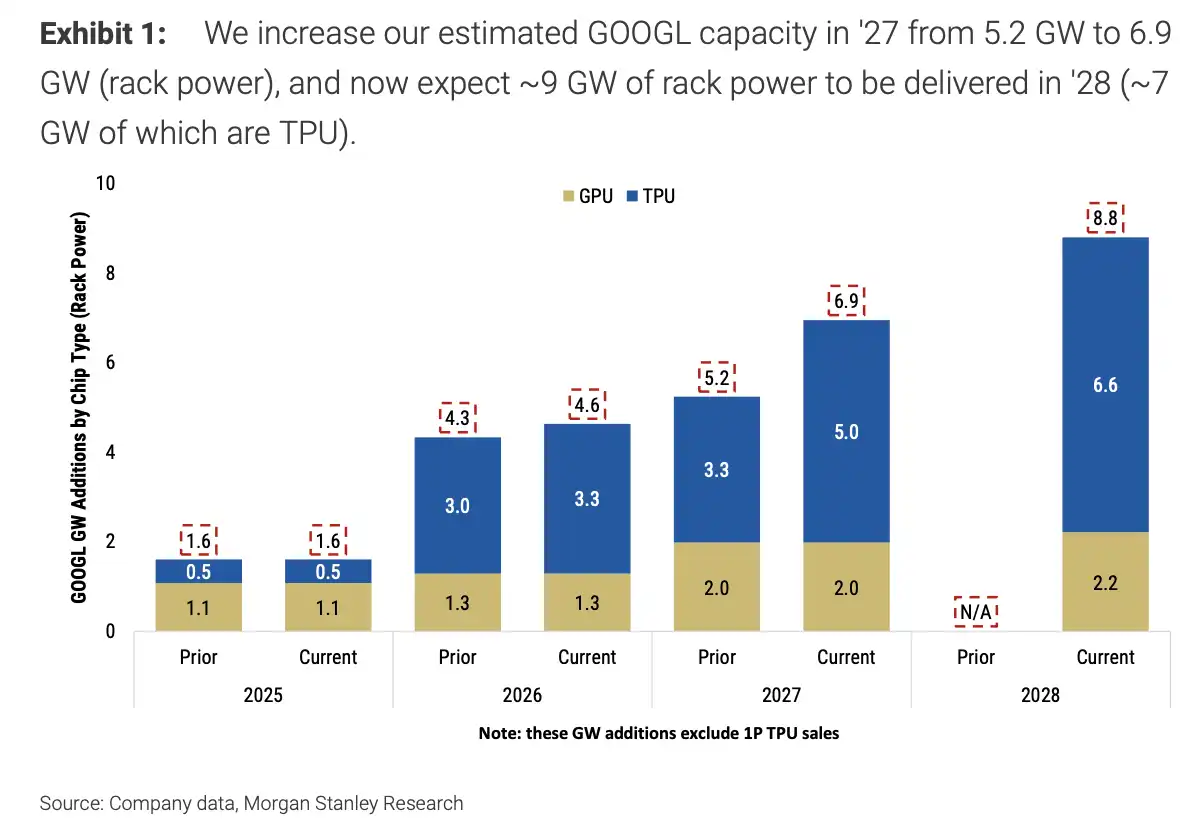
This model does not simply assume "stronger demand for AI" but derives Google Cloud revenue from ASIC shipments, rack power, and available computing power. The key assumption the report adopts is that core Google Cloud revenue will be realized at $15 per watt and $18 per watt in 2027/2028, corresponding to core cloud revenue of $152 billion and $229 billion.
The report also assumes that by 2028, about half of the additional computing power at Alphabet will be used for Google Cloud, and the other half for core products such as Search, AI Agent, YouTube, etc. In other words, TPU expansion supports both the cloud business and the commercialization of Alphabet's internal AI products.
TPU External Sales Decision Caps Google Cloud Revenue
Google Cloud's revenue surge to $308 billion is not just attributed to its core cloud business, but also to TPU external sales.
Morgan Stanley projects that by 2028, Alphabet will retain around 5GW of TPUs for its own use and cloud workloads, while selling around 4GW of first-party TPUs to external customers. The report estimates that first-party TPU sales will contribute approximately $62 billion/$79 billion to Google Cloud revenue in 2027/2028, respectively.
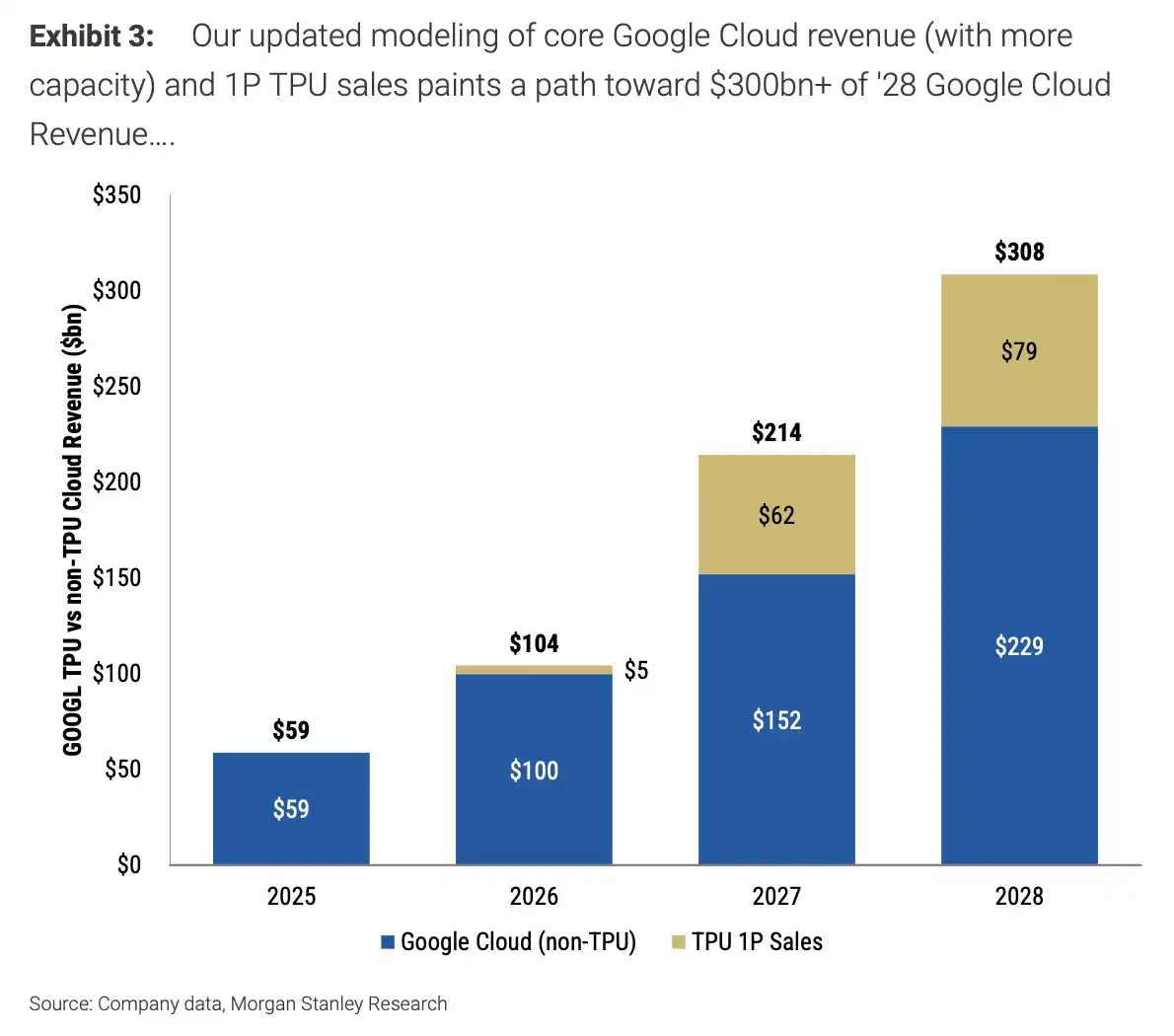
This portion of the revenue is a key driver of Google Cloud's total revenue increase from $2.29 trillion in core cloud revenue to $3.08 trillion.
The report further breaks down the unit economics of TPU external sales. Morgan Stanley assumes a gross margin of around 20% for first-party TPU system sales, with each 1GW TPU external sale corresponding to approximately $20 billion in revenue. The sales format is primarily in rack systems rather than complete data center shells. The report also acknowledges that this gross margin still requires more scrutiny from channels and subsequent disclosure validation.
This is also the most intriguing part of the research report. While Google has been more commonly perceived as an AI model and cloud services provider, in this model, it is also extending to be an AI infrastructure supplier. If external customers are willing to purchase TPU systems, Google Cloud's revenue boundary will be significantly expanded.
However, this is also where the biggest discrepancies lie. Factors such as TPU ecosystem, software adaptation, customer migration costs, Broadcom and other supply chain costs will impact the scale and gross margin of external sales. If the projected 4GW external sales or 20% gross margin cannot be realized, both Google Cloud's revenue and EBIT will need to be revised downwards.
Cloud Profit Pushed to the Core of Alphabet Valuation
The revenue increase ultimately has to translate into profit.
Morgan Stanley forecasts that Google Cloud revenue will grow by 106%/44% in 2027/2028 and reach $3.08 trillion in 2028. More importantly, the report anticipates that Google Cloud's EBIT will reach around $132 billion in 2028, accounting for approximately 46% of the company's overall EBIT.
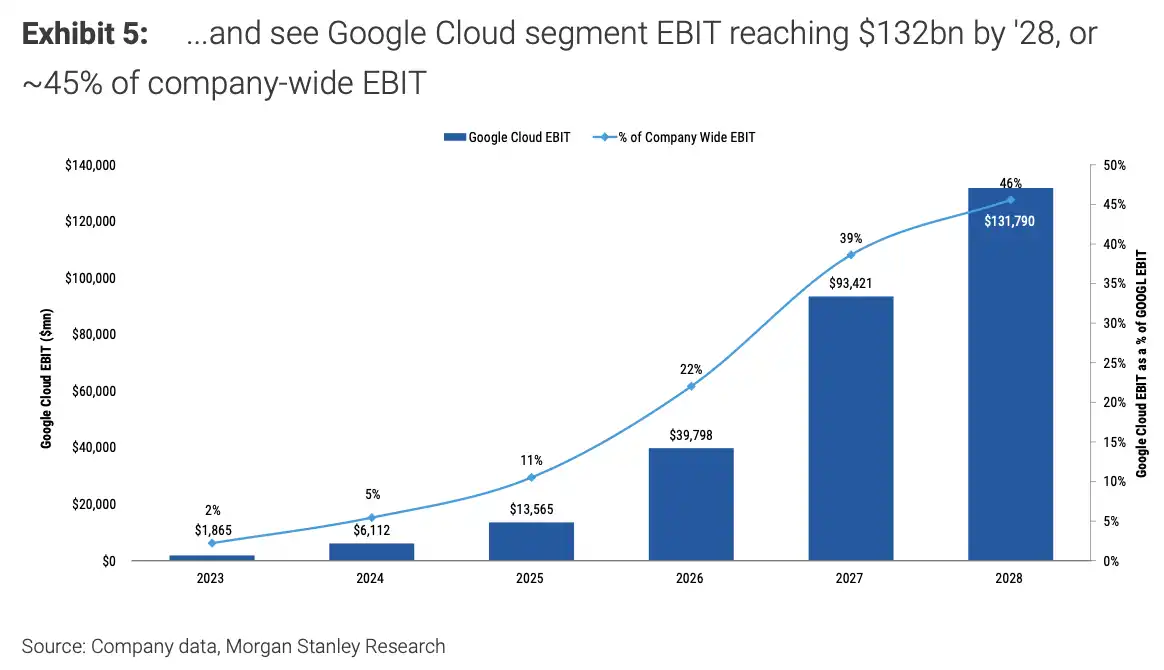
This means that if the model holds true, Google Cloud will no longer just be Alphabet's high-growth business, but will become one of the company's most important profit drivers. Search advertising remains the bedrock, but the valuation weighting of the cloud business will increase significantly.
This also explains why Morgan Stanley is willing to raise the price target to $415. The report's valuation scenarios show that in the base case, $415 corresponds to 23 times the average EPS for 2027/2028; the bull case is $480, and the bear case is $250. The wide valuation range indicates that there is still a significant market divergence on TPU external sales, cloud profit margins, and AI monetization.
Capital Expenditure is the Biggest Pressure
Higher revenue and profit assumptions require greater capital expenditure support.
Morgan Stanley has raised its Alphabet's 2027 capital expenditure forecast from $300 billion to $350 billion and expects capital expenditure in 2028 to be $375 billion. The report states that the increase mainly comes from higher TPU capacity and chip development needs.
This will bring direct financial pressure. In the report's model, Alphabet's depreciation expense is projected to increase from around $34.5 billion in 2026 to around $70.2 billion in 2027 and reach around $117.6 billion in 2028. Free cash flow will also be affected, turning negative in 2027 and then recovering to around $23.2 billion in 2028.
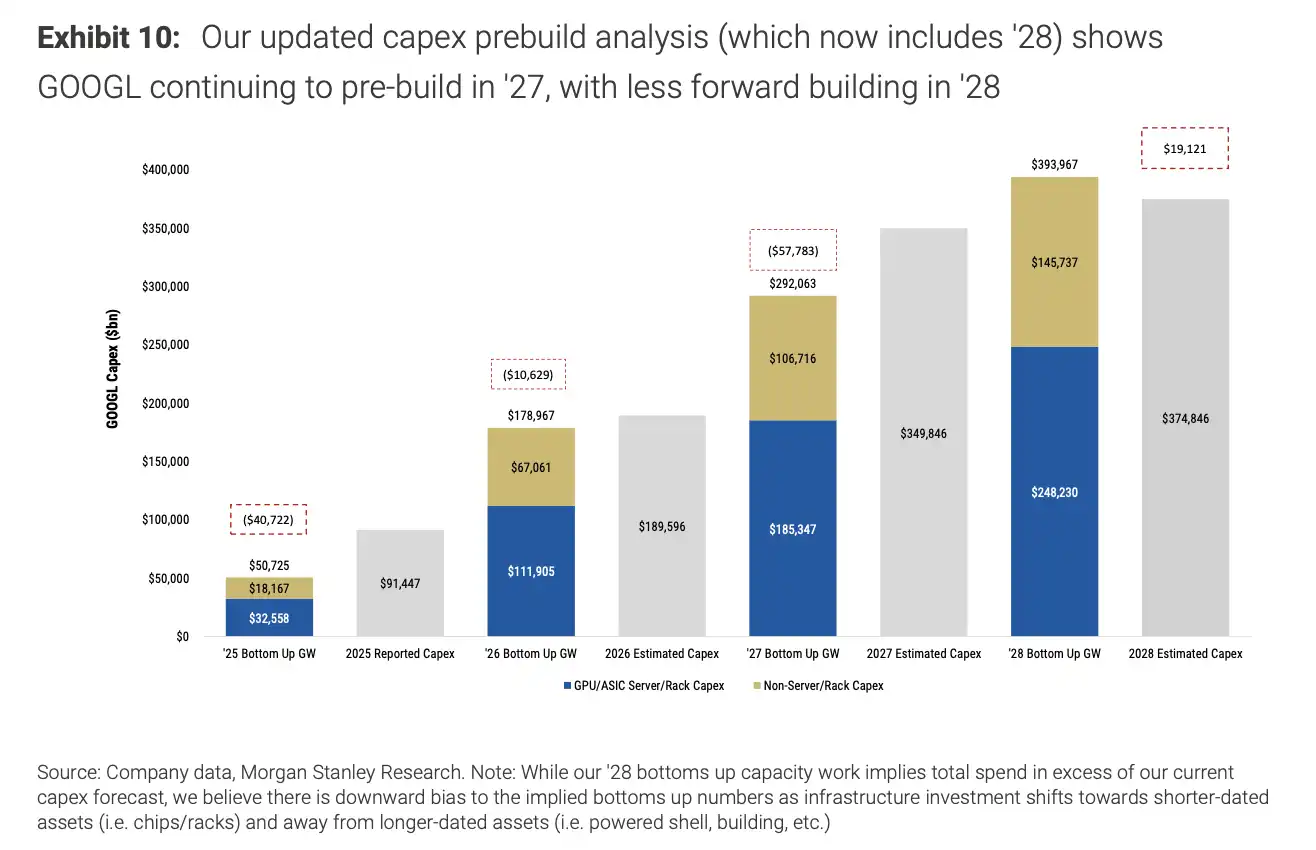
Morgan Stanley also mentioned two mitigating factors. Firstly, Alphabet may more adopt leasing data centers or collaborate with financial partners rather than building data center shells entirely. Secondly, as MediaTek's contribution to TPU supply increases, some TPU hardware costs may be lower than the capital expenditure estimated based on the Broadcom architecture.
But these are still model assumptions. What the market will look for next is not whether Alphabet will continue to ramp up AI but whether these investments can translate into revenue, profit, and cash flow.
Behind the $415 price target is a very clear validation chain: whether TPU shipments can land as planned, if external customers are willing to purchase TPU systems, whether Google Cloud can convert additional computing power into revenue, and if the cloud business EBIT margin can continue to rise. If these links are successfully realized, Alphabet's valuation logic will further shift from a search advertising company to an AI infrastructure and cloud profit platform; if any of these links fall below expectations, high capital expenditure will become a pressure point first.
Welcome to join the official BlockBeats community:
Telegram Subscription Group: https://t.me/theblockbeats
Telegram Discussion Group: https://t.me/BlockBeats_App
Official Twitter Account: https://twitter.com/BlockBeatsAsia