Twilight of the Gods (Part II): The Great AI Retreat
Original Article Title: "Twilight of the Gods (Part 2) — The Great Ebb"
Background Summary: "Twilight of the Gods (Part 1): The End of the Old Financial Era"
Article Summary:
1. The global financial market bubble brought about by the AI wave is about to burst, with a time window of 3-12 months in the future.
2. The business fundamentals of AI technology companies are already shaky. Human "usage habits" of AI have been formed, but the payment habit is far from complete migration. A large number of application companies are being squeezed by Anthropic, further weakening the underlying payment power.
3. This AI bull market cycle runs from 2023-2027, much like the Internet bubble period of 1996-2000. Early 2027 is highly likely to be the peak of this four-year cycle bubble burst. Currently, we are in the late stage of this round of the "bull market five waves," not the end.
4. There has not yet been a collective IPO and surge in stock prices of AI industry giants, triggering a frenzy for more AI-native companies to go public.
Before the final madness, we can still see Nasdaq hitting new highs again. At the moment, there is no need to rush to liquidate. The most reasonable way to deal with the secondary market is not to bet on a specific "top" event or time point but to gradually withdraw in batches between 2026Q4 and 2027Q1.
On the Macro Financial Market
Starting from mid-2025, the crypto market has been almost forgotten by mainstream society.
Because compared to the sluggish global stock market in 2021 due to the pandemic, BTC’s overwhelming performance has made the world take notice. However, starting from mid-2025, the cryptocurrency world has been lackluster, while the global stock market bull run driven by AI development has surged.
In the past 12 months, the U.S. stock market, Chinese A-shares, Japan, and South Korea's stock markets have all hit record highs. The relevance of the global stock market industry chain around the hype of AI is increasing.
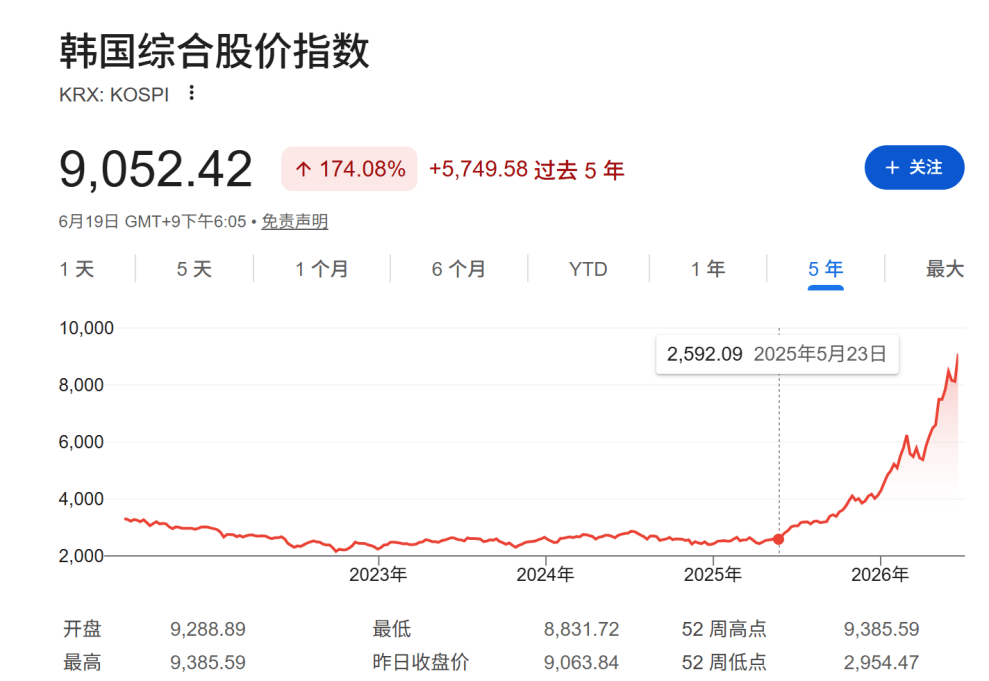
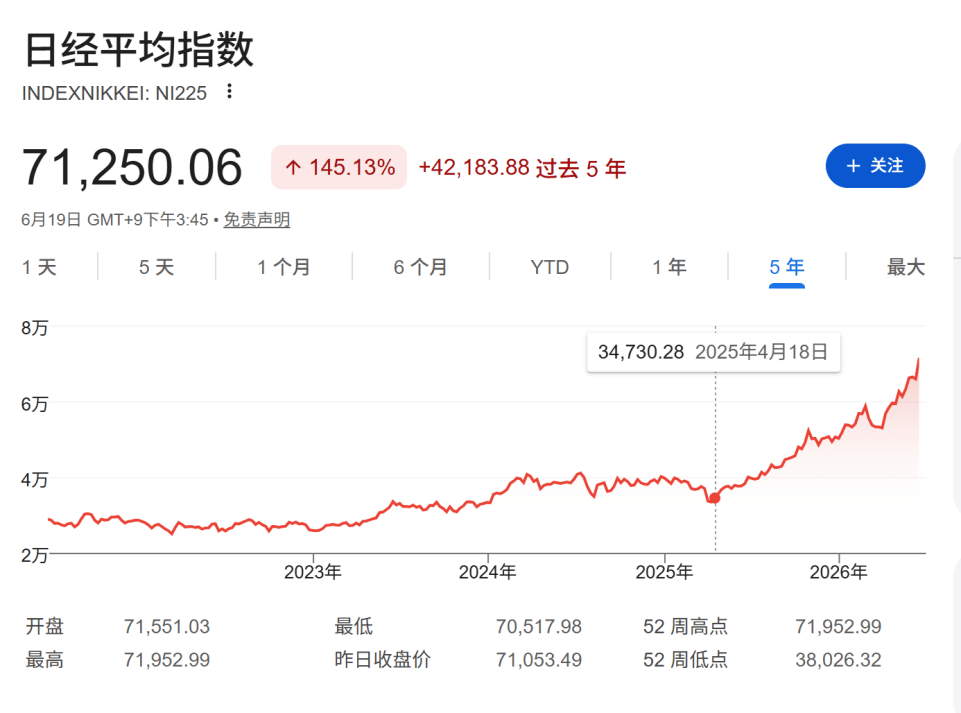
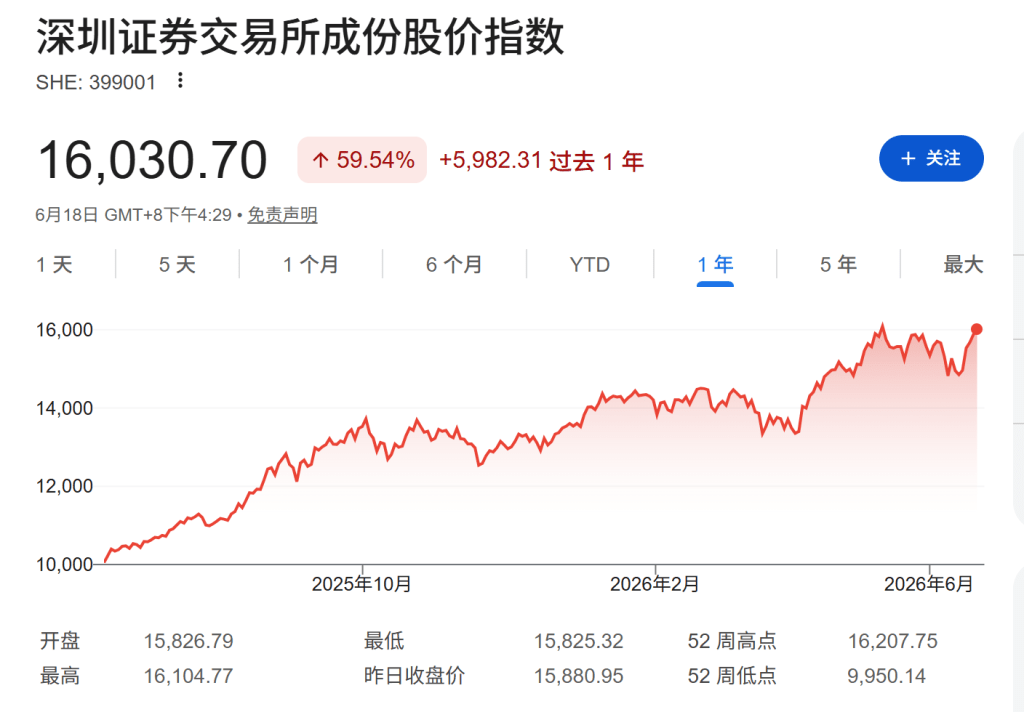
Why?
Because people in every corner of the world have almost universally come to believe by today that AI will fundamentally alter human society.
A disaster is imminent.
The global mainstream stock markets are all rallying, signaling the trumpet of the apocalypse.
The trumpet will not sound just once. And eventually, there will be a single event, followed by a series of events, that will abruptly halt the AI bull market in the secondary market. Just like October 10, 2025, was to the crypto world.
Viewed from a singular point, the catalyst for disaster may seem accidental, described by future generations in various ways as "an accumulation of coincidences." It is, in fact, inevitable. Perhaps it will happen sooner, perhaps later.
Human financial history spans only a few hundred years, with modern history being merely four or five decades. In this time, we have heard many claims of an "eternal bull market." But the course of nature, the trend of the world, what is united will split, what is split will unite. This is an eternal truth.
Three Theories of Bubbles
Setting aside specific price predictions for the stock market, let's first discuss the fundamentals:
· The fundamentals of AI companies. The industry's concern over the profitability of most AI applications has become the norm. The giants have realized that their profit growth curve is facing a bottleneck. The business model of standalone AI applications has not had a real breakthrough, and the first generation of AI applications that exploded in popularity with GPT has actually seen many "quiet deaths."
And as we enter 2026, Anthropic has further encroached on the survival space of many niche applications, making it even harder for AI standalone applications targeting the consumer market to raise funds compared to 2025. Those applications centered around token consumption have not strengthened their payment capability to the head AI infrastructures, but have weakened it instead. If an ecosystem lacks a healthy capital cycle, over time, this will turn those top AI giants into trees without roots.
The giants thought that by monopolizing the market, they would eliminate their competitors. In reality, what they have eliminated is their own customers and demand.
Envisioning the future, there may be two ways to solve this problem:
The first way: back in the Internet era, the ad-based monetization model was the primary business model for the first generation of portal websites and super apps, with most advertisers coming from the e-commerce industry. This period witnessed the e-commerce industry accumulating infrastructure such as payment and logistics over many years.
However, in the AI era, the interaction frequency between agents will be hundreds or thousands of times higher than that of humans. Previously, in order for a human user to achieve a goal, they needed to pay 0.1 cent to obtain data or search for a piece of news. This was simply impossible to achieve in the Internet era and could only attract users through a free model, aggregating millions of users before packaging and selling the traffic to advertisers for monetization.
In the AI era, the task orientation of agents will lead to a more peer-to-peer (P2P) business model. An American agent may purchase research services from a Korean agent, then utilize financial services from a Dubai agent, ultimately forming an entire workflow.
Conversely, AI does not require the human "attention aggregation effect." The ad-based model will become a thing of the past, replaced by an agent-to-agent micropayment system. To achieve this, a comprehensive infrastructure for agent quoting, charging, and delivering results will be needed, similar to the e-commerce payment and logistics systems of the Internet era.
This transformation may take several years to permeate all aspects of the industry.
The second way is a more wild speculation—looking back at the end of 2024 in my article "2024&2025, BTC's Final Mega Cycle—BTC's Value and Price Thesis"
At the same time, I have a more radical view: when everyone is discussing economic downturns and talking about finding viable business models, why does business itself need a business model? Has the term "business model" itself lost its meaning?
Let's express this viewpoint differently: in the future, it may not be necessary for a company to be profitable. As we enter the AI era, the focus on token usage volume and AI-friendly utility from a sufficient number of AI users participating in the market may be more important than the business model. Since the modern securities market is based on profit and the PE ratio valuation method created by humans, will AI develop its own trading logic closer to the essence of finance in the future?
Moreover, right now, even if the human financial world may not openly acknowledge it, the valuations of many AI companies may have already detached from the basic logic of price-to-earnings and price-to-book ratios and moved on to price-to-dream ratios.
Secondly, the fundamental landscape of macroeconomics, which I will not delve into much here. However, ongoing localized conflicts and deteriorating geopolitics have already become a global consensus. The shift in discourse power and political landscape is happening day by day, and the day when, if coincidentally combined with a financial market crash, will be that "inevitable accidental" day.
The first two points are still consensually recognized by the industry as the danger of this AI bubble, while the third point, I believe, is a more profound fundamental "decoupling" —
Thirdly, it is the fundamental trading paradigm of the financial market itself, or rather, the participants.
The entire financial market is a magnifier of history.
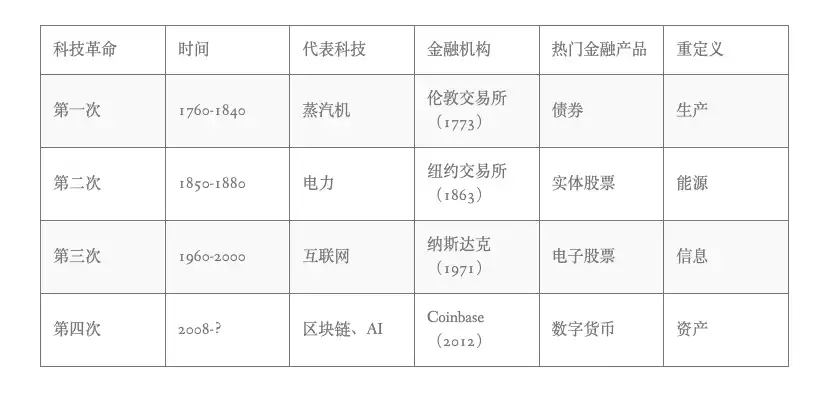
In the past, the world has undergone three technological revolutions, accompanied by revolutions in the financial system, and now we stand at the historical juncture of the fourth revolution (refer to "How Should We Invest in Digital Currency in 2021? Part One").
And in each round of the global financial market's "bull run," manifesting as an explosion in overall market capitalization, what is more crucial is the explosion in trading speed, breaking through the limit. Because when the total market value of the financial market reaches a certain stage, people's limited attention can only be focused on a relatively small number of stocks, and the base of the pyramid cannot support it, meaning the vulnerability of the financial market is continuously magnified, and it will inevitably collapse at some point.
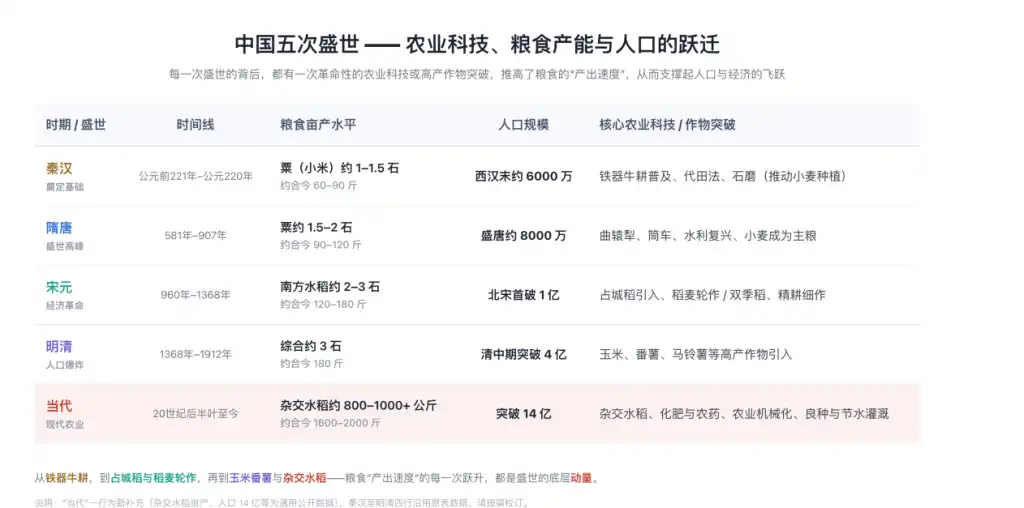
This is similar to looking back over the past few thousand years of history. In China's five golden ages from ancient times to the present (Han, Tang, Song, Qing, contemporary), they were all accompanied by a population explosion. Behind this, each of these dynasties witnessed revolutionary advances in agricultural technology/crop development, ensuring the core "momentum" of food production speed that supported the leap in "economic GDP" under the golden age.
The development of the technology market and the financial market is not always perfectly synchronized. Currently, the integration of the financial market and AI is still in a fragmented state.
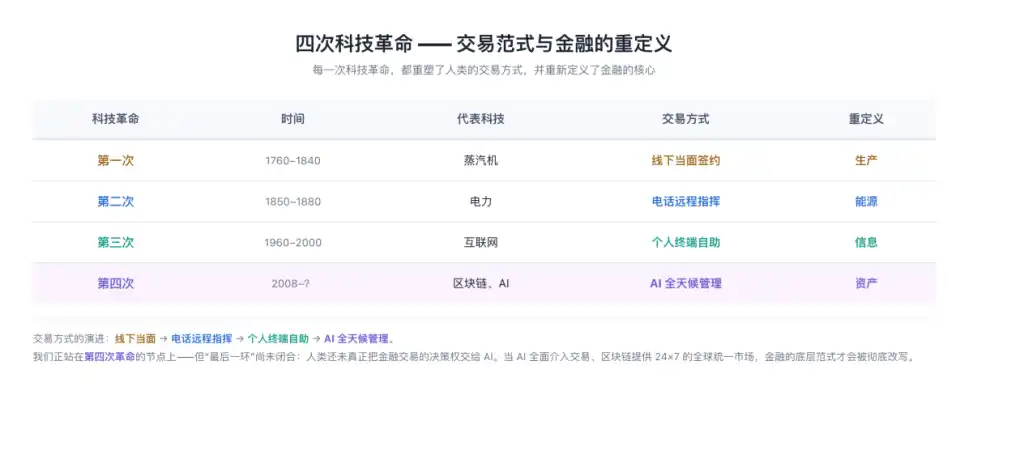
The first technological revolution brought the steam engine, revolutionizing human transportation. People across European countries could take trains to London more quickly to sign securities trading contracts in person.
The second technological revolution brought the telephone, revolutionizing human communication. Wealthy individuals worldwide could instruct brokers in New York to trade through the telephone system.
The third technological revolution brought the internet, revolutionizing how humans access information. People worldwide could go online themselves and directly trade using personal terminals such as computers and mobile phones.
The Fourth Industrial Revolution, undoubtedly led by AI and, in my belief, also including blockchain, has transformed how humans access services and hold assets. People all over the world are already using AI to assist them in their work, write code, and perform tasks.
Wait, something seems to be missing...
The final piece — humanity has not yet granted AI the permission to participate in financial transactions. In other words, just like in the previous three revolutions, the "innovation" at the heart of technological development needs to directly impact the financial markets. Currently, we only use AI to search for financial information, provide advice, and manage some workflows, without truly touching the core of the transactional aspect. Essentially, humans currently do not dare to trust AI with financial decision-making.
Of course, all of this is changing. However, at this moment, or in the foreseeable future as far as I can see, these changes are not yet substantial enough to meet the demand for an increase in "transaction speed" in the financial market.
The current bottleneck in transaction speed is, in fact, the concentration of human effort. Humans can never keep up with a 24/7 market, nor can they swiftly process a thousand pieces of just-happened information to trade a hundred different financial assets across various markets.
To overcome this hurdle, humanity must decentralize decision-making, realizing that the ultimate future of humans using AI for financial transactions is not AI suggesting to humans, with humans saying "yes" every time; rather, it is humans informing AI of their key focuses, risk preferences, financial situations, and within a set framework, saying "no" outside the framework, leaving the rest to AI.
Therefore, what we are discussing is not the extent to which humans can use AI tools to understand information in the financial market, but that AI itself should become the "brain." Just as with the emergence of blockchain and crypto, a globally unified 24/7 trading market appeared for the first time, clearing obstacles for AI to execute trades more seamlessly.
Currently, the pricing mechanism in the financial market is still mainly determined by human will. The financial market may have market value and capital, but trading speed and "concentration of effort" cannot support its market value.
So, when people are fundamentally incapable of researching newly emerging concepts and projects from around the globe and keeping pace with developments, the best solution is to concentrate on purchasing those most well-known top projects. Over time, the stock market has almost become a game of attention-grabbing, where the vast majority of companies cannot benefit from the Nasdaq index or the gains brought about by the surge of those top few supergiants.
Only when AI fully engages in trading can the bottom of the market be better amplified. However, how humans can inject their own "ideas" and "data" into AI still has a long way to go.
And we say that by the hypergrowth state of the stock market in 2026, the business fundamentals of AI companies have already found it difficult to support further benign stock price growth. It is not that the fundamentals of AI companies have turned negative that will trigger a collapse, but rather their growth rate must accelerate more and more to sustain current market expectations and valuations.
From this perspective, the business fundamentals development of AI has already reached its limit.
Let's emphasize once again, we are not talking about the technical fundamentals, but the business fundamentals; we are not talking about speed, but acceleration.
The Choice We Face Today
So, what stage has the financial market entered in this AI era?
The mid-1999 of the Internet era.
In other words, it is the late stage of a bull market cycle, not the end stage. Or in the current context, June 2026 belongs to the middle of the fourth wave of the entire AI bull market.
The familiar AI giants we know today will certainly achieve success, even changing the course of human development for some.
However, in the previous era, during the heyday of the early 2000s Internet bubble, 80% of the giants disappeared into the annals of history. Around 15%, similar to hardware giant Cisco, a company that reached a peak market cap of $555 billion in March 2000, took a full 26 years and 3 months to finally surpass the $500 billion mark once again.
If we were to pick stocks at the micro level, the companies from 2000 that have truly provided valuable financial returns today may be fewer than 5%.
The year 2000 did not mark the end because the Internet had failed.
On the contrary, the Internet ultimately achieved success far beyond what anyone at the time could have imagined.
AI may follow a similar path.
The years 1996-2000 of the Internet era correspond to the years 2023-2027 of the AI era.
The market may be overestimating the profits that can be realized in the coming quarters but underestimating the productivity revolution that will unfold over the next few decades.
If the years 1996-2000 were the first pricing of the future by the Internet, then perhaps now is the first pricing of the future by AI.
Naturally, it will be wrong, but a beneficial pricing.
So here we are, standing in the present, at the end of June 2026. Should we stop here?
Most likely not, depending on your role. If I were a VC fund manager, I would choose to invest in a gradual slowdown, relatively more focus on driving exits for the portfolio, and concentrate on preparing materials for the final wave of fundraising for a new fund.
If I were a trading fund that has not entered the market yet, even if I were to enter, I would need to be very cautious, manage positions well, make quick decisions, and be prepared to enter and exit quickly.
If I were already in the market, with a long-term allocation and liquidity in a family office, I would let the bullets fly a little longer.
If I were an entrepreneur, I would need to accelerate, strive to reach higher ground on the mountain before the tsunami arrives.
As for those who would lead, they must first understand the timing, then take advantage of the favorable conditions, gather the right people, and only then can they advance.
Once again, I believe that we are currently in the mid-1999 of the Internet era. From the mid-1999 until March 10, 2000, in just over half a year, the Nasdaq index surged from 2500 points to over 5000 points. So, even though the risks are accumulating, there is still the steepest part of the upward trend before reaching the peak of complete madness.
Prior to that, at the beginning of 1996, when the Internet had just entered the mainstream view and representative products like portal websites and search engines such as Yahoo, Excite, and Infoseek went public, the Nasdaq index lingered between 1100-1300.
From what we consider the "dawn of the Internet era" to the "midterm of the bubble" in 1999, the increase in three and a half years was the same as the increase in the last half year before the bubble burst.
History always shows astonishing similarities—starting from early 2023 when ChatGPT emerged, heralding the beginning of the AI era, to now, exactly three and a half years later, the Nasdaq has risen from 12000 to its current 25000. If you remove a zero, twenty-seven years before and twenty-seven years later, it seems as if the wheel of history has once again crossed the same track.
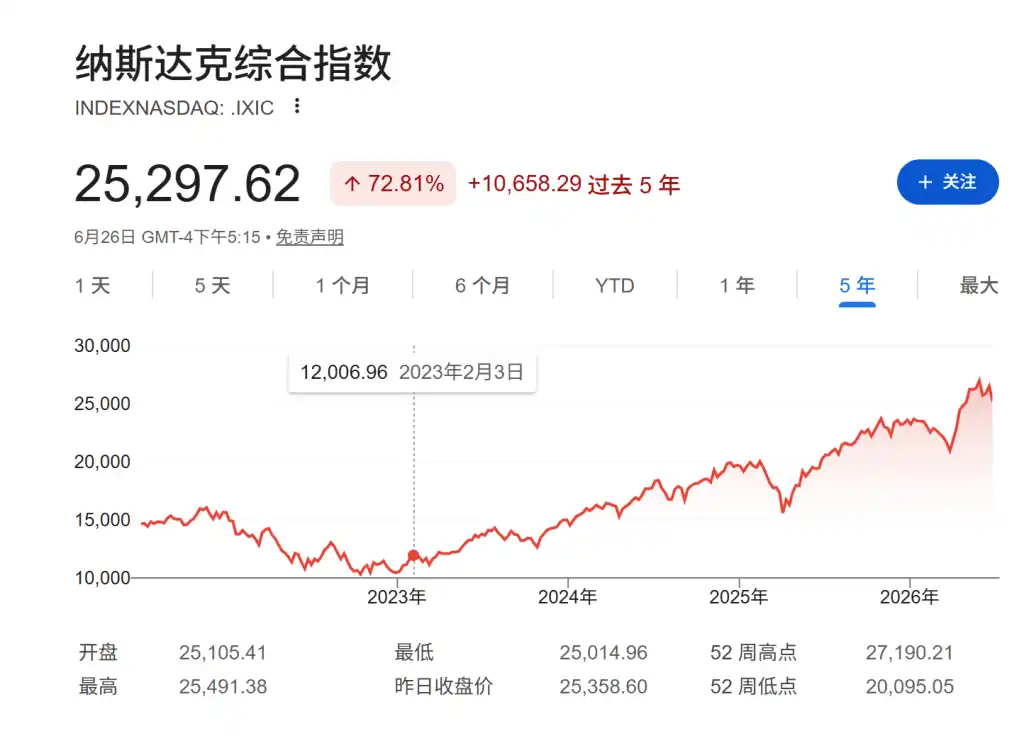
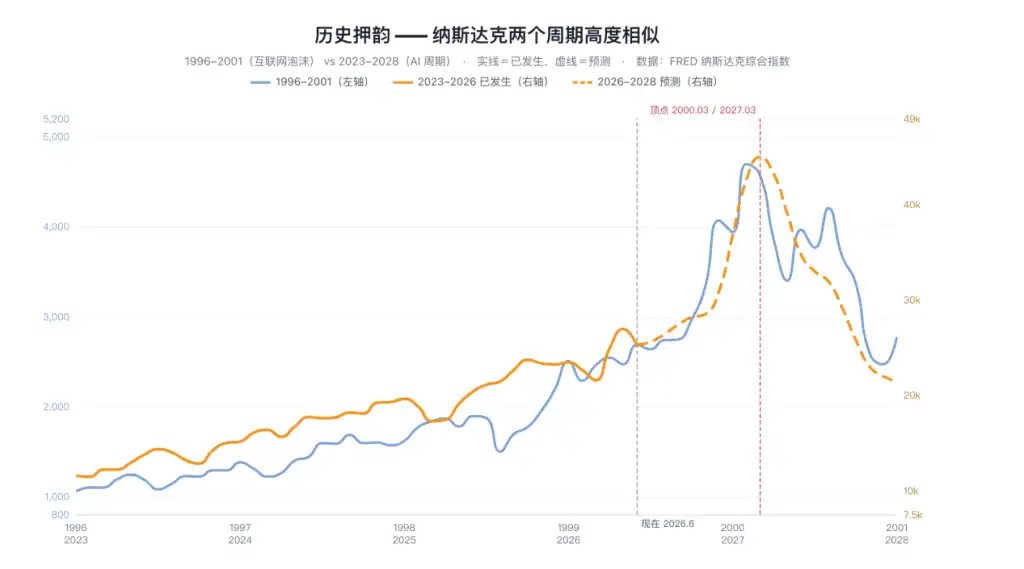
So, I said, I could already see the incoming massive tsunami. However, a true surfing expert can still safely reach the shore by riding the penultimate wave. Then, without looking back, resolutely dives back in. This time, it could be 2026Q4-2027Q1, exiting in batches.
Turning Point Speculation
So, will there be one or more events at that time that will serve as obvious turning points?
Historical turning points often occur as "necessity turned chance," and I cannot predict accurately. Those "events that change the course of history" are merely the ones selected from the "chance" to become the catalyst, which future generations will repeatedly interpret. No one can foresee it.
Perhaps this sword will be the next month's Fed meeting, or more likely, the Fed meeting after the November 3, 2026, US midterm elections. We know the moment of interest rate hike will eventually come.
It might be some geopolitical event early in 2027, be it a hot war or a trade war.
It may even be another sudden US government shutdown.
One thing that people tend to overlook is that there are always several false alarms before each disaster. Before this sword is drawn, there should be several "cry wolf" moments.
Going back to what I mentioned earlier, the current bull market's five waves, at present, are in the middle of the fourth wave. In February 2025, after deepseek emerged, posing a serious threat to major US chipmakers, it sparked panic in Silicon Valley, resulting in over a 20% pullback in two months.
At that time, many people were "schadenfreude," thinking that the AI bubble had burst. However, in just about two more months, the market fully recovered. Looking back, it was just a minor episode in the middle of the bull market. I marked that point as the "end of the second wave in the bull market's five waves."
In the next 3-12 months, there will surely be several seemingly "imminent collapse" fluctuations.
If we rewind 27 years.
From June 1999 to March 2000, the Nasdaq did not rise steadily but was a "highly volatile bubble": the market kept hitting historical highs on one side, while every few months, there was a sudden 10%~15% drop. In between, there were three retractions enough to make investors at that time think that "the bubble was over," only for the market to quickly set new highs.
Until the very end, everyone was caught in madness. Or rather, knowing it was madness, but after several false alarms, knowing it was a point of no return yet still unwilling to be "left behind," they were willing to take a gamble.
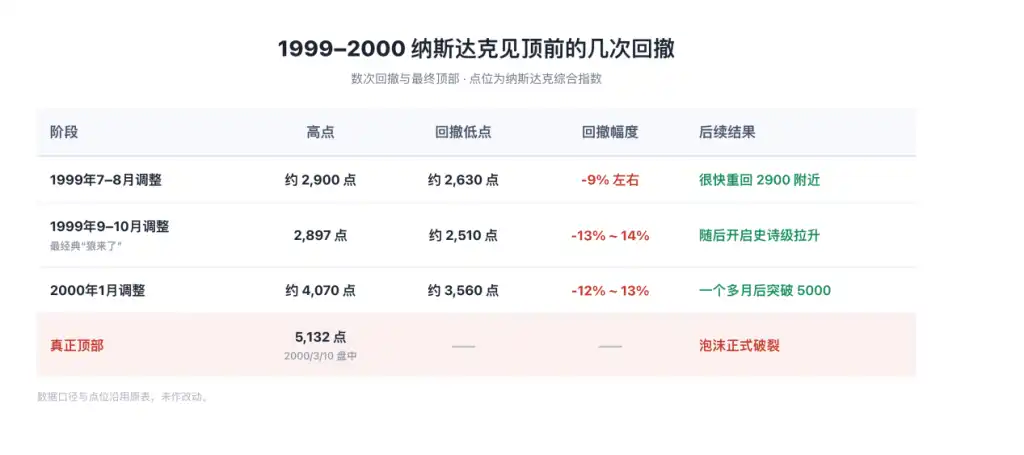
And at this moment, evidently it is not yet the peak of madness.
While in South Korea, a nationwide "casino rush" may have already begun, for the global financial participants as a whole, the market may need to become even more frenzied before they are willing to collectively "take a chance."
It's not just us ordinary folks. Before the U.S. midterm elections on November 3, I think even Trump had to "take a chance."
Bold Prediction:
1. In the next month or two, the market will be mainly characterized by volatility. Even if the Nasdaq Index occasionally reaches new highs, there may not be a significant opportunity for a strong breakout to new highs.
2. SpaceX's IPO has raised many doubts, with many people believing that this marks the end of the stock market. However, I believe that SpaceX, including the next few flagship projects, will not quickly plummet shortly after going public. SpaceX went public on 6/12, opening at $150.
Two weeks have passed, and the price has been hovering above $150. Perhaps the end of the fourth wave of the "bull market five waves" will be signaled by SpaceX's short-term fall below $150, causing panic.
Don't worry, it's just a retracement until the IPO of the most important AI native core companies.
3. The bull market began with OpenAI and will also end with it. It is currently widely expected that OpenAI will most likely go public in early 2027. Perhaps OpenAI's IPO failure will damage confidence in the primary market, or after OpenAI goes public, scrutiny will reveal internal business logic issues leading to a sharp decline in its stock price.
If one of these two events occurs, it will be the fifth wave of the bull market and a signal that the final wave is about to end.
4. In fact, these most well-known AI companies have not yet gone public, and their performance has not been put under a microscope for public judgment. In the coming months, the U.S. stock market has companies like Anthropic and OpenAI, both valued at trillions of dollars, waiting to go public, while the Hong Kong stock market has companies like Kimi, DeepSeek, and several "AI Six Dragons" lined up.
If OpenAI/Anthropic successfully go public and manage to boost the market, it will undoubtedly trigger a global frenzy of AI companies rushing to go public.
In early 2026, represented by Group Nuclear Technology, there have been several tech stocks' Pre-IPO frenzy in the Hong Kong stock market; in early 2027, if there are signs of various AI companies from the U.S. going public, it will indicate that the bubble is nearing its peak. Perhaps after this happens, there will be a "fake pullback," followed by Nasdaq hitting a new high again, marking the peak of the bull market’s fifth wave.
5. NVIDIA's market cap may reach $10 trillion. If one day it truly crosses that epic threshold, even just touching that historic milestone, it will surely cause a celebration worldwide. Please listen carefully; that will be the final horn to tell you it's time to retreat.
You might say, by early 2027, if the stock market really descends into madness, won't people learn from the past and refrain from rushing into the market?
Rest assured, vested interests will find ways to guide people into "misjudgment."
If we consider the beginning of this AI bull market as the shocking ChatGPT incident in early 2023, then by early 2027, four years later, the bull market should come to a close.
Of course, a wise man does not stand under a crumbling wall; do not wait for a specific time point. The "premature" collapse of crypto on 10/10/2025 serves as a cautionary tale. If it were me, in late 2026 to early 2027, in the mainstream financial markets, sell on rallies, and if a trend reversal is clearly identified, do not hesitate, liquidate quickly.
This is not the end of the final chapter, but the end of the prelude
A tsunami is indeed terrifying, as if the world is about to collapse when you are in it. But if you stand on a distant mountain peak and look back at the coastline, you will naturally feel indifferent.
The bursting of the internet bubble from 2000 to 2002 almost destroyed Silicon Valley, and the entire venture capital industry was on the brink of collapse. Looking back today, that mountain peak at that time was just a small hill.
By the end of 2017, BTC multiplied several times within a month, soaring to the $20,000 mark. As a witness at the time, I felt the "world had gone mad." Then, the prolonged bear market from 2018 to 2020 almost wiped out the entire crypto industry, shaking my confidence in the industry. But when Bitcoin surpassed $100,000, today, it's just a casual chat.
Oh, and let's not forget the NFT industry still lingering at its low point. I believe that starting in 2029, there will be a new scene.
I think that by 2040, or perhaps even sooner, looking back at the financial market's dormancy, rise, collapse, and recession over these years, it will all seem just like this.
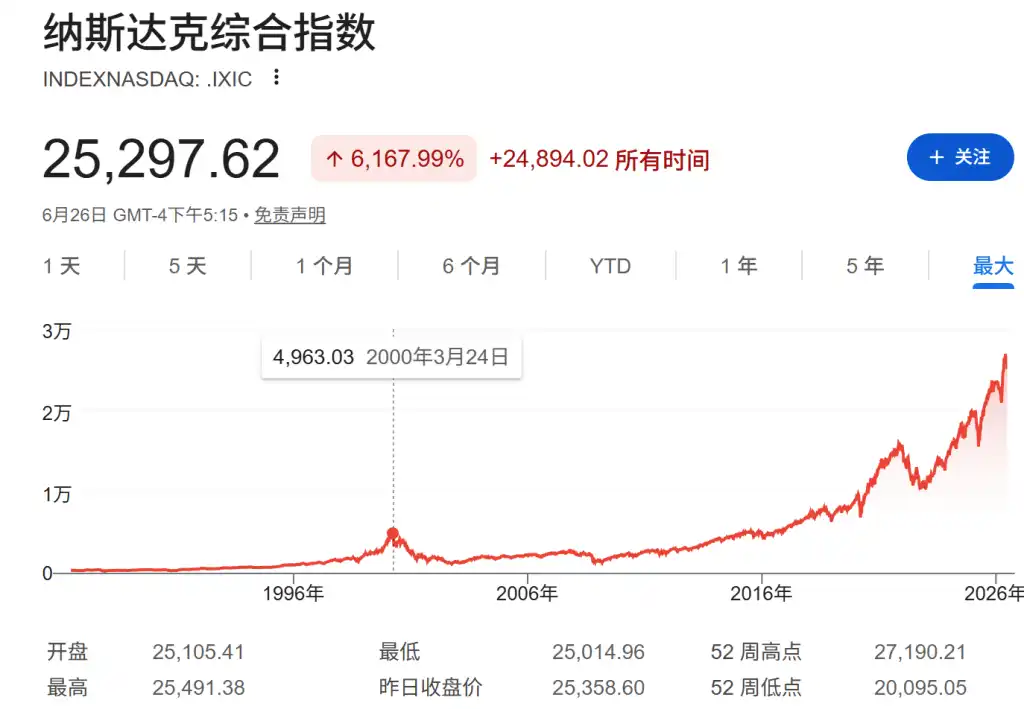
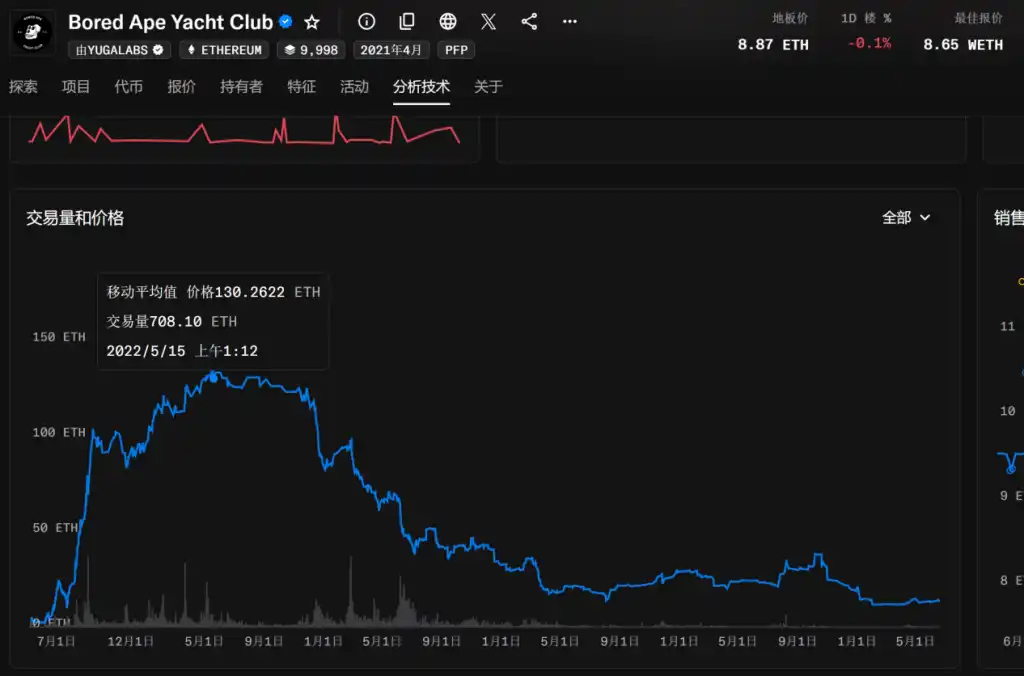
What will the era after the ebb tide, after the curtain call of the old financial order, look like?
The Genesis of AI Finance. Next, let's take a glimpse into the future new world from that ray of light.
Original Article
Welcome to join the official BlockBeats community:
Telegram Subscription Group: https://t.me/theblockbeats
Telegram Discussion Group: https://t.me/BlockBeats_App
Official Twitter Account: https://twitter.com/BlockBeatsAsia

 Related Articles