21 banks stake $270 million to launch new stablecoin Faro, what needs attention?

TL;DR
· On November 10, Bloomberg cited people familiar with the matter reporting that Goldman Sachs, Citi, Santander, Deutsche Bank and other institutions collectively pledged approximately $270 million to cover five years of operating expenses for a joint venture stablecoin company.
· The money precedes US stablecoin rules taking effect in January 2027, and is used to secure issuer status and governance seats—it is not reserve capital, nor a valuation. The contribution split, on-chain plan and distribution agreements have not been disclosed.
· Related tickers: CRCL, GS, C, SAN, DB, WFC, BAC; indirect impact on COIN, V, MA.
On November 10, Bloomberg cited people familiar with the matter reporting that Goldman Sachs, Citi, Santander, Deutsche Bank and several other institutions have collectively pledged approximately $270 million to cover five years of operating expenses for a joint venture stablecoin company.
The company is registered in the US under the internal codename Project Faro, its CEO is still being sought, and neither the banks nor the project have publicly confirmed it.
This is not the first time these institutions have spoken out. On September 1, 2026, 21 institutions issued a joint announcement pledging to establish a new company in the second half of 2026, first issuing a US dollar stablecoin in the first half of 2027, with the euro as the next priority.
The announcement stated "subject to satisfaction of closing conditions," with the company name "to be announced later." Two months have passed and the name has still not been announced, while by the calendar the establishment window given in September has only six weeks left.
A five-year budget buys an issuance seat
To understand what this $270 million is competing for, one must first know how stablecoins make money. For every US dollar stablecoin a user holds, the issuer places $1 in cash, bank deposits or US short-term debt maturing within three months behind it, with the interest going to the issuer.
The cash flow comes from this reserve yield and is unrelated to coin price movements. This money buys the building of the company before January 2027—offices, compliance teams, custody audits and licensing pathways all cost money. Its purpose is to make the company exist first, not to confront the more than $200 billion in outstanding supply head-on.
Averaged over five years, that is about $54 million per year. Placed against peer benchmarks, the scale of this money becomes clear.
Circle's reserve yield in the third fiscal quarter of 2026 was 3.5%, with average circulation of $73.3 billion, and revenue plus reserve yield for the quarter totaled $865 million—a single quarter equivalent to 16 times Faro's annual budget.
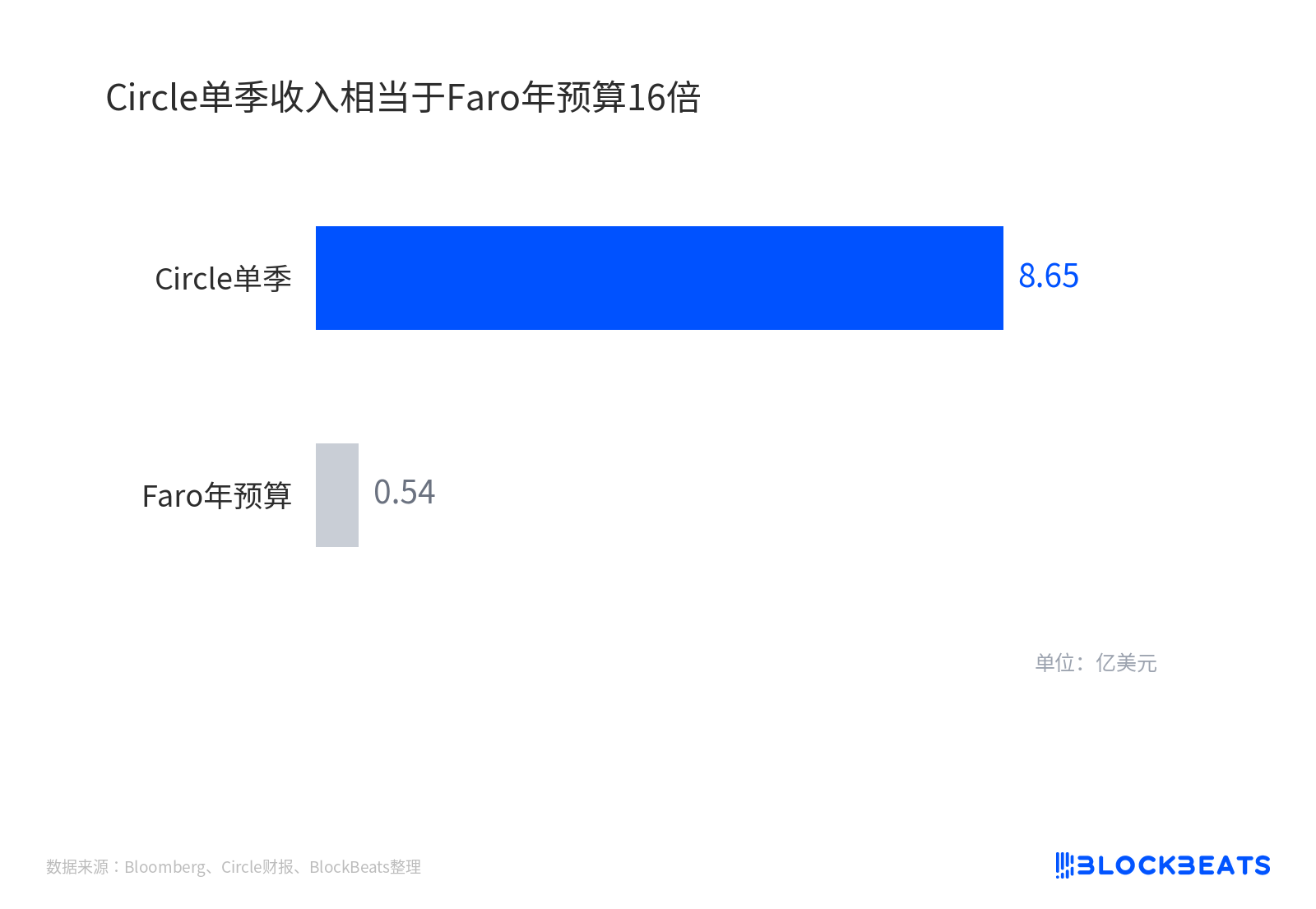
Circle's single-quarter revenue equals 16 times Faro's annual budget
The stock gap is even larger. USD stablecoin circulation is about $290 billion, with USDT at about $176 billion and USDC at about $70 billion; together they account for more than 80%, and $270 million is less than 1.1% of this pool.
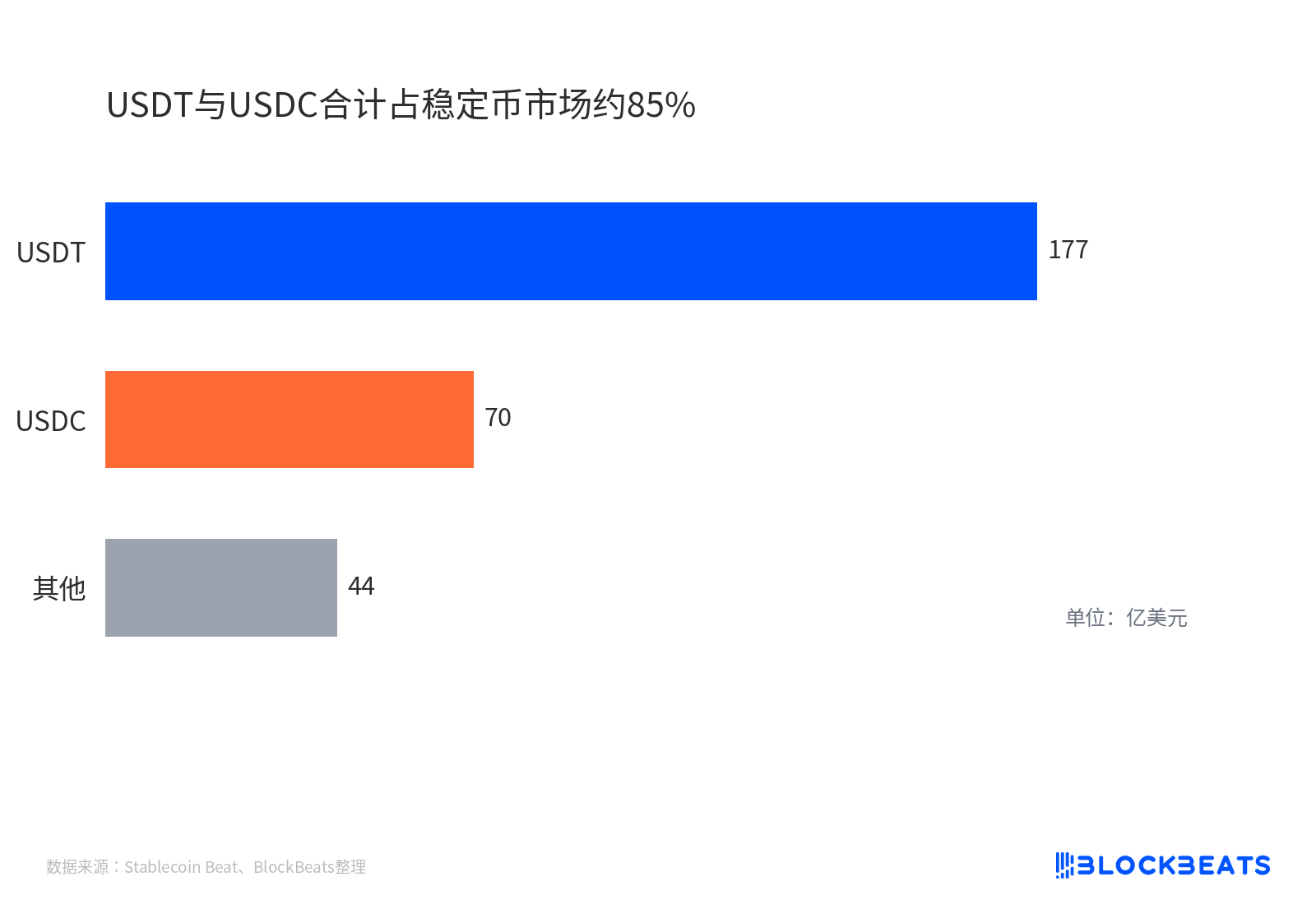
USDT and USDC together account for about 85% of the stablecoin market
The allocation method was also not explained. The report only said that "multiple institutions including Goldman Sachs and Citi" collectively committed, without disclosing who would provide the money or how much each would contribute; the September announcement did not even include an amount. If it is directly understood as 21 parties contributing equally, the certainty of this money would be overestimated.
None of the four matters has been implemented
The rules come from the GENIUS Act (the U.S. stablecoin licensing and reserve law) signed on July 18, 2025, with core provisions taking effect on January 18, 2027, when issuers must be licensed.
Reserves are limited to 1-to-1 cash, insured deposits, U.S. short-term debt with remaining maturity of no more than 93 days, or eligible repurchase agreements. To issue coins in the first half of 2027, working backward, four matters must be resolved by the end of 2026: entity registration, licensing path, reserve custody, and on-chain solution.
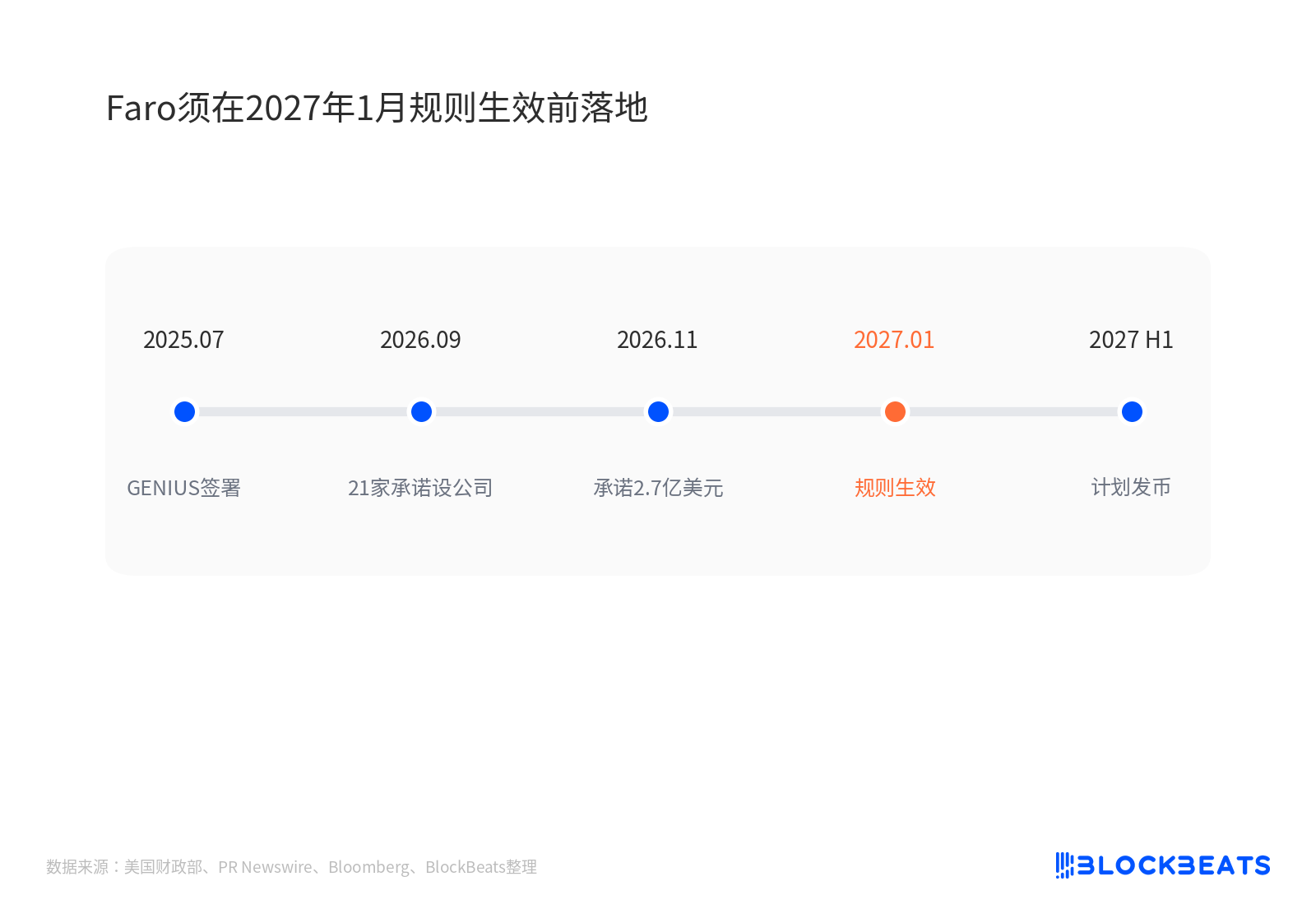
Faro must be implemented before the rules take effect in January 2027
According to currently public information, none of the four matters has been implemented, and the company name and leader are both blank. A more likely pace is that the entity is implemented first while the product slips later; the date in the September announcement has already changed from a commitment into pressure.
The same group of banks is placing three kinds of bets
Putting Faro into the competitive landscape, it is not the fastest-moving line.
The payment network line is ahead. Open Standard's Open USD announced on June 30 that more than 140 companies were participating, and on September 30 it was already live on Ethereum, Solana, Base, and Tempo, issued by Stripe's Bridge.
It charges no minting or redemption fees and distributes reserve income to partners. It currently has about $924 million in circulation—still small in scale—but its distribution network is already in place.
The European line is already licensed. Qivalis, a joint venture of 37 European banks, obtained an electronic money institution license from the Dutch central bank on October 13, aiming directly at a euro stablecoin. Euro stablecoin outstanding balances total only about $846 million—a small pool with clear rules—and early movers get the standard-setting seat.
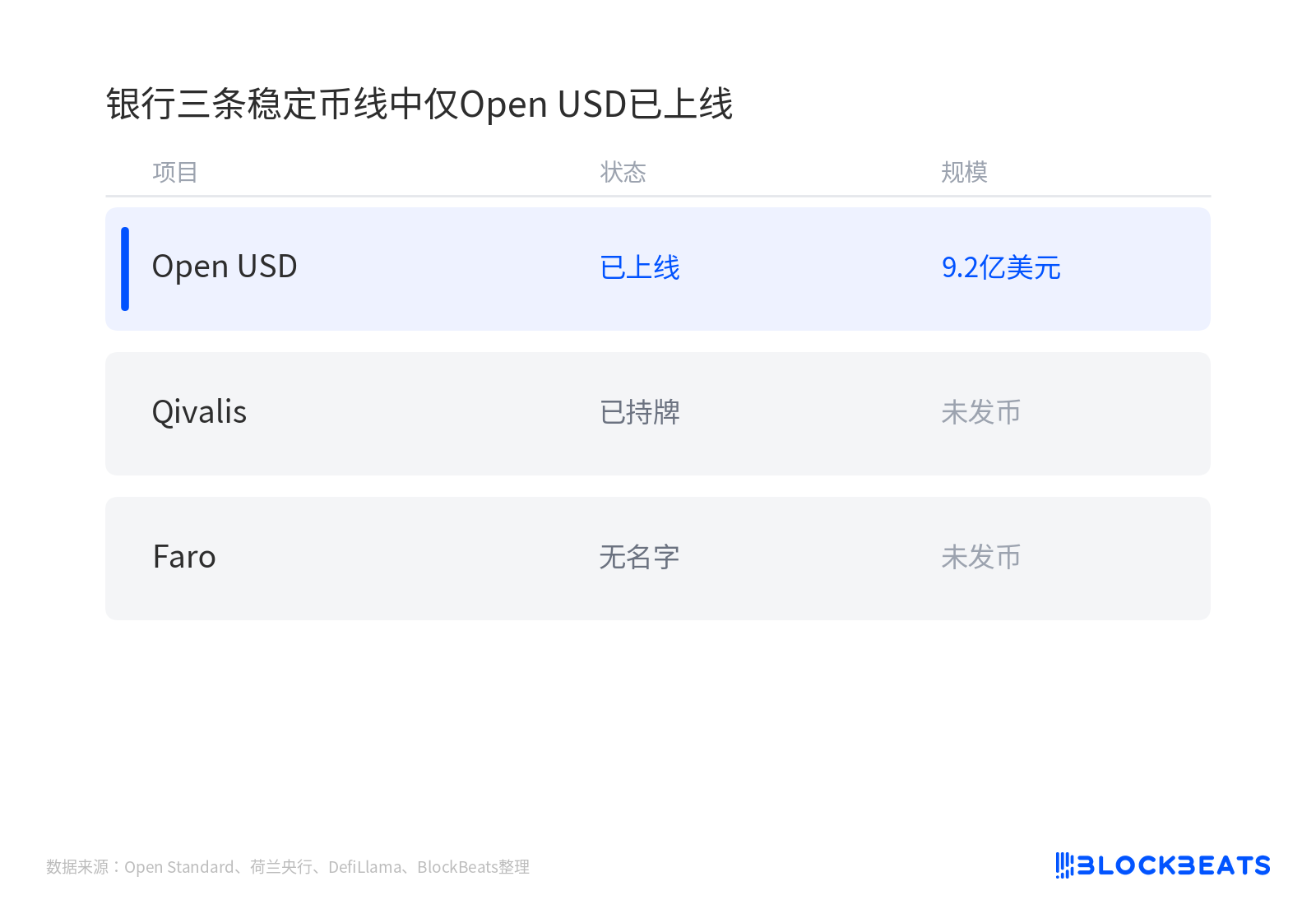
Among the banks' three stablecoin lines, only Open USD is already live
Cross-shareholdings show the banks are betting on multiple horses at once. BBVA appears on both the Faro and Qivalis lists, while Citi, Bank of America, and Wells Fargo are participating in Faro while also advancing a tokenized deposit network for 2027. Stablecoins are on-chain claims held by customers, while tokenized deposits remain the banks' own liabilities.
Circle CEO Jeremy Allaire said in the third-quarter earnings report that institutions are still continuing to build on USDC. That statement carries a vested interest, but at least it shows the existing network has not loosened overnight.
How long can the 3.5% reserve yield hold up
More noteworthy than "whether banks can issue coins" are two variables that have not yet been priced.
One is whether distribution is mandatory. If major banks require corporate clients to use their own coins for cross-border settlement, market share will migrate year by year. If it is merely one more option on the shelf, Faro is just a very expensive compliance shell.
The other is how reserve interest is split. GENIUS pins eligible reserves to short-term debt and deposits. The larger the minting scale, the more short-end U.S. Treasuries gain a price-insensitive buyer, and how yields are divided among issuers, distributors, and banks is where Circle's valuation truly comes under pressure.
Circle fell about 4% on November 10, but several sell-side firms had already cut target prices by November 5, so the drop that day cannot be attributed to Faro alone. What needs to be verified is whether the 3.5% reserve yield will drift lower as profit-sharing competitors multiply.
Before January 18, 2027, what could change the judgment is when four things land: the company name, the person at the helm, the licensing path, and the first chain. They determine whether Faro is an issuance entity that has already started work, or a letter of intent with a not-low price tag.
Welcome to join the official BlockBeats community:
Telegram Subscription Group: https://t.me/theblockbeats
Telegram Discussion Group: https://t.me/BlockBeats_App
Official Twitter Account: https://twitter.com/BlockBeatsAsia