Where can retail investors track the price of Bitcoin ETF? A popular science article.

Author: Luccy, BlockBeats
At 4:00 am Beijing time on January 11th, the US Securities and Exchange Commission (SEC) simultaneously approved 11 spot Bitcoin ETFs. This is a historic moment in the history of Bitcoin and the entire cryptocurrency market. The spot Bitcoin ETF has finally been approved, and Bitcoin has turned a new page.
So what is the principle of ETF? How to track the prices of various institutional Bitcoin ETFs? BlockBeats has sorted out the existing information.
ETF (Exchange Traded Fund) is a type of fund that is traded on an exchange. It represents a portion of ownership in the underlying assets, so ETF products support redemption and cannot be issued out of thin air. The issuer needs to hold equivalent underlying assets in order to issue ETFs.
Bitcoin ETF is a certificate that is tied to the price of Bitcoin. ETFs are divided into spot ETFs and futures ETFs.
其中,比特币期货 ETF 就是一个协议,他不跟比特币现货价格绑定,类似一个到期合约。你可以通过签订协议,约定在未来某个时间内,购买或出手比特币。换句话说就是,假如你开了一个比特币期货 ETF,你不需要拿一分钱出来购买比特币。
其中,Bitcoin futures ETF is a protocol that is not tied to the price of Bitcoin spot, similar to a futures contract. You can sign an agreement to buy or sell Bitcoin at a future time. In other words, if you open a Bitcoin futures ETF, you don't need to spend any money to buy Bitcoin.Unlike Bitcoin spot ETFs, it is tied to the price of Bitcoin spot. Each purchase of a spot ETF corresponds to a spot Bitcoin.
ETF Price Change Tracking
In the fierce competition of Bitcoin spot ETFs, the fees set by each company have a decisive importance, which not only affects the choices of investors, but also significantly impacts the market competitiveness of the companies. As the management cost borne by investors, ETF fees directly relate to investment returns. Therefore, when choosing ETF products, investors often prioritize options with lower fees.
As of January 11th, the updated fees are shown in the following chart. Hashdex charges a fee of 0.90%, ARK 21Shares Bitcoin ETF (ARKB) charges a fee of 0.0% (0.21%), Bitwise charges a fee of 0.0% (0.2%), Franklin charges a fee of 0.29%, BlockRock charges a fee of 0.2% (0.3%), VanEck charges a fee of 0.25%, WisdomTree charges a fee of 0.0% (0.3%), Invesco and Galaxy Digital charges a fee of 0.0% (0.39%), Valkyrie Investment charges a fee of 0.0% (0.49%), Grayscale charges a fee of 1.5%, and Fidelity charges a fee of 0.0% (0.25%).
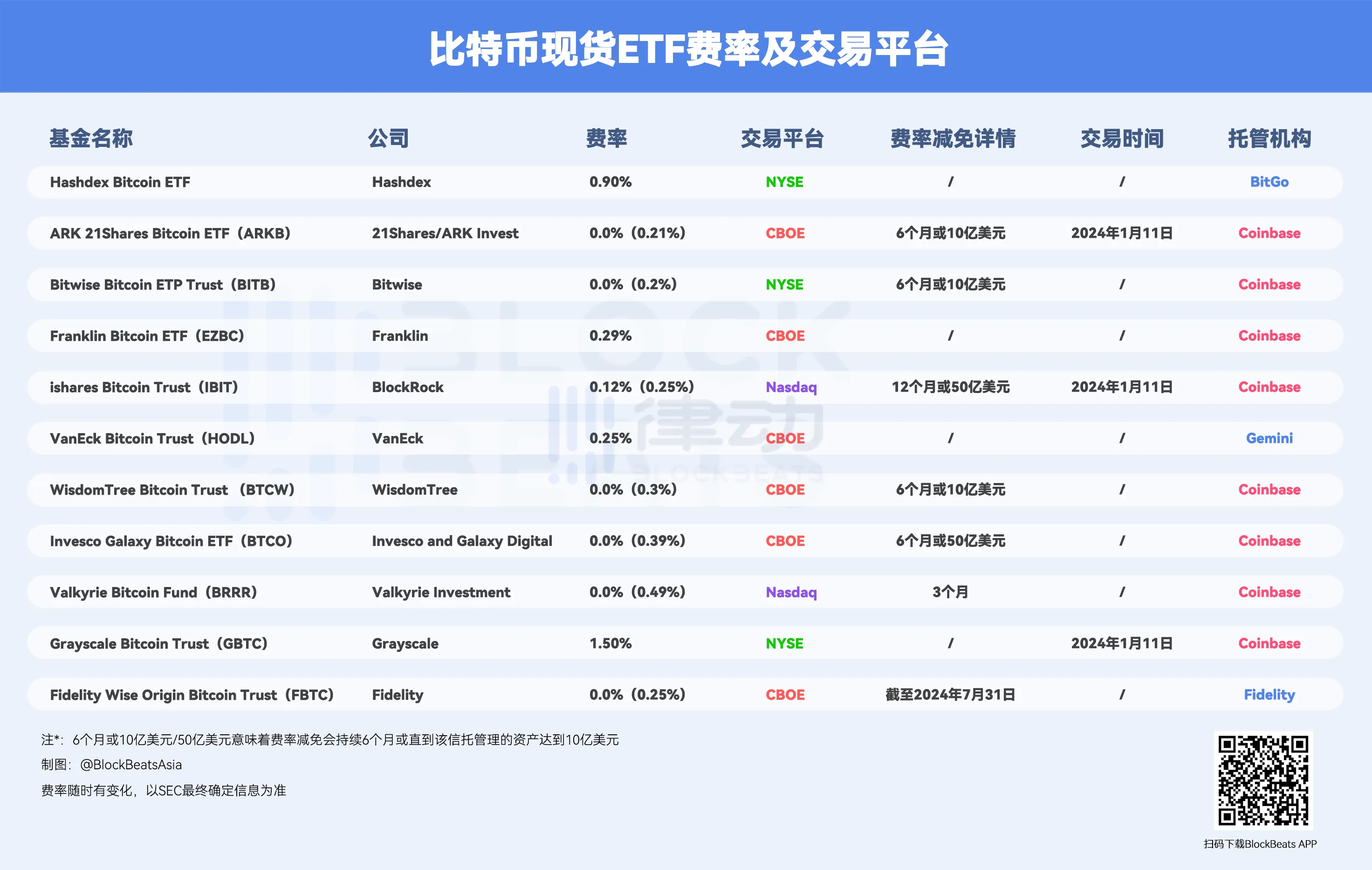
Tools
1.SEC: You can register on the official website of SEC, fill in your email address, in order to receive official news and decisions related to Bitcoin ETF as soon as possible. As a regulatory agency, the information released by SEC is the most authoritative and accurate.
When it comes to mastering market information, you can also follow some well-known industry analysts, such as Bloomberg ETF analyst Eric Balchunas and James Seyffart. They have in-depth research and insights on Bitcoin ETFs. Following their social media can provide more professional analysis and predictions, and turning on notifications will ensure you receive updates as soon as possible.
2. ETF management company official website: You can see basic information such as issued shares, expense ratio, total amount of Bitcoin trust, and Bitcoin holdings per share, as well as market price, market price changes, and daily trading volume (shares) and other trading data.
· Fidelity Wise Origin Bitcoin Fund
· Hashdex Bitcoin ETF: Currently, there is no spot exposure added to the Hashdex Bitcoin ETF, and the proposal is currently awaiting final approval from the U.S. Securities and Exchange Commission (SEC).
3. Trading Platform: Of the 11 spot Bitcoin ETFs approved by the SEC, six will be listed on the Chicago Board Options Exchange (CBOE), three will be listed on the New York Stock Exchange (NYSE), and two will be listed on Nasdaq. Enter the Bitcoin ETF code that will be listed on the platform in the search interface to view relevant information.
· NYSE
· CBOE
· Nasdaq
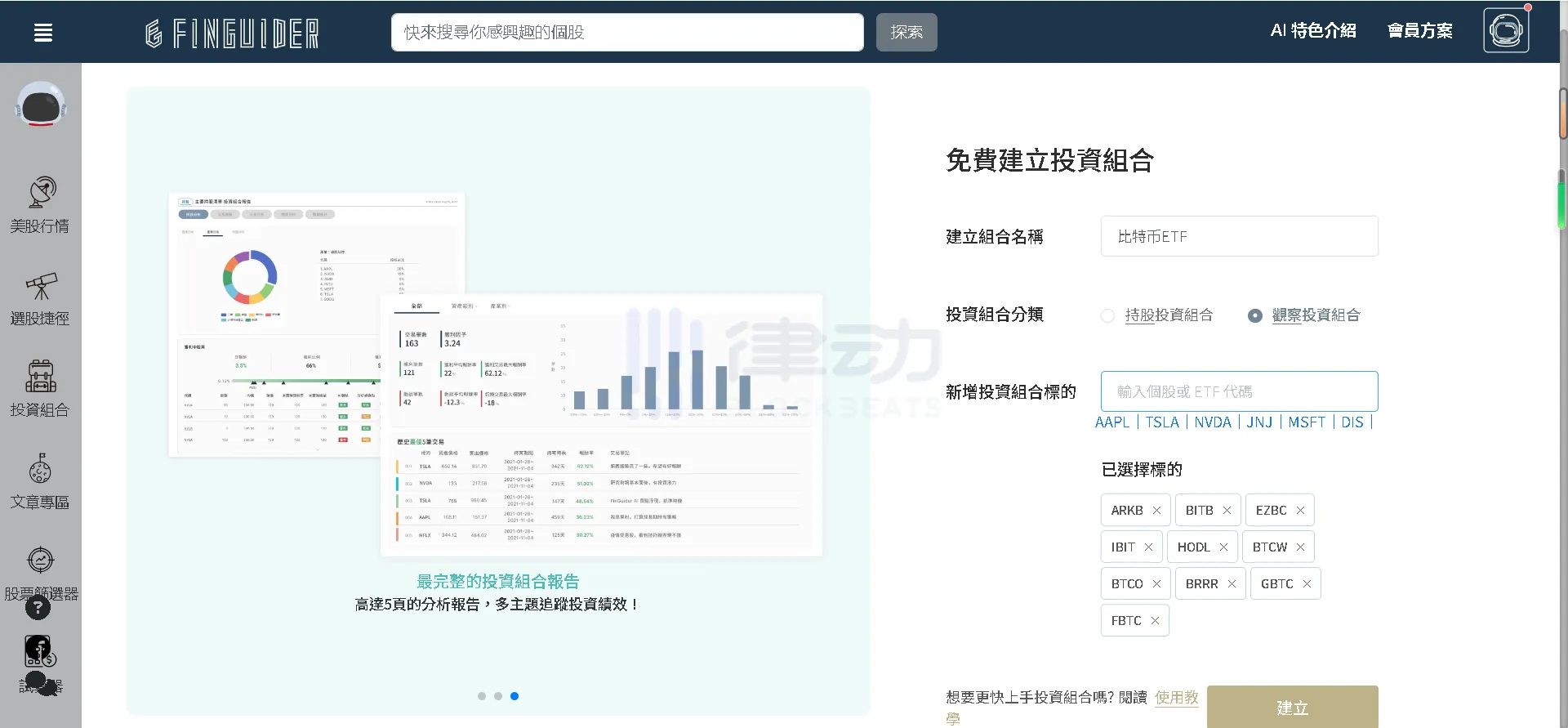
3. Data Network: Tradingview, Yahoo Finance, CNBC, FinGuider, etc. Investors can enter the ETF code they want to search for in the search box of these websites to view relevant information such as ETF prices.
After registering an account with an email on FinGuider, you can select the ETF targets you want to observe and create a watchlist. The website will automatically generate comparative information on the selected ETFs' market trends.
ETF Asset Management Scale of Management Companies
Among these lists and applicants, Grayscale (GBTC) stands out with its asset management scale of about 46 billion US dollars, while iShares under Blackrock also ranks in the industry's leading position with its huge asset management scale of 9.42 trillion US dollars. Following closely behind is ARK 21Shares (ARKB), which manages about 6.7 billion US dollars in assets. In contrast, Bitwise (BITB), although smaller in scale, still has an asset management scale of about 1 billion US dollars.
Other important participants include VanEck, which manages approximately $76.4 billion in assets; WisdomTree (BTCW) with $97.5 billion in assets under management; Jingshun Invesco Galaxy (BTCO) and Fidelity (Wise Origin), which manage $1.5 trillion and $4.5 trillion in assets respectively.
ETF Price Determination Mechanism
ETFs can be traded in real time like stocks, so their prices are determined by market supply and demand. ETFs can be created based on a basket of assets or a single asset, and the total price of this asset is called the ETF's NAV (Net Asset Value), which is the net value of the asset.
When you purchase this ETF, it is equivalent to purchasing the assets contained in this basket. In theory, the ETF price reflects the NAV, which is the most basic premise of investing in an ETF. ETFs are also traded in the market, and the market trading price is determined by the behavior of countless participants. The market cannot dictate that everyone must trade according to NAV. Therefore, the market price of an ETF may differ from its NAV.
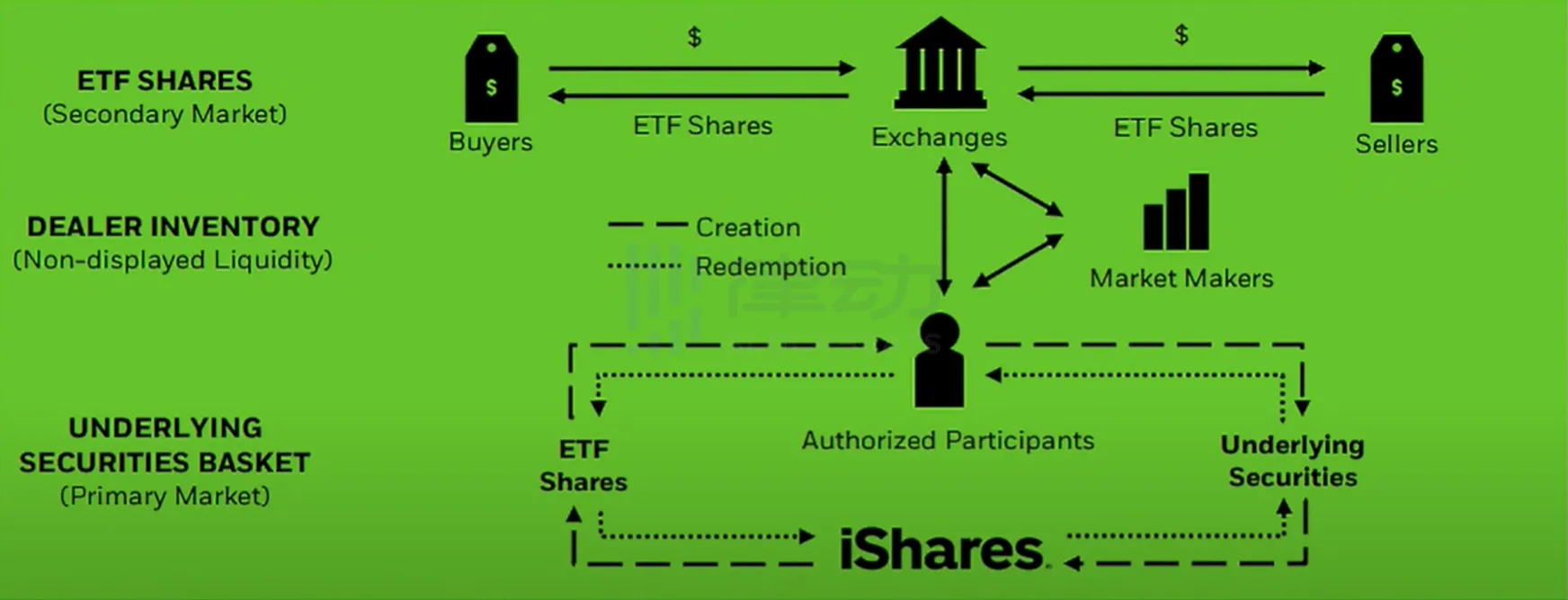
Here, we use a very simplified model to illustrate the trading operation principles of ETFs.
If an issuer wants to issue an ETF fund that contains only two stocks, A and B, in a 1:1 ratio, the issuer will buy a large amount of stocks A and B after obtaining approval from the SEC, and then put these stocks into a trust to create the corresponding ETF based on the owned stocks and release it to the market.
Therefore, the ETF sold in the market is a certificate and does not include the stocks involved in the actual buying and selling. The stocks themselves are held by the issuer. The issuer of the ETF earns management fees and is responsible for issuing and managing the ETF, but does not directly participate in its market transactions.
Assuming that each ETF contains two stocks with a market price, or NAV, of $2 when trading begins, and there are only two people trading the ETF in the market. The first buyer is willing to pay $4 for one share of the ETF. If he successfully purchases it, the market price will rise to $4, far above the NAV of $2. This may cause potential investors to refuse to buy the ETF.
Reference:
1. "The ETF Trading Principle You Must Know: How is the Price of ETF Determined?";
2. "5 Key Information to Pay Attention to Regarding Bitcoin Spot ETF";
3. "Introduction | Analysis of the Differences Between BTC Spot and ETF"
Welcome to join the official BlockBeats community:
Telegram Subscription Group: https://t.me/theblockbeats
Telegram Discussion Group: https://t.me/BlockBeats_App
Official Twitter Account: https://twitter.com/BlockBeatsAsia
 Related Articles