Why did the SEC reject the Grayscale spot Bitcoin ETF
0x711& WZP, BlockBeats
As an asset that tracks the price of bitcoin, users can profit from the rise of bitcoin by investing in bitcoin ETFs without having to go through the process of buying bitcoin, such as registering on trading platforms and passing various certifications. The first Bitcoin ETF was a futures ETF, the ProShares Bitcoin Strategy ETF(BITO). There are no actual bitcoin spot ETFs.
Gray filed an application to convert GBTC into a Bitcoin spot ETF with the SEC last October through NYSE Arca. CEO Michael Sonneshein has said he is likely to take legal action against the SEC if the BITCOIN spot ETF is rejected by the SEC. The rationale is that a grayscale "bitcoin spot ETF is no different from the Teucrium Bitcoin futures ETF that the SEC has already approved. SEC approval principles should not be inconsistent."
As the July 6 deadline for the SEC to approve or reject gray-scale bitcoin spot ETF applications approached, Gray-scale CEO Michael Sonnenshein issued an open letter to investors, Hire Donald B. Verrilli, Jr., former U.S. Deputy Attorney General, as senior legal Strategist. Grayscale said at Consensus 2022 in Austin, Texas that they are optimistic that the spot Bitcoin ETF will eventually receive SEC approval soon.
Today, however, the SEC rejected Grayscale's application to convert its GBTC into a Bitcoin spot ETF, saying it failed to answer the SEC's questions about preventing fraud and manipulation and other concerns.
Brett Harrison, CEO of FTX.us, on the reasons for the rejection
The CEO of FTX.us analyzed the reasons for SEC's rejection of the gray spot ETF application:
The SEC has approved BITO, Proshares and other futures ETFs,These FUTURES ETFs, based on the Chicago Mercantile Exchange, have adequate anti-manipulation protection.
CME's bitcoin futures settle at the CF benchmark Bitcoin Reference Rate (BRR), which is made up of the spot price of bitcoin on eight global cryptocurrency trading platforms. But the SEC rejected spot ETFs that use the same BRR to calculate net asset values because of concerns about manipulation. However, there is a contradiction in reality. The US Commodity Futures Trading Commission (CFTC) has approved BTC futures based on BRR, and the SEC has approved FUTURES ETFs based on BRR, but the SEC refuses to directly settle ETFs based on BRR.
The SEC broadly rejected spot ETFs,The reason is that the spot market is not licensed under us federal regulations. There are three main situations:
· ETFs such as EWJ (iShares MSCI Japan) contain financial instruments regulated in non-US jurisdictions. Bitcoin is regulated in a number of non-US jurisdictions and is traded on regulated exchanges in non-US jurisdictions.
· ETFs such as HYG (iShares High yield corporate bond) contain debt instruments that are not traded on any licensed exchange.
· ETFs such as FXE (Invesco Euro Trust) contain fiat currency and have no market regulator.
In past spot ETF rejection decisions, the SEC raised concerns that there was not enough liquidity or trading volume in the spot market.But many corporate bond ETFs, such as HYG, trade in the single digits on a median day.
Ironically,Approval of a spot Bitcoin ETF would bring greater oversight to the spot bitcoin market and help achieve many of the SEC's stated goals for spot cryptocurrencies.Much of the liquidity of existing institutions, as well as capital from a large number of new participants, will go into these investment vehicles, which trade primarily on securities trading platforms regulated by the SEC. The surveillance-sharing agreement between the fund issuer and the spot trading platform will also give the SEC greater oversight of market activity, further ensuring the integrity and proper operation of the spot order book.
All parties talk about grayscale Bitcoin spot ETF and supervision
Katherine Greifeld, bloomberg's crypto columnist
I'm a crypto columnist for BloombergKatherine Greifeld writesGray is doomed to fail whether or not the SEC approves its GBTC conversion to cash ETF application (the SEC had not yet rejected gray at the time of publication). Even if the SEC agreed, GBTC's current 2% user management fee would not work in the ETF market, as the ProShares Bitcoin Strategy ETF (BITO), for example, has a 0.95% expense ratio. If Greyscale gets caught in a price war, its annual management fee of about $230 million will be slashed.
Perianne, founder of Chamber of Digital Commerce
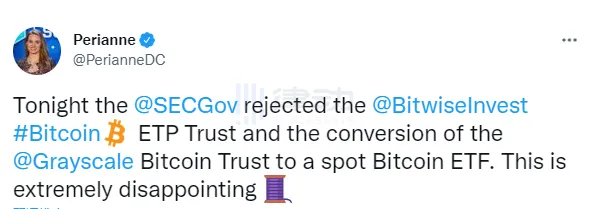
Founder of Chamber of Digital Commerce & NBSP;Perianne saidOver the past several years, the SEC has received extensive data to demonstrate that a substantive and regulated market surveillance framework has developed around BTC transactions. With an estimated 16 percent of Americans owning cryptocurrencies, the BTC Spot ETF will offer U.S. investors the opportunity to invest in Bitcoin under the protections of U.S. securities laws. Moreover, well-regulated jurisdictions such as Canada and Australia have adopted BTC spot ETFs for retail investors. The SEC's decision is really "disappointing".
Ryan Selkis, founder of Messari
Messari founderRyan said Selkis, a "winning" lawsuit and eventual ETF conversion will cut Grayscale's revenues by more than 50 per cent. Etfs would mean an open redemption window and possibly lower fees to preserve AUM. That means DCG will lose more than $200 million a year in profits.
Selkis believes the SEC is unlikely to approve greyscale's conversion of GBTC into ETFs, at least during Gensler's tenure. This is partly related to premium harvesting trades that occurred when GBTC was trading at a premium rather than a discount, when Three Arrows used extremely high leverage.
Interestingly, the chances of the SEC blocking Grayscale out of sheer malice aren't zero, because they don't want to reward what they see as bad behavior. Bad gray trading was the first step towards bankruptcy for Sanjian, which leveraged a large stake in GBTC - at one point as much as 6 per cent of the trust. The most prudent and realistic way to "fix" GBTC is through the so-called Regulation M exemption.
Welcome to join the official BlockBeats community:
Telegram Subscription Group: https://t.me/theblockbeats
Telegram Discussion Group: https://t.me/BlockBeats_App
Official Twitter Account: https://twitter.com/BlockBeatsAsia

 Related Articles