Without Jensen Huang, how much would Nvidia still be worth?
TL;DR
· Stifel has made a leadership transition its base case, cutting its Nvidia price target from $315 to $205 while maintaining a Buy rating.
· The adjustment falls mainly on the valuation multiple, with Stifel lowering its FY2028 expected P/E from 20x to 13x, while still expecting near-term results to modestly beat expectations.
· Dan Ives and Gene Munster previously estimated that Jensen Huang's departure could reduce Nvidia's valuation by 20% to 30%, but at the time assigned only a 10% to 15% probability of departure.
· With reports of a removal and successor search emerging, the earlier judgment that "departure risk is already priced in" needs to be revisited.
· TIKR calculates that, with earnings expectations unchanged, a 20% to 30% discount would compress Nvidia's forward P/E to roughly 10 to 12x.
· If subsequent export restrictions affect sales already factored into forecasts, the market would also need to cut earnings expectations, and both the valuation multiple and earnings could come under pressure simultaneously.
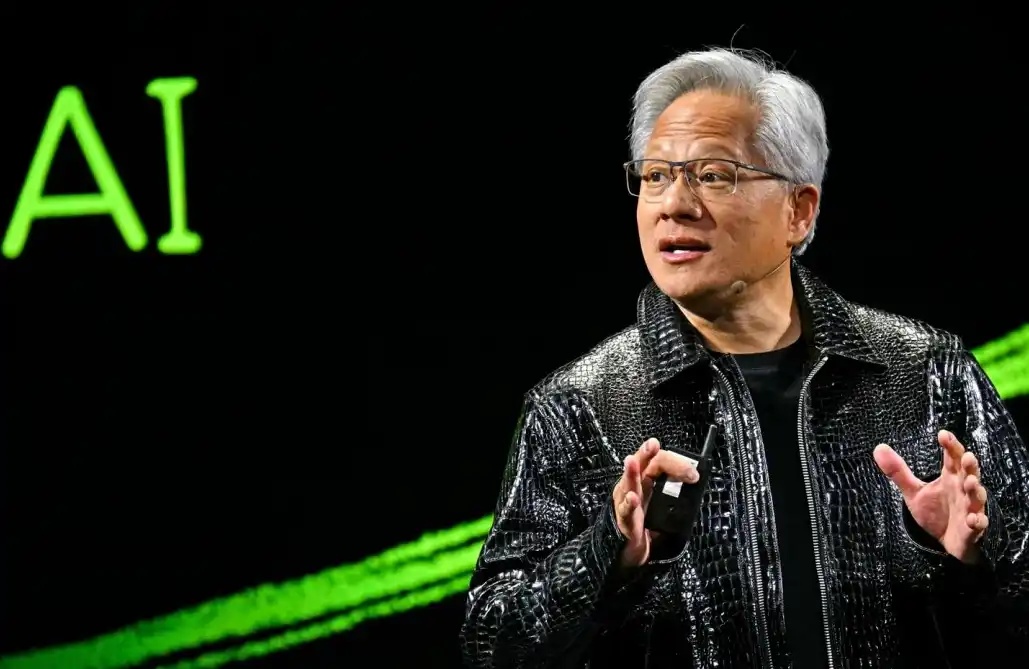
Jensen Huang's signature leather jacket is becoming a metaphor on Wall Street for discussing Nvidia's valuation.
On November 10, Scott Galloway said on the Pivot podcast that the AI industry that night seemed to be "held up entirely by a leather jacket." As Nvidia's board launches an independent investigation into Jensen Huang, investors are beginning to price a scenario rarely seriously discussed in the past—how much would Nvidia be worth if its founder left?
Some analysts' preliminary judgment is that the valuation could fall by 20% to 30%. Brokerages then began adjusting their price targets. On November 12, according to Investing.com, Stifel cut its Nvidia price target from $315 to $205, a reduction of about 35%, while maintaining a Buy rating.
As of the time of the report, Nvidia had not announced any leadership change. But in Stifel's valuation framework, a management transition has already become the base case.
Jensen Huang's value is beginning to show up as a P/E discount
Stifel's adjustment provides a concrete set of numbers for "how much Jensen Huang is worth."
The firm used a fiscal 2028 expected earnings per share of $15.65, reducing the price-to-earnings multiple used to calculate the target price from 20x to 13x. On that basis, a 13x P/E corresponds to about $203, close to the new $205 target price.
The P/E ratio reflects how much investors are willing to pay for each dollar of earnings. When earnings forecasts remain at similar levels, a lower multiple means investors have less confidence in future growth and are willing to pay less.
Stifel's assessment of Nvidia's near-term operating performance remains relatively positive. The firm expects the company's fiscal 2027 third-quarter results, due Nov. 17, to modestly beat expectations, with supply still the main constraint on growth, and sees room for upward revision to fiscal 2028 earnings forecasts. At the same time, the choice of successor, the timing of the handover, whether core executives will stay, and how sales channels and export compliance arrangements will be adjusted all add to uncertainty about long-term growth.
Other firms are also reassessing this risk. According to Investing.com, Bernstein downgraded Nvidia from "outperform" to "market perform" and cut its target price to $200. Morgan Stanley removed it from its top-picks list but kept its overweight rating and $300 target price. The trade-offs各家 institutions make between earnings and valuation have clearly diverged.
Jensen Huang's importance is first reflected in the way Nvidia is organized. Robert Cyran, a columnist for Reuters Breakingviews, noted that more than 60 people report directly to Huang, with four executives below him of roughly equal standing. This structure, built around the founder, means a successor would need to simultaneously take on multiple responsibilities including technical judgment, internal coordination and client communication, increasing the difficulty of an emergency handover.
Business relationships outside the company also test a successor. Large customers such as Microsoft, Amazon and Google continue to buy Nvidia chips and also have incentives to develop cheaper in-house products. Huang raises the cost for customers to switch suppliers by expanding supporting software and hardware, while establishing financing partnerships with institutions such as Apollo and Blackstone to help customers raise funds to buy chips. Cyran believes that investment and financing support for smaller customers also helps broaden the buyer base and limits the bargaining power of a few large customers.
This arrangement links product competitiveness, customer financing and order growth together. Whether a successor can continue the related partnerships will affect investors' judgments on future revenue and margins, and will also determine how much valuation premium Nvidia can retain.
A 20% to 30% shock, depending on the probability of departure
Before Stifel adjusted its target price, Dan Ives and Gene Munster had already attempted to quantify the impact of Jensen Huang's departure.
Dan Ives of Yorkville Ives & Co. said on November 10 that if Jensen Huang were removed from the CEO position, Nvidia's company and stock value could decline by 25% to 30%. At the time, he estimated the probability of this scenario at approximately 15%.
Gene Munster of Deepwater Asset Management put the impact at around 20%. He believed the stock price at the time may have already reflected a roughly 25% departure probability, while his own estimate was 10% to 15%.
TIKR conducted a simple probability-weighted calculation based on this. According to Ives' estimate, a 25% to 30% valuation loss multiplied by a 15% probability of occurrence corresponds to an overall valuation impact of approximately 3.75% to 4.5%. According to Munster's estimate, the impact is approximately 2% to 3%.
Based on these assumptions, TIKR argued in a November 11 article that the decline over two consecutive trading days may have already priced in most of the departure risk.
But this conclusion is highly dependent on the timing of the news release.
Subsequently, The Wall Street Journal reported that the board was preparing to replace Jensen Huang, while Bloomberg reported that the company had engaged a headhunting firm and was considering appointing an interim CEO. By the time Stifel published its latest assessment, a leadership transition had already entered its base case scenario. The previous 10% to 15% probability assumption therefore needed to be reassessed.
If investors believe a departure is increasingly likely, even if the estimated magnitude of valuation loss upon departure remains unchanged, the risk discount that the current stock price needs to reflect would also widen. Determining whether the risk has been fully priced into the stock requires simultaneously estimating the departure probability and the actual impact of management turnover on company value.
Earnings expectations unchanged, Nvidia could fall to 10 to 12 times P/E
TIKR believes Nvidia's valuation still has support, based on market expectations for its earnings growth.
According to consensus estimates cited by TIKR, Nvidia's adjusted earnings per share will rise from $9.32 in the fiscal year ending January 2027 to $21.41 in the fiscal year ending January 2029, more than doubling over two years.
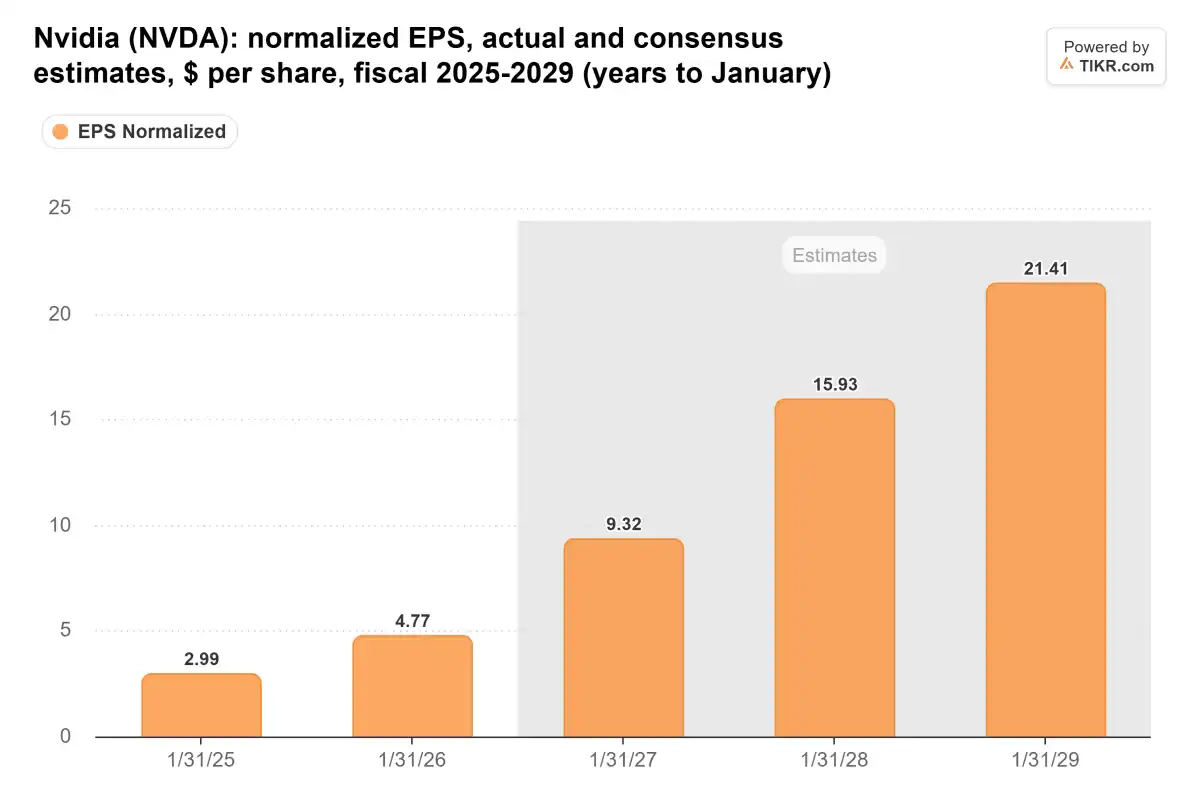
NVIDIA adjusted earnings per share for fiscal years 2025-2029, in U.S. dollars. The gray area represents market consensus estimates.
TIKR data shows that on November 9, NVIDIA's forward 12-month expected P/E ratio was approximately 14.8x, at a low level over the past three years and below the average of about 30.1x over the same period.
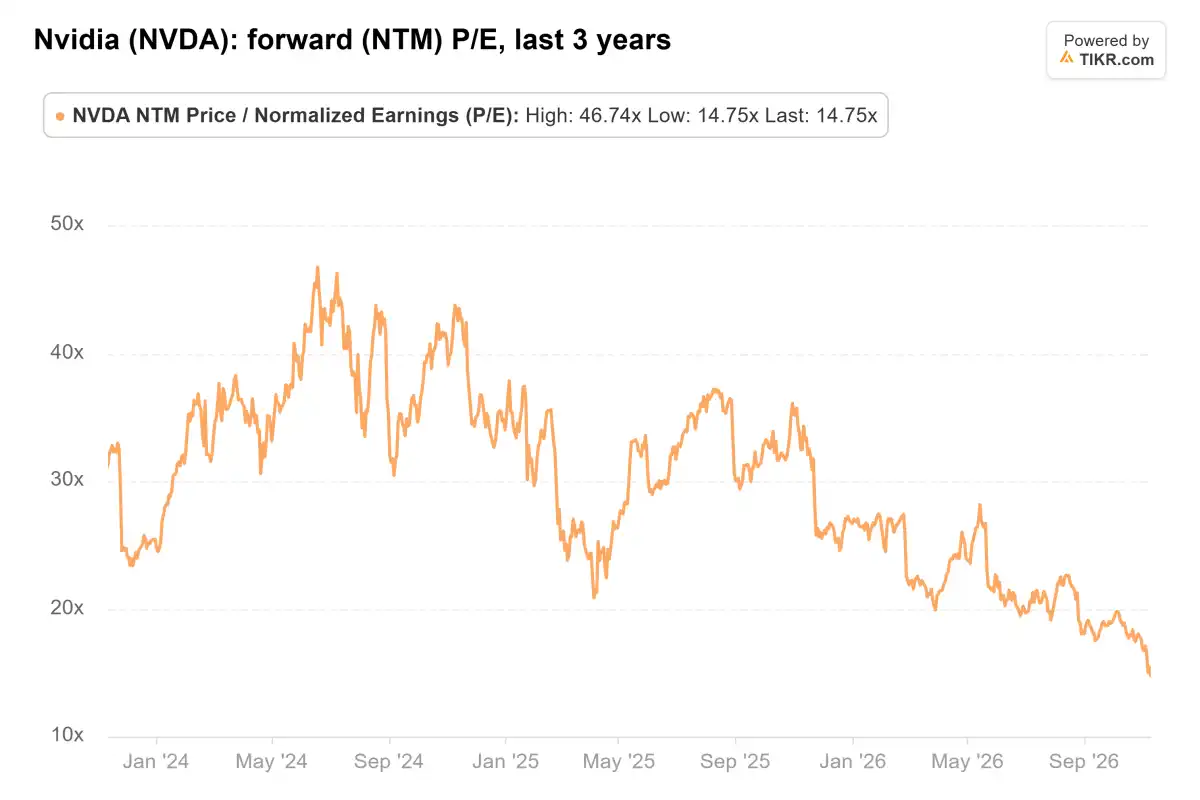
NVIDIA's forward 12-month expected P/E ratio over the past three years, with the latest value in the chart at 14.75x.
If earnings forecasts remain unchanged, the stock price would bear a 20% to 30% discount on this basis, corresponding to a P/E ratio of approximately 10.4x to 11.8x. This is what TIKR means by "without Jensen Huang, NVIDIA could become a 10x to 12x P/E stock."
This calculation uses the stock price and earnings expectations at the time. As prices and market judgments change, the corresponding multiples will also change. In addition, TIKR uses forward 12-month expected earnings, while Stifel uses fiscal year 2028 expected earnings, so there are differences in valuation methodology between the two.
Both calculations jointly reflect that the market still expects NVIDIA's profits to continue growing, but is reconsidering how much it should pay for those profits. The lack of a clear successor, management stability, and strategic continuity could all become factors weighing down valuation multiples.
How much of this discount ultimately remains depends on whether NVIDIA can provide a credible succession arrangement and whether the successor can maintain product execution, customer relationships, and financing partnerships.
If earnings forecasts are also cut, the re-rating will deepen further
The above calculations share another common premise—that the profits in analyst expectations can be delivered.
TIKR notes that if subsequent reviews drive tighter export rules and affect sales already included in forecasts, analysts will need to cut EPS expectations. At that point, target prices could come under pressure from both declining earnings and multiple contraction.
NVIDIA's previous business outlook already assumed no data center computing revenue from China. Therefore, the impact of subsequent policy needs to be assessed at the level of specific customers, regions, and sales channels to see whether new restrictions affect existing revenue forecasts.
The earnings report on November 17 will provide a test. The company previously guided quarterly revenue of $108 billion, plus or minus 2%. Stifel expects actual results to modestly beat expectations, and investors will also focus on forward growth guidance and management commentary on supply, customer demand, and leadership arrangements.
"How much would Nvidia be worth without Jensen Huang" still depends on two sets of variables. If the company continues to deliver earnings growth, the main adjustment the market will make is to the price-to-earnings ratio it is willing to pay; if management changes further affect business execution and order expectations, earnings forecasts could also face downward revisions.
Whether the succession arrangement can stabilize the core team, whether product plans can proceed on schedule, and whether customers can continue to obtain funding to purchase computing power will determine whether the discount Wall Street is currently assigning is risk compensation during the transition period or a more lasting valuation adjustment.
Welcome to join the official BlockBeats community:
Telegram Subscription Group: https://t.me/theblockbeats
Telegram Discussion Group: https://t.me/BlockBeats_App
Official Twitter Account: https://twitter.com/BlockBeatsAsia
 Related Articles