Anthropic Pre-Market Contract Arbitrage Review: Key Event Timeline and Position Micro-Management
Original source: X @Billy0xFF
Editor's note: Uncertainty surrounding Anthropic's IPO process, combined with differences across trading platforms in contract-to-share conversion rules, share capital calculations, and valuation expectations, has created this rare cross-platform arbitrage opportunity. Because platforms such as Binance and Hyperliquid price Anthropic differently, their implied valuations and total market caps briefly showed significant deviations. This article reviews the entire arbitrage process from spread formation and rule confirmation to final convergence, as well as how traders adjusted positions based on key events.
The following is the original text:
The Anthropic pre-market contract arbitrage was a rare arbitrage opportunity in the market with both considerable capacity and profit margin. If you didn't get on board this time, or didn't size up heavily enough, then I think it's very necessary for you to review the entire arbitrage process with me and figure out why such a huge opportunity still didn't get heavy bets even after we made it public.
For the complete logic of this arbitrage, see my previous post. Today I'll only review two things:
1. Timeline: over the two weeks, which events drove the spread to converge, which events widened it again, which events affected the win rate, and which events affected the odds;
2. Micro-management: under the premise that the big logic remained unchanged, how I managed positions in real time based on the above external events.
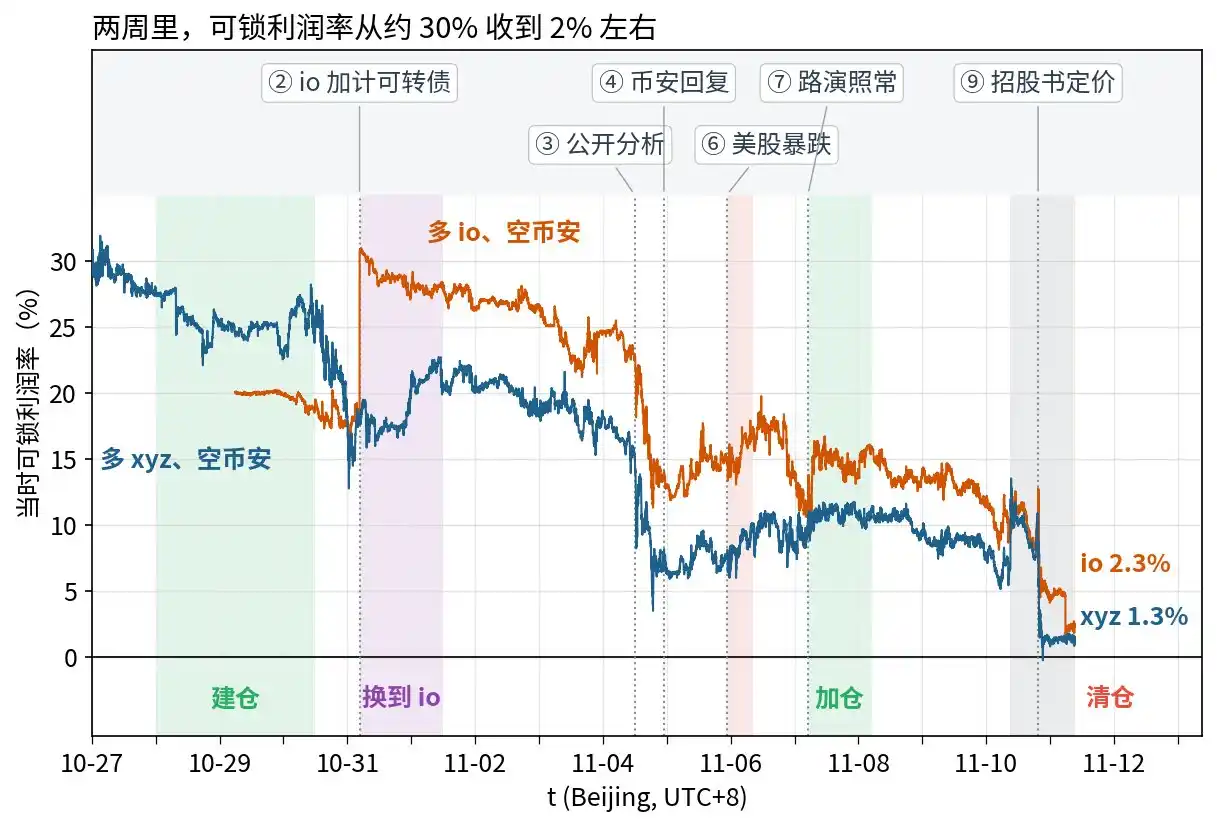
Conclusion first: the spread converged from about 30% to around 2% over two weeks, and I have fully closed out and taken profit. Before we made the analysis public, we basically monitored no peers; after it was public, there were actually two very good entry points, one in the few hours right after our tweet was posted, and the other on 11-07 when the roadshow confirmed things would proceed as normal: all the rules had been confirmed, yet the profit margin was still about 15%, and the entry window was long enough.
I. What this trade was earning
Anthropic hasn't listed yet, and several exchanges first opened "pre-market contracts," which will be converted into stock prices and continue trading after listing. The key is how many shares each contract converts into at listing:
- Binance quotes based on "valuation ÷ 1 billion." If the market rumored $1.3 trillion, Binance would quote about 1,300. But at listing it converts only based on post-issuance total share capital, with 1 contract converting into only about 13.1 shares.
- The valuations the market talks about are all on a fully diluted basis (total share capital plus options, RSUs, convertible bonds, and other parts that may become shares in the future, about 17.5 billion shares). $1.3 trillion implies about $74 per share, so 13.1 shares are worth only about $970, yet Binance was selling at 1,300. With about a quarter fewer shares, the price was effectively about one-third more expensive.
- There are two stock-based contracts on Hyperliquid: xyz:ANT (trade.xyz) is quoted directly per share; io:ANTH (Entropy) is converted based on fully diluted shares, with each contract converting to approximately 17.5 shares after listing. Neither of these has this mispricing.
So the approach is to go long HL and short Binance, balancing according to the respective share conversion at listing. Regardless of whether Anthropic rises or falls after listing, the share difference can be locked in at the moment of conversion. A few terms below:
- Route: Long xyz, short Binance is called the "xyz route"; long io, short Binance is called the "io route."
- Lockable profit margin: If a position is opened now and held until listing conversion, the return that can be locked in (calculated based on the amount used to buy HL). At market open, the xyz route was approximately 30%.
II. Before Public Announcement: No Competitors
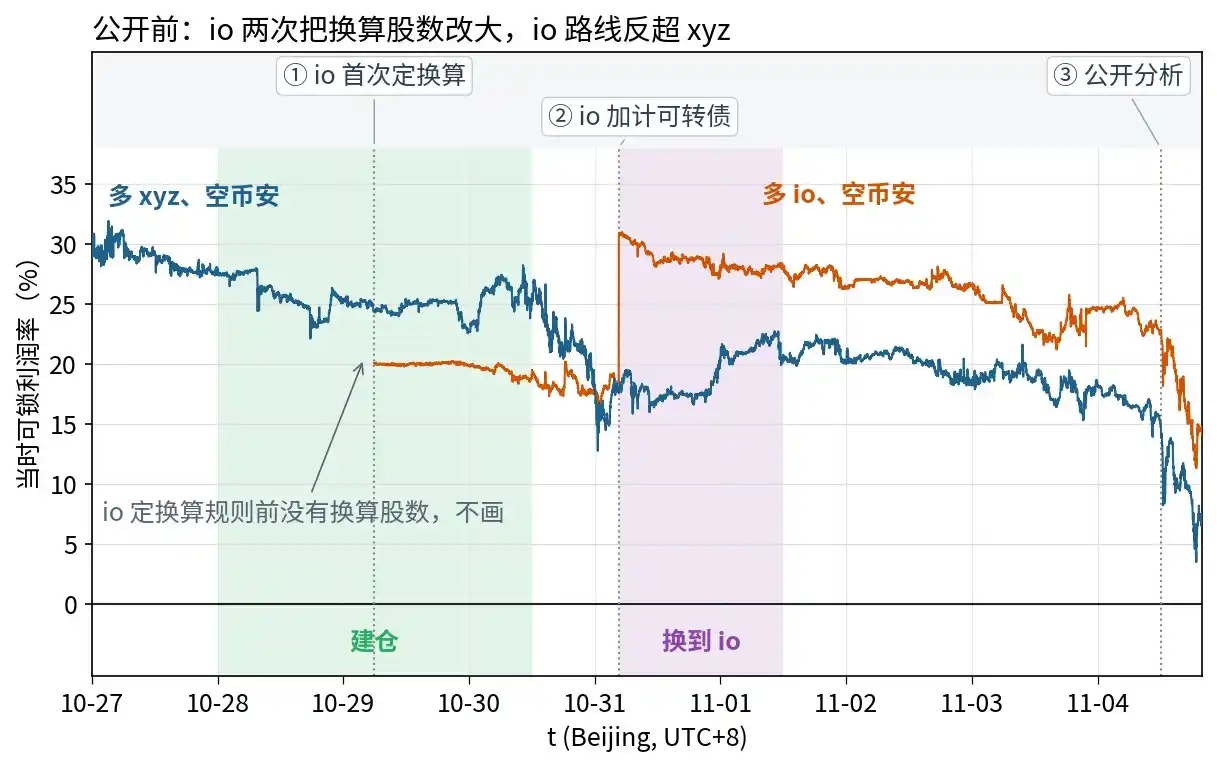
To get on board at this stage, one must thoroughly research the prospectus and the rules of the four exchanges, and confirm that Binance will convert based on total share capital — the barrier is relatively high. From our monitoring at the time, basically only my collaborators and I were doing this arbitrage during this phase.
We built positions during this period, starting with the xyz route. Afterward, io's conversion rules changed twice:
① On 10-29, io first published its conversion rules: after listing, conversion based on "total shares + options + RSUs," which came to approximately 15.3 billion shares, giving the io route approximately 20%, lower than the xyz route's approximately 24%, so we continued with xyz.
② On 10-31, io added convertible bonds: Amazon's convertible bonds were also fully included, bringing it to approximately 16.9 billion shares — this was the complete fully diluted basis. The number of shares each io contract could convert to went from approximately 15.3 shares to approximately 16.9 shares, and the io route jumped to approximately 31%, more than 10 percentage points higher than the xyz route.
Micro-adjustment one: switching routes. The io route's profit margin changes with io's rules and the prices on both sides — whichever route is higher is where you switch. On the day ② came out, we switched our longs from xyz to io. That portion of the position ultimately earned approximately 11% more than if we had continued holding xyz.
III. Public Announcement Day: Half Closed Out in a Few Hours
③ At noon on 11-04, my collaborators Longwang, Ray, and others and I separately published articles analyzing the logic of this arbitrage from our respective perspectives.
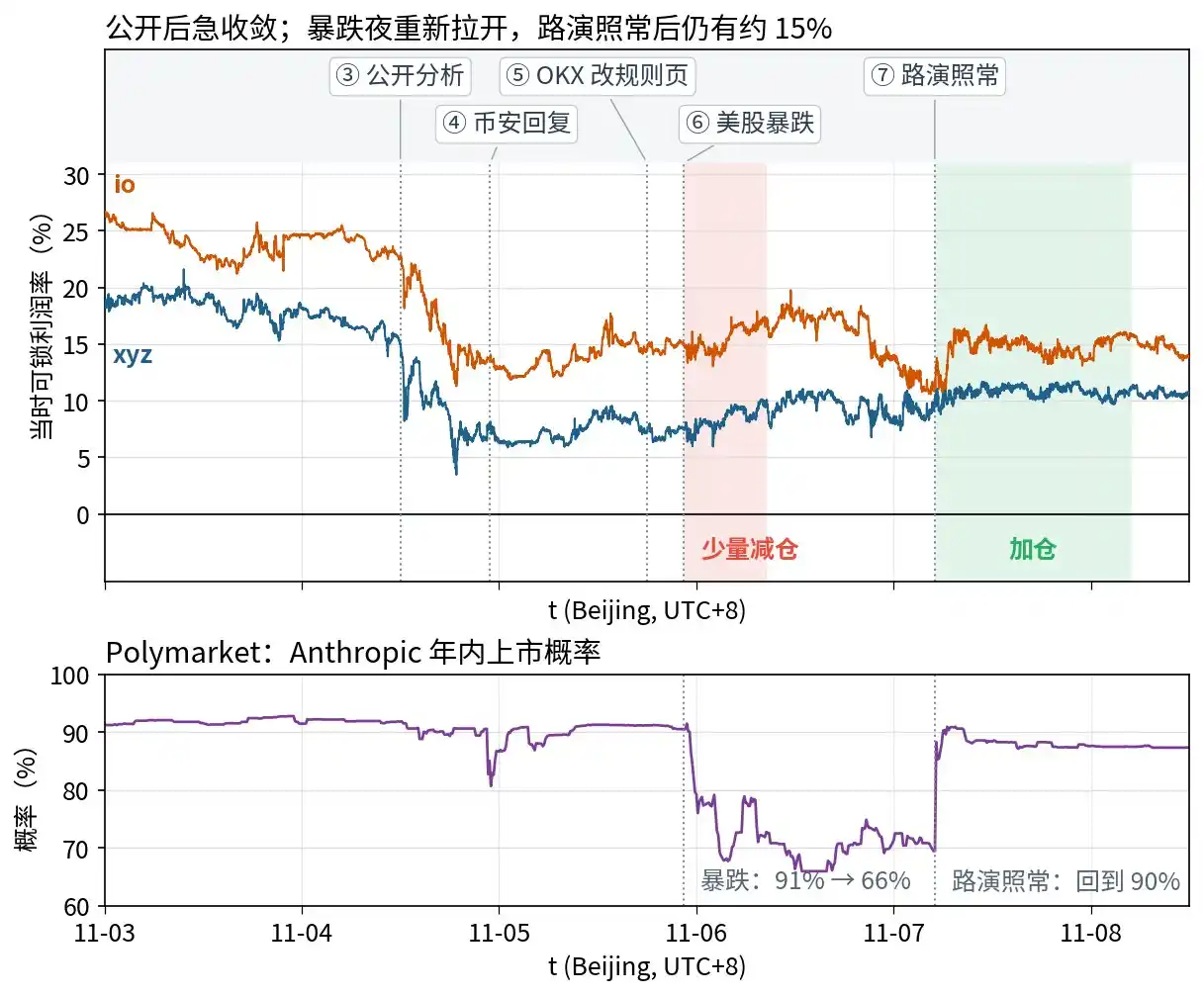
- Within 40 minutes, the xyz route dropped from 15.3% to 10.5%, and the io route dropped from 22.7% to 19.6%. On an hourly basis, the xyz route hit a low of about 6%, and the io route hit a low of about 12%.
- The compression happened so quickly partly because newly entered arbitrage funds placed orders on both sides simultaneously, and partly because those who had previously taken the opposite position (long Binance, short HL) admitted their mistake and closed out.
- Acting immediately upon seeing the tweet could earn substantial profits. It did not matter if you missed the fastest wave; later, some people took profits early and closed positions, widening the spread back somewhat. During the daytime the next day, the xyz route still had 7–8%, and the io route still had 13–15%.
IV. Three Exchanges Speak: Rules Go from Inference to Confirmed Fact
Within one day after publication, all three exchanges' positions were settled:
④ Binance: Binance staff clarified the total share capital rule under Longwang's tweet, essentially stating: the contract tracks the price of 1 ordinary share of Anthropic. Share capital counts only issued and outstanding ordinary shares. Unexercised options, unsettled RSUs, unconverted convertible bonds, underwriters' over-allotment, and shares reserved under incentive plans are not yet ordinary shares and are not counted;
This position was not set ad hoc; it was already specified in Article 8 of the Contract Specifications when the contract launched on June 2;
⑤ OKX: OKX's Anthropic contract is the same type as Binance's (quoted by valuation), and it directly changed its rules page, stating in black and white "the total number of ordinary shares outstanding immediately upon completion of the IPO," explicitly not using fully diluted shares.
io (Entropy): The rules page states that it copies the "fully diluted total" from the prospectus, and io's CEO also publicly stated that conversion is based on fully diluted share count.
At this point, "which share count each exchange uses" is no longer an inference; it is officially confirmed. The only remaining major risk is: whether the IPO will be delayed.
V. The Crash Night: The Only Remaining Risk Is "Delay"
⑥ On the evening of 11-05, US stocks crashed: the Nasdaq 100 fell about 6.4%, the chip index fell about 12%, and the VIX rose about 70% in a single day.
- The market began speculating whether Anthropic would delay or even cancel its listing. Polymarket's "listing within the year" fell from about 91% to a low of about 66% (lower panel of Figure 3).
- Some panicked and closed out, widening the spread: the io route moved from about 15% back to around 18%, nearing 20% intraday.
- Our judgment: it will most likely still list as usual. Our friends at investment banks have heard no news of the roadshow being canceled; and a mere delay does not actually affect the strategy's fundamentals, at most diverging by a few points because of peers closing out early.
Micro-move two: once the news broke, we trimmed a small amount of the insurance position and kept the main position unchanged. The risk shifted from "rules" to "time." We sold a small portion on the night of the crash, but kept most of the position unchanged.
Six, the roadshow proceeds as usual: the highest certainty, with about 15% profit margin still left. The best betting opportunity after the public announcement
The night before the roadshow news (11-06 21:12), Bloomberg reported that some potential investors were only willing to give $1.2–1.3 trillion (previously $1.4–1.5 trillion). That night Binance fell about 11%, while io fell only about 7%, and the io route briefly received about 11%.
⑦ In the early hours of 11-07, FT and CNBC successively reported that Anthropic was proceeding as usual and would start the roadshow the following week.
- Polymarket's "list within the year" went from about 69% back to 90% within an hour.
- The spread widened again instead: after the news came out, io was sold lower while Binance barely moved, and the io route went from about 11% back to about 15%, then stayed around 15% for more than a day.
Micro-move three: add to the position as soon as the news breaks. All three rule sets were confirmed, and the worry about a delay was lifted; certainty was the highest in two weeks, yet the profit margin was still about 15%. This was the most worthwhile moment to get on board in the whole process; we restored our position as soon as we saw the reports, and used floating profits to add more.
Afterward this window lasted two or three days, the spread slowly converged, and the profit margin slowly declined; by the morning of 11-10 the io route was about 9% and the xyz route about 6%.
Seven, the leak, the prospectus, and closing out
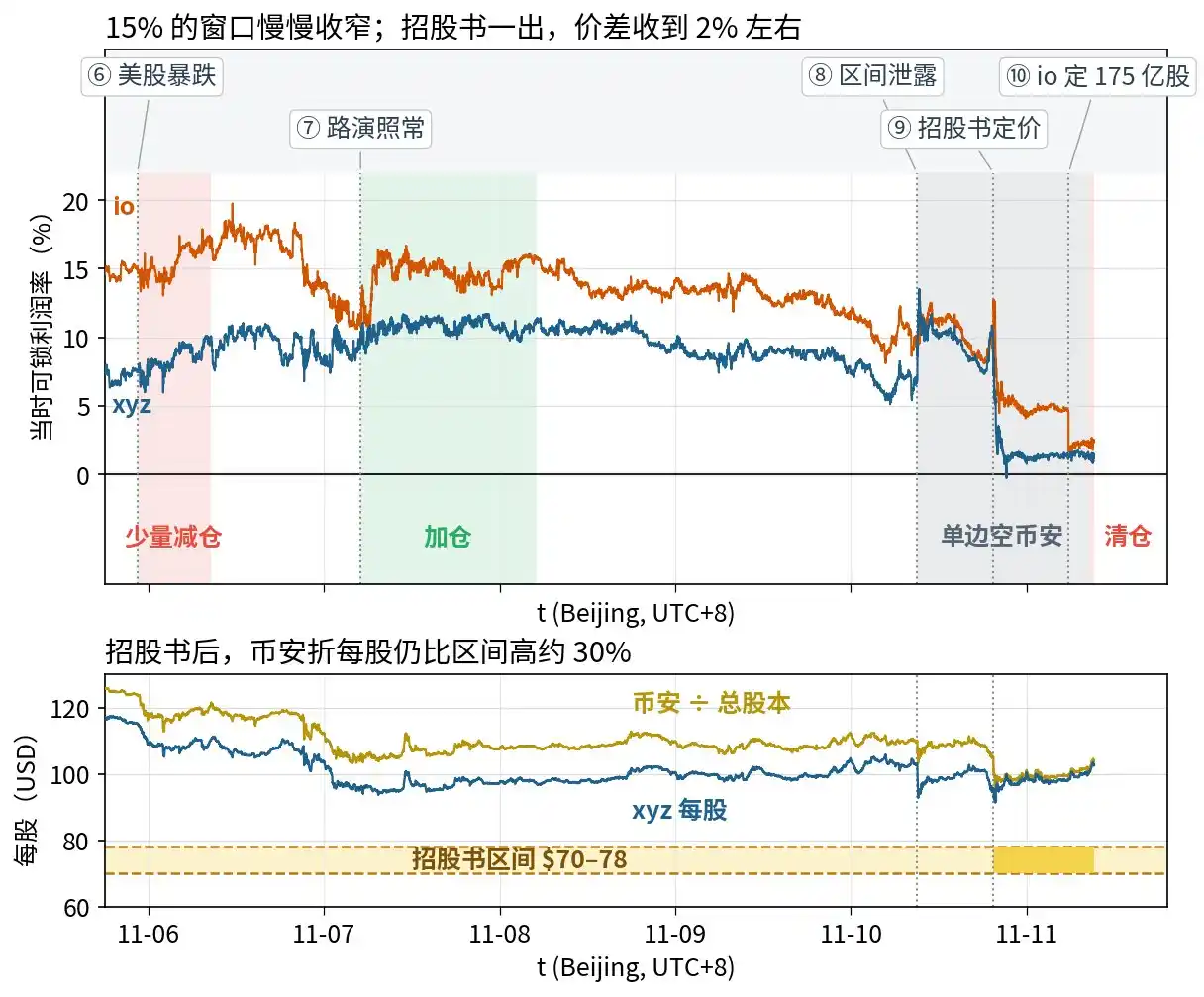
⑧ On the morning of 11-10, the offering range leaked: Reuters reported $70–80 per share, and subsequent reports said the terms were withdrawn. We judged the range was most likely real: $75 times the fully diluted share count comes out exactly to the previously rumored $1.2–1.3 trillion. Since the terms had leaked, a formal price-version prospectus would most likely come out that evening. At the moment the news came out, xyz fell from about $104 to about $95, falling even more than Binance, and the xyz route briefly stretched to about 11%. The reason is that xyz quotes per share, so everyone directly compared it with $70–80.
From this point we began adding a one-sided short Binance position; the logic is in section eight.
⑨ On the evening of Nov 10, the priced prospectus: $70–78 per share, with total shares outstanding after issuance at approximately 13.09 billion. The spread was directly eliminated: the xyz route went from about 10% to over 2%. Binance fell about 4% within an hour.
⑩ In the early hours of Nov 11, io finalized at 17.5 billion shares: Entropy stated the estimated listing conversion at about 17.5 billion shares, slightly less than the approximately 18 billion estimated under the previous version. The io route dropped from about 5% to about 2%.
On the morning of Nov 11, we fully liquidated all positions. Now the xyz route is about 1%, and the io route is about 2%. This arbitrage is over.
VIII. Single-Sided Short on Binance: Why We Kept It and Why We Added on the Leak
Beyond the arbitrage position, we always held an extra single-sided short on Binance (no corresponding long). The reason starts with "who is moving."
Binance was the one that was wrong, but HL was the one that got pulled back. The share-count mispricing belonged only to Binance; logically, the spread convergence should have come mainly from Binance falling. The actual situation was:
- Before the public disclosure, it was indeed mainly Binance falling: Binance −12.6%, xyz down only 1.9%.
- After the public disclosure, arbitrage funds placed orders on both sides. But Binance has the best liquidity; the same money hitting it moved it the least, while xyz and io on HL were bought up more: from the tweet to before the crash, Binance −3.6%, xyz +3.4%; after the roadshow proceeded as normal, Binance +3.6%, xyz +6.8%.
- It was not until the night of the prospectus that Binance finally caught down 5.0%, while xyz barely moved.
Binance's premium has two layers. Using the rumored valuation: $1.2–1.3 trillion (fully diluted) implies about $71 per share; on Nov 07, Binance at total shares outstanding implied about $105 per share, about 50% higher. Of that 50%:
- About 10 points are the share-count mispricing, belonging only to Binance, which is the arbitrage spread itself, and the arbitrage funds would gradually close it;
- The remaining about 40 points are the whole market's optimism on valuation, and xyz is the same (about $97 per share).
The single-sided short on Binance bets on both layers at once: the first layer will most likely converge, and the second layer requires waiting for the market to admit it was wrong.
Why we added on the leak. Once the issuance range leaked, we added to the single-sided short for two reasons:
- The range is very likely real (at $75 multiplied by fully diluted shares, it exactly matches the $1.2–1.3 trillion rumor);
- With a range in place, the second-layer premium has a direct benchmark for comparison. xyz is quoted per share, the same unit as the offering price; with $100 per share sitting next to a $70–80 range, anyone can see it's expensive. As xyz converges toward the range, arbitrage flows linking Binance and xyz will drag Binance down as well.
9. The Final Mistake: Continuing to Short After the Prospectus
After the prospectus came out, we kept shorting Binance. Our thinking at the time was:
- Binance's per-share price based on total share count was still around $98, roughly 30% above the prospectus range of $70–78 (the gap between the yellow band and the Binance line in the lower panel of Figure 4);
- Once the media reported "market cap of about $1 trillion on a total share count basis" per the prospectus, everyone would realize the price was off, and the premium should start to converge.
But when we woke up the next morning:
- The premium hadn't converged; Binance had actually risen a bit, and xyz rose along with it;
- Just then there was news (FT) that underwriters were preparing to raise the valuation to over $1.5 trillion.
At that point we knew we had misjudged it — the bulls hadn't capitulated just because the media wrote "market cap of about $1 trillion," so we stopped out immediately and closed the entire position. That short had been sitting on a decent unrealized gain on the night of the prospectus, but it ended in a loss.
Welcome to join the official BlockBeats community:
Telegram Subscription Group: https://t.me/theblockbeats
Telegram Discussion Group: https://t.me/BlockBeats_App
Official Twitter Account: https://twitter.com/BlockBeatsAsia
 Related Articles