An overview of the latest developments in the ownership economy in 2022
The latest developments in the Ownership economy in 2022
Source: Variant
Original text: Li Jin, Geoff Hamilton, Jesse Walden, Spencer Noon, Derek Walkush, Medha Kothari
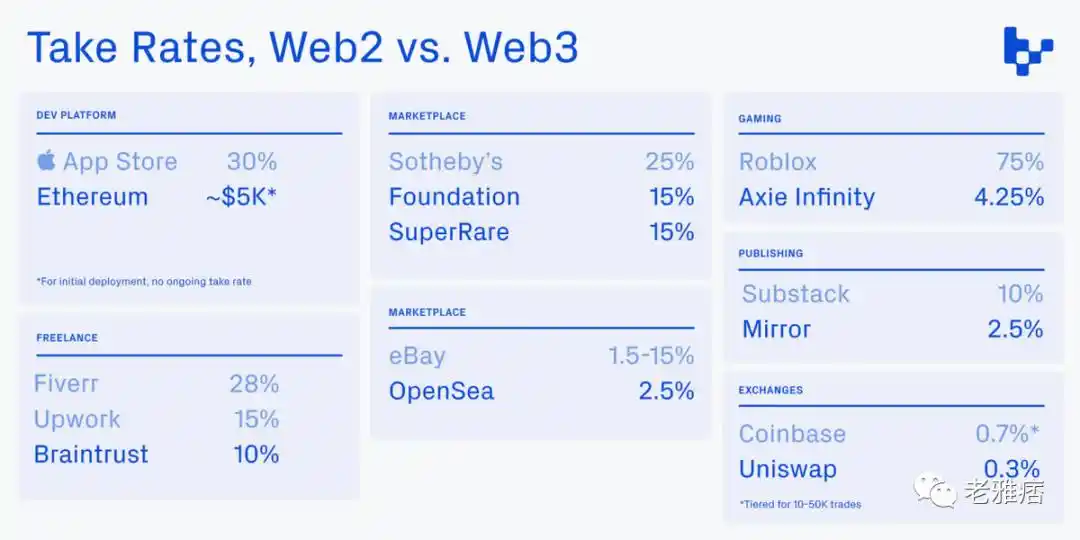
During the world Wide Web's 30 years of development, a few companies controlled the majority of user attention and advertising revenue, and a closed ecosystem stymied innovation by independent developers. The economic interests of the largest Internet platforms are not aligned with those of their most valuable contributors: users.
Ownership has long been popular with Silicon Valley start-ups, which award options to motivate employees. Despite this, the vast majority of Internet users own 0 percent of the services they contribute. Creators can't own their content, developers can't control their code, and consumers can't influence the policies or decisions of the platforms they use. This was once unquestioned, but now it looks increasingly out of date.
This is beginning to change with the economy of ownership, often referred to as Web3, where products and services turn users into owners.
It all started with Bitcoin and Ethereum, both of which reward participants who secure the network with their native tokens, which is becoming common across all categories of software, from developer infrastructure and DeFi's new financial marketplace to consumer products, marketplaces and social.
A new Internet owned by users
If the previous generation of software was built on user-generated content, the next generation will be user-owned, and digital ownership will be used as a cornerstone for novel user experiences. At its core, the ownership economy not only provides a powerful new tool for builders to use market incentives to launch new networks, it also has the potential to create positive social change through a broader distribution of wealth accumulation and assets.
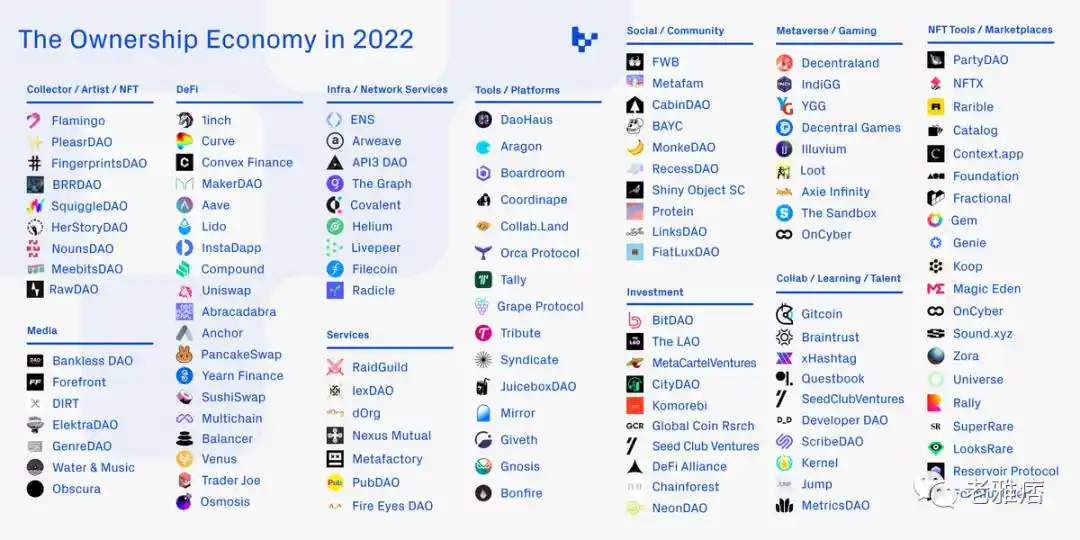
In the two years since Jesse Walden published his original vision of a user-owned Internet, the landscape has changed dramatically and expanded. From user-owned financial markets to user-owned social networks, investment clubs and digital assets, there are now more than 15,000 ownership economy projects. While the ownership economy is still a small part of all Internet platforms, it is a fast-growing sector. Ethereum, one of the more established networks supporting an ownership economy, saw its monthly average number of accounts grow 46 percent in 2021.
Amid all this growth, we want to take a step back and reintroduce the ecosystem through some fundamental questions: What is an ownership economy? How big is it? Where is it going? What trends determine its current state and likely future? To answer all these questions, we'll turn to data and case studies to illustrate how the ownership economy works in real time.
The purpose of this report is to provide an introductory guide for new entrants who wish to learn more about Web3. Without further ado, let's get started.
What is the ownership economy?
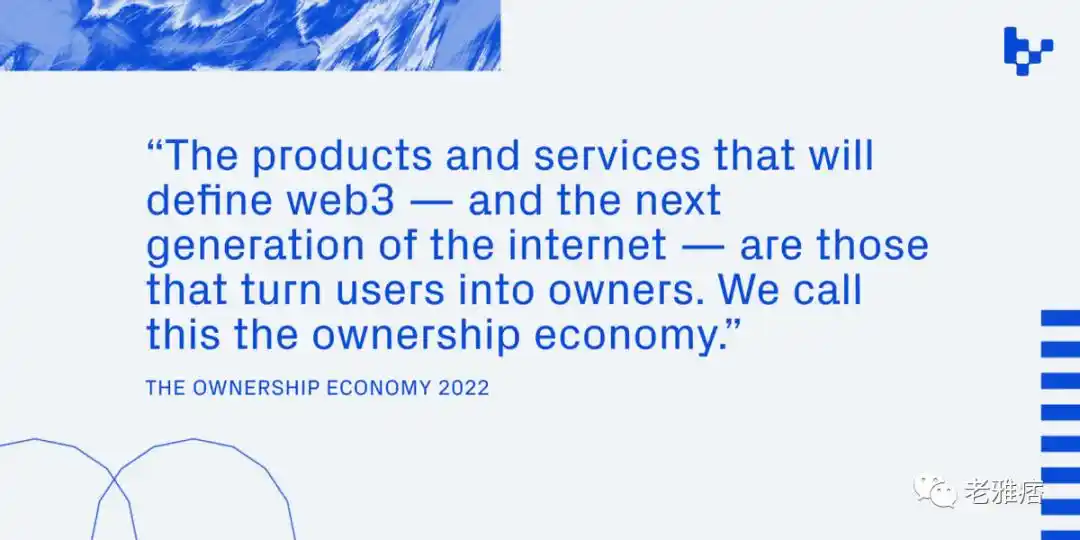
Simply put: we call the products and services that define web3 and the next generation of the Internet those that turn users into owners the ownership economy.
然而,识别这种现象并不总是简单或明显的。这是因为所有权体现在一系列体验中,这些体验在用户的努力、责任和集体性程度方面都有差异。一个用户可能只拥有一个数字媒体资产,比如 NFT。另一个人可能通过治理 Token 影响网络的操作。所有者的体验包括被动 (即持有) 和主动参与。
请注意,在本报告中,我们关注的是作为所有权经济基础的加密 Token ,而不是股权。 Token 具有更丰富和更无摩擦的设计空间。它们可以按程序分配,有可能对参与者和购买者进行奖励;它们可以有效地自由部署,可以以我们传输信息的方式传递价值——即时地传递给世界上任何地方的任何人。
The ownership economy is huge and growing
截至 2022 年 4 月 26 日,数据聚合器 CoinMarketCap 跟踪的超过 19000 个 Token 的市值为 1.76 万亿美元。作为比较,全球股市的市值超过了 100 万亿美元。
按市值计算,最大的加密网络是建立在第一层的区块链:2009 年推出的比特币 (7250 亿美元) 和 2015 年推出的以太坊 (3370 亿美元)。市值排名前 20 的其他第一层 Token 包括 Solana、Polkadot、Terra 和 Avalanche。
We can also think of the scale of the ownership economy in terms of people -- the users who become owners in the networks they build.
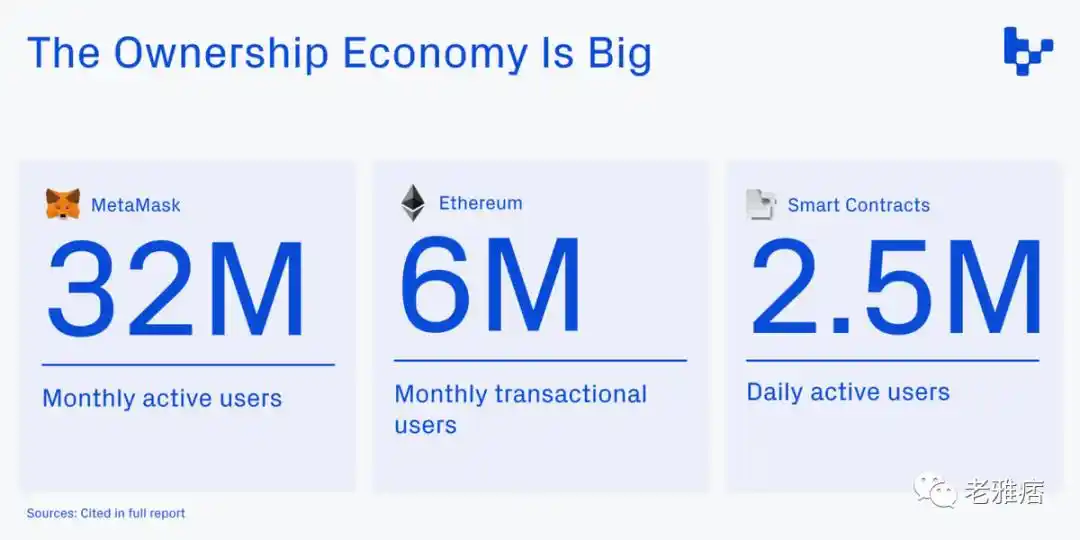
As of 2021, there were 360,000 NFT owners, according to estimates by the Financial Times and Chainalysis. In addition, there are tens of millions of users of cryptocurrency networks. Metamask, a wallet for connecting de-centric apps, recently announced 32 million monthly active users as of February 2022, while Phantom(currently focusing on Solana's wallet) announced 2 million monthly active users in January 2022. In the fourth quarter of 2021, Ethereum averaged about 6 million monthly transaction users and about 400,000 daily active transaction users. From a multi-chain perspective, about 2.5 million daily active users interact with the smart contracts tracked by DappRadar. As a rough estimate, if we extrapolate these 2.5 million daily active users using Ethereum's DAU/MAU(0.06), we can estimate 39 million MONTHLY active users across the 29 networks covered by DappRadar data.
DAO(去中心化自治组织)是由其成员拥有和管理的在线社区。它们可以被认为是构成 Web3 的经济、社会和文化景观的组织构件。新的 DAO 正在以如此快的速度形成,以至于很难计算它们的数量,但似乎可以有把握地说目前数量超过了 1000 个。数据源 DeepDAO 跟踪了大约 180 个 DAO 的详细信息。仅在这些 DAO 中,就有 170 万治理 Token 持有者,其中约 50 万持有者积极参与了 DAO 的治理。一些 DAO 的规模相当大:180 个 DAO 中有 69 个拥有超过 1000 个成员。
The state of ownership economics in 2022
Today, user ownership is changing the way people trade, invest, create, build, play, learn, communicate, and socialize.
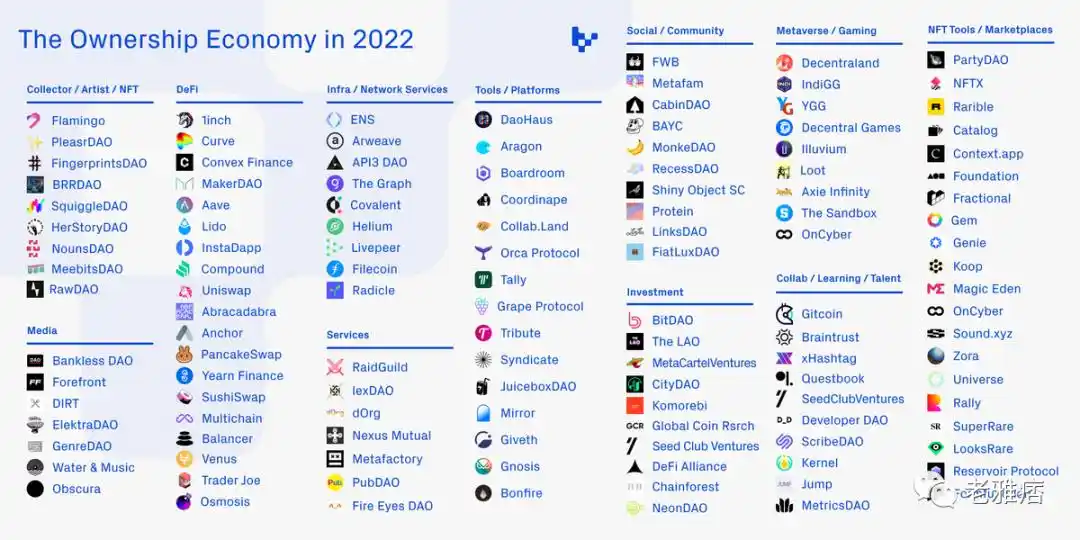
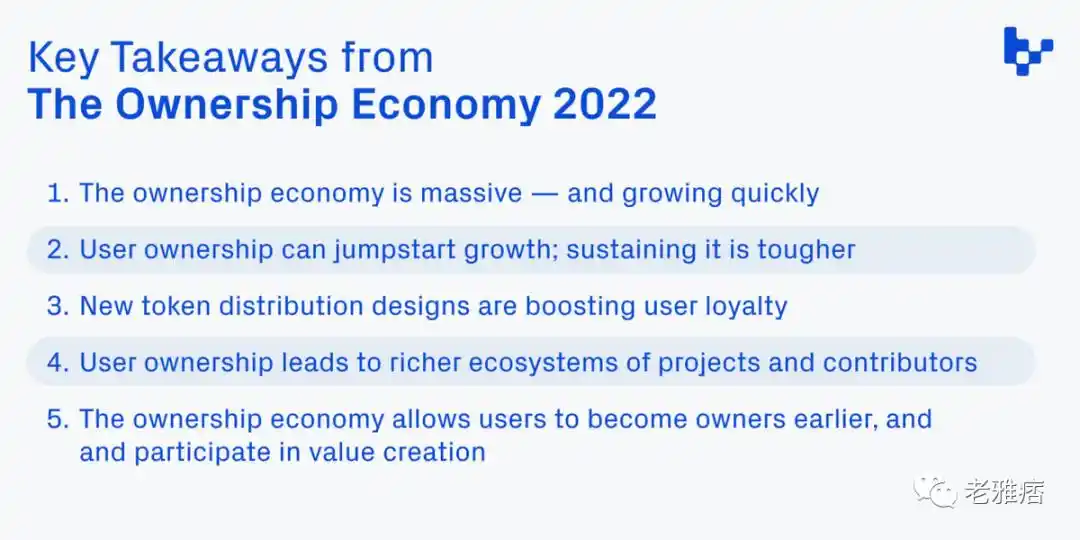
In the Economy of Ownership, Walden argues that user ownership can make "platforms bigger, more resilient, and more innovative." As we discuss in this report, many of these aspirations remain unfulfilled or have mixed results because the rules of the game on how best to achieve user ownership are still in their infancy. Still, we believe in the power of user ownership to build larger, more reliable networks and foster positive social change. Realizing this potential will require more research on best practices for ownership allocation and education for developers and users. As a step toward that goal, we'd like to share some key insights about the economics of ownership today.
User ownership can drive growth, but sustaining it is more challenging
以 Token 的形式给予用户所有权可以是付费营销的一个强大替代方案,有助于引导网络并克服冷启动问题。
But before we delve into this issue, let's consider how much non-cryptocurrency services and products cost to attract users. In 2015, Facebook generated $2.9 billion in AD revenue from mobile app installs, accounting for 17% of Facebook's total AD revenue. Instead of going to app developers for r&d and product improvements, or to end users in the form of lower prices or higher returns, this money will flow into the pockets of Facebook, the intermediary platform. High upfront user acquisition fees also mean that consumer apps that can't raise outside funding struggle to get off the ground: the average cost of acquiring an app user in 2019 was $3.52.
相比之下,对于加密货币项目来说,给予用户所有权可以起到营销的作用,通过所有权承诺吸引新用户,并通过拥有游戏中的皮肤而提高参与度。一个案例是 Coinbase 和 Uniswap,这两家加密货币交易所允许用户交换各种 Token 。
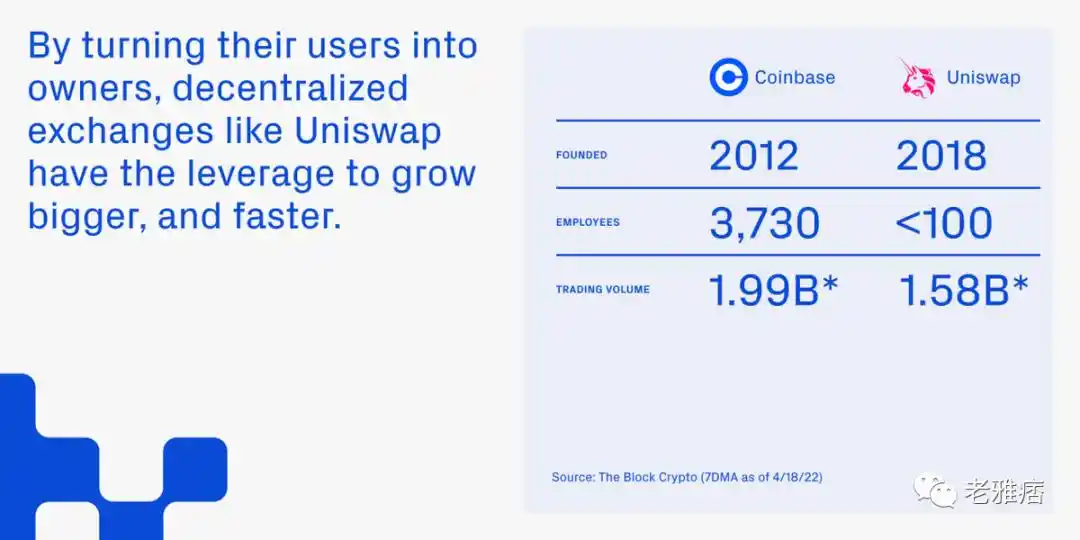
Coinbase 是一个中心化的交易所,管理用户的钱包和资金,并使用其订单簿匹配交易,而 Uniswap 则是去中心化的,它完全通过智能合约促进自动化交易。Coinbase 成立于 2012 年,截至 2021 年共有员工 3730 人。相比之下,Uniswap 成立于 2018 年,只有不到 100 名员工。Uniswap 的员工人数只占 Coinbase 的 3%,但交易量却占了其 73%。这怎么可能? 重要的是,Uniswap 通过治理 Token 和 LP 份额使其用户成为其所有者,从而使其可以更快地发展壮大。此外,由于 Uniswap 是去中心化的,任何人都可以添加任何资产。如果世界上所有的价值都将被 Token 化,就像互联网上所有的信息都被打包一样,那么我们应该期待去中心化的交易所增长速度超过其中心化的同行。
Token 并不是产品与市场匹配的替代品
然而在我们的分析中很明显的是,仅仅给予用户所有权并不足以确保一个产品胜过其竞争对手。 Token 在吸引用户注意力和引导最初的采用方面是有用的,但它们需要与强大的产品市场契合 (解决用户的广泛需求) 相结合,以维持使用。
NFT 领域是所有权不足以推动持续参与的一个典型例子。占主导地位的 NFT 市场 OpenSea 尽管没有 Token ,但仍拥有超过 90% 的交易市场份额,而多个竞争对手 (如 LooksRare、SuperRare、rare) 都有 Token 。值得注意的是,在 2020 年夏天,在 Rarible 向在 Rarible 市场上买卖 NFT 的用户空投流动性挖掘 Token 后,其交易量短暂超过了 Opensea,但 Opensea 更深的流动性、更强大的产品和更好的搜索功能帮助它在一段时间内赢得了比赛。对于市场的用户来说,流动性仍然是选择一个市场而不是另一个市场的最强大的动力。在其他较小的市场中,激励交易的 Token 币的存在不足以克服 OpenSea 在满足核心用户交易需求方面的优势。
另一个例子是第 1 层区块链生态系统。尽管 L1 区块链都提供了自己的代表网络所有权的原生 Token ,但由于用户和开发者的网络效应,更成熟的开发者工具环境以及与其他现有应用程序组合的能力,以太坊仍然是增长最快的平台。这些因素表明,即使替代区块链的费用较低,也不足以克服以太坊的网络效应 (尽管它是否会保持其优势尚不清楚)。
还有一个问题是,所有权是否真的排挤了使用产品的内在动机,导致用户以更唯利是图、交易性(可能是暂时的)的方式使用产品。关于外在动机 (为获得经济利益等外部奖励而进行的行为) 与内在动机之间的相互作用已经有了大量的研究。根据一些研究,外部动机会削弱内在动机,特别是当用户之前发现行为具有内在奖励时。这意味着, Token 激励应该在时间 (通过渐进去中心化)、规模、资格和其他因素方面进行优化,以保持用户的内在动机。
新的 Token 分配设计正在提高用户的忠诚度
In theory, engagement and retention should be higher when users are owners and engaged. Today's reality is mixed.
A good example of how ownership breeds loyalty is the success of games like Axie Infinity. Axie Infinity is a blockchain-based game in which users collect, breed and battle digital creatures called Axies, which are NFT. Ownership of in-game assets is a key difference between blockchain games like Axie Infinity and non-blockchain games: in the latter, "owned" assets typically cannot be exchanged for money or transferred out of the game.
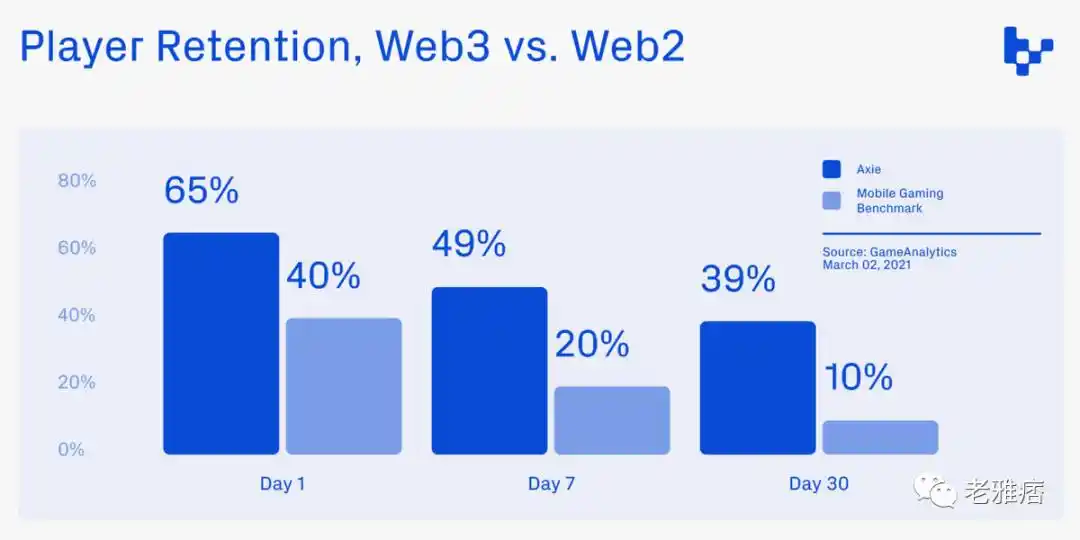
Having in-game assets increases player loyalty.
《Axie Infinity》采用 play-to-earn 机制,玩家在游戏中赚取可兑换当地货币的 Token 。这款游戏已经取得了显著的规模,累计营收超过 10 亿美元,日活跃用户近 300 万。这款游戏的玩家留存率远高于传统手机游戏,一直保持强劲和稳定。
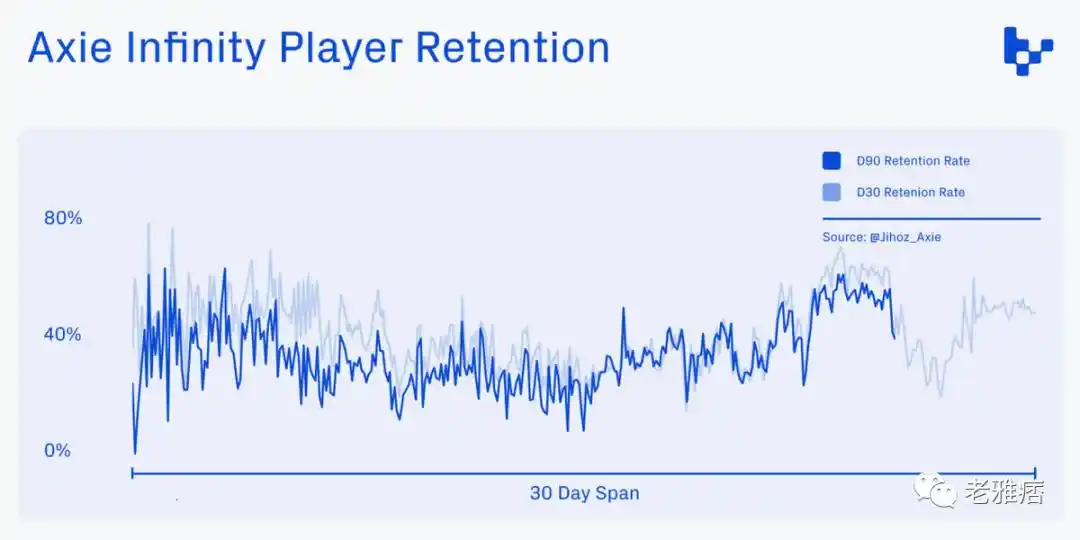
Axie Infinity's retention rate has been consistently strong compared to traditional mobile games, highlighting the importance of digital ownership.
但也有反例表明, Token 激励对用户参与度的影响好坏参半。 Token 经济学的整个领域还处于起步阶段,围绕所有权分配的最佳实践仍然未知。到目前为止,用户已经提出了重要的问题,并围绕着 Token 激励和所有权转化为用户忠诚度或理想的社会成果的有效性提出了批评。
虽然流动性挖掘项目已经变得普遍,并推动了新产品的短期参与,但它们在历史上并没有促进长期可持续性。根据 Nansen 的研究,「在 DeFi 项目启动当天进入的人中,高达 42% 的人在 24 小时内退出。约 16% 的用户会在 48 小时内离开,到第三天,70% 的用户会退出合约。」 Token 激励的外在本质意味着许多流动性提供者在经济上受到最高回报的激励,从而导致流失。
此外,虽然几乎不可能的高额 Token 奖励成为「DeFi 2.0」浪潮的一个决定性特征,但它们的可持续性现在受到了质疑。不断变化的市场情绪导致许多此类项目的价格急剧下跌,它们的 Token 模型成为了严肃辩论的主题。这些衰退对以项目原生 Token 支付的贡献者和项目最热情的支持者产生了最严重的影响。
Token 分配的创新
因此,许多项目正在重新思考 Token 激励机制,一波新模式开始出现。例如,Curve 的投票托管 (「ve」) 合同使用锁定期来增加 Token 奖励;Gro 还引入了一种授权机制,以鼓励长期参与。随着关于 Token 工程和加密货币经济学的学术研究的激增,这些模型越来越受到测试和审查,这表明下一代 Token 将更有效地吸引用户并激励长期贡献。
在高层次上,我们有机会让 Token 的分发更加细化和有针对性地奖励那些真正有助于网络留存和可持续发展的行为。这种分配将导致比第一代项目更容易获得更高的可访问性,并且比现实世界中存在的资本复合回报要好几个数量级,因为在现实世界中,资本需要购买而不是赚取。举个例子, Token 门控的社交社区 Friends with Benefits (FWB) 需要 75 个 FWB Token 才能加入,这相当于 1.2 万美元以上。但除了购买 Token ,还有其他方式可以通过获得所有权来加入社区,包括写作、设计、通过 FWB 的工作室创作艺术品或为各种工作流程作出贡献。
除了直接的贡献者奖励,一些 DAO 开始实施奖励计划来吸引用户并委托工作。这些一次性任务的范围从短期的开发人员协助和业务开发到简单的社区参与,以项目的原生 Token 进行支付。Rabbithole 和 Layer3 等平台为多个 DAO 汇总这些赏金,让潜在用户有机会搜索符合他们兴趣的项目和任务。新一代的 Token 激励似乎更重视贡献者的增长,而不是单纯地深化流动性——这是发展所有权经济用户群的必要过渡。
User ownership promotes a richer ecosystem of projects and contributors
User-owned projects can foster rich ecosystems when they combine ownership allocation with permissionless access. Deployed in this way, decentralized ownership deployed in this way can be a catalyst for projects to become platforms built by third parties.
Ethereum is one of the strongest examples of this. Distributed ownership of the network has fostered a community of developers and users interested in the continued success of Ethereum: the value of their stake in Ethereum provides ample incentives to continue building and using the network, forming an ecosystem that spans social, marketplace, DeFi, and more. Shared ownership reinforces network effects and disincentives to switch to other blockchains. Of course, Ethereum's success is not just a result of distributed ownership; It also benefits from competent leadership and embedded values that help to adjust and energize its community.
Another manifestation of decentralized ownership in NFT is in the form of CC0(or "copyright-free") projects that give up all copyright and put their work into the public domain. Individuals, Cryptoadz, Chain Runners and Loot have placed their assets in the public domain, allowing their intellectual property to be freely used, remixed and commercialized.
Because of their permissionless nature, users, creators, and developers are attracted to these projects and start building around them. Loot is a CC0 NFT series that became popular in September 2021, and each NFT contains a simple list of fantasy adventure gear. There are now over 53 Loot derivatives and at least nine guilds for the owners of specific items in the Loot universe.
The CC0 NFT project creates the potential for its intellectual property to be used in novel and generative ways, which increases the reach, relevance and ultimately value of the intellectual property. "Just as academic citation makes the original papers more important, citing individual names...... in any form makes the original papers more important and valuable," said Contributor 4156 of the Individuals DAO. The group is putting this theory into practice, catalyzing the spread of its intellectual property, and pursuing partnerships with brands such as Budweiser, which featured iconic soccer glasses in its Super Bowl ads, and traditional media companies.
Similarly, the team behind Cryptoadz worked with art and game studio Arcade NFT to create Toad Runnerz, a collection of NFT, each of which is a playable arcade-style game that uses Cryptoadz as an in-game asset. Arcade NFT has hosted an exclusive contest for Toad Runnerz NFT holders, further expanding Cryptoadz IP's reach and content into gaming.
By allowing free use of their assets, the CC0 NFT project expands the definition and possibilities of ownership. This approach can spur construction, creativity and collaboration -- and we are only beginning to see its potential.
An ownership economy allows users to become owners earlier and participate in value creation
A key theme of the ownership economy is that users can become owners faster than centralized users, enabling them to contribute to and benefit from value creation.
在我们的分析中,我们发现 web3 公司发行 Token 的平均时间为 2.7 年;2020 年,风投支持的公司在获得第一笔风险投资后约 5.3 年上市。与 Token 发行相比,IPO 的时间安排有助于消除散户投资者的大量上行潜力。
This phenomenon stands out when comparing Coinbase with Uniswap. Coinbase went public in April 2021, nearly nine years after it was founded. The stock ended its first day of trading with a market value of $85.7 billion, an incredible result for private investors like Y Combinator, which provided seed funding for the company in 2012 at a valuation of about $2 million.
However, Coinbase's ipo was not a good outcome for retail investors, whose opportunity to invest came after the company's valuation increased 40,809 times over its first private investment round. Virtually all retail investors who bought and held Coinbase shares since the ipo lost money as of April 2022.
相比之下,在所有权经济中,项目在其生命周期的更早期退出社区,允许用户为更大的价值创造做出贡献并从中受益。Uniswap 于 2020 年 9 月推出了 UNI 治理 Token ,这距离该协议最初部署到以太坊主网不到两年的时间。与 Coinbase 不同的是,后者的直接上市意味着上市时没有新股发行,UNI genesis 的 60% 分配给了 Uniswap 用户。这种情况在所有权经济的项目中很常见。
The future of ownership economics
The rules of the game are still being written, but one thing is certain: ownership is becoming the cornerstone of new experiences across all categories of software products. Web3 was originally a developer phenomenon for layer 1 blockchain, and most innovation was initially targeted at developers. But Chris Dixon used his dictum to predict that "what the smartest people are doing every weekend is exactly what everyone else will be doing every weekday for the next ten years." Ownership now extends to all types of products and networks.
The original link
Welcome to join the official BlockBeats community:
Telegram Subscription Group: https://t.me/theblockbeats
Telegram Discussion Group: https://t.me/BlockBeats_App
Official Twitter Account: https://twitter.com/BlockBeatsAsia

 Related Articles