The Web3 Ownership Economy: A New Internet for Users
Original title: "2022 Web3 Ownership Economy"
Original author: Li Jin, Geoff Hamilton, Jesse Walden, Spencer Noon, Derek Walkush, Medha Kothari
Original compilation: Block unicorn
During the 30 years of the World Wide Web, a handful of companies controlled most of user attention and advertising revenue, and a closed ecosystem held back independent developers innovation. The economic interests of the largest Internet platforms are at odds with their most valuable contributors—their users.

Ownership has long been embraced by Silicon Valley startups, through Grant options to adjust employee incentives. Despite this, the vast majority of Internet users own exactly 0% of the services they contribute to. Creators do not own their content, developers have no control over their code, and consumers have no say in the policies and decisions of the platforms they use. This scenario, once unchallenged, now looks increasingly outdated.
This is starting to change through the ownership economy (commonly known as web3), where products and services turn users into owners.
From Bitcoin and Ethereum - both of which reward participants who use native tokens to secure the network - to become common across all classes of software, From developer infrastructure and new financial markets in DeFi to consumer products, marketplaces and social.
A new Internet owned by users
If the previous generation of software was built on user-generated content Based on that, the next generation of software will be owned by users, with digital ownership serving as the building block to enable novel user experiences. At its core, an ownership economy not only provides a powerful new tool for builders to use market incentives to launch new networks, it also has the potential to create positive social change through a broader distribution of wealth-creating assets.
In the two years since Jesse Walden published his original vision for a user-owned Internet, the landscape has changed and expanded dramatically. There are now over 15,000 projects in the ownership economy, from user-owned financial markets to user-owned social networks, investment clubs, and digital assets. While the ownership economy still represents only a small fraction of all internet platforms, it is a rapidly growing segment. Ethereum is one of the most mature networks supporting an ownership economy, with average monthly account growth of 46% in 2021.
Amid all this growth, we wanted to take a step back and reintroduce this ecosystem with some fundamental questions: What is an ownership economy? How big is it and where will it go? What trends are defining its current state and likely future? To answer all of these questions, we'll turn to data and case studies to illustrate how the ownership economy works in real time.
This report is intended as a primer for new entrants looking to gain a deeper understanding of web3. We will also use it as a starting point for more in-depth articles on topics such as token distribution strategies, regulatory issues, and more that we plan to publish this year.
What is an ownership economy?
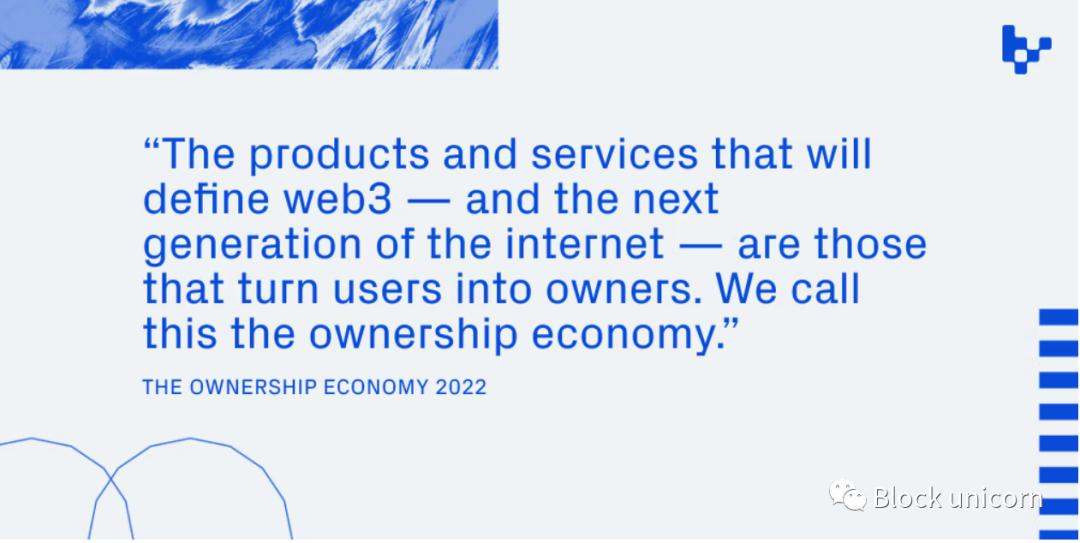
In short: Defining web3 and next-generation Internet products and services, users will be transformed into owners of products and services, we call it an ownership economy .
Nevertheless, identifying this phenomenon is not always simple or obvious. This is because ownership manifests itself in a range of experiences such as user effort, responsibility, and collectiveness. A user may own a single digital media asset, such as an NFT. The other may affect the operation of the network through governance Token. The experience of being an owner includes passive (ie, hodling) and active participation.
Please note that in this report we focus on cryptographic tokens — not equity — as the basis of the ownership economy. Token has a richer and more frictionless design space. They can be distributed programmatically, potentially rewarding participants rather than buyers; they can be deployed virtually freely, and can deliver value in the same way we deliver information—instantly to anyone, anywhere in the world.
Sizable and growing ownership economy
As of April 26, 2022, data The more than 19,000 tokens tracked by aggregator CoinMarketCap have a market capitalization of $1.76 trillion. By comparison, the global stock market has a market capitalization of more than $100 trillion.
The largest crypto networks by market capitalization are established layer 1 blockchains: Bitcoin launched in 2009 ($725 billion) and 2015 Ethereum launched in 2019 ($337 billion). Other Tier 1 tokens in the top 20 tokens by market cap include Solana, Polkadot, Terra, and Avalanche.
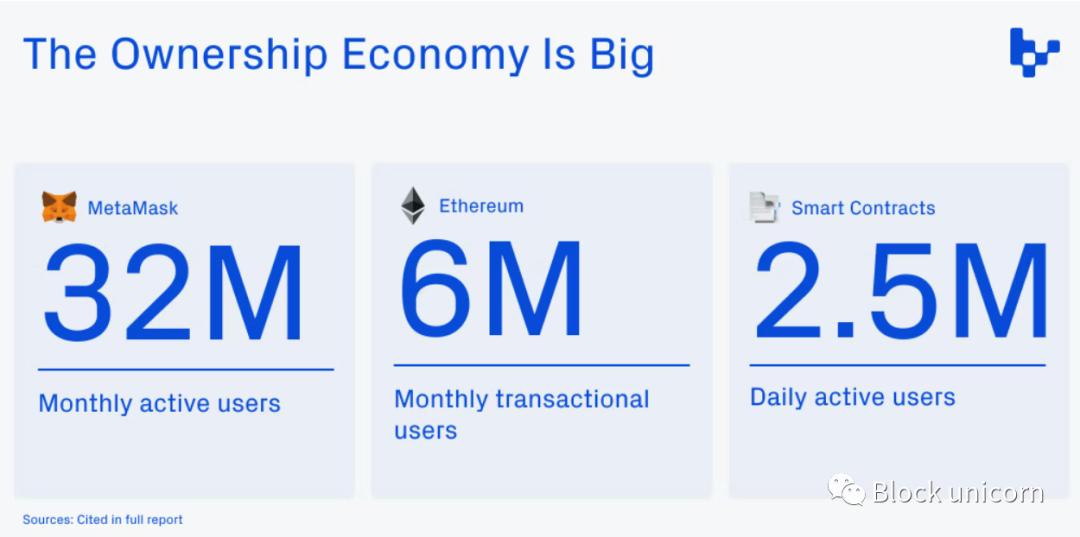
We can also consider the size of the ownership economy from the perspective of people - in the network they build The user who becomes the owner in .
Financial Times and Chainalysis estimate there are 360,000 NFT owners by 2021. In addition, there are tens of millions of encrypted network users. Metamask, a wallet for connecting dapps, recently announced that it had 32 million monthly active users as of February 2022, while Phantom (the wallet currently focused on Solana) announced monthly active users for January 2022 to 2 million. In the fourth quarter of 2021, the average monthly trading users of Ethereum is about 6 million, and the daily active trading users are about 400,000. From a multi-chain perspective, there are about 2.5 million daily active users interacting with smart contracts tracked by DappRadar. As a rough estimate, if we use Ethereum's DAU/MAU ratio of 0.06 to extrapolate these 2.5 million daily users to calculate monthly users, we can estimate MAUs of 39 million for the 29 networks covered by the DappRadar data.
DAO, Decentralized Autonomous Organization, is an online community owned and managed by its members. They can be seen as the organizational building blocks that make up the web3 economic, social and cultural landscape. New DAOs are being formed at such a rate that it's hard to count them all, but it's safe to say there are over 1,000 of them. DeepDAO is a data source that tracks the details of about 180 DAOs. In these DAOs alone, there are 1.7 million governance token holders, of which about 500,000 holders actively participate in DAO governance. Some of these DAOs are very large: 69 of the 180 have more than 1,000 members.
The State of the Ownership Economy in 2022
Today, user ownership is changing how people trade, invest, The way to create, develop, play, learn, communicate and socialize.
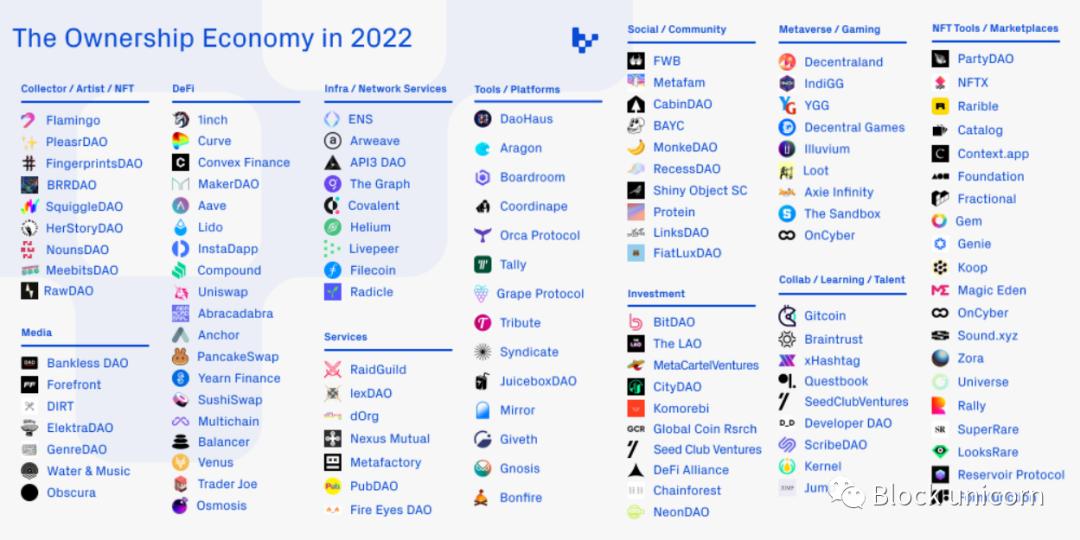
A non-comprehensive list of items
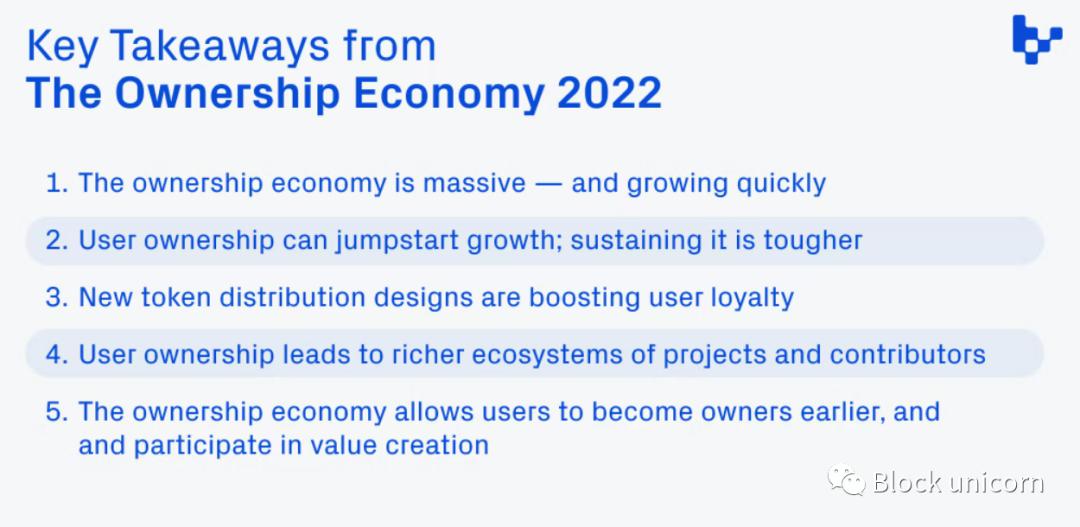
Walden’s original article, “The Ownership Economy,” argues that user ownership could lead to “larger, more resilient, and more innovative platforms.” As we discuss in this report, many of these aspirations have yet to be realized, or with mixed results, due to the emerging playbook on how best to achieve user ownership. Nonetheless, we remain confident in the power of user ownership to build larger, more defensible networks and catalyze positive social change. Realizing this potential will require more research into best practices for ownership assignment and education for developers and users. As a step toward that goal, we want to share some key insights about the state of ownership economies today.
1. User ownership can drive growth, but maintaining growth is more challenging
Giving user ownership in the form of tokens can be a powerful alternative to paid marketing, helping to bootstrap the network and overcome the cold start problem.
Before we dive in, let's consider how much it costs non-encrypted services and products to attract users. In 2015, Facebook’s mobile app install ad business generated $2.9 billion in revenue, accounting for 17% of Facebook’s total ad revenue. This huge sum of money goes into the pockets of the intermediary platform — Facebook — instead of going to app developers to invest in R&D and product improvements, or to reach end users in the form of lower prices or higher incentives. High upfront costs for user acquisition also mean that consumer apps that cannot raise external funding are hard to get off the ground: the average cost of acquiring an app user in 2019 was $3.52.
In contrast, for crypto projects, giving user ownership can serve as a marketing function, attracting new users through the promise of ownership and increasing engagement by playing games Spend. A case study is Coinbase and Uniswap, two cryptocurrency exchanges that enable users to exchange various tokens.
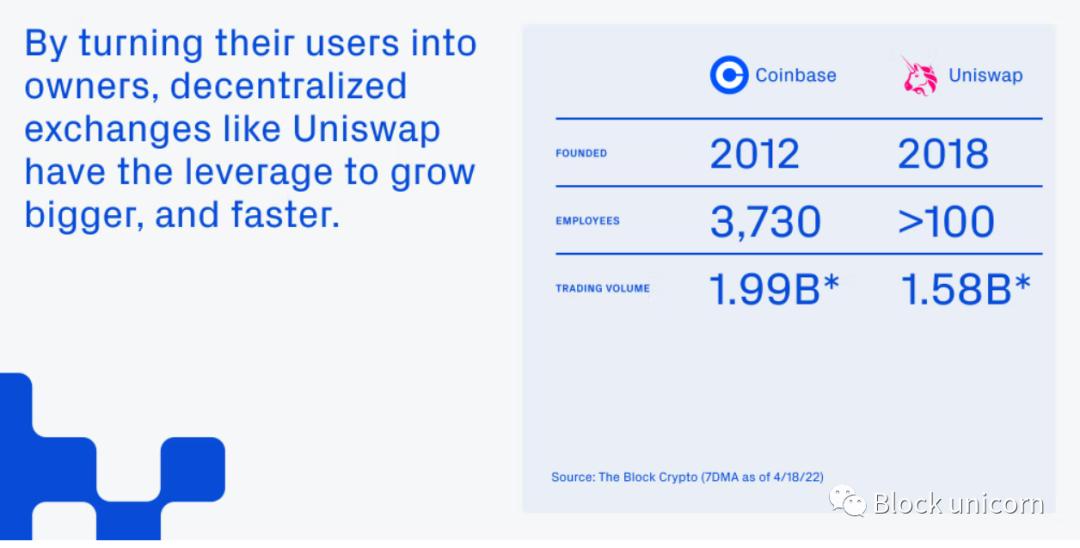
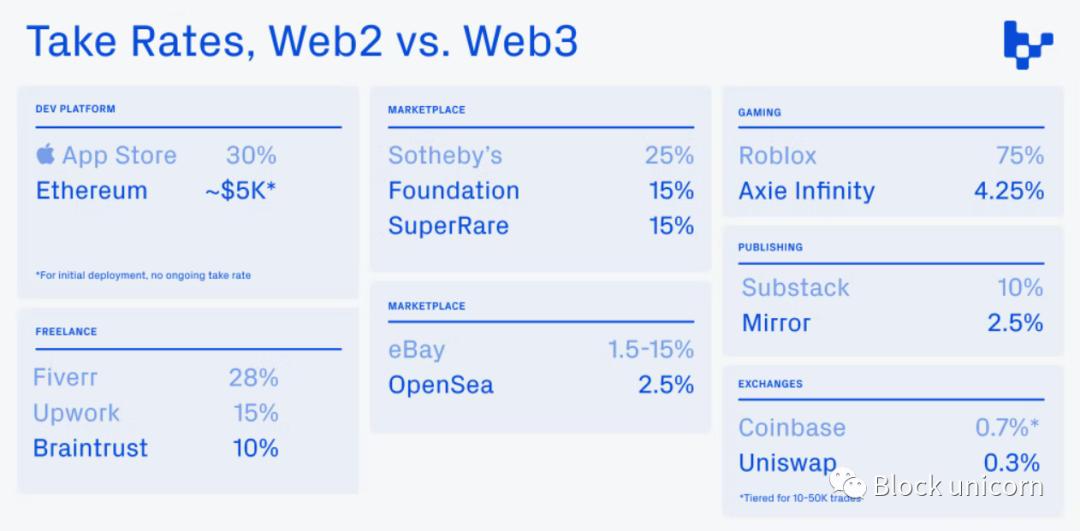
Although Coinbase is a centralized exchange, it hosts users' wallets and funds and uses its orders Book matching transactions, but Uniswap is decentralized and facilitates automated transactions entirely through smart contracts. Founded in 2012, Coinbase has 3,730 employees as of 2021. In contrast, Uniswap was founded in 2018 and has fewer than 100 employees. How is it possible that Uniswap accounts for only 3% of Coinbase’s workforce and accounts for 73% of its trading volume? Importantly, Uniswap makes its users owners by governing Token and LP (liquidity) rights and interests, enabling it to grow bigger and faster. Also, since Uniswap is decentralized, anyone can add any asset. If all the value in the world is tokenized the way all information is packaged on the internet, then we should expect decentralized exchanges to grow faster than centralized exchanges.
Tokens are not a substitute for product market fit
However, in our analysis, very Clearly, simply giving users ownership is not enough to ensure a product outperforms its competitors. Tokens are useful in capturing user attention and guiding initial adoption, but they need to be paired with a strong product-market fit — addressing a broad range of user needs — to sustain usage.
The NFT landscape is a prime example of not enough ownership to drive ongoing, ongoing engagement. Although there is no token, the dominant NFT market OpenSea has more than 90% of the transaction market share, while multiple competitors have (such as LooksRare, SuperRare, Rarible). It is worth noting that after Rarible launched liquidity mining in the summer of 2020 (airdropping Tokens to users who buy and sell NFT on the Rarible market), its transaction volume once exceeded that of Opensea, but Opensea has deeper liquidity and stronger Its products and better search capabilities have helped it win over time. For users of a market, liquidity—the existence of a counterparty—remains the strongest motivator for choosing any market over another. The existence of tokens that incentivize alternative transactions in smaller markets is not enough to overcome OpenSea's advantages in meeting the transaction needs of core users.
Another example is the layer 1 blockchain ecosystem. Although the L1 blockchains all offer their own native tokens that represent network ownership, Ethereum remains the fastest growing due to network effects for users and developers, a more mature developer tools environment, and the ability to combine with other existing applications. Fast platform. These factors suggest that even the lower fees of alternative blockchains will not be enough to overcome Ethereum’s network effects (although whether it will maintain its advantage is unclear).
There is also the question of whether ownership really crowds out the intrinsic motivation to use the product, leading users to act in a more mercenary, transactional (and possibly temporary) way Interact with the product. There has been a great deal of research on the interaction between extrinsic motivation (behavior taken for some external reward such as financial gain) and intrinsic motivation. According to some studies, extrinsic motivation can undercut intrinsic motivation, especially when users have previously found the behavior to be intrinsically rewarding. This means that token incentives should be optimized in terms of time (through progressive decentralization), scale, qualifications, and other factors to keep users intrinsically motivated.
2. The new Token distribution design is improving user loyalty
In theory, when As users become owners and (literally) invest, they should become more highly engaged and retained. Today, the reality is mixed.
A great example of how ownership breeds loyalty is the success of gaming money-making games like Axie Infinity. Axie Infinity is a blockchain-based game where users can collect, breed and fight digital creatures called Axies, which are NFTs. Ownership of in-game assets is a key difference between blockchain games like Axie Infinity and non-blockchain games: in the latter, “owned” assets typically cannot be exchanged for currency or transferred outside the game.
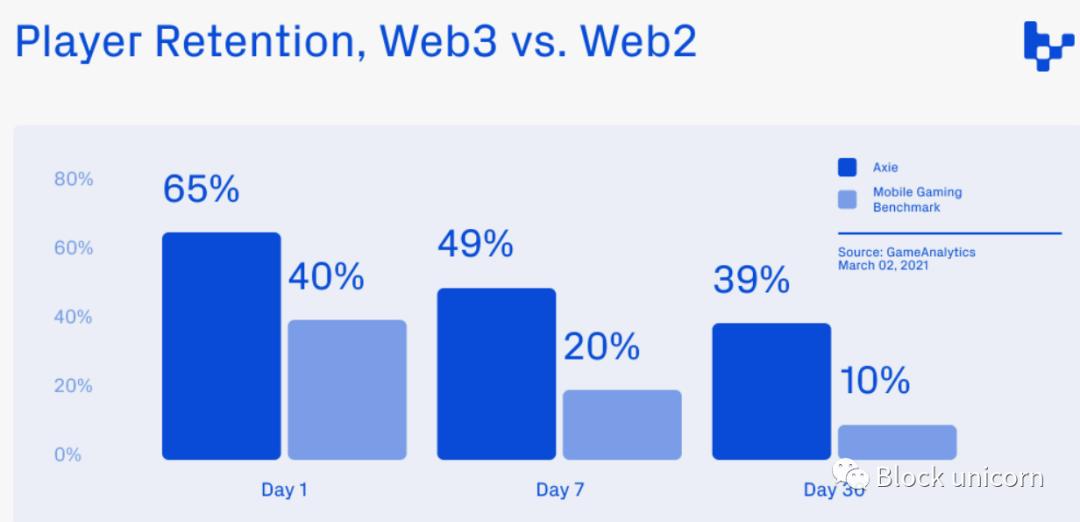
Axie Infinity is a "play-to-earn" game in which players earn Tokens that can be exchanged for local currency "Mechanism to provide support, has achieved considerable scale, cumulative revenue of more than 1 billion US dollars, daily active users of nearly 3 million. And the player retention rate of the game is much higher than that of traditional mobile games. Axie Infinity's player retention has remained strong and stable over time, showing that engagement is not just a function of the game's novelty.
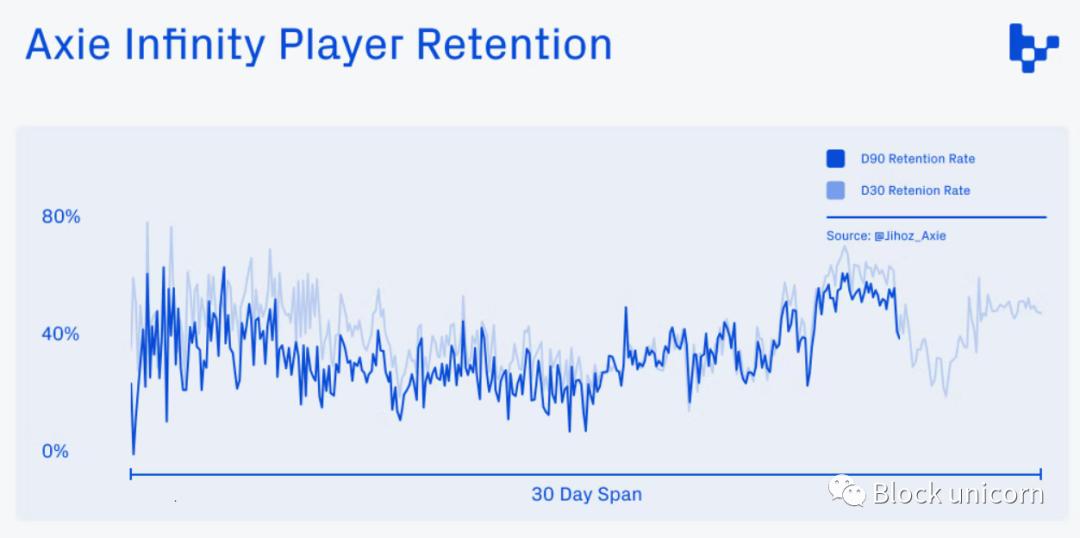
Axie Infinity's retention rate has remained strong compared to traditional mobile games, underscoring the importance of digital ownership sex.
But there are also counter-examples of the mixed impact of Token incentives on user participation. The entire field of token economics is in its infancy, and best practices around ownership distribution are still unknown. To date, users have asked important questions and criticized the efficacy of token incentives and ownership in translating into user loyalty or desirable social outcomes.
While liquidity mining programs (rewarding users with tokens for ownership of liquidity) have become common and drive short-term participation in new products, they have historically does not contribute to long-term sustainability. According to Nansen research, “Up to 42% of yield farmers who enter the farm on the day the farm is launched, exit within 24 hours. About 16% leave within 48 hours, and by the third day, 70% of these users have exited from the contract .” The extrinsic nature of token incentives means that many liquidity providers are financially incentivized with the highest rewards, resulting in customer churn.
Furthermore, while impossibly high token incentives became a defining feature of the "DeFi 2.0" wave, their sustainability is now being questioned. Changing market sentiment has led to significant price drops for many of these projects, and their token models have been the subject of intense debate. These downturns affect contributors paid in the project’s native token (often bound by a vesting schedule) and the project’s most ardent supporters the most.
Innovation in Token Distribution
Therefore, many projects are rethinking Token incentives Mechanism, a wave of new models began to emerge. For example, Curve’s voting escrow (“ve”) contract uses a lock-up period to increase Token rewards; Gro also introduces an attribution mechanism to encourage long-term participation. These models are increasingly being tested and scrutinized as academic research on token engineering and cryptoeconomics proliferates, suggesting that the next generation of tokens will more effectively engage users and incentivize long-term contributions.
At a high level, the opportunity is to make token distribution more granular and targeted to reward behaviors that actually contribute to network retention and sustainability , rather than simply rewarding those tech-savvy networks that translate early knowledge into new products or engage in mercenary user behavior. This allocation will result in higher accessibility than first-generation projects, and orders of magnitude better compound returns on capital than exist in the real world, where capital is purchased rather than earned. For example, the Token-gated social community Friends with Benefits (FWB) requires 75 FWBTokens to join, which at one point equated to over $12,000. But besides buying Tokens, there are multiple ways to join the community by taking ownership, including writing, designing, creating artwork through FWB's studio, or contributing to various workflows.
In addition to direct contributor rewards, some DAOs have started implementing bounty programs to attract users and delegate work. These one-time tasks range from short-term developer assistance and business development to simple community engagement and are paid in the project’s native token. Platforms such as Rabbithole and Layer3 aggregate these bounties for multiple DAOs, giving potential users the opportunity to search for projects and tasks that match their interests. Compared with purely deepening liquidity, the new generation of token incentives seems to place more emphasis on the growth of contributors - a necessary transition to expand the user base of the ownership economy.
3. User ownership fosters a richer ecosystem of projects and contributors
User-owned projects can foster a rich ecosystem when they combine ownership distribution with permissionless access. Deployed in this way, distributed ownership can be the catalyst for a project to become a platform for third-party builds.
Ethereum is one of the strongest examples of this. Distributed ownership of the network fosters a community of developers and users interested in Ethereum’s continued success: the value of their stake in Ethereum — their ether — provides enough incentive to continue building and using the network , resulting in an ecosystem of applications across social, marketplace, DeFi, and more. Shared ownership strengthens network effects and dampens the incentive to move to other blockchains. Of course, Ethereum's success isn't just a result of distributed ownership. It also benefits from capable leadership and embedding values that help align and motivate its communities.
In the NFT space, another manifestation of decentralized ownership is emerging in the form of CC0 (or "Copyright Free") projects - those who give up All copyright and transfer their works to the public domain project. Nouns, Cryptoadz, Chain Runners, and Loot have placed their assets in the public domain, allowing their intellectual property (IP) to be freely used, remixed, and commercialized.
Due to their permissionless nature, users, creators, and developers have been attracted to these projects and started building around them. Loot is a collection of CC0 NFTs that will be popular in September 2021, and each NFT contains a simple list of fantasy adventure gear. There are now more than 53 Loot spinoffs and at least nine guilds -- groups of owners of specific items in the Loot world.
The CC0 NFT project creates the potential for its IP to be used in novel and generative ways - increasing the scope, relevance and ultimately value of that IP. Contributor 4156 of the Nouns DAO said: "Just as academic citations make the original paper more important, citing nouns in any form... makes the original paper more important and more valuable." Collaborations between brands (such as Bud Light, which incorporated the iconic Nouns glasses into a Super Bowl ad) and traditional media companies have put this theory into practice.
Similarly, the team behind Cryptoadz partnered with art and game studio Arcade NFT to produce Toad Runnerz, a collection of NFTs where each NFT is a playable arcade style game featuring Cryptoadz as an in-game asset. Arcade NFT hosts exclusive tournaments for Toad Runnerz NFT holders, further expanding the scope and content of the underlying Cryptoadz IP into the gaming space.
By using its assets for free, the CC0 NFT project expands the definition and possibilities of ownership. This approach inspires construction, creativity, and collaboration—and we're only just beginning to see its potential.
4. Ownership economy allows users to become owners earlier and participate in value creation
Ownership A key theme of the economy is that users become owners faster than their centralized counterparts, allowing them to contribute to and benefit from value creation.
In our analysis, we found that, on average, web3 companies launching Tokens did so 2.7 years after their founding; Backed companies go public about 5.3 years after receiving their first VC investment. The IPO timeline helps remove much of the upside potential for retail investors compared to token offerings.
This phenomenon comes into focus when comparing Coinbase and Uniswap. Coinbase went public in April 2021, nearly nine years after the company was founded. The stock closed its first day of trading with a market capitalization of $85.7 billion, an incredible result for private investors such as Y Combinator, which pumped the company with a valuation of about $2 million in 2012. Seed round.
However, the public listing of Coinbase is not a good outcome for retail investors, whose The investment opportunity arose after the company's valuation had multiplied 40,809 times from its first round of private equity investment. In fact, as of April 2022, every retail investor who bought and held Coinbase shares since Coinbase went public has lost money on their investment.
In an ownership economy, by contrast, projects exit their communities early in their life cycle, allowing users to contribute to greater value creation Contribute and benefit from it. Uniswap launched its UNI governance token in September 2020, less than two years after the protocol was initially deployed on the Ethereum mainnet. Unlike Coinbase’s direct listing, which meant no new shares were issued at the time of listing, 60% of UNI’s genesis supply was allocated to Uniswap users, which is common for projects in an ownership economy.
The Future of the Ownership Economy
Script It's still being written, but one thing is for sure: ownership is becoming the cornerstone of new experiences for software products of all categories. Web3 started out as a developer phenomenon for layer 1 blockchains, and historically most innovations were initially developer oriented. But Chris Dixon predicts with his adage: “what the smartest minds do on the weekend is what everyone else will do in a week ten years from now”—ownership now extends to various products and networks.
Original link< /a>
Welcome to join the official BlockBeats community:
Telegram Subscription Group: https://t.me/theblockbeats
Telegram Discussion Group: https://t.me/BlockBeats_App
Official Twitter Account: https://twitter.com/BlockBeatsAsia
 Related Articles