Returning the Internet to Users (2)
Original title: " Deep Dive into the User-Owned Internet: Part II "
Original author: Sofia Blikstad
Original compilation: Block unicorn
Web3 aims to empower any Power and control of participant autonomy, but to remove intermediaries we need ways to separate the network layer from the application layer, into the data center.
Society has become data dependent and our economy is increasingly becoming a data economy. However, this economy currently relies on a handful of data silos: large tech monopolies that keep our data private for competitive reasons. In this article, I will introduce the decentralized data layer - a prerequisite concept for understanding Web3 use cases.
But before I go on to tease out the Web3 wonderland we're in, let's do a quick recap. Web3 is often described as the decentralized web, but is still a term under construction. However, the ultimate goal is to become a secure, transparent and dependent peer-to-peer ecosystem - the new and improved network. To do this, we need to separate the network layer from the application layer. So, let's look at the data. This is Deep Dive into the User-Owned Internet: Part 2, Click here to read Part 2 part.
Technology related to Web3
Many builders in this space were originally Attracted by earlier ideologies—privacy, decentralization, and self-sovereignty—many people mistake them for value propositions (myself included). However, for these reasons, the average end user does not adopt the technology. Instead, the most powerful feature of Web3 is that it can be extended and improved through incremental composability - talented builders improve the state of things, and more talented builders improve at the top.
While there is a bewildering number of technologies, frameworks and chain implementations that fall under the Web3 umbrella, here are the core technologies that support this:
1. Encryption keys and Decentralized Identification (DID) enable direct data management, enabling anyone to sign, transact and participate in a decentralized network.
2. Smart contracts ensure that economic activities are open, transparent and rule-based in executable code.
3. Data composability allows peer-to-peer networks to freely share and interact with code, data, and contracts, closed networks are becoming open.
4. Distributed storage systems can split data across multiple servers and retrieve it based on content rather than its physical location.
5. Cryptoassets help eliminate the need for Web2 middleware by economically incentivizing people to run open protocols and align with the interests of the network.
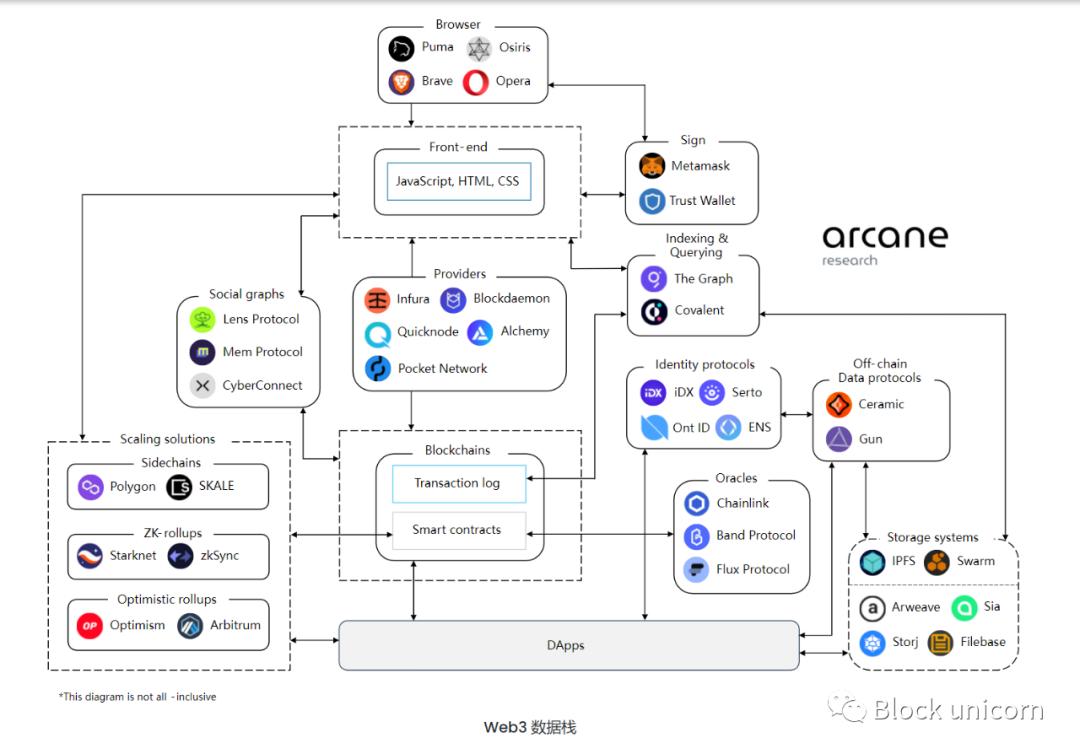
The Web3 protocol is built on open and interoperable data, and projects like Graph help developers query blockchain data in an accessible way by indexing off-chain data. Ceramic Network is a decentralized data network for managing information without the need for databases or servers; Arweave achieves permanent data storage through economic incentives; IDX is an identity protocol that replaces centralized user tables with unified digital identities. In addition to data services, Web3 protocols can also provide other backend functions such as file storage, computing, authentication, governance, and content distribution.
These technologies make Web3 more fluid and interactive than the Web today, as many applications can manipulate the same data. If our data were bundled with us, rather than dispersed in application-specific silos, we would be able to travel through cyberspace with our full, authentic selves. More specifically, users can carry their data from one application to another, and applications can use data related to users. Companies don't have to choose X or Y for their productivity suite, imagine everyone being able to choose a different tool and still collaborate on documents.
Must-have concept: social graph
Most of the "big technology monopoly" The discussion misses a key distinction: the difference between platforms and charts.
A social graph is the connections between members of a social network. It is not the property of any company. However, you cannot freely transfer this information between different platforms, which means that these platforms actually own this information. Meta has my friends; Twitter has my followers; Amazon has my shopping history. If you leave the platform, you will be forced to manually rebuild the graph elsewhere. This creates a high switching cost for users and provides a huge advantage to the platform.
In the early days of Web2, each social application had its own social graph, but people quickly got tired of registering and re- add friend. Therefore, the best solution is to consolidate all relationships into one application, Meta (formerly known as Facebook). Once Facebook was embraced by the masses and realized the value of the social graph it possessed, the company quickly adopted a strategy of self-protection and shut down the API to insulate itself from competitors.
At the same time, data has become the most valuable resource in the world. Big data is already a $274 billion industry—3% of world GDP.
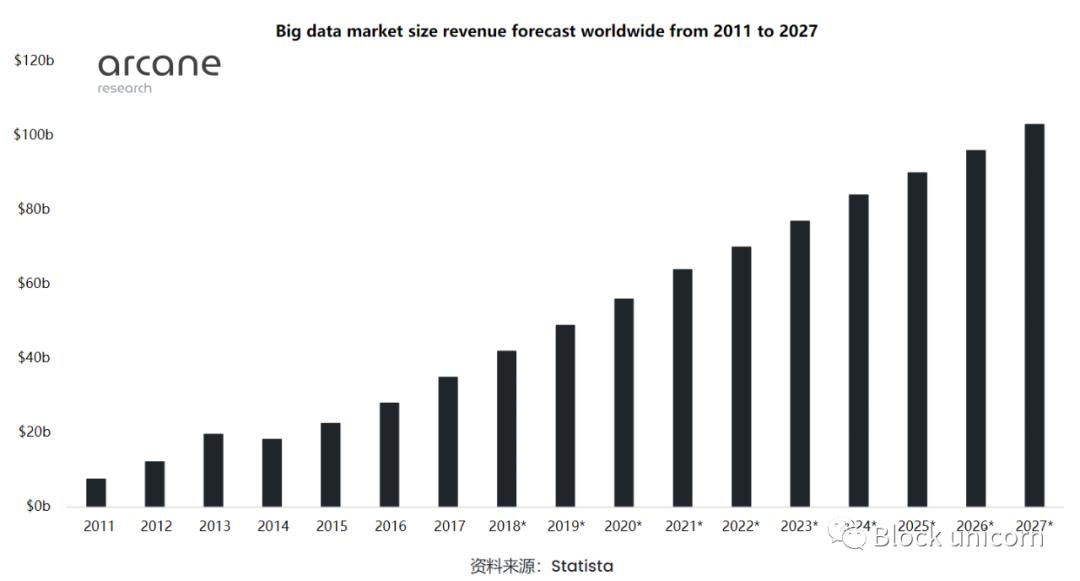
A decentralized social graph changes the power imbalance between users and platforms, and while applications can be proprietary and fragmented, the data that populates them can be shared across protocols . No longer subject to data monopolies, power shifts from platforms to users, and the web becomes fiercely competitive again.
Redecentralization
The core of the Web3 vision is "composable data". Rather than being trapped in application-specific silos, the information that underpins our online experiences can be read, mixed, and structured by applications across the web. Data composability is a paradigm shift because it not only changes how applications are built, but also what applications are. What it means: An integrated and customized experience across the Internet, taking all your information and assets with you. You get the benefits of diversity without the cost of spreading.
While Web2 may be built on such a backend, composability is not reflected in the Web2 company itself. For example, the internet itself is decentralized, so the US cannot disable China's internet. Effective monopolies like Facebook, Amazon, and Google are centralized solutions built on decentralized networks with little incentive to break themselves down into composable services. But in the presence of shared network effects, those incentives shift.
However, instead of immediate results, it is "power" decentralization that brings its own challenges. One stumbling block to composability is the high fees we see on Ethereum as the network becomes popular and congested. Coupled with the inherent complexity of bridging between blockchains — which in its current state would dilute security and liquidity resources — this creates a challenging environment for complex operations across multiple Dapps. The transition from Web2 to Web3 is underway, but the process will require patience and innovative solutions.
From zero sum to positive sum
Web3 is a collective effort to solve Web2 economic, social and political issues. This requires an infrastructure spanning storage, compute, indexing, etc., while allowing for a seamless user experience without sacrificing the value of Web3. In exploring the current state of the technology, it is clear that the market is willing to give up some level of decentralization in exchange for more data and a better, faster user experience.
However, foresight is required here. There is a level of centralization where applications no longer need to build an entire stack and compete for the best underlying data, the data layer is shared. Instead, anyone with an idea to improve an existing use case can tap into the ecosystem and its data and provide improvements. Builders can build faster, users have more choice, and the entire network accelerates through rapid, permissionless innovation. With fewer centralized networks, the network will become competitive again.
Original Link
Welcome to join the official BlockBeats community:
Telegram Subscription Group: https://t.me/theblockbeats
Telegram Discussion Group: https://t.me/BlockBeats_App
Official Twitter Account: https://twitter.com/BlockBeatsAsia
 Related Articles