Yao Qian on Web3.0: the Approaching New Generation of Internet
原文标题: 《中国金融》|姚前:Web3.0:渐行渐近的新一代互联网
Source: China Finance, No.6, 2022 & NBSP;
Author: Yao Qian, Director of China Securities Regulatory Commission Science and Technology Regulatory Bureau
Internet is a major revolution of human communication technology, which has exerted a profound influence on human society. With the current iteration innovation of all kinds of information technology, the Internet is showing the trend of the evolution of the next generation of Internet. This evolution may trigger a new round of information revolution, further profound changes in people's life, work and social aspects. In 1993, just before the advent of Web1.0, the Clinton administration of the United States issued the "National Information infrastructure" strategic plan to vigorously build the "highway" of the information age, thus gaining the global leadership of Web1.0 and Web2.0.
After 30 years of development, the Internet is now at an important point of evolution from Web2.0 to Web3.0. To strengthen Web3.0 forward-looking research and strategic prediction is undoubtedly of great significance to China's future Internet infrastructure construction. This paper intends to analyze the possible form of Web3.0 and think about it based on the domestic and foreign Internet development practice and technological evolution trend.
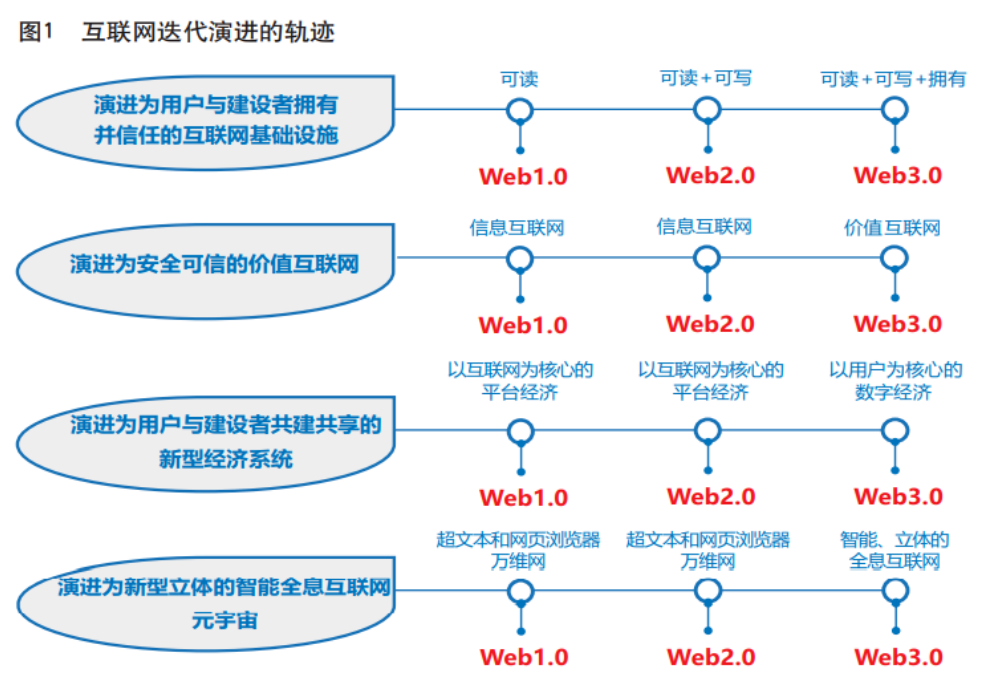
Web3.0 is an Internet infrastructure that users and builders own and trust
Chris Dixon, a tech entrepreneur and investor, describes Web3.0 as an Internet of builders and users, and digital assets as the link between builders and users. Eshita, a researcher of Messari, described Web1.0 to Web2.0 and then to Web3.0 as: Web1.0 is "read", Web2.0 is "read+write", and Web3.0 is "read+write+own".
Web1.0 was the early days of the Internet, where users could only passively browse text, images and simple video content. They were consumers of content and watched whatever the Internet platform offered. In the era of Web2.0, users can not only read but also write, especially with the development of mobile Internet, Youtube, Facebook, wechat and other network platforms, users can create and spread their own content (including text, pictures, videos, etc.) on the platform, and communicate and interact with other users. However, whether it is Web1.0 or Web2.0, users' online activities depend on specific Internet platforms; Even in the Web2.0 stage, users can be content producers, but the rules are still set by the Internet platform, and users lack autonomy.
First, the user's digital identity lacks autonomy.Users can only have a digital identity to participate in online activities if they open an account on the Internet platform. Once they close their account, they lose their rights. Each time an account is opened, users repeatedly fill in their personal information. Different Internet platform enterprises establish different account systems, and the rules of each account system are different. Users need to manage many accounts and passwords. Different account systems are independent of each other, which is easy to form "islands", which is not conducive to the ecological development of the Internet, and gives rise to problems such as monopoly and unfair competition. In recent years, Federated Identity Management (FIM) has become popular. Although this mode reduces the number of repeated account opening and gives users a sense of identity autonomy, it does not fundamentally change the disadvantages of identity management mode on Internet platforms. Digital identities are still tied to specific accounts on Internet platforms.
Second, users' personal data lack autonomy.In front of large Internet platforms, individual users are relatively weak. Under the "agree or do not serve" treaty, users can only consent to personal data being collected or even over-collected. Nowadays, Internet platforms are highly permeated into all aspects of society, providing users with communication, social networking, online shopping, information, entertainment and other services. In order to obtain these services, users have to surrender data subject rights. A large amount of user data is concentrated in the Internet platform, once leaked, will cause great damage to user privacy, such as Facebook has a similar case. Some Internet platforms may abuse their technological advantages, induce users, collect and use data without users' knowledge, and circumvent legal restrictions by technological means.
Third, users lack autonomy in front of algorithms.Algorithms are at the heart of Internet platforms. Through "thousands of faces" user portrait, can form a unique customer insight, become a magic weapon to win the network economy. But in recent years, algorithm abuse, algorithm evil and other problems become increasingly prominent. For example, using big data to "kill", the same goods or services, old customers are more expensive than new customers; Only recommend products that can bring potential commercial benefits, even fake and shoddy products, rather than the most suitable and appropriate products for users; Abuse of human weakness, over-stimulate, persuade and induce users to consume, so that people get used to "being fed", unconsciously addicted to the products put by the algorithm; The specific principles and parameters of the algorithm can only be known by a small number of operating enterprises, which may easily lead to the problem of benefit encroachment. Some platforms even use algorithms to push vulgar content or sensational false information to increase traffic.
Web3.0 is user-centric and emphasizes user ownership.One is self-Sovereign Identity (SSI).Users do not need to open an account on the Internet platform, but through the public and private key signature and verification mechanism to identify digital identity. Web3.0 also leverages Distributed ledger technology to build a Distributed Public Key Infrastructure for trusted authentication without an Internet platform account. DPKI) and a new trusted distributed digital identity management system. Distributed ledgers are a tamper-proof paradigm of trusted computing, a trusted machine on which trust can be transmitted end-to-end between the issuer, the holder, and the verifier.
The second is to give users real data autonomy.Web3.0 not only gives users self-management identity, but also breaks the natural monopoly of data controllers in centralized mode. Distributed ledger technology can provide a new autonomous and controllable data privacy protection scheme. User data is protected by cryptography algorithms and stored on distributed ledgers. It is up to the user to decide who the identity information is shared with and for what use. Only personal data authorized by the user can be used legally. Through the confirmation of rights in the whole life cycle of data, the informed consent rights, access rights, refusal rights, portability rights, deletion rights (right to be forgotten), correction rights and continuous control rights of data subjects are more effectively guaranteed.
The third is to enhance the autonomy of users in front of the algorithm.Smart contract is a fully functional, flexible and controllable program that can be invoked on distributed ledger. It has the advantages of transparency, reliability, automatic execution and compulsory performance. When deployed to a distributed ledger, the program's code is open and transparent. Users can check and verify the possible algorithm abuse, algorithm bias and algorithm risk at any time. Smart contracts cannot be tampered with and will execute according to pre-defined logic to produce the desired result. The implementation of the contract will be recorded, monitored, and the algorithm can be audited, providing strong evidence for user inquiries and appeals. Smart contracts do not depend on a specific center, any user can initiate and deploy, natural openness and open source greatly enhance the end-user's control over the algorithm.
Fourth, to establish a new relationship of trust and cooperation.In the era of Web1.0 and 2.0, users have little trust in Internet platforms. Edelman Public Relations Worldwide has been measuring Public trust in institutions, including large commercial platforms, for 20 years. The results of the 2020 survey found that most commercial platforms cannot consider their own development from the standpoint of public interest, and it is difficult to gain the full trust of the public. Web3.0 is not centralized, there is no single platform to control, and there are multiple providers for any service. Platforms are linked by distributed protocols that allow users to move from one service provider to another at minimal cost. The user is equal to the builder, and there is no question of who controls who, which is a significant advantage of Web3.0 as a distributed infrastructure.
Web3.0 is a secure and trusted value Internet
In the computer world, without a trust mechanism, the Value carried and transmitted by electronic information can easily be copied and tampered with at will, leading to the problem of Value counterfeiting and Double Spending. Web1.0 and Web2.0 are only information networks. Although they can spread text, picture, sound, video and other information, they lack the support of secure and credible value transmission technology, so they cannot send value (such as digital cash) point-to-point like email and SMS, and can only rely on the account system of trusted institutions. Carry out value registration, circulation, clearing and settlement.
The emergence of distributed ledgers creates a highly secure and trusted value delivery technology. Based on cryptography technology, it records the whole process of value transfer (transaction) completely and imalterably through distributed consensus mechanism. Its core advantage is that it can realize the point-to-point transmission of value without relying on specific intermediaries, so that the Internet is transformed from the information Internet of Web1.0 and Web2.0 to the value Internet of higher order, which is safe and reliable, Web3.0.
The value registered and transmitted on Web3.0 can be either digital currency or digital assets. Distributed ledger technology provides a unique proof of equity for digital assets. The hash algorithm and the serial number generated by the timestamp guarantee the uniqueness of the digital asset, which is difficult to copy. The distributed consensus algorithm with one person recording and multiple people supervising and reviewing eliminates the problem of digital asset counterfeiting and "double spending" in the absence of trusted middleman. Digital assets can also be non-separable, such as NFT, which can exist, be owned and transferred in its entirety.
In addition to on-chain native assets, digital assets can also come from off-chain physical assets, such as a painting or a house. How to ensure the value mapping between digital assets on the chain and physical assets off the chain is the key. It can be considered that RFID, sensors, TWO-DIMENSIONAL code and other data identification and sensing technologies as well as the global positioning system can be used to connect Things with Things, form the Internet of Things (IoT), and form the integrated information network of "heaven, earth, Things and people" with the Internet and mobile network to realize automatic data collection. Reduce the possibility of fake data being linked at the source.
On the one hand, Web3.0 can realize the self-management of identity on the user side, and on the other hand, it can also realize the self-management of address on the network resource side, so as to truly realize the de-intermediation of end-to-end access process. As a global open network, the traditional Internet relies on the centrally managed Domain Name System (DNS) to access resources. DNS is the most fundamental infrastructure of the Internet, although the system has been extended and optimized from IPv4 to IPv6, it can still be manipulated.
As a new decentralized value Internet, Web3.0 needs a new decentralized DNS root domain name governance system. This can technically be achieved through distributed ledgers, in which resource publishers register and manage domain names themselves, and users query and resolve domain names themselves. Can support traditional Internet information resources not only, still can be on the wider meaning of digital assets and resources, digital entity naming and parsing, chain blocks, etc, so as to make the intelligent contracts to digital assets to operate more convenient and readable way, make Web3.0 can better realize the digital space and realistic space interaction.
For example, the Ethereum Name Service (ENS) is a Web3.0 domain Name Service. It is a distributed, open and scalable naming system based on the Ethereum blockchain. ENS 'job is to parse readable domain names (such as "Alice.eth") into identifiers that computers can recognize, such as Ethereum addresses, hashes of content, metadata, etc. ENS also supports "reverse resolution," which makes it possible to associate metadata, such as normalized domain names or interface descriptions, with Ethereum addresses.
Like DNS, ENS is a hierarchical domain name system. The domain names of different levels are separated by dots. We call the names of the levels domains, and the owner of a domain can fully control its subdomains. The owner of the top-level domain names, such as ".eth "and".test ", is a smart contract called the "registrar" that specifies the rules governing the distribution of subdomains. Anyone can take ownership of a domain name for their own use and configure subdomains for themselves or others as needed, according to the rules set out in these contracts.
Web3.0 is a new economic system co-built and shared by users and builders
The Internet economy is typically characterised by traffic being king - the more users, the higher the value. The simplest way to realize user value is through advertising. Advertising is still an important source of revenue for the Internet industry. Internet platforms can also use big data analysis technology to mine users' characteristics, habits, needs and preferences from massive user data, so as to carry out precision marketing and intelligent recommendation, or sell relevant data analysis products to third parties to benefit from it. In the era of Web1.0 and 2.0, users can use the service for free, and receive benefits such as coupons and spending money in the early days. However, as the source of Internet value, users can not enjoy the value benefits of the Internet. The user data deposited by ecology is also occupied by Internet platforms, and users, as important participants and contributors of ecology, cannot benefit from it.
Web3.0 will restructure the organization and business model of the Internet economy. Web1.0 and 2.0 take the Internet platform as the core, and the Internet platform organizes information production and collection. Through the platform connection, the network effect is generated, which reduces the search cost between producers and consumers and optimizes the matching of supply and demand. Therefore, it is called the platform economy. On the other hand, Web3.0 uses distributed ledger technology to build an incentive compatible open environment, which is called Decentralized Autonomous Organization (DAO).
In such an environment, many unknown individuals voluntarily participate in "unorganized" distributed collaborative work, invest, operate and manage projects like traditional enterprises, and share the Stake and assets. Project decision-making relies on democratic governance and is decided by voting of participants, and the matters after decision are automatically executed by smart contract. DAO is an "unorganized organizational force" with no board of directors, no articles of association, no rigid hierarchy system, no centralized manager, disintermediation and point-to-point equality. Users are participants and builders of the network, as well as investors, owners and value sharing of the network.
In the Web3.0 era, developers can create any consensus-based, extensible, standardized, turing-complete, easy-to-develop, and collaborative application, and anyone can develop distributed business applications by setting up their own ownership rules and transaction methods in smart contracts. Thus build a new type of programmable finance, programmable economy. A smart contract could be a business model, with unlimited possibilities for users to share in the benefits of the growth of programmable business projects.
As mentioned earlier, Web3.0 also gives users real data autonomy. Personal information will become a data asset controlled by users. Users can truly benefit from data transfer and transaction, so that their data is no longer a free resource of the Internet platform.
Web3.0 is a three-dimensional intelligent holographic Internet
Hyper Text and Web Browser are key technologies of Web1.0 and Web2.0. The World Wide Web (WWW) server organizes information into illustrated hypertext through Hyper Text Markup Language (HTML). Various Hypertext pages and data are transmitted between WWW browsers and servers using Hypertext Transfer Protocol (HTTP). The WWW browser displays HTML files in an easy-to-read manner on its Graphical User Interface (GUI).
Thus, the user can read or browse HTML files on the interface, and can jump from an HTML file on one computer to an HTML file on another computer on the network using the hypertext link tag attached to the HTML file. The world Wide Web is a collection of countless information sites and web pages linked by hypertext technology. The World Wide Web has made it possible for people all over the world to search for information, browse for information, transmit information and share information through the Internet in an unprecedented way. But people are not satisfied with that. With the rapid development of information technology, the new generation of Internet will be more intelligent.
The current Internet of information is organized by standard machine language. Although it is presented in human natural language on the browser interface, it is still machine language at the bottom, and the browser does not understand the true meaning of the web content. The new generation of Internet can not only combine information, but also like human beings can read information, and similar to human way of independent learning and knowledge reasoning, so as to provide more accurate and reliable information for human beings, make the interaction between people and the Internet more automatic, intelligent and humanized. Tim Berners-Lee, inventor of the World Wide Web, put forward the concept of Semantic Web in 1998. Semantic web is an intelligent network that can make decisions based on semantics and is considered as one of the characteristics of Web3.0. Driven by the World Wide Web Consortium (W3C), semantic Web architecture and technical standards are under construction, such as RDF/RDFS, OWL, SPARQL, etc.
Web3.0 is not only an intelligent Internet, but also a three-dimensional holographic Internet, providing users with unprecedented interactivity and a high degree of immersion and participation, which is the currently hotly discussed Metaverse. One can think of the metadverse as a physical Internet, where people are not just spectators, but actors. To achieve such a high degree of authenticity and immersion, a variety of advanced technologies are required.
One is virtual reality technology. In order to provide users with more realistic, more immersive and more sensory virtual reality experience, Web3.0 needs to include immersive AR/VR terminal, brain-computer interface, tactile gloves, tactile tights and other advanced equipment, as well as virtual Avatar, motion capture, gesture recognition, spatial perception, digital twin and other related technologies. Like ready Player One, players enter a virtual world while wearing a VR headset and stepping on a removable base. In the virtual world, every movement is exactly the same as the physical movement of real people. In addition to vision and hearing, the sense of touch that players feel in the virtual world can even be transmitted to themselves through clothes made of special materials. By contrast, Web1.0 and 2.0 deliver only sight and sound.
Second, 5G, edge computing, cloud computing, AI, image rendering and other technologies. To deliver real-world interaction, Web3.0 requires advanced high-bandwidth network communications technology that allows terminals to access the network anytime, anywhere, and with low latency. For example, through image rendering and AI technology, users can improve the real-time simulacra in the virtual world, eliminating the sense of distortion; Cloud computing can provide users with large-scale interaction and sharing experience that is smooth, immediate feedback, stable and persistent, and virtual sharing. The third is chip. In order to support the massive calculation and transmission of various data, Web3.0 requires a strong support of computing power, and the foundation of computing power is inseparable from powerful chips.
Web3.0 innovation development strategy
Web3.0 is expected to greatly improve the existing Internet ecosystem, effectively solve the problems of monopoly, lack of privacy protection, evil algorithms in the Web2.0 era, make the Internet more open, universal benefit and security, to a higher level of trusted Internet, value Internet, intelligent Internet, holographic Internet innovation development. As a public infrastructure, the construction of Web3.0 not only needs to give play to the innovative spirit of the private sector, but also needs to be regulated and guided by the top-level national design and the governance framework of balancing justice and mercy through mass innovation and competition.
First, build high-quality distributed infrastructure.Many industry people call Web3.0 "Cambrian innovation explosion". However, many technical elements and infrastructure are still not perfect, such as development tools, technical standards, business models, distributed identity management and so on are in the initial stage. It is suggested to increase r&d investment in chips, cryptography, the Internet of Things and other related technologies and industrial layout, and build a new data infrastructure with clear ownership, clear responsibilities, secure and controllable, and efficient utilization on this basis.
Second, we will promote well-governed technological innovation.We will provide a "safe" space for innovation in a new type of programmable finance and programmable economy through pilot innovation mechanisms, and reduce innovation costs and policy risks. In the pilot process, we will constantly improve the focus, tools, means, rules and institutional arrangements of supervision to strike a balance between innovation and safety. Explore the construction of a new regulatory framework with users as the starting point, builders as the core and smart contracts as the focus, and strengthen anti-money laundering and anti-terrorist financing. We will strengthen Web3.0 network governance, safeguard national digital sovereignty, and prevent distributed networks from becoming a "paradise" for dark networks, illegal transaction networks and money laundering.
Third, establish common standards to enhance interoperability.TCP/IP, HTTP, SMTP, TLS/SSL, as standard protocols of Web2.0, are the basis of open cooperation on the Internet at present. Similarly, Web3.0 needs to establish common standards to prevent distributed networks from becoming new islands. Governments should provide support for standard formulation and play an active role in industry, national and international standard formulation.
Fourth, establish clear and fair tax rules.Strengthen theoretical research and practical exploration of digital tax, closely follow the progress of international reform of digital tax, actively participate in the formulation of international tax rules, and establish a standard, fair, scientific and reasonable digital tax system based on the actual development of China's digital economy.
Fifth, establish a legal framework for DAO.DAO is an unorganized "organization" and a new economic cooperation mechanism of Web3.0. It is suggested to establish a clear legal framework for DAO at the national level, enabling DAO to fulfill the same legal obligations and rights as ordinary enterprises, such as declaration, tax payment, opening of bank accounts, signing of legal agreements, etc., so as to fully expand the compliance innovation space of distributed economy.
At present, the connotation and extension of the concept of Web3.0 are still constantly enriched and expanded, which is a dynamic process of evolution. How to follow up in time, distinguish the direction, compete in an orderly way and lead by innovation requires the industry, academia and regulatory authorities to pool their wisdom and make joint efforts. (The views expressed in this article are personal)
The original link
Welcome to join the official BlockBeats community:
Telegram Subscription Group: https://t.me/theblockbeats
Telegram Discussion Group: https://t.me/BlockBeats_App
Official Twitter Account: https://twitter.com/BlockBeatsAsia
 Related Articles