Can Web3 Create Equitable Wealth Opportunities?
Original title: " The Web 3 Way of Wealth Distribution "
Original author: Andrew Beal
Original compilation: Block unicorn
Every Thursday, the Forta Foundation team will all meet up on Zoom for a virtual happy hour. I haven't met some of my co-workers in person, so this is the only time I get to know who they are outside of the office. Everyone has a story to tell, you just have to ask.
The rule is "we don't talk about work". More often than not, someone asks an interesting question and it ends up snowballing into discussions about economics, politics, the impact of social media, etc.
In April, Juan asked the question "Will encryption and Web 3 have a positive impact on global wealth distribution and equality?"
During the discussion, I was pessimistic. The evolution of the technology industry over the past 30 years has objectively had the opposite effect. Value creation is concentrated in a small group of companies (many of which operate effective monopolies in their respective verticals), and wealth creation is concentrated in a small group of people (founders, early employees, and investors). Seven of the nine richest people in the world have founded or run tech companies in the United States, with a combined wealth of about $1 trillion.
We will explore what enables the tech industry to create and capture disproportionate value, but the question I really want to dig into is "Are Cryptocurrencies and Web 3 Will it perpetuate the wealth gap, or will it level the playing field?" We zoom in on...
Web 2 Value Capture
As I mentioned above, over the past 30 years, the largest technology companies have been able to create and capture value disproportionate to their size.
Amazon, Microsoft, Google, Apple, and Facebook are effective monopolies in e-commerce, operating systems, search, smartphones, and social media—owning entire industries and Get most of the industry value.
Their founders and CEOs - Bezos, Gates, Page, Brin, Ellison, Ballmer, Zach Berger -- also amassed a huge fortune. Now that Elon owns Twitter, I can put them in a group:

This comes down to the fact that That is, thanks to computers, software, and the Internet, a small team can create and capture value at unprecedented multiples. Sudden spikes in value creation have also occurred historically...during the Industrial Revolution when machines replaced human labor.
When Amazon went public in 1997, it had 256 employees. Amazon's IPO has a market capitalization of $438 million, equating to a valuation of $1.71 million per employee. These days, tech companies that have recently gone public have even higher valuations per employee...

From the above eight Seven of the companies founded or run by the richest tech billionaires are located on the U.S. West Coast, California and Washington.
Early employees with the largest equity will also work closer to the main office, resulting in a concentration of personal wealth in these areas. Not surprisingly, 3 of the 7 fastest-growing real estate markets in the U.S. since 2000 are San Jose, San Francisco, and Seattle.
Financialisation
Even outside technology, asset ownership has concentrated over the past 30 years . Since 1980, the U.S. economy has undergone rapid financialization, with more and more corporate profits derived from financial activities rather than from trade or production. During the same period, US household wealth shifted from real assets (real estate, commodities) to financial assets (stocks, mutual funds). From 1984 to 2011, real estate declined from 40% to 25% of household wealth, while financial assets increased from 25% to 50% of household wealth.
The top 10 percent of U.S. households own 90 percent of their wealth in stocks and mutual funds, but only 30 percent of their wealth in primary home ownership. There are barriers to ownership of physical assets that don't exist with financial assets...you need to be close to the physical asset for practical application. That's why people who live in Detroit own houses in Detroit, and people who live in San Diego own houses in San Diego, not Detroit.
The top 10 percent of U.S. households own 90 percent of their wealth in stocks and mutual funds, but only 30 percent of their wealth in primary residence ownership. There are barriers to ownership of physical assets, financial assets do not, you need to be near physical assets to get real assets. That's why people who live in Detroit own houses in Detroit and people who live in San Diego own houses in San Diego, not Detroit.
My conclusion is:
( a) Technology and the Internet allow us to create more value with fewer people who are disproportionately captured by traditional corporate structures, and
Web 3 Wealth Distribution
Web 2 Crypto Wealth Distribution and the Broader Tech Industry resemblance. Crypto started in the Web 2 world, dominated by centralized companies headquartered in common places like San Francisco. Most of the value creation and capture happens on a few large exchanges (Coinbase, Binance, FTX). Their small teams create disproportionate value, and their founders and early investors capture most of the wealth creation. The CEOs of all three companies (only one of which is public) appear on the Forbes 100 list.
However, in terms of asset ownership, it is interesting that while about 70% of BTC is owned by the top 2% of network entities, from 2012 to 2022 , retail investors have actually been gradually and continuously growing. In 2012, retail investors owning 10 BTC or less accounted for 2% of the total supply. The same segment of retail investors owns roughly 12% of the BTC supply by 2022.
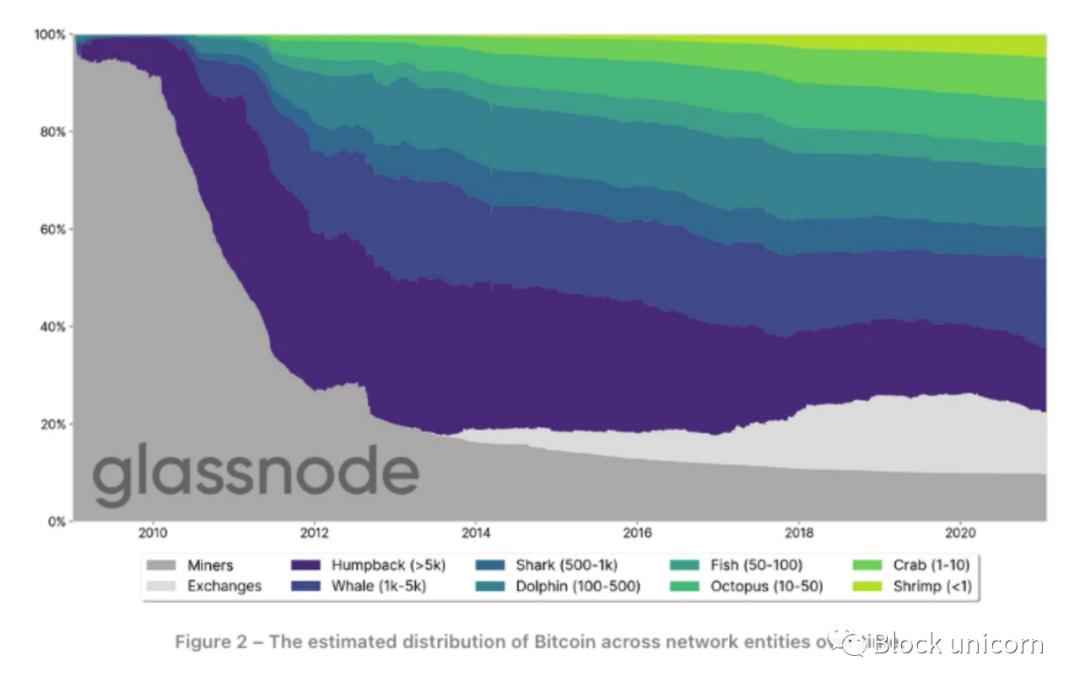
I like this statistic because it violates the spec. In general, high-risk/high-growth asset classes (i.e. tech startups) are not readily accessible to the average retail investor. Cryptocurrencies are unique in that they are both high-risk/high-growth and easily accessible.
Seeing retail investors own 10%+ of assets, you might think it would be refreshing to still find product-market fit and a strong indicator of a potential shift in wealth distribution .
Geographic perspective
Geographically, Web 3 is more diverse than Web 2. San Francisco and New York are undoubtedly hubs of activity, but they're not as dominant as Silicon Valley and Seattle were 20 years ago.
The default work schedule for today is "remote first". You can be anywhere, which means startup teams are more geographically diverse. For the first time in my life, most of my co-workers are based outside of the US (which also happens to be one of my favorite aspects of working in this industry).
The best people are everywhere.
Two other market forces that affect crypto and Web 3 talent and companies—regulation and taxation.
States with no state income tax like Nevada, Texas, and Florida, and countries with favorable capital gains treatment like Puerto Rico and Portugal, have seen a massive crypto brain drain .
For companies, regulations and taxes can affect your base of operations. FTX, now one of the world's leading exchanges, recently moved its global headquarters from Hong Kong to the Bahamas, mainly for regulatory and tax reasons. Such a move would have been unrealistic for the previous generation of tech companies, who needed to be where the talent was.
Value Capture
Web 3 value capture is already more decentralized than Web 2
It starts with ownership, and decentralized networks and applications are owned differently than their Web 2 counterparts. For example, protocols that issue tokens typically allocate 50% or more of the total supply to the community through airdrops, grants, rewards, etc. This means that founders, early team members, and investors hold Token 50% reduction, and more than 50% held by users and early backers.
Value capture is also naturally more decentralized, with blockchain and Web 3 protocols generating a lot of revenue, but not by one company. Instead, fee revenue is distributed among miners, validators, stakers, and liquidity providers.
Now you could say that these stakeholder groups are simply replacing employees in traditional corporate structures. While there is some logic in this, the absence of an intermediate entity with centralized ownership means that the value captured by decentralization is more decentralized.
Summary
When I write this question, my mind Economics of ownership emerges here (about the economics of ownership of Web3). The number of assets being created is growing exponentially, and access to these newly created assets is increasing every day.
How will the ownership economy, especially NFTs, affect wealth distribution? One thing I'm confident about is that it's becoming more geographically diverse, I'm sure it won't become as concentrated.
Original link
Welcome to join the official BlockBeats community:
Telegram Subscription Group: https://t.me/theblockbeats
Telegram Discussion Group: https://t.me/BlockBeats_App
Official Twitter Account: https://twitter.com/BlockBeatsAsia
 Related Articles