Popular science | influence of culture in DAO
Issue #26: How You DAO
原文作者:Andrew Beal
DAOrayaki
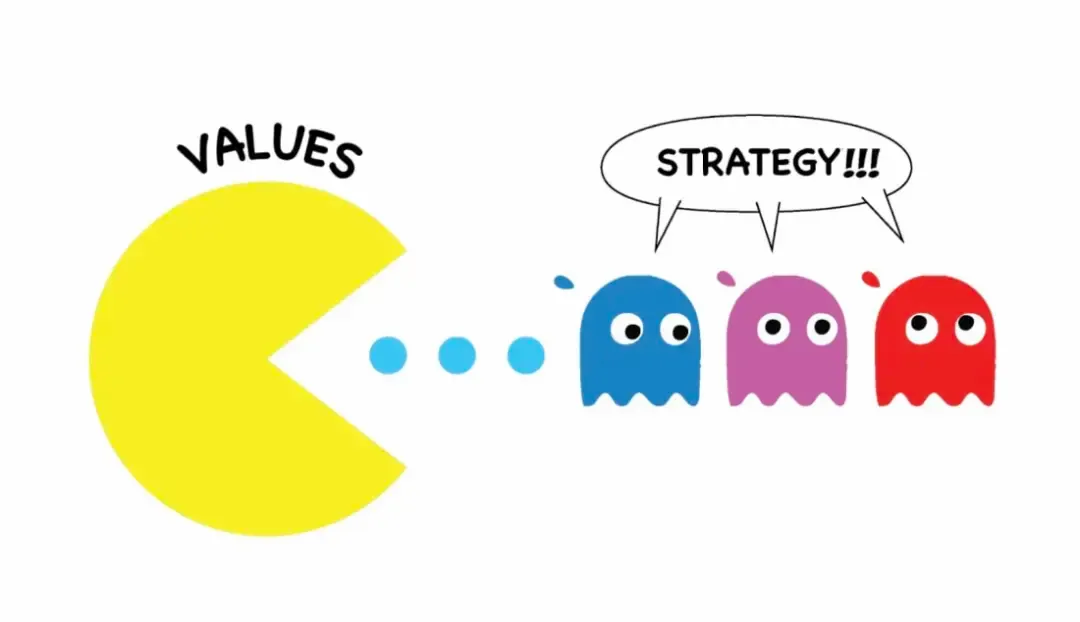
Culture, as the business adage goes, eats strategy for breakfast. Organizations are made up of people, and their culture determines how they behave. The best strategy in the world cannot overcome behavior that is contrary to an organization's mission and values. At least not for long.
Now, culture is a fuzzy thing. You know intuitively what it is, but it's hard to define.
I admit I didn't fully understand what culture was until I read Ben Horowitz's book, "What You Do Is Who You Are." It's a great read for anyone who wants to better understand the hows and whys of culture.
Your organizational culture is about how to make minute-by-minute decisions day in and day out. How long does it take to respond to customer emails? How do you welcome new employees to the team? Who speaks during the meeting?
It is also a fluid thing, always mixing in different directions. That's why great cultures are so powerful, and why toxic cultures are so destructive.
Culture is obviously an important part of any company. But what about decentralized projects... Is culture a thing? Does that matter? Now that I'm working at DeFi, I'm starting to think about a lot of these questions.
My conclusion is that culture is actually more important for decentralized programs than for traditional organizations.
Let's zoom in...
Why is culture important in a decentralized organization?
Reason 1:
Culture is important to the DAO for the same reason it is important to traditional organizations. They involve people.
There is a misconception that DAOs in particular do not need people because smart contracts govern everything. This is clearly wrong.
The best comparison I can think of is that smart contracts are to DAOs what internal rules are to traditional organizations. A charter describes how an organization operates. What they don't do is run businesses. You can have a perfect set of regulations and a failing business. Similarly, smart contracts describe and enforce the operational mechanisms of DAOs. What they don't do is make business decisions.
How should the web evolve? Should fees be increased or reduced? What assets should be supported? Who should we hire?
People make these decisions. Smart contracts enforce and enforce decisions made.
This is a long introduction to the first answer to the question... Culture matters because people engage with it.
When you have a group of people working together to get something done, the culture determines how those people work. This is an organization of how to distinguish between success and failure, centralized or decentralized.
Reason 2:
Culture is important to the DAO because it is the most enduring and pervasive force in the absence of a traditional leadership structure.
In traditional organizations, culture starts at the top. The founder or executive sets the cultural tone and leads by example. Whatever culture their actions create will gradually be accepted by the rest of the organization, for better or worse.
A culture that reinforces the mission and values a team needs to succeed can be a good one. A culture that reinforces behavior that runs counter to the team's mission and values is likely to be a bad culture.
If a company finds its culture going off course along the way, there is a leader or leadership team that can right the ship. In 2017, we watched Uber's navigation very publicly. The ability to make changes quickly is one of the main benefits of a centralized governance structure.
Truly decentralized organizations are usually flatter. They lack the hierarchy and leadership structure we see in traditional organizations. In these cases, the role of culture and values is enhanced. In the absence of a CEO and management team, DAO contributors take their cues from the mission, values, and culture established early on. People will come and go, but the culture of the community remains.
How is culture formed in DAO?
Spoiler... Any decentralized project, whether it's a public blockchain, DeFi protocol, or a service DAO, does not start with decentralization. Everything has a creator. This means that a project is managed by one person or a small group of people for a period of time.
Bitcoin, Ethereum, MakerDAO, And Forever. That's how they all started.
Another spoiler... Even after the "decentralization" of many projects, most projects are still controlled by the original insiders (because they hold a large token supply).
That's not a bad thing. In my opinion, this is actually the best way to introduce and extend something new.
Because decentralized projects often start the way traditional companies do, culture is formed the same way.
Culture begins with the founder. The way they act every day sets the benchmark for everyone else. As companies grow, it's hard to lead by example because founders don't interact with everyone every day. To encourage certain behaviors, leadership adopts and institutionalizes a set of values. They write them down, communicate them, and hope to reinforce them.
The same thing happens in decentralized organizations.
The people who start a decentralized network or DAO behave in a certain way. As the network or DAO evolves, newcomers take cues from early contributors.
This model is now frustrated by truly decentralized organizations, as founders eventually take a step back from the control they exercised earlier. So what happens to the culture?
Ethereum is a good example. Vitalik Buterin, one of ethereum's founders (but actually the project's leader), stepped back from his role as founder because he knew it was in the long-term interest of the Ethereum network. Fortunately, Vitalik's mission and culture and the team it created early on are so strong that they have not only survived the decentralization process, but have become the ethereum ecosystem's most valuable asset.
With intent, culture can be strengthened and perpetuated as the number of contributors increases.
Sometimes the opposite is true. Without intent, cultures can split. Contributors to a decentralized organization revert to their default way of operating. Everyone is autonomous, and it's easy to lose the collective goals and values that drew people to the project in the first place.
What is a good DAO culture?
Believe it or not, the ingredients of a good DAO culture are the same as the ingredients of a good company culture.
1. Clear tasks. People need to know why they are contributing. A clear mission gives everyone purpose, and purpose is a basic need for all people. It also helps to keep contributors. The most committed and passionate contributors will continue to support your mission as long as you are making progress toward it. Without this, people tend to jump at the first sign of trouble, or when something new appears.
2. Strong values. What behaviors would you like to define in your community? Establishing a set of core values as a standard for future behavior is important not only for existing DAO contributors, but also for new contributors.
3. Early. Timing is important. Establishing a clear mission and a strong set of values early in the DAOs life cycle will give you a cultural foundation that will not diminish as the number of people grows. If you're not aware of these components early on, you'll end up with the mission and values of the loudest voice in the room (as a rule of thumb, these are usually not the values you want).
4. Strengthened by leaders. Establishing mission and values is only half the battle. Values need to be constantly reinforced in the actions and decisions of community leaders. Sometimes that's the founder. Other times they are members of working groups or committees, or contributors with large social media followings.
Every DAO contributor should feel like an owner and be responsible for the success and culture of the project. This is a sure way to maximize the value you get from each person.
One of the best examples of these ingredients in action is Index Coop, a decentralized asset manager that creates and maintains crypto Index products. Index has a community handbook that Outlines the principles of cooperative operations, cooperative communities and the people involved in cooperatives.
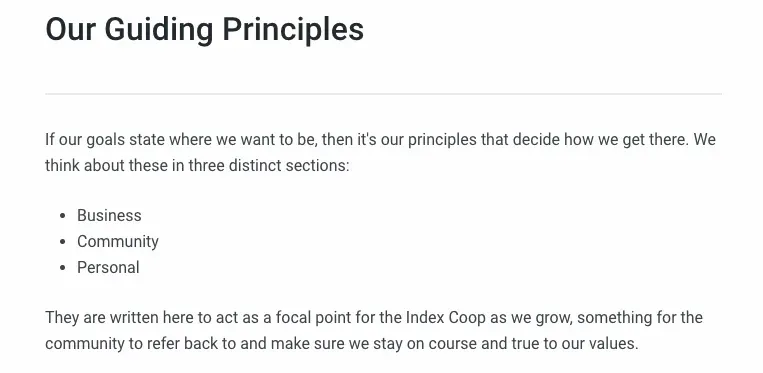
The existence of this document is a testament to its intent that it is the North Star of existing and new contributors.
This kind of documentation is not common in decentralized projects, but I expect it to become the standard for DAOs, especially in the future.
Other great cultural decentralization programs include Friends with Benefits, Yearn, SushiSwap, KrauseHouse and Llama. All of these projects have very clear, simple missions and strong values. In Clausehouse's case -- referring to former Chicago Bulls GENERAL manager Jerry Krause -- the mission was to acquire an NBA team (one of the most ambitious DAOs to date). For Llama, the mission was to help manage the crypto Treasury.
Piecemeal ideas
Thinking about the DAO's future from a cultural perspective raises a number of interesting topics.
One is the decision structure of the DAO that I've explored before. If they evolve into smart contract companies organized by functional areas (product, finance, human resources) rather than true decentralized, flat ecosystems, cultural factors can be managed as in traditional organizations.
Another is "stickiness". Communities are transient, barriers to entry are low, and there is little effort or discomfort to leave. This affects retention, which is just as important for DAOs as it is for traditional organizations. What keeps people in the same job for years? A lot of this has to do with the process of finding and finding new jobs. It's a tough job. But it's also the sense of purpose people feel, the security of pay and benefits, and the sense of responsibility that comes with working in a team with other people who expect you to show up every day and get the job done. You don't want to let the team down.
How do you create a DAO structure and culture that improves retention? I don't have all the answers, but a higher barrier to entry coupled with a strong sense of mission and ownership seems like a good place to start.
The original link
Welcome to join the official BlockBeats community:
Telegram Subscription Group: https://t.me/theblockbeats
Telegram Discussion Group: https://t.me/BlockBeats_App
Official Twitter Account: https://twitter.com/BlockBeatsAsia
 Related Articles