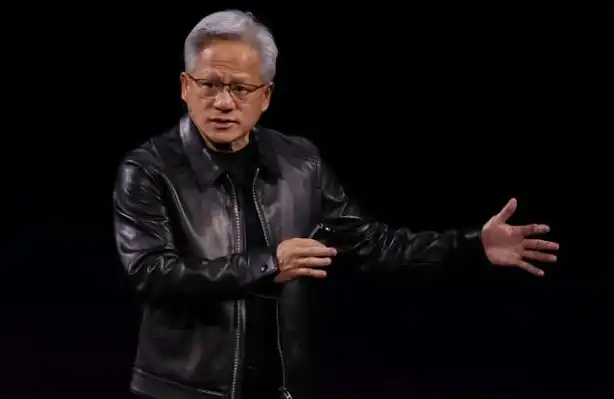
Why did Washington agree to Jensen Huang's reinstatement at Nvidia?

Original Title: "Why Washington Agreed to Let Jensen Huang Return to Nvidia"
Original Author: Worth Noting
Monday, November 23, 2026, 4:38 AM Eastern Time.
A piece of news that seemed unrelated to Nvidia appeared first: chip design company Arm announced that CEO Rene Haas had renewed his contract through 2033 and would simultaneously serve as vice chairman of SoftBank Group. Ten days earlier, the Nvidia board had been searching everywhere for someone to succeed Jensen Huang, and his was the first door they knocked on.
More than four hours later, before the U.S. stock market opened, Nvidia's official website posted an announcement of fewer than six hundred words: the board unanimously approved the reinstatement of Jensen Huang as President, Chief Executive Officer, and Director, effective immediately. Pre-market trading screens jumped almost simultaneously, and the stock surged more than 30% after the opening bell.
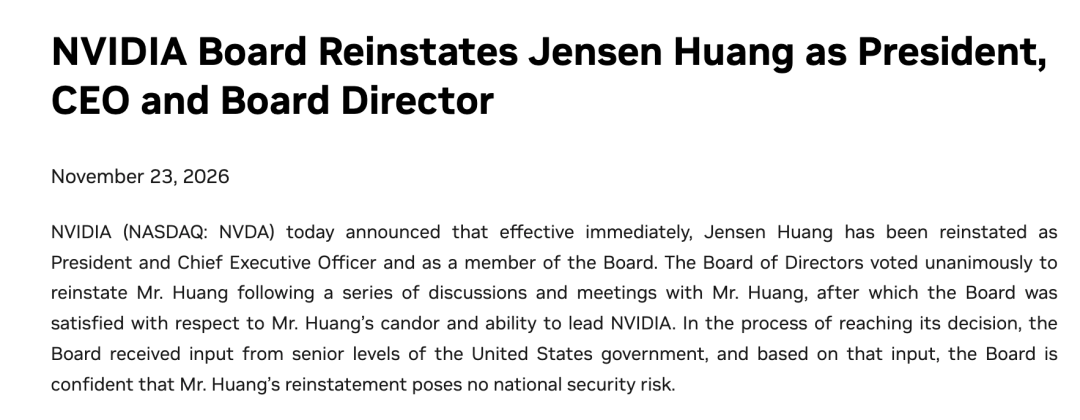
It had been exactly eleven days since he relinquished those three titles.
Eleven days earlier, Jensen Huang—a man who had always answered emails within minutes and could dress down executives in meetings until they couldn't lift their heads—had completely lost his fire. Bloomberg later revealed that on the eve of his resignation, his replies to company emails grew slower and slower, he began frequently typing "whatever" and "I don't care," and he cursed himself as "a piece of shit" to those around him. In those days, a personal conduct scandal compounded by Washington's doubts had pushed him out almost overnight.
The palace coup itself was hardly a suspense. The rift between the White House and the Republican Party had long been impossible to hide: 55-year-old Secretary of State Rubio leaked a memo drafted in the spring to the media, offering a loyalty pledge to the party's hawks; Treasury Secretary Bessent, nursing a grudge over Commerce Secretary Lutnick's delays on chip controls, seized the moment to direct the fire at Nvidia.
These internal fractures are all established facts. That is precisely why the reinstatement announcement of November 23 is so intriguing—it explicitly states: "In the course of reaching its decision, the Board received input from senior levels of the U.S. government, and based on that input, the Board is confident that Mr. Huang's reinstatement does not constitute a national security risk."
How did Rubio and Bessent, who eleven days earlier had been dead set on using Jensen Huang to establish their authority, both reverse course within just a few days?
The answer can only lie in the seven days between November 16 and 22. Trump, Bessent, and Rubio clearly reached a new agreement. Each party took away the chip it wanted most, the internally fractured group that had been on the verge of falling apart closed ranks again, and only then did Jensen Huang receive his pass back to Santa Clara.
Bessent Got the Pen
The first signal that the deal was landing came from Treasury Secretary Bessent.
On Sunday, November 15, he appeared on Fox News' morning program. On camera, Bessent wore a stern face and issued an ultimatum to Nvidia's board: explain the export compliance issues within ten days, the company needs a thorough overhaul, find a new CEO, "must look outside the company."
By then, the money betting on Commerce Secretary Lutnick's ouster on prediction markets had surged to 63%. Over the past six months, Bessent had been nursing a bellyful of frustration at the White House: in May of this year, he and White House Chief of Staff Wiles spent months grinding out an executive order to review AI models, only for it to be torpedoed at the last minute when David Sacks, who had just stepped down as White House AI czar, called Trump; by November, the Treasury Department, State Department, and Office of the U.S. Trade Representative all supported adding Megaspeed — suspected of chip transshipment — to the Entity List, yet Commerce Secretary Lutnick, who controlled export licenses, sat on it.
In a November 13 interview with CNBC, Bessent practically pointed his finger at his colleague: "Everyone has supported sanctions for months, but the pen is in Commerce's hands."
While that pen was in Commerce's hands, how much product got approved? On November 19, the House Foreign Affairs Committee released a report that flipped the ledger wide open: as of May 11, 2026, Nvidia and AMD had cumulatively applied to sell more than 3.4 million H200 and MI325X chips to China-affiliated entities, and the Commerce Department's Bureau of Industry and Security (BIS) approved 879,868 units. The names on the list were all well-known Chinese companies — the ones whose apps are installed on everyone's phones.
Eight hundred seventy-nine thousand eight hundred sixty-eight. That number, printed in a congressional document, would make anyone gasp.
The first bargaining chip in the deal was putting that pen in Bessent's hands.
On November 16, BIS issued an "interim final rule" — in Washington's administrative process, those six words mean skipping public comment and going straight into effect. The document specifically noted its origin: the rule was personally drafted and directed for issuance by the Treasury Department and the National Security Council.
On November 19, the new rule officially took effect. It closed the very loophole that had given Bessent the biggest headache: previously, chips weren't shipped directly into restricted regions but instead sent to Singapore, Malaysia, Thailand, Indonesia, and Brazil to build data centers, then provide computing power via remote connections — old rules didn't cover that; now, chips shipped to these countries all require licenses, and overseas data centers providing remote computing power have 90 days to complete the paperwork.
The pen returned to the Treasury's hands, and Bessent immediately softened his tone.
On Friday, November 20, Bessent, who had just returned to the US after his Asia trip, appeared on CNBC again. This time, his tone had softened: "Appropriate chip restrictions are already in place, remote access has been curbed, and there is no need to add further restrictions on older chips."
Two days later, on Sunday, November 22, in the CBS studio, host Margaret Brennan was not about to let him off the hook and cut straight to the point: "The president said Jensen Huang should get his job back, and you previously said the board needed to look outside for someone."
Bessent paused on camera for a moment, then smoothly delivered a tongue-twister of a line: "I did say we should look outside, but Jensen Huang is now outside."
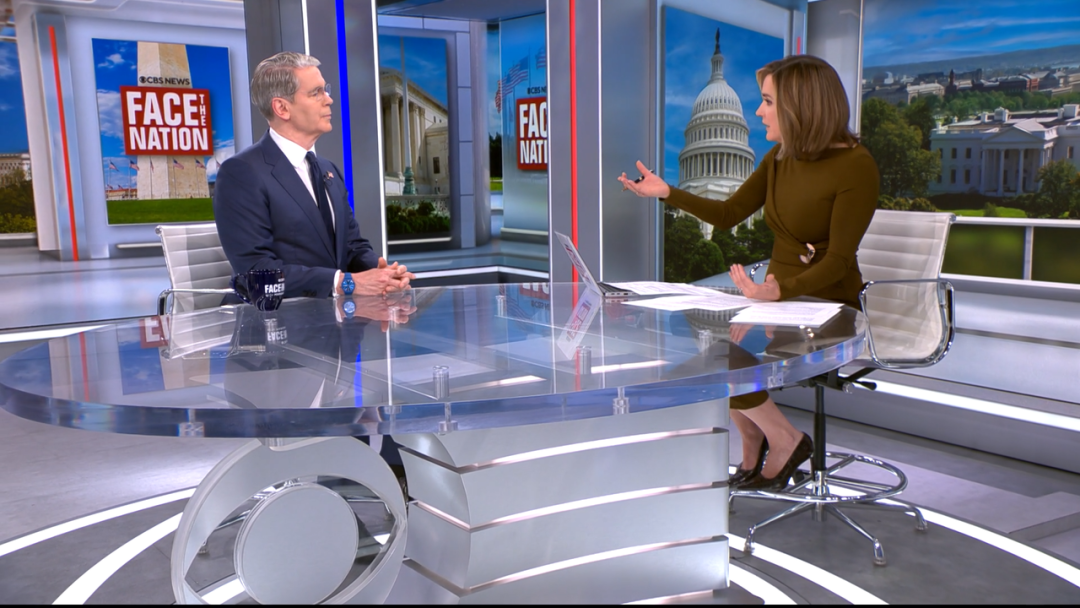
Washington officials never waste words. The fact that he was willing to find himself such a far-fetched way out on a Sunday morning show only proves one thing: the deal has been signed, and what he wanted is in his pocket.
Rubio switched positions
Bessent took the substantive power over the rules, while the signal Rubio released was even more direct: he publicly put away his opposition to Trump.
Within the Republican Party, Rubio has traditionally belonged to the traditional hardline faction on Russia and had previously resisted direct contact between Trump and Putin. Coupled with the fact that in early November he had just used a classified memo to distance himself from the White House on the AI issue, the outside world originally expected that he would continue along this line and further separate himself from the president.
The turning point came on November 20 in the White House press briefing room. Trump stood in the middle of the podium, with Vice President Vance and Secretary of State Rubio standing on either side. Facing fierce criticism from the outside over Trump's direct meetings with Putin and other heads of major powers, Rubio proactively walked to the microphone and backed up the president.
He said that for several countries possessing the vast majority of the world's nuclear weapons, "the idea that these leaders should not engage regularly is not only absurd, but dangerous." Changing tack, he added that maintaining direct communication between heads of state makes it easier for trade negotiators and diplomats to do their work afterward, and that "these meetings are invaluable."
A secretary of state who truly intended to keep opposing the president would not say such things on camera.
Putting the two events together, the logic becomes clear: after the midterm elections, 70% of the public in domestic polls opposed building data centers in their own backyards and complained that electricity bills were rising too fast. Rubio, through his earlier memo, had already built up enough of a record with the party's hawks of being able to "check the president and Silicon Valley"; but at this point, even on his most sensitive red line of contact with Russia, he was willing to stand at the front and defend Trump. This itself was a clear statement of attitude: the divisions within the White House had been settled, and he chose to stay on board and keep a firm grip on the secretary of state's microphone, so naturally there was no reason to keep going after Nvidia alone.
Trump's Ledger and the $2.7 Trillion Hole
In this tripartite agreement, the chip Trump most directly wants to keep is simple: Jensen Huang must come back.
On November 16, he told reporters he "wouldn't mind" Jensen Huang returning; on November 20, he said America is a country of "second chances" and hoped Jensen Huang would offer a big apology and then be reinstated; by late night on November 22, he directly named the board on Truth Social: "I want the Nvidia board to rehire Jensen Huang. It's best for the company, and best for America."
In the same week, the White House also floated the idea of designating Nvidia, Microsoft, and other companies as "national champions" in the U.S. AI sector.
Trump is working so hard to protect him, and the on-the-books reason isn't hard to find. On November 16, The Washington Post dug through his financial disclosure filings: at the end of 2024, Trump's personal holdings in Nvidia stock were still between $615,000 and $1.3 million; by the end of August this year, that position had ballooned to $13 million to $62 million. His account had made at least 103 Nvidia stock trades over time, and he was still buying in September, with a single trade as high as $265,000.
Beyond his personal account, there's also the government's purse. When the White House greenlit H200 sales last December, it set the rule that the U.S. government would take a 25% cut directly from sales revenue.
More importantly, Wall Street's slump those few days was simply too ugly to ignore.
After the close on November 17, Nvidia reported its fiscal 2027 third-quarter results: quarterly revenue of $115.8 billion, more than doubling year over year (103%), with GAAP net profit of $65.3 billion. Even by the standards of business history, this was a scorecard that left people speechless.
But the market looked at the numbers and kept selling. From the all-time high of $239.24 on October 6 through seven consecutive trading days of declines to November 20, Nvidia shed roughly $2.7 trillion in market value, about the equivalent of wiping out an entire Amazon. Investors understood clearly: for a company that has tied its chip architecture, major customer orders, TSMC capacity, and White House relations all to its founder, suddenly swapping in a CFO with the "interim" title makes it hard to sleep at night no matter how pretty the books look.
With a $2.7 trillion hole sitting there, it's not just the Trump family and Silicon Valley financiers who are feeling the pain; even Rubio and Bessent, with an eye on the 2028 election, have no one willing to inherit a mess of a stock market crash and a disintegrating AI leader. This forms the common bottom line that brought the three parties to the table.
The chair in Santa Clara, and the two ugliest faces
Cut back to Santa Clara, California.
Over the past six days, Nvidia's board of directors was actually more tangled up than Washington. On the morning of November 17, Jensen Huang, silent for five days, posted on X to test the waters, saying that if the board thought it was in everyone's interest, he "would be honored to return to the CEO role"; a few hours later at the Q3 earnings call, new chairman Harvey Jones slammed the door shut in front of analysts worldwide, declaring "no intention to reinstate Jensen Huang." That same evening, Semafor leaked the inside story: three board members had been privately pushing for his return.
The next day at the all-hands meeting, interim CEO Colette Kress rarely announced that next year's salary adjustments and equity grants would be moved up to December, but morale still scattered. Rumors spread in Silicon Valley that Jensen Huang might jump to Intel, and the "Stand with Jensen" petition surpassed 178,000 signatures in four days, with about 8,800 claiming to be Nvidia employees.
Even the prediction markets betting real money almost misjudged it. On November 18, the probability of Jensen Huang's return on Kalshi dropped to just 6% to 11%; even by November 23, just hours before the official announcement, the odds on prediction markets had only just climbed to 19%.
Then, opinions from top White House officials were relayed to the board, and at 4:30 a.m., Arm locked external top candidate Rene Haas into a long-term contract through 2033. As soon as the announcement came out, the odds on prediction markets shot up in a vertical line, pinned at 100%.
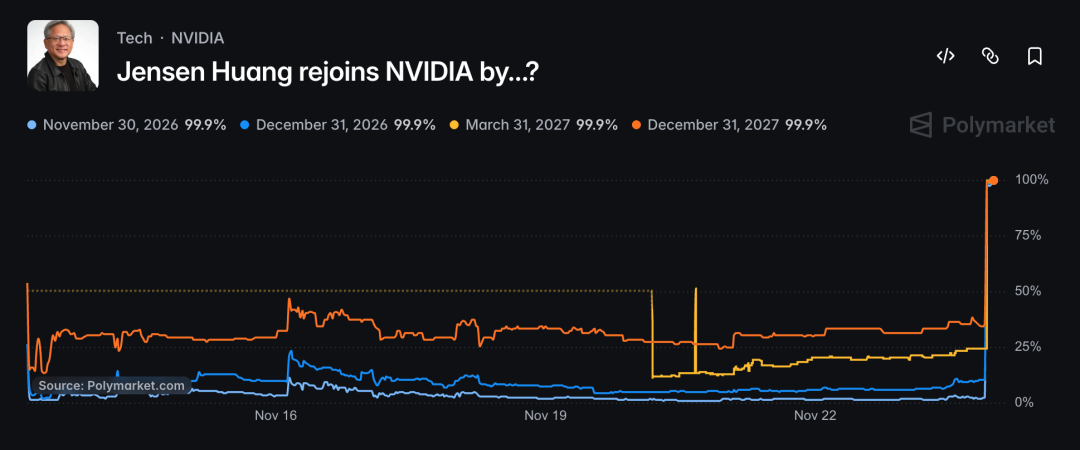
By this point, all factions in Washington had taken the chips they wanted, Jensen Huang kept his chair, and Wall Street was in a frenzy. One hour after the open on November 23, Eastern Time, Nvidia soared 35.64% to $170.28, with market cap returning to $4.1 trillion; AI and chip sectors surged across the board, SK Hynix rose over 21%, Cerebras rose nearly 20%, and SpaceX also rose over 9%.
Only two faces looked especially ugly in this frenzy.
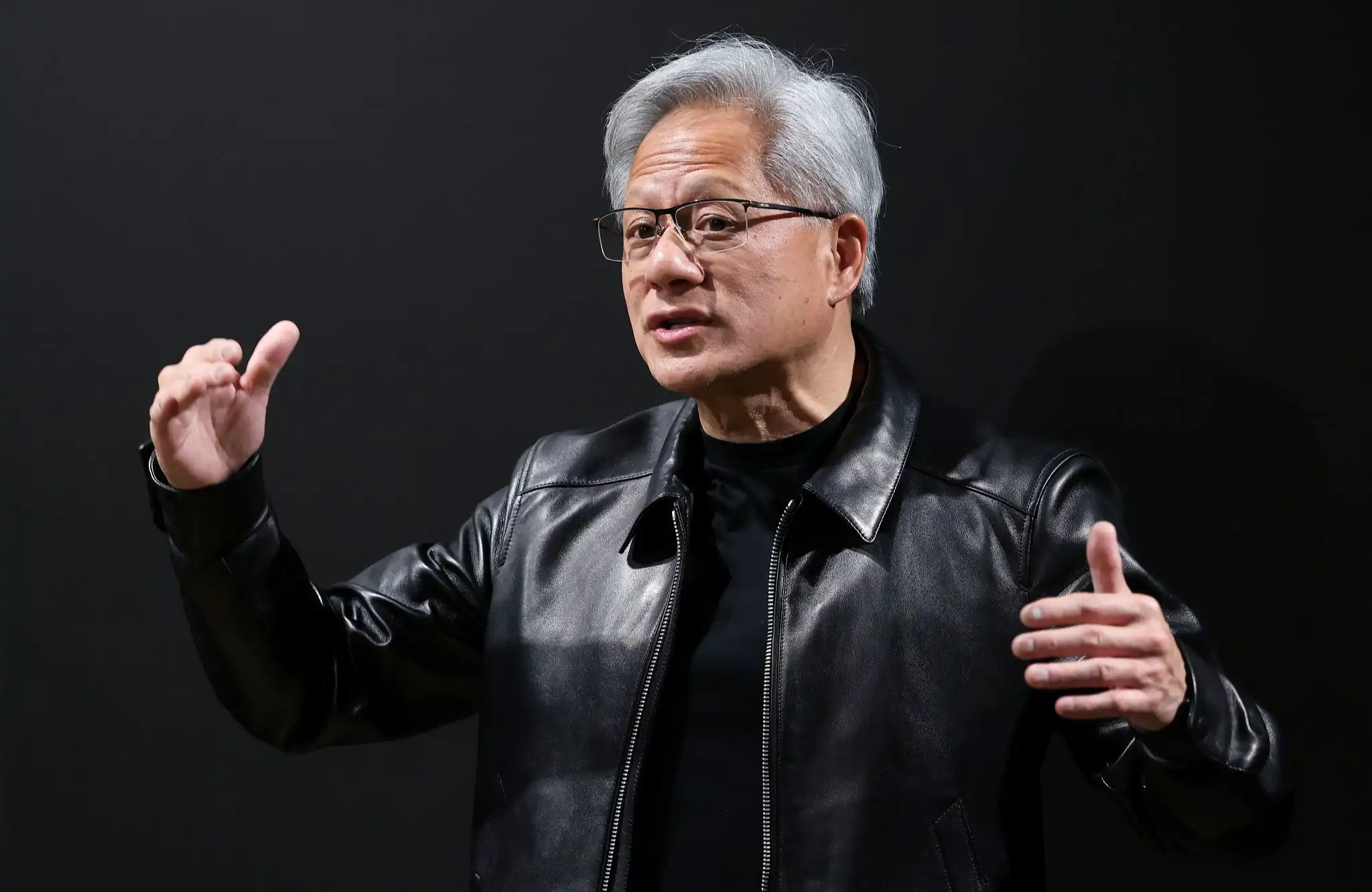
The first is The New York Times. Over the past eleven days, this newspaper ran multiple exclusives that pushed Jensen Huang out, and beyond the reporting, even his iconic black leather jacket wasn't spared—first writing that he "betrayed the leather jacket world," then a columnist penned a sarcastic piece asking "whether an expensive leather jacket worn by a middle-aged man has become some kind of new symbol." The ink on the sarcasm hadn't dried before the man in the black leather jacket sat back down in the Santa Clara office.
The second is Anthropic, which has just landed on Nasdaq. After a stellar debut on November 19, Anthropic plunged 8.5% on its second trading day; by the first hour of trading on November 23, the entire tech sector was surging, yet Anthropic alone opened high and drifted lower, turning red with a 3.42% decline to $85.87, at one point dipping to $84.79 intraday — less than two dollars away from its $83 IPO price.
Over the past year, Anthropic and Jensen Huang have been walking two completely opposite paths in Washington. In 2026, Anthropic donated $40 million to the political action committee Public First Action and saw its federal lobbying spending surge to $5.6 million in the first three quarters, aggressively pushing for stricter AI regulation and chip export controls; while Nvidia under Jensen Huang's leadership has consistently opposed tightening exports and poured heavy money into supporting open-source models and its competitors.
During the most heated days of the controversy, many in Silicon Valley pointed fingers at Anthropic, questioning whether someone had leaked material to The New York Times at the critical juncture of its IPO sprint. That case remains unproven to this day, but the results are now on the table: the White House has reunified its messaging internally, the board has returned the chair to Jensen Huang, and the market has handed both applause and capital back to Nvidia.
As for Jensen Huang himself, at the end of his November 23 reinstatement announcement he left only one familiar line: "I can't wait to get back to work."
Original link
Welcome to join the official BlockBeats community:
Telegram Subscription Group: https://t.me/theblockbeats
Telegram Discussion Group: https://t.me/BlockBeats_App
Official Twitter Account: https://twitter.com/BlockBeatsAsia

 Related Articles