Are 138 funds withdrawing from data center stocks? How are the funds adjusting their positions?

TL;DR
· Reuters' tally of nearly 6,400 13F filings shows that in the third quarter, more institutions fully exited data center stocks than opened new positions, with the power and utilities segment most pronounced.
· This is a segment-by-segment cooling, not a wholesale exit. Semiconductors still have net buyers but holdings are more concentrated; changes in the number of institutions do not equal capital outflows.
· Related names: Vertiv, Digital Realty, Nvidia, Micron, TSMC.
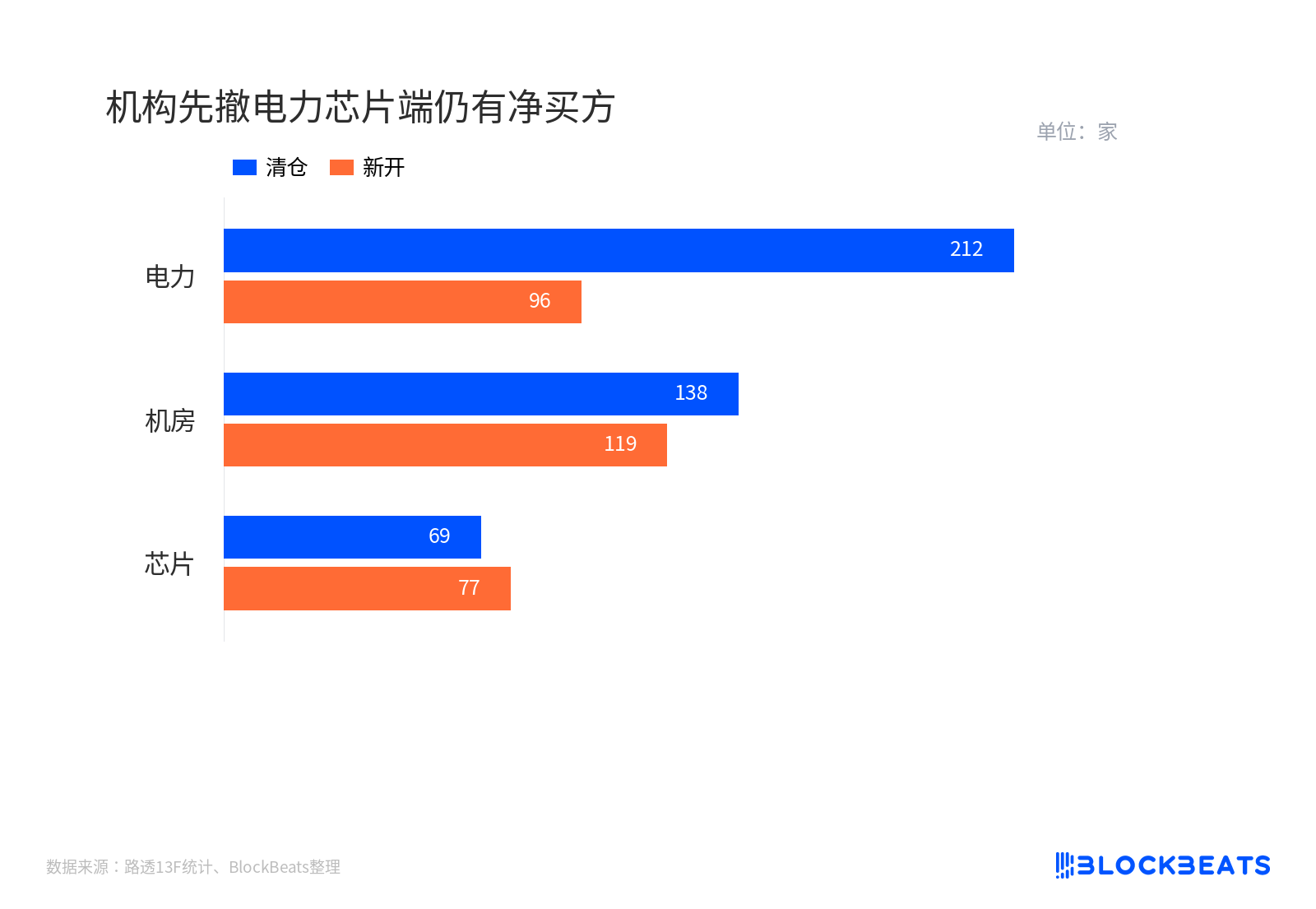
On November 16, Reuters published a tally of nearly 6,400 13F filings. In the third quarter, 138 institutions completely wiped data center stocks from their holdings lists, more than the 119 that opened new positions. The power and utilities segment was colder still: 212 fully exited, while 96 opened new positions.
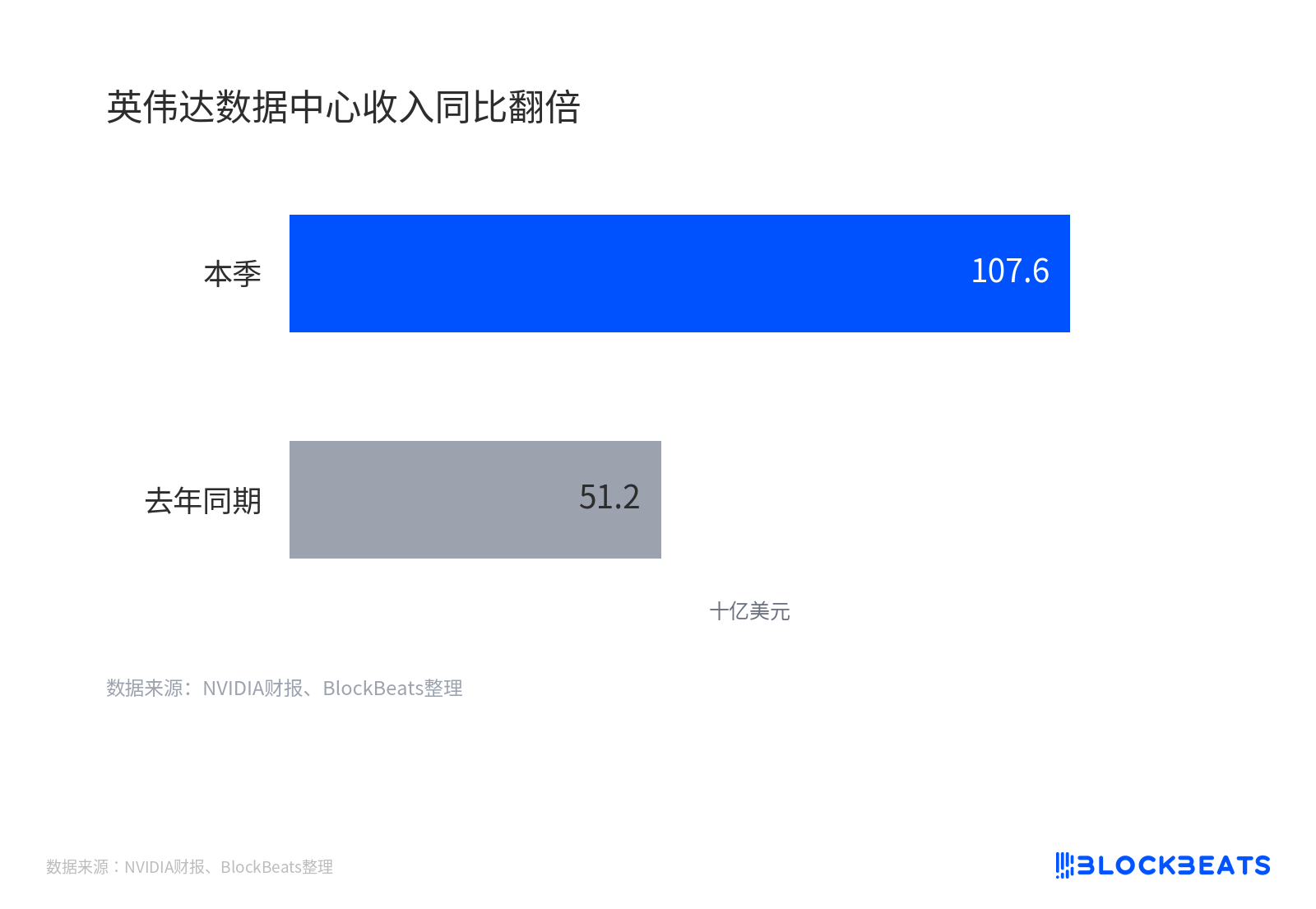
The next day, Nvidia reported results for the fiscal quarter ended October 25, with revenue of $115.8 billion, up 103% year-over-year, including data center revenue of $107.6 billion, up 110% year-over-year.
On one side, institutions are trimming; on the other, earnings are accelerating. The two pieces landed in the same week and read as contradictory, but they are not talking about the same thing.
13F only records holdings on the last day of the quarter
13F requires institutions managing more than $100 million in U.S. equities to submit a list of long positions within 45 days after each quarter ends. It does not explain the reasons for buying or selling, does not include shorts, and does not include most private assets. The holdings cutoff date for this tally is September 30, and most top funds did not disclose until mid-November.
Reuters counted the number of institutions, not dollar amounts. "Fully exited" by 138 institutions means these institutions no longer hold long positions in the stock under the reporting basis; it could be active selling, or positions shrinking below the disclosure threshold, or simply swapping the position into options.
Power and data centers cooled first; chips still have net buyers
The stratification is clear in the statistics. In the power and utilities segment, the number of institutions retreating was more than double the number opening new positions, the most pronounced decline in the entire set of materials. Data center and server farm stocks came next, with more full exits than new positions, but the gap was much smaller.
Semiconductors were completely different. Among institutions that held semiconductors continuously in both the second and third quarters, 2,951 added to positions and 2,584 trimmed, with adders still in the majority. New positions at 77 versus full exits at 69 was also a net increase. The number of institutional holders of AI-related stocks rose by only 33, roughly flat.
Institutions retreat from power and chips first, but net buyers remain
The picture these numbers point to is that the layer most dependent on electricity prices, approvals, and local politics is contracting first—power, cooling, and data centers are all part of it. There are still buyers on the chip side, but buyers have become more concentrated, and marginal institutions are moving out. In the same round of AI capital expenditure, institutions have split different risk tiers and are handling them separately.
Power stocks and data center stocks overlap in classification, and the same institution may be counted once on each side, so the two numbers cannot be added directly.
On the same batch of stocks, several funds did opposite things
According to a summary of public 13F filings, position adjustments by funds with clear names show the extent of the divergence better than aggregate statistics.
Leopold Aschenbrenner's Situational Awareness changed the most. The total disclosed 13F value fell from $20.24 billion to $1.58 billion, IREN was cut by 94.4%, Core Scientific, Riot, Hive, and 4.83 million Micron shares were liquidated, and Bloom Energy and Nebius were converted into call options, nominally accounting for about 66% of the remaining holdings. A contraction of this scale looks more like passive deleveraging and cannot be taken as evidence of active bearishness.
Renaissance Technologies took another path. Nvidia was cut from 7.09 million shares to 23,200 shares, a 99.7% reduction, while Micron was increased by about 619% to 1.52 million shares, becoming its largest holding. It also nearly liquidated Meta, Apple, and Amazon. This is an overall rebalancing of a quantitative portfolio, not a judgment statement on AI.
Opposite moves are equally clear. David Tepper's Appaloosa increased Micron by 28% to about $1.3 billion, accounting for 17.6% of the portfolio, added 31% to Nvidia for 2 million shares, and liquidated AMD and Broadcom. Third Point liquidated Amazon and ASML and built a new 1.5 million-share position in Nvidia. Tiger Global added 7% to Nvidia for 12 million shares.
The result is that on Micron, Situational Awareness liquidated while Appaloosa and Renaissance bought. On Nvidia, Renaissance nearly liquidated while Third Point, Tiger Global, and Appaloosa added. At the same quarter-end, on the same batch of stocks, the directions were completely opposite.
After the snapshot, earnings and pullback happen simultaneously
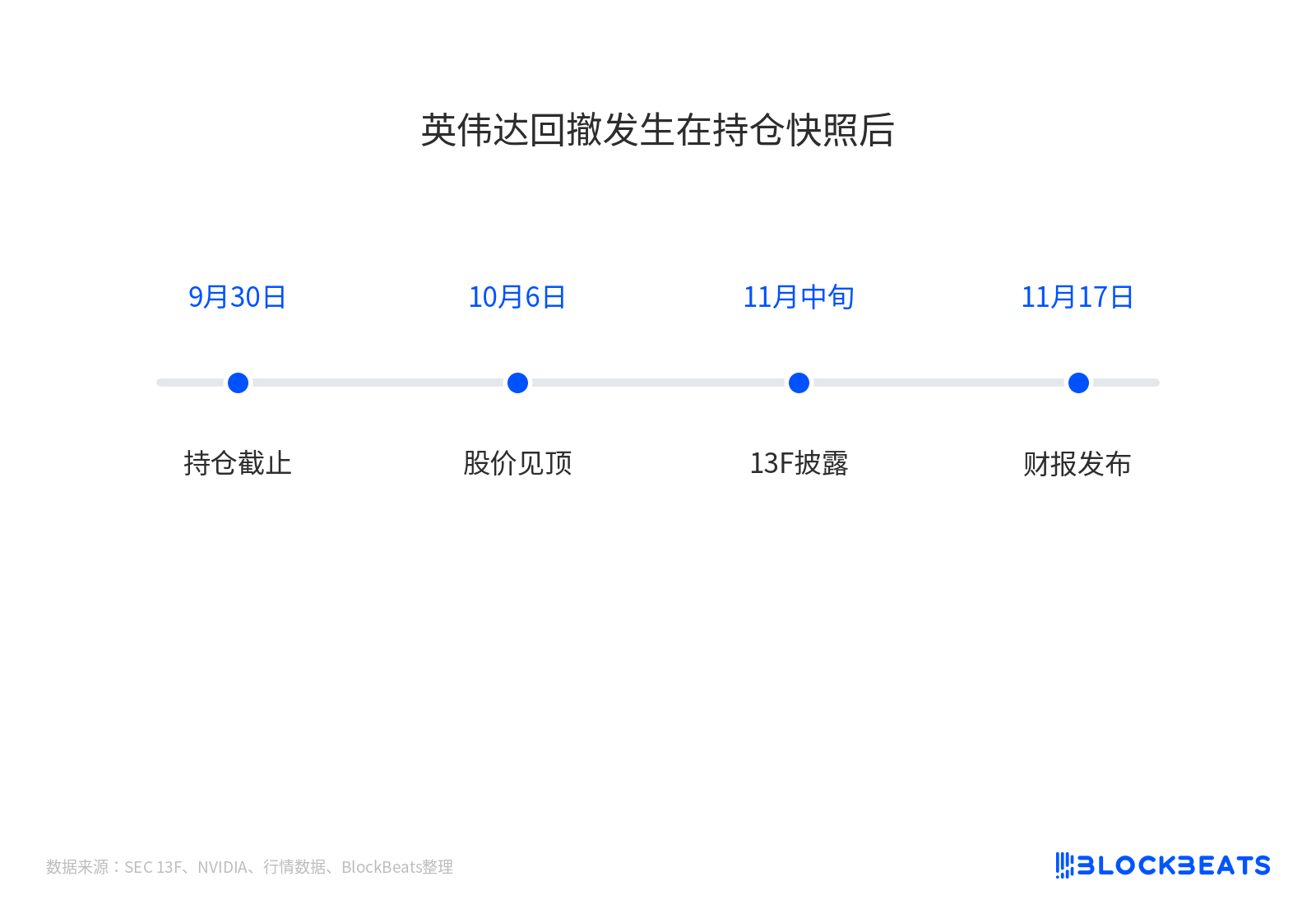
According to market data, Nvidia's stock price peaked in early October and then pulled back by about one-third within a month, a period that falls after September 30. Attributing Renaissance's quarter-end reduction to this pullback does not hold up chronologically: the holdings snapshot predates the decline, and the 13F was not seen by the market until mid-November.
Nvidia's pullback occurred after the holdings snapshot
The earnings report on November 17 provided evidence pointing in another direction. Data center revenue was still doubling, with guidance of $130 billion for the next fiscal quarter (ending in January of next year), and that excludes China data center compute revenue. On the demand side at that time, there was no cooling of the kind implied by the 13F.
Nvidia's data center revenue doubled year over year
The two things can coexist. Institutions reduced the breadth of their physical infrastructure holdings at the end of the third quarter, while chip orders continued to accelerate over the same period. The former trades on electricity prices, approvals, and political risk; the latter trades on the compute shortage.
The unanswered question lies in the time gap. Fourth-quarter 13Fs will not be legally disclosed until mid-February 2027, leaving more than three months of blank space in between. What can verify in advance whether the stratification continues is the next round of capex guidance from hyperscalers, as well as the order metrics of data center and power suppliers such as Vertiv and Digital Realty. If capex guidance continues to be revised upward while the breadth of holders in power and data centers continues to shrink in the fourth quarter, that would indicate the stratification is deepening. If orders on the data center side strengthen in tandem, then this 13F is merely a quarter-end position rebalancing.
Welcome to join the official BlockBeats community:
Telegram Subscription Group: https://t.me/theblockbeats
Telegram Discussion Group: https://t.me/BlockBeats_App
Official Twitter Account: https://twitter.com/BlockBeatsAsia
 Related Articles