Nvidia's revenue doubles but payout policy tightens—who will foot the bill for the next round of AI expansion?

On November 17, Eastern Time, Nvidia released its latest quarterly earnings, once again pushing revenue to a record. After the conference call entered the Q&A session, analysts, in addition to pressing on chip demand, also asked another question: will Nvidia's support for customers take effect only after they first secure financing?
This quarterly report, covering the period through late October this year, belongs to Nvidia's fiscal 2027. The company's revenue for the quarter was approximately $115.8 billion, already more than double that of a year earlier. At the same time, Nvidia is also locking in component supply in advance and providing credit support for some customers to build data centers. Sales growth and the financing arrangements supporting those sales appeared in the same earnings report.
Where does the new revenue come from?
First, break down data center revenue by customer. Nvidia divides it into hyperscale cloud providers, and AI cloud, industrial and enterprise. The latter category includes both new cloud providers offering GPU compute services and industrial and enterprise demand. Reading this mixed category directly as new cloud providers would narrow the view of the customer structure.
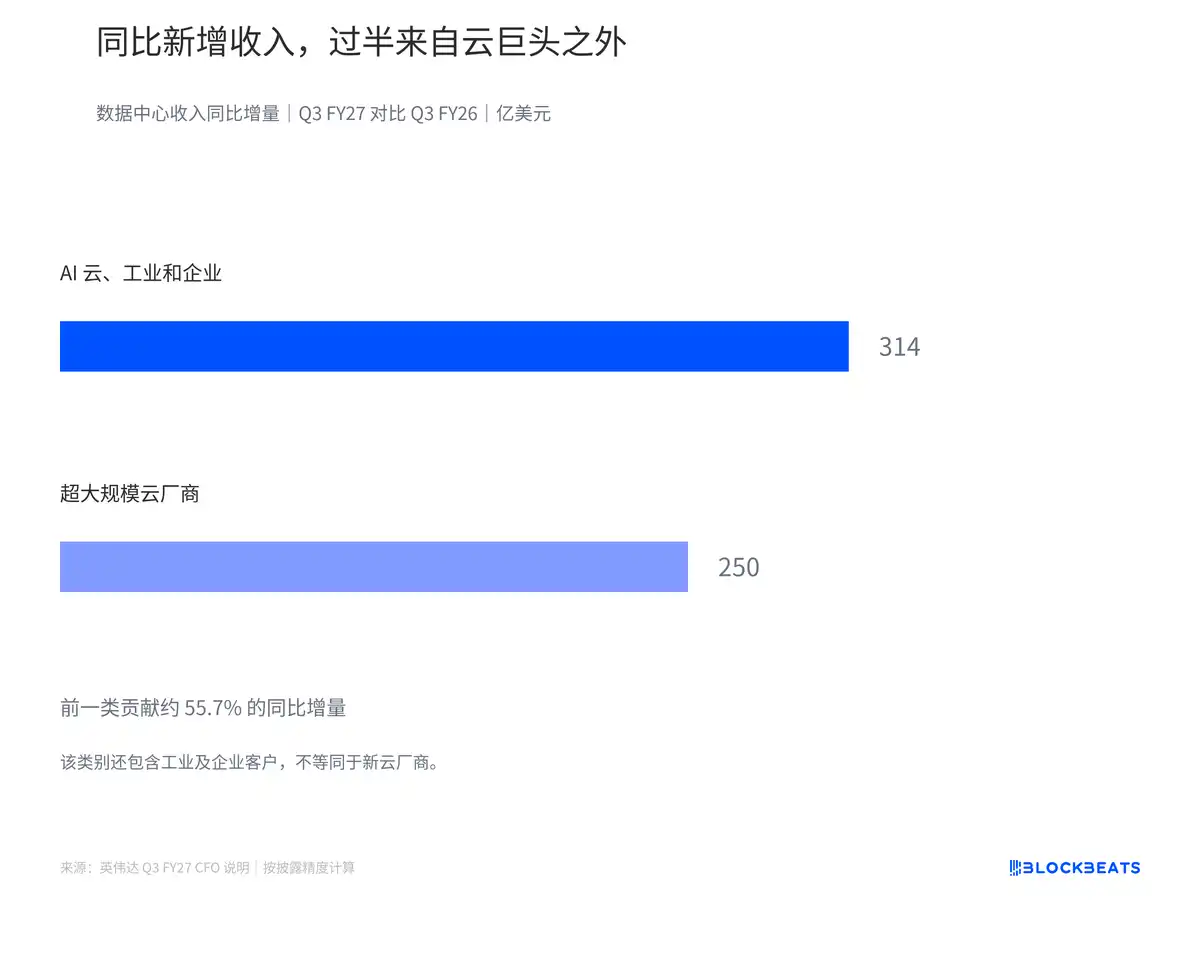
Subtracting the year-earlier period from the current-quarter amount in the CFO's explanation, AI cloud, industrial and enterprise contributed about 55.7% of the incremental data center revenue. In other words, of every additional hundred dollars sold, more than half came from this mixed category. Hyperscale cloud providers remain the larger revenue category, but more of the year-over-year increment has already come from outside them. What is calculated here is revenue increment, and it cannot be used to identify whether each customer relies on Nvidia financing.
Compared with the previous quarter, the result is different again. Hyperscale cloud providers contributed about 61.3% of the sequential data center increment. The longer comparison shows an expansion of the customer base, while the shorter comparison shows that cloud giants are still driving the most recent quarter's deliveries. Both changes are happening at the same time.
On the conference call, interim CEO and CFO Colette Kress said the new-generation Vera Rubin platform had begun shipping, and the AI cloud, industrial and enterprise category also benefited from purchases by new cloud providers and frontier model labs building their own data centers. For Nvidia, more buyers bring more sales opportunities, and also make "whether customers' facilities and funding are ready" part of the delivery question.
Kress also raised the revenue growth forecast for the next fiscal year to about 75% from about 70%, and said the assessment took into account customer demand, supply and customers' ability to obtain funding. This is management's judgment on the scale of future deliveries, and customer financing conditions are also part of that assessment; this forecast cannot be directly regarded as confirmed revenue.
Selling More, So Why Is the Gross Margin Guidance Pulling Back?
The company's guidance midpoint for next quarter's revenue reaches $130 billion. However, next quarter has one more week than a typical quarter, so not all of the sequential increase should be understood as selling faster within the same amount of time.
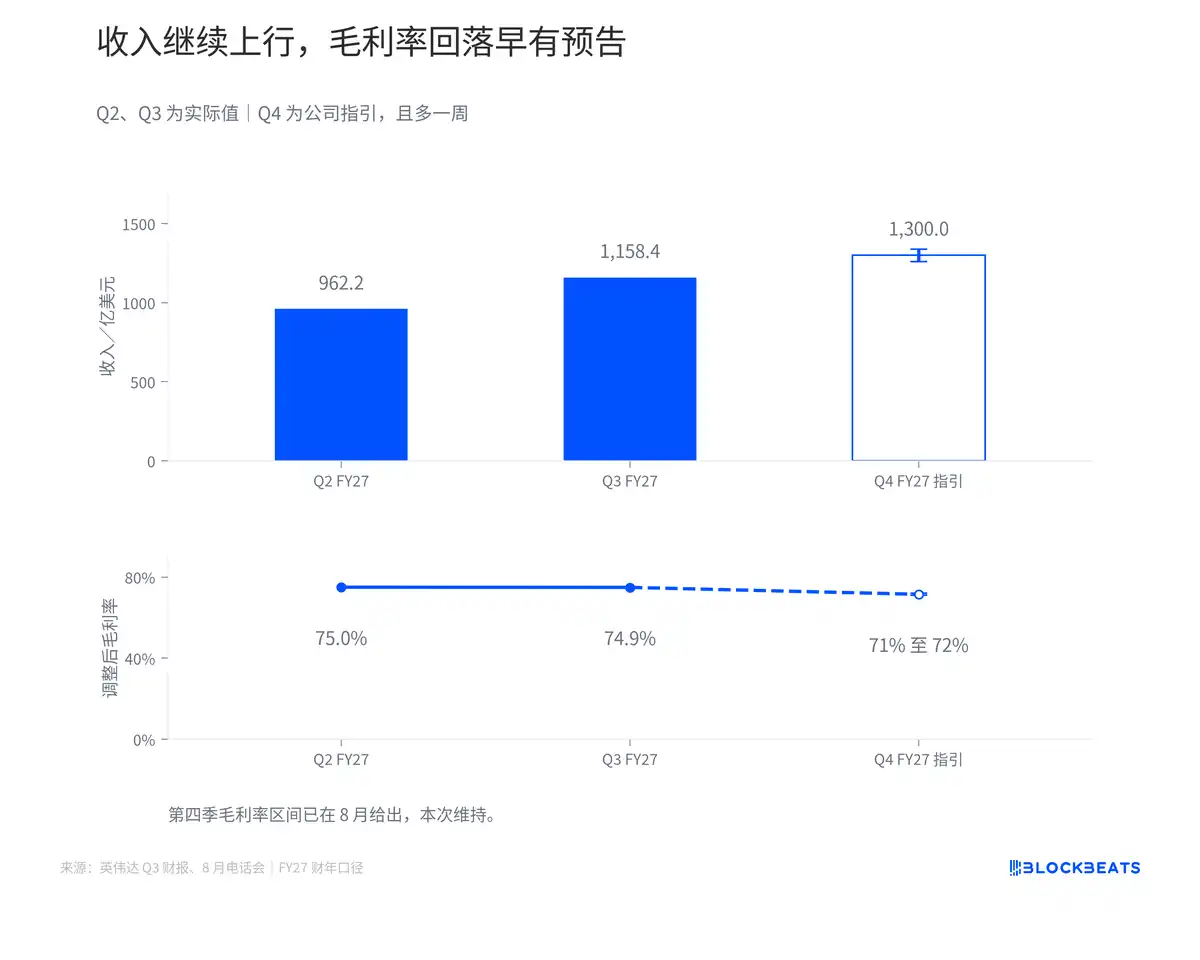
Gross margin, meanwhile, is heading in the other direction, with guidance of 71% to 72% for next quarter. That range was already provided last quarter. According to the corrected transcript of the August earnings call hosted on Nvidia's official website, Kress explained at the time that price increases for components such as memory exceeded prior expectations, and the company needed to reset its gross margin outlook. Growing demand will drive chip sales and also intensify competition for scarce components—heat on the sales side and pressure on the procurement side can rise simultaneously.
In this Q&A, Kress again mentioned the time lag between old orders and new pricing. Purchase orders already placed must still be fulfilled, while the effects of price adjustments will only show up later. It explains how management views this margin shift, but does not yet prove that all subsequent costs can be passed on to customers.
A decline in gross margin means less gross profit is retained per hundred dollars of sales. As long as total sales grow enough, total gross profit can still increase. To judge profit changes, one must also continue deducting R&D, sales, and administrative expenses—this single percentage alone is not enough.
Customer Expansion—What Does Nvidia Need to Bear?
To deliver more systems, Nvidia must first commit to purchases from suppliers. To help some customers build out data centers, it has also participated in another type of arrangement, supporting land, power, building shells, and hardware financing. These matters are all related to expansion, but the timing of spending and the triggering conditions differ.
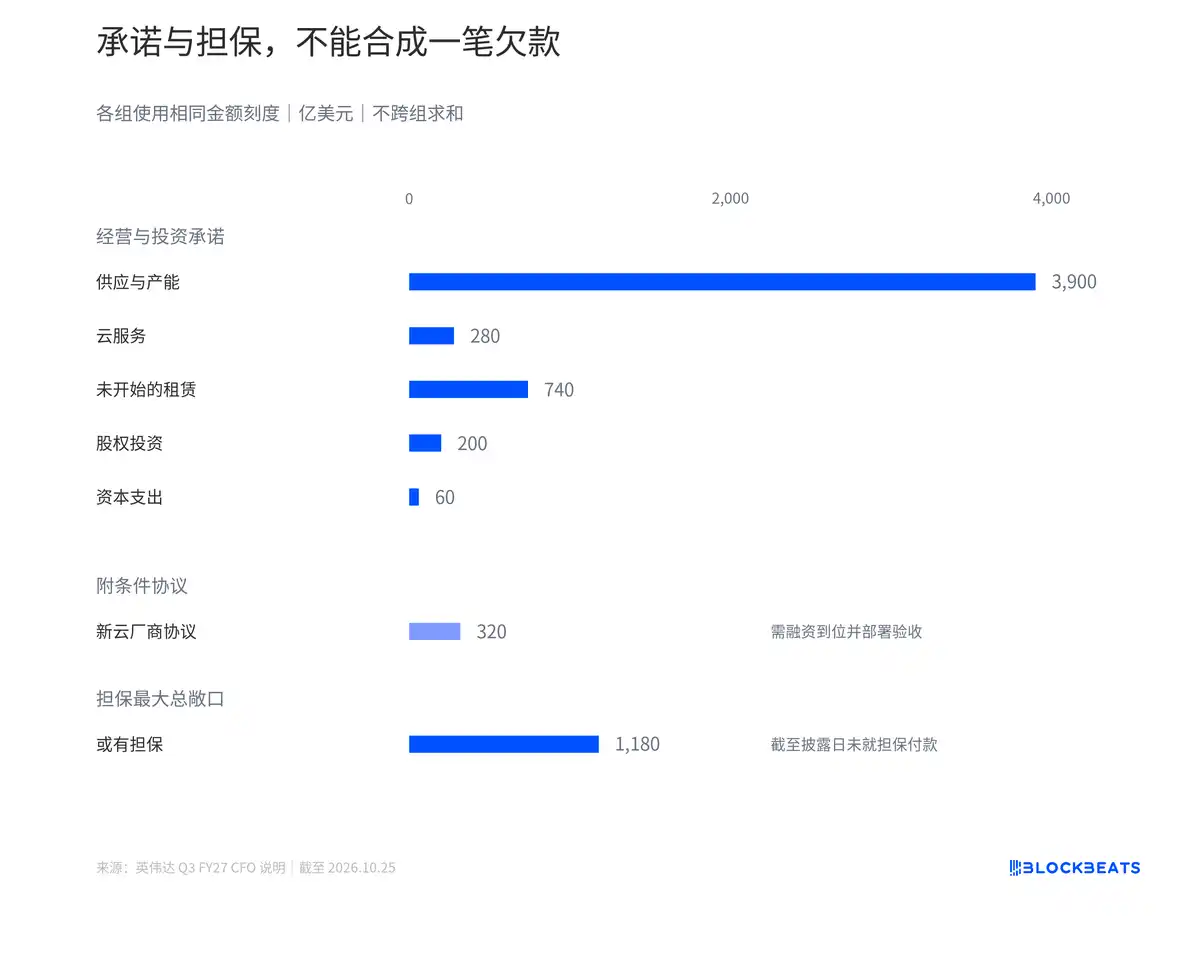
Supply and capacity commitments increased by about 40% in one quarter. The company says the increase mainly comes from multi-year memory purchases. Locking in supply ahead of time is preparation for converting future demand into actual shipments, while also tying procurement plans more closely to future sales. Whether orders can be delivered as expected will affect the economic outcome of these arrangements.
The new cloud provider agreements come with preconditions. Customers must first secure financing to purchase infrastructure, and the related compute capacity must be deployed, put into operation, and pass Nvidia's acceptance. Only after conditions are met do Nvidia's commitments take effect. The company sells equipment on the front end and, when conditions are met, shares in the revenue generated by customers renting out compute capacity externally. This creates a deeper link between equipment sales and subsequent compute operations.
When analysts pressed on whether this means a change in business model, Kress said the relevant conditions already existed and this time they were simply written more clearly. Based on this response, it can be said the company emphasized financing and delivery preconditions; it cannot yet be written that Nvidia has comprehensively tightened support for new cloud providers.
Guarantees are another matter entirely. The company disclosed a maximum total exposure of $118 billion, representing potential payment obligations that could be triggered if the relevant partners default—not cash already spent, nor projected losses. The bulk of this consists of items that take effect in stages as construction is completed and facilities become operational. The company stated that, as of the disclosure date, no guarantee payments had been made.
Accordingly, the third chart groups different arrangements. Purchases are commitments to buy goods in the future, leases correspond to infrastructure usage, and guarantees involve assuming payment obligations on behalf of partners once conditions are met. All are worth tracking, but they cannot be summed across categories into a single amount of debt due immediately.
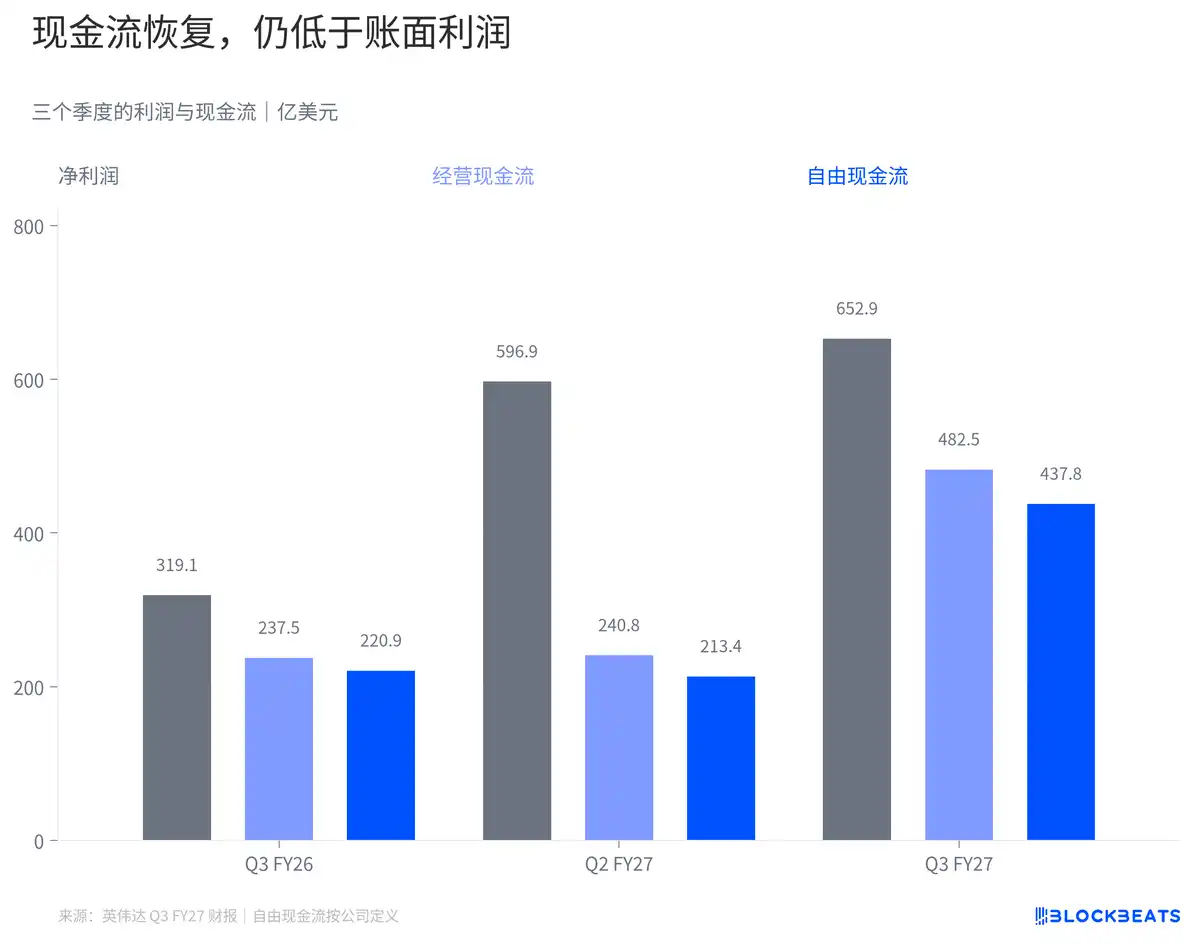
Nvidia's own cash flow is also growing. Per company disclosures, free cash flow this quarter was approximately $43.8 billion, equivalent to roughly two-thirds of reported net income for the same period. This metric deducts purchases of fixed and intangible assets as well as related principal payments from operating cash flow, bringing it closer to the discretionary cash the company generates under that definition—but it is still not the balance after deducting all strategic investments.
The gap between cash and profit can also be traced through working capital. Supplementary financial data shows that changes in accounts receivable and inventory both consumed operating cash this quarter. Equipment already sold but payment not yet collected, or systems still in production, will cause cash flow and profit to be reflected at different times. The company also noted that the quarter-over-quarter rebound in operating cash flow this quarter was affected by the timing of federal cash tax payments, and that a single quarter's ratio is insufficient to judge collection quality.
Nvidia's confirmed equipment revenue and the obligations it bears for customers' future compute operations fall on different timelines.
Welcome to join the official BlockBeats community:
Telegram Subscription Group: https://t.me/theblockbeats
Telegram Discussion Group: https://t.me/BlockBeats_App
Official Twitter Account: https://twitter.com/BlockBeatsAsia

 Related Articles