NVIDIA Earnings Preview: Market No Longer Counting on an Upside Surprise

After the U.S. stock market closed on Wednesday, Jensen Huang will take the stage.
The average analyst expectation is: second-quarter revenue of $92.18 billion, nearly doubling year-on-year, the fastest growth rate in seven quarters, driven by the data center business more than doubling. This $5 trillion company has beaten analyst expectations for 14 consecutive quarters—last quarter saw a 210% year-on-year increase in net profit, while Wall Street's forecast was 126%, nearly twice as much.
In theory, this should be a night to make people nervous.
But the pricing in the options market tells a different story.
What Are the Options Saying?
Traders have priced in a 5.4% post-earnings move, corresponding to roughly a $280 billion market cap change—larger than the total market cap of 90% of the stocks in the S&P 500 index.
It sounds scary, but you have to look at the context: before the May earnings report, the market priced in a 6.5% move; over the past 12 quarters, its actual average post-earnings move was 7.4%. In other words, this time is the calmest expectation in the last two years.
Matt Amberson, founder of the options analytics firm ORATS, hit the nail on the head: "This shows a certain complacency toward NVIDIA, and it also means it has become more predictable."
Chris Murphy, Co-Head of Derivatives Strategy at Susquehanna, put it more bluntly: "When the AI era was just beginning, NVIDIA always managed to surprise everyone, with moves of 10%, 15%, 20%—that phase has basically ended. There are very few people in the market who truly believe they will spring a huge positive surprise, and then the stock will soar."
One piece of evidence is its stock performance this year.
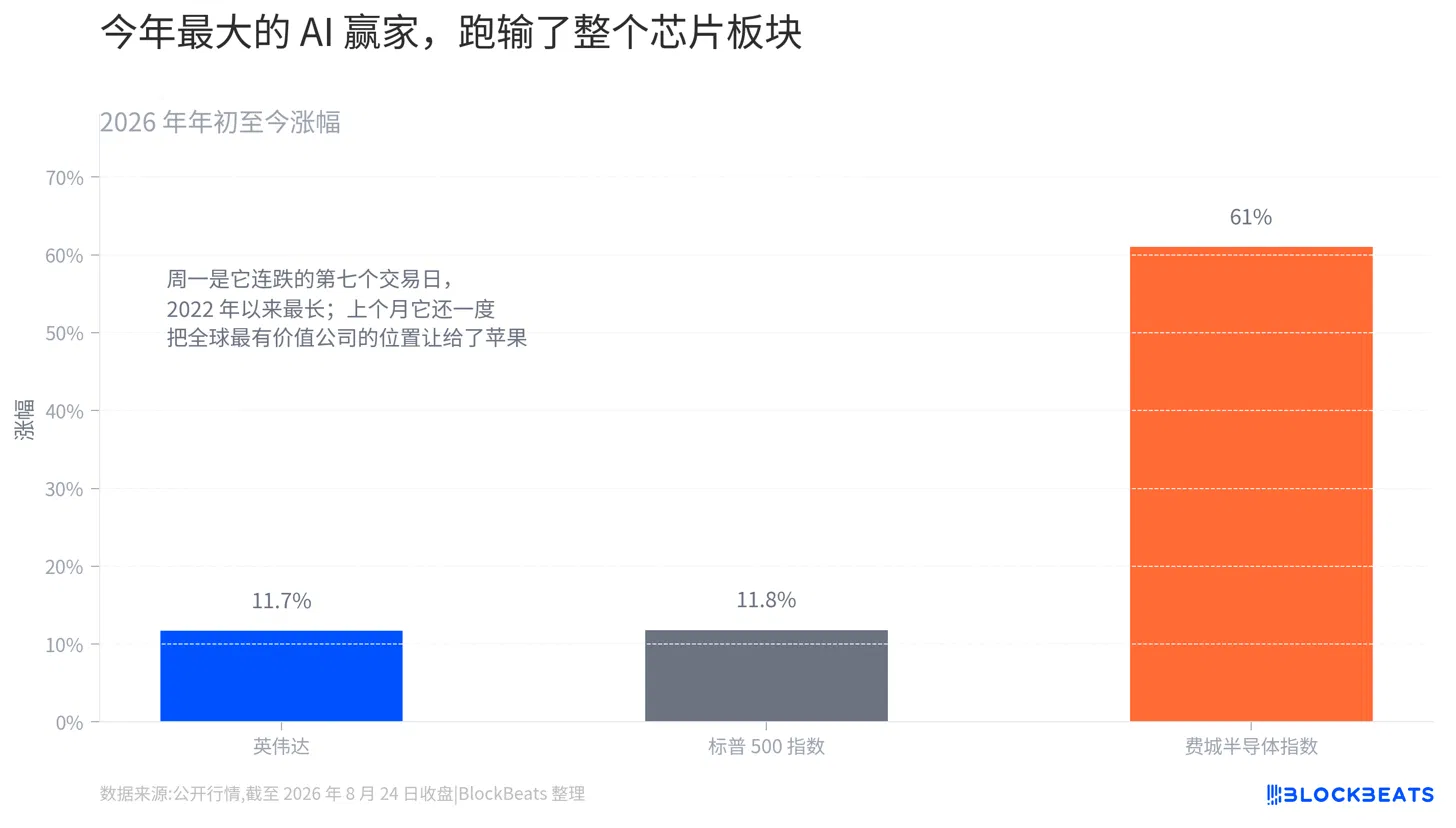
Year-to-date, NVIDIA has risen by 11.7%, the S&P 500 has risen by 11.8%—it slightly underperformed the market. The Philadelphia Semiconductor Index has risen by 61%. The biggest player in AI development has lagged behind the entire shovel industry this year. On Monday, it closed lower for the seventh consecutive trading day, the longest stretch since the start of 2022.
Last month, it briefly ceded the position of "world's most valuable company" to Apple.
In pre-market trading on Tuesday, it rebounded by about 1%, potentially ending this losing streak. However, the driver behind this rebound is more due to Brent crude oil falling towards $89. XTB's Research Director Kathleen Brooks commented: "The change in sentiment is due to the oil price drop."
What Is the Market Really Waiting For?
Fund manager Sara Araghi, of Franklin Equity under Franklin Templeton, made this demand clear on Bloomberg TV on Tuesday: Nvidia needs more than just a pretty earnings report; it needs to specifically outline how it plans to deploy capital and maintain its spending program.
“More details on these investments, the value of these investments—I think the market needs to see that.”
She pointed out a discrepancy: Nvidia's forward 12-month P/E ratio is currently around 21 times, completely out of line with its expected revenue and earnings growth. This multiple indicates that the market has already priced in a growth slowdown.
“It’s been phenomenal,” she said, “but the slowdown is coming, and unfortunately, the market is looking at next year.”
She also provided two specific checkpoints.
First is the gross margin. Nvidia's roughly 75% gross margin is very unusual for a hardware company and will be scrutinized closely in the face of rising raw material costs. To hedge against higher memory costs, Nvidia has already been raising prices: the company's early 2027 servers based on the Vera Rubin and Grace Blackwell architectures will see prices increase by over 15% for key customers.
Second is the use of that money. The reason why earnings growth is important is because it allows Wall Street to be confident “that the free cash flow they are generating is sufficient to support the investments they need to make.” She added, “And they have to use that money to buy back stock.”
Bloomberg Intelligence analysts have issued a similar warning: a routine “beat and raise” may no longer be enough to uplift sentiment.
Where Is the Money Really Flowing?
This is the true theme of this earnings report. Over the past month, Nvidia's actions have gone beyond those of a typical chipmaker:
It teamed up with Wall Street's six largest financial institutions to arrange a $500 billion AI financing plan, committing to backstop loans for customers who cannot afford its chips.
Last week, it agreed to provide up to $105 billion in guarantees for OpenAI to lease a large data center in Ohio, with a 20-year term—this is one of its largest AI financing commitments to date.
Also last week, it acquired Cloverleaf Infrastructure, a company specializing in arranging electricity for data centers.
It also struck a $6 billion deal with the startup Poolside to develop a powerful open-weight AI model.
Zacks Investment Management's Chief Market Strategist Brian Mulberry gave a name to this series of actions: "This makes them some sort of central bank in the AI field." He holds NVIDIA stock but also pointed out the risks: "The real risk is being fully exposed to AI without any diversification. For this to succeed, key is the continuing adoption of AI tools."
"Round-trip trading" is the core question here: If I lend you money to buy my chips, is my revenue really demand-driven, or is it self-manufactured?
Huang Renxun's defense is very straightforward: the logic is simple, the company has ample cash to support those fast-growing but still loss-making customers with this money for construction. He said that the Ohio deal is not a form of round-trip financing.
For this argument to hold, the premise is that those customers will eventually make real money. And recently, the signals have not been good: OpenAI recently told investors that its second-quarter revenue only grew by 18%, while losses are still expanding.
Huang Renxun Tonight Faces More Than Just Himself
NVIDIA's earnings report lands in a very unfriendly backdrop.
The political backlash against AI is growing. Over 500 towns in the U.S. have now restricted data center construction. Bond sell-offs have pushed borrowing costs to multi-year highs, with the 30-year U.S. Treasury yield hitting a 19-year high last week. The once-minting machines—hyperscale cloud providers—are increasingly relying on debt for construction, and this year, Big Tech's data center spending is expected to exceed $730 billion.
Mulberry from Zacks used a metaphor to describe the weight of this earnings report: "It's becoming more like a World Cup final rather than a Super Bowl. That's how big it's getting."
What investors are actually looking for is just one thing: how fast the transition from Blackwell to Vera Rubin can happen, with shipments expected to begin this fall.
AJ Bell's Investment Director Russ Mould cut to the chase: "NVIDIA's upcoming performance has the ability to lift or drag the entire market. The clue investors are looking for is—whether AI demand is losing momentum."
Welcome to join the official BlockBeats community:
Telegram Subscription Group: https://t.me/theblockbeats
Telegram Discussion Group: https://t.me/BlockBeats_App
Official Twitter Account: https://twitter.com/BlockBeatsAsia