Seven Major Fund 13F Holdings Analysis: What Are Buffett, Duan Yongping, and Dan Bin Thinking?
Original Title: "Analysis of Seven Major Funds' 13F Holdings: What Are Buffett, Duan Yongping, Li Lu, and Dan Bin Thinking?"
Original Author: Azuma, Odaily Planet Daily
In mid-August, major funds successively released their 13F quarterly reports, disclosing the fund's static holdings as of June 30.
· Odaily Note: The so-called 13F is a quarterly disclosure document that the U.S. Securities and Exchange Commission (SEC) mandates for funds with assets under management exceeding $100 million. The SEC requires that funds meeting the disclosure requirements must submit this document within 45 days after the end of each calendar quarter. Funds must focus on disclosing their holdings of U.S. listed stocks, call/put options, convertible bonds, and specific ETF positions held at the end of the last quarter in the document.
Although there is a certain lag in the disclosure time of 13F, making it unsuitable for simple replication, as the most direct window to peek into the top funds' layouts and trends, 13F still holds significant importance in exploring the ideas of on-chain high-level players. The consensus and differences between different funds may very well conceal clues to the future market direction.
In the following sections, we will analyze the 13F reports of 7 top funds including Berkshire Hathaway (Buffett, Abel), Duquesne Family Office (Stanley Druckenmiller), H&H International Investment (Duan Yongping), Himalaya Capital (Li Lu), ARK Investment (Cathie Wood), Orient Harbor Overseas Fund (Dan Bin), and Situational Awareness LP (Leopold Aschenbrenner), focusing on core holdings and major trends, hoping to provide insights into your investment strategy.
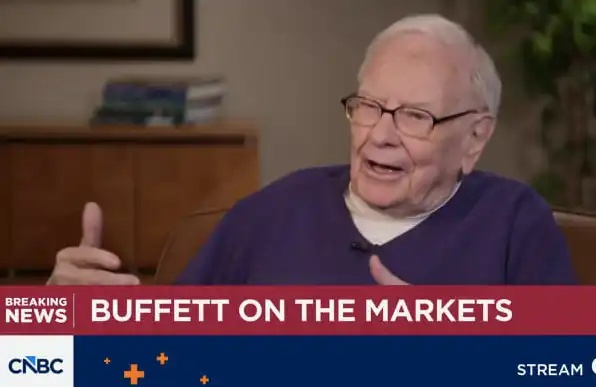
Berkshire Hathaway (Buffett, Abel)
Report Summary
As of June 30, Berkshire Hathaway disclosed a total of 29 holdings in its 13F report (13F only covers U.S. listed securities that require disclosure, not equivalent to the fund's total asset size), including 1 new position, 7 increases, 6 reductions, and 1 exit, with a nominal holding value of approximately $299.3 billion.
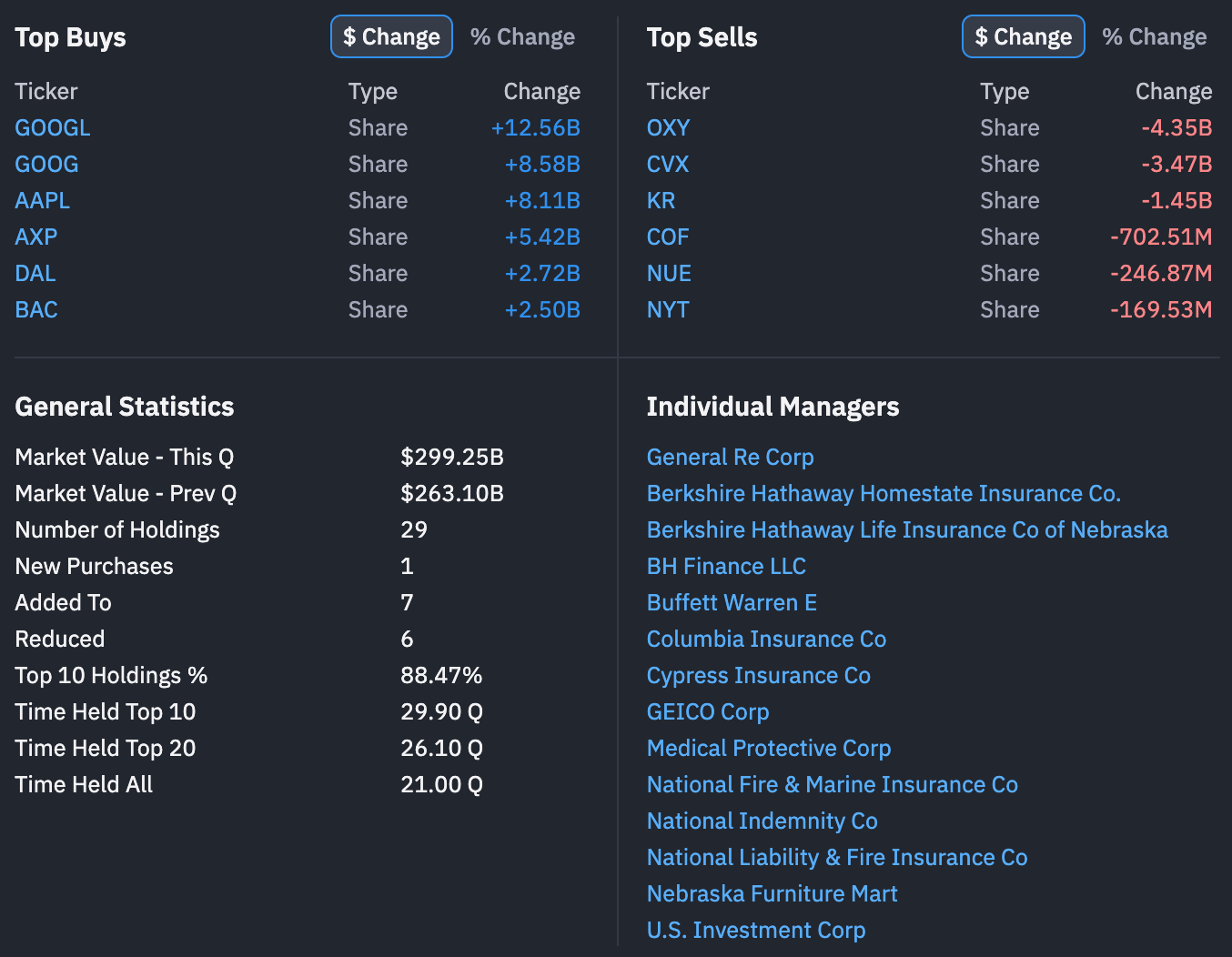
It is worth noting that this is Berkshire Hathaway's second 13F report since Greg Abel officially took the helm as CEO, and it is the first quarter of significant net buying after ending the previous streak of 14 consecutive quarters of net selling. The net purchase of stocks in the quarter was close to $20 billion.
Top Holdings
Berkshire's holdings remain highly concentrated, with the top ten core positions accounting for approximately 88.47% of the portfolio:
· Apple (AAPL): Approximately $659.5 billion, holding the top position with a 22.0% allocation;
· American Express (AXP): Approximately $512.8 billion, representing 17.1%;
· Alphabet (Google, GOOGL + GOOG): Approximately $377.6 billion, including about $281.6 billion in GOOGL (Class A common stock with voting rights) and $96.1 billion in GOOG (Class C common stock with no voting rights), making it one of the top three holdings;
· Coca-Cola (KO): Approximately $325.1 billion, accounting for 10.9%;
· Bank of America (BAC): Approximately $275.4 billion, with a 9.2% allocation;
· Chevron (CVX), Occidental Petroleum (OXY), Chubb (CB), Moody's (MCO), Kraft Heinz (KHC) round out the sixth to tenth positions.
Structurally, Berkshire Hathaway has not significantly altered its core portfolio framework of consumer, financial, and energy sectors. However, the addition of Google has significantly increased the weight of the technology sector in the portfolio.
Quarterly Changes
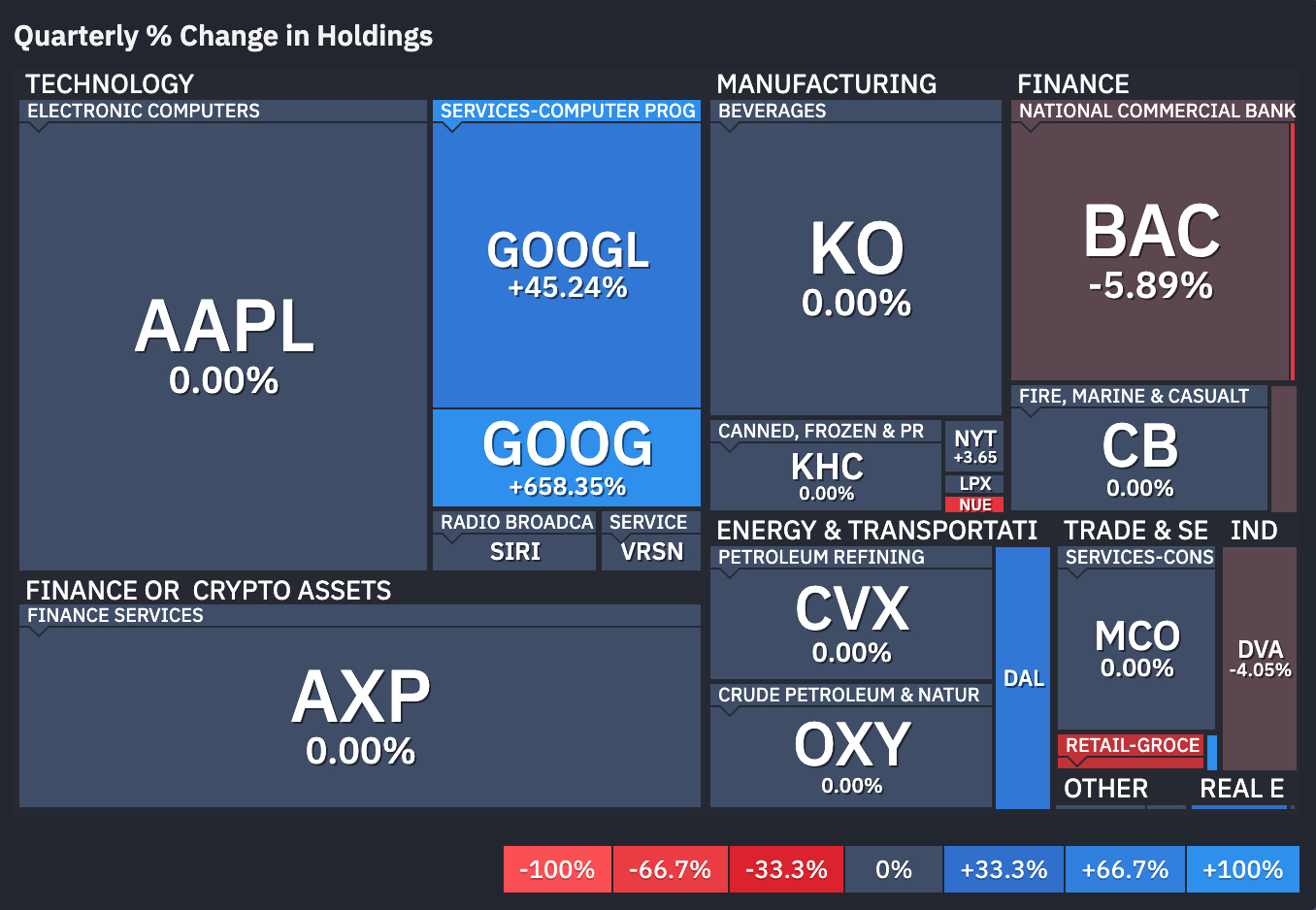
In the second quarter, Berkshire's most notable move was undoubtedly a major bet on Alphabet – increasing its holdings of Alphabet Class A shares (GOOGL) by approximately 24.54 million shares, a 45.2% increase; simultaneously increasing its holdings of Class C shares (GOOG) by about 23.60 million shares, a staggering 658.3% surge – the combined increase in the two classes of stock was about 48.10 million shares, propelling Google into the fund's top three holdings. Apart from Alphabet, Berkshire also significantly increased its positions in Delta Air Lines (DAL), Lennar Corporation (LEN), Macy's (M), among other stocks.
On the other hand, reductions were mainly concentrated in the financial, consumer, and cyclical sectors. Bank of America (BAC) reduced its holdings by about 30.23 million shares, a 5.9% decrease, and has been continuously reduced for two consecutive quarters; Capital One (COF) reduced by about 58%, Kroger (KR) by about 22%, Ally Financial (ALLY), DaVita (DVA), and Nucor (NUE) also saw decreases in their holdings.
Summary Analysis
Under the Abel era, Berkshire Hathaway is undergoing a subtle style shift, with the clearest signal in the second quarter being a tilt from traditional finance and consumer sectors towards technology growth. The heavy position in Google not only further breaks Buffett's stereotype of "not touching tech stocks," but also reflects the new management's deep appreciation of Google's moat in AI and search — essentially still a typical "value affirmation" rather than trend-chasing.
However, Berkshire's core holdings remain unchanged: the quantities of "anchor" stocks such as Apple, American Express, and Coca-Cola are basically maintained, and the energy sector's Chevron and Exxon Mobil have not been sold off (the proportion decrease is mainly due to dilution from new holdings).
Overall, this quarter Berkshire is presenting a logic of portfolio adjustment that includes "heavily increasing positions in tech leaders, structurally reducing in financials and consumer, holding firm in core energy, and tentatively positioning in real estate and aviation." While quietly tilting the investment portfolio towards a digital future while maintaining very high concentration, Abel is still following Buffett's fundamentals of "longing" and "heavy commitment."
Duquesne Family Office (Stanley Druckenmiller)
Although not as well-known as Buffett and Berkshire, Stanley Druckenmiller may be the most prominent fund manager on Wall Street today.
Who is Druckenmiller? He is a legendary American macro hedge fund manager who served as the Chief Investment Officer of Soros Fund Management from 1988 to 2000, becoming Soros's most successful trader... And nowadays, his most crucial role is that both U.S. Treasury Secretary Scott Bennett and Fed Chair Kevin Wash are his disciples (having studied under him or had long-term working relationships with him).
Therefore, compared to Berkshire's more long-term focused 13F, the quarterly report of Duquesne Family Office, this family office, looks more like a macro trading map—especially in a rapidly changing environment of AI, interest rates, and the U.S. economic outlook.
Report Summary
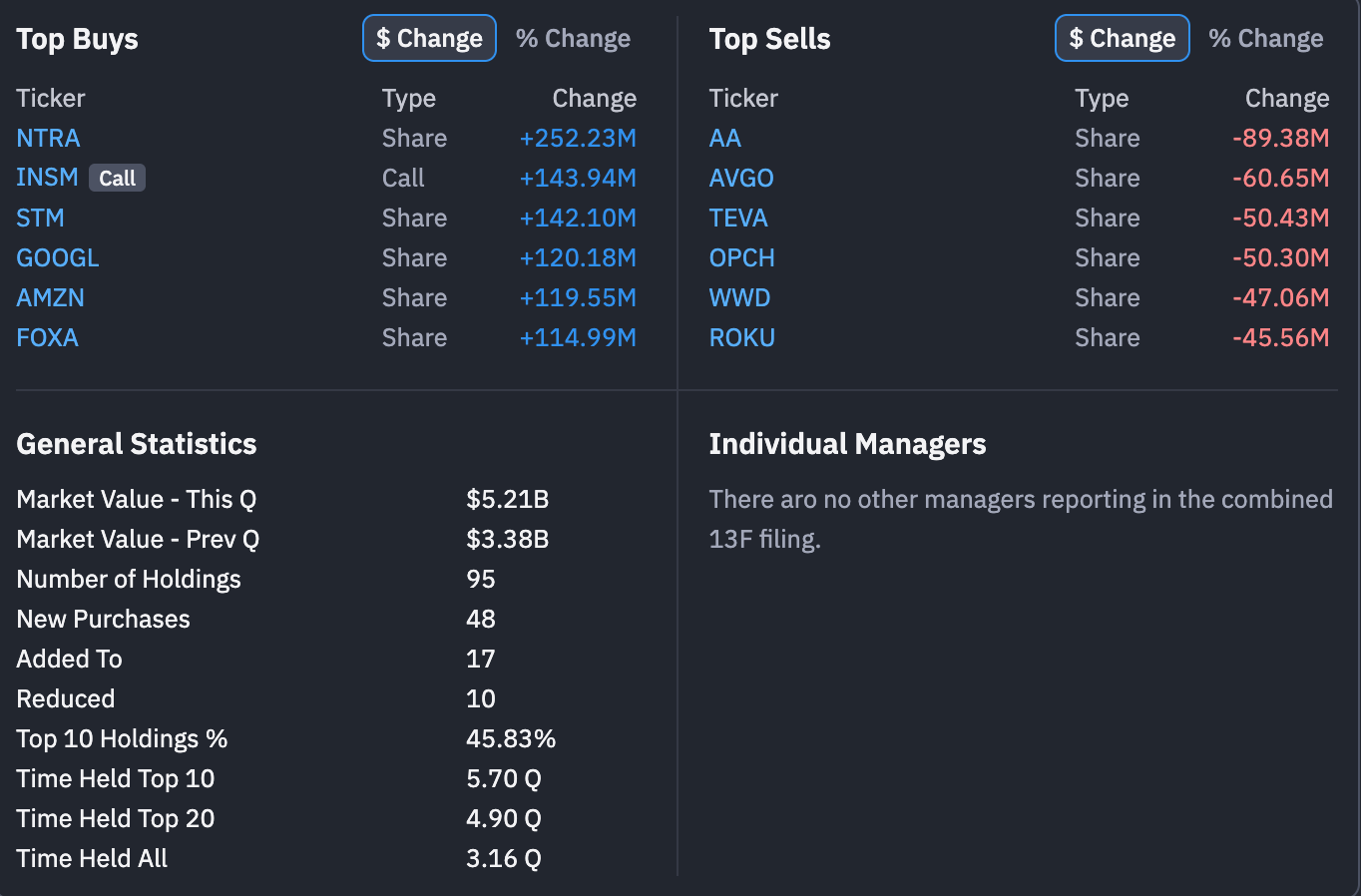
As of June 30, the Duquesne Family Office disclosed a total of 95 holdings in its 13F filing, with 48 new positions, 16 increased positions, 11 decreased positions, and 23 exits. The nominal value of the holdings is approximately $5.21 billion, a significant increase from the previous quarter's $3.38 billion.
Core Holdings
The 13F report reveals that the top ten holdings of the Duquesne Family Office account for approximately 45.8% of the portfolio:
· Genetic testing company Natera (NTRA) remains the largest stock holding of the Duquesne Family Office, with around 3.19 million shares at the end of the second quarter, valued at approximately $865 million, representing about 16.6% of the portfolio;
· The second and third largest holdings have now become Taiwan Semiconductor (TSM) and STMicroelectronics (STM), accounting for about 5.4% and 4.4% of the portfolio, respectively;
· Additionally, biopharmaceutical company Insmed (INSM, held in both stock and options), Argentina's national oil company YPF Sociedad Anónima (REPYY), and Amazon (AMZN) are among the top ten holdings.
Quarterly Changes
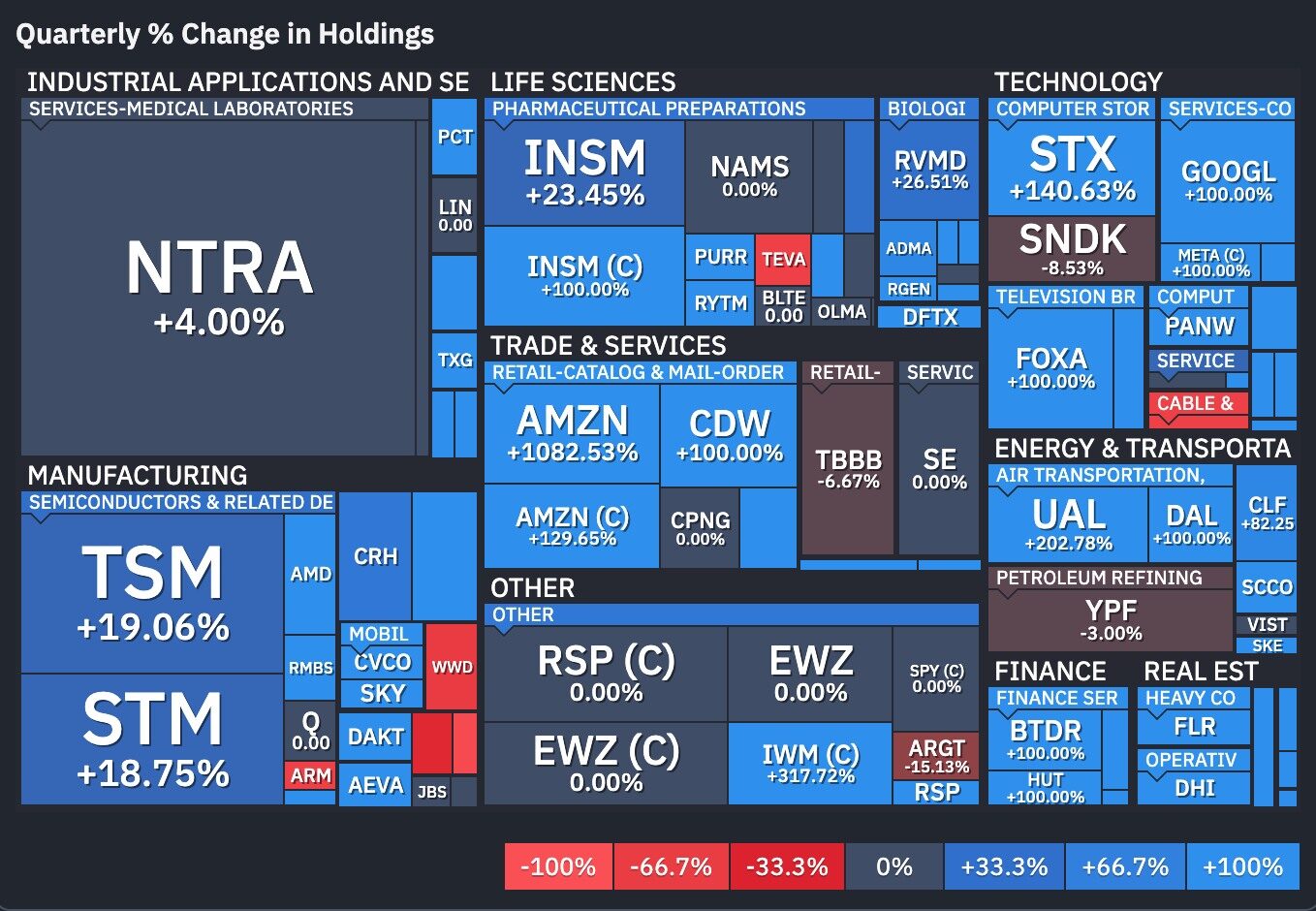
In the second quarter, the most notable change for the Duquesne Family Office was the reshuffling within the AI industry chain.
The Duquesne Family Office completely exited positions in Micron Technology (MU), Broadcom (AVGO), and Intel (INTC), with Broadcom having been a new position in the first quarter. However, this does not mean that Druckenmiller has given up on semiconductors; instead, he continued to increase holdings in Taiwan Semiconductor (TSM), STMicroelectronics (STM), and initiated a new position in AMD. At the same time, the fund has begun to expand its reach into the periphery of AI infrastructure, acquiring stakes in Hut 8 (HUT), Bitdeer (BTDR), Riot Blockchain (RIOT), and other Bitcoin mining companies that have transitioned towards data center operations.
It appears that Druckenmiller has chosen to cash out on some of the previously high-growth positions, while reallocating the funds to assets he believes offer a better risk-return profile.
Additionally, in the second quarter, the Duquesne Family Office reinitiated positions in Alphabet (GOOGL), which had been liquidated in the first quarter, and significantly increased its holding in Amazon (AMZN) that was trimmed in the first quarter — a move that may be a bet on the premise that the tech giants, which had previously borne significant AI capital expenditures, will gradually transition from being "AI infrastructure payers" to "AI commercialization beneficiaries."
In addition to the aforementioned AI-related portfolio adjustments, the Duquesne Family Office, like Berkshire, also expressed bullish sentiment toward the aviation sector by initiating a new position in Delta Air Lines (DAL) and adding to its stake in United Airlines (UAL); notably, in the second quarter, the Duquesne Family Office also reestablished a position in Baidu ADR (BIDU) of approximately 88,000 shares, marking the first time in two and a half years since late 2023 that it has once again held U.S.-listed Chinese stocks after exiting Alibaba.
Summary Analysis
If we were to distill this 13F filing into a single sentence, Druckenmiller has not moved away from AI but instead is picking the winners in the next phase of AI. At least based on the end of the second-quarter holdings, Druckenmiller has still maintained a sizable AI exposure, merely realigning from certain highly crowded hardware sectors toward cloud platforms, data centers, AI applications, and the like.
Simultaneously, the return of Baidu is another noteworthy signal. While the position of 88,000 shares is not substantial, the tentative reentry into Chinese tech assets after a long avoidance period at least indicates a resurgence of interest in Chinese tech.
It is important to reiterate that due to Druckenmiller's relatively high-frequency trading pace, the 13F filings of the Duquesne Family Office are more challenging to simply mimic and are better suited for observing directional allocations.
H&H International Investment (Richard Yoo)
Turning our attention next to H&H International Investment managed by the legendary Chinese investor Richard Yoo. From this 13F filing, it can be seen that Richard Yoo's holdings remain highly concentrated, but there are signs in the second quarter of a rotation from some overvalued tech stocks to Chinese internet companies.
Report Summary
As of June 30, H&H International Investment disclosed a total of 18 holdings in its 13F filing, with a nominal value of approximately $19.101 billion (equivalent to about 130 billion RMB), a decrease from around $20 billion at the end of the first quarter.
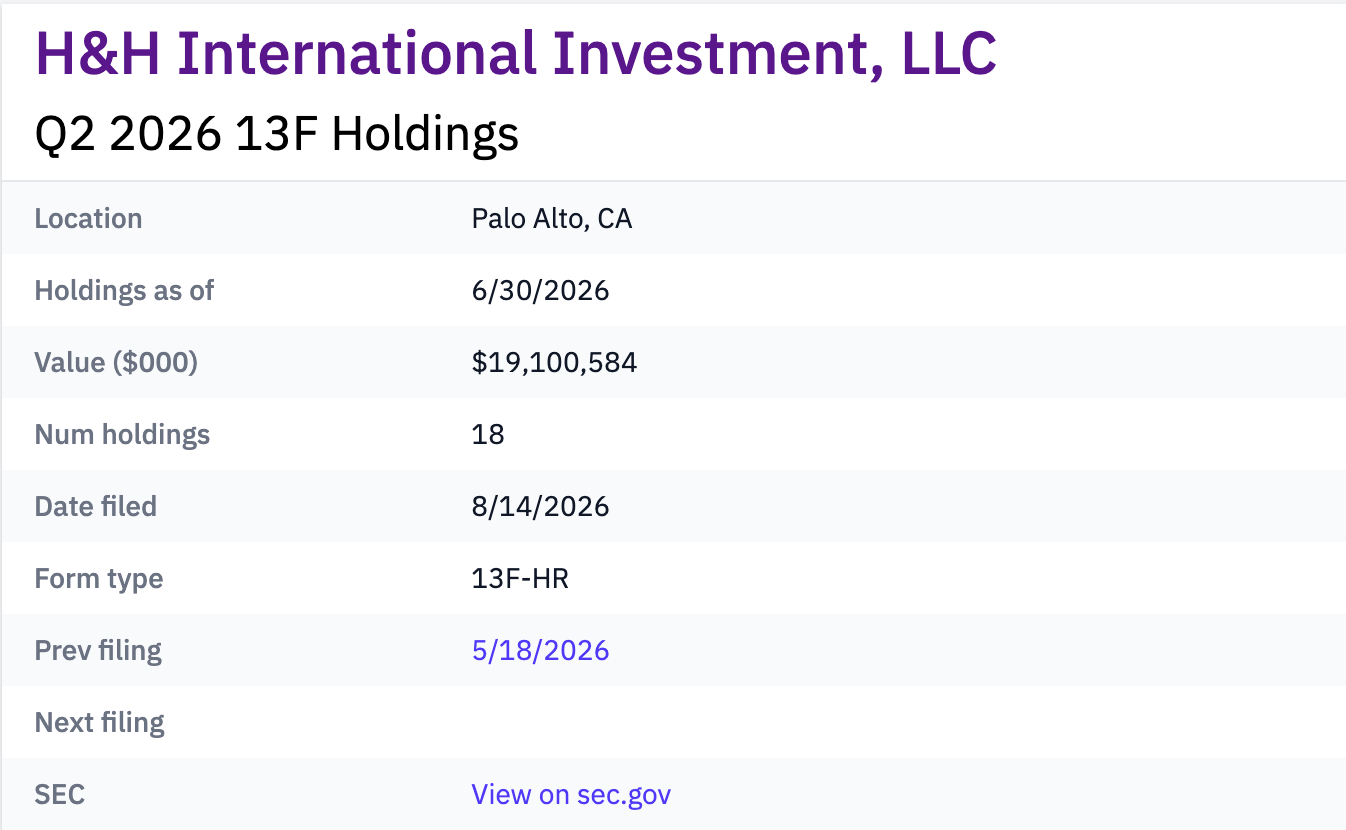
It is worth noting that 13F filings only disclose long positions in U.S. stocks. Therefore, assets held by Duan Yongping such as Tencent, Pinduoduo, Kweichow Moutai, as well as a significant amount of put option writing for premium income, are not included in this table.
Top Holdings
H&H International Investment's holdings remain highly concentrated, with the top five positions accounting for over 88% of the portfolio.
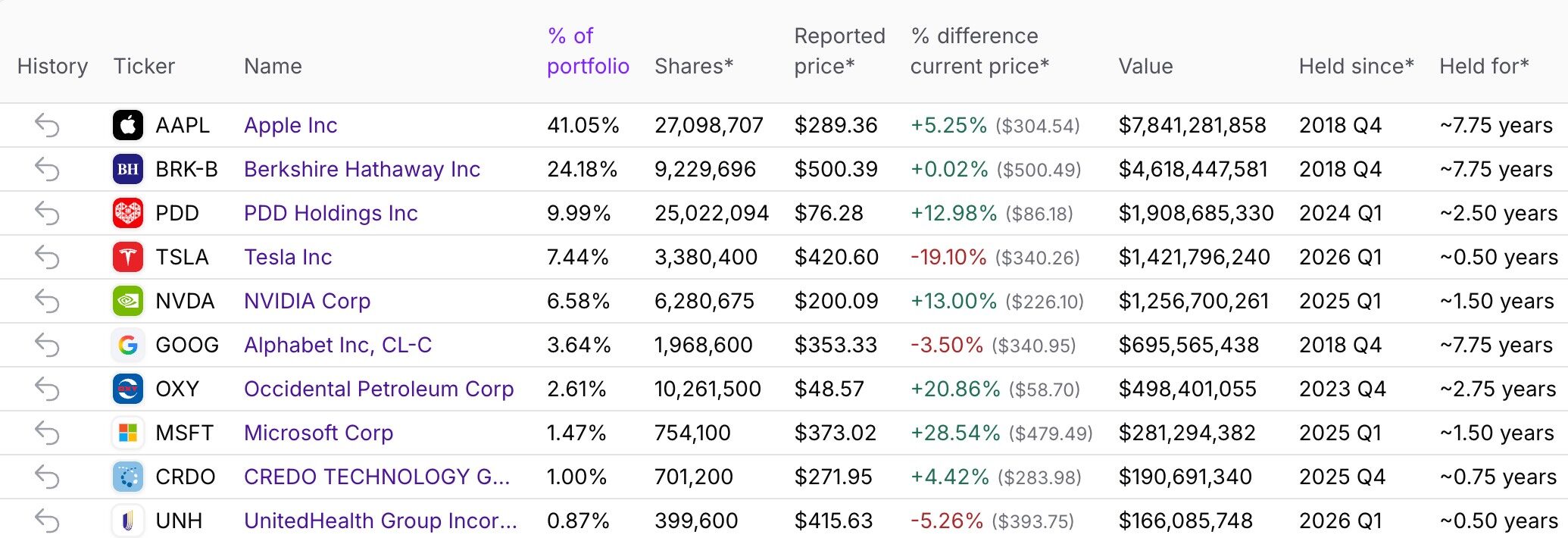
· Apple (AAPL): Approximately $7.841 billion, representing 41.05% of the portfolio, maintaining its position as the largest holding;
· Berkshire Hathaway (BRK.B): Approximately $4.618 billion, accounting for 24.18%, forming the cornerstone alongside Apple;
· Pinduoduo (PDD): Approximately $1.91 billion, with a 9.99% share, rising to the third-largest position, marking a significant increase in the weight of Chinese internet companies in Duan Yongping's portfolio;
· Tesla (TSLA): Approximately $1.42 billion, representing 7.44%;
· NVIDIA (NVDA): Approximately $1.26 billion, with a 6.58% share.
Quarterly Changes
In the second quarter, H&H International Investment's most significant move was a substantial increase in its Pinduoduo (PDD) position—adding 5.2738 million shares, a 26.71% increase, propelling it to the third-largest holding; concurrently, there was a slight increase in Berkshire Hathaway Class B shares (BRK-B), indicating a long-term endorsement of the value investing framework. Additionally, Alibaba (BABA), which was completely divested by Duan Yongping in the first quarter, saw a repurchase of 301.4 thousand shares (approximately $28.93 million) in the second quarter.
On the reduction side, AI and tech leaders were the main targets for profit-taking by H&H International Investment in the second quarter. NVIDIA was slashed by 7.5631 million shares, a staggering 54.63% reduction; Google (GOOG) saw a reduction of over 1.7 million shares, a cut of 46.88%; Microsoft reduced by 25.78%; Apple also reduced its holdings by 1.8469 million shares—marking the second consecutive quarter of selling (after reducing by 3.4129 million shares in the first quarter); additionally, TSMC and CrowdStrike were completely divested.
Of note, Duan Yongping is not simply bearish on the tech stocks being reduced. In late July, he publicly stated, "I will add more Google," while also expressing intentions to continue finding opportunities to buy NVIDIA at lower levels through selling Puts. In other words, the reduction is more a judgment on price and margin of safety rather than a complete negation of the companies themselves.
Summary Analysis
If we were to summarize this 13F in one sentence—sell a bit on the rise, buy a bit on the dip, and continue holding onto good companies.
Overall, the second-quarter repositioning strategy of H&H International Investment is relatively clear—core holdings are only slightly adjusted, increasing exposure to Chinese internet companies, and realizing gains from high-flying AI assets. Apple and Berkshire remain core holdings, but after continuous reductions, Apple's holdings have decreased for two consecutive quarters; meanwhile, Pinduoduo has become a new third-largest position, and Alibaba has re-entered the portfolio; while NVIDIA, Google, and others have been reduced, it is not a bearish move, but rather a way to secure profits, with Duan Yongping expressing a desire to buy back at lower prices in the future.
This indicates that Duan Yongping's actions in the second quarter are not a full turn towards a new theme but rather a search for a margin of safety amidst valuation changes, selectively realizing gains from high-flying AI and tech leaders, and re-adding exposure to Chinese internet companies that have undergone long-term adjustments and that he is familiar with.
Himalaya Capital (Li Lu)
Similar to Duan Yongping, another Chinese legendary investor Li Lu's Himalaya Capital also significantly increased its holdings of Pinduoduo (PDD) in the second quarter.
Report Summary
As of June 30, 2026, Himalaya Capital disclosed a total of 8 holdings in its 13F, with 2 increases and 6 exits. The number of holdings has significantly decreased from 14 in the first quarter, but the nominal holding value has increased from $3.201 billion in the first quarter to $3.703 billion in the second quarter, further shrinking and concentrating its positions, with the top five holdings now accounting for a high 94.77%.
Core Holdings
The 13F filing reveals that Himalaya Capital's current 8 holdings demonstrate a pattern of "Google as the cornerstone, Pinduoduo's surge, and a financial foundation."
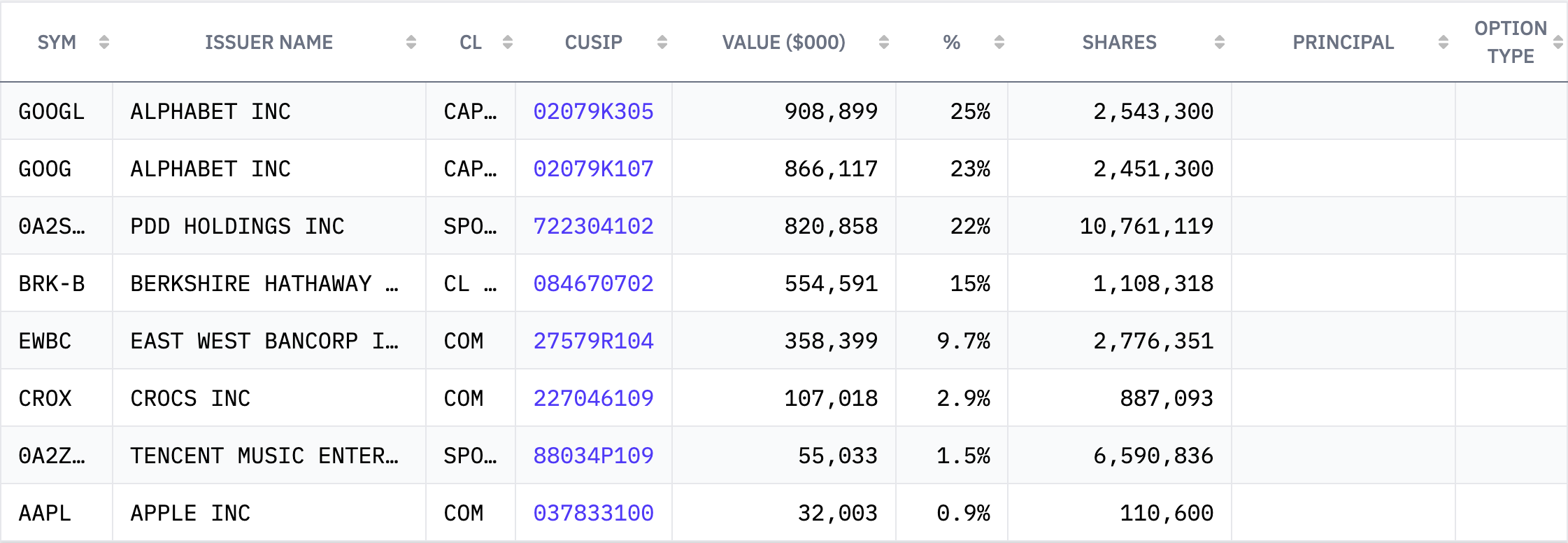
· Google (GOOGL + GOOG): Approximately $1.775 billion, accounting for 47.64% of the portfolio. Held long-term since 2020, it is the unwavering "cornerstone" of Li Lu's portfolio;
· Pinduoduo (PDD): Approximately $821 million, accounting for 22.17%. A violent increase in position made it the second largest holding after a considerable increase;
· Berkshire Hathaway (BRK.B): Approximately $555 million, accounting for 14.98%, with continued accumulation;
· East West Bancorp (EWBC): Approximately $358 million, accounting for 9.68%, with a stable position.
· Additionally, Crocs (CROX, 2.90%) and Tencent Music Entertainment (TME, 1.50%) remain unchanged, while Apple (AAPL) now holds only a 0.88% minuscule observation position.
Quarterly Changes
In the second quarter, Himalaya Capital only added to two positions, liquidating the other six old holdings in a one-time move, a resolute decision rarely seen among top funds.
Pinduoduo (PDD) was the heaviest addition for Himalaya Capital in the second quarter — increasing its stake by 6.1531 million shares, a staggering 133.53% growth. The holding surged from 4.608 million shares to 10.7611 million shares, with an end-of-quarter market value of approximately $821 million, swiftly becoming the second-largest holding. Furthermore, Berkshire Hathaway (BRK.B) saw a 23.46% increase, essentially entrusting more funds to Buffett and Abel's management.
Simultaneously, Himalaya Capital completely exited 6 positions — Bank of America (BAC), Occidental Petroleum (OXY), S&P Global (SPGI), Moody's (MCO), MSCI (MSCI), and H&R Block (HRB). This signifies Li Lu's decisive retreat from traditional finance, index data services, and the oil and gas sector. Particularly noteworthy is Bank of America, which was once one of its core cornerstones but now aligns with Berkshire Hathaway in "bank reduction." However, Li Lu chose a complete exit rather than a slight reduction.
Summary Analysis
If we were to summarize Li Lu's second-quarter actions in one sentence, it might be—significantly reducing positions outside his circle of competence to further concentrate limited funds on a few companies he truly understands.
On one hand, he maintained a heavy position in Google (GOOGL, GOOG) while also increasing his stake in Pinduoduo (PDD), representing Li Lu's long-term views on leading US technology and Chinese internet assets. Simultaneously, the complete liquidation of positions in financial, energy, and index service-related assets signifies Li Lu's continued portfolio reduction, with the current concentration nearing his classic value investing style.
Of course, similar to what happened with Duan Yongping, the 13F will only disclose securities that meet the conditions in the US market. Therefore, this filing cannot represent Li Lu's entire investment portfolio, and assets like BYD, Postal Savings Bank of China, and CRRC Corporation Limited listed on the Hong Kong Stock Exchange will not appear in this 13F.
ARK Investment (Cathie Wood)
Report Summary
As of June 30, ARK Investment, managed by the "Female Warren Buffett," "Wood Sister" Cathie Wood, collectively disclosed 191 holdings in its 13F filing. This included 15 new positions, 78 additions, 96 reductions, and 6 liquidations, with a total nominal holding market value of approximately $15.4 billion, representing a significant increase of over $2 billion compared to the first quarter.
In the second quarter, ARK Investment made aggressive portfolio adjustments, showcasing Cathie Wood's typical high turnover style.
Core Holdings
The 13F filing shows that ARK Investment's top ten largest holdings accounted for 39.45% of the total, with a relatively moderate level of concentration, indicating a relatively high risk appetite in the core asset portfolio.
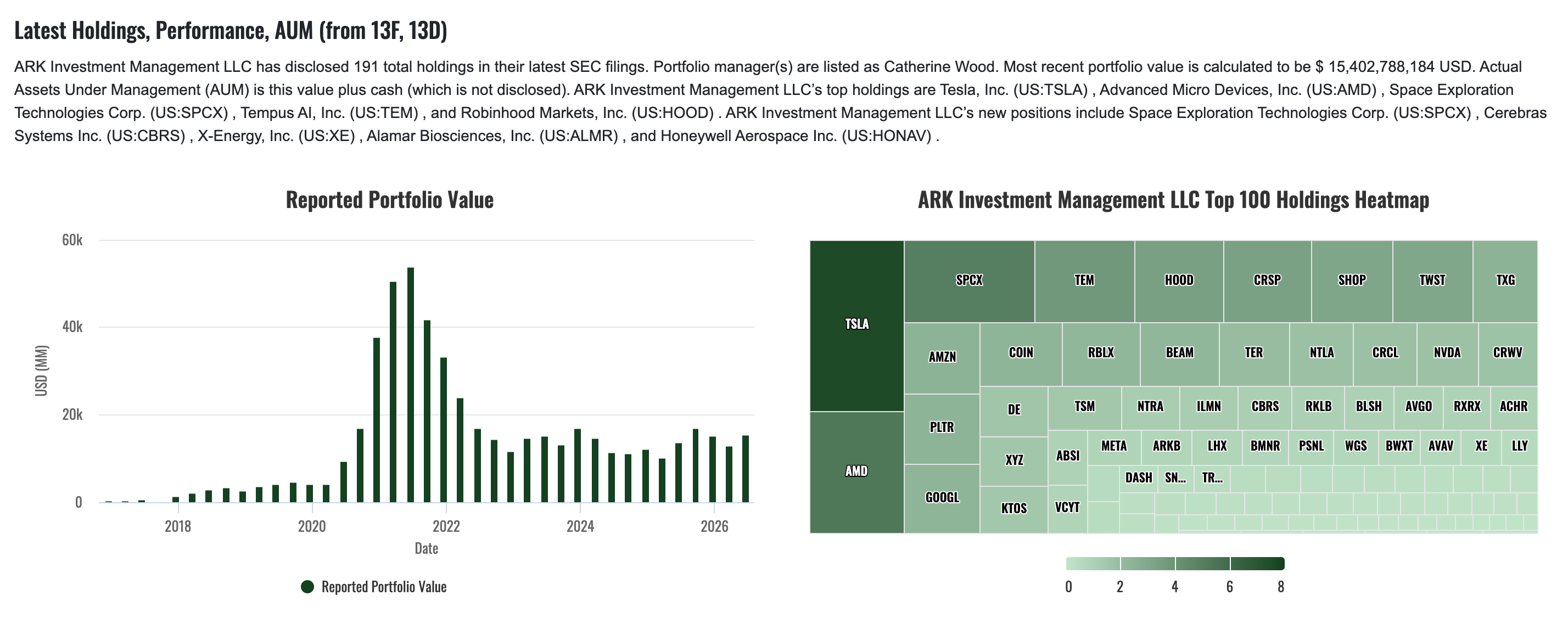
· Tesla (TSLA): Approximately $11.61 billion, with a 7.5% holding, still the largest core position but has been reduced for the third consecutive quarter;
· AMD (AMD): Approximately $8.2 billion, with a 5.3% holding, a core holding in the AI computing sector;
· SpaceX (SPCX): Approximately $7.65 billion, with a 5% holding, a new addition this quarter and directly entering the core position;
· Tempus AI (TEM): About $5.8 billion, with a portfolio weighting of 3.8%, focusing on precision medicine + AI diagnostic benchmarks;
· Robinhood (HOOD): About $5.25 billion, with a portfolio weighting of 3.4%, involving fintech and retail investor ecosystem.
Quarterly Changes
In the second quarter, ARK Investment's most significant move was the "public debut rush" of SpaceX (SPCX). On the first day of SpaceX's public listing on June 12, ARK's multiple ETFs collectively purchased about 3.29 million shares. By the end of the quarter, this number had increased to 4.478 million shares, with SPCX's weight in the fund's portfolio briefly reaching nearly 7%.
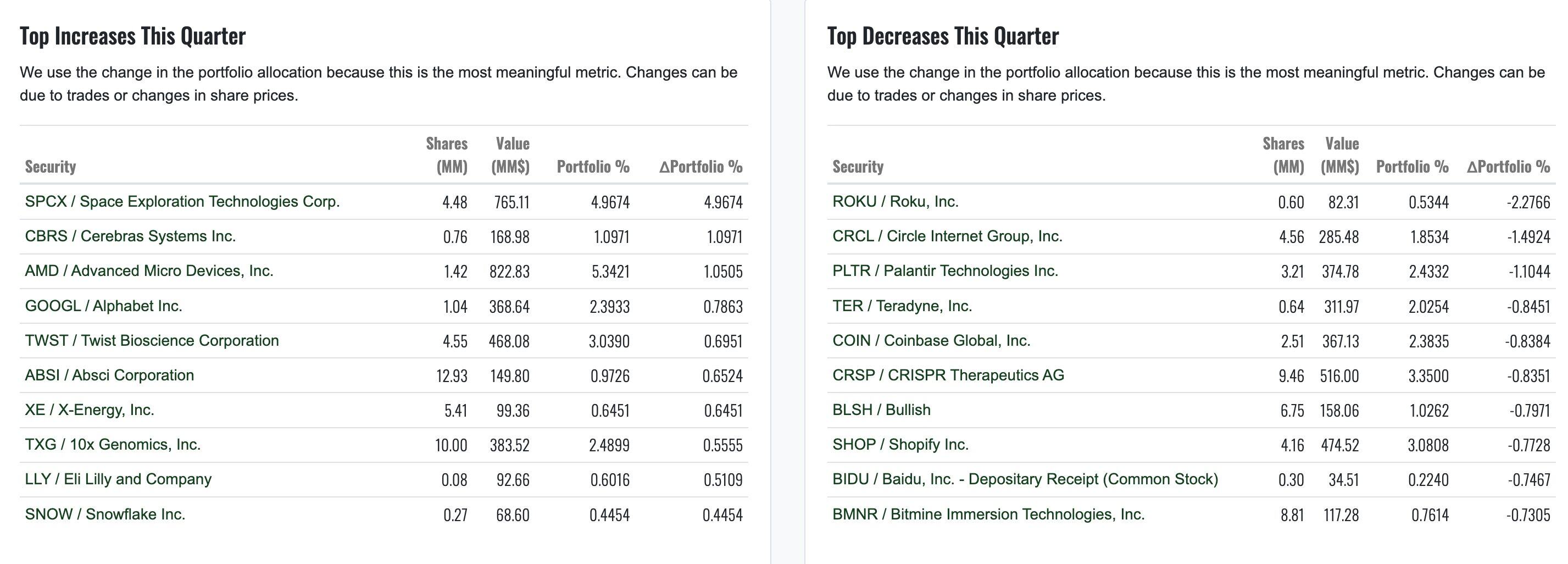
Besides SPCX, in the second quarter, ARK Investment's investment portfolio also showed a clear trend of deepening industry chain expansion. New positions were taken in Cerebras Systems (CBRS), representing a bet on AI computing architecture; increased holdings in Google (GOOG) strengthened their exposure to platform-based AI; the purchase of X-Energy (XE) signaled the fund's early layout of nuclear energy as a baseload power source in the AI era; while the additional investment in Eli Lilly (LLY) reinforced the life sciences theme...
On the reduction side, the most notable action was the continuous reduction of Tesla (TSLA) for three consecutive quarters, indicating a possible judgment by "Cathie Wood" on Tesla's diminishing relative position in the AI narrative.
Summary Analysis
Overall, ARK Investment's second-quarter actions exhibited a reallocation logic of "actively embracing SpaceX's listing, expanding AI and energy frontiers, reducing traditional core holdings, and maintaining high turnover innovation hunting."
ARK Investment still maintains a relatively high risk appetite among top funds, focusing more on finding technologies that can reshape industries—from AI computing power, to aerospace, to nuclear energy, and then to life sciences, "disruptive innovation" remains the fund's favorite theme.
Oriental Harbor Overseas Fund (Bin Du)
Compared to the previous few funds, the latest 13F report of Oriental Harbor Investment Master Fund managed by Chinese investor Dan Bin can be described as quite "aggressive" — instead of simply adjusting a few stocks, the fund almost completely redesigned its AI portfolio.
Report Summary
As of June 30, Oriental Harbor Investment Master Fund disclosed a total of 13 holdings in its 13F report, including initiating positions in 7 stocks, adding to 1, reducing 5, and completely selling out of 6, with a nominal value of approximately $1.65 billion, representing a 45.6% increase from the previous quarter's approximately $1.133 billion.
Core Holdings
The 13F report shows that by the end of the second quarter, the top five core holdings of Oriental Harbor Investment Master Fund accounted for approximately 73% of the total portfolio, further increasing concentration, with over 70% of the portfolio weight allocated to AI hardware and semiconductor industry-related assets, indicating a significant shift in portfolio strategy.
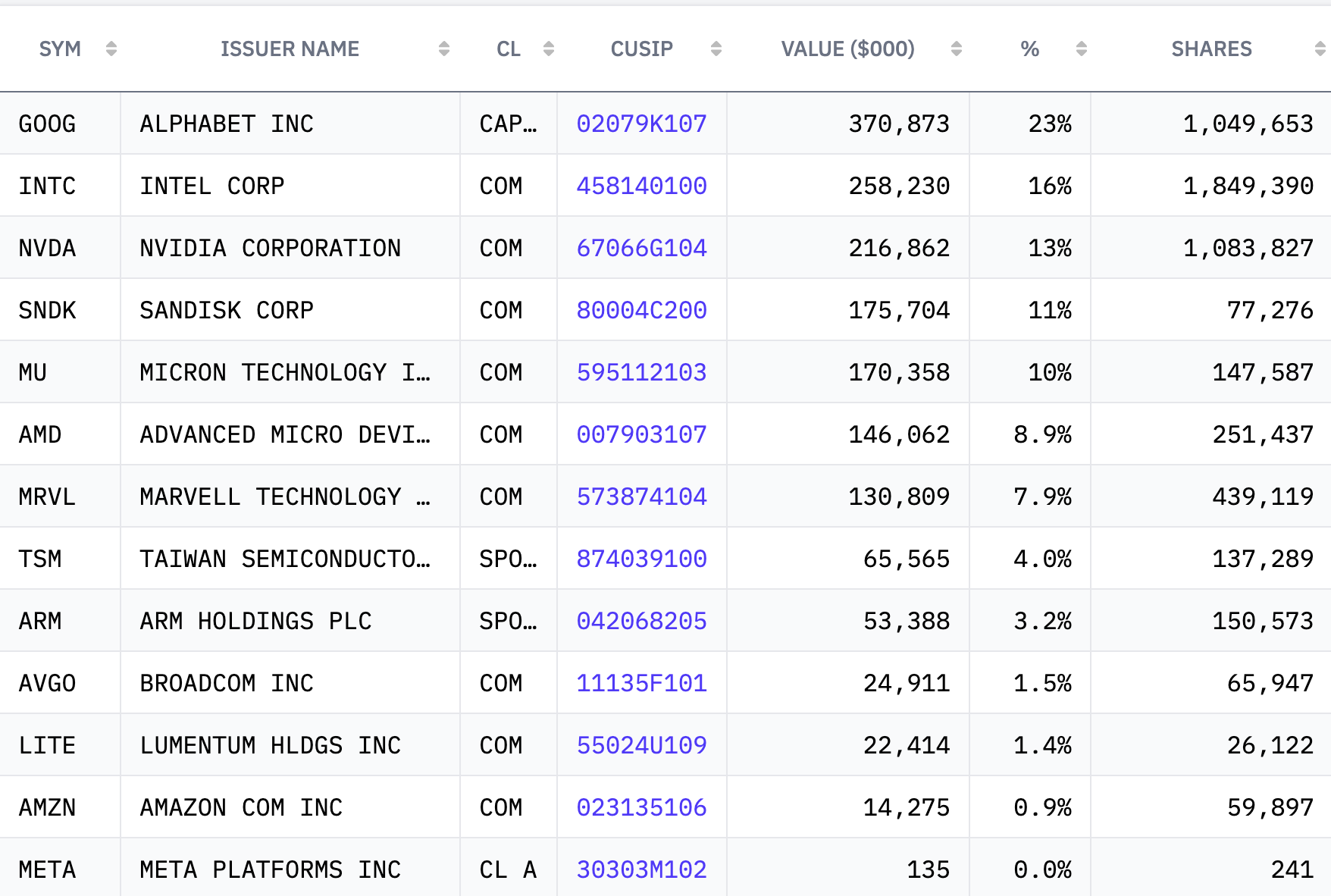
· Google (GOOG): Approximately $371 million, representing about 23% of the portfolio, maintaining its position as the largest core holding;
· Intel (INTC): Approximately $258 million, with a 16% allocation, entering as a new position and quickly becoming the second largest holding;
· NVIDIA (NVDA): Approximately $217 million, with a 13% allocation, sliding from first to third place in holdings;
· SanDisk (SNDK): Approximately $176 million, representing 11%, newly entering and securing the fourth position;
· Micron (MU): Approximately $170 million, with about a 10% allocation, doubling its position;
· The sixth to tenth positions are occupied by AMD (8.9%), MRVL (7.9%), TSM (4%), ARM (3.2%), AVGO (1.5%).
Except for Google, nine out of the top ten core holdings belong to AI computing infrastructure or the semiconductor industry chain, signifying a complete shift from the previous focus on software platforms to a "selling shovels" hardware strategy.
Quarterly Changes
This quarter, East Bay Overseas Fund launched a "saturation attack" on the AI hardware supply chain, quickly acquiring 7 new related targets—Intel (INTC), SanDisk (SNDK), AMD, Marvell Technology (MRVL), ARM, Broadcom (AVGO), Lumentum (LITE), all focusing on computing chips, storage, optical communication, and semiconductor upstream. Among them, Intel was directly brought in as the second largest holding, while SanDisk and AMD entered the top six holdings, clearly indicating an emphasis on the storage sector.
While fully embracing hardware, Ben made "pruning" adjustments to the existing holdings. Nvidia (NVDA), TSMC (TSM), and Amazon (AMZN) were all reduced; although Google remains the top holding, the position was reduced by 155.2K shares compared to the first quarter. Additionally, the 2x long Google ETF position has been liquidated, significantly reducing its overall weight in the portfolio.
Furthermore, in the second quarter, East Bay Overseas Fund also liquidated its entire positions in Apple (AAPL) and Tesla (TSLA), the two leading consumer electronics companies, which may indicate Ben's short-term skepticism about the recovery on the consumer end. At the same time, the fund has also exited its position in the stablecoin issuer Circle (CRCL).
Summary Analysis
Overall, the most crucial information in East Bay Overseas Fund's 13F is that Ben is still betting that AI CapEx will continue to flow into the hardware sector. While the market is still debating whether there is an AI bubble, Ben believes that the hardware segment where "the real money is made" is still the most certain direction.
This is also consistent with Ben's recent public statements—he still believes that AI is the super theme of the next decade and has stated that the market still does not fully understand AI's long-term potential. During the storage sell-off at the end of July, Ben even made a high-profile declaration that "you must dare to buy the dip, and have used up all remaining ammunition."
Situational Awareness LP (Leopold Aschenbrenner)
For the story of the "AI Stock God" Leopold Aschenbrenner and his fund Situational Awareness LP, we have provided a detailed analysis in the article "Today, the world finally sees why the 'AI Stock God' fell."
Due to its outstanding performance in the past few quarters, the market had high expectations for Situational Awareness LP's 13F. However, sadly, the fund just experienced its darkest moment at the end of July—due to a significant pullback in AI-related stocks combined with high leverage, the fund suffered major losses, was forced to liquidate a large portion of its public holdings, and has already sold most of its stock portfolio at a discount to Ken Griffin's Citadel.
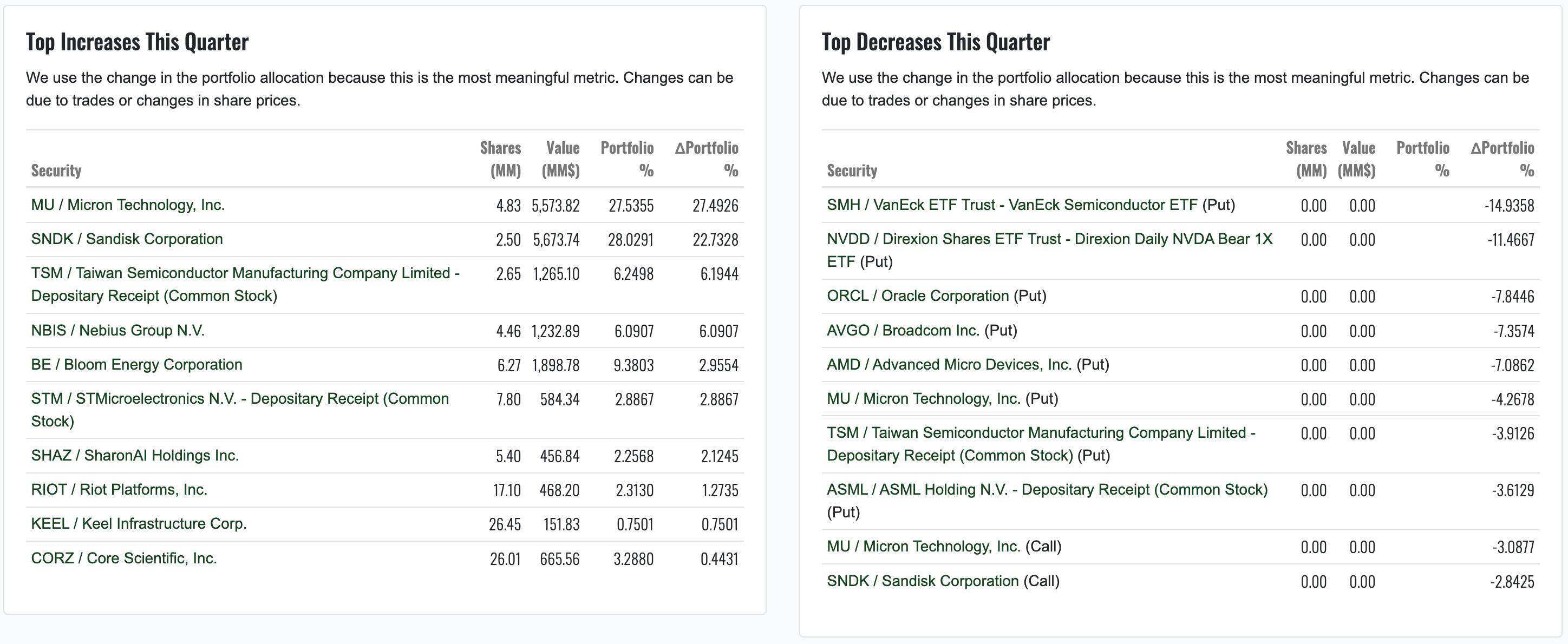
Dissecting Situational Awareness LP's 13F filing reveals an even more regrettable story. The fund had built a bearish view option position on chip and storage leaders with a notional value of over $8 billion by the end of the first quarter. This was intended to effectively hedge against the current market downturn. However, due to an early shift to an overwhelmingly bullish stance, Leopold Aschenbrenner himself dismantled this insurance wall, ultimately leading to the fund's past glory being discounted and plucked by Ken Griffin.
The AI Narrative Remains Intact, but Where the Money Flows Changes
Putting the 13Fs of these seven funds together, a relatively clear consensus point seems to emerge — AI remains in the forefront of top investors' minds, with funds significantly repricing around the AI industry chain. The certainty that "AI will continue to grow" seems unquestionable, but the real question is, in the next phase, who will truly turn investment into profits?
Berkshire has started a significant position in Google, Druckenmiller is rotating within semiconductors and reemphasizing bets on cloud computing and AI infrastructure, while Bin takes a more aggressive stance, significantly shifting overseas portfolios toward chips, storage, and optical communications. ARK continues to explore next-generation growth assets along AI, SpaceX, energy, and life sciences. Meanwhile, Duan Yongping and Li Lu are not simply chasing the AI hype but, after trimming some highly appreciated tech stocks, reallocating funds to assets they are more familiar with and consider to have a higher safety margin.
Merely observing the 13Fs of various funds makes it difficult to deduce a clear "next big stock," but the capital flows from different funds themselves constitute a rotational game of logic in AI investment — GPU, chips, storage, networking, optical communications, data centers, power, cloud computing, commercialization... From selling shovels, to providing computing power, to ultimately sharing in the AI commercialization dividend, funds are constantly seeking the next profit realization point along the AI value chain.
It is important to reiterate that all these positions are as of June 30, 2026. The 13F filings themselves have a maximum 45-day disclosure lag, especially for investors like Druckenmiller and Bin who rebalance rapidly. Therefore, instead of viewing it as a "cheat sheet," it is better to see it as a snapshot of how different funds interpret the market in the next phase.
Original Article Link
Welcome to join the official BlockBeats community:
Telegram Subscription Group: https://t.me/theblockbeats
Telegram Discussion Group: https://t.me/BlockBeats_App
Official Twitter Account: https://twitter.com/BlockBeatsAsia

 Related Articles