StarkWare CEO's Latest Speech: Ethereum Upgrades Too Slow, Starknet Considering Independence?
TL;DR
·Starknet is considering transitioning from an Ethereum L2 to an independent L1 to autonomously control the network security upgrade process.
·Eli Ben-Sasson believes that quantum computing and AI are accelerating changes in the cryptographic security landscape, and blockchain must prepare in advance.
·Starknet already possesses ZK-STARKs and cryptographic agility, but as an L2, its security remains constrained by Ethereum's underlying architecture.
·Ben-Sasson proposes that Starknet could achieve quantum-resistant security by 2027, while Ethereum currently sets the end of 2029 as its target for a full quantum-resistant upgrade.
·The STRK price has recently risen significantly, but the L1 transition is still in the discussion phase and has not yet become a formal implementation plan.
Editor's Note: As more and more Ethereum Layer 2s continue to compete for users, liquidity, and applications, Starknet has begun to rethink a more fundamental question: should it still remain an L2?
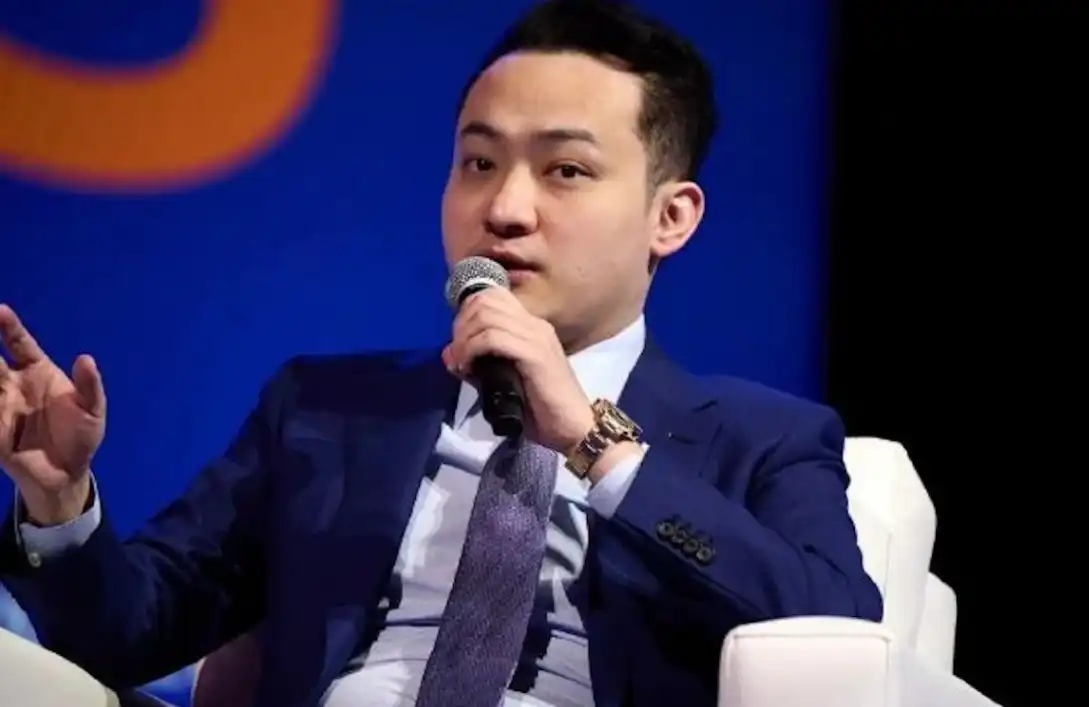
On October 8, StarkWare co-founder and CEO Eli Ben-Sasson delivered a speech at TOKEN2049 and subsequently shared the core viewpoints related to the speech on X. He proposed that the team is considering multiple technical paths, including transforming Starknet into an independent Layer 1. What is driving this consideration is not transaction speed, fees, or ecosystem expansion, but a longer-term challenge: quantum computing and AI may threaten the existing cryptographic security system earlier than expected.
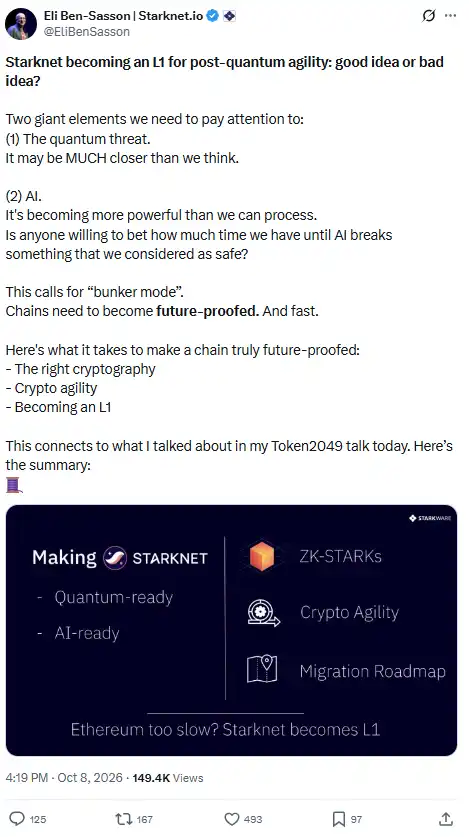
These remarks drew market attention. As independent L1 and quantum-resistant security became new focal points of discussion, the STRK price rose significantly. According to an October 8 report by TokenPost, STRK recorded a roughly 26% 24-hour gain.
However, what is truly noteworthy about this discussion is not just the token price. As a network built on ZK-STARKs, Starknet already has some quantum-resistant technological advantages, but it still relies on Ethereum for underlying security guarantees. If Ethereum's upgrade pace cannot meet its own needs, should Starknet choose independence?
This could become an important attempt by Starknet to redefine its long-term positioning.
Quantum threats and AI development are changing the security logic of blockchain
Ben-Sasson opened his tweet with a question: To have greater flexibility and adaptability in the post-quantum era, is it a good idea or a bad idea for Starknet to transition to L1?
He believes that the crypto industry currently needs to focus on two major changes at the same time: progress in quantum computing and the rapid improvement of AI capabilities.
Regarding quantum computing, he warned that the related threat may arrive earlier than the market generally expects. Of particular concern is that AI is accelerating breakthroughs in mathematical research, which may further shorten the time window before the existing cryptographic system faces risk.
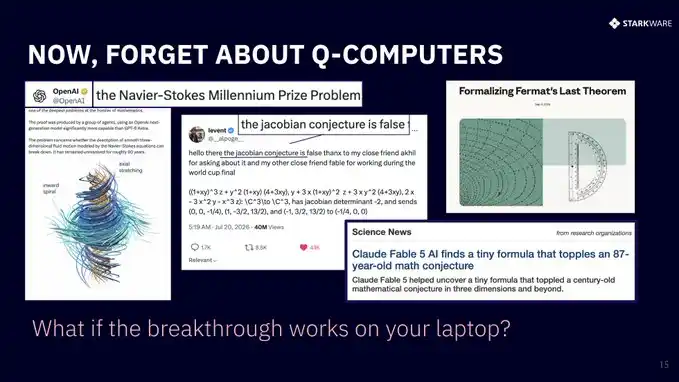
Breakthroughs in AI in the field of mathematics may bring new challenges to existing cryptographic security.
He specifically mentioned the ecdsa/fail project. This research, through collaboration between human researchers and AI tools, continuously optimizes quantum computing circuits targeting elliptic curve cryptography, attempting to reduce the computing resources required for future quantum attacks.
This does not mean that current quantum computers can already crack the cryptographic systems used by Bitcoin or Ethereum, but it shows that the theoretical resources required for related attacks may decline as algorithms are optimized.
Ben-Sasson therefore believes that the industry cannot wait until the so-called "Q-Day" actually arrives before starting to act. Q-Day refers to the moment when quantum computing power develops enough to threaten existing mainstream public-key cryptographic systems.
And even if quantum computing is temporarily set aside, the rapid progress of AI itself is also bringing new security challenges.
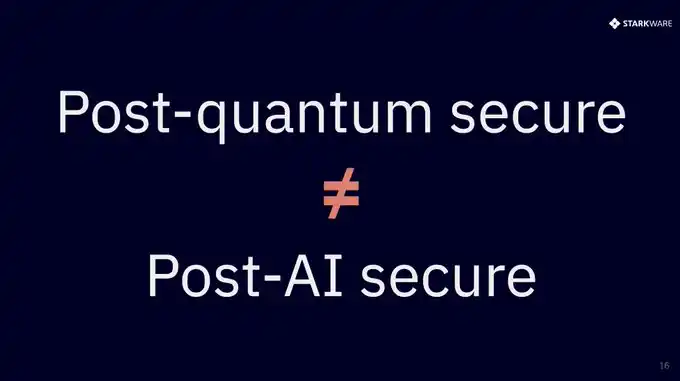
Ben-Sasson emphasized that quantum-resistant security is not equivalent to being able to withstand all security threats brought by AI.
In his view, blockchain needs to enter a kind of "Bunker Mode," building in advance a security architecture capable of continuously responding to future threats.
This has also changed his thinking about the next generation of digital currency.
He described the evolution of money as going from gold to digital gold Bitcoin, and then to Zcash, a digital gold that emphasizes privacy protection. The next question is: What other characteristics should future digital assets have?
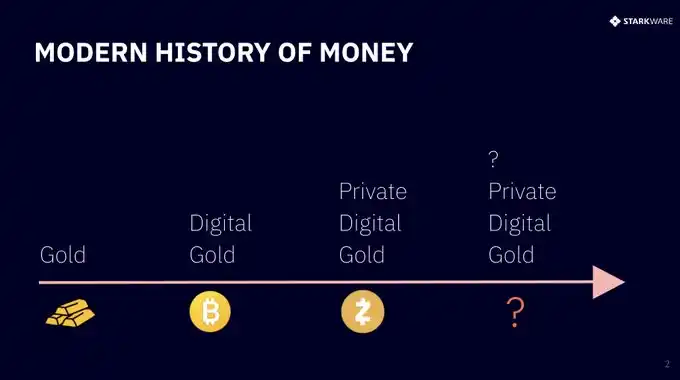
From gold to Bitcoin and Zcash, what characteristics will the next generation of digital currencies have?
His answer points to long-term security and the ability to continuously upgrade in the face of new technological threats.
Starknet already has quantum-resistant technological advantages, yet still depends on Ethereum
To make a blockchain withstand future quantum computing and AI threats, Ben-Sasson emphasized two key conditions: adopting the right cryptographic technology and possessing Crypto Agility.
The former involves the security foundation currently adopted by the blockchain, while the latter determines whether the network can smoothly switch to new security mechanisms when existing cryptographic solutions face new risks.
In both aspects, Starknet believes it has certain inherent advantages.
The first is ZK-STARKs. Unlike some proof systems that rely on elliptic curve cryptography security assumptions, the STARK proof system is primarily built on security assumptions related to hash functions, and its design is more conducive to resisting known quantum computing attack paths.
The second is Starknet's native account abstraction capability. Developers can configure different signature verification logic for accounts, thereby providing greater flexibility for future migration to post-quantum signature schemes.
StarkWare has previously published a post-quantum security migration roadmap and conducted experiments related to wallets and signature schemes. But these technological advantages do not mean that the entire Starknet network has already achieved comprehensive quantum-resistant security.
The real problem is that Starknet is still an L2 that depends on Ethereum.
As an Ethereum Layer 2, Starknet submits part of its transaction data and state information to Ethereum and obtains security guarantees through the latter's underlying mechanisms.
This means that even if Starknet's own proof system, account signatures, and other cryptographic components are upgraded, some key links may still be affected by the progress of Ethereum's upgrades.
In its previously published technical roadmap, StarkWare explicitly pointed out that cross-chain message passing and data availability mechanisms related to Ethereum are external dependency links in the post-quantum migration.
In other words, Starknet can control most of its own technological upgrades, but it cannot fully decide when the underlying network will complete the corresponding security migration. And this is precisely the core reason why Ben-Sasson began discussing an independent L1.
From L2 to L1: What Starknet Wants Is Autonomy Over Security Upgrades
In a recent tweet, Ben-Sasson made it clear that the team is considering multiple options, including making Starknet an independent Layer 1.
His reasoning is straightforward: if Starknet becomes an L1, it can autonomously control its own security migration without waiting for Ethereum or Bitcoin to act first.
In his view, timing may be the most critical variable.
According to Ben-Sasson, Ethereum aims to achieve full quantum-resistant security at the L1 level by the end of 2029, while Bitcoin has yet to make a similar explicit timeline commitment.
By contrast, he believes Starknet could achieve this goal by 2027. This means that if the relevant technical roadmap progresses smoothly, Starknet could complete a full quantum-resistant security migration earlier than Ethereum.
However, it is important to distinguish that 2027 is a potential technical target proposed by Ben-Sasson, and does not mean Starknet has formally committed to completing an L1 transition by then.
For Starknet, moving to L1 is not simply about severing its dependency on Ethereum. An independent L1 needs to establish and maintain its own consensus, security, and data availability mechanisms, and bear the corresponding validator incentives, network maintenance, and security costs. Some of the underlying guarantees originally provided by Ethereum would also need to be realized through a new architecture.
Therefore, while an independent L1 may bring greater technical autonomy, it does not necessarily mean the network will be more secure.
The questions Starknet needs to answer will also change accordingly: from how to achieve more efficient scaling on top of Ethereum, to how to independently build a sufficiently reliable and sustainable underlying security system.
As of this public statement, Starknet has not announced a final transition decision, nor has it published a complete L1 migration implementation plan.
After STRK's Rally, the Market Begins to Reassess Starknet's Positioning
The reason Ben-Sasson's remarks drew attention is also related to the current competitive environment in the Layer 2 sector.
Over the past few years, the main narrative for Ethereum L2s has centered on scaling: higher transaction throughput, lower fees, and a better user experience. But as more Rollups and other scaling networks enter the market, relying solely on performance improvements has made it increasingly difficult to form long-term differentiated advantages.
For a project like Starknet, which is centered on zero-knowledge proof technology, quantum security may offer a new positioning direction.
If Starknet can establish a verifiable technological advantage in the post-quantum security field, its competitive logic could extend from traditional scaling performance comparisons to long-term asset security, privacy protection, and cryptographic upgrade capabilities. This is one of the reasons the market has begun to reassess Starknet.
However, there is still a gap between token price increases and the project's long-term value.
What the market is currently trading is more about expectations for potential technological roadmaps and future positioning, rather than a network transformation that has already been implemented. Even if Starknet ultimately decides to become an L1, it would still need to prove that an independent operating model can bring sufficient security, developer support, and real usage demand.
The vision Ben-Sasson outlined at the end of his tweet is for Starknet to become a network capable of conducting transactions, payments, earning yield, and holding assets long-term, both publicly and privately, while possessing quantum-resistant security and cryptographic agility.
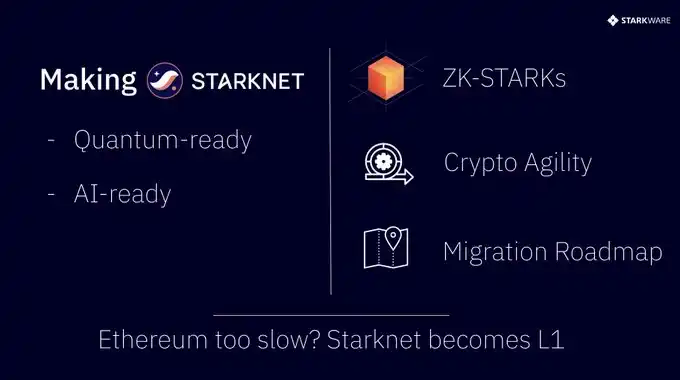
Starknet hopes to combine privacy, post-quantum security, and cryptographic agility to explore the next generation of digital asset networks.
But to achieve this goal, Starknet first needs to determine its future underlying architecture.
From an Ethereum L2 to a potential independent L1, Starknet is exploring a path different from traditional scaling competition. As for whether quantum security can truly become a new competitive advantage, it still depends on whether the technological upgrades can be delivered and whether an independent network can establish a sustainable security and economic system.
Welcome to join the official BlockBeats community:
Telegram Subscription Group: https://t.me/theblockbeats
Telegram Discussion Group: https://t.me/BlockBeats_App
Official Twitter Account: https://twitter.com/BlockBeatsAsia