StarkNet technology risks, economic models, and comments.
Original Title: "StarkNet Technical Risks, Economic Models, and Comments"
Original Authors:
Jin Cheng Zheng, Researcher at New York University, Builder at Global FinTech Academy and Biteye, Columnist at Ocean Views
Guoquan Li, Professor at New York University, Vice President of Singapore Economic Association, Chairman of Global FinTech Academy
The wealth effect of the Arbitrum airdrop has ignited the market's confidence in L2, and many are laying out plans for L2 that has not yet been launched. StarkWare, with a high valuation of $8 billion, naturally attracts attention. So what unique technology does StarkWare have that is worth the attention of major institutions? And what problems does its subsidiary, StarkNet, aim to solve? We will explore these questions in this article.
1.STARKs, StarkEx, StarkNet
1.1 STARKs
STARKs (Scalable, Transparent ARgument of Knowledge) is a proof system that can prove and verify computations, aimed at improving the scalability of Ethereum. It allows large computations to be moved off-chain to reduce costs, generates proofs for the correctness of the computation, and then performs a small amount of computation on-chain to verify the proof. In other words, validators can determine the integrity of off-chain computations by performing very few operations on-chain.
L2 uses STARKs technology to bundle multiple transactions together for thousands of calculations, and then uses a single STARK proof to verify their validity on the chain. All transactions in this batch share the cost of on-chain processing, reducing Gas costs and improving user experience while inheriting the security of Ethereum. This model is similar to sharing the cost of a taxi ride among users.
SNARKs (Succinct, Non-Interactive, Argument, Knowledge) is a concise non-interactive proof. STARKs and SNARKs are both solutions for ZK Rollups.
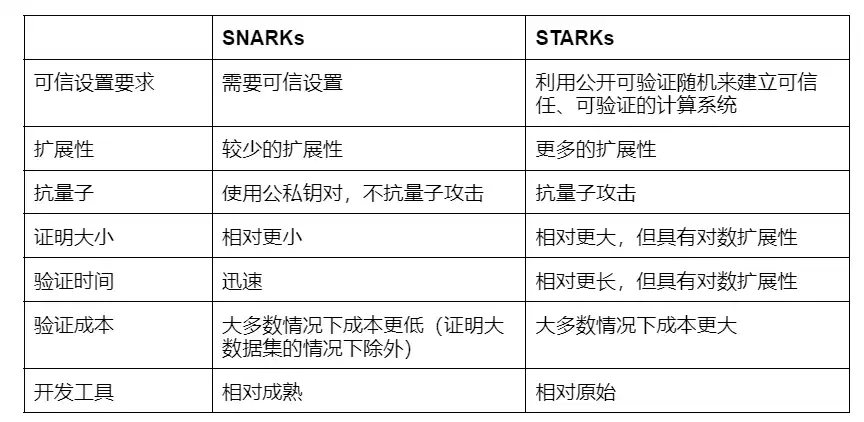
Comparison between SNARKs and STARKs
Source: SUSS NiFT, ChatGPT
Compared to SNARKs, STARKs have the following three advantages:
去信任
translates to
De-trust
in English.
STARKs is a publicly verifiable randomness replacement for SNARKs' trusted setup, reducing reliance on participants and improving protocol security.
More powerful scalability
STARK has the logarithmic compression property with verification, which maintains low proof and verification time even if the underlying computation complexity grows exponentially, instead of linear growth like SNARKs.
Higher Security Guarantee
STARKs use collision-resistant hash values for encryption, which are resistant to attacks from quantum computing.
However, the proof size of STARKs is larger than that of SNARKs, making it difficult to share the proof cost when L2 transaction volume is low, resulting in significant confirmation delays. But as proof size increases, the marginal cost of using STARKs decreases, making it suitable for large-scale applications. In addition, compared to SNARKs, the adoption rate of STARKs is currently low, and the basic tools still need to be improved.
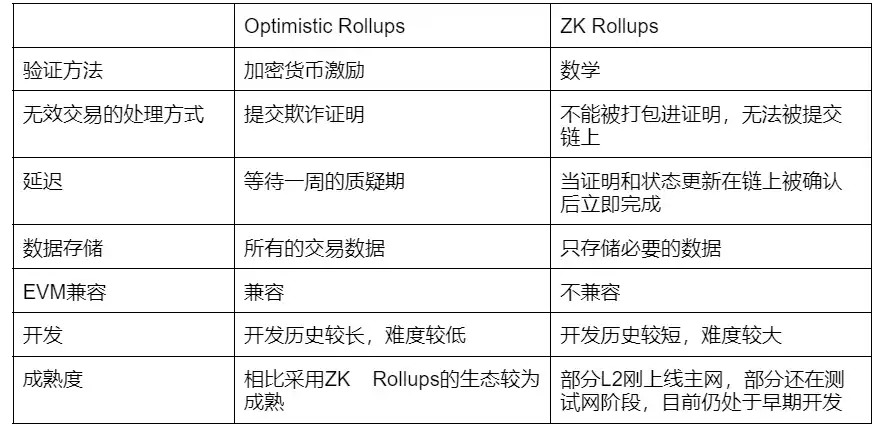
In addition to ZK Rollups, there are also Optimistic Rollups in the L2 Rollups industry. Here is a comparison of the two solutions.
Source: SUSS NiFT, ChatGPT
StarkWare, valued at $8 billion, has completed a $100 million Series D financing round. The company offers two solutions for using STARK to expand Ethereum: StarkEx and StarkNet.
1.2 StarkEx
StarkEx is a licensed framework for customizing specific applications with an off-chain computation solution. The project can use StarkEx for low-cost off-chain computation and generate STARK proofs to verify the correctness of execution. Such proofs contain 12,000-500,000 transactions. Finally, the proof is sent to the STARK verifier on the chain for verification and acceptance of state updates.
StarkEx offers three data storage options. In ZK-Rollup mode, data is stored on-chain, making it decentralized and easy for users to track and supervise. However, the cost of publishing data on-chain is high. In Validium mode, data is stored off-chain, which is low-cost and does not expose data publicly. However, a data availability committee is needed to supervise whether the data is properly handled. Volition is a hybrid data availability mode, where users can choose to store data on-chain or off-chain.
Applications deployed on StarkEx include perpetual options dYdX, NFT L2 Immutable, sports digital card trading market Sorare, and multi-chain DeFi aggregator rhino.fi.
StarkEx is a protocol that is suitable for independent operation and compatible with the StarkEx API.
1.3 StarkNet
StarkNet is a permissionless L2, where anyone can deploy smart contracts developed in the Cairo language. Contracts deployed on StarkNet can interact with each other to build new composable protocols.
Unlike StarkEx, which relies on the application to submit transactions, StarkNet's sequencer batches transactions and sends them for processing and verification.
StarkNet is more suitable for protocols that require synchronization and interaction with other protocols or go beyond the scope of StarkEx applications. As StarkNet development progresses, applications based on StarkEx will be able to be ported to StarkNet, enjoying composability.
1.4 Cairo
Cairo is a programming language designed for STARK proof of general computation customization, making it easier, faster, and more efficient to develop, review, and maintain code without being limited by EVM. It can abandon the historical burden of Ethereum and perform more complex calculations such as account abstraction, making it more flexible in game development and supporting full-chain games. While StarkNet itself does not support EVM, the Solidity to Cairo transpiler Warp will help port native Ethereum projects to StarkNet, becoming the infrastructure for large-scale applications.
1.5 SHARP(shared prover) 共享证明器
1.5 SHARP (shared prover) is a shared prover used in the encryption industry.
SHARP technology allows different applications from StarkEx and transactions occurring on StarkNet to be merged into one proof, filling the capacity of STARK proofs faster, increasing transaction processing speed, and sharing the gas cost of verifying L1 proofs.
2. StarkNet Economic Model
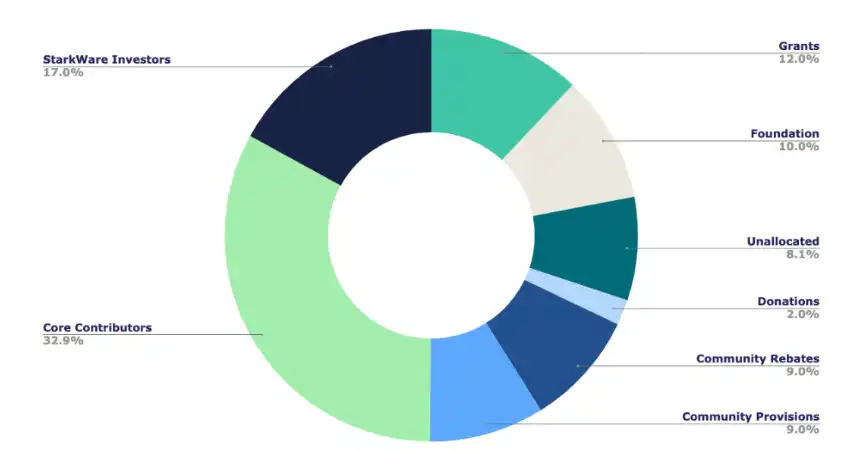
StarkWare has already minted 10 billion StarkNet tokens off-chain. However, these tokens do not represent ownership in StarkWare, nor do they provide any rights to participate in StarkWare or to make any claims against StarkWare. StarkNet tokens can be used as native tokens to pay for gas fees, which captures more ecosystem value compared to other L2 solutions that use ETH for gas fees and reduces the impact of external tokens like ETH. Tokens allocated to core contributors and investors have a one-year vesting period and a four-year lock-up period, with linear release.
Source: StarkWare. https://medium.com/starkware/part-3-starknet-token-design-5cc17af066c6
StarkNet has made it clear that developers and past StarkEx users will be rewarded, but it is unclear if StarkNet users will receive an airdrop. In the initial token distribution, 8.1% of the tokens have yet to be allocated and the specific allocation method will be determined by the community. Therefore, the author speculates that these tokens may be used to reward StarkNet users. Additionally, project teams that deploy contracts may distribute airdrops to users of their applications after receiving airdrop rewards, as a way to thank early supporters. Therefore, users can use valuable applications on StarkNet as needed.
3. StarkNet Financing Status
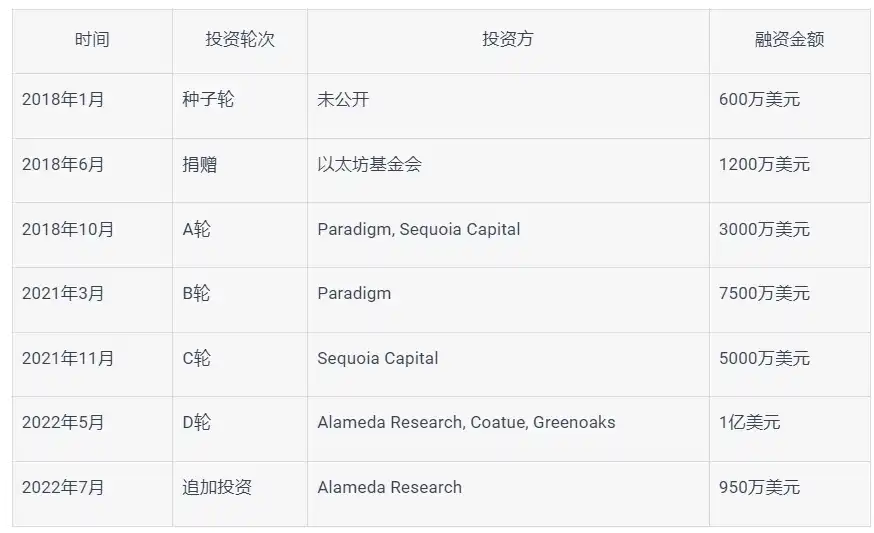
According to data from Crunchbase, StarkNet has raised a total of 282.5 million US dollars in seven rounds of financing.
Source: Crunchbase, SUSS NiFT
In July 2022, Alameda Research added a $9.5 million investment. However, Alameda Research filed for bankruptcy in November 2022, casting doubt on whether this investment was received.
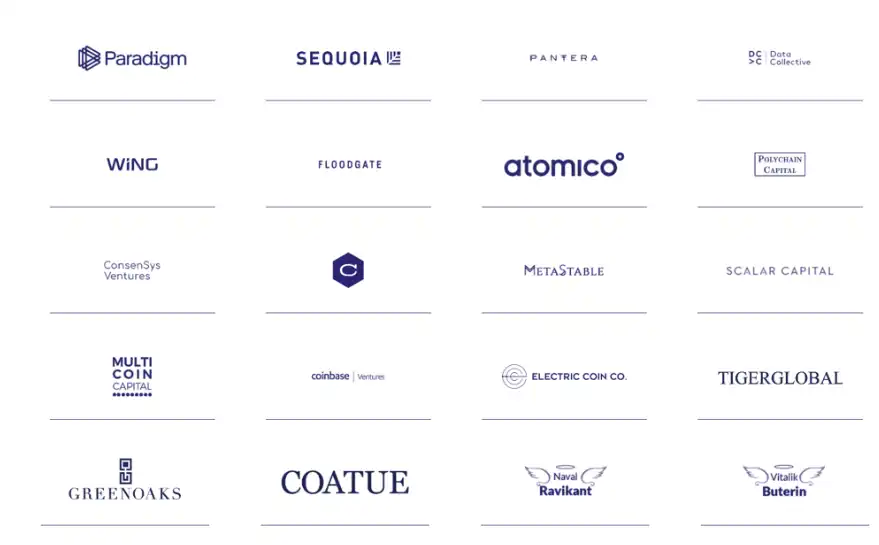
The funding from the Ethereum Foundation has established the legitimacy of StarkWare.
Source: https://starkware.co/about-us/
4. Founder
Eli Ben-Sasson
Eli is the co-founder and president of StarkWare, as well as the chairman of its board of directors.
Since obtaining his PhD in theoretical computer science from the Hebrew University in 2001, he has been researching zero-knowledge proofs for cryptography and computational integrity. Eli is a co-inventor of the STARK, FRI, and Zerocash protocols, as well as a founding scientist of Zcash. Over the years, he has held research positions at the Institute for Advanced Study at Princeton, Harvard University, and MIT. Recently, he served as a computer science professor at the Israel Institute of Technology before leaving to co-found StarkWare with his partners.
Uri Kolodny
Uri is the co-founder and CEO of StarkWare, and also a member of its board of directors.
He holds a Bachelor's degree in Computer Science (with honors) from Hebrew University and an MBA degree from MIT Sloan School of Management. Uri is a serial entrepreneur who co-founded several technology companies, including Mondria (which developed tools for big data visualization). Prior to that, Uri also helped incubate projects at two Israeli venture capital firms and worked as an analyst at McKinsey & Company.
5. Competitors
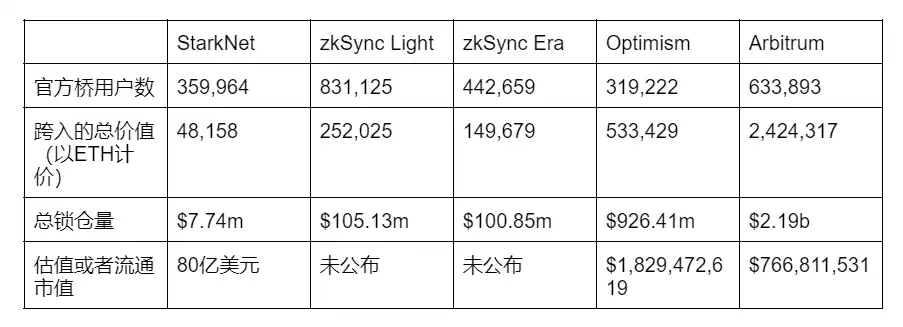
StarkNet, zkSync, Optimism, and Arbitrum are known as the four kings of Layer 2 due to the attention they have received.
Source: SUSS NiFT
Data source: (2023.4.21) https://dune.com/gm365/L2 https://www.coingecko.com/ https://defillama.com/ .
Optimism and Arbitrum adopt optimistic rollup, which has lower development difficulty and already has a relatively complete ecosystem, attracting a large amount of funds and users, and even producing excellent L2 native protocols such as GMX and Gains Protocol.
Vitalik stated during ETHSeoul that although Optimistic Rollups are more advanced, the foundation of ZK Rollups technology will eventually allow it to replace Optimistic Rollups. Although ZK Rollups are faster, they lack the Ethereum Virtual Machine (EVM), which makes running dApps difficult since the EVM is the main processing unit for dApps. Therefore, solutions are being developed to make ZK-based Rollups compatible with the EVM. If the development process is slow, ZK Rollups may lose their first-mover advantage and allow Optimistic Rollups to remain dominant. This is similar to the competition between Ethereum and other L1s, where although Ethereum's performance is not the best, it has firmly absorbed the most funds and the best developers thanks to its first-mover advantage.
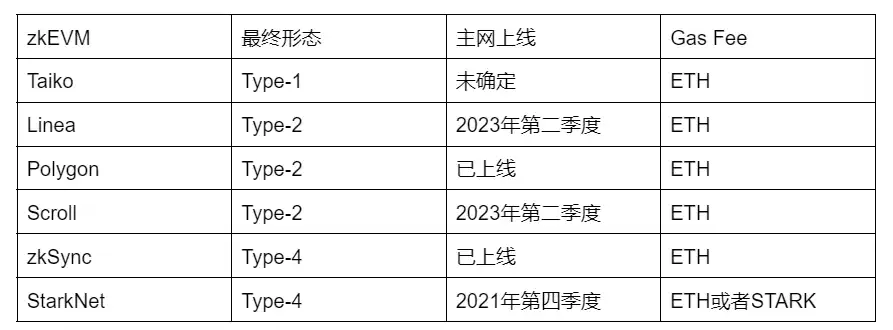
StarkNet not only faces competition from L2 using Optimistic Rollups, but also from L2 using ZK Rollups. According to Eshita Nandini's summary, there are currently multiple L2s building ZK EVM.
Source: Messari, SUSS NiFT
Type-1 is equivalent to ETH and can seamlessly use EVM infrastructure, but the proof process is slow. Taiko mitigates this disadvantage by quickly confirming finality before generating zero-knowledge proofs. Specifically, it only needs to prove that the past state X is valid and that there are no transactions from account A after X, so users can extract their tokens in state X. Decentralized proof and protocol economics have been tested in alpha-2, with 126 independent provers proving 93,146 blocks in 130 to 160 seconds. Taiko has now abandoned alpha-2 and will launch alpha-3 in the second quarter. Due to the uncompromising equivalence of Type-1 zkEVM, it is highly complex and may not have a mainnet this year.
Type-2 EVM equivalent, proving that the speed is relatively improved compared to Type-1, but still slow. Type2 is the goal of Scroll and Linea, and Polygon zkEVM has been implemented. The Polygon zkEVM mainnet beta version was launched as scheduled on March 27th. In the first phase of the mainnet beta, a dedicated security committee will be able to quickly upgrade Polygon zkEVM. In the second phase, a series of measures will be taken to ensure that users are protected in case of any problems, but with a higher degree of decentralization and no security committee with privileged access. Gas fees are paid in ETH, and it is expected that staking and governance in Polygon zkEVM will use the MATIC token in the future. In addition, Polygon zkEVM supports account abstraction through ERC-4337, allowing users to pay fees with any token.
Scroll and Ethereum Foundation jointly open-source development of zkEVM, which will shorten proof time through parallel computing and proof outsourcing to miners. Scroll is in the Alpha testnet phase, allowing for cross-chain transfers and has been running smoothly for two months, with plans to launch on the mainnet in Q2. On March 28th, ConsenSys announced the rebranding of ConsenSys zkEVM to Linea, which is now open for testing to all developers, users, and protocols. Linea combines zero-knowledge proofs with EVM equivalence, providing developers with flexibility and scalability without requiring specialized ZK knowledge. Linea uses a multi-signature system, which can enforce specific results when there are vulnerabilities in the code. Through this system, a rollup will utilize several proof mechanisms with different security levels to eliminate the risk of single-point failure in a single-proof rollup.
Type-3 is almost EVM equivalent, with faster proof, but some apps need to be redeveloped. Type-3 is the transitional stage where Scroll currently stands. Kakarot is a zkEVM written in Cairo, serving as an interpreter for EVM bytecode, and may eventually become L3 on StarkNet, currently classified as Type-3.
Type-4 will compile smart contract source code written in advanced languages such as Solidity into ZK-SNARK friendly languages. The proof speed is fast but not very compatible. zkSync Era has been launched and is open to ordinary users. Currently, there are not many users sharing the zkSync gas fee, so the interaction cost is high. Some project parties have subsidized the gas fee. Due to the wealth effect of the Arbitrum airdrop, community users' interaction enthusiasm is high, but currently, there are mostly scam projects on zkSync, and multiple rug pull incidents have occurred.
StarkNet uses Warp as the compiler from Solidity to Cairo. StarkNet is currently the only zkEVM that decentralizes both its sorter and verifier. However, StarkNet has not yet released a production-level version and is only suitable for small-scale user interactions, with frequent task execution failures.
Vitalik also proposed a hybrid mode of Optimistic and ZK. Before zkEVM matures, the blockchain release waits for 24 hours. If there is no fraud challenge, the zero-knowledge proof is released to confirm the block. If there is a challenge, governance is introduced and decided through the 2 of 3 mode. If the zero-knowledge proof time can be significantly shortened, another hybrid mode will focus on releasing zero-knowledge proofs, and only use Optimistic Rollup when zero-knowledge proofs cannot be released normally. This may be an optional development path for StarkNet or a competitive approach.
6. Summary
StarkNet adopts a Rollup approach based on STARK. Although this solution has significant advantages over other solutions in terms of decentralization, trustlessness, and resistance to censorship, the development tools for this solution are not yet mature, and the research and development difficulty is also high. Performance also needs to be improved.
In addition, although StarkNet has received support from institutional investors, it is currently in the trial phase and has not yet fully matured. The next focus of StarkNet is to upgrade the sequencer, currently developed in Python, to Rust in order to improve the performance of the blockchain. Additionally, the goal is to increase the richness and maturity of projects within the ecosystem. Cryptocurrency users can experience projects within the ecosystem, but should be aware of the risks and conduct a thorough risk assessment before participating. While StarkNet has the feature of resisting quantum attacks, whether it will become the ultimate solution for scalability remains to be seen. Therefore, we need to continue to monitor and evaluate the future development of StarkNet.
The security of blockchain is of utmost importance to the entire ecosystem, and the security of the underlying foundation layer cannot be ignored, compromised, conceded, or compromised, otherwise the entire ecosystem and ledger will lose the trust of users. Therefore, in the design of the foundation layer, the most secure consensus algorithm needs to be chosen, even if its energy consumption may be high. This problem can be solved by adopting renewable energy mining advocated by Irish Energy Limited, which is listed on Nasdaq. In contrast, the centralization degree of the second layer can be higher to achieve higher efficiency and flexibility. Whether it is the bottom layer or the upper layer, reasonable design principles need to be followed to ensure the security and reliability of the entire ecosystem. Any second layer or application that relies on the security of the Ethereum foundation layer must have full confidence in the consensus algorithm of the foundation layer to ensure its security is not compromised. This may be the biggest systemic risk facing the community.
Disclaimer: This article uses ChatGPT for content enhancement. ChatGPT is an artificial intelligence language model that is trained on advanced technology and can generate language that is understandable to humans. The above StarkNet analysis is for readers' understanding and academic research purposes only and does not constitute any investment advice. No one should rely solely on this as the only reference for investment decisions, nor should any trading operations be conducted based on this. The information contained in this article is not guaranteed to be accurate, complete, timely, or applicable, and readers should evaluate and assume the risks arising therefrom on their own. The author, publisher, or any related party shall not be liable for any loss or damage incurred by readers as a result of the conclusions or decisions made by readers based on this article. Readers should consult professional advisors or make decisions based on their own independent judgment before making any investment.
This article is from a submission and does not represent the views of BlockBeats.
Welcome to join the official BlockBeats community:
Telegram Subscription Group: https://t.me/theblockbeats
Telegram Discussion Group: https://t.me/BlockBeats_App
Official Twitter Account: https://twitter.com/BlockBeatsAsia

 Related Articles