With $14 million in financing, is it possible for Ethena Labs to reshuffle the stablecoin market?
Original Title: "An Analysis of Ethena Labs: The Stablecoin Disruptor in Arthur Hayes' Eyes with a Valuation of 300 Million US Dollars"
Original Author: Azuma, Odaily Planet Daily
On February 16th, stablecoin project Ethena Labs announced that it had completed a strategic round of funding of $14 million, with a total of $300 million raised. The round was led by Dragonfly, Brevan Howard Digital, and Maelstrom, the family office of BitMEX founder Arthur Hayes.
Last July, Ethena Labs completed a $6.5 million seed round of financing, with Dragonfly as the lead investor and participation from Deribit, Bybit, OKX, Gemini, Huobi, Arthur Hayes, and his family office.
Inspiration Source: Arthur Hayes
Ethena Labs' main product is the "Delta Neutral" stablecoin USDe, which was inspired by BitMEX founder Arthur Hayes.
In March 2023, Arthur wrote an article titled "Dust on Crust", in which he discussed his vision for a new generation stablecoin called "Satoshi's Dollar". The idea is to create a stablecoin supported by an equal amount of BTC spot longs and futures shorts.
Ethena Labs then turned Arthur's idea into reality, but chose ETH as the primary asset underlying spot and futures positions. In other words, the collateral assets for USDe are made up of an equal amount of long spot ETH and short futures ETH.
Or because Ethena Labs is replacing Arthur to advance its vision, the project has received strong support from Arthur in both of its first two rounds of financing, and Arthur himself has personally minted a large amount of USDe, even publicly declaring on the X platform: "USDe will surpass USDT to become the largest USD stablecoin in terms of scale."
"Delta Neutral" - What is it?
The largest tag for USDe is "Delta Neutral".
Delta, in finance, is an indicator used to measure the impact of underlying asset price changes on portfolio changes. The value range is "-1 to 1". The definition of "Delta neutral" is that if an investment portfolio is composed of related financial products and its value is not affected by small changes in underlying asset prices, such an investment portfolio has the property of "Delta neutrality".
Considering the nature of USDe's product, due to the fact that the stablecoin's collateral assets are composed of an equal amount of spot ETH long positions and futures ETH short positions, the Delta value of the spot position is " 1 ", the Delta value of the futures short position is "-1 ", and the Delta value after hedging the two is " 0 ", achieving "Delta neutrality".
The fundamental properties of "Delta Neutral" determine that the basic position of USDe's mortgage casting warehouse is not significantly affected by small price changes in ETH, thus (under normal circumstances) ensuring that USDe always maintains a stable mortgage status.
收益率才是王道
translates to
Yield is the king
Earlier, we introduced the mortgage structure of USDe. So why did Ethena Labs adopt such a complex design? How can USDe seize market share from stablecoins such as USDT and USDC, which have been stable for a long time?
The answer lies above the yield, and USDe staking users can share dual benefits from the mortgaged assets.
· One is stable income from spot long positions pledging. Ethena Labs supports pledging spot ETH through derivative protocols such as Lido for liquidity pledging, earning an annualized return of 3% - 5%.
· The second is unstable returns from short-selling funding rates in the futures market. Users familiar with contracts understand the concept of funding rates. Although funding rates are an unstable factor, for short positions, the majority of the time the funding rate is positive in the long run, which also means that overall returns will be positive.
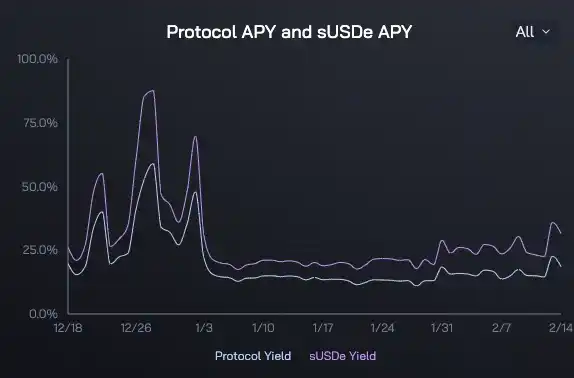
The combination of two yields has achieved a considerable rate of return for USDe. Official data shows that the yield of the Ethena Labs protocol and the yield of sUSDe (USDe staking certificate token) have been quite impressive in the past two months. The highest protocol yield has reached 58.9%, and the lowest is 10.99%; the highest sUSDe yield has reached 87.55%, and the lowest is 17.43%.
Currently, the real-time yield of sUSDe is 27.6%. Thinking back to the crazy scene when MakerDAO achieved an 8% yield using RWA, it is not difficult to understand why Arthur has so much confidence in USDe.
Four Layers of Potential Risks
Last October, Austin Campbell, a professor at Columbia Business School and founder and managing partner of Zero Knowledge Consulting, wrote an article dissecting the design structure of USDe.
Austin points out in the article that he prefers to refer to USDe as a "structural note" rather than a stablecoin, and analyzes the four potential risks of USDe:
· One is the security risk at the pledge level, whether the security and sustainability of the pledge node can be guaranteed;
· The second is the security risk of futures contract opening platforms, whether it is DEX or CEX, there is a risk of hacker attacks;
· Three is the risk of contract usability, sometimes there may not be enough liquidity to short.
· Fourth is funding rate risk, although the funding rate of short positions is mostly positive, there is also a possibility of turning negative. If the comprehensive yield after weighted collateral yield is negative, it is quite fatal for "stablecoins".
Current Data and Future Outlook
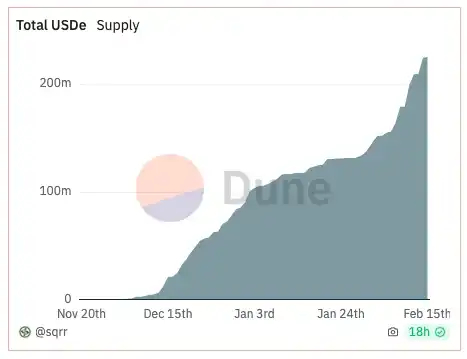
Currently, the real-time total minting amount of USDe is 234 million US dollars, which has maintained a strong growth trend in the past few months.
It is worth mentioning that Ethena Labs has not yet publicly released its products, and access to USDe products is still by invitation only, making the achievement of this data even more rare.
Welcome to join the official BlockBeats community:
Telegram Subscription Group: https://t.me/theblockbeats
Telegram Discussion Group: https://t.me/BlockBeats_App
Official Twitter Account: https://twitter.com/BlockBeatsAsia

 Related Articles