The annualized rate of stablecoin reaches 27%. How sustainable is Ethena Labs?
Original Title: "27% APY on a stablecoin - how sustainable is Ethena Labs?"
Original Author: ROUTE 2 FI
Translated by: Luccy, BlockBeats
Editor's Note:
On February 16th, Ethena Labs, the developer of the Ethereum-based stablecoin USDe, completed a strategic round of financing worth $14 million with a valuation of $300 million. The round was jointly led by Dragonfly, Brevan Howard Digital, and Maelstrom, the family office of BitMEX founder Arthur Hayes. Other investors included PayPal Ventures, Franklin Templeton, Avon Ventures, Binance Labs, Deribit, Gemini, and Kraken.
It is reported that USDe is an Ethereum-based stablecoin backed by derivatives, with its biggest tag being "Delta Neutral". Delta is an indicator used in finance to measure the impact of changes in the price of underlying assets on the portfolio. Its value ranges from "-1 to 1". The definition of "Delta Neutral" is that if a portfolio is composed of related financial products and its value is not affected by small changes in the price of underlying assets, the portfolio has the property of "Delta Neutral".
Related Reading: "With $14M Funding, Can Ethena Labs Reshape the Stablecoin Market?"
To create USDe, Ethena allows users to use USD, ETH, or liquidity collateral tokens as collateral. Cryptocurrency researcher ROUTE 2 FI analyzed Ethena Labs' synthetic dollar protocol, discussing its workings, advantages, risks, and comparisons with other similar protocols. BlockBeats translated the original article as follows:
This year, there are two DeFi protocols that really excite me: EigenLayer and Ethena Labs.
I have already provided a detailed introduction to EigenLayer. This time, I want to take a look at Ethena Labs and their insane 27% annualized return rate.

Ethena is a synthetic dollar protocol built on Ethereum, aimed at providing a cryptographic local solution for currencies that do not rely on traditional banking system infrastructure, and providing a globally accessible savings tool denominated in US dollars - the "Internet Bond".
Ethena's synthetic dollar USDe will be hedged against Delta through pledging Ethereum, providing the first anti-censorship, scalable, and stable local cryptocurrency solution.
USDe will be fully collateralized on-chain and can be freely combined in DeFi.
The stability of USDe's anchoring is ensured through Delta hedging of derivative positions held by the protocol, as well as the creation and redemption arbitrage mechanism. "Internet bonds" will combine the returns from pledged Ethereum with financing and basis returns from perpetual and futures markets.
Ethena's construction aims to address the most important and obvious immediate needs in the cryptocurrency field. DeFi attempts to create a parallel financial system, but stablecoins are the most important financial tool and rely entirely on traditional banking infrastructure.
Why are stablecoins so important?
Stablecoins are the most important tool in the cryptocurrency industry.
In all major centralized and decentralized trading venues, whether in spot or futures markets, the main trading pairs are priced in stablecoins, with over 90% of order book trades and over 70% of on-chain settlements priced in stablecoins.
Stablecoins settled over $12 trillion on-chain, making up two of the top five assets in the field and accounting for over 40% of the total value locked (TVL) in DeFi. They are also the most widely used assets in decentralized currency markets to date.

Centralized stablecoins, such as USDC or USDT, provide stability and capital efficiency, but also introduce some issues:
· The introduction of un-hedgeable custody risks in bond pledges in regulated bank accounts can easily come under scrutiny.
· There is a critical dependence on existing banking infrastructure and constantly evolving regulatory requirements specific to the country.
· Users are facing a "risk-free return" situation, as the issuer internalizes the profits and shifts the decoupling risk onto the users.
Decentralized stablecoins have gone through a series of issues in history, including scalability, mechanism design, and lack of embedded income.
· "Super-collateralized stablecoins" have historically encountered problems in expansion because their growth is inevitably closely linked to the growth of on-chain leverage demand on Ethereum. Recently, some stablecoins have chosen to absorb the national treasury in order to improve scalability, at the cost of sacrificing resistance to scrutiny.
· "Algorithmic stablecoins" face challenges in their mechanism design and are found to be inherently fragile and unstable. We believe that these designs do not have sustainable scalability.
· The previous "zero-risk synthetic dollar" was difficult to scale due to its critical dependence on decentralized trading venues with insufficient liquidity.
Therefore, USDe provides the following benefits:
· By utilizing derivatives, scalability under capital utilization efficiency has been achieved, enabling USDe to expand based on capital utilization efficiency. As the pledged ETH assets can be perfectly hedged through equivalent short positions, synthetic dollars only require a 1:1 "pledge".
· By hedging immediately after issuance, stability is provided, ensuring support for the synthetic USD value of USDe under all market conditions.
· By separating the supporting assets from the banking system and storing the untrusted supporting assets in a transparent, 24/7 auditable programmatic custody account solution outside of decentralized liquidity venues, anti-audit has been achieved.

How does it work?
The user deposits approximately $100 worth of stETH and immediately receives approximately $100 worth of USDe, minus any costs incurred from executing the hedge.
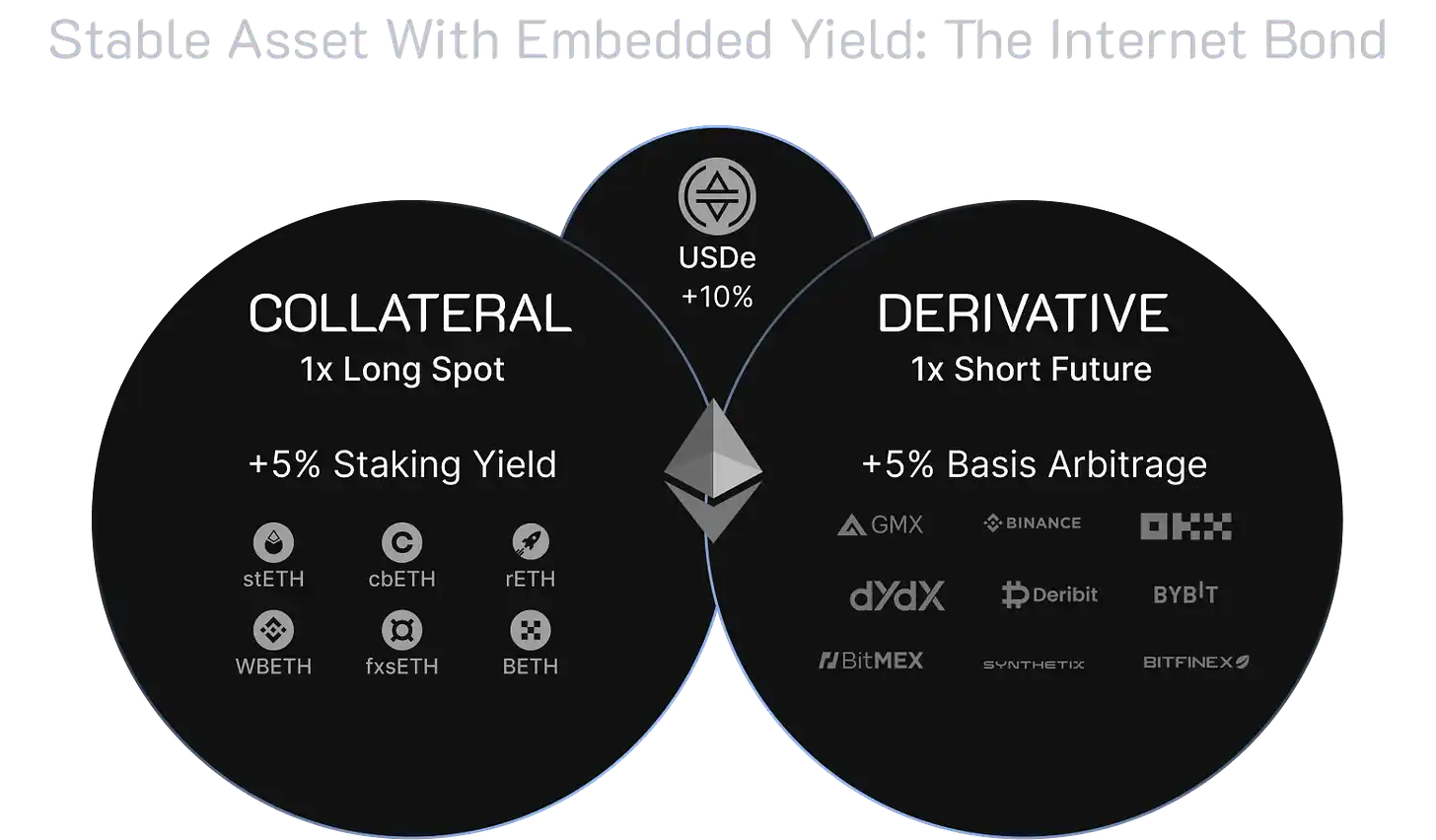
In this case, "collateral risk" refers to the fact that the collateral asset (stETH) of USDe is different from the underlying asset (ETH) of perpetual futures positions.
Currently, all protocols that rely on stETH (and any ETH LST) accept this liquidity risk profile. This means that the amount of stETH that can be unstaked may be delayed or users may have to accept a slight discount if they need to trade on external markets immediately.
Ethena's approved users can redeem USDe for stETH (or any ETH LST) at any time as needed, or request alternative assets, and utilize Ethena's multiple liquidity pools to obtain assets.
The loss of confidence in the integrity of LST may be due to the discovery of critical smart contract vulnerabilities in LST. In this case, users may attempt to withdraw their staked assets or exchange them for alternative collateral as soon as possible. This could result in prolonged exit queues for validators in protocols like Lido, as well as liquidity shortages for DeFi and CeFi exchanges.
Discussion
· 27.6% annual interest rate
· The income comes from using LSD ETH as collateral for a 1x ETH short position.· LSD ETH yield + short ETH financing rate = sUSDe yield
(Note: The original text contains some industry-specific terms and names that are not translated.)· Airdrop (called Ethena Shards) is about to take place, lasting for 3 months or until the USDe supply reaches 1 billion US dollars.
· Provide LPs + lock LP tokens = 20x Shards per day
· Buy and hold USDe = 5 times Shards per day.
· Pledge and hold sUSDe = 1x Shards per day
· All stable pool capacities are currently full (I expect them to lift the restriction, this is just my intuition).
· Smart contract has lower risk, but higher centralization risk (funds are on centralized exchanges), and performs best in a bull market (when people are borrowing and leveraging) (don't expect funding rates to be positive when everyone wants to short ETH).
Looking further, you can soon use your sUSDe in DeFi, as demonstrated by Seraphim, Growth Director at Ethena Labs:

One thing that people find difficult to understand is why we need financing rates.
The establishment of financing interest rates is to ensure that the financing mechanism keeps the futures market price consistent with the index spot price: whenever the demand for long-term ETH is too high and the perpetual price of ETH > the spot price of ETH, CEX needs some way to reduce people's motivation to continue to increase their positions.
Therefore, financing interest rate is a way to maintain the dynamic balance between futures market prices and index spot prices. As the entire market tends to be bullish, that is, long positions > short positions, if you short ETH, you will receive the profits earned by those who are long ETH, in order to offset the overwhelming demand that drives the perpetual price of ETH closer to the spot price of ETH.
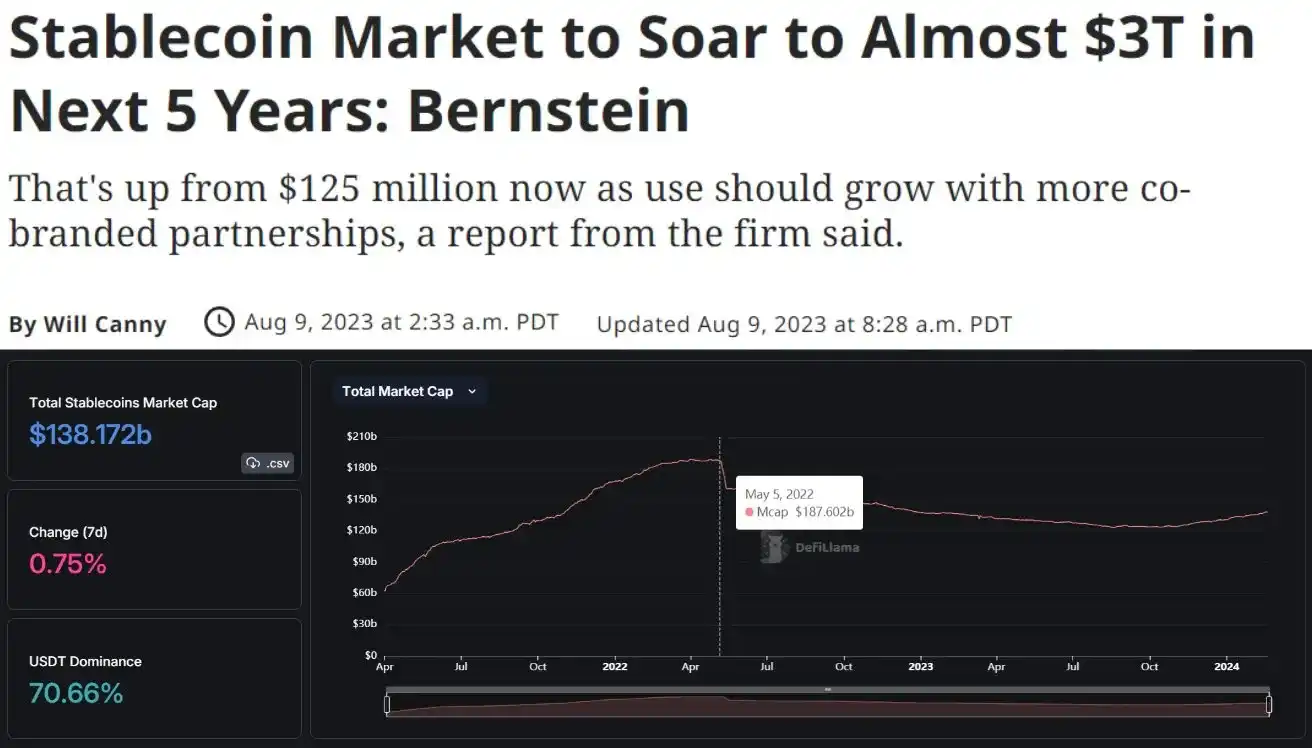
The global asset management company AllianceBernstein has a managed asset size of $725 billion. It predicts that the market capitalization of stablecoins will reach $3 trillion by 2028. If we look at the current market, the market capitalization of stablecoins is currently $138 billion, with a peak of $187 billion. This means that there is a potential growth space of up to 2000%.
In addition, Ethena has received a total investment of $140 million from top global investors, including @binance, @CryptoHayes, @Bybit_Official, @mirana, @lightspeedvp, and @FTI_US. It is worth noting that angel investors include @dcfgod, @cobie, and @blknoiz06.
Ethena has a very good dashboard where you can monitor and at least give people some peace of mind in terms of risk.

Ethena's shortcomings
Simply put, it is just a basis trading. When the yield curve is inverted, you start losing money, and the larger the stablecoin, the more money you lose. Now those who go long on ETH pay those who go short on ETH. This situation may last for a long time, especially in a bull market. But at certain times, the yield curve will invert, and people will short ETH and profit from it. Then Ethena suddenly has to bear this cost. They have their insurance fund to temporarily solve this problem. However, as the yield of sUSDe decreases, I suspect that people may want to withdraw their funds. That being said, this is not a fatal spiral. It's just that people may want to look for returns elsewhere.
Using stETH as collateral can provide a safe margin against negative interest rates. This means that Ethena only cares about the days when ETH financing is more negative than stETH returns. However, stETH liquidity is crucial for anchoring. Without sufficient stETH liquidity, USDe cannot expand to $100 billion.
Assuming the following situation occurs:
· User redemption
· Insurance funds can be used for coverage. According to Ethena, every $1 billion USD can survive almost all pessimistic funding rate predictions (Chaos Labs claims that $1 billion requires $33 million USD).
· The biggest risk of this project may not be explosive growth, but rather more people considering locking their funds in non-profitable tokens instead of choosing "trusted" alternatives (I'm just pointing out Lindy stablecoins, such as USDT or USDC, not saying that they are better, but because they have been around for a while, most people trust them).
· The counterparty risk of trading from CEXs and smart contracts may be one of the biggest issues. According to @tbr90, long-term risks slowly dissipate as negative interest rates eventually deplete insurance funds and force slow unlocking.
As Cobie pointed out, people can conduct these transactions themselves.
Welcome to join the official BlockBeats community:
Telegram Subscription Group: https://t.me/theblockbeats
Telegram Discussion Group: https://t.me/BlockBeats_App
Official Twitter Account: https://twitter.com/BlockBeatsAsia

 Related Articles