Insights from two market cycles: When will the bull market begin? What new narratives are worth continued attention?

Original Title: "Echoes of the Past: What the Deja Vu Market Tells Us About the Next Bull Market."
Original Author: IGNAS, DeFi Researcher
Original Translation: czgsws, BlockBeats
In the field of encryption, there is a popular belief that you need to go through three encryption cycles to truly succeed: the first cycle is to suffer heavy losses and learn important lessons about encryption operations; the second cycle is to gain some profits and feel comfortable; and only in the third cycle can you obtain wealth that can be passed down.
For me personally, this is my second bear market experience, and I will soon usher in the third bull market.

I feel that everything I am experiencing now seems familiar, because I have indeed experienced the bear market cycle of 2019-2020. But what I am referring to is not just the trend of price decline, but the overall atmosphere: official regulatory crackdowns, ordinary people gradually becoming indifferent to or accusing cryptocurrencies of being scams, and stock funds engaging in a kill-or-be-killed mode by transferring their returns from one token to another.
If you joined the cryptocurrency market in the previous bear market or earlier, then you may also have the same feeling. This familiarity is a huge advantage, which comes from your past experience in the cryptocurrency market and can lay the foundation for the next bull market.
Each bull market and bear market is slightly different, but overall they are very similar. This article will explore when the next bull market is likely to begin based on my own past experience.
似曾相识的市场
translates to
A Familiar Market
First Bull Market & Crash
The feeling of déjà vu usually only lasts for a few seconds, but the current cryptocurrency market has given people a sense of déjà vu that has lasted for years.
At the end of 2017, when BBC reported on Bitcoin constantly breaking historical highs, I began to enter the cryptocurrency field with FOMO emotions.
I bought some Bitcoin and soon after the price doubled. I felt very excited and thought I was very smart for entering a new financial field early. This excitement quickly turned into confidence, believing that investing in more new coins and cheaper tokens could earn me more money. Because the first trading platform I used (Bitstamp) did not list many altcoins, I searched on Google for the best altcoin trading platform and found Gateio. I liked its old user interface, where I could see all token symbols clearly, and more importantly, see the token identification.
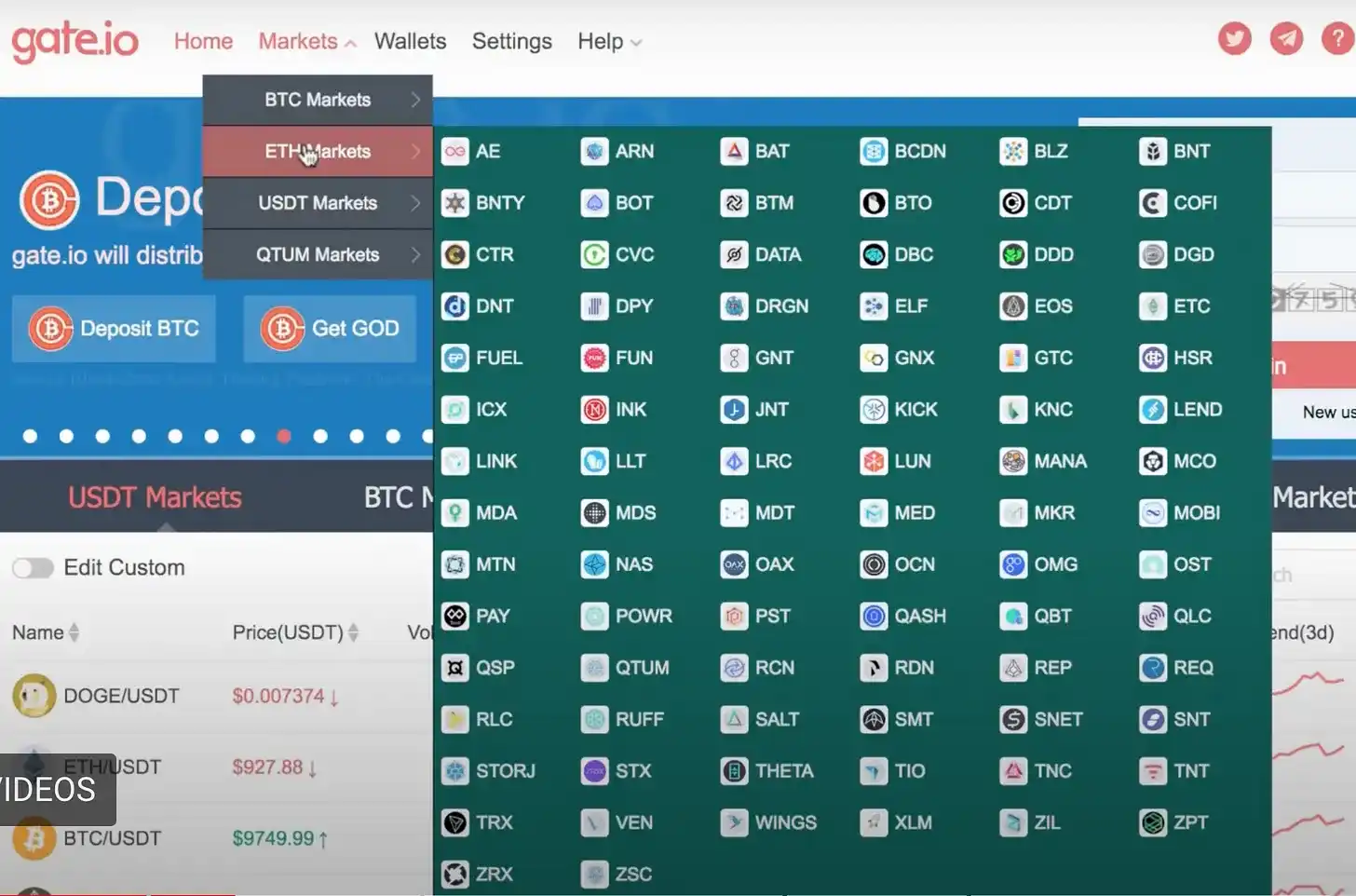
I have done some "research" by reading their website and whitepapers. All of these projects seem to be revolutionary, with decentralized supply chain management, decentralized storage, and even decentralized banking! The FOMO sentiment is getting stronger and stronger.
I keep investing more scholarships into these tokens, but there are too many types and they all look very similar, so I decided to choose based on the color of the token identifier without detailed investigation. I am paranoid that "red tokens" can outperform the market.
To make a long story short, I lost a lot of money in the end. I don't understand why this happened. I diversified my investment portfolio, read the whitepapers, and believed that these projects would fulfill their promises when they built their products.
But they failed to establish anything substantial, leaving only a website and a whitepaper.
This is very common for newcomers in the encryption industry. Greed, naive belief in new ideas, and lack of knowledge and experience about how the encryption market operates have led to tragic consequences. Many people have lost so much that they have given up on the encryption industry. However, those who stay and learn from their mistakes have a greater chance of success.
I was also disappointed at the time, but curious about what the problem was.
This curiosity is the main driving force behind my continued writing on encryption-related topics. Although sponsorship of my blog may not bring me any profits, it allows me to stay engaged and informed about truly important market trends. In this article, I will introduce two of these trends.
Second Bull Market & Crash
Curiosity and greed are powerful motivators that drive me to wake up early.
Despite the Bitcoin crash in 2017-2018, I still maintained a strong interest in cryptocurrency and followed all the news. At the end of 2018, this passion led me to my first job at a Korean CEX, where I spent about 4 years learning about market making, analyzing hundreds of tokens, talking to their teams, and attending dozens of conferences.
However, the market at that time was boring and calm, and the relative calm of the market was just one of the similarities with our current market stage. Other similarities include:
- The regulatory crackdown on ICOs (especially in Asia), similar to the current regulatory crackdown in the West.
- So far, cryptocurrency has been called a scam or Ponzi scheme at least 385 times.
- Waiting for institutions to adopt: institutions begin to buy Bitcoin, similar to the current spot Bitcoin ETF (pending).
- The game is played between on-exchange funds, and there is no new money entering the market.
- Waiting for widespread adoption of cryptocurrency.
There are more similarities, but compared to the last bear market, not all narratives are absent in the cryptocurrency field. There wasn't much to do during the bear market of 2018-2019. There was no DeFi, no NFT, and all my trades and holdings were on CEX. The most interesting thing was the IEO and the EOS token sale, which raised a record-breaking $4.2 billion, but had almost no results. There was hardly anything exciting in the market. However, things seem to have suddenly changed. In early 2020, I discovered a new popular token called AMPL (Ampleforth), which completely changed my understanding of token economics. It was the first token with elastic supply.
AMPL smart contracts will automatically increase or decrease the total supply based on the target price (between $1.06 and $0.96), a process known as "rebasement". If the price exceeds $1.06, the protocol will automatically issue more AMPL at 2am to bring the price back down to the target level. If the price falls below $0.96, the protocol will destroy excess tokens. This means that you don't own a fixed amount of AMPL, but rather a certain percentage of the supply. Investors will see their AMPL token quantity increase or decrease, which is different from the operation of any other currency.
It was novel and exciting, and I even made money from it. I didn't fully understand the intricacies (mostly guessing at what others were doing during the token rebase period), but I was happy to see the number of AMPL tokens in my wallet grow. At the time, it was a new and popular concept, and very rare.
Soon after, more and more new popular concepts began to emerge, and the most exciting were BAL and COMP token liquidity mining, which rewarded protocol users with free tokens in proportion to the amount they deposited into the smart contract.
This is a surprising moment, and it is also the time when you should focus your attention!
Because from time to time, an innovative token model emerges that changes the trajectory of the industry. The originality of the new token economics has driven the industry's development and may trigger a new bull market.
Why do they give away tokens for free? At first, it was really puzzling. Previously, you either had to buy new tokens in ICO/IEO or complete millions of tasks to get a $5 airdrop.
The craziest thing was the distribution of Yearn Finance YFI tokens. I just had to deposit my stablecoin into Curve and earn free YFI at an interest rate of 1000%+ APY.
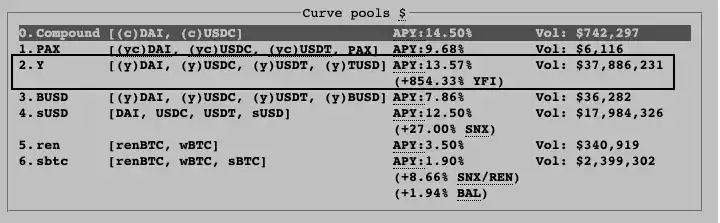
With the progress of SushiSwap liquidity mining, the situation is becoming increasingly crazy. The mechanism is to deposit ETH/USDT to earn SUSHI, or buy SUSHI and deposit it into the ETH/SUSHI LP farm to earn more SUSHI.
This Pool2 token mechanism is a true Ponzi scheme, as the price of SUSHI only goes up when more people join.
Dozens of Pool2 mining projects go online and collapse every day. The game theory of winning is simple: enter early, mine as many tokens as possible, and sell them when the new funds are less than the token issuance plus the exit funds. Eventually, the increasing number of new mines weakens people's attention and investment in the ETH/USDT amount. When the token price drops and APY decreases, the TVL flows to higher-yielding places, and they all collapse.
However, this crash is an important lesson and a pattern that is constantly repeated in the cryptocurrency field, which ultimately provides the best opportunity for the cryptocurrency field, as long as you know when to exit.
Bull Market: How it Starts and Ends
SecretsOfCrypto summarized in "The Road to Shanzhai" how funds enter the cryptocurrency ecosystem through Bitcoin and gradually flow to Shanzhai coins.
I believe there is another key factor to the bull market story: innovative money printing.
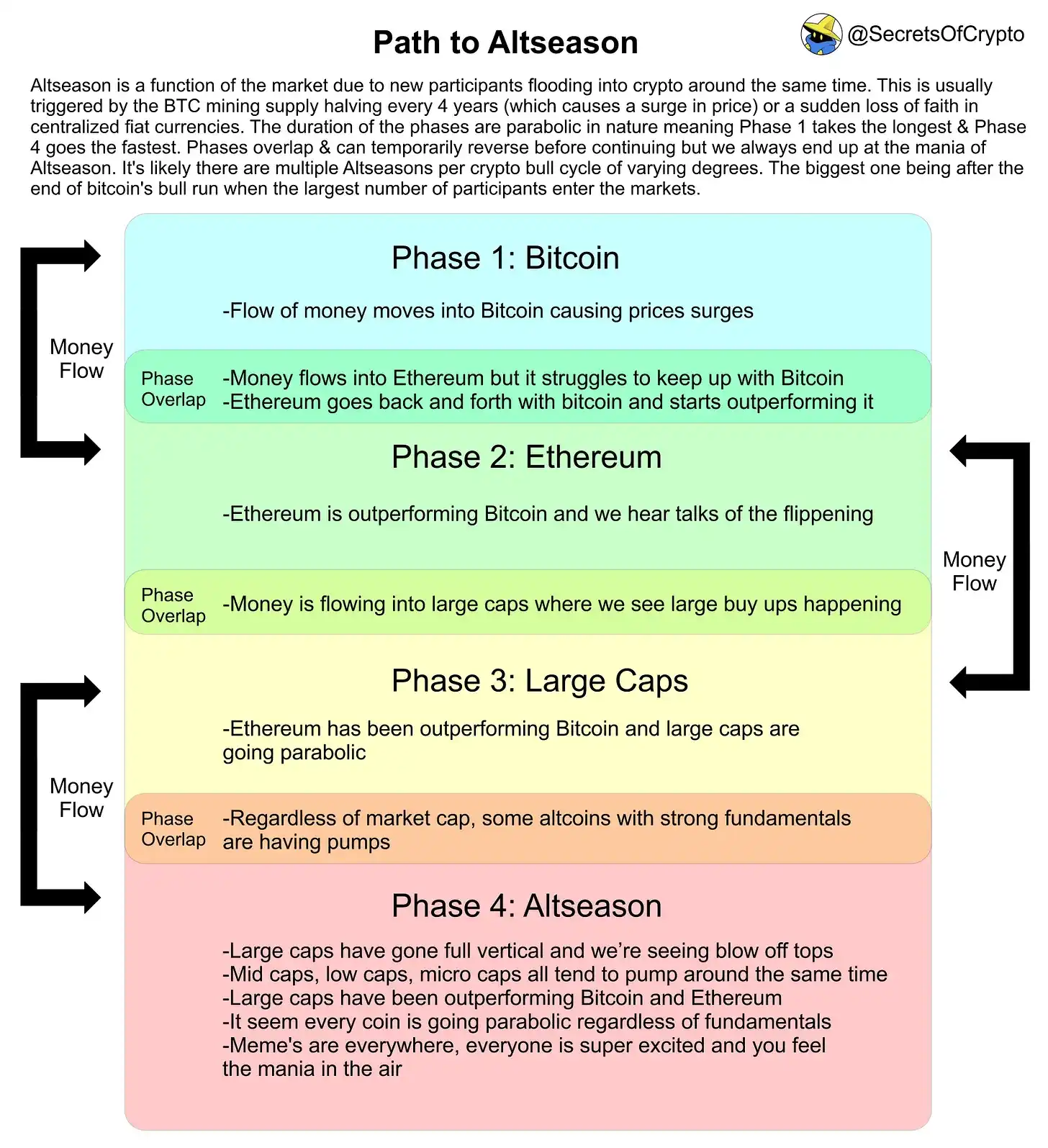
Here, "printing money" does not refer to the central bank's printing behavior, although this does benefit the price of cryptocurrency. What I mean is the inherent printing machine of cryptocurrency.
In the field of cryptocurrency, we say we dislike the central government's printing behavior because it dilutes the purchasing power of fiat currency, exacerbates inequality, and ultimately leads to currency collapse.
However, the cryptocurrency industry is most skilled in printing money, and it becomes easier with each bull market.
In fact, it took several years after the launch of Bitcoin for new competitors to emerge.
Litecoin is the first altcoin, launched in 2011, followed by Ethereum in 2015. In the following years, Bitcoin fork coins such as BCH and BSV also emerged. This is the original Layer 1 Seaon.
These Bitcoin fork coins also allowed OG printing machines, as BTC holders, to receive new tokens, which would be profitable if sold on the day of release.
However, issuing a new token is costly as these PoW mining machines require electricity to maintain network security.
Thanks to ERC20 tokens supported by Ethereum smart contracts, issuing new tokens has become easier and cheaper. Now anyone can issue tokens at a low cost, launching thousands of new tokens with just a website, whitepaper, and significant commitment.
However, the biggest impact brought by Ethereum and ERC20 is not technical, but social. Before ERC20, tokens were mainly seen as currencies for payment or value storage, but with the emergence of ERC20, tokenization became possible for everything. With the rise of cryptocurrency prices, the use cases for cryptocurrency have also increased.
And then, suddenly, the price plummeted.
The reason for the crash is that the funds flowing into the cryptocurrency system cannot support the exponential growth of new tokens launched every day. We printed too many tokens to meet the demand. As the number of circulating tokens increases, attention becomes scattered, leading to confusion about investment direction.
During DeFi Summer, a similar pattern emerged.
During this time, protocols distributed tokens for free through airdrops to liquidity providers or users, claiming that the airdrops were to comply with the decentralized spirit of cryptocurrency.
Returning to the ICO collapse period in 2017, it seemed that everything needed a token to function. Now, in the DeFi field, protocols require a token for governance, and we are still mainly in this stage, but disappointment with DeFi governance is rapidly increasing.
However, the true motivation behind these tokens is to activate liquidity. Without liquidity, protocols like Aave, Uniswap, or Curve have no value.
Just like in 2017, the DeFi collapse is due to the daily issuance of tokens exceeding the funds entering the system.
The stories may be different, but the fundamental reason for the collapse is the same.
Interestingly, NFTs also experienced a collapse for the same reason. Crypto Punks and BAYC caused FOMO among those who missed the opportunity, leading to the birth of new NFTs. However, when the inflation of new NFTs could not sustain the price level, the market eventually collapsed.
Currently, only a few NFT series have managed to survive, which makes me feel that the NFT market may be approaching its bottom.
New Bull Market: New Story, Same Mechanism
Briefly reviewing "Journey to the Altcoin Season" by SecrestsOfCrypto, the article mentions that the bull market began with new fiat money entering Bitcoin, and then funds gradually flowed into lower market value tokens.
However, I believe that the profit opportunities of the bull market will begin before new funds enter the system, through innovative leverage and the recycling of existing crypto capital.
A typical example is the DeFi craze: before the surge in Ethereum and Bitcoin prices, DeFi tokens had already shown promise. The natives of the cryptocurrency industry deposited Ethereum and stablecoins to obtain new tokens, which are telling the story of a new financial system. Some people are selling these tokens, but many believe in this story and continue to hold DeFi tokens.
The DeFi hype, bull market bubble, and the wealth generated from it are enough to attract newcomers to the crypto system to buy Ethereum and Bitcoin. Of course, the impact of low interest rates is much greater than the relatively mild effect of our printing money, but we'll talk about that later.
What interests me the most is that, before the DeFi craze, the infrastructure for DeFi had already been built, but few people cared about DeFi before liquidity mining became popular.
We are currently in a similar pre-DeFi bull market season, laying the foundation for innovative money printing and attention-grabbing narratives. Some top opportunities may generate bigger echo bubbles than some short-term narratives we saw during this bear market period.
Each innovation is worth writing a separate article about, and I will briefly introduce the importance of these innovations to the printing of echo bubble currency.
再质押
translates to
Re-pledge
in English.
EigenLayer is at the forefront of this narrative.
Simply put, the security of Ethereum can be enhanced by allowing Ethereum holders to "re-stake" their ETH to protect multiple networks simultaneously. However, this comes with higher risks. To compensate, re-staking holders can receive higher returns, in the form of a new altcoin that promises to change the world we live in.
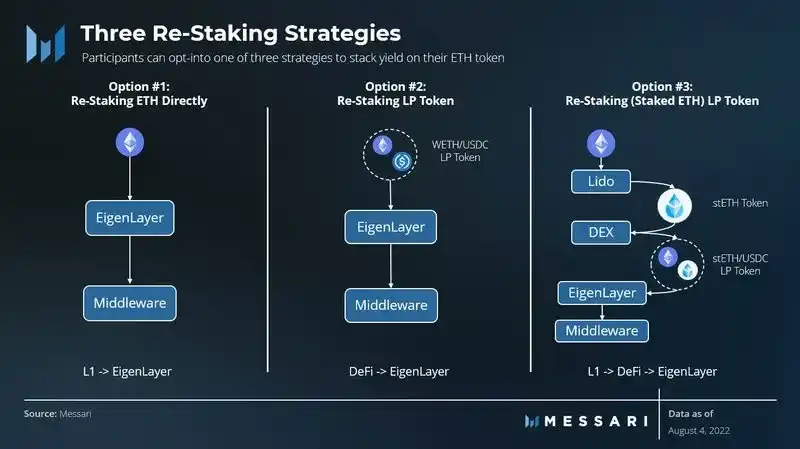
Many mining Ponzi economic strategies will be invented, each one more creative than the last, in order to prevent you from selling tokens. Our focus is on finding tokens that can generate a flywheel effect, so that the adoption of decentralized applications (dApps) can grow with token inflation. Stader's rsETH is a liquidity-backed re-staking token.
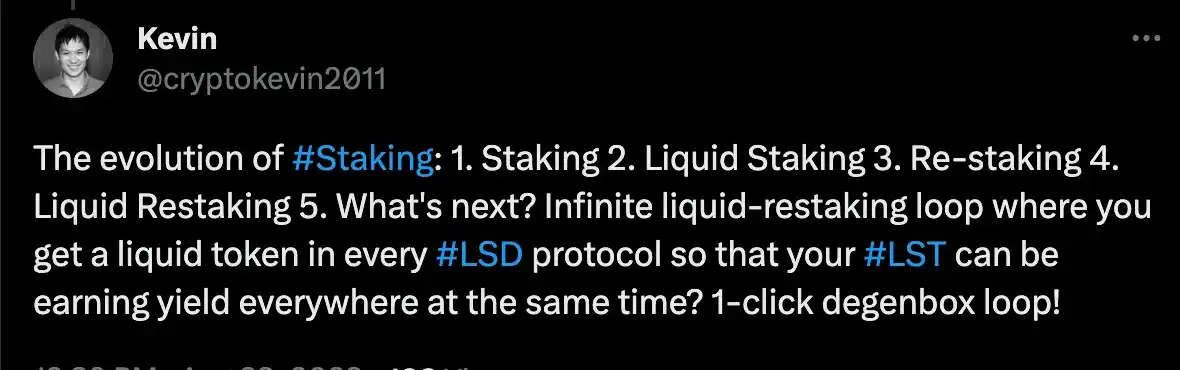
However, re-staking is a larger narrative beyond Ethereum. Cosmos first introduced the concept of "replicating security", where ATOM stakers "rent out" their security to other blockchains, with the first being Neutron. I expect more blockchains to adopt the idea of re-staking, just as they pursued liquidity mining rewards during the DeFi summer. Our task is to understand how re-staking works, because time is money after the echo bubble begins.
Bitcoin DeFi Ecosystem
This is a brand new narrative, even among EVM DeFi enthusiasts, it is rare.
I am optimistic about the potential for the vigorous development of Ordinal and Inscriptions, but currently they do not have a Ponzi token economics to sustain inflation of newly issued tokens in the market.
Bitcoin Ordinals are the basic units of Bitcoin, which are the satoshi or sat that have been minted and integrated with unique information. Therefore, satoshi can become unique and have the same identity as the underlying NFT.
However, I believe things will change. Ordinal and Inscriptions indicate a strong demand for non-fungible tokens (NFTs) and decentralized finance (DeFi) within the Bitcoin ecosystem. As a platform deeply integrated with Bitcoin and with more powerful features, Stacks is well-suited to meet this demand.
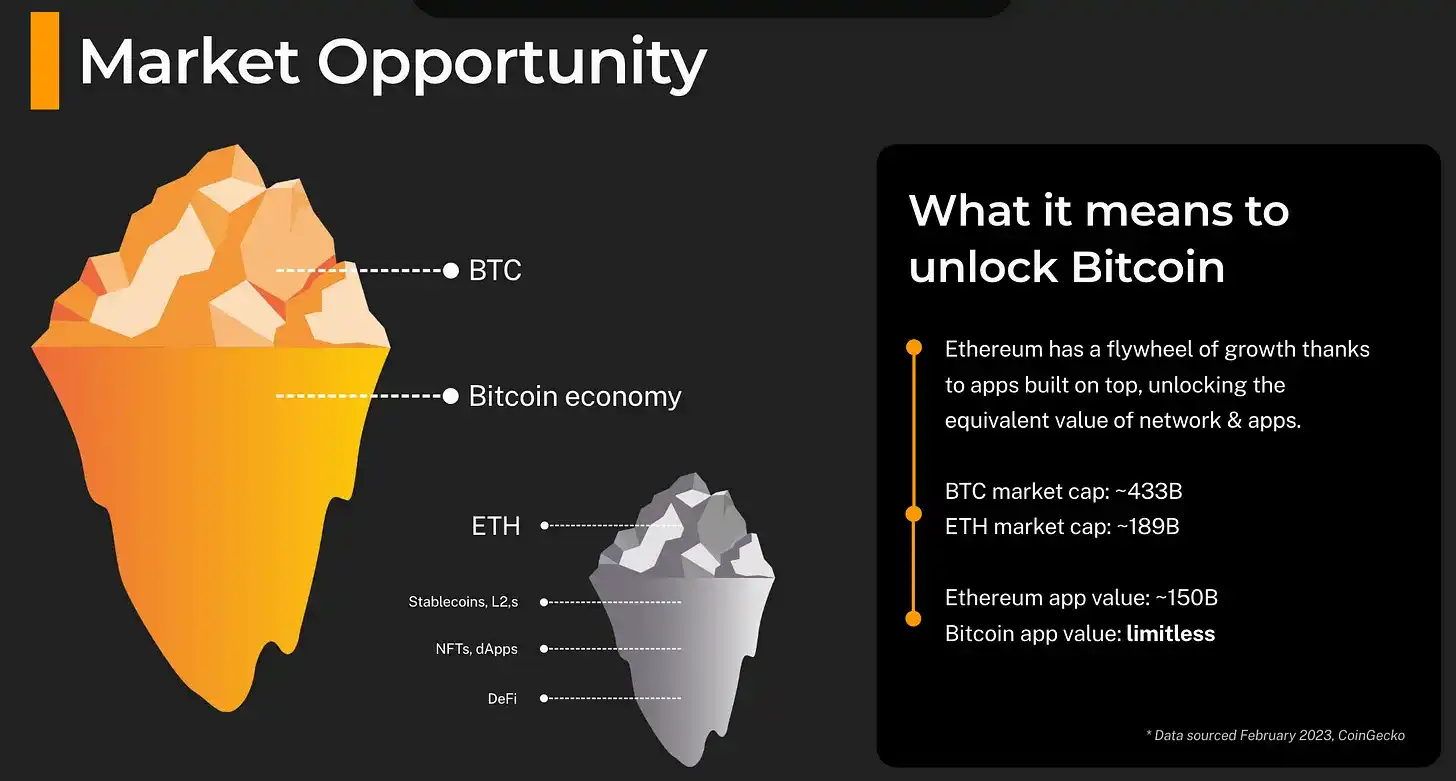
Source: Stacks
Stacks is a Bitcoin smart contract layer where DeFi applications are executed and settled in Bitcoin. Stacks is preparing for the important release of sBTC.
sBTC is a decentralized Bitcoin anchoring system that facilitates BTC transfers between Bitcoin and Stacks. BTC sent to Stacks is converted to sBTC at a 1:1 ratio. Converting it back to BTC involves a trust assumption, minimizing trust but not eliminating it. Unlike wBTC or RBTC, sBTC avoids the use of centralized custodians and instead uses an open user network, increasing Bitcoin liquidity for DeFi and NFTs on Stacks.
I am bullish on Stacks because Bitcoin will soon enter the Stacks ecosystem, but there are currently not many places to invest. Capital and attention will be focused on the first few applications to go live, one of which is Alex. ALEX is expanding its lead in Stacks DeFi, emphasizing cryptocurrency trading and lending, settling in Bitcoin, and its core is the AMM protocol, which supports its Launchpad and Orderbook. It also has a BSC/Ethereum USDT cross-chain bridge linked to the Stacks chain.
Alex has also launched an on-chain indexer (wrapper) for BRC20 tokens, allowing for trading of BRC20 and adding any desired Ponzi token economics on Stacks.
When will the bull market arrive?
The two narratives mentioned earlier have significant advantages in issuing new tokens and controlling inflation, mainly due to the engaging stories (secure sharing and decentralized finance on Bitcoin) and innovative token economics.
However, the injection of fresh capital from New Capital is crucial for sustainability and determining the lifecycle of the echo bubble. Currently, due to the lack of new funds injected into the system, the appearance and disappearance of narratives have become quite frequent. But I believe that these specific narratives have the potential to attract external capital to the entire crypto market, especially buyers who purchase ETH for re-staking and buyers who purchase BTC for decentralized finance narratives.
But please remember, these two narratives will also have a day of disillusionment, where too many tokens are minted to the point where demand and attention cannot keep up. Do not blindly buy into the narratives they are selling you, and have an exit strategy in place.
The key is timing, and the most important factor is still the macro environment, which is also improving. Over the past few years, we have been influenced by three heavyweight narratives: the Fed's liquidity cycle, war, and new policies. However, there have been some changes recently, with regulatory crackdowns easing, China entering deflation, and inflation and interest rate hikes peaking.
If we believe in the cryptocurrency cycle, then we can predict that the highest price of cryptocurrency will reach $69,000 in the fourth quarter of 2024, and before the fourth quarter of 2025, cryptocurrency will experience a crazy surge, creating a new historical high price.
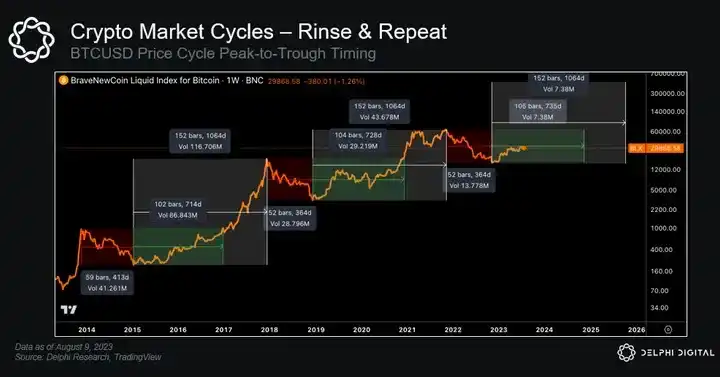
If it really goes as expected, then these two Ponzi echoes will start before the new ATH.
Now is the best time for research and learning, because when the happy times begin, we need to be prepared.
Original article link
Welcome to join the official BlockBeats community:
Telegram Subscription Group: https://t.me/theblockbeats
Telegram Discussion Group: https://t.me/BlockBeats_App
Official Twitter Account: https://twitter.com/BlockBeatsAsia

 Related Articles