Bankless: These 5 narrative themes could be catalysts for a bull market

Bankless | 5 Key Themes and Trends for the Next Bull Market
Original article by Jean-Paul Faraj
The Way of DeFi
Bear markets are the best opportunity to build wealth. The tourists (speculators) have all left and it's the low season. It's a time for builders to get their heads down and for investors to place bets on the next big trend.
The recent bull market cycle has seen the rise of DeFi and NFTs, both circuits seeing a lot of innovation, interest and capital.
So, what about the next round? What will be the key themes and trends of the next bull market?
Predicting the future is hard, but here are some illuminating thoughts.
We know it's not easy for newcomers to watch prices collapse. Even for seasoned bulls and bears, watching the money go down is no easy task.
Although we're here for the technology, right?
Bear markets are often called fortunes, but why?
This is because opportunities to buy into projects at extremely low prices compared to the activity, growth, and utility of the projects abound throughout the crypto space. It's not easy to choose the right project, but the opportunities are clear.
This article is not meant to be a guide to getting rich, but if you take the time to learn and observe during this bear market, you will most likely be in a good position.
This article will outline what's bubbling on the crypto market's surface and which tracks will lead the charge in the next big bull market.
1. The L2
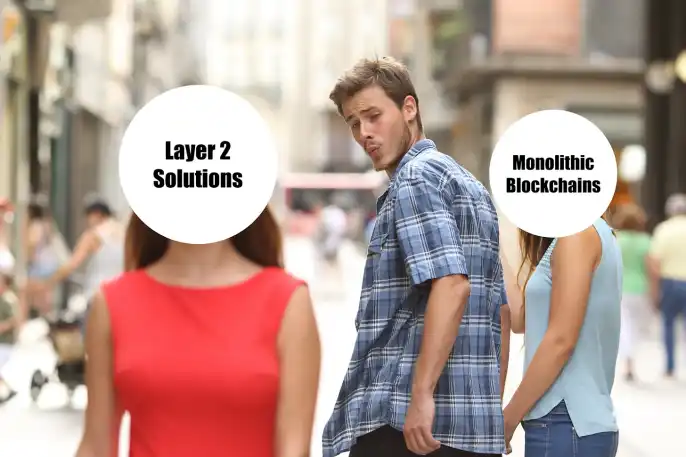
In the blockchain space, there is a clear, current push to enable scaling and increase transaction throughput. In the last bull market, we saw a lot of interest and speculation around projects like Solana and other Alt L1. That's largely because Ethereum doesn't yet have the proper scale to handle the bull market demand for its block space.
However, many of these blockchains, while boasting incredible speed and throughput, have sustained outages that make many users indignant or underperform when demand is high. Ultimately, many of these blockchains fail because they are monolithic, not modular, and try to provide all the security, decentralization, and throughput in a single product.
It doesn't work on a large scale, and it's pretty obvious (the point is biased, but well supported). So what is the solution that provides high throughput, high security, and high decentralization?
Enter the L2
The Layer 2 solution provides the ability to increase throughput, thereby improving the scalability of the blockchain while inheriting the security of the backbone. Solutions like StarkNet and zkSync enable "batch processing", bundling thousands of transactions into a single transaction and publishing it to the main chain (Ethereum). This reduces the cost per transaction by orders of magnitude and increases the speed and total number of transactions that can be processed on the chain.
So why is this so amazing, and why should we care? In order for this amazing technology to seep into the mainstream and be adopted as the core technology of the new Internet, we need it to be fast, secure and decentralized.
The L2 solution solves the speed problem, while the backbone provides security.
This will enable a wide range of use cases to operate to the standards we need in order to achieve worldwide adoption. Examples include video games that process thousands of microtransactions per second, media that are shared instantly and cheaply, and money transactions that can be completed in the blink of an eye.
Without a solution at Layer 2, it is likely that the full potential of blockchain will not be realized for a long time. If we want adoption, we need to provide a Layer that allows easy transactions while allowing mass adoption --Layer 2 provides this core requirement.
Currently, Layer 2 solutions, such as zkSync, Starknet, Polygon Hermez, Optimism, and Arbitrum, are under active development, with a lot of progress, and will soon reach the basic requirements required for adoption.
2. The maturation of DeFi and NFTS
Much of the last bull market was driven by two things: namely DeFi and NFTS. Both are very powerful tools, but both are still in their infancy -- NFTS have advantages over DeFi.
With the market calm, now is the time to allow these products to refine their capabilities and retest the market suitability of the products.
So why should decentralised finance lead to the next bull market?
DeFi is an open financial system where anyone, anywhere and any amount of money can participate.
This has not only opened up plenty of opportunities for people without access to banking services, but has also allowed a variety of new fintechs to grow and mature. The problem is, "decentralized lending is in its early stages. It doesn't offer everything that centralized lending does, but it beats the inefficiencies of traditional finance and approaches the creative thinking that Web3 attracts."
- Bankless
The existing centralised financial system (CeFi) is a huge walled garden controlled by banks and governments. They choose who gets in and who gets paid how much. Even if you give them everything they want, they can still easily shut you out, and often do.
DeFi lending agreements and services circumvent the threshold of such licensing, providing the same financial services that banks currently offer to everyone.
It is 100% transparent and trusted. Each can view the other's chips (anonymously via their address), as well as assess the financial health of the creditor/debtor according to their own criteria. This means you can peel back the layers as before and have a window into the inner workings of DeFi's new era bank.
This opened up a world of financial innovation, introducing new utilities, new opportunities and clarity around who could make, borrow or lend money.
But what about NFTS? Aren't those just JPEgs?
Why should they lead to the next bull market?
If you think so, you are sorely mistaken. NFTS are a Trojan horse to a real world of digital ownership.
In the last bull market, monkey pictures and pixelated punks ruled the universe. And this is just the beginning, a simple demonstration of the basic utility of digital ownership.
When we buy a shirt from a physical store, it's yours, only you own that particular shirt, and you have the receipt to prove it. It is "non-homogeneous" in every sense of the word.
Before NFTS, however, this was not possible in the digital realm. You can certainly buy X, Y or Z collectibles online, but they are stored on servers rented by the seller's company. With NFTS, the asset resides in a wallet that you control.
Industries that this technology can and is likely to disrupt include gaming, music, as well as home mortgages and money lending. The scope is unimaginable, and some of the other products and solutions outlined below that will lead us into the next bull market use this key technology.
In short, focus on innovation in the NFT space and those teams that are striving to reach their full potential.
3. Use Web3 single sign-on
Single sign-on Web3 authentication allows the use of a single password and account on millions of new websites and existing major news organizations and platforms, without the need for additional personal details.
Another huge topic that keeps popping up in the news is privacy and data. Companies like Meta, Amazon, and Google almost own your identity. They know everything about you -- your password, date of birth, SSN, everything you say and do on the Internet.
They say it's safe, but how many times has your data been hacked? This is basically Westworld level data collection, and most people just allow it to happen because there isn't a better solution yet.
The market for data collection is worth billions of dollars, and that's how these companies make their money. According to Datamation data:
"The global data collection market was valued at US $1.66 billion in 2021. It is estimated to reach US $8.21 billion by 2028 at a CAGR of 25.6%."
These trillion dollar companies are in the business of selling personal data. It's not just random data about a 25-year-old white woman living in Ohio, it's your name, your email, your location, the products you buy, and the list goes on and on.
Web3 single sign-on solves this problem. It allows companies to collect data, learn your likes and dislikes and provide you with personalized information they think you're interested in, while keeping your identity safe.
They can only have the data if you give them permission. For more information on personalized data sharing, see the Brave browser.
The way I see it, the future looks like this: Create a Web3 wallet/identity and link it to any of the 100 websites where you have an account. When you visit any site, click a button --" Log in with Web3 Wallet "-- and you're done. This is a password that can rule all websites, while protecting your data and identity, making it easier for you to get online.
4. The rise of GameFi
Currently, in traditional gaming environments, players either pay upfront for the game, pay monthly, or buy digital assets in free-to-play games.
However, no matter what game they play, every action they make and every item/character they acquire is not theirs. It's stored by the game, and if the player stops playing or paying, it's sitting dead on a server they can't control. Current game studios often have strict terms of service that prohibit players from making any "real money transactions."
This means that all the time the player has invested in the game, and all the value added to the game universe, is not theirs. The current system does not allow players to take advantage of it, and if they try to circumvent the rules, they are permanently banned.
Such markets are ripe for disruption. Allowing players to take ownership of the time and money they invest in blockchain-powered games through verifiable NFTS will create opportunities for both games and players.
We may soon be living in a world where instead of saying "Why waste your time playing games," mums say "I don't understand what Jimmy does with these games, but he can pay for all his stuff."
The gaming industry is now more profitable than all other media industries combined, but until now gamers have been left out of it. Web3 gaming isn't some fairy tale fantasy, it's a reality that's already in the making.
Unfortunately, there is a huge lack of fully playable web3 games. But in this bear market, look out for games that are highly playable and have a strong community.
These are the games you want to try.
Some of the games I keep a close eye on are:
Influence: Spatial strategy MMORP
Parallel: A science fiction card game
Loot Realms: Massively multiplayer chain game of economics and chivalry
Guild of Guardians: Mobile RPG
5. Music NFT
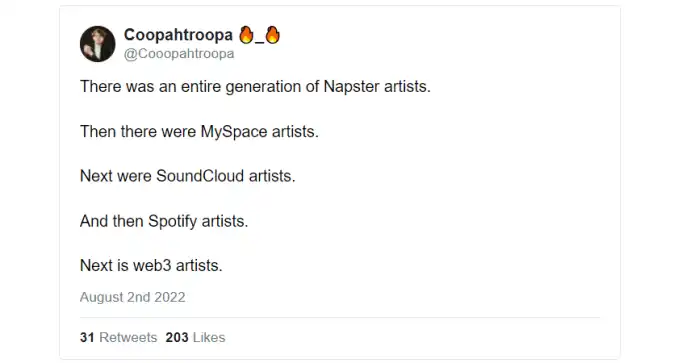
It's harder than ever to make a living as an artist these days, even though the ability to get your music out there is easier than ever.
Why is that? Simply put, streaming services and record labels take most of the money, leaving little for artists.
As an artist, you have to be one of the lucky few to be picked up by a record label or get content revenue through the algorithms of social media. However, even with the income of a content creator, you need to be at the top of the charts to keep living.
In Web3, artists can better monetize their music through new monetization channels, a closer connection to the community, and fuller ownership of their music.
Monetizing NFTS can occur in several different ways
Selling exclusive membership NFTS gives fans access to artists, for example, VIP lanes at shows, limited edition merchandise, face-to-face opportunities with artists.
Selling revenue-sharing NFTS, which share a percentage of profits from future sales, gives artists the freedom to work without the massive amount of red tape that comes with partnering with record labels and streaming services.
Ownership of music
The ownership of music by artists is the crux of the problem in the market today. The labels keep most of the profits, and then the streaming services pay a small percentage, which is then split unfairly between the artists and the labels.
With NFTS and Web3, artists can release music in NFTS, whether singles or whole albums, and fans can buy music directly from the artist without going through a record label.
A closer community
With Web3 certification and NFTS, artists can leverage a small fan base to make a living. You don't need a global audience to buy your world tour - all you need is one. 100 loyal fans.
A typical example is artists. Gramatik, who has long championed cryptocurrencies, blockchain and empowering artists to own their own music catalogs and create freely.
Free up content creators to create how they want, where they want, and with their own audiences.
In Web3, artists and content creators are no longer constrained by the platform on which they built their audience and no longer rely solely on advertising as a source of income.
Being able to offer their followers a basic, and possibly free, NFT to access your private website, content, discussion boards, and community will enable these content creators to get closer to their community, bring their followers to any new platform, and unlock new and unique Web3 monetization opportunities.
There are winds and clouds on the way forward
It's still early days for web3, and a lot of development and user experience design is needed to push us to the next level.
To support this growing ecosystem, a few more big things are needed:
The solution at Layer 2 needs to be fully operational and provide the base Layer with the ability to support the number of transactions needed to support large-scale adoption and utility
Ethereum successfully merged, closed proof of Work (PoW), converted to proof of Equity (PoS).
Bring the user experience of new users into these platforms and products to a point where it is comparable to the Web2 experience we enjoy today.
We don't know when the next bull market will come. But we are working our way out of the bear market and expect the next bull market to provide real utility and mass adoption.
The original link
Welcome to join the official BlockBeats community:
Telegram Subscription Group: https://t.me/theblockbeats
Telegram Discussion Group: https://t.me/BlockBeats_App
Official Twitter Account: https://twitter.com/BlockBeatsAsia