AI Anxiety and Crypto Corruption: The Democrats' New Electoral Weapons

On September 22, New York Democratic Assemblymember Alex Bores launched an organization aimed at bringing together parents, teachers, unions, and civil rights groups to give 2028 Democratic candidates—from the presidential race down to local elections—a shared AI safety agenda to win over voters.
Alex Bores
The organization's name is blunt and powerful: "Who Decides"—who decides the future of AI?
It is powerful because the name, or rather the slogan, implicitly captures ordinary people's unease under Silicon Valley's power. How models will change work, education, and the information environment is not something a few big companies can answer on everyone's behalf. Bores also saw something else: once voters start worrying about AI, safety can shift from a technical discussion into a set of electoral language.
Who Decides plans to conduct polling in 11 states tied to the presidential primaries or general election, partner with local organizations, and then use candidate questionnaires, forums, and endorsements to deliver policy demands to voters.
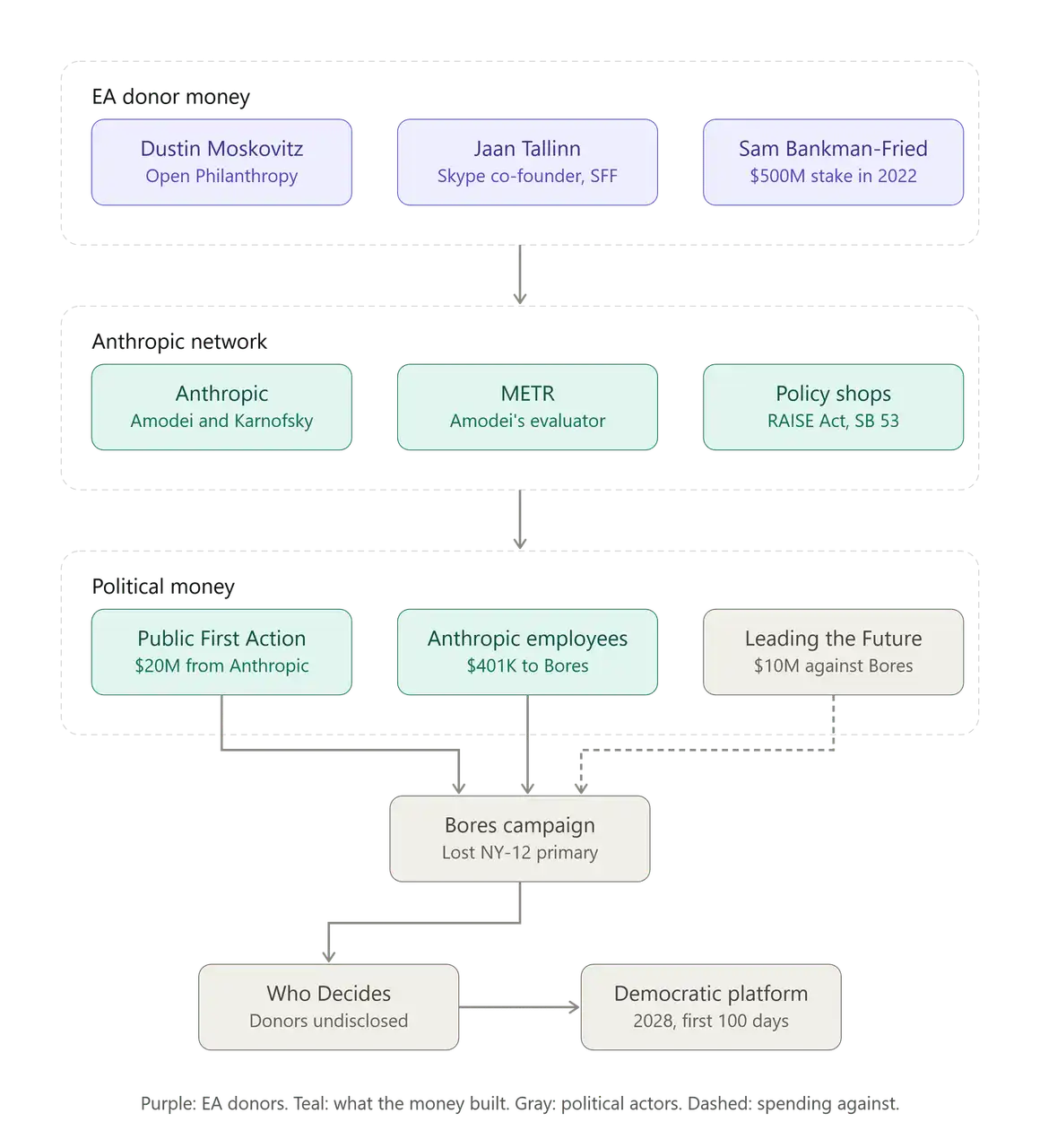
The AI threat is being packaged by some Democrats into a political issue that can mobilize voters.
From the AI lab to Capitol Hill
There is a clear timeline behind this shift. On September 12, Anthropic CEO Dario Amodei published a long essay calling on frontier AI companies to slow the growth of model capabilities so that safety research can catch up with the product race. He worries that models are beginning to participate in developing the next generation of models, and he also mentioned an incident in which an AI agent attacked beyond its bounds. In his judgment, if more powerful systems continue to develop along the same path, the damage will rapidly expand.
Amodei's proposal is to have external evaluators embedded in labs for the long term to review safety processes and incidents; to have frontier companies in democracies establish common standards with government support; and then to try to discuss verifiable international arrangements with countries such as China. He advocates linking capability growth to safety testing, and he also raises the possibility of limiting compute or the speed of model self-improvement.
These proposals would change the pace of R&D, and also change who has the right to enter labs, set standards, and review models. But Amodei also makes clear that slowing down does not mean stopping training or technological progress. He is also worried that if the United States slows down too much, it will lose its lead over China, and he is not confident about achieving a comprehensive global pause in the short term.
Three days later, Obama picked up the topic on Twitter. He welcomed several frontier labs discussing slowing down AI, then pushed the issue into a larger political arena: AI development should be at the center of public debate, self-imposed standards are not enough to constrain a handful of companies, and Washington needs to act. He also discussed the benefits in healthcare and education, job displacement, the wealth gap, and concentration of power, and said he "does not believe AI is destined to destroy humanity."
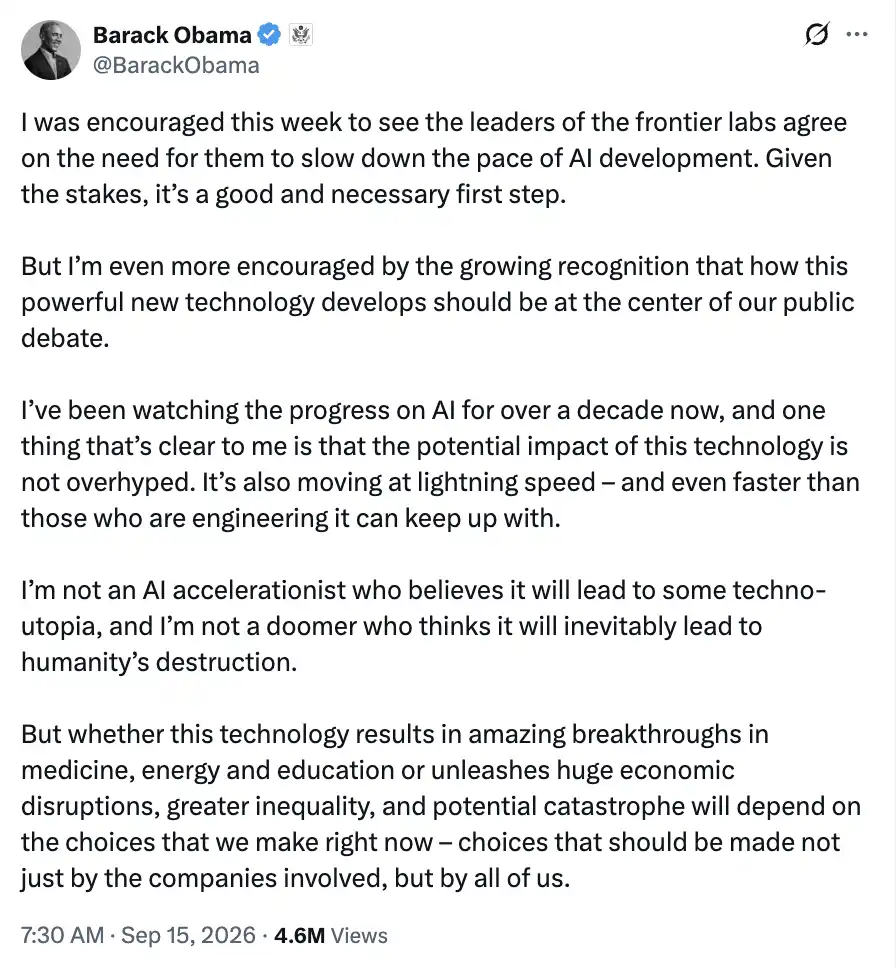
From lab risk assessments to a former president's public call, and then to election organizing aimed at 2028, AI safety completed an identity transformation and began to take on a familiar political task: organizing scattered discontent and anxiety so that opponents are forced to respond.
Republican Pushback
The Trump camp quickly made its own response, defining the Democratic call as "stopping American innovation." Trump opposed slowing the industry and stressed that the government already has criminal and regulatory powers. Guests on the All-In podcast, when discussing AI, directly described risk warnings as a Democratic campaign to pause AI development. They argued that slowing technology amounts to driving the industry out of the United States and could also give China a chance to take the lead.
This counterattack seized on a difficult problem in the Democratic agenda. If regulation requires expensive review, long-term external assessments, and complex compliance processes, the first ones able to afford it are often the well-funded top labs. Amodei himself is the head of one of those labs. Vice President Vance has expressed skepticism about this situation: why would the strongest AI companies voluntarily ask the government to regulate them?
Organized Fearmongering
The material for this debate was not fabricated out of thin air. The behavior of frontier models is indeed difficult to predict, and the development race also puts pressure on companies to release first. But moving from risk research to short videos on voters' phones requires more relatable "messengers."
动察 Beating tracked this传播方式: groups supporting stronger regulation recruit teachers, parents, and workers to talk about AI risks; political funding opposing regulation also buys videos from creators that emphasize American competitiveness. The two sides hold opposite positions, but both want to use ordinary people's faces to gain trust.
Back to the Who Decides plan, it does not need to prove that all risks will occur. It only needs to turn parents' worries about their children, employees' worries about their jobs, and voters' worries about tech company power into a set of appeals that candidates can use repeatedly. Well-known figures such as Obama "blow the whistle," policy organizations raise the banner, and several "effective altruism" candidates provide an outlet for votes.
This is how the "anti-AI narrative" gets weaponized.
A Two-Pronged Attack
Cryptocurrency is equally unable to escape being "weaponized."
The Trump family's crypto business has given Democrats a concrete target. Project documents for World Liberty Financial state that the Trump-linked DT Marks entity received 22.5 billion WLFI tokens and has the right to claim 75% of the protocol's net revenue after deducting agreed fees and initial reserves.
On September 14, Democratic Senator Elizabeth Warren pushed a proposal to restrict the president and family members from owning banks, discussing World Liberty's bank application alongside Trump's crypto income. A week later, Senator Richard Blumenthal introduced another bill advocating a 100% surtax on income obtained by businesses controlled by the president and other officials and their immediate family members as a result of favorable government actions.
At the same time, Democrats have also played the "Iran card." Yesterday, Democratic minority staff of the Senate Permanent Subcommittee on Investigations released a report tracking 846 wallets linked to Iran and its regional proxy organizations that have been sanctioned or placed under seizure orders, finding that 84% of them used almost exclusively USDT. The report questioned the speed at which Tether freezes funds and also asked whether the Trump administration has been too lenient with it. Tether responded the same day, saying it has assisted U.S. authorities this year in freezing approximately $550 million in Iran-related USDT.
Under the Democrats' "two-pronged attack," Trump's midterm elections are destined not to go smoothly.
Welcome to join the official BlockBeats community:
Telegram Subscription Group: https://t.me/theblockbeats
Telegram Discussion Group: https://t.me/BlockBeats_App
Official Twitter Account: https://twitter.com/BlockBeatsAsia