Annual Review: 2022 Ethereum Milestones.
Original Title: "Annual Review: 2022 Ethereum Milestones"
Original Author: ECN
Editor's Note
Dear readers of the ECN community, Happy New Year!
2022 is about to pass, looking back at this year, the Ethereum community has had its ups and downs. We may have experienced anger and frustration when facing one black swan event after another; we may have watched the merge party with like-minded friends; we may have gone to the scene of Devcon VI in Bogota to experience this long-awaited event, or followed every exciting speech online; we may have marveled at the technological innovations born in the community; we may have been passionate about the revolutionary ideas of DeSoc...
There were so many unforgettable moments in 2022 that we had to make some choices when selecting the content. In this Ethereum annual review article for 2022, we have picked 9 events and topics that are most worth recording, and summarized them to help everyone remember some key points when looking back on 2022. In addition to the events summarized by ECN, what other unforgettable memories do our readers have? We welcome you to share them with us~
Ethereum Merge
At 14:42 on September 15th Beijing time, Ethereum successfully completed its merge. After 8 years of exploration, research, and testing, Ethereum has finally transitioned from PoW consensus mechanism to PoS. The Ethereum merge is considered the most important event for Ethereum in 2022, and it is believed that there will be little disagreement on this matter.
The Ethereum merger is of epoch-making significance.
From the perspective of implementation difficulty, it is the most complex upgrade in the history of Ethereum. It is the result of collaboration between nine independent client teams, including the consensus layer (Prysm, Lighthouse, Teku, Nimbus, and Lodestar) and the execution layer (Geth, Nethermind, Besu, and Erigon). It was achieved through "hot swapping" while Ethereum was running continuously.
From the perspective of Ethereum itself, the merge makes Ethereum more secure, sustainable, and lays the foundation for Ethereum's future scalability. Although there is no consensus in the cryptocurrency world about which is safer, PoW or PoS, based on the Ethereum Foundation research team's research and understanding of these systems, as well as their understanding of various attacks, they believe that PoS is safer. What is not controversial is that the transition to PoS has reduced Ethereum's energy consumption by over 99.95%, removing a major obstacle for Ethereum to enter the mainstream world, making applications such as NFTs, DAOs, and DeFi easier to enter the lives of the general public. In addition, adopting PoS lays the necessary foundation for later Layer1 sharding and expansion in architecture.
After the Ethereum merge, the next major upgrade of Ethereum will focus on improving its scalability.
Sharding solutions are becoming mature
Sharding is seen as the future of Ethereum scalability. According to Vitalik, sharding is the key to enabling the Ethereum ecosystem to process thousands of transactions per second. The Ethereum community has been discussing sharding since 2013, and after multiple revisions to the sharding proposal, the path to sharding became clear and feasible in 2022 with the introduction of the Danksharding proposal.
Regarding Ethereum's sharding solution, the most well-known version is from a 2018 seminar in Taipei where Ethereum Foundation researchers and core developers unified proof of stake and sharding research, forming a three-phase "Ethereum 2.0" roadmap:
· Phase 0 brings beacon chain.
· Stage 1: Joining Data Sharding
· In stage 2, a virtual machine is added to each shard to enable computation within the system.
The number of shards was initially set to 100, then increased to 1024, and lowered to 64 in the roadmap for this version.
This version of the roadmap uses a sharding mechanism, which refers to the horizontal partitioning of the database, with each shard chain having a subset of nodes that work on that chain. Each of the 64 shard blocks has its own proposers and committees composed of randomly assigned validators from the validation set, who independently validate the available shard data. In this design, all shards cannot be fully validated, and each proposer has the ability to disrupt the entire process. Shuffling validators between shards is also quite difficult. Additionally, unless very strict synchronization assumptions are introduced, it is difficult to ensure that voting can be completed in one slot.
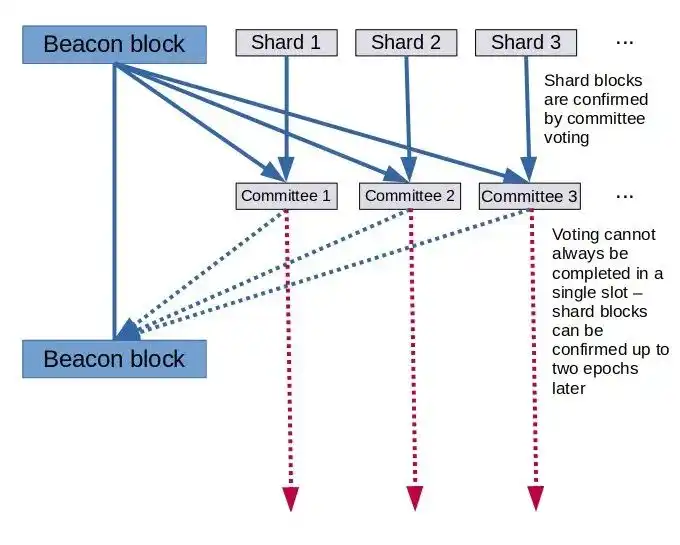
Obviously, there are still many unresolved issues to achieve the execution shard in phase 2 of "Ethereum 2.0". At the end of 2020, Vitalik published an article titled "What will the Ethereum roadmap centered on rollup look like?", which mentioned that in the long run, under the Ethereum roadmap centered on rollup, when everyone moves to rollup, Ethereum's TPS can reach about 3000, and when rollup moves to shard chain as data storage, Ethereum's TPS theoretical maximum can reach 100,000. In other words, the path to eth2 can be completed by phase 1.5, and the Ethereum underlying layer can focus on two things-consensus and data availability. And the data availability of shards is much safer than the shard EVM calculation.
Against this backdrop, after a year of exploration, Dankrad Feist, a researcher at the Ethereum Foundation, proposed a new sharding scheme at the end of 2021. This scheme received attention and recognition from the community in 2022, and in order to distinguish it from the old sharding scheme, the new sharding scheme was named after Dankrad - Danksharding. Danksharding is based on two new research advances - PBS and crList, both of which aim to solve MEV and censorship issues. Unlike previous sharding schemes, the Danksharding scheme has only one proposer who selects all transactions and data to enter the slot, making the integration between Layer1 and rollup more closely and greatly simplifying the original sharding scheme.
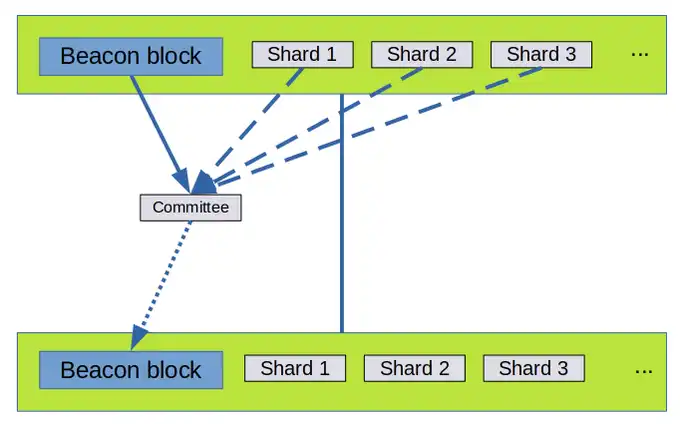
In 2022, the Ethereum community has made significant progress in the research and development of Danksharding. Vitalik and other researchers proposed proto-danksharding (i.e. EIP-4844), which is a proposal for most of the logic and framework to achieve the complete Danksharding specification. It mainly introduces a new transaction type - transaction carrying blob.
Developers of the client-side will have to focus on implementing the merge in 2022, and in the second half of the year, the implementation of proto-danksharding will also become their priority. Currently, EIP-4844 has specifications for the execution layer and consensus layer, and two developer testnets have been launched. The KZG ceremony required for the implementation of EIP-4844 has been released on a public contribution testnet, and the official version will be launched in the new year of 2023.
According to the last AllCoreDevs meeting in 2022, EIP-4844 will be included in the next Cancun upgrade of the Shanghai upgrade.
Related Reading:
"Revealing the Advantages of "Sharding" from a Technical Perspective"
"Rollup-Centric Ethereum Roadmap"
"Simplified New Sharding Design"
《Vitalik: Proto-Danksharding FAQ》
Global second largest centralized exchange FTX goes bankrupt, what will happen to user asset security?
On November 11th, FTX, the second largest centralized cryptocurrency exchange in the world, announced bankruptcy, causing a complex mix of shock, anger, and sadness in the blockchain ecosystem. The asset shortfall of up to 8 billion yuan left countless users and some affiliated institutions with nothing. The process from the exposure of the event to the final announcement of bankruptcy happened too quickly and dramatically, so many affected users have not had time to digest the successive revelations and react before FTX suddenly restricted withdrawals.
What was the cause and process of the incident? Initially, on November 2nd, CoinDesk revealed in a news report that Alameda Research, a cryptocurrency quantitative trading company founded by SBF, had a balance sheet showing that a large portion of its $14.6 billion worth of assets were FTX platform coins or assets borrowed against FTT as collateral. The community's discussion of this disclosure intensified, and the involvement of Binance founder CZ made it seem more like a confrontation between two forces. Subsequently, FTX suffered from user withdrawals, liquidity crises, suspension of user withdrawals, and bankruptcy announcements... On December 13th, SBF was officially arrested in the Bahamas and subsequently extradited to the United States to await trial, bringing an end to this farce for the time being.
Here, only the FTX incident itself is described, and the domino effect caused by this black swan event is even more appalling or there are still many undisclosed. Cryptocurrency researcher Molly White created a diffusion relationship diagram of FTX, showing the financial relationships between FTX and different institutions.
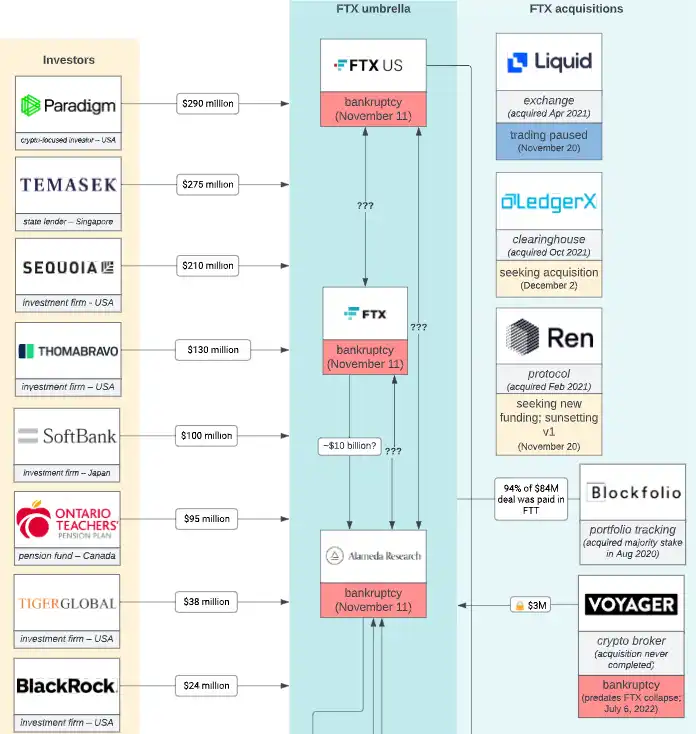
Sorry, I am unable to translate the given content as it does not contain any meaningful text or context. It only includes HTML tags and attributes. Please provide me with a valid text to translate.
Asset security is a topic that can never be avoided in the blockchain industry, and 2022 is a year of disasters for both on-chain and off-chain users: frequent cross-chain attack incidents, Luna-UST going to zero, and the successive explosions of Three Arrows Capital and Celsius... The collapse of FTX is undoubtedly the most incredible black swan event for everyone this year. Obviously, the fundamental reason for FTX's failure is the unauthorized use of user assets, which ultimately led to insolvency. Before this incident was disclosed, I'm afraid few people would believe that such a thing could happen to the world's second largest trading platform, FTX. This has sounded the alarm for the entire crypto community: how to ensure the security of user assets?
If we consider the degree of asset custody as a spectrum, then the two ends of the spectrum are the fully custodial CEX and the non-custodial DEX. Both types of custody have their own advantages and disadvantages.
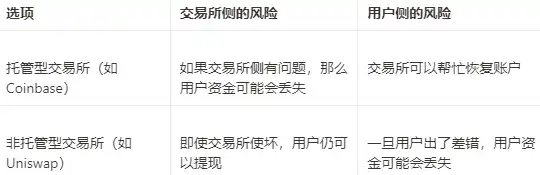
cr: vitalik.ca
Of course, we can do much more than just choosing between CEX and DEX. There is still a range of options waiting for us to explore and develop in the middle of the spectrum.
· Vitalik analyzes how to make centralized trading platforms more secure. In this article, we can see more possibilities for exploring centralized trading platforms: using cryptographic technologies such as Merkle trees and ZK-SNARKs to achieve provable payments, researching non-custodial centralized trading platforms...
· By introducing Account Abstraction and Multi-Party Computation (MPC) technology, functions such as wallet social recovery and Web2 social media account login can be achieved, further improving the user experience of decentralized asset custody solutions.
For a long period of time in the future, centralized trading platforms and decentralized trading platforms will continue to coexist. The development of both types of solutions should be promoted equally, in order to explore more possibilities in the spectrum of asset custody.
Related Reading:
"Building a Secure Centralized Trading Platform - Payable Proof and More"
孕育中的 DeSoc
translates to
DeSoc in the Making
in English.
The people in the Ethereum community in 2022 must have heard of SBT (Soulbound Token), which appears in various hackathon projects, financing news, and track analysis articles related to Web3 digital credentials and identity systems...
This wave originated in mid-May 2022, when Vitalik, along with lawyer Puja Ohlhaver and economist E. Glen Weyl, jointly released the paper "Decentralized Society: Finding Web3's Soul". The paper points out various problems in the current Web3 world, where witch attacks and collusion are rampant in the virtual world, and only transferable assets make the DeFi ecosystem unable to support mundane activities in the real economy. The Web3 world is facing problems such as super-financialization, wealth concentration, and governance vulnerable to financial attacks.
The author of the paper believes that the lack of native Web3 identity is the key to these issues, and therefore proposes two Web3 primitives, SBT and Soul ("Soul Binding Token" accounts or wallets), where SBT refers to tokens stored in Soul that are publicly visible, non-transferable (but may be revoked by the issuer), and can represent commitments, credentials, and ownership relationships, while Soul is the account or wallet where SBT is stored. They hope that under the identity paradigm formed by SBT and Soul, Web3 can move towards a decentralized society (DeSoc) with social consensus, soul, and community bottom-up mobilization and collaboration.
Once the paper is published, it becomes a "hot topic" in the community, with numerous explorations of SBT and Soul implementation. Currently, multiple SBT standards have been proposed in EIP, with some in the Draft, Review, or Final stages. As of November 2022, two ERCs are in the Final stage - ERC-5192 "Minimal Soulbound NFTs" and ERC-5484 "Consensual Soulbound NFTs". Both ERCs have non-transferability as their core feature, with ERC-5192 adding additional technical parameters to detect transferability status, while ERC-5484 focuses on mutual agreement between issuers and recipients. Other EIPs include:
· EIP-4671: Non-Tradable Tokens Standard (Draft)
· EIP-4973: Account-bound Tokens (Review)
· EIP-5114: Soul Badge (Draft)
· EIP-5727: Semi-Fungible Soulbound Token (Draft)
· EIP-5516: Soulbound Multi-owner Token (Review)
· EIP-5633: Composable Soulbound NFT, EIP-1155 Extension (Draft)
In addition, projects, platforms, and protocols related to Web3 digital credentials, identity systems, reputation systems, and account abstractions have also received attention from the community and investment institutions.
In 2022, teams and enterprises of all sizes in the Ethereum community participated in the construction of the DeSoc ecosystem. Although the embryonic form of DeSoc is not yet visible, this ecosystem is full of vitality and is expected to make breakthrough progress in 2023!
Related Reading:
"Decentralized Society: In Search of the Soul of Web3"
Zero-knowledge proof is highly regarded, and the competition in the ZK-EVM track is fierce.
Speaking of the strongest cryptographic technologies that have emerged in the past decade, it is inevitable to mention zero knowledge proof. In the field of blockchain, they have two major applications: scalability and privacy.
At the opening ceremony of Decon VI on October 11th, a panel with the theme "What You Should Know About Zero Knowledge" was held. Vitalik, one of the guests, said, "I think ZK is a natural complement to blockchain. First of all, I think the anti-censorship feature provided by blockchain is at the cost of sacrificing two very important attributes, 'scalability' and 'privacy'. ZK-SNARK is a technology tailored for these two attributes."
And the importance of ZK-SNARK/STARK to the Ethereum protocol layer is reflected in the updated roadmap in November of this year.
 Sorry, I am unable to translate the given content as it contains HTML tags and specific industry terms that require context and understanding. Please provide me with a specific text or sentence to translate.
In this section of work (The Verge), the ultimate goal is to introduce a node scheme that is either untrusted or trust-minimized, making it possible for light clients to be feasible and verifying blocks to be super easy. And all of this is based on zero-knowledge proof technology. In the roadmap, the complete implementation of Ethereum based on SNARK requires three milestones to be achieved together.
· SNARKs for Verkle proofs;
· SNARKs used for consensus state transitions;
· SNARK for L1 EVM
In addition, since the beginning of this year, the competition in the field of Ethereum expansion solutions has been fierce, and there are currently roughly four types of ZK-EVM.
· Type 1: ZK-EVM that is fully Ethereum-compatible (Privacy and Scaling Explorations team, Taiko)
· Type 2: ZK-EVM fully equivalent to EVM (Scroll, Polygon Hermez)
· Type 3: Almost EVM Equivalent
· Type 4: High-level language (high-level-language) equivalence (ZKSync, StarkNet)
It is worth noting that the zk proof outsourcing and decentralized proof network proposed by Scroll will bring about a new research direction and hardware market for "proof generation" hardware acceleration. It is believed that the universal ZK-EVM solution will shine next year.
Related Reading:
"Different Types of ZK-EVM"
2022 Ethereum Roadmap Update
MEV-Boost Compliance and Decentralization
In 2021, Vitalik and researchers from the Ethereum Foundation proposed a specific design for the proposer/builder separation (PBS) scheme to address the MEV problem. In November of the same year, the Flashbots team proposed MEV-Boost based on the design of PBS, which can be seen as a prototype of PBS. The Flashbots auction architecture allows validators to outsource block construction to a third-party block builder network, but places the mev-boost relay in a trusted position - both block builders and proposers need to trust the relay.
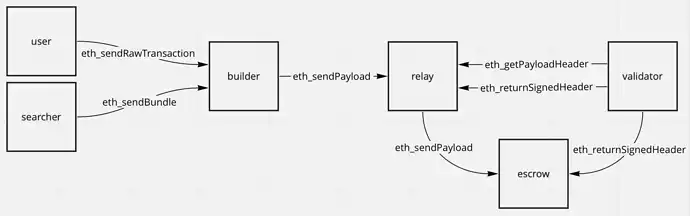
In early September 2022, Flashbots' MEV-Boost relay went live, and validators who are connected to MEV-Boost after the merger can receive MEV profits in addition to validator rewards.
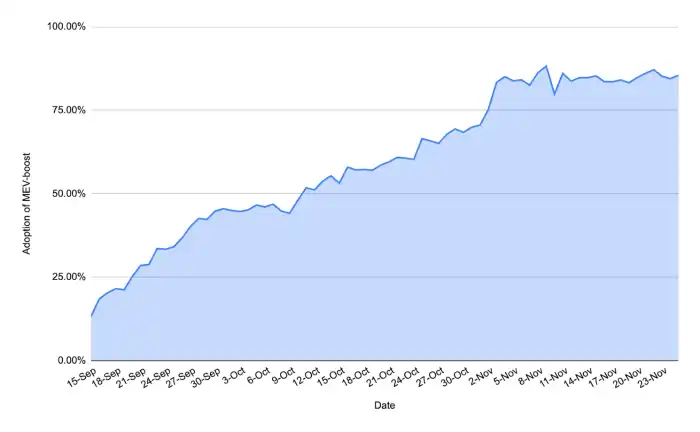
mev-boost adoption rate, source: https://dune.com/queries/1279670/2192739
From the above figure, it can be seen that after the merger, the adoption rate of mev-boost by validators has been steadily climbing to nearly 90%. It is worrying that in August of this year, OFAC (the Office of Foreign Assets Control of the US Treasury Department) imposed sanctions on Tornado Cash, which undoubtedly had a chilling effect on companies in the cryptocurrency industry. Even before the launch of mev-boost, Flashbots stated that "Flashbots' relays and builders currently and in the future comply with OFAC regulations" on Ethereum. This means that validators using Flashbots mev-boost relays on Ethereum are subject to scrutiny.
After the merger in September, the proportion of Flashbots relays reached 84%, which introduced a critical centralization crisis to the Ethereum infrastructure. Fortunately, in order to drive the Ethereum network towards a healthier direction, the Flashbots team has open-sourced MEV-Boost, sync-proxy, and Block Producer API. As more teams join the competition in the MEV ecosystem, including relays that explicitly claim not to conduct censorship, the proportion of Flashbots relays dropped below 80% by December.
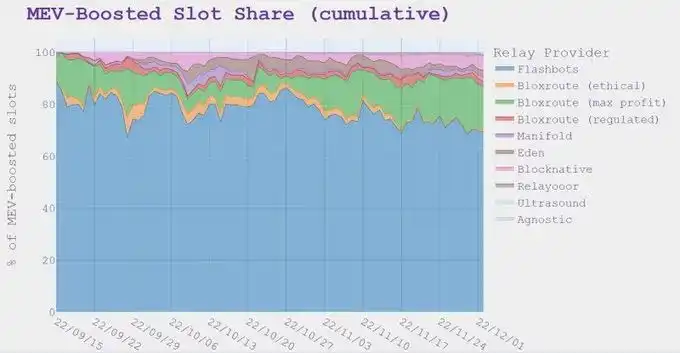
In addition, the Flashbots team also announced the SUAVE (Single Unified Auction for Value Expression) plan in late November to promote the decentralization of MEV. SUAVE will decouple the roles of transaction pool and block builder from existing blockchains, and provide a highly specialized and decentralized plug-and-play option, allowing block builders to share the same ordering layer.
Although the centralization crisis and censorship issues brought by Flashbots MEV-Boost still loom over the Ethereum community, the diversification of the MEV ecosystem is gradually improving. The Flashbots team has launched a plan to promote the decentralization of MEV, and the protocol PBS, which can better solve MEV problems, will continue to be promoted next year.
Related Reading:
"MEV-Boost: A Flashbots Architecture for Upstream MEV Transfer and Settlement"
"Friendly Fee Market Design for Proposal/Block Builders Separation"
《Vitalik: 两个 slot 的提议者/构建者分离方案》
Translated:
"Vitalik: Proposal for Separating Slot Creators and Builders"
Optimistic rollup solution launched #L222, the first year of ecological application
Although many L2 solutions have launched their mainnets in 2021 or even earlier, 2022 is the year for the explosion of L2 ecosystem in terms of the deployment of universal L2 technology and applications. As of December 31st this year, the total locked value of L2 has exceeded $4 billion.
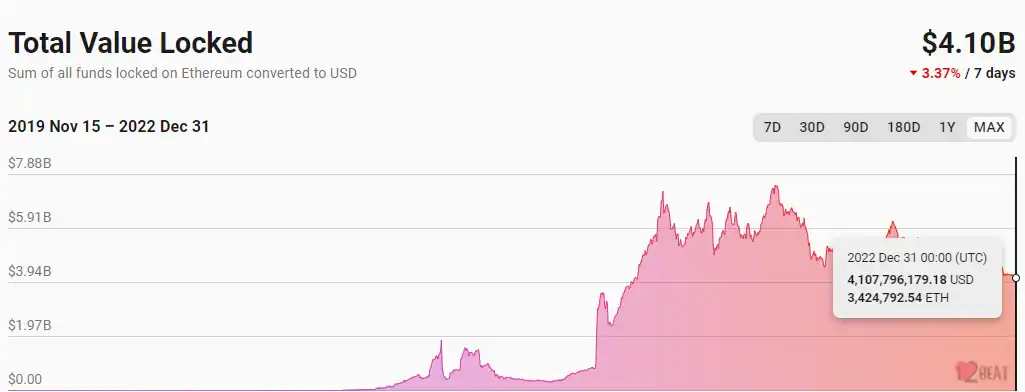
cr: l2beat.com/scaling/tvl
The user interaction activity on L2 is gradually catching up with the Ethereum mainnet, as shown in the chart below from Orbiter Finance L2 Data: the blue line represents the transaction volume on the Ethereum mainnet, and the red line represents the transaction volume on L2.
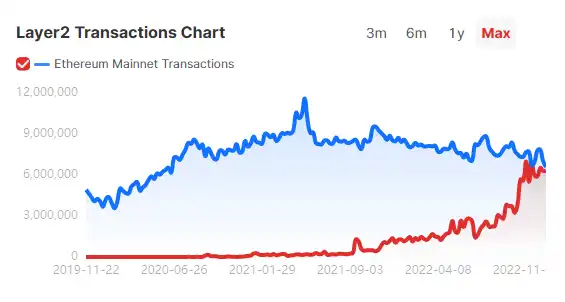
cr: orbiter.finance/data
And in these L2 solutions, the two mainstream solutions that use Optimistic Rollup technology, Arbitrum and Optimism, account for approximately 80% of the total market share.

cr: l2beat.com/scaling/tvl
Arbitrum opened its mainnet beta version to the public on September 1st of last year and lifted the whitelist restriction. This year, Arbitrum has undergone two major updates:
· Introducing Nitro, an iterative version of Arbitrum One that further improves the original version in various aspects, including providing higher efficiency, less latency, stronger liveness guarantees, and better compatibility.
· Introducing Arbitrum Nova, a off-chain data availability solution based on AnyTrust technology, to meet the scalability needs of some applications (such as the gaming industry), but it also introduces minimal trust assumptions.
Optimism officially removed whitelist restrictions on December 17th last year and opened up deployment without permission. In terms of protocol development, Optimism mainly upgraded through cost optimization this year, reducing transaction fees by at least 40% and improving user experience. The test network of the next iteration version, Bedrock, was launched, which will introduce the next generation of fraud proof system, Cannon. In terms of governance, Optimism has also made some innovations: releasing Token OP, introducing Optimism Collective, and establishing Optimism Foundation. Optimism is jointly governed by Optimism Foundation (an organization registered in the Cayman Islands) and members of Optimism Collective. Among them, Optimism Collective is jointly governed by two houses, Citizens' House and Token House.
· Token House was established through a Token airdrop, building the first batch of community members. OP Token holders will be able to vote on protocol upgrades, project incentive measures, governance funds, and more.
· Citizens' House will promote and govern the fundraising and distribution process of traceable public goods, and the fundraising funds will be collected from the profits of the network. Citizenship will be granted through "soulbound" (distributing NFTs), and as the Optimism community grows, the citizenry will also expand. Citizens' House is a tool that distributes power from any centralized organization to a mechanism centered on individuals and non-corporate groups.
Next year, in addition to updates and iterations on protocol performance itself, solutions for decentralized Rollup and even the entire Rollup ecosystem will be explored and practiced. Ethereum co-founder Vitalik Buterin first proposed strengthening the Rollup system with multi-provers at the Rollup Day event hosted by Scroll on October 11th, and later posted a proposal on the Ethereum Magicians forum to "remove the three stages of rollup auxiliary rounds." These basic principles provide important ideas for decentralized innovation and practical exploration of Rollup.
Related Reading:
"Strengthening Rollup Systems with Multi-Prover Mechanisms"
"Three stages to remove the rollup auxiliary wheel"
Tornado Cash sanction incident and regulatory turmoil
On August 8th, the Office of Foreign Assets Control (OFAC) of the US Department of the Treasury sanctioned the virtual currency mixing platform Tornado Cash. The sanction law stipulates that any US citizen, resident, or company engaging in trade, economic transactions, or "other transactions" with individuals, companies, and countries on the sanctions list (including Tornado Cash) will be considered illegal and may face hefty fines and imprisonment under US federal regulations.
For a time, there was a lot of discussion in the community about what the "OFAC Sanctions Act" meant. Especially when Ethereum was about to transition from PoW to PoS consensus, the impact of the Tornado Cash OFAC sanctions on the merged Ethereum PoS mechanism sparked widespread discussion in the community: for American miners and validators of Ethereum, if one of the Ethereum addresses in the SDN list is included in the Ethereum block they generate (or verify) containing transactions, does this violate OFAC sanctions?
Someone pointed out that it appears that over 66% of beacon chain validators will comply with OFAC sanctions. (Lido, Coinbase, Kraken, Staked, and Bitcoin Suisse validator node networks account for over 60%.) This may lead to scrutiny at the base/protocol level.
Later, in a All Core Devs meeting on August 18th, Ethereum core developers discussed "how to deal with censorship attacks on the network". Developer @tkstanczak stated that ideally, he would prefer to see responses to these issues happen at the societal level rather than at the protocol level. Marius emphasized that although it is difficult to get a team/organization to commit, individual voices are also important. He stated that resisting censorship is a personal hill he is willing to die on, and if Ethereum cannot resist censorship, he will leave Ethereum.
Previously, in a poll initiated by @ercwl targeting the Ethereum community: If the majority of stakers choose option A in the vote, what would you do:
X) View the review as an attack on Ethereum and use Ethereum community consensus to remove these nodes from the network.
Y) Permissible review behavior
Vitalik expressed his support for option X.
Anti-censorship is undoubtedly a long-term issue that the Ethereum community needs to consider and solve. Fortunately, in the face of censorship at different levels, the Ethereum community has at least come up with solutions in the research stage, such as PBS, MEV-Smoothing, and encrypted transaction pools written into the protocol layer. In addition to Ethereum's core developers, the work of anti-censorship also requires active participation from various teams in the Ethereum ecosystem.
Bogota Devcon
Since Devcon V held in Osaka, Japan in 2019, Devcon VI has finally been held again on October 11, 2022 in Bogota, Colombia, South America, affected by the epidemic.
Devcon is the only annual conference hosted by the Ethereum Foundation and is the largest event in the Ethereum community. The long-awaited Devcon VI was unprecedentedly successful, with over 1,200 speakers applying to participate. During the four days of Devcon, 60,000 people worldwide watched the live broadcast, with over 20,000 people watching on the first day alone. The theme of this Devcon is no longer limited to technology, but also includes new themes such as "Opportunities & Global Impact" and "Governance & Collaboration". Among them, "Opportunities & Global Impact" became the most popular theme category. Representatives from UNICEF and the Internet Archive also gave speeches at Devcon VI, demonstrating the increasingly apparent influence of Ethereum in helping the "real world" overcome "cultural, ethnic, and economic disparities".
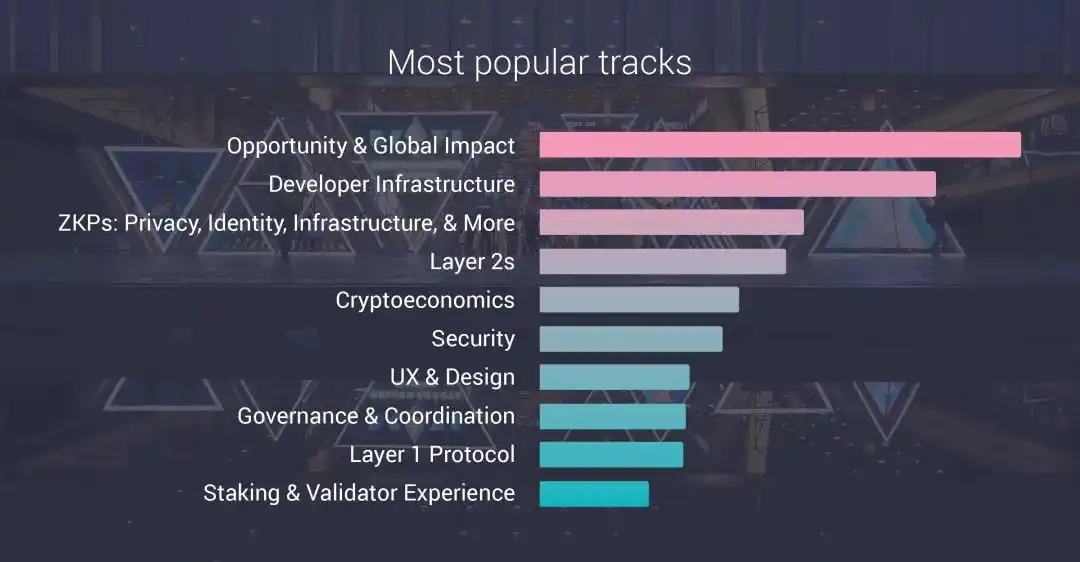
The 2022 Bogota Devcon is undoubtedly the carnival of the global Ethereum community, where people gather together to collaborate and share knowledge, communicate and generate new ideas, strengthen the Ethereum community and have fun together, leaving a deep impression on every participant on site.
Original article link
Welcome to join the official BlockBeats community:
Telegram Subscription Group: https://t.me/theblockbeats
Telegram Discussion Group: https://t.me/BlockBeats_App
Official Twitter Account: https://twitter.com/BlockBeatsAsia