2021 Year-end Summary: How did Ethereum establish itself as the cornerstone of digital civilization?
原文作者:Josh Stark(供职于以太坊基金会);Evan Van Ness(Week In EthNews 创始人)
The Year in Ethereum 2021
原文编译:ETH中文
Ethereum is the foundation of digital civilization.
Strong, secure and reliable, Ethereum is the necessary building block to support the digital cities built on top of it.
These cities are developing rapidly. Since Ethereum is open to everyone, users from different sectors have found reasons to build on it.
- Markets use Ethereum as a financial infrastructure;
- Artists are using Ethereum to make their work permanent;
- Ethereum also exists as a settlement layer for assets;
- Communities use Ethereum to manage shared resources.
This year, Ethereum applications began to catch the public's attention. As people around the world come to understand the vision of a more decentralized network based on Ethereum, the old term "Web3" has come back into fashion.
Like the annual reviews of 2018, 2019 and 2020, this 2021 review aims to encapsulate the key events of the past year and give readers a blueprint for the future.
In our view, the most important developments for Ethereum in 2021 include:
1. Multiple Layer 2 protocols go live on the main network -- After years of development, L2 goes live on the main network and begins to expand ethereum's capacity
2. Creator economy becomes mainstream & NBSP; NFT is everywhere, and artists have made billions using Ethereum
3. Core protocol upgrade & NBSP; -- The Ethereum r&d community rolled out several upgrades to transition to proof-of-stake consensus (PoS). To prepare
4. DAO crossed a turning point. DAO became a viable tool for community autonomy, amassing billions in assets and attracting new users
在细述上面的所有话题之前,让我们先来盘点一下以太坊在过去这一年的发展。上几年的回顾中,我们追踪了不同的核心指标,试图将以太坊置于不同的背景中。今年,其中的几项指标已经达成了重要的里程碑。
Which blockchains are users paying for?
以太坊连续两年成为世界上需求量最大的区块链。

Source: Cryptofees (cryptofees.info)
This chart takes some L1 blockchains and shows their total transaction fees. This is the total transaction fee a user pays for each L1 (sending a transaction or interacting with a smart contract). Taken together, the data represents the value of the total "block space" -- the total transaction capacity of the blockchain in a given year -- of a particular blockchain.
Total transaction fees are just one metric, and taken alone, they don't fully represent the value of a blockchain or its usefulness to users. However, the chart does show us the comparative value of each blockchain to its users. In a functioning market, the value of things depends on what people are willing to pay for them.
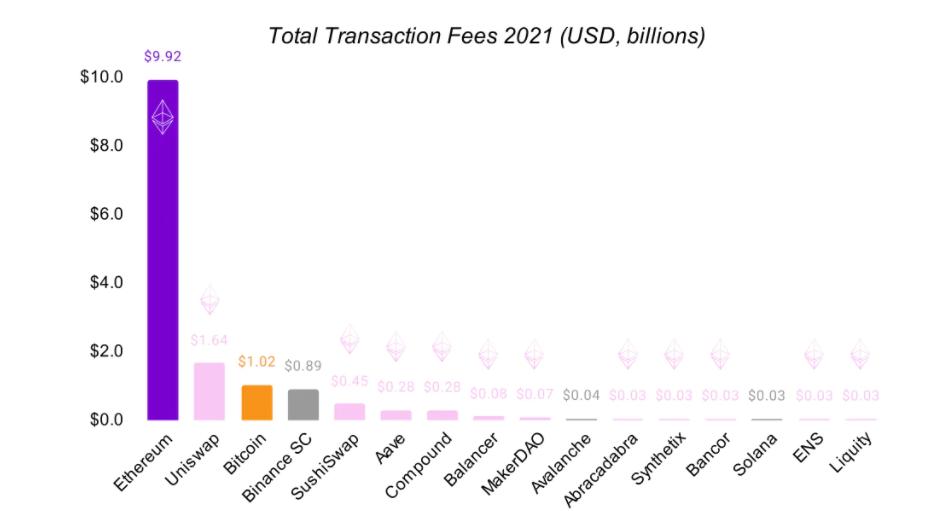
If we expand the comparison to include applications, L2 networks, and other L1s, we come up with the following chart:
Source: Cryptofees (cryptofees.info)
Each pink bar in the chart above is an Ethereum-built application such as Uniswap or ENS. For these applications, the total fee here does not refer to blockchain transaction fees, but rather to other types of fees paid by users to use the application (such as fees paid to liquidity providers on an exchange).
In 2021, users paid more for apps on Ethereum than they paid for all other L1s combined.
Since user demand for the Ethereum block space continues to exceed user demand for all other blockchains, we can look for other meaningful comparisons. So let's compare what people paid with Ethereum L1 this year to what payment networks like Visa and Stripe made:

Sources: Cryptofees (Cryptofees.info), Visa, backlinks
总交易费用和公司收入并不完全可比(Visa 和 Stripe 从用户支付的费用以外的来源获得收入,以太坊可以做 Stripe 做不到的事情)。然而 交易费总额和企业收入并不完全具有可比性 (Visa 和 Stripe 除了用户直接支付的费用之外,还有其他赚取利润的资源;并且以太坊可以做很多 Stripe 做不到的事情)。然而,这个比较还是可以展示以太坊的规模和它对市场的价值。
How much value does Ethereum transfer?
One of the simplest use cases for blockchain is the transfer of assets. How much value has been transferred on Ethereum this year?
Since surpassing Bitcoin in mid-2020, Ethereum has been the blockchain that handles the most asset settlements worldwide.
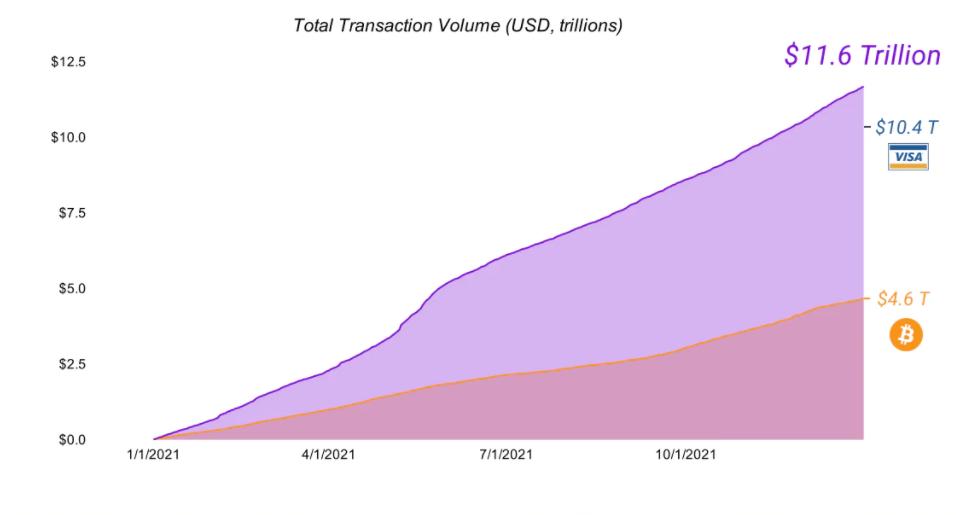
Data from Visa (annualreport.visa.com) and CoinMetrics (Coinmetrics.io)& NBSP;
The Ethereum data in the chart includes all major ERC20 tokens traded, with a total value of over $500 million. Bitcoin data includes USDT assets on Omni. Since we don't count all of Ethereum's assets, this chart actually understates the total trading volume of Ethereum.
Ethereum moved about $11.6 trillion in 2021. That's more than Visa and more than twice as much as Bitcoin.
DeFi 锁仓量
Finally, we can track the total value of all assets locked up in the DeFi agreement. Having an asset "locked up in DeFi" means that the user has deposited some money into the agreement in return for allowing the agreement to use their asset -- for example, the user makes a profit by providing liquidity.
Ethereum still has more DeFi locks than other chains, and by a wide margin.

Source: DeFi Llama (https://defillama.com/chains)
这再一次表明,我们必须在区块链生态系统之外找到可比的数据。2021 年,以太坊上的 DeFi 锁仓总值 (1530 亿美元) 超过了 Robinhood (800 亿美元) 和 Bridgewater Associates (1400 亿美元) 的管理资产。
多个 Layer 2 协议上线主网
After years of development, technology to improve ethereum's scalability went live on the main network this year.
Ethereum's transaction capacity is no longer just the capacity of Ethereum Layer1.
Instead, it includes the capacity of ethereum L1 plus the capacity of all the "Layer2" protocols built on ethereum security.

Figure: L2 data is incomplete due to the limitations of publicly available information. Complete data refer to this link: https://docs.google.com/spreadsheets/d/1-Is51Do_AgatnUsoxo-Iy7B0clCyxf1VN_gDt8mtly4
This chart shows us the cumulative total of Ethereum transactions in 2021, including L1 and L2 transactions.
In 2021, Ethereum L1 will process about 1.2 million transactions per day (or about 15 transactions per second). As the Layer2 protocol went live, ethereum's effective capacity began to increase and the composite transaction rate (the top line in the chart) began to curve upward.
All L2 protocols have just been deployed on the main network, and some have not removed all temporary trust assumptions (see L2 Beat for more information). The technical differences between the protocol categories in the chart are also evident. For example, the technology StarkEx chain provides for instances is Validium, which means that their proof is stored under the chain rather than on the chain.
As L2 matures and its market share increases, the proportion of L2 sector in the chart above will increase until it far exceeds THAT of L1. "Ethereum" no longer refers to a single protocol, but to a community of all protocols built on the same L1.
You've probably heard that Ethereum is expensive or slow, but only because people are making the wrong comparison. Ethereum is the first blockchain mature enough for multiple production-grade L2 to be built on top of it. While gas is still expensive for some use cases on L1, 2021 is a watershed year where most users will interact with Ethereum only through L2.
Most L2 transactions are currently done over application-specific L2 protocols called "ZK Rollups". These are L2s specifically for certain types of applications, such as processing transactions or simple token transfers.
The ZK-Rollup ecosystem built on Ethereum made these advances in 2021:
-Loopring launched a zkRollup decentralized exchange back in 2020. They completed the release of version V2 in early 2021 and added support for NFT casting and trading in August 2021.
-Matter Labs launched a payment rollup (zkSync) in June 2020 that can be integrated into a wallet like Argent or an app like Gitcoin. And committed to "zkSync 2.0" development, version 2.0 will be EVM compatible.
-Aztec launched a privacy payment rollup (" ZK.Money ") in March 2021 and added support for Staboin DAI in April.
- Multiple projects have launched their own versions of Validiums in collaboration with Starkware's StarkEx platform, including these projects:
· DeversiFi (a decentralized exchange) launches its rollup version in June 2020;
· ImmutableX (一个 NFT 交易所) 在 2021 年 4 月 推出其 rollup 版本;
· dYdX (一个 DeFi 交易平台) 在 2021 年 4 月 推出其 rollup 版本;
· Sorare (一个虚拟足球 NFT 项目) 在 2021 年 7 月 推出其 StarkEx rollup 版本

Figure: L2 data is incomplete due to the limitations of publicly available information. Complete data refer to this link: https://docs.google.com/spreadsheets/d/1-Is51Do_AgatnUsoxo-Iy7B0clCyxf1VN_gDt8mtly4
This year, two new significant players have joined the rollup ecosystem: Arbitrum and Optimism.
Arbitrum and Optimism, as the first universal rollup to the product level, deserve our attention. This means that each rollup acts like a natural extension of Ethereum -- they're all "EVM compatible." Users can easily migrate Ethereum-based assets to rollup, where developers can deploy (and interact with) Solidity contracts and applications.

Figure: L2 data is incomplete due to the limitations of publicly available information. Complete data refer to this link: https://docs.google.com/spreadsheets/d/1-Is51Do_AgatnUsoxo-Iy7B0clCyxf1VN_gDt8mtly4
Arbitrum launched the main network on May 14, and removed its whitelist restriction on August 31. A few months later, Optimism also launched on the main network on August 19 and removed its whitelist restrictions on December 16.
As the L2 ecosystem grows, users deposit more and more money into it. As of this writing, approximately $6 billion exists in L2.
Background on Rollup
For a decade, the crypto community has been working to develop "Layer 2" technology to enable blockchain scaling.
Bitcoin's payment channel has been discussed since 2012. However, "Payment Channels" will eventually roll out product-level solutions on Ethereum -- as a relatively niche scale-up solution because they can't scale smart contracts.
In 2017, Vitalik and Joseph Poon proposed a new solution called Plasma. The basic idea is to extend Ethereum by creating separate blockchains that will be built on ethereum and inherit its security through clever code and economic mechanism design.
This line of research introduces a new technique called "rollup". Building on the Plasma solution, Rollup extends Ethereum by creating a unique L2 blockchain that inherits L1 security while providing a cheaper and faster user experience.
The application exists on the Rollup chain, and the user interacts directly with the Rollup chain. On the back end, this protocol bundles everyone's transactions (" rolls up ") and stores a record of those transactions on Ethereum L1. These records ensure that users' transactions have ethereum L1 level security.
But there are two different ways to implement this scenario, so there are two different types of rollup designs: Optimistic rollup and zero-knowledge rollup.
Zk-rollup uses cryptography to prove the validity of transactions and then stores the resulting proof on Ethereum. Most of the data can be thrown away (meaning you don't need to store it on the chain) and only a small amount can be retained. But it was enough to prove mathematically that the trade worked.
There are already a number of application-specific rollups available, as we mentioned above. But the universal ZK-Rollup is still in development, with teams like Matter Labs, Starkware, Polygon Hermez, Scroll Tech and Privacy & AMP working on it. Expansion study group and so on.
Long story short: ZK-Rollup works by converting the code running on rollup into a special mathematical equation. It's this equation that gives us the neat proof stored on the main net.
It is much easier to define such an equation when some possible inputs are restricted. For example, these application-specific equations are easier to design when we are only going to do simple token transfer transactions.
By contrast, an equation is much more difficult if it can handle any possible code input and create a proof of it. This is where the challenge comes in creating a ZK-rollup that can be used with arbitrary code in general.
Such "generic" calculations (also known as "EVM equivalence") are easier to achieve using Optimistic Rollups.
Leveraging Optimistic Rollups solutions, L2 Rollup chains leave records of bundled transactions on L1.
In most cases, however, the "proofs" that ensure these trading results are valid do not actually work. Because this protocol is "optimistic" -- as the name implies, it assumes that every block is valid, while reserving the right for every user to verify it if necessary.
Because Optimistic Rollups need to keep the data so that someone can run the proof later, they need to post more transaction data on the chain (not just a neat proof, such as one verified using zero-knowledge techniques). But because there is no need for new cryptography innovation, fully universal Optimistic Rollups (such as Arbitrum and Optimism) already exist product-level projects.
But either rollup means that the user has a very high level of assurance that his transaction on the rollup has been finalized. If someone transfers ETH to you on rollup, proof of the transfer transaction exists on Ethereum, and you will always be able to withdraw the ETH to L1.
The long wait for Layer2 is over. The Layer 2 era has really arrived -- it's just very uneven. It will take several months for applications, exchanges, and wallets to support L2 and help users migrate to L2.
Ethereum's creator economy went mainstream
In last year's annual review, we noted that Ethereum's "creator economy" was showing signs of growth.
Cryptoart trading volumes spiked in December, and there are signs that more artists are experimenting with the tools ethereum offers them to capture value.
Then the following year, the creator economy outperformed expectations.
In 2021, artists, musicians, writers and other creators collectively made $3.5 billion from Ethereum. That number makes Ethereum one of the largest platforms for creators in the world.

Graph: due to the limitation of publicly available information, complete data refer to this link: https://docs.google.com/spreadsheets/d/1-Is51Do_AgatnUsoxo-Iy7B0clCyxf1VN_gDt8mtly4/
In 2021, Ethereum will make more money for artists and musicians than OnlyFans or Patreon, and almost as much as the world's largest creators' platform.
What is the creator economy?
Ethereum's "Creator Economy" is a set of tools, services, and marketplaces that enable creators around the world to make money through the Ethereum platform.
Until now, the Internet's "creator economy" has been dominated by large, centralised platforms. Most use a similar model, with platforms like YouTube or Spotify taking revenue from advertising or subscriptions and passing a small portion of that revenue to creators.
That business model has made Spotify a $40 billion company. But most artists, who make a tiny percentage of every stream, have been dissatisfied. In 2020, only 13,400 artists made more than $50,000 from Spotify (there are 1.2 million artists on the platform).
A much larger number of artists provide free Labour (Posting their work on Instagram or Twitter). Artists are paid for "exposure," and platforms capture that value.
Ethereum gives creators new tools to tokenize their work. One tool in particular stands out: NFT. A digital certificate that represents ownership of any digital file, including art, music, photography, video, or game projects. Platforms such as OpenSea, Rarible, Foundation, Zora, and Mirror will enable artists to create, sell, and trade NFT during 2021.
The NFT ecosystem is at a very early stage. Remember, a year ago, the market for NFT was almost non-existent. Today, the majority of NFT transactions and users are concentrated on one platform (OpenSea). However, a number of projects are struggling to come up with competing schemes, including decentralised exchanges. As we know from the history of decentralized exchanges and Uniswap's incredible growth, decentralized projects that transfer ownership to users can compete well with current centralized schemes.
The rapid expansion of the NFT market has attracted mainstream interest. Steph Curry, Eminem and Shaquille O "Neal buy Boring Ape. Adidas also entered the NFT market, they also purchased digital land and released their own NFT collection. The ceos of Budweiser, Paris Hilton, Trey Songz, Drake Bell and Shopify have all registered the ENS domain name and updated it to their Twitter profiles.
In addition to soaring NFT valuations and growing celebrity interest, the emergence of the Ethereum creator economy signals a quiet revolution in our community.
For most of the history of the cryptocurrency industry, the majority of people who were able to make a living with these technologies belonged to just a few categories: investors, developers, or people who worked for cryptocurrency companies.
But in 2021, that's starting to change.

This year, more people from new and unrelated professional backgrounds started using Ethereum to earn revenue. In 2021, people will not need any capital accumulation, any technical ability, no background in finance or investment, or work in the crypto industry to earn revenue using Ethereum.
These creators are not only users, they are also core members of the Taifang community. They depend on Ethereum and have a strong stake in the interests of the Ethereum ecosystem. This change has brought new blood, ideas, communities, talent, perspectives and concerns into the Ethereum ecosystem, transforming it and affecting its future.
Most notably, many new Ethereum users have legitimate concerns about the amount of power PoW consumes. Fortunately, they are joining a community that shares their concerns. The Ethereum community has known since 2014 that PoW would gradually consume too much energy, and has been working on shutting down PoW and transitioning to PoS ever since.
Core Protocol Upgrade
In 2021, the Ethereum community made steady progress on the transition to PoS (Proof of Stake), with two major mainnet upgrades that brought new fee markets and multiple minor optimizations, among other changes.
The research, development, coordination and implementation of these upgrades are carried out by independent teams around the world through open research and collaboration. As always, Ethereum is a marketplace, not a cathedral.
Much of this work is done by teams building and maintaining individual clients. Ethereum is notable in this respect because it is the only blockchain with multiple independent teams actively building product client software.
Client-side diversity has always been a focus of the Ethereum community, even if it remains challenging in practice. Client diversity helps prevent a bug in one client from destroying the value of its currency. Ethereum is a "spec first" blockchain, meaning that the rules of the protocol are independent of any particular software or the people who maintain it. Anyone can implement the specification and build their own clients to compete with existing ones.
This year, the client team and the larger r&d community implemented two major upgrades to the Ethereum main network: the "Berlin Upgrade" in April and the "London Upgrade" in August. These upgrades include several changes. The most notable was IP-1559, which revolutionized ethereum's premium market (discussed in more detail below), but also included key changes like IP-2929, which improved Ethereum's defenses against DOS attacks.
The team also implemented an "Altair" upgrade to the beacon chain -- the PoS chain started running parallel to the Ethereum main chain on December 1, 2020. The Altair update launched the light client for consensus, updated forfeit and activity incentives.
Behind all this work has been the development of "the Merge," which permanently shuts down Ethereum's PoW system and switches to PoS (discussed in more detail below).
Even through these changes during this period, the Ethereum mainnet remained operational, processing, and providing security for billions of dollars of assets.
EIP-1559 - Fee market reform
On August 5, IP-1559 went live on the Ethereum main network. The upgrade introduces several changes to Ethereum's "fee marketplace," a set of rules that define the marketplace in which users pay to record their transactions on the Ethereum blockchain.
Ip-1559 has multiple objectives:
- Reduce the likelihood that users will be overcharged for their transactions;
- Reduce transaction congestion;
- Improves protocol security by reducing the possibility of recombination and makes DOS attacks more expensive;
- Burn some transaction fees, which increases the value of ETH and improves the economic security of Ethereum.
Like most Ethereum protocol upgrades, this is the result of years of research, development, testing, and debate by the Ethereum community. Vitalik wrote a blog post in 2014 sharing early thoughts, followed by a July 2018 post on Ethresear.ch, An EIP (Ethereum Improvement Proposal) was drafted in 2019. It took two years of analysis and discussion, and Tim Roughgarden.
IP-1559 has not been fully adopted. Some wallets, exchanges and other apps need to upgrade their own software to take advantage of the new fee market.

Source: Pintail (https://pintail.xyz/posts/gas-market-analysis/)
This chart shows the breakdown of "Type 2" transactions (transactions using IP-1559) and "legacy" transactions on Ethereum. By the end of 2021, about 35% of transactions on Ethereum were legacy transactions. However, even legacy deals can benefit from IP-1559 because it improves the way gas forecasts are generated.
Many wallets and exchanges already support IP-1559-style trading, Including MetaMask, Rainbow, MyCrypto, Frame, Trezor, Brave, Coinbase (and Coinbase Wallet), Blockfi, FTX, and several others.
Four months after the changes took effect, IP-1559 is achieving its goals in terms of improving ethereum's user experience:

Source: Pintail (https://pintail.xyz/posts/gas-market-analysis/)
In this diagram, the blue line represents the median gas price for legacy transactions, while the orange line represents the median gas price for type 2 (Type EIP-1559) transactions. With the implementation of IP-1559, the average gas overhead of type 2 transactions is lower than that of legacy transactions.

Source: Pintail (https://pintail.xyz)
This chart shows these advantages in more detail. The blue line represents the difference in gas prices between the two types of transactions since IP-1559 went live (the higher the line, the greater the savings in transaction fees for IP-1559 transactions). Legacy transactions consistently cost 10-20 GWEI more.
Ip-1559 also appears to reduce the likelihood of transaction congestion by eliminating the need for users to pre-emptively overpay for packaging, as many users accustomed to transaction congestion have been doing. If you're interested in learning more, see this article by Pintail, this one by Coinbase, and this one by Blocknative.
Feel the cost burn
Ip-1559 also introduced a change in which a portion of the fee each user paid for the use of the agreement was destroyed (" burned "). This means that in each transaction, a certain amount of ETH is removed from the total supply.
This creates a mechanism that adds value to ETH -- an important part of the broader vision to make Ethereum the world's most secure blockchain.
Ethereum's consensus mechanism relies in part on the value of ETH. Under PoW, miners receive ETH for their work ensuring network security, and under PoS, pledgers not only receive ETH for their work ensuring network security, they are required to pledge ETH to provide that security.
The cost of burning the portion establishes a relationship between the use of the agreement (transaction fees) and the value of the ETH itself (through reduced supply). Since August, 1.32 million ETH have been burned in 2021.
Source: Watch the Burn (https://watchtheburn.com/insights)
The yellow bars represent days and weeks when circulation was negative and there were enough payoffs due to heavy use of Ethereum -- the cost of burning by IP-1559 exceeded the additional ETH issued per block. Keep in mind that these are the results under the current PoW system and the increase rate will be lower when moving to PoS.
merge
Moving from PoW to PoS has been the vision of the Ethereum community since its earliest days.
While PoW may have been necessary to launch the first experiments in blockchain design, over the past 12 years it has become clear that better designs are possible. These designs are much safer and do not require much energy to generate strong economic security.
Ethereum's PoS system is the result of more than seven years of research and development. Why is it taking so long? From the beginning of this journey, the Ethereum community has been unwilling to compromise on decentralization.
Although there are different PoS systems on other chains today, most of them have made significant concessions to decentralization. They rely on some form of delegation, meaning that the actual block verification is concentrated in the hands of a small number of pledgers.
Even though some communities have stopped, Ethereum continues to innovate. The advancement of new technology allows Ethereum to retain maximum decentralization and security. The development of BLS signatures used in PoS Ethereum enables thousands of nodes to participate in consensus, which means PoS Ethereum does not require delegation. There are thousands of individual verifiers involved, not a handful of professional mortgage agencies.
At the same time, Ethereum's design makes the technical requirements for collateral very low. Low enough that anyone with a consumer laptop can pledge at home on an equal footing with a professional mortgage service provider.
Ethereum's PoS system is already live -- it's just not being used to provide security for any user activity. The beacon chain -- Ethereum's PoS mechanism -- has been running since December 1, 2020, without major problems.
In the past year, users have pledged more than 8 million ETH to the Beacon chain, worth about $26 billion.

Source: @ Carvas (https://dune.xyz/queries/252741/473336)
All that remains is to incorporate the existing Ethereum L1 into the new PoS infrastructure, replacing PoW.

Source: Trent Van Epps (https://twitter.com/trent_vanepps)
While the beacon chain was running, the Ethereum community achieved several milestones toward consolidation:
- In April, in the Rayonism project, developers worked together on a test network that simulated merging, as well as early sharding designs.
- In October, the client team gathered in Greece for the Amphora workshop, during which a short-term multi-client test network was built.
- In November, Kintsugi testnet continued, and a long-term multi-client testnet based on the latest specifications was unveiled.
When the specification is finalized and the new test network is widely used by end users and application developers, the existing test network will be used for the combined pilot run.
If these trials go well, the focus will turn to the final step: deploying the merge on the main network and shutting down the PoW for good.
客户端多样性
Ethereum has many client implementations, and each client has a different share of the total verifier participating in PoS.
Today, client diversity is far from optimal:

Source: https://twitter.com/sproulM_/status/1481109509544513539
Ideally, no client to network accounts for more than 33%. If each individual client is below this ratio, it reduces the risk of a vulnerability in one client affecting the entire network.
Ideal client diversity is a theoretically achievable goal: Ethereum has four excellent pledge clients (Lighthouse, Nimbus, Prysm, and Teku), and recently a fifth player. (Lodestar).
Prior to the merger, it would be helpful if no client had more than 50% of the network. For example, in the event of a fork (which is unlikely), a client network ratio of less than 50% gives the client developer a secure buffer time to resolve the issue without a major forfeiture event.
Achieving better client-side diversity is in everyone's interest -- even the majority of client-side developers. To their credit, Prysmatic Labs recognizes this fact and is working to reduce their share.
The extension of ecology of pledge
PoS Ethereum allows everyone, from hobbyists to organizations, to pledge ETH and participate in network maintenance. As communities of pledgers have grown, an ecosystem of services, tools, infrastructure and applications has evolved:
-Rocketpool is a highly anticipated decentralized pledge agreement that will go live in November 2021. Rocketpool is a protocol that allows users to deposit ETH and share pledge rewards without having to run their own pledge infrastructure. In short, users of the protocol can securely deposit their ETH into a network of individual node operators, coordinated by the Rocketpool protocol. Decentralized pledge agreements are an important infrastructure for building a healthy pledge ecosystem. As of this writing, 74,000 ETH have been pledged to Rocketpool.
-Lido is also a pledge protocol, but in its current implementation there is an additional trust assumption. As of January 2021 (two months after the beacon chain went live), 100,000 ETH were pledged to Lido. By the end of 2021, 1.6 million ETH (worth $13 billion) were pledged to Lido, with 33,000 unique pledgers. Recently, Lido has made good progress on client diversity in the network of operators serving its protocols.
- There are also developments in the ecology of collateral instruments
The StakeHouse community publishes Eth - Wizard (a CLI pledge installation tool for hobbies and networking) and Wagyu (a one-click Eth2 pledge installation tool)
Existing node hardware providers Dappnode and Avado have expanded their offerings and now support Ethereum pledging as well
Stereum has launched an open source node setup tool
Want to pledge your ETH? A good place to start is ethereum.org.
跨过了转折点
One of Ethereum's earliest dreams was to achieve a "decentralized autonomous organization" (DAO). Because Ethereum allows anyone to write arbitrary rules in code, we can use those rules to design organizational and governance systems that allow a group of people to make decisions together through voting or other mechanisms.
The BREAKTHROUGH for DAO ecology comes in 2021. A simple and workable technology stack comes together to enable existing DAOs to do something, while the newly established DAOs broaden the boundaries of what DAOs can do and who can join them.
On Snapshot, the number of monthly unique voters (DAO participants) grew throughout the year and exploded in November and December.

Source: the Snapshot
Today, hundreds of DAOs have daily activities, make payments to members, build products, and vote on the use of shared funds. Collectively managed DAO assets on Ethereum are worth more than $16 billion.
但首先,什么是 DAO?
The term "DAO" is used to describe many types of structures. Generally speaking, DAO refers to any group of people who use a blockchain like Ethereum to collectively manage something on the chain. Sometimes those things are money (like tokens in ETH or DAO vaults), but they can also include NFT, on-chain protocol parameters like MakerDAO, or all of the above.
While DAO has existed in Ethereum since 2016, these early experiments were more science projects than actual products.
But in the past few years, DAOs have become a real need. The first major driver is DeFi protocols that want to decentralize themselves credisibly -- handing over control of their protocols to the user base, who votes with tokens (" governance tokens ").
The basic structure pioneered by agreements such as Compound 2020 has become the de facto standard for many daOs created later, such as Uniswap's coin-issuing plan in September 2020.
The evolution of the DAO in 2021 is significant because it happened outside of the DeFi protocol (the first major entrants). These DAOs begin to demonstrate the breadth of possible design space for an organization on a chain.
Ethereum Domain Name Service (ENS). First launched in 2017, ENS is a decentralized domain name protocol that lets users create simple usernames (your name.eth) that can be used as ethereum accounts, receive non-ETH cryptocurrencies (including BTC), or as a Web URL. In 2021, ENS creates a DAO, which governs certain parameters of ENS protocol, and a community fund to support ENS ecology.
In a few days in November, strangers from the Internet collectively raised $44 million to buy a copy of the United States Constitution. In all, 17,521 different accounts contributed to the cause. The project gained mainstream media coverage and led to a runaway livestream of bemused auctioneers mediating bids between representatives of a new Internet organisation and representatives of old-world finance.
- The PleaserDAO started with a tweet and quickly grew into an investment club. PleaserDAO explores another part of the DAO design space -- it's not a mass organization with tens of thousands of members, it's a relatively small investment club whose members pool money to make joint purchases. It should be noted that PleaserDAO has already purchased some high profile cultural assets such as Doge 1/1 and the yet-to-be-released Wu Tang album.
-Friends with Benefits (FWB) is an online social community that requires $FWB tokens to become a member. The token is used to control access to multiple online and offline Spaces, including group chats, parties, dinners, after-parties, and more.
-MakerDAO started as a DAO, but later established some traditional organizational structure in 2018. MakerDAO is the creator of stablecoin DAI, the first decentralized stablecoin on Ethereum, and one of the most important DeFi projects to date. This year, MakerDAO completed its promised return to decentralization, ending its foundation and handing over control of the Maker protocol to DAO, which is governed by its token holders.
The DAO is a very general toolbox that provides a lot of design space. With private keys and smart contracts, we can design almost any system, and humans can collectively manage on-chain assets and protocols.
As a result, we can see that daOs have such a huge range of utility. Soon, it may be hard to talk about them as a useful category. DAO is an important decentralized means by which agreements can be effectively removed from the control of the founders. DAO is a tool for the online community to quickly and seamlessly pool funds to achieve common goals. Is a new kind of social network; It's also a new way to collectively fund public goods.
The DAO's evolution this year was driven by a suite of software tools that made it easy to start a DAO.
Many DAOs use a simple combination of tools. Most on-chain smart contracts fork. Compound system. The voting itself is handled by projects like Snapshot while discussion and discussion of individual proposals takes place in forums like Discourse.
-Mirror has introduced a set of tools to help people create "media DAOs" : joint publishing and co-ownership of content created on the Mirror.
-Coordinape is separated from the Yearn community to provide a framework for distributed teams to collaboratively determine compensation for the work done by DAO members.
-Rabbithole launches tools for new users to join daOs and build skills and credentials to work for DAOs.
- Far-sighted governments have developed new legal structures to streamline DAO formation and reporting, such as in Wyoming.
The DAO had no shortage of issues and challenges to overcome as it scaled up to meet the needs of millions of people around the world. We hope to see progress in 2022 on several key challenges:
- Today, most DAOs use some form of currency voting. This means that the weight of the decision depends on the percentage of ownership of a governance token. Monetary voting systems already have many known drawbacks. Anti-witch experiments like Proof of Humanity and BrightID provide a system of governance based on individuals rather than tokens.
- Look for management structures and work systems that enable distributed communities to effectively build products and coordinate actions.
- Legal systems can be very slow to adapt to new forms of human productive activity, and DAO is no exception. The lack of a clear legal framework poses risks for DAO members. Work in this area continues around the world - for the latest work in the US context, see Paper by David Kerr and Miles Jennings.
New types of organizations are emerging to address these and other challenges. One such organization is The DAO Research Collective, whose goal is to make it easier for DAO founders to find answers and information about these questions.
其他方面
As with every year, too much has happened in the Ethereum ecosystem to be summed up in a single blog post. But ethereum is more than just the four themes above -- there are several other developments in 2021:
- Identity: Ethereum domain Name Service (ENS) saw breakthrough growth, growing to hundreds of thousands of users, hundreds of integrations, and a new DAO community Treasury ($1.9 billion) to fund the ecosystem's continued growth. Proof of Humanity and BrightID are being used as an anti-witch attack mechanism, the Sign in with Ethereum standard is becoming more popular, and having an Ethereum identity is becoming fashionable.
- Games: Axie Infinity saw huge growth, reaching 2.9 million users, making it the most successful game ever built on Ethereum. New crypto groups like Yield Guild have sparked interest in a gaming ecosystem that can be played while making money. Skyweaver launched in Polygon, Dark Forest released version V0.6, and continues to develop a cult following around its crypto native on-chain strategy game.
- Public Goods fundraising: CLRFund (a CLR agreement that lets anyone run their money) completed their trust setting ceremony and led to multiple rounds of funding. Gitcoin continued their successful CLR offering, raising over $24 million during the year. Optimism experimented with retrospective public good funding, and the Ethereum Foundation launched client incentive programs to sustainably fund client development and maintenance. A new public goods organization, 0xPARC, was launched to focus on innovation at the application layer.
2021 is a big year for the Ethereum community. The ecosystem has achieved several major milestones and the shutdown of the PoW is imminent.
When the market is in your favor, it's easy to feel like you're winning. It's even easy to get distracted.
But the city won't build itself -- see you on the other side of PoW.
Special thanks to Bruno Lulinski, Miguel Pereira and Nazim Rizvic for their assistance in the research, drafting and data analysis of this annual summary!
Thanks also to Superphiz, Lakshman Sankar, Liam Horne, Danny Ryan, Tim Beiko, Dankrad Feist, Trent Van Epps, Barry Whitehat and Snapshot Fabien.
The original link
Welcome to join the official BlockBeats community:
Telegram Subscription Group: https://t.me/theblockbeats
Telegram Discussion Group: https://t.me/BlockBeats_App
Official Twitter Account: https://twitter.com/BlockBeatsAsia
 Related Articles