Breaking the oligopoly of MEV market, how can MEV2.0 make users beneficiaries
MEV2.0: MPSV Breaks oligopoly in MEV Market and Makes Users Passive Profit
Ali Sheikh
Skypiea
Since 2017, the maximum extractable value, or "MEV," has undergone several major innovations. These advances revolve around two participants, miners and MEV searchers. One of the biggest leaps forward in MEV is the creation of Flashbots, which aims to democratize meVs for both participants. However, in MEV's existence today, one key player is still missing: the user.
Despite the evidence of ethereum's work today (" PoW Consensus mechanisms have widely accepted this, but proof of equity (" PoS " ) opens the door to redefining MEVs to potentially include users. Most MEV solutions today focus on miners, MEV searchers, and even builders. We believe that users can and should be included in this mix as well.
This paper introduces the concept of MPSV (MEV Profit-sharing Validator), a novel concept that will eventually complete the full democratization of MEV by using users as beneficiaries of MEV. By fully democratizing, I mean that users may ultimately be able to claim a piece of MEV profits because they "choose" where they stake otherwise. However, before we get into MPSV, we first need to understand :(1) today's advanced MEV participants, (2) the economic market structure of MEV, (3) proof-of-stake (PoS) systems in general and the role of verifiers, and finally (4) some game theory.
MEV participants
Maximum extractable Value (MEV) continues to be one of the areas in the crypto market where participants can extract profits, in both bull and bear markets. MEV refers to extracting value from users by reordering, inserting, and reviewing transactions within a block.
Mevs can be profitable in both bear and bull markets because the design space for trading strategies is vast and relatively untapped. Given current market dynamics, participants are encouraged to continue devising new and innovative long tail strategies to extract value. According to Flashbots, $20 million worth of MEVs have been withdrawn on Ethereum alone in the last 30 days. Even though & have spent Terra With the ecosystem collapsing and the entire crypto market in a downturn, we see one of the highest (if not the highest) gross margins of daily extracted MEVs for all of 2022 happening on May 12, 2022:
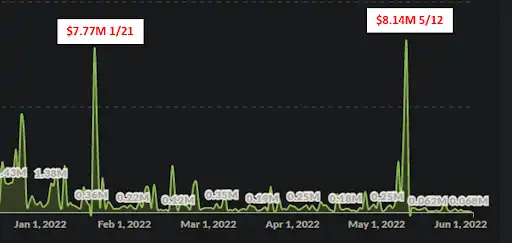
Source: explore.flashbots.net
* Gross profit = the daily withdrawal value of a successful MEV transaction without removing miner payments
Today, there are two types of winners in MEVS: miners and searchers. In this world, searchers are the main recipients of MEV rewards:
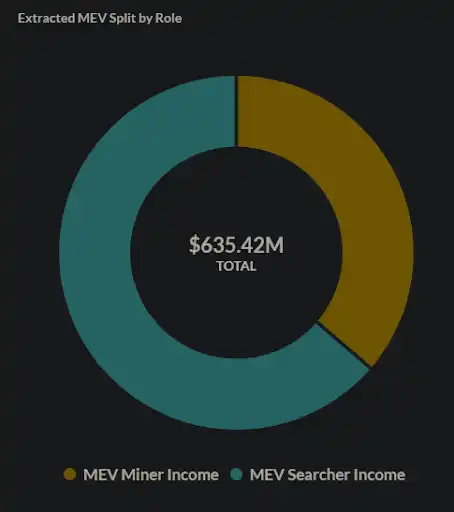
Source: explore.flashbots.net
Economic market structure and MEV
Before analyzing market dynamics, it is important to clearly define its structure. Let's look at the overall structure of the MEV market first, followed by the sub-markets of MEV searchers and miners.
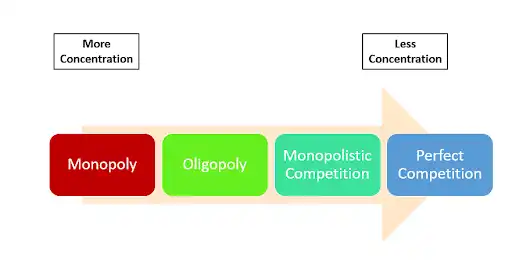
MEV market
The MEV market is unique in that there are two participants, miners and MEV searchers, who work together to extract value. When evaluated as a whole, the MEV market looks more like an oligopoly structure.
An oligopoly is a market or industry dominated by a small number of large sellers or producers. In this case, block space is the production of goods and passes through. Monetization. Let's look at how oligopoly translated into today's MEV market:
1. High entry threshold:
Miner: The high upfront costs of equipment, technical expertise and capital requirements make it extremely difficult for individuals to enter the market
MEV Searchers: While this may not be capital intensive, the high barrier to entry comes from the technical skills, specialization, and commitment required to run MEV strategies; DeFi, ETH And other blockchains.
2. Imperfect competition/pricing power:
Often, MEV searchers and miners will work together to maximize total extractable value, even if it comes at a cost to the user. In addition, miners have an advantage because they can choose to accept whichever MEV searcher offers the highest reward -- thus making these miners price-setters.
3. Interdependence of enterprises:
Because of their size and minimal competition, how miners structure meVs affects the actions of other miners.
In addition, MEV searchers and miners depend on each other, as the searchers are the ones who look for MEV opportunities and present them to miners to decide whether to reorder, insert, and/or review intra-block transactions.
4. Non-price competition:
In general, miners do not compete for profit distribution between MEV searchers and miners, but on other factors: specialist equipment, hosting, service levels, and branding.
5. Possibility of collusion:
Given the centralization of miners, they can actually work together in this space as well. Miners may agree among themselves that they will only accept a 95 per cent share of MEV profits with searchers. However, Flashbots solves this problem in the current MEV market.
Similarly, if MEV searchers band together, they may demand a higher profit split between miners and MEV searchers.
MEV searcher market
Now that we have defined the entire MEV market, we can also look at its sub-markets. Now let's look at the MEV searcher market.
MEV searchers are like plumbers for blockchain. They delve into transactions within the block to find MEVs. It is a group of artisans and professional anonyms who have valuable technical knowledge of how to extract value. This dynamic has the characteristics of monopoly competition.
Monopolistic competition (not to be confused with monopoly) is imperfect competition in which there are many producers competing with each other but selling services that differ from each other rather than being perfect substitutes.
Let's see how monopolistic competitive characteristics align with the MEV searcher market:
1. Slightly different services:
MEV searchers all try to find extractable value on the chain, although MEV methods vary from searcher to searcher. For example, searchers can focus on arbitrage, liquidation, sandwich strategies, or specialized long tail strategies.
2. Many Searchers:
Speak for themselves
3. Maximize profits:
MEV searchers seek to maximize profits and therefore extract as many MEVs as possible from the block. Similar to a pure game monopoly, each searcher will try to find as many MEVs as possible without being penalized (usually) by the user.
4. Imperfect information:
MEV searchers have an information advantage over users, who often unknowingly surrender value to the searchers.
5. The result:
Searchers know that their behavior won't affect the behavior of other searchers.
MEV mining machine market
One of the core reasons why the MEV market resembles an oligopoly is that the miners' market is an oligopoly. Given that MEV searchers work with miners -- the two markets together look more like oligopolies and monopolistic competition. In this section, we can calculate the Herfindahl-Hirschman index (HHI) to understand the degree of centralization of the mining market, rather than rediscussing the characteristics of oligopolies.
The HHI index is a measure of the size of companies in relation to their industries, as well as the degree of competition between them. The calculation is as follows:
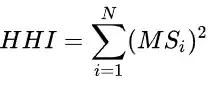
In this equation, MSi is the market share of firm I and N is the total number of firms. We add numbers to get a sense of industry concentration. We squared the MSi because the square of ownership weight provides a greater weight to a player with a larger market share.
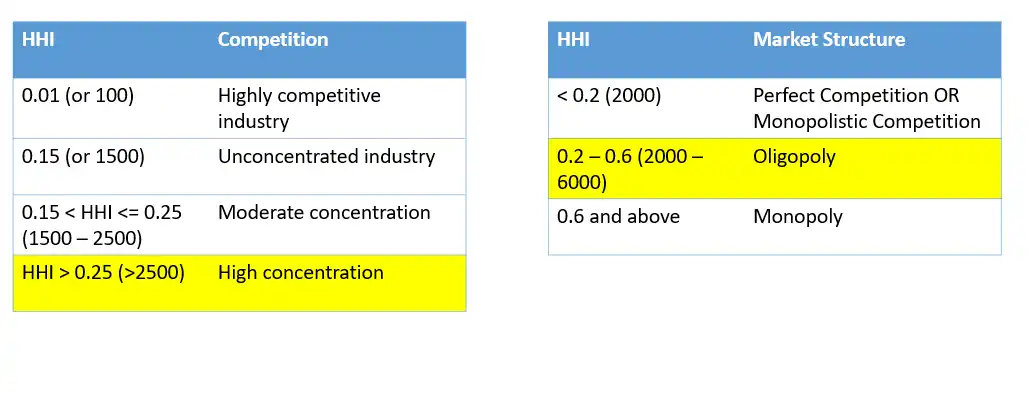
We can use MiningPoolStats to know the hash rate of each miner, which is ultimately the benchmark for its market share (approximately 81 miners listed).We use the following steps:
Convert each miner's calculation force to TH/s
Finally force TH/s
Divide each miner's computational force by the total force
Square each value in #3
Sum up the sum of #4
If we calculate the HHI of these miners, we get an HHI of about 545 or 0.545, which means that the miners' market is highly centralized and belongs to an oligopoly market structure.
Optimal perfectly competitive MEV market
Perfect competition is an ideal market structure in which all producers and consumers have sufficient and symmetrical information and no transaction costs.
The characteristics of perfectly competitive markets are:
Bulk buyer and seller
Product homogenization
Free entry of enterprises
Sound market knowledge
Sellers make normal profits (as opposed to extraordinary profits)
In this market, we have reached the point where quantity supplied equals quantity demanded, and therefore Pareto Efficiency. Pareto efficiency is a situation in which no individual or preference criterion can be made better without making at least one individual or preference criterion worse.
One of the greatest innovations in MEV is the creation of Flashbots, which aims to democratize MEV.
"Mitigate the negative externalities of current maximum extractable value (MEV from now on) extraction technologies and avoid the existing risks that MEV may pose to state-rich blockchains such as Ethereum."
The three goals of Flashbots:
Democratization earns MEV income
Bring transparency to MEV activities
Reallocate MEV income
Flashbots helps level the playing field for MEV searchers by helping prevent collusion and democratize MEVs. While Flashbots democratize MEV opportunities for searchers, users are still left out. One could argue that anyone can participate in MEV, including users, but we know this is unrealistic, as most DeFi users do not have access to MEV.
So while MEV searchers and miners are getting better benefits from Flashbot's MEV system in proof-of-work, users are either getting nothing or being targeted for extractable value. The MEV dynamics of today's searchers and miners are not enough to fully democratize MEVs and push them into a perfectly competitive market. Proof of equity, however, could change that and eventually bring us to theoretically perfectly competitive markets.
New paradigm: Into proof of interest
Ethereum is known to be moving towards proof-of-stake (PoS) systems. In PoS, instead of miners competing with each other to validate and confirm transactions, "validators" are randomly selected to validate transactions according to leader scheduling.
Proof-of-stake (PoS) is a cryptocurrency consensus mechanism that requires you to either put your coins in or set them aside and randomly select them as verifiers.
What fundamentally breaks the oligopoly competition in proof of interest is the ability of users to decide with which verifiers they pledge their assets, which may influence leader selection or equity weighting (more on that below).
我们或许可以从 Solana 中吸取一些教训,了解用户如何潜在地参与 MEV 的收益并从「可提取价值」中受益。对权益证明中的用户而言,改变游戏规则的是他们决定在哪里质押他们的 Token ,这为 MEV 创新打开了大门。验证者的权益权重越大——被选为领导者的机会就越高。
Before starting to understand how it helps to understand some basic information about validators on Solana.
Solana consensus and Verifier
Solana uses historical proof, its own novel proof-of-interest consensus mechanism. Solana's network infrastructure consists of validators and RPC nodes. Verifiers are the backbone of Solana's network, responsible for processing transactions and participating in consensus. Verifiers are "consensus nodes" of the network, meaning they validate transactions, vote on blocks, and drive consensus mechanisms on Solana's network.
Running a validator (or RPC node) requires a dedicated bare metal server with high-end specifications.
From Solana's documentation on leader scheduling generation algorithms (note #3) :
Leader plans to generate algorithms
The leader program is generated using predefined seeds. The process is as follows:
Periodically use PoH scale heights (monotonically increasing counters) to sow stable pseudo-random algorithms.
At that height, sample banks for all mortgage accounts that have leadership status and vote within the tick-tock of cluster configuration. This sample is called the activity set.
Sort the activity set by equity weight.
Use a random seed to select equity-weighted nodes to create a equity-weighted sort.
This sort takes effect after the number of ticks configured for the cluster.
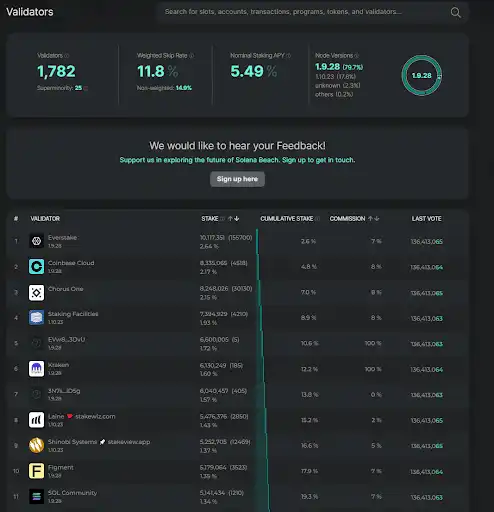
Today, validator awards fall into three categories:
- Agreement-based rewards: Issued at the inflation rate defined by the Global agreement - rewards are provided on top of transaction fees earned.
- Pledge: The pledgee is rewarded for helping to validate the books. Users can benefit from pledging because they can delegate their pledge to the authentication node. The verifier is responsible for replaying the ledger and sending votes to each node's voting account to which pledgers can entrust their shares. When bifurcate & have spent When present, the rest of the cluster uses these equity-weighted votes to select a block.
-Staking pools -- These are liquidity Staking solutions that help promote censorship resistance and decentralization, like Marinade Finance and &NBsp; Lido .
Today's pledge yield is based on the current inflation rate, the total number of SOL pledged, and the uptime and commission of individual verifiers. The verifier's commission is the percentage fee paid to the verifier by network inflation. The uptime of the verifier is determined by the vote of the verifier.
In other words, Staking is rewarded by Solana's inflation plan. The verifier offers the user a pledge reward, but the verifier may also charge the user a fee/commission. What if we could increase rewards above standard inflation in a way that benefits everyone?
用户可以使用他们喜欢的验证者进行质押,如果他们愿意,还可以切换到其他验证者,这在 Solana 上需要 2-4 天。此外,借助 Marinade 的流动 mSOL 等解决方案,用户可以立即为 SOL 实时解封 mSOL Token 。这在验证者之间创造了一种有趣的竞争动态。用户将选择为他们提供最高奖励的验证者以及收取最低费用 / 佣金的验证者。
All else being equal, users will choose the verifier with the highest rate of return and lowest cost.
This is where things get really interesting! The more SOL the Validator can aggregate and pledge, the higher the pledge weight the Validator can obtain. The greater the pledge weight of the Validator, the greater the chance of becoming a Leader. Think of it like a lottery system, where the more equity the verifier has, the better its chances of being elected leader.
MEV on Solana today
Today, most meVs extracted on Solana are handed over to MEV searchers. Most of the MEVs on Solana come from bots that spam Solana's blockchain, constantly trying to find arbitrage opportunities or launch early. NFT . Since transaction costs on Solana are so cheap, running robots is an easy strategy to capture MEV opportunities.
Future MEVs on Solana
Now, one way to break the cycle of these spam bots is to set up a sealed bid status auction, where disputed resources get locked up at a higher cost than other resources. On Solana, Jito Labs is building sealed silent bid auctions to enable searchers to bid on block space. The benefits of this include the ability to run MEV transactions chain down in some common memory pool (Solana currently does not). Transactions sent via Jito will be prioritised, with rewards split with verifiers, similar to Flashbots. The benefits of this include:
- Kill spam bots -- they can no longer find meaningful MEVs because they are not preferred transactions
- Better user experience
- Help unclog the Solana network and make it run more efficiently
So how can we fully democratize MEV and bring it to a fully competitive market?
User choice!
Enter MPSV, the future of efficient MEV market
Some interesting game theory arises when MEV searchers are able to work with verifiers to extract MEVs. A best-case scenario is that the user ends up passively receiving a portion of the MEV reward, but what?
MPSV = MEV Profit sharing validator

Let's first explore two game theory exercises. Game 1 is trivial, but let's look at it. Should verifiers and MEV searchers share the rewards? For simplicity, let's assume that there is only one MEV searcher and one verifier.
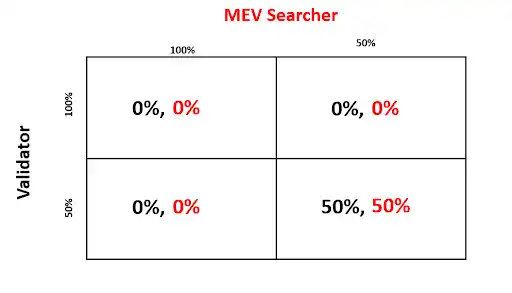
As I mentioned, this case is trivial, because if neither party wants to share any type of reward and wants to keep 100% of the MEV extracted, then neither party will agree to work together. The best solution in the figure above is to split the profits between MEV searchers and verifiers. Although 50% is somewhat arbitrary, it is in everyone's best interest to work together. It doesn't matter whether it's 60/40, 90/10, etc. -- they have to work together.
It is clear that there is an interdependence between MEV searchers and verifiers in the MEV market. It cannot exist without the other.
In the long run, we could see validators bringing MEV searchers in-house or starting to run MEV strategies themselves -- leaving only exotic forms of MEV available to searchers.
The next example is a little more interesting. We have determined above that there will be some profit sharing between the verifier and the MEV searcher. Now we ask, should the verifier itself decide to share any MEV profits with users pledged on its platform?
Let's assume the following:
- The interdependence between MEV searcher and verifier has been established according to Game 1.
- There are now two validators: validator A and validator B
- Both start with the same amount of pledged weight (i.e. the same amount of pledged assets)
- The user is economically rational, i.e. the user will choose to pledge with the validator who offers the highest reward
- Verifier A and Verifier B each decide how much MEV profit they want to share with their respective users
- If a verifier loses its users, it can no longer be a Leader (assuming all of its tokens have been transferred to another verifier)
- If a verifier loses its users, it no longer receives any MEV transactions from the searcher and instead forwards MEV transactions to another verifier
- Assuming that the generated MEV is uniform and constant, i.e. each verifier has $100 of MEV, the numbers outside the box represent how much profit each verifier decides to keep.
- We assume the long run, not the short run.
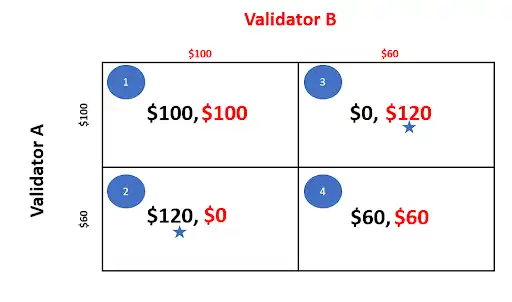
Now let's look at each scene in each box.
1. A = B
Verifier A sets its MEV profit to $100 (user A's profit = $0).
Verifier B sets its MEV profit to $100 (user B's profit = $0).
Total user profit = $0.
The two validators take home $100 each, and the user gets nothing.
2. A < B.
Verifier A sets its MEV profit to $60 (user profit = $40).
Verifier B sets its profit to $100 (user profit = $0).
Users earn $40 per MEV transaction ($80 total).
In the long run, verifier B's users leave, and verifier B ends up with a profit of $0.
At the same time, examiner A gets an additional MEV transaction and earns an additional $60 ($60 + $60 = $120). The logic is as follows:
Long running
Again, the user is rational because Verifier A offers A higher return on the pledge -- the user transfers money to Verifier A and abandons verifier B over time.
Because users transfer all of their pledged assets to Verifier A, verifier B no longer has the opportunity to become the Leader and no longer receives MEV transactions from the searcher.
* The same level of profit should be provided for MEV generated by verifier B to flow into Verifier A -, i.e. $60 + $60 = $120.
This ultimately pushes verifier B's MEV profit to $0.
3. A > B.
The logic in #2 above applies.
4. A = B
Verifier A sets its MEV profit to $60 (User A's profit = $40)
Verifier B sets its profit to $60 (user B's profit = $40)
Users earn $40 per MEV transaction ($80 total).
In this case, the user from A stays where he is, and the user from B stays where he is. No verifier is abandoned.
MPSV Nash equilibrium
Nash equilibrium is a decision theorem in game theory that states that players can achieve a desired outcome by not deviating from their initial strategy. In a Nash equilibrium, each player's strategy is optimal when considering the decisions of other players.
As we can see from the figure above, if both verifier A and verifier B set profit equal to each other, they would both be better off than setting profit at A higher level (i.e. box 1 instead of box 4). But the question remains, is box 1 the result we can expect? To solve this problem, let's first find the responses of verifier A and verifier B:
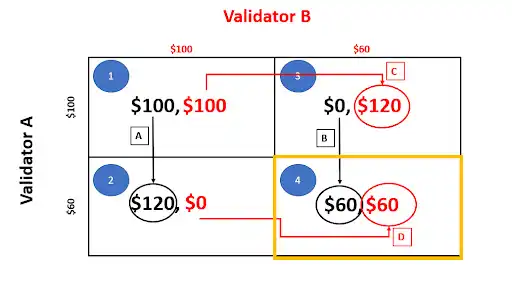
Similarly, let's start fromThe verifier A Start executing each response gradually:
A.For Verifier A, if Verifier B sets her profit to $100, then Verifier A has two profit options (box 1 and box 2) :
$100 if Verifier A sets profit to $100
If verifier A sets A profit of $60, it is $120
Given that Verifier A is economically sound -- it sets the profit at $60, this will produce A total profit of $120.
B.For Verifier A, if Verifier B sets her profit to $60, then Verifier A has two profit options (box 3 and box 4) :
If verifier A sets profit to $100, it is $0
$60 if Verifier A sets the profit to $60
Given that Verifier A is economically sound -- it sets the profit at $60, this will produce A total profit of $60.
Note that in both cases, setting profit at $60 instead of $100 was the dominant strategy of Verifier A. Verifier A setting profit at $100 is never the best response.
Verifier B:
C.Boxes 1 and 3:
Given that verifier B is economically sound -- it sets the profit at $60, this will produce a total profit of $120.
D.Boxes 2 and 4:
Given that verifier B is economically sound -- it sets the profit at $60, this will produce a total profit of $60.
Nash Equilibrium: For verifier A and verifier B, there is only one potential outcome where both verifiers respond best, and that is if both verifiers set profit to $60 (yellow box in the figure above). This is going to be the only Nash equilibrium, and they're going to make a total profit of $60 each.
Thus, we have shown above that if users are able to smoothly transfer their pledged assets between verifiers, then a Nash equilibrium occurs when the verifier offers the most attractive profit-sharing distribution in the user's favor, similar to how perfectly competitive markets work:
This is where MPSV = MEV profit-sharing validators come in.
MPSV flywheel
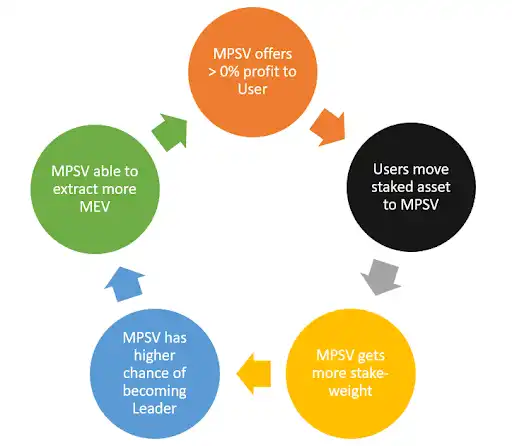
Proof of interest (PoS) enables users to decide where they want to pledge assets. Having more staking, all else equal, allows you to be the Leader in your PoS model as a validator. For rational economic actors, deciding where to place your bets depends on where you can earn the highest APY at the lowest fee/commission.
Using MEV revenues, AN MPSV with a lower staking weight might be able to return a percentage of MEV profits to the user, raising yields above standard inflation.
Also, if smaller MPSVS pool their MEV profits -- it gives users more room to pledge revenue. Over time, new users will switch to the MPSV model (that is, offering MEV profits to users), so that the verifier will be able to earn additional equity from other verifiers. This in turn leads to MPSV being chosen as Leader more frequently.
conclusion
Summing it all up, we can see that there is a proof-of-equity MEV scenario where everyone is actually better off, including users. In a proof-of-work system - miners act independently of users when identifying blocks. In the system of proof of interest, there is a dependency relationship between the verifier and the user.
This is what I mean by "fully democratizing MEV". We have shown above that MPSV's Nash equilibrium occurs when different verifiers share the most attractive profits with users. In the long run, just one validator can drive the validator market by providing users with a better share of MEV profits.
We believe that MPSV can play the following roles:
- Create new transformations in MEV where users can passively benefit from MEV
- For smaller MPSVS, if they are able to share more of their profits with their users than the top 10 or largest verifier, this can be used as a way to compete with the larger verifiers -- or even join forces with other small MPSVS and share MEV profits.
- In a competitive situation where all verifiers transfer 100% of MEV profits to users, users end up benefiting as a whole. [Note: Verifiers can still earn revenue from transactions and priority fees].
- Everyone is better off in this world, including MEV searchers, verifiers and users in this model.
It is user choice that breaks the MEV oligopoly!
Maybe, just maybe, we will move the MEV market to a fully competitive market structure.
The original link
Welcome to join the official BlockBeats community:
Telegram Subscription Group: https://t.me/theblockbeats
Telegram Discussion Group: https://t.me/BlockBeats_App
Official Twitter Account: https://twitter.com/BlockBeatsAsia

 Related Articles