MEV and Flashbots: DeFi Stories Like No other
Original title: MEV and Flashbots: The Uniquely DeFi Tale
Original author: 0xFishy
Kxp, BlockBeats
introduction
MEV is a byproduct of blockchain design and is unique to DeFi. In essence, MEV is simply a profit-maximizing behavior, in which the verifiers operating the blockchain attempt to maximize their profits on the task of verifying the transaction. Although we can argue that MEVs provide benefits through increased capital efficiency, MEVs can significantly impact the user experience of using decentralized applications, including higher Gas charges, slippage, and verifier collusion and centralization risks. This paper will first examine MEV from a theoretical conceptual perspective and the systemic risk it poses to ecosystems. Next, I'll explore how the DeFi community is trying to address all of these negative externalities of MEVs, using Flashbots as a case study, and explain why MEV's story is a representative DeFi story: It reveals many fundamental questions, challenges, principles, and trade-offs about building a truly decentralized financial system.
Flash Boys Club
Mevs are a feature of blockchain technology, not a bug. In a given blockchain network, the verifier (or miner in the traditional PoW model) is responsible for deciding what data is put into the chain. Specifically, they can control the entry and removal of data, as well as the ordering of that data along the chain. Like rational economic agents, validators structure transactions to maximize profit from transaction costs.
The concept of MEVs was first elaborated by smart contract researcher Phil Dainan inan important paper called Flash Boys 2.0. In the paper, the researchers emphasize that the use of legions of bots and arbitrage agents to "predict and exploit" regular user DEX trades is now commonplace, similar to high-frequency traders in traditional finance actively optimizing trade delays. In the last 24 hours of writing this article alone, these entities have realized 2,578 ETH, or about $4.9 million, through MEV operations.
While MEV is a general generalization that includes many different arbitrage methods and scenarios, there are several key characteristics that form the basis of many MEV opportunities in DeFi. First, most MEVs are implemented through a process called "priority Gas auction" (PGA), where users can pay a higher transaction (Gas) fee in order to run their transaction first. Since many arbitrage bots depend on the preferential running of their trades to make a profit, these bots will engage in Gas bidding wars, raising prices sequentially so that their trades are run by the verifier, resulting in high network congestion and exceeding the average user's bid fees unless they also pay high transaction fees.
The verifier, on the other hand, is one of the main beneficiaries of this practice. In fact, the amount of power is directly related to the amount of profit: Because the verifiers (at least in theory) have the power to determine which transactions to run, they can prioritize which transactions based on the cost of the transaction, and thus reap "ranking optimization" benefits. In fact, because the verifier is responsible for so much of the MEV search, packaging, and execution pipeline, much of the "sort optimization" is outsourced to dedicated searchers, builders, and relators, these intermediate entities can be thought of as "secretaries" of the verifier, who get a share of the profits by simplifying the MEV process. Specifically, the searcher will discover MEV opportunities, which the builder packages into complete "blocks," and the relay will send those complete "blocks" to the verifier or actual block builder. Thus, an overview of the current MEV ecosystem is as follows:

MEV Ecosystem, Source:https://chain.link/education-hub/maximal-extractable-value-mev
As we have hinted before, while arbitrage enabled with MEVs may offer some benefits, including greater capital efficiency and ensuring that prices are consistent across exchanges, there are huge externalities for end users, such as resulting in higher transaction fees, slower execution, and higher slip points (such as sandwich attacks). But that's not the biggest risk MEVs pose to the blockchain -- if verifiers collude, MEV operations could actually undermine the security of the blockchain's consensus layer.
This safety issue stems from misalignment of incentives -- in all these lucrative MEV opportunities, miners can make more money by optimizing transaction fees rather than relying on constant block reward allowances. As Dainan wrote, this meant:
"Thus, miners can bifurcate high-fee blocks, retaining some fees to entice other miners to build on the fork. In extreme cases, the incentive to deviate from the agreement can lead to strategic sabotage by economically rational miners, reducing the security provided by block confirmation."
This is known as a "price war" attack, and is one of several ways MEVs undermine the basic security guarantees of the blockchain. Other known attacks include "time thief attacks," in which instead of stealing lucrative deals from the current block, verifiers collude to steal and exploit MEV opportunities in past blocks by rewriting past history. Moreover, MEV extraction does not even need to take place on the chain, as all of this can be done through over-the-counter transactions, such as those between large traders and verifiers.
So, as we have seen, there is a lot at stake.
Flashbots: Mitigate negative effects of MEVs
Given the potentially serious consequences of unrestricted MEVs, several projects and teams have worked to mitigate the negative externalities of this practice. One of the most important teams in the field is Flashbots, a project dedicated to realigning MEV incentives in a way that rewards honest validators while mitigating the worst effects on the average user.
To this end, Flashbots tries to take three different steps: (1) reveal the MEV "dark forest," (2) democratize MEV extraction, and (3) redistribute the benefits back into the ecosystem. To achieve the first goal, Flashbots has a specialized product called MEV-inspect that aims to "reveal" the "dark forest" of MEVs in order to quantify the negative externalities caused by MEVs and present the scale of the problem.
The other two goals of "Democratizing MEV extraction" and "redistributing benefits" are more complex, covering the entire suite of products and evolving as the scope and focus of the problem changes. In some ways, it's fair to say that Flashbots' product development history over the past two years is itself a microcosm of Ethereum's growth and evolution.
The first major product line released by Flashbots was the MeV-Geth client, or an improved version of the Ethereum Golang implementation that better protected against MEV manipulation by routing it to a private trading pool. Based on this new client, a MEV auction market is established using the "one-price mothballed bid" method (also known as "blind bidding"), where each participant is only allowed to submit one price, and none of the participants knows the price of the other participant's bid. With this design, Flashbots mitigates the previously discussed "bidding on price" wars that cause network congestion.
The guiding principle for creating MeV-Geth and MEV markets is to diffuse the power and responsibility of the verifier to build blocks through an incentive-re-coordination process called "blocker builder separation". Instead of going through the complex process of MEV search and deal packaging, verifiers using MEV auctions can simply look at the MEV market, find the deal that will give them the highest MEV, and submit a single bid that reflects their actual preferences. Also, to prevent the verifier from including its own trades and profiting from the advance trades of user trades, the actual trade details (buy orders, sell orders, clearing, etc.) are not made public until the build block is complete.
So why would a verifier use this algorithm and forgo the lucrative MEV opportunities mentioned above? This is because it is easier and cheaper for the verifier for this Flashbots algorithm to just pick MEV transactions from the market. As more and more high-quality MEVs are traded through the market rather than directly on the chain, validators can earn higher returns by sticking with Flashbots. The results were impressive: Shortly after MEV-Geth was released, over 90% of Ethereum verifiers began using the project, thus demonstrating the importance and effectiveness of incentivize recoordination in addressing potential problems. As the Ethereum ecosystem evolves and moves from a proof-of-work model (PoW) to a proof-of-equity model (PoS) in September 2022, this change in Ethereum's underlying consensus structure makes it necessary to update the concept of the "locker-builder separation".
The main reason PoS is more efficient than PoW is that in PoW, each node is built and blocked from scratch; In PoS, only a few verifiers act as the main blockers, adding data to the blockchain. While this is great for the environment and computational efficiency, because MEV benefits are so attractive, it can introduce additional centralization risks, especially if the validator (" blocker ") is in cahoots with the key "builder" of the market seller. Even Flashbots, which run private trading pools, can fall prey to this, but the very fact that we place our trust in a single entity, such as Flashbots, goes against the spirit of decentralization.
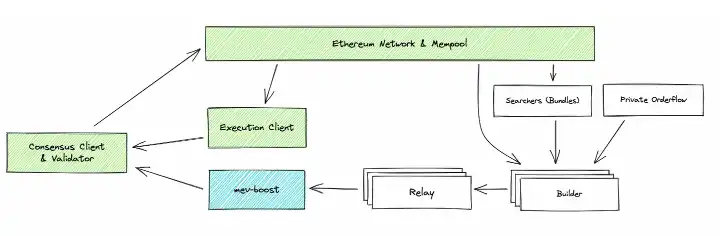
MEV Boost system diagram, Source:https://github.com/flashbots/mev-boost
As a result, Flashbots released MeV-Boost, a piece of software that decentralized the "supply side" of this MEV market. MEV-boost not only contains trades in the Flashbots private trade pool (effectively a monopoly), it also allows any builder running this software to submit trades to all participating verifiers. For verifiers, with more builders involved in building all these different blocks, they can generate more revenue and level the playing field for validators to build a stronger, safer ecosystem. Like MEV-Geth, this novel design realign incentives for multiple parties to avoid centralization risks and has been hugely successful, with a network adoption rate of over 85%, with Flashbots relays only 34% of transactions.
Flashbots SUAVE
So far, the quest to mitigate all centralization risks and insulate decentralized finance from the most pernicious effects of MEVs is not over. In implementing the block-builder separation, Flashbots' solution is to decentrate, or redirect, key authority and responsibility from the verifiers to the "builders," who, as separate entities from the verifiers, do the picking and choosing of transactions for the verifiers. As it turns out, there are significant economies of scale, which in turn lead to centralization risks in the builder's role.
So what do these economies of scale mean for the builder role? Recall from earlier that searchers, builders, and relays all play different roles. Searchers search for MEV opportunities and then send those opportunities to builders, who send complete blocks to relays. This means that the searcher must choose which object to send the results to. In order to maximize their returns, they will choose the highest quality builders, and these builders will often be selected by the verifiers. As more quality deals flow to the top builders, this creates a centralization effect - the top builders will consistently receive the highest MEV deals from searchers, thus cementing their position.
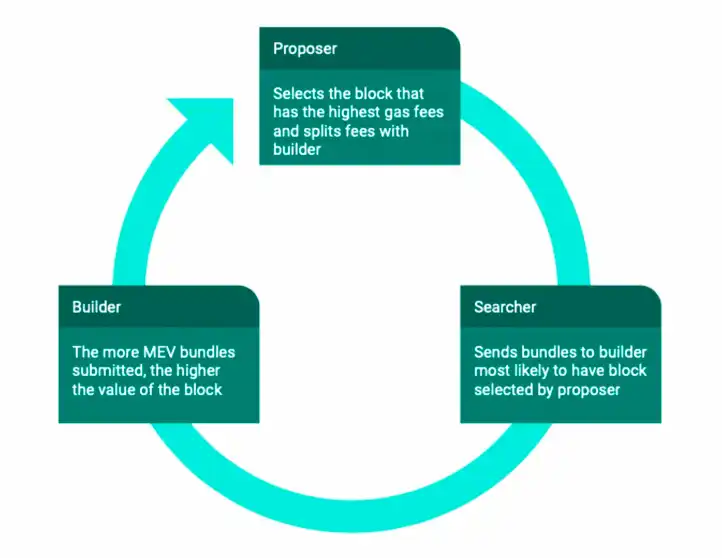
Builder centralization effect, source:https://simbro.medium.com/mev-driven-centralization-in-ethereum-ec829a214f18
This effect of builder centralization has been proved in practice. In the last 24 hours of writing this article, the top 5 builders came up with about 90% of the total MEV-Boost blocks. As this centralization increases, these oligopolistic companies may begin to use their dominance to manipulate transactions, including colluding and censoring certain transactions, all of which could compromise the security of the underlying blockchain. This is the goal of Flashbots' latest project: a single unified auction for value expression that aims to decentralize the role of the block builder by separating the block building process from any single blockchain and outsourcing it to a separate network.
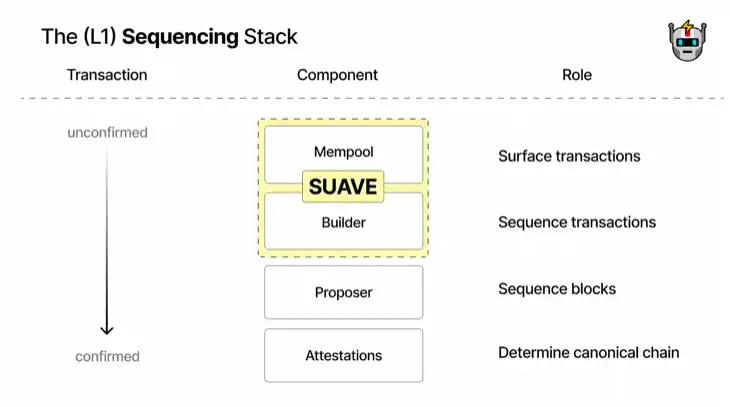
SUAVE and L1 blockchain stack, source:https://writings.flashbots.net/the-future-of-mev-is-suave/
SUAVE is actually a separate and dedicated blockchain sequencing chain that is primarily responsible for transaction memory pools and builder responsibilities, while the prover of a native chain such as Ethereum will be responsible for the block-out and proof roles. As we have seen, SUAVE is a natural extension of the "block-builder separation" principle, where we put the blocker and builder on two completely separate chains so that they are both sufficiently decentralized and separate from each other. In addition, the vision for SUAVE is that it will act as a common sorting layer for many different chains, so that whether you are a verifier on Ethereum, Arbitrum, Polygon, or any other EVM chain, you can use SUAVE to find the best MEV opportunities. This applies not only to the native chain you're on, but also to cross-domain MEVs for cross-chain transactions, so we can't just focus on the transaction memory pool of the native chain.
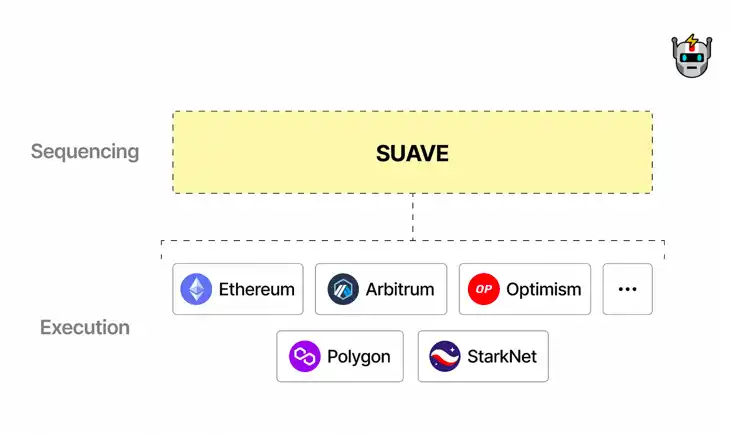
SUAVE cross-chain case, source:https://writings.flashbots.net/the-future-of-mev-is-suave/
While SUAVE has ambitious goals that ultimately benefit all parties involved and make the Ethereum ecosystem more decentralized, there are still several core design issues that need to be resolved in the six months since its launch in November 2022. For example, one of the central issues is whether to establish SUAVE as a separate L1 chain (similar to Chainlink), or use a Rollup solution, or a remortgage service that "borrows" Ethereum verifier, such as Eigenlayer. Each of these solutions has its own unique tradeoffs in terms of ease of implementation, validator retention, security, and flexibility, which we will not discuss in detail here.
Another central question is whether SUAVE will issue its own Token. Although the SUAVE forum is currently denying that it will launch its own Token, we still have a few questions about whether Flashbots will stick to this. Especially considering that in the long run, as a private company, launching SUAVE Token seems to make a lot of economic sense. In addition, one could make a reasonable argument that Flashbots thought it could raise a $1 billion unicorn valuation in a bear market because of its implications for future SUAVE Token offerings.
So what made Flashbots choose not to push out SUAVE Tokens? As it turns out, launching the Token brings with it several heady design decisions. For example, is this Token useful for some transactions, or is it just "another Token for governance only"? If this Token is useful, what will it be used for? How can different stakeholders using Flashbots (e.g., different chains, end users, builders on Flashbots, etc.) be incentivified to use and trust this new Token instead of using more established tokens such as ETH or even L2 tokens such as ARB? In any case, they will face a complex and laborious process of incentive coordination; So it makes perfect sense for the Flashbots team to steer clear of launching tokens for now.
The bigger picture of DeFi's future
Although it's hard to say at this point what form SUAVE will ultimately take, and whether this brand new ordering chain will succeed in achieving its goals and coordinating incentives in a way that truly mitigates the negative externalities of MEVs, I believe, Mevs and Flashbots are typical of the trade-offs, issues, and principles that need to be made when designing a truly decentralized financial system.
First, as mentioned earlier, MEVs are a feature of blockchain design, not a bug. These arbitrage opportunities and profit incentives for verifiers stem from the immediate accessibility of the blockchain and guarantee capital efficiency for DeFi. The negative harms of MEVs, including congestion, Gas wars, and end-user slippage, are merely by-products and negative externalities of this process.
By definition, negative externalities do not affect entities that engage in negative behavior. In this case, creating network congestion and slippage for the end user does not harm the verifier or arbitrage robot engaging in this profitable behavior. It has been widely recognized through traditional economics that pure market systems do not deal well with all these externalities. In traditional markets, governments or other regulators step in to correct market fluctuations and minimize the impact of negative externalities (such as tobacco and alcohol taxes).
The DeFi, on the other hand, is inherently distrustful and opposes any form of government law enforcement. The closest it comes to a "law enforcement agency" is probably to achieve certainty and transparency by encoding rules and regulations in code (for example, through smart contracts). Thus, as the Flashbots story demonstrates, reducing the negative externalities of the MEV phenomenon always relies on complex incentives for redesign and adjustment. After all, like Wall Street's quant traders, DeFi arbitrage bots are not known for their high ethical standards and good intentions.
Using incentive redesign to reduce negative externalities of MEVs is not just an approach inherent to Flashbots. In addition to Flashbots, there are many other teams trying to realign incentives to develop protocols to reduce the impact of MEVs. For example, Chainlink's Fair Sorting Service (FSS) uses its network of decentralized prognostics to outsource the "transaction sorting" process to verifiers, achieving goals similar to those pursued by the SUAVE network. Another example is the coincidence of Wishes (CoW) mechanism of the CoW protocol (formerly known as Gnosis chain), which automatically slices together transactions based on whether the wishes complement each other (e.g. I want 1500 USDC for 1 ETH and you want 1 ETH for 1500 USDC). And use solver algorithms to make sure everyone trades at the best price.
But incentivizing refactoring, especially in decentralized environments that distrust any one party, can be a maddening conundrum, because you're basically trying to offset economies of scale. In the case of Flashbots' builder centralization, builders who have "proven their worth" are more likely to be "trusted" by searchers, leading to more quality deals and solidifying their position as market leaders. Identifying, solving, and implementing a decentralised alternative through incentive reallocation is basically like playing Whack-a-mole -- you never know what centralised vulnerabilities and implied economies of scale might be contained in a newly introduced incentive system, all of which can only be known in hindsight.
Moreover, in a complex system such as blockchain, where there are many different stakeholders and agents, it is almost impossible to avoid externalities because there will almost certainly be cases where the behavior of one stakeholder affects the behavior of another. As Dainan showed in "Flash Boys v2.0," many of these externalities can pose real threats that destabilize the entire system. Thus, any decentralized system -- even those with well-designed principles of game theory -- will always be inherently complex, sophisticated, and vulnerable, and any one of those unforeseen vulnerabilities could threaten its existence.
In contrast to a centralized system that is vulnerable (and where necessary countermeasures can be created), a decentralized system does not contain any obvious "single points of failure" -- but this is precisely what makes a decentralized system sometimes deadlier than a centralized system -- every node can become a "single point of failure" if there is a flaw in the system design.
Ultimately, the story of MEV and Flashbots tells us that maintaining the health of decentralized systems is always a constant and difficult endeavor -- like playing a game of Whack-a-mole. In a decentralised system, the spread of trust requires the spread of responsibility and vigilance, especially when there are so many economic incentives: for better or worse, MEVs are here to stay.
Original link
Welcome to join the official BlockBeats community:
Telegram Subscription Group: https://t.me/theblockbeats
Telegram Discussion Group: https://t.me/BlockBeats_App
Official Twitter Account: https://twitter.com/BlockBeatsAsia

 Related Articles